
Graphical Analysis Uniform Motion Homework Graphical analysis worksheets

- Slides: 12
Graphical Analysis – Uniform Motion Homework: Graphical analysis worksheets
Velocity n Velocity is the rate of change of positions. It is measured in m/s [N, E, S, W].
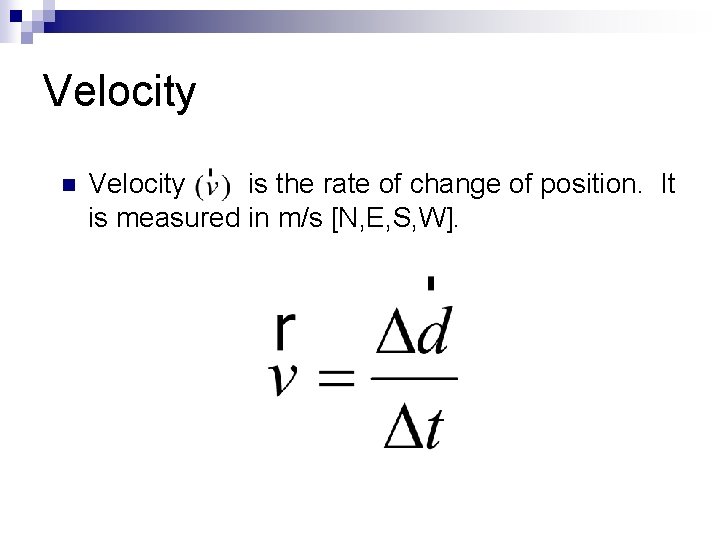
Velocity n Velocity is the rate of change of position. It is measured in m/s [N, E, S, W].
Acceleration n Acceleration is the rate at which velocity changes. It is measured in m/s 2 [N, E, S, W].
Acceleration n Acceleration is the rate at which velocity changes. It is measured in m/s 2 [N, E, S, W].
Position-Time Graphs n Position-Time (d-t) graphs illustrate 1 -D motion ¨ 0 is reference point ¨ One direction +ve the other –ve n Uniform Motion = n Uniform Acceleration =
Position-Time Graphs n Position-Time (d-t) graphs illustrate 1 -D motion ¨ 0 is reference point ¨ One direction +ve the other –ve n Uniform Motion = Constant velocity n Uniform Acceleration = Constant non-zero acceleration
Uniform Motion: Interpreting d-t Graphs n The slope of a line segment on a d-t graph tells you the average velocity.
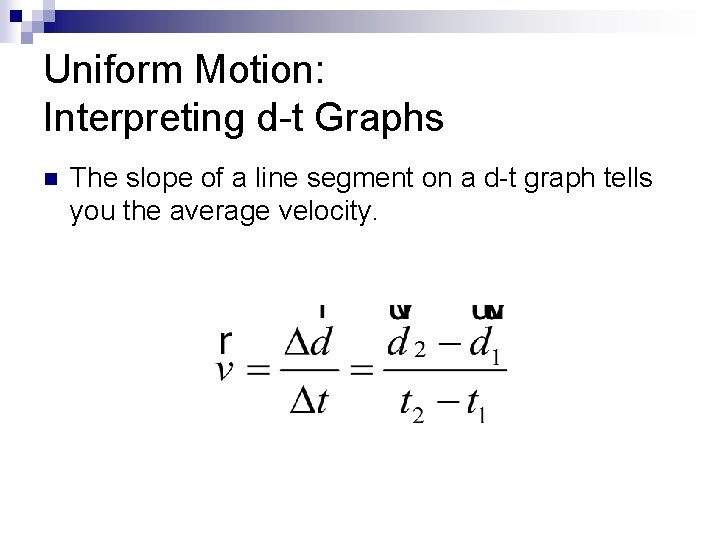
Uniform Motion: Interpreting d-t Graphs n The slope of a line segment on a d-t graph tells you the average velocity.
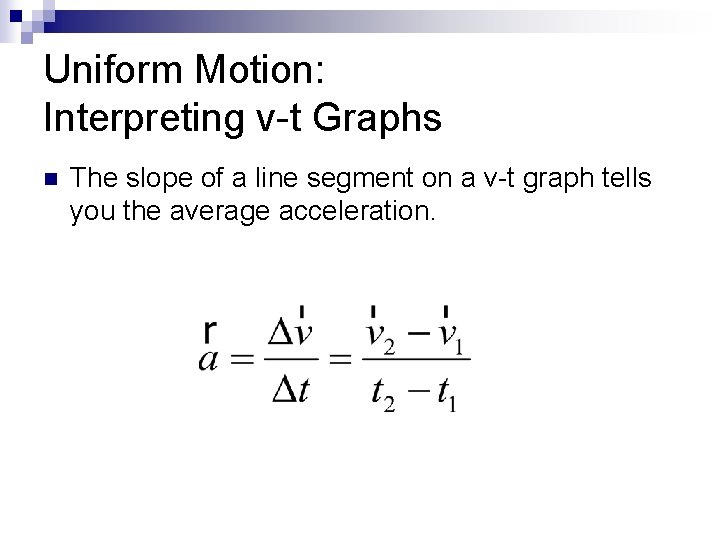
Uniform Motion: Interpreting v-t Graphs n The slope of a line segment on a v-t graph tells you the average acceleration.
Uniform Motion: Interpreting v-t Graphs n The slope of a line segment on a v-t graph tells you the average acceleration.
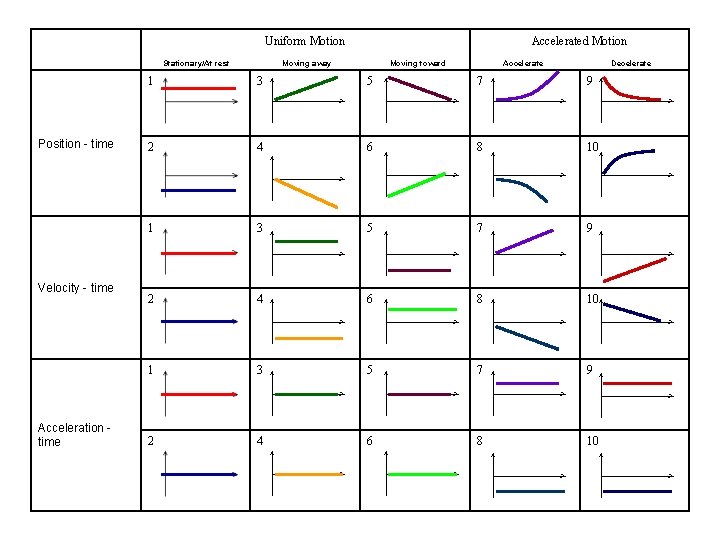
Uniform Motion Stationary/At rest Position - time Velocity - time Acceleration time Accelerated Motion Moving away Moving toward Accelerate Decelerate 1 3 5 7 9 2 4 6 8 10