
Graphic Statics Graphical Kinematics and the Airy Stress
- Slides: 27
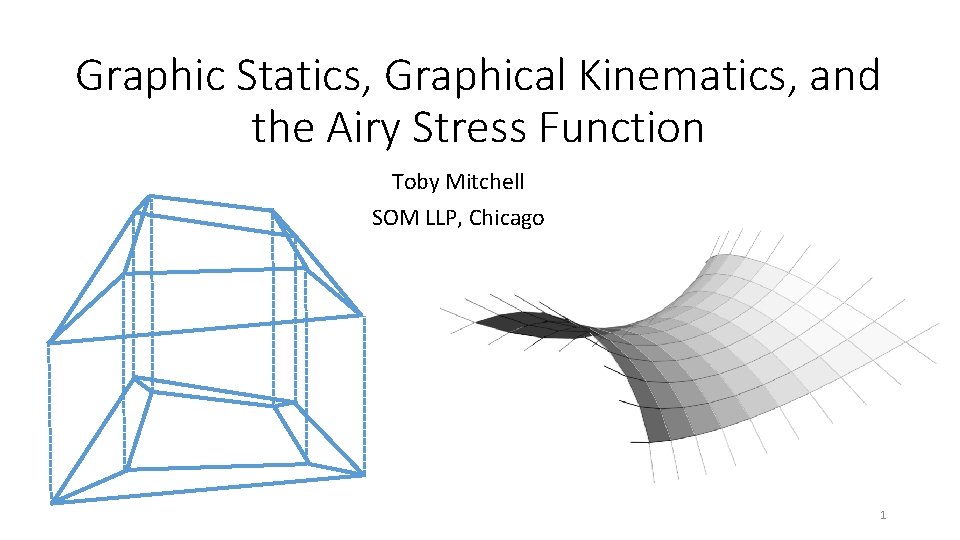
Graphic Statics, Graphical Kinematics, and the Airy Stress Function Toby Mitchell SOM LLP, Chicago 1
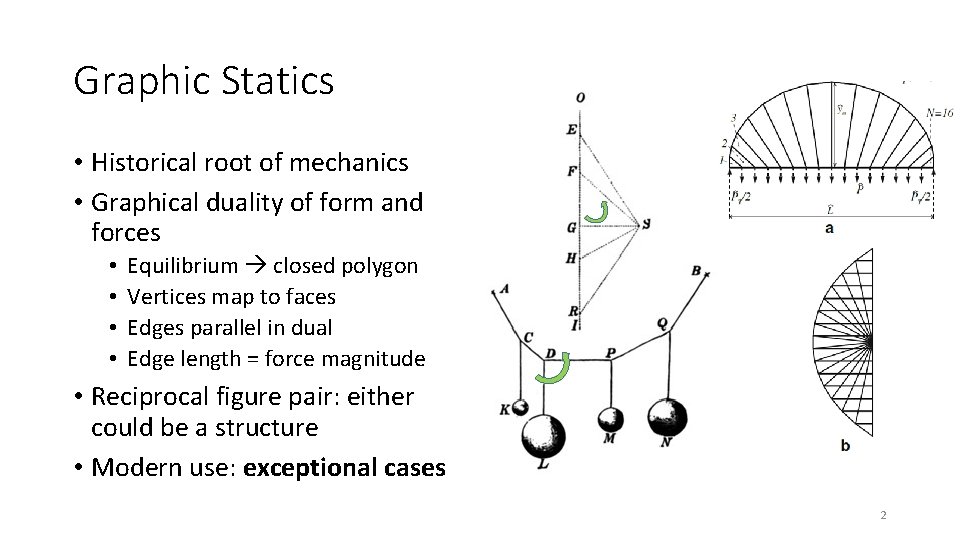
Graphic Statics • Historical root of mechanics • Graphical duality of form and forces • • Equilibrium closed polygon Vertices map to faces Edges parallel in dual Edge length = force magnitude • Reciprocal figure pair: either could be a structure • Modern use: exceptional cases 2
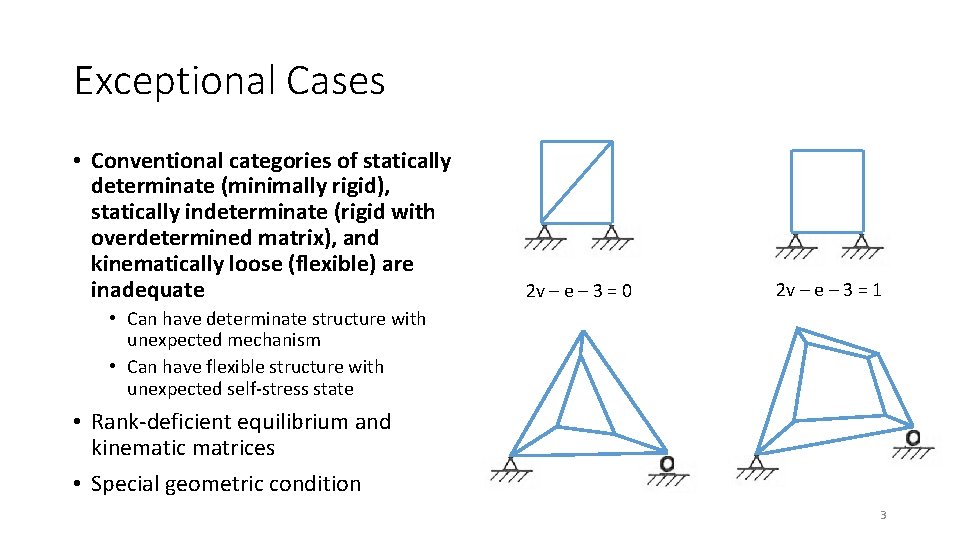
Exceptional Cases • Conventional categories of statically determinate (minimally rigid), statically indeterminate (rigid with overdetermined matrix), and kinematically loose (flexible) are inadequate 2 v – e – 3 = 0 2 v – e – 3 = 1 • Can have determinate structure with unexpected mechanism • Can have flexible structure with unexpected self-stress state • Rank-deficient equilibrium and kinematic matrices • Special geometric condition 3
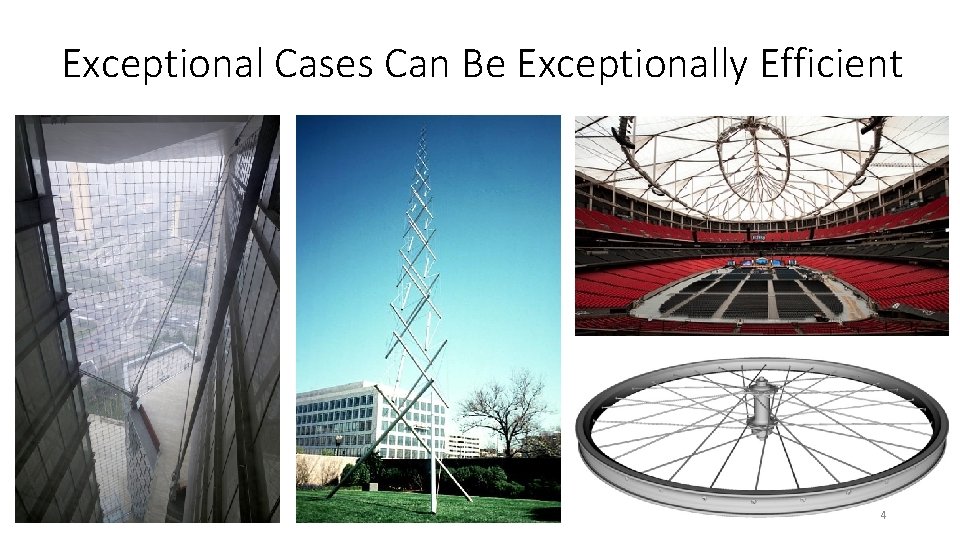
Exceptional Cases Can Be Exceptionally Efficient 4
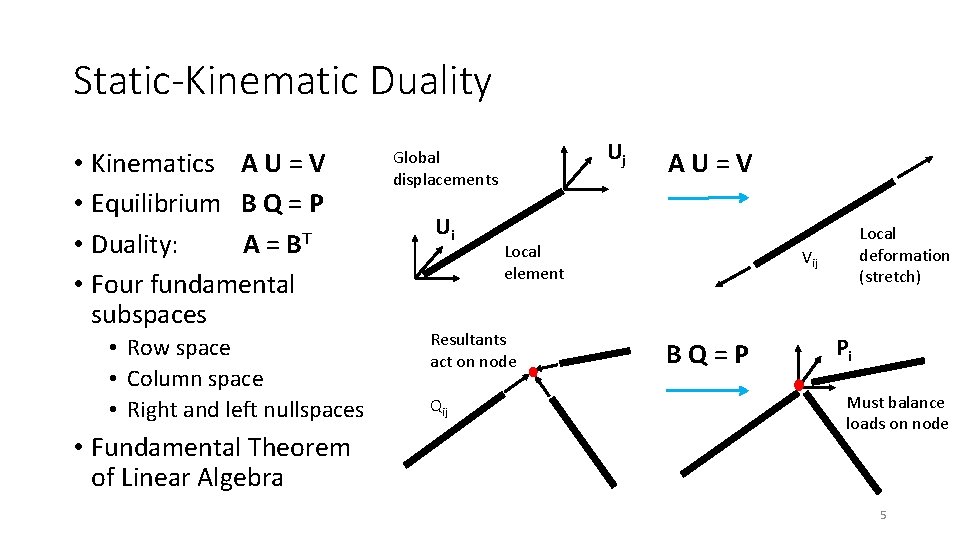
Static-Kinematic Duality • Kinematics A U = V • Equilibrium B Q = P • Duality: A = BT • Four fundamental subspaces • Row space • Column space • Right and left nullspaces • Fundamental Theorem of Linear Algebra Uj Global displacements Ui Local element Resultants act on node Qij AU=V Local deformation (stretch) Vij BQ=P Pi Must balance loads on node 5
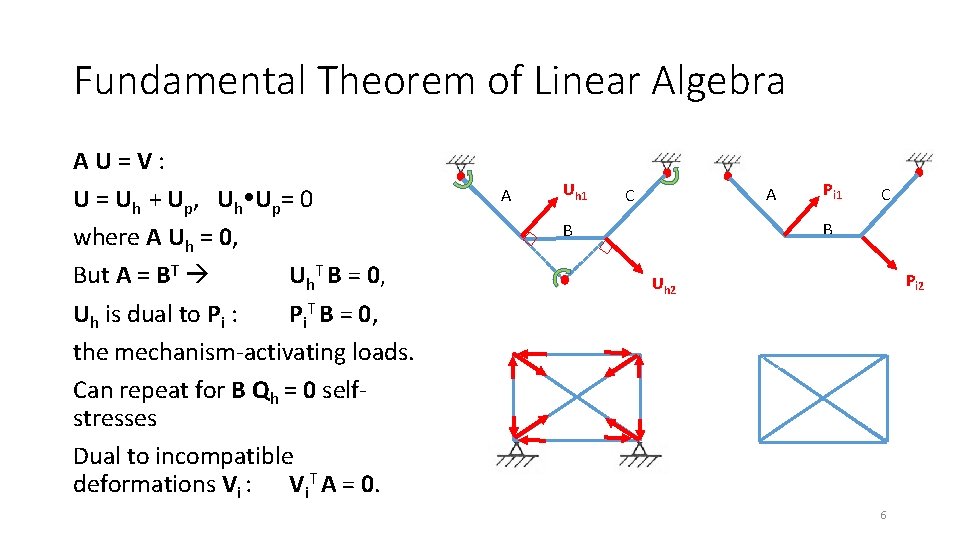
Fundamental Theorem of Linear Algebra AU=V: U = Uh + Up, Uh Up= 0 where A Uh = 0, But A = BT Uh. T B = 0, Uh is dual to Pi : Pi. T B = 0, the mechanism-activating loads. Can repeat for B Qh = 0 selfstresses Dual to incompatible deformations Vi : Vi. T A = 0. A Uh 1 A C Pi 1 C B B Pi 2 Uh 2 6
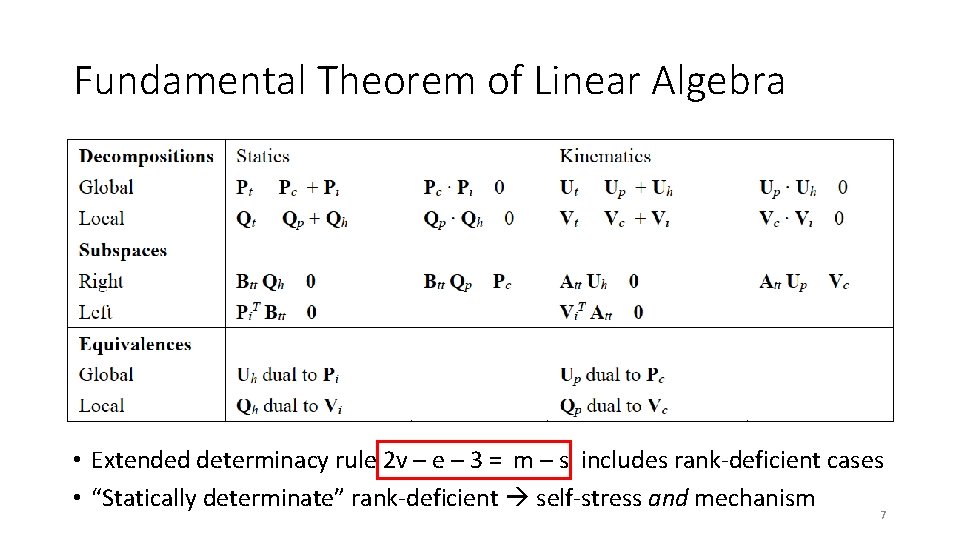
Fundamental Theorem of Linear Algebra • Extended determinacy rule 2 v – e – 3 = m – s includes rank-deficient cases • “Statically determinate” rank-deficient self-stress and mechanism 7
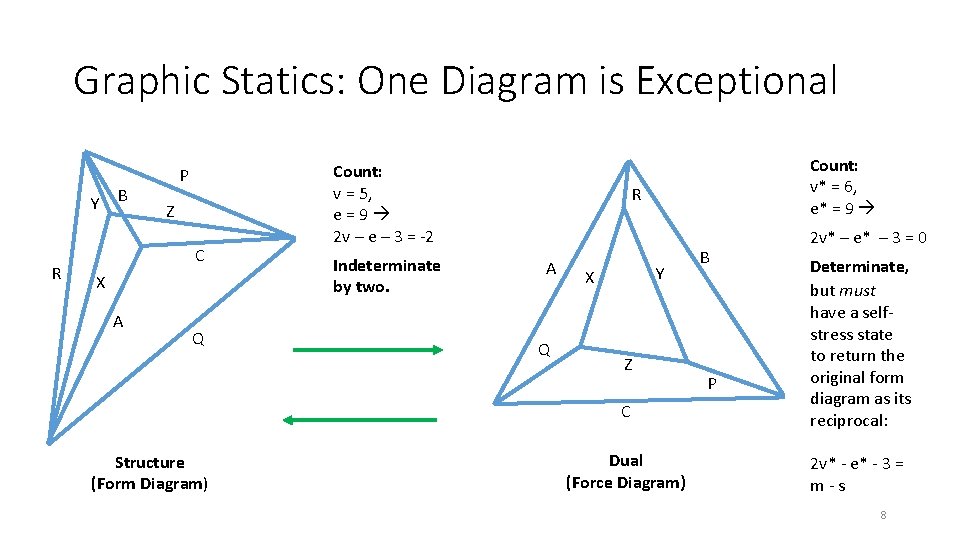
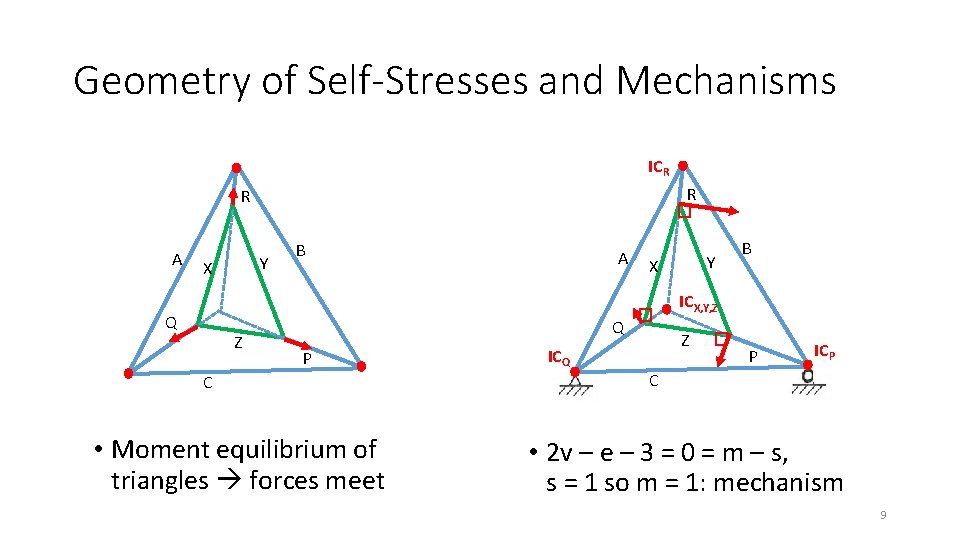
Graphic Statics: One Diagram is Exceptional Y R B P Z C X A Q Structure (Form Diagram) Count: v = 5, e=9 2 v – e – 3 = -2 Indeterminate by two. Count: v* = 6, e* = 9 R A Q B 2 v* – e* – 3 = 0 C Determinate, but must have a selfstress state to return the original form diagram as its reciprocal: Dual (Force Diagram) 2 v* - e* - 3 = m-s Y X Z P 8
Geometry of Self-Stresses and Mechanisms ICR R R A Y X B ICX, Y, Z Q P C • Moment equilibrium of triangles forces meet Z ICQ P ICP C • 2 v – e – 3 = 0 = m – s, s = 1 so m = 1: mechanism 9
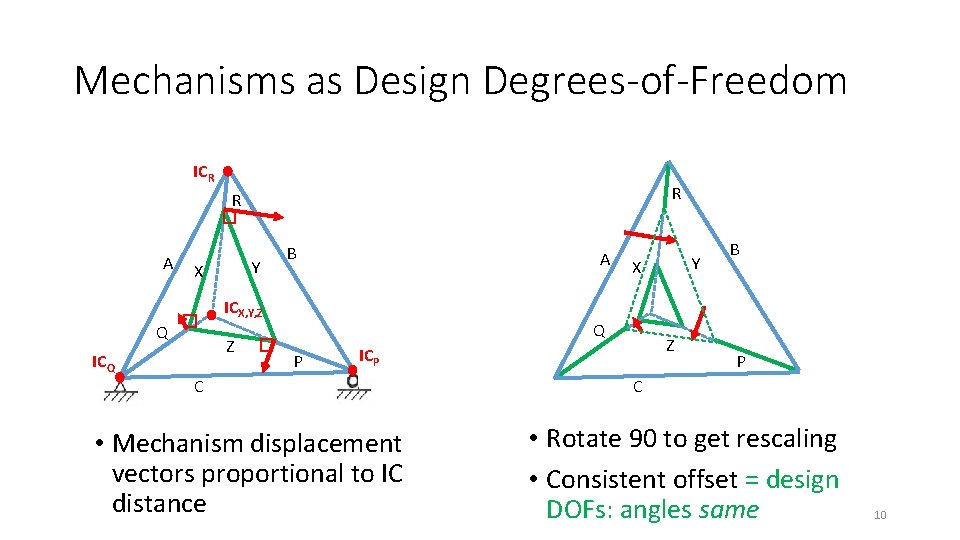
Mechanisms as Design Degrees-of-Freedom ICR R R A Y X B A ICX, Y, Z Q Z ICQ Q P Z ICP C • Mechanism displacement vectors proportional to IC distance Y X B P C • Rotate 90 to get rescaling • Consistent offset = design DOFs: angles same 10
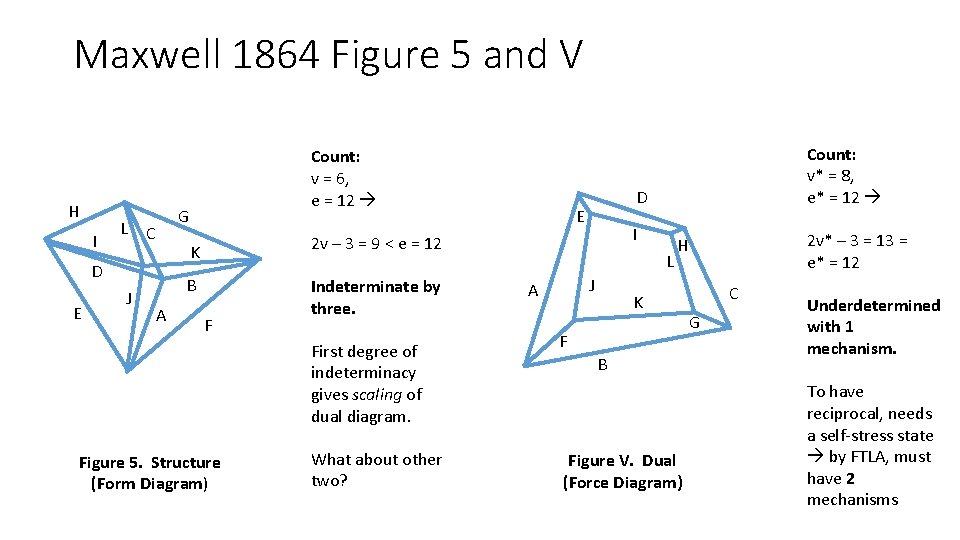
Maxwell 1864 Figure 5 and V H I G L C E B A F Indeterminate by three. First degree of indeterminacy gives scaling of dual diagram. Figure 5. Structure (Form Diagram) What about other two? Count: v* = 8, e* = 12 D E I 2 v – 3 = 9 < e = 12 K D J Count: v = 6, e = 12 L J A 2 v* – 3 = 13 = e* = 12 H K F B Figure V. Dual (Force Diagram) C G Underdetermined with 1 mechanism. To have reciprocal, needs a self-stress state by FTLA, must have 2 mechanisms
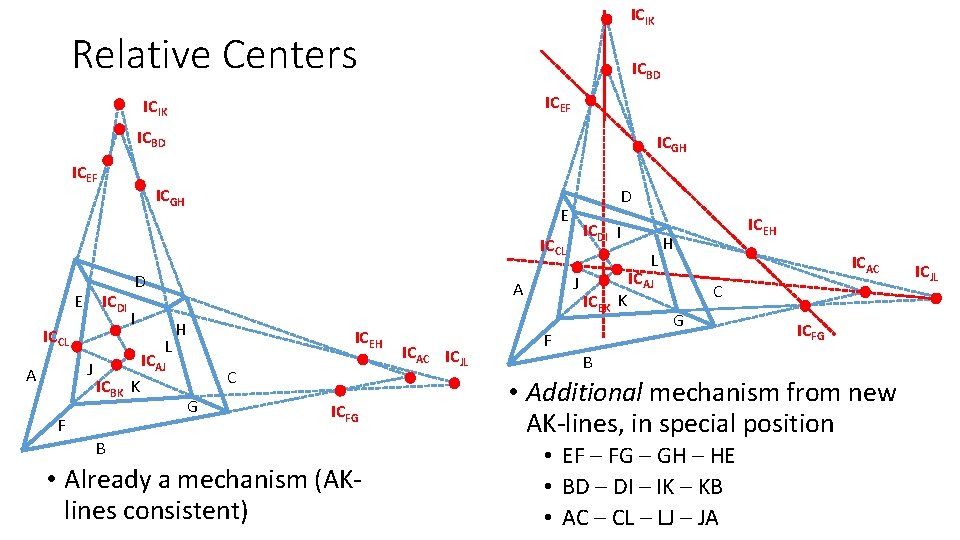
ICIK Relative Centers ICBD ICEF ICIK ICBD ICEF ICGH D E ICDI I ICCL E ICDI ICCL I H ICEH ICAJ ICBK K F J A L J A D C G ICFG B • Already a mechanism (AKlines consistent) ICAC ICJL L ICBK K F ICEH H ICAC ICAJ C G ICFG B • Additional mechanism from new AK-lines, in special position • EF – FG – GH – HE • BD – DI – IK – KB • AC – CL – LJ – JA ICJL
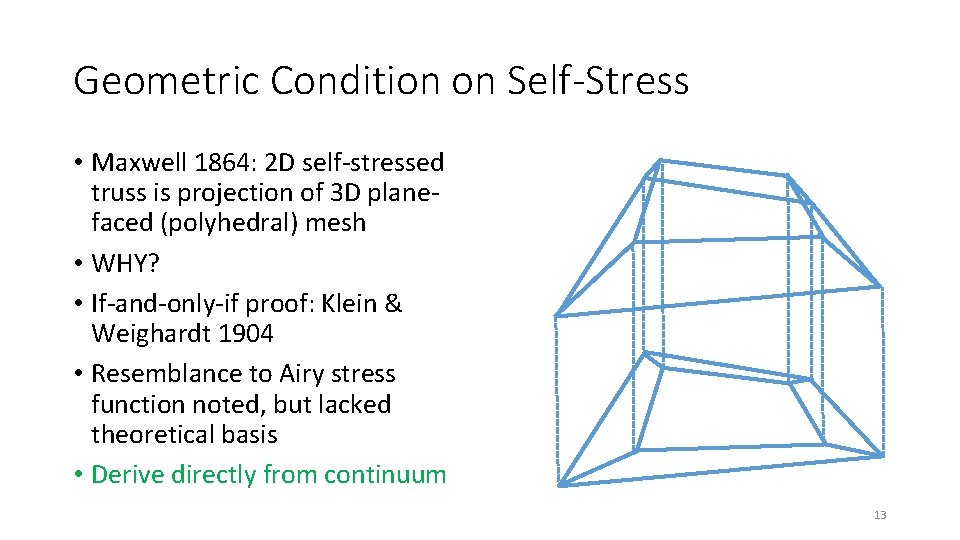
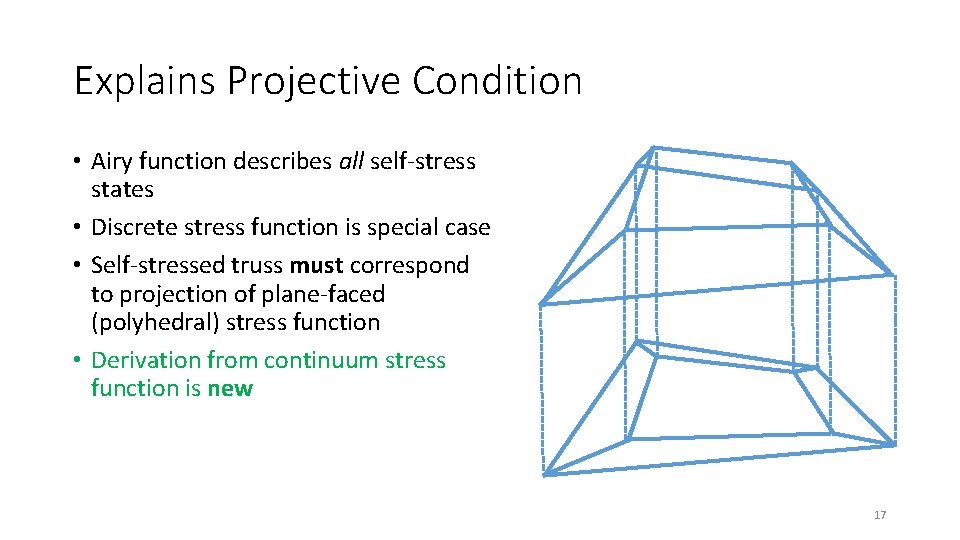
Geometric Condition on Self-Stress • Maxwell 1864: 2 D self-stressed truss is projection of 3 D planefaced (polyhedral) mesh • WHY? • If-and-only-if proof: Klein & Weighardt 1904 • Resemblance to Airy stress function noted, but lacked theoretical basis • Derive directly from continuum 13
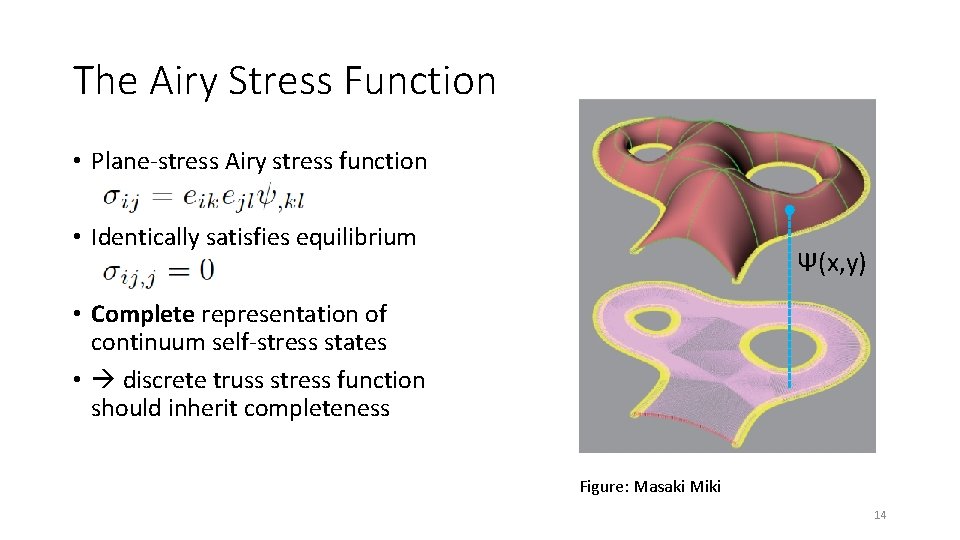
The Airy Stress Function • Plane-stress Airy stress function • Identically satisfies equilibrium Ψ(x, y) • Complete representation of continuum self-stress states • discrete truss stress function should inherit completeness Figure: Masaki Miki 14
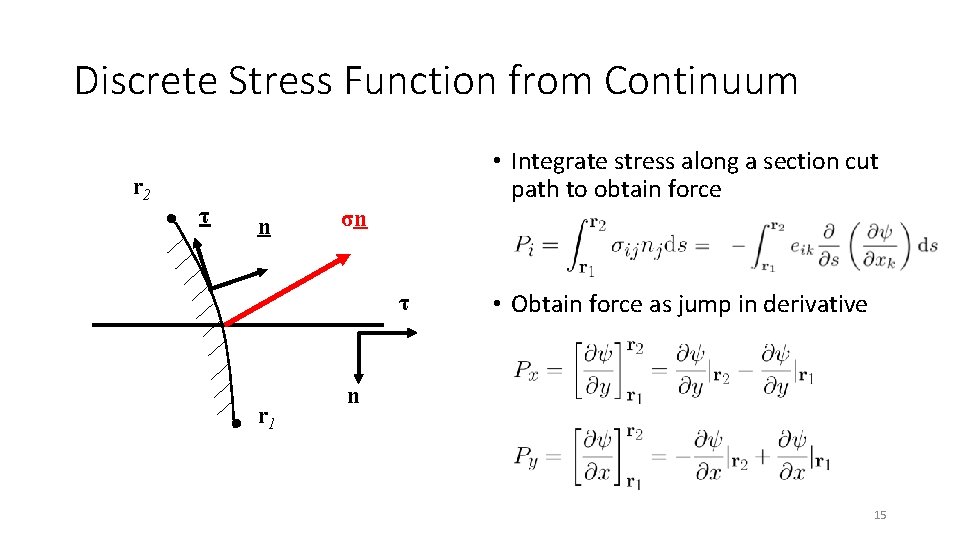
Discrete Stress Function from Continuum r 2 τ n • Integrate stress along a section cut path to obtain force σn τ r 1 • Obtain force as jump in derivative n 15
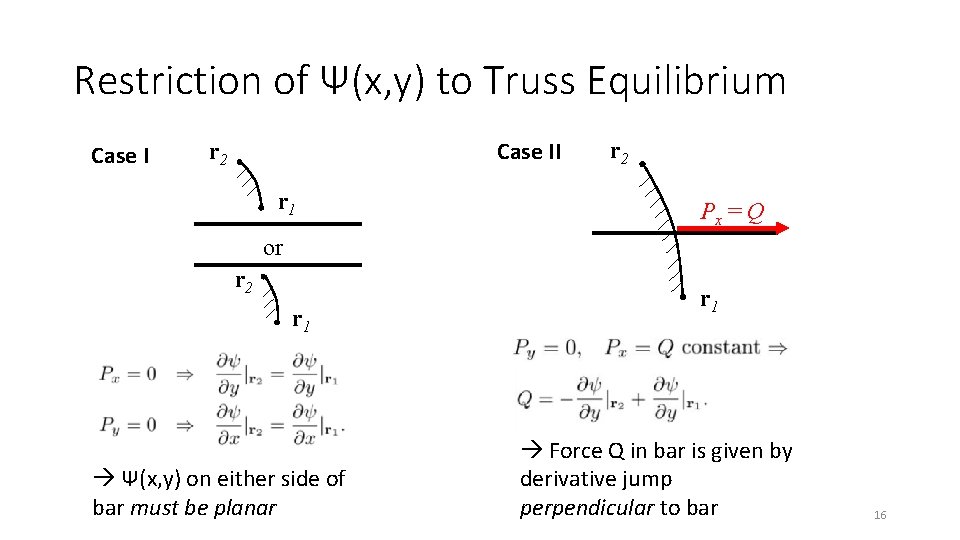
Restriction of Ψ(x, y) to Truss Equilibrium Case II r 2 r 1 r 2 Px = Q or r 2 r 1 Ψ(x, y) on either side of bar must be planar r 1 Force Q in bar is given by derivative jump perpendicular to bar 16
Explains Projective Condition • Airy function describes all self-stress states • Discrete stress function is special case • Self-stressed truss must correspond to projection of plane-faced (polyhedral) stress function • Derivation from continuum stress function is new 17
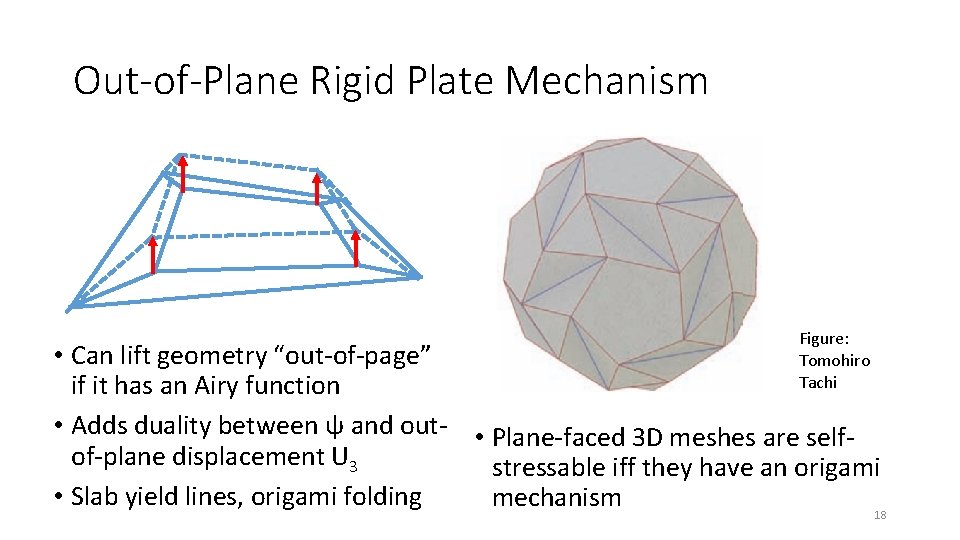
Out-of-Plane Rigid Plate Mechanism Figure: Tomohiro Tachi • Can lift geometry “out-of-page” if it has an Airy function • Adds duality between ψ and out- • Plane-faced 3 D meshes are selfof-plane displacement U 3 stressable iff they have an origami • Slab yield lines, origami folding mechanism 18
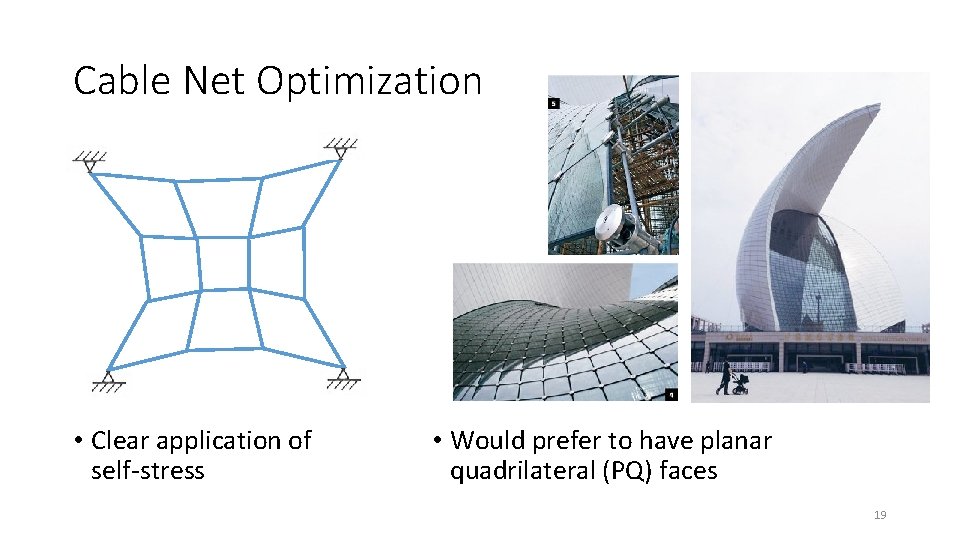
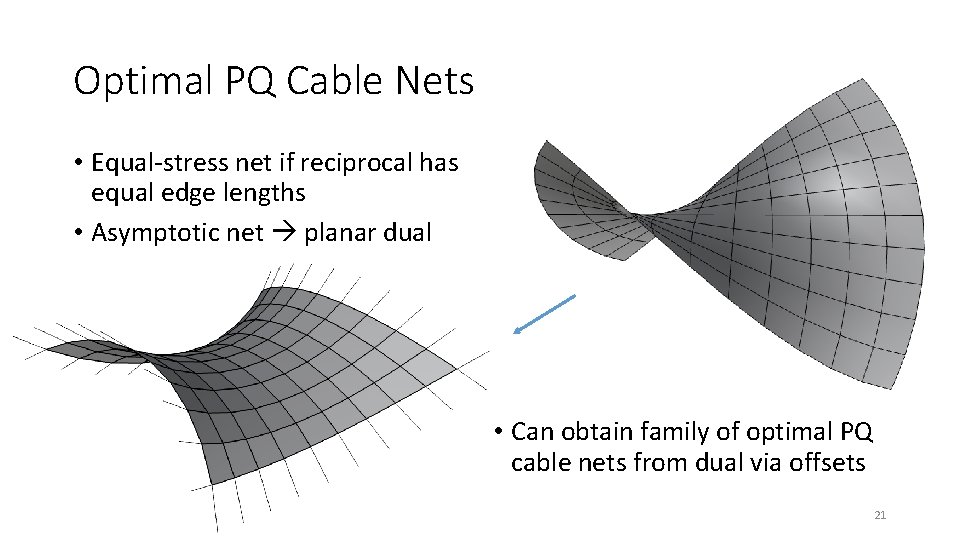
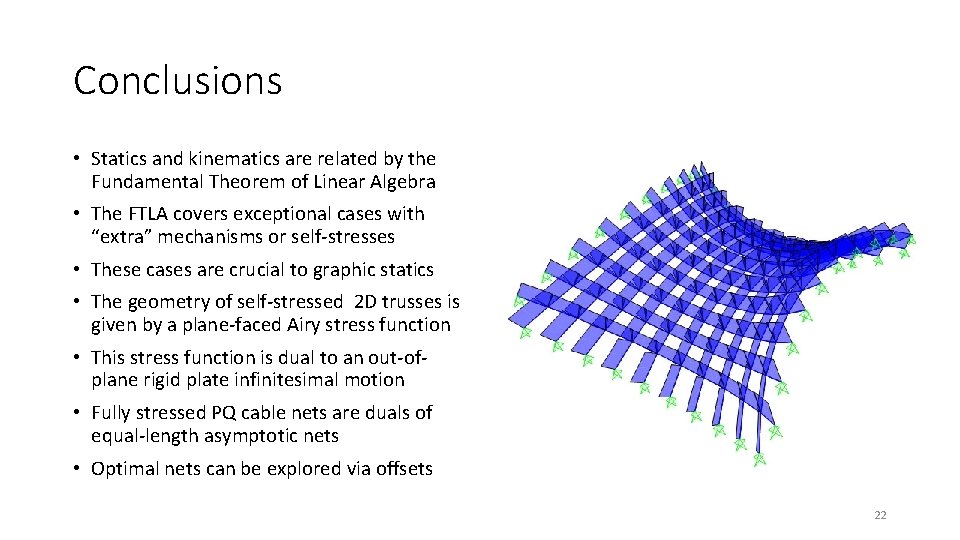
Cable Net Optimization • Clear application of self-stress • Would prefer to have planar quadrilateral (PQ) faces 19
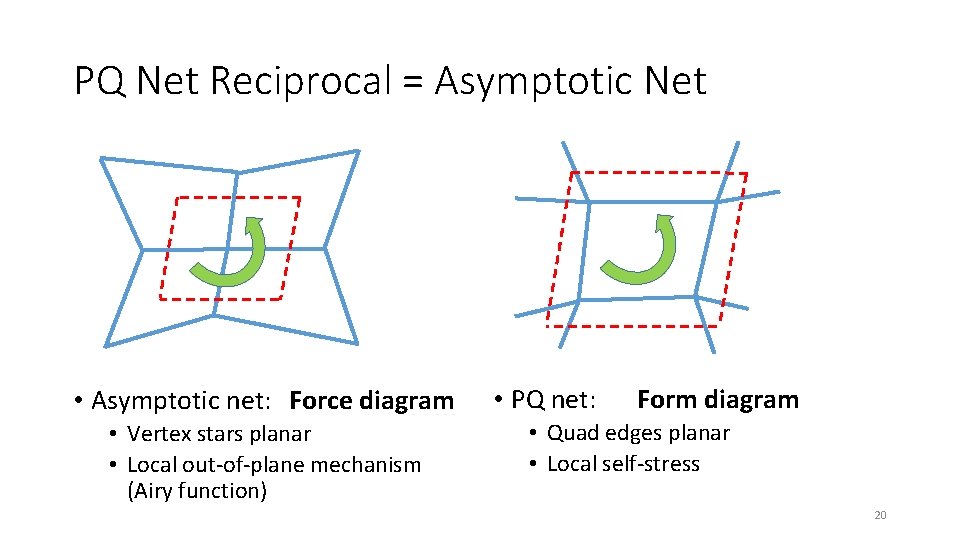
PQ Net Reciprocal = Asymptotic Net • Asymptotic net: Force diagram • Vertex stars planar • Local out-of-plane mechanism (Airy function) • PQ net: Form diagram • Quad edges planar • Local self-stress 20
Optimal PQ Cable Nets • Equal-stress net if reciprocal has equal edge lengths • Asymptotic net planar dual • Can obtain family of optimal PQ cable nets from dual via offsets 21
Conclusions • Statics and kinematics are related by the Fundamental Theorem of Linear Algebra • The FTLA covers exceptional cases with “extra” mechanisms or self-stresses • These cases are crucial to graphic statics • The geometry of self-stressed 2 D trusses is given by a plane-faced Airy stress function • This stress function is dual to an out-ofplane rigid plate infinitesimal motion • Fully stressed PQ cable nets are duals of equal-length asymptotic nets • Optimal nets can be explored via offsets 22
Thank you! 23
References Pellegrino S. , Mechanics of kinematically indeterminate structures, Ph. D thesis, 1986; Cambridge University. Calladine, C. R. , Buckminster Fuller’s “tensegrity” structures and Clerk Maxwell’s rules for the construction of stiff frames. International Journal of Solids and Structures 1978; 14: 161 -172. Tachi T. , Design of infinitesimally and finitely flexible origami based on reciprocal figures. Journal for Geometry and Graphics, 2012; 16; 223 -234. Shai O. and Pennock G. , Extension of graph theory to the duality between static systems and mechanisms. Journal of Mechanical Design, 2006; 128; 179 -191. Crapo H. and Whiteley W. , Spaces of stresses, projections and parallel drawings for spherical polyhedra. Beitrage zur Algebra und Geometrie, 1994; 35; 2; 259281. Maxwell J. C. , On reciprocal figures and diagrams of forces. Philosophical Magazine and Journal of Science, 1864. 26: 250 -261. Baker W. , Mc. Robie A. , Mitchell T. and Mazurek A. , Mechanisms and states of self-stress of planar trusses using graphic statics, part I: introduction and background. Proceedings of the International Association for Shell and Spatial Structures (IASS), 2015, (this volume). Borcea C. and Streinu I. , Liftings and stresses for planar periodic frameworks. Discrete and Computational Geometry, 2014; 53. Whiteley W. , Convex polyhedral, Dirichlet tessellations, and spider webs. In Shaping Space: Exploring Polyhedra in Nature, Art, and the Geometrical Imagination, 2013; Springer-Verlag. Fraternali F. and Carpentieri G. , On the correspondence between 2 D force networks and polyhedral stress functions. International Journal of Space Structures, 2014; 29; 145 -159. Pottmann H. , Liu Y. , Wallner J. , Bobenko A. and Wang W. , Geometry of multilayer freeform structures for architecture. ACM Transactions on Graphics (SIGGraph), 2007; 26. Van Mele T. and Block P. , Algebraic graph statics. Computer-Aided Design, 2014; 53; 104 -116. Maxwell J. C. , On reciprocal diagrams in space and their relation to Airy’s functions of stress. Mc. Robie A. , Baker W. , Mitchell T. and Konstantatou M. , Mechanisms and states of self-stress of planar trusses using graphic statics, part III: applications and extensions. Proceedings of the International Association for Shell and Spatial Structures (IASS), 2015, (this volume). Klein F. and Wieghardt K. , Über Spannungsflächen und reziproke Diagramme, mit besondere Berücksichtigung der Maxwellschen Arbeiten. Archiv der Mathematik und Physik, 1904; 8; 1 -10 then 95 -119. 24
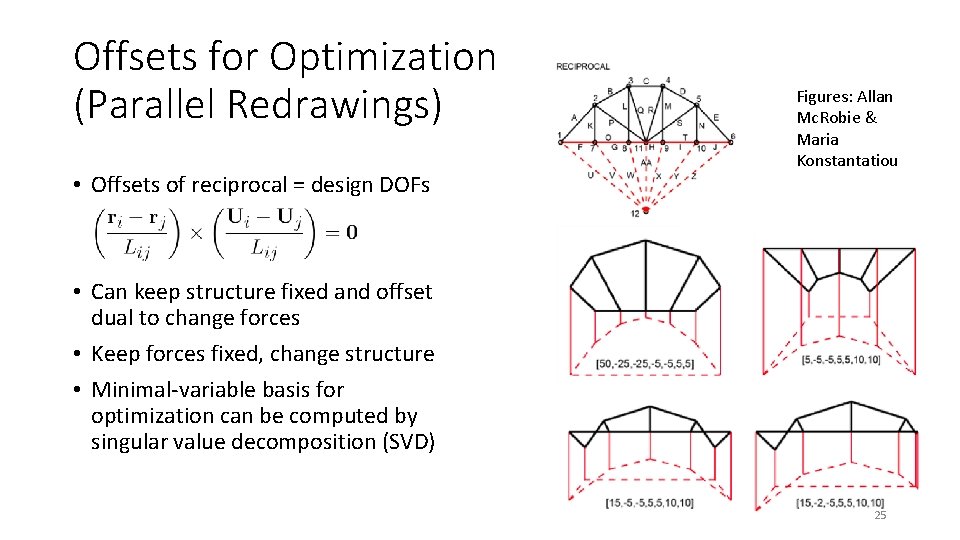
Offsets for Optimization (Parallel Redrawings) • Offsets of reciprocal = design DOFs Figures: Allan Mc. Robie & Maria Konstantatiou • Can keep structure fixed and offset dual to change forces • Keep forces fixed, change structure • Minimal-variable basis for optimization can be computed by singular value decomposition (SVD) 25
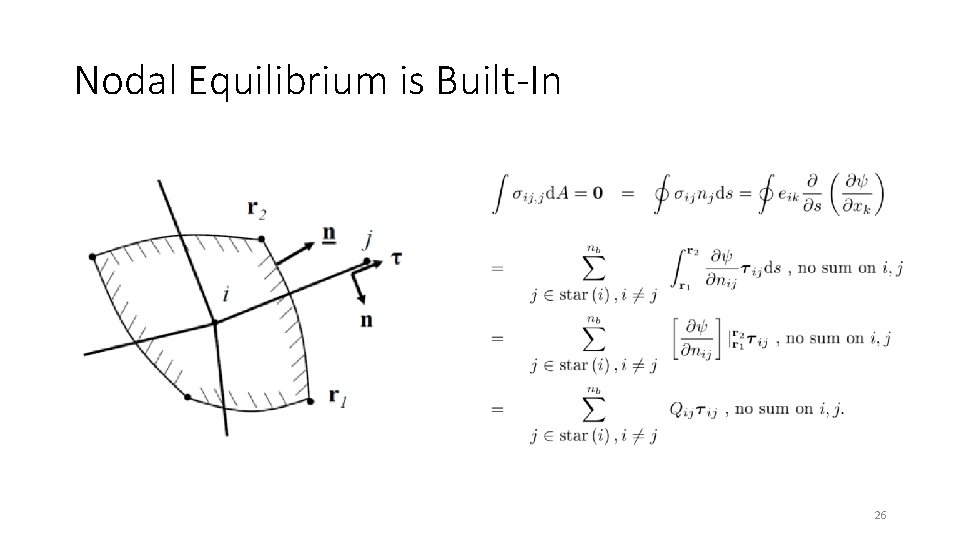
Nodal Equilibrium is Built-In 26
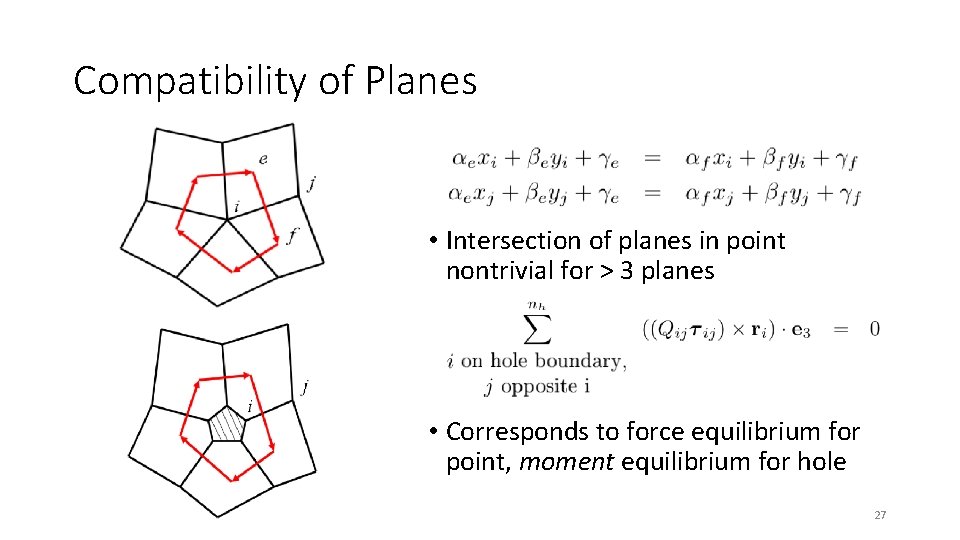
Compatibility of Planes • Intersection of planes in point nontrivial for > 3 planes • Corresponds to force equilibrium for point, moment equilibrium for hole 27