
Graphic interface External viewable coding Text Editor Internal

Graphic interface External viewable coding Text Editor Internal coding Rendering engine
in user terms : Md. C coding is easily understood and learned Md. C coding is concise Md. C coding provides two sets of functionalities : basic (i. e. implemented by all rendering engines) extended functionalities (i. e. optional but implemented using a standardised syntax) current Md. C 88 is supported for a certain period of time In rendering engines terms : Md. C coding is based on a « regular » syntax to be easily implementable and to reduce the consumed resources software not supporting « extended functionalities » is silencious at rendering time Software should provide a tool signaling « deprecated » and not supported « extended functionalities »
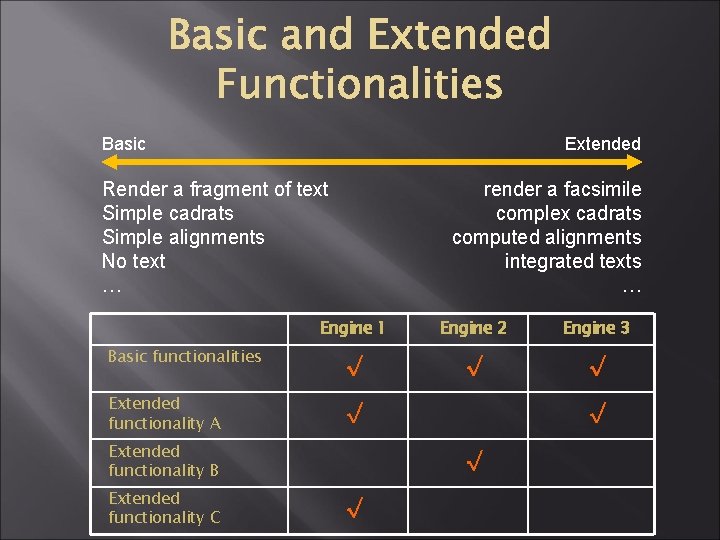
Extended Basic Render a fragment of text Simple cadrats Simple alignments No text … render a facsimile complex cadrats computed alignments integrated texts … Engine 1 Engine 2 Engine 3 Basic functionalities √ √ √ Extended functionality A √ Extended functionality B Extended functionality C √ √ √

Last version of the Manuel de Codage released in 1988 has been fruitfully used for many years Two directions of evolutions direction 1 : introduction of new functionalities direction 2 : move to a « state of the art » syntax
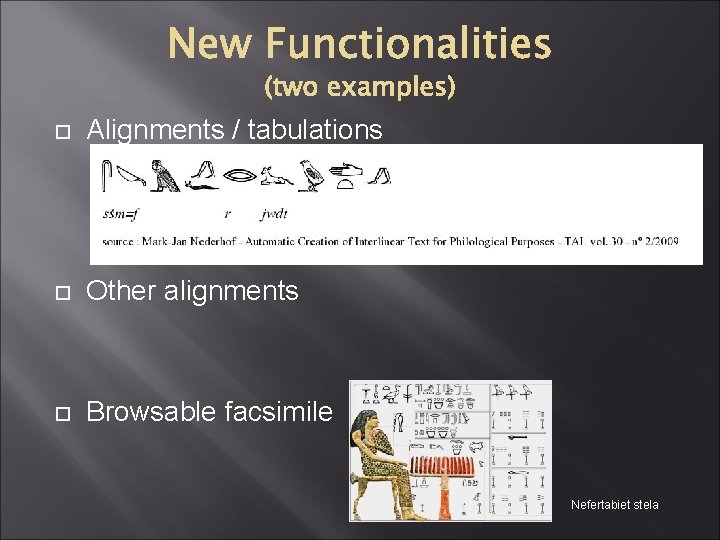
Alignments / tabulations Other alignments Browsable facsimile Nefertabiet stela
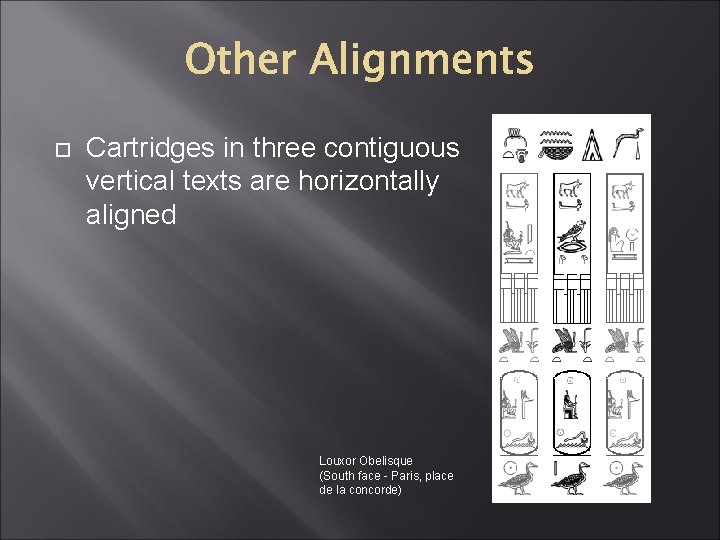
Cartridges in three contiguous vertical texts are horizontally aligned Louxor Obelisque (South face - Paris, place de la concorde)
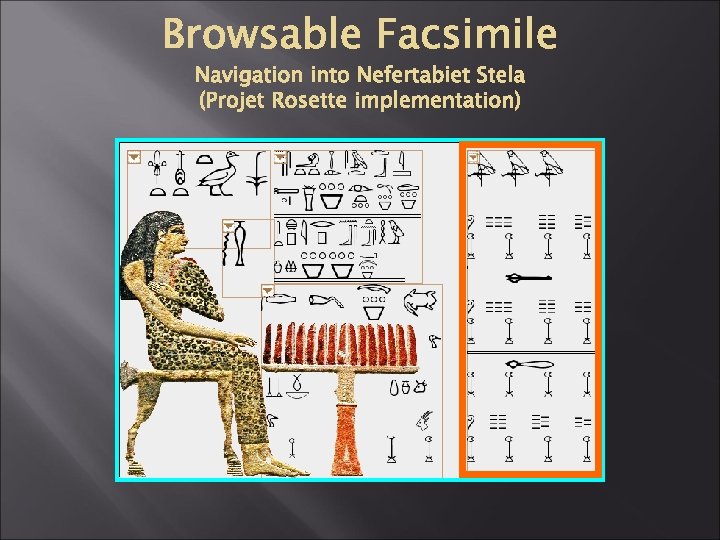
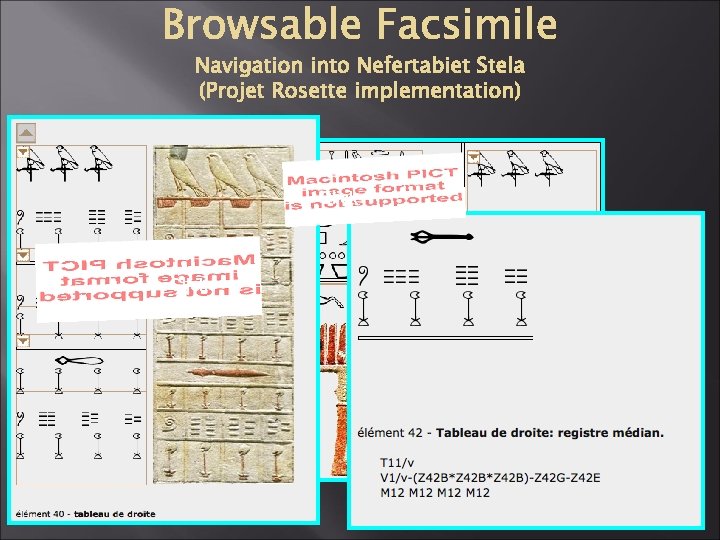
Click

Last version of the Manuel de Codage released in 1988 has been used for many years Two directions of evolutions direction 1 : introduction of new functionalities direction 2 : move to a « state of the art » syntax
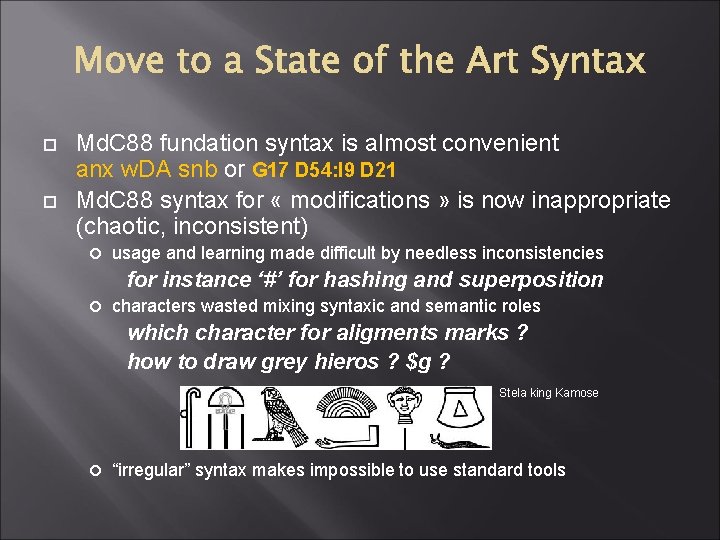
Md. C 88 fundation syntax is almost convenient anx w. DA snb or G 17 D 54: I 9 D 21 Md. C 88 syntax for « modifications » is now inappropriate (chaotic, inconsistent) usage and learning made difficult by needless inconsistencies for instance ‘#’ for hashing and superposition characters wasted mixing syntaxic and semantic roles which character for aligments marks ? how to draw grey hieros ? $g ? Stela king Kamose “irregular” syntax makes impossible to use standard tools
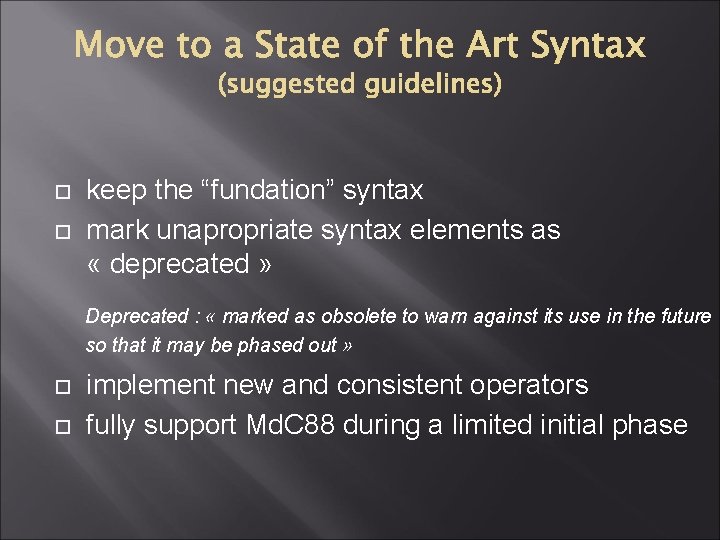
keep the “fundation” syntax mark unapropriate syntax elements as « deprecated » Deprecated : « marked as obsolete to warn against its use in the future so that it may be phased out » implement new and consistent operators fully support Md. C 88 during a limited initial phase
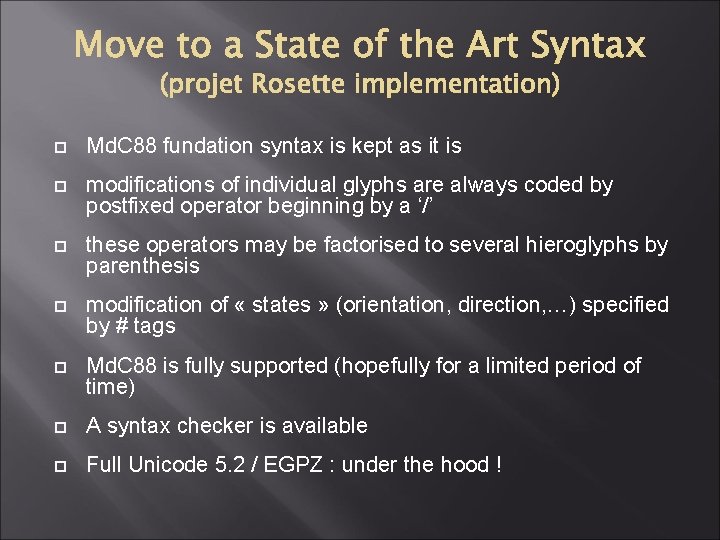
Md. C 88 fundation syntax is kept as it is modifications of individual glyphs are always coded by postfixed operator beginning by a ‘/’ these operators may be factorised to several hieroglyphs by parenthesis modification of « states » (orientation, direction, …) specified by # tags Md. C 88 is fully supported (hopefully for a limited period of time) A syntax checker is available Full Unicode 5. 2 / EGPZ : under the hood !
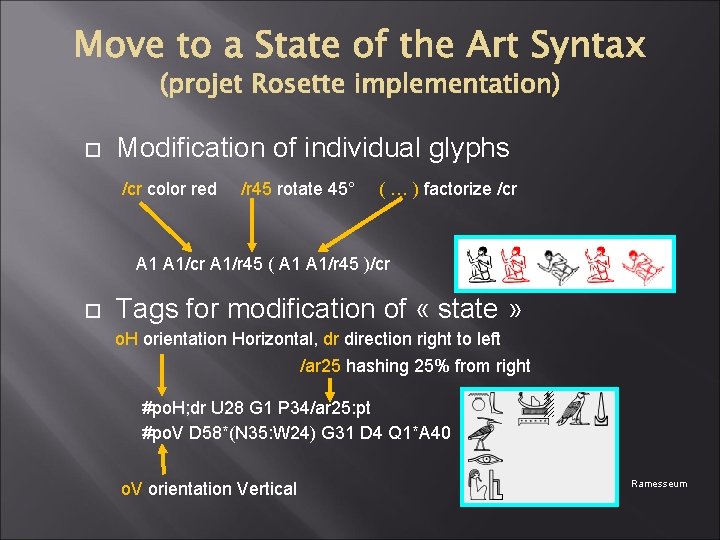
Modification of individual glyphs /cr color red /r 45 rotate 45° ( … ) factorize /cr A 1/cr A 1/r 45 ( A 1/r 45 )/cr Tags for modification of « state » o. H orientation Horizontal, dr direction right to left /ar 25 hashing 25% from right #po. H; dr U 28 G 1 P 34/ar 25: pt #po. V D 58*(N 35: W 24) G 31 D 4 Q 1*A 40 o. V orientation Vertical Ramesseum
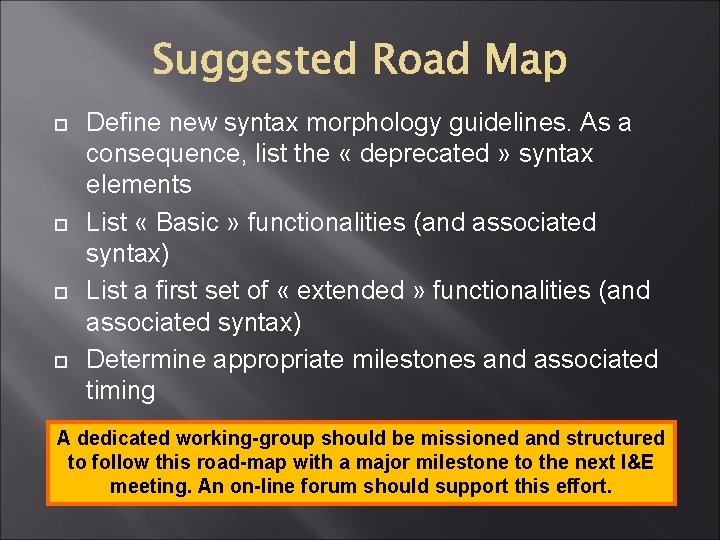
Define new syntax morphology guidelines. As a consequence, list the « deprecated » syntax elements List « Basic » functionalities (and associated syntax) List a first set of « extended » functionalities (and associated syntax) Determine appropriate milestones and associated timing A dedicated working-group should be missioned and structured to follow this road-map with a major milestone to the next I&E meeting. An on-line forum should support this effort.
- Slides: 15