
Graphic Communications Chapter 1 The term graphic relates

- Slides: 19
Graphic Communications Chapter 1
• The term “graphic” relates to the visual, or things we see • The term “communication” refers to the exchange of information in a visual form
Why is communication important? • Method (medium) will vary based on the needs of the individual. • Images are less likely to be misinterpreted than a verbal message • People often have an immediate need for practical knowledge (instructions on how to build a bicycle etc). • Advertising is an extremely important form of selling/sharing information in a visual manner.
Producing visual images • Design – assures the printed image conveys the intended message. • Specifications – guidelines used to determine the format and cost of the final product • Quote – lists the prices and quantities for production of printed goods and services
Editing • Final preparation of the authors or writers manuscript for publication • Content editing – check the material for up to date, accurate and organized information • Copy editing – correct grammar and spelling • Image editing – look for flaws within the image. Make sure it’s the right color, size etc.
Text Composition • Done by hand as well as by computer • Oftentimes it’s done by computer, altered by hand, then rescanned into the computer program to create the final image
Page Composition It’s essential that the printed material: – be attractive in design – Hold attention – Transmit the desired message to the reader To make this possible text and images must be arranged creatively and effectively
Design Process • Initial design – idea in basic form. Created by thumbnail sketches • Rough layout – actual size visual of the page that accurately shows all information • Comprehensive layout – detailed sketch clearly showing the final image before it goes into print
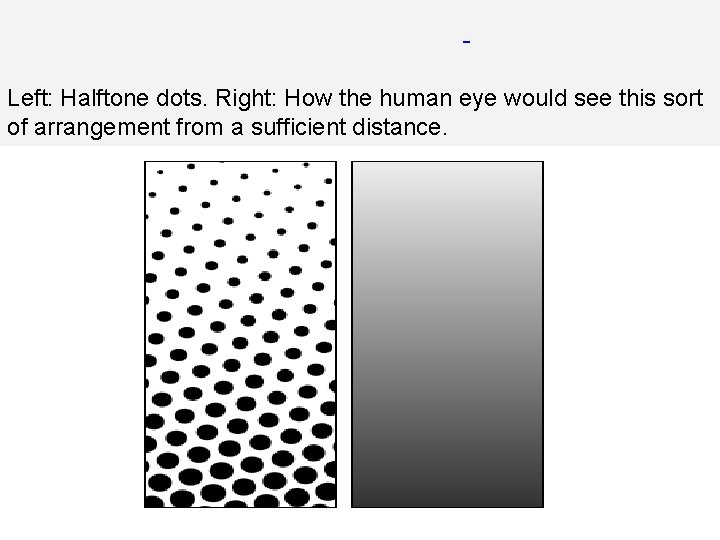
Left: Halftone dots. Right: How the human eye would see this sort of arrangement from a sufficient distance.
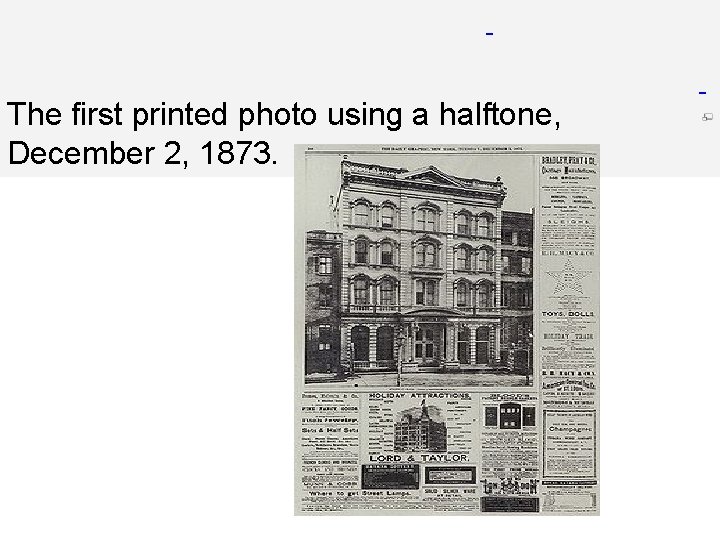
The first printed photo using a halftone, December 2, 1873.
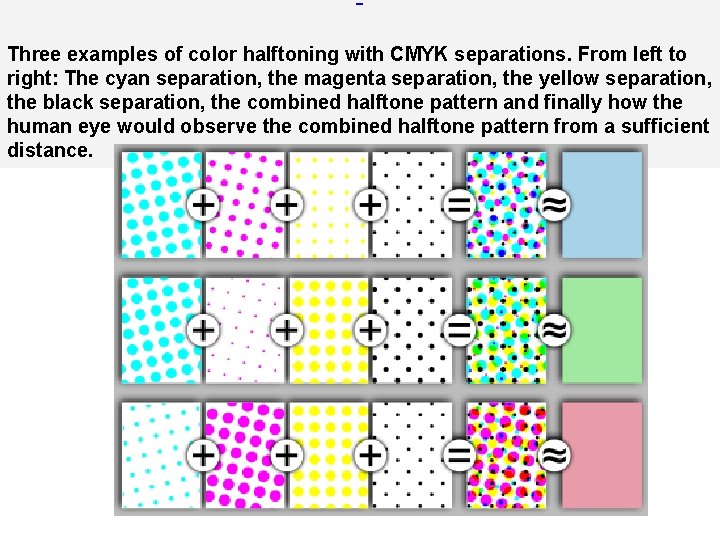
Three examples of color halftoning with CMYK separations. From left to right: The cyan separation, the magenta separation, the yellow separation, the black separation, the combined halftone pattern and finally how the human eye would observe the combined halftone pattern from a sufficient distance.
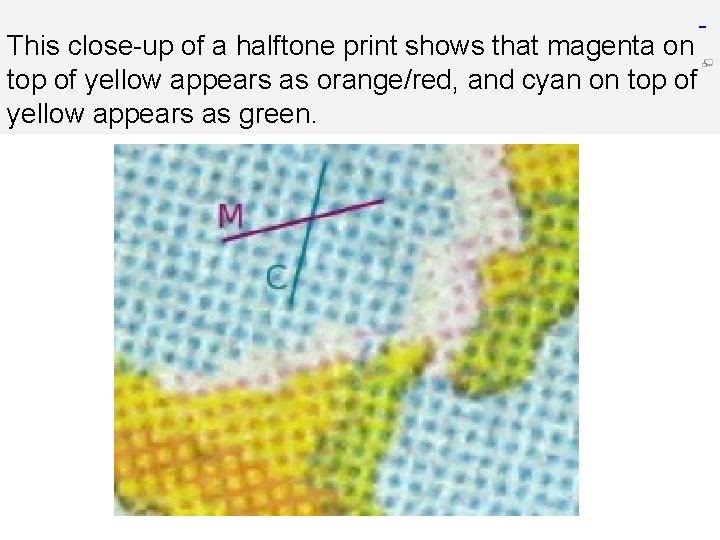
This close-up of a halftone print shows that magenta on top of yellow appears as orange/red, and cyan on top of yellow appears as green.
Questions 1. A material on which printing is done is called Substrate 2. A quote lists the _____ and ______ for production of goods and services prices and quantities
3. This is the most common way of generating copy for printing Computer 4. Line art is a type of drawing consisting of continuous tones. T of F False. It is contrast, which means it cant have value
5. Explain the term “halftone” A method of generating on press or on a laser printer an image that requires varying densities or shades to accurately render the image. This is achieved by representing the image as a pattern of dots of varying size or in spacing. An image that has been reproduced in one color, using a screen, a fine pattern of printed dots to give the effect of shading object as a series of dots obtained, for example, by photographing or scanning an image through a mesh screen
6. What is a mechanical? Completed page of type on photographic paper including illustrations 7. What process has replaced manual paste-up? Electronic Page Composition
8. Which is NOT a process color used in printing full color photos? Green. The process is CMYK 9. Describe the types of printing: flexography - is a form of printing process which utilizes a flexible relief plate. It is basically an updated version of letterpress that can be used for printing on almost any type of substrate including plastic, metallic films, cellophane, paper
gravure - intaglio printing: a printing process that uses an etched or engraved plate; the plate is smeared with ink and wiped clean, then the ink left in the recesses makes the print screen printing - printing technique that uses a woven mesh to support an ink-blocking stencil. The attached stencil forms open areas of mesh that transfer ink as a sharp-edged image onto a substrate.
impactless printing – does not require direct impact by image carrier and substrate 10. ____ is the process used most extensively in the commercial printing segment? Quick Printing