
GRAPHENEGRAPHITE ALUMINUM BATTERY OR IS IT A CAPACITOR
GRAPHENE-GRAPHITE ALUMINUM BATTERY (OR IS IT A CAPACITOR) Bartholomew T. Frey Stark County High School Toulon, IL
PROBLEMS WITH TRADITIONAL BATTERIES Society moves from dependence on fossil fuels, and moves towards greener forms of energy. Demand for batteries is increasing at an enormous rate. Commercially manufactured contain materials that are detrimental to the environment, explosive, made from expensive materials, and/or present a difficulty for disposal.

WHY USE ALUMINUM, GRAPHENE, & GRAPHITE? Constructing a battery from cheap materials that are readily available, recyclable, and are less harmful to the environment is a desired. Won’t explode or catch fire. Aluminum is the third most abundant material in the Earth’s crust and is exceptionally recyclable. Carbon, the only element in graphene and graphite, is the fourth most abundant element in the universe and also positively addresses the concerns of current battery materials.

WHAT ARE GRAPHENE AND GRAPHITE? Graphene is a single layer of hexagonal carbon Semiconductor Lower resistivity than silver High electron mobility 2 D material, so it is bendable Graphite Semiconductor Multiple layers of Graphene Weak van der Waals Forces allows it to be separated in layers Thermally stable https: //en. wikipedia. org/wiki/File: Graphen. jpg
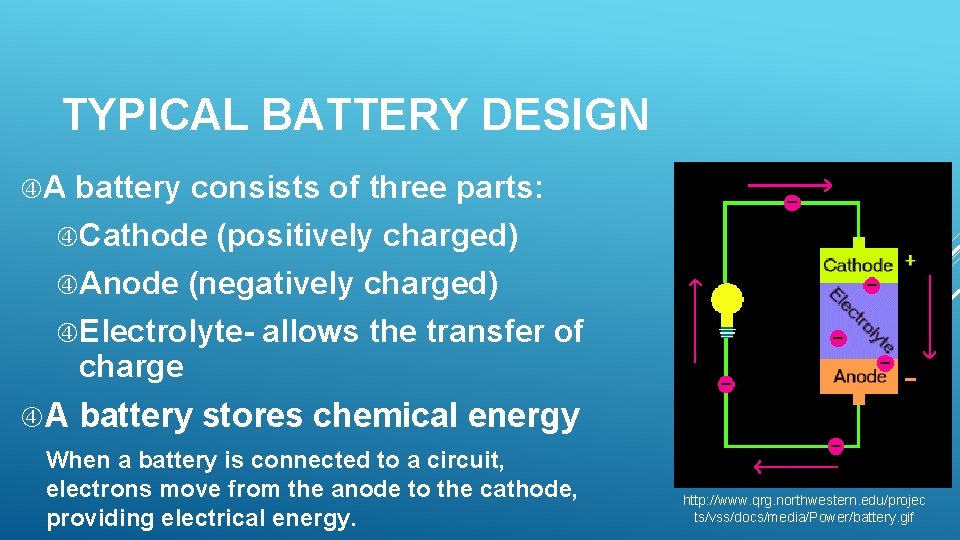
TYPICAL BATTERY DESIGN A battery consists of three parts: Cathode (positively charged) Anode (negatively charged) Electrolyte- allows the transfer of charge A battery stores chemical energy When a battery is connected to a circuit, electrons move from the anode to the cathode, providing electrical energy. http: //www. qrg. northwestern. edu/projec ts/vss/docs/media/Power/battery. gif
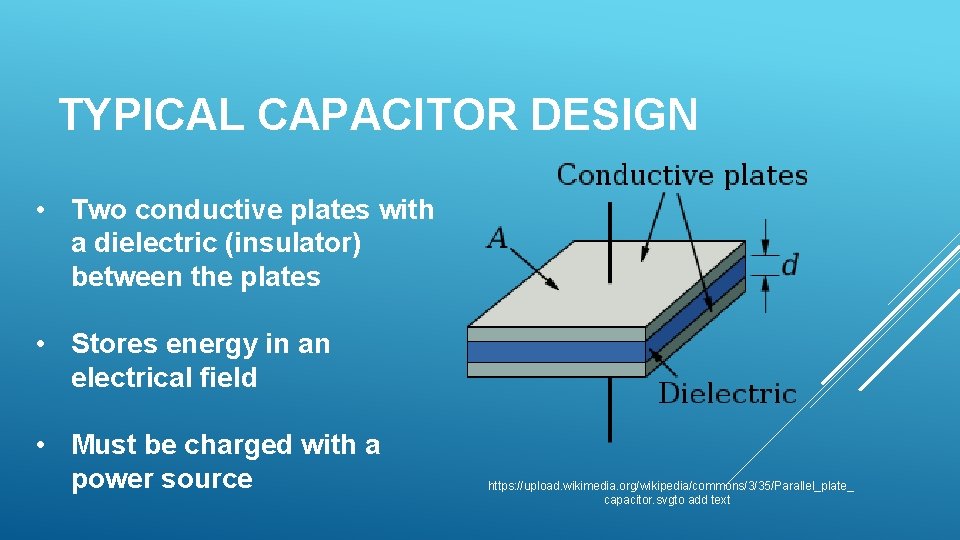
TYPICAL CAPACITOR DESIGN • Two conductive plates with a dielectric (insulator) between the plates • Stores energy in an electrical field • Must be charged with a power source https: //upload. wikimedia. org/wikipedia/commons/3/35/Parallel_plate_ capacitor. svgto add text
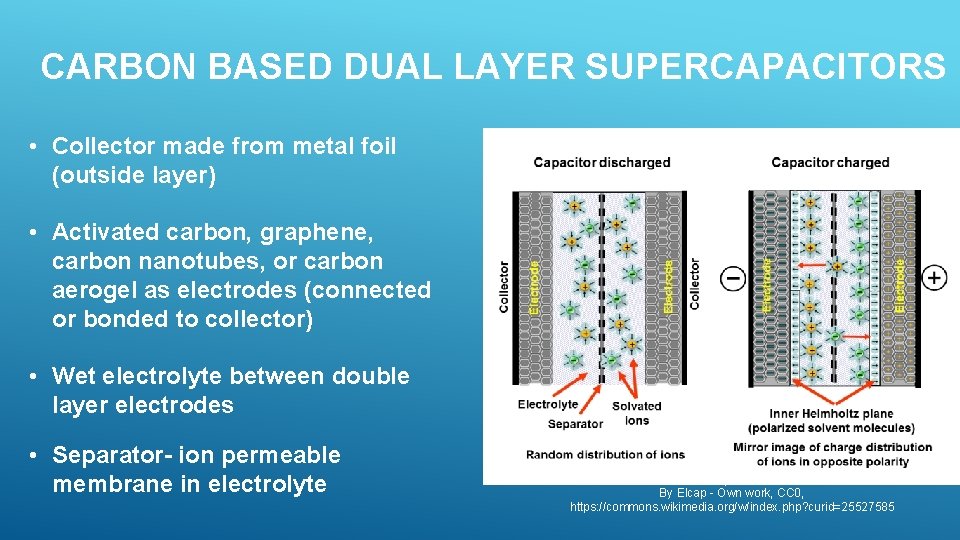
CARBON BASED DUAL LAYER SUPERCAPACITORS • Collector made from metal foil (outside layer) • Activated carbon, graphene, carbon nanotubes, or carbon aerogel as electrodes (connected or bonded to collector) • Wet electrolyte between double layer electrodes • Separator- ion permeable membrane in electrolyte By Elcap - Own work, CC 0, https: //commons. wikimedia. org/w/index. php? curid=25527585
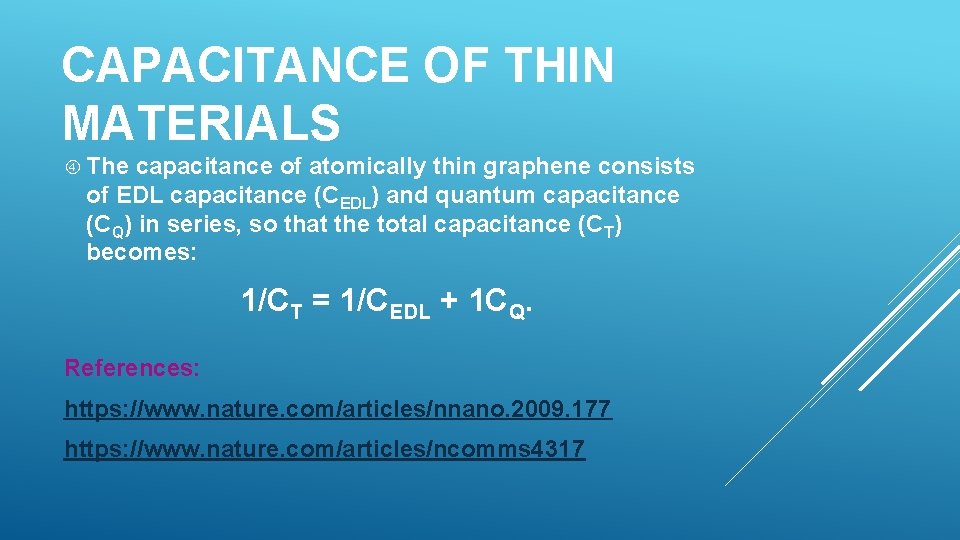
CAPACITANCE OF THIN MATERIALS The capacitance of atomically thin graphene consists of EDL capacitance (CEDL) and quantum capacitance (CQ) in series, so that the total capacitance (CT) becomes: 1/CT = 1/CEDL + 1 CQ. References: https: //www. nature. com/articles/nnano. 2009. 177 https: //www. nature. com/articles/ncomms 4317
Financial support was provided by the National Science Foundation under grant #NSF EEC 14 -07194 RET, as part of the nano@illinois project, through the University of Illinois Center for Nanoscale Science and Technology and the Micro and Nanotechnology Lab at the University of Illinois at Urbana-Champaign. This work, which includes teacher and student resources, is licensed under a Creative Commons Attribution. Noncommercial-Share Alike 3. 0 Unported License. To view a copy of this license, visit: http: //creativecommons. org/licenses/by-nc-sa/3. 0/. To attribute this work, please use [“B. Frey. Graphene-Graphite Aluminum Battery (or is it a Capacitor) Presentation (2018). ”] The nano@illinois Research Experience for Teachers (RET) at the University of Illinois at Urbana-Champaign (from 2014 -2017) exposes a diverse set of in-service and pre-service science, technology, engineering, and mathematics (STEM) teachers and community college faculty from across the nation to cutting-edge research in nanotechnology. The RET focuses on recruiting underrepresented minority populations (focused on ethnicity, geography, disability, and veteran status) including women and will target teachers from high-need areas, including inner city, rural, low-income, and those with significant URM students. Participants conduct research over 6 weeks in world-class labs with 4 follow-up sessions during the school year. Teacher professional development opportunities includes teacher-focused lectures, mentoring, networking, poster sessions, ethics seminars, hands-on modules, STEM education issues, career choices, and resources for implementing a nano lab and curriculum. Teachers will develop modules to be disseminated widely and present their results. High-quality follow-up sessions and evaluation will be infused. The nano@illinois Research Experiences for Teachers (RET) is managed by the University of Illinois Center for Nanoscale Science Technology. Center for Nanoscale Science and Technology 208 N. Wright, MC-249 Urbana, Illinois 61801 217 -244 -1353 nanotechnology@illinois. edu www. nano. illinois. edu
- Slides: 9