
Graphene in Protective Coatings Adrian Potts Lynn Chikosha

- Slides: 31
Graphene in Protective Coatings Adrian Potts / Lynn Chikosha 18 December 2019
Overview 1. Introduction to Graphene • Graphene Nanoplatelets • Graphene Dispersions 2. Graphene in Industrial Epoxy Primers • Water Vapour Transmission Rates • Prohesion • EIS 3. Extension into Highly Corrosive Environment 4. Further work 2
Introduction to Graphene 3
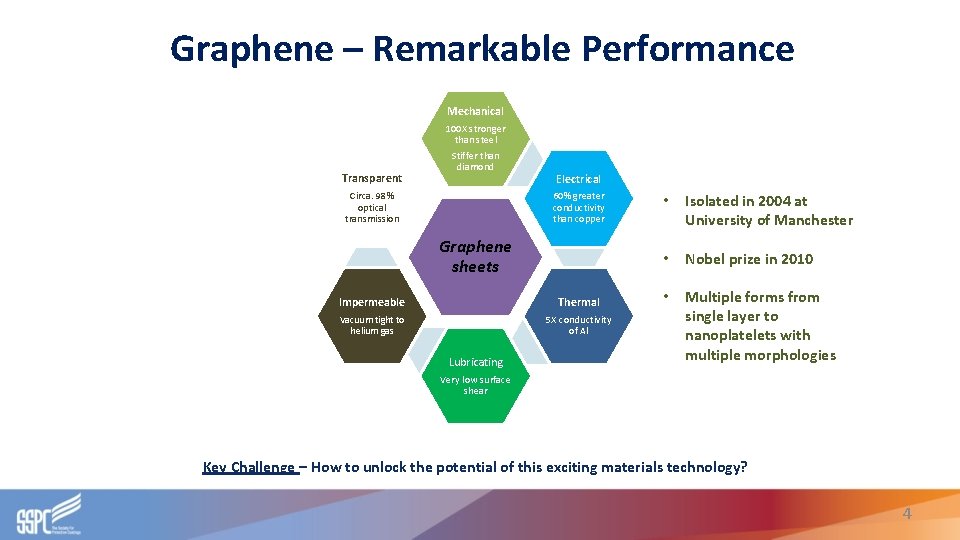
Graphene – Remarkable Performance Mechanical Transparent 100 X stronger than steel Stiffer than diamond Circa. 98% optical transmission Electrical 60% greater conductivity than copper Graphene sheets Impermeable Thermal Vacuum tight to helium gas 5 X conductivity of Al Lubricating • Isolated in 2004 at University of Manchester • Nobel prize in 2010 • Multiple forms from single layer to nanoplatelets with multiple morphologies Very low surface shear Key Challenge – How to unlock the potential of this exciting materials technology? 4
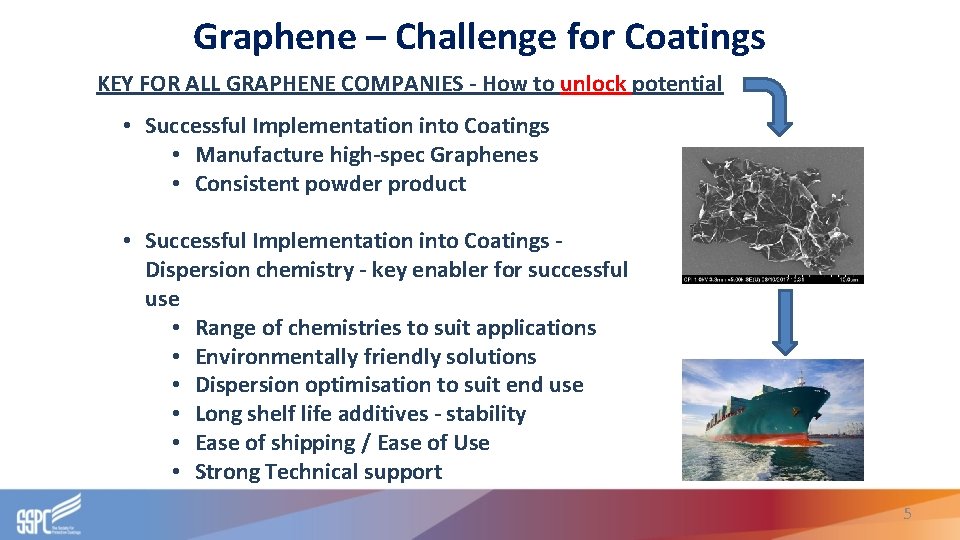
Graphene – Challenge for Coatings KEY FOR ALL GRAPHENE COMPANIES - How to unlock potential • Successful Implementation into Coatings • Manufacture high-spec Graphenes • Consistent powder product • Successful Implementation into Coatings Dispersion chemistry - key enabler for successful use • Range of chemistries to suit applications • Environmentally friendly solutions • Dispersion optimisation to suit end use • Long shelf life additives - stability • Ease of shipping / Ease of Use • Strong Technical support 5
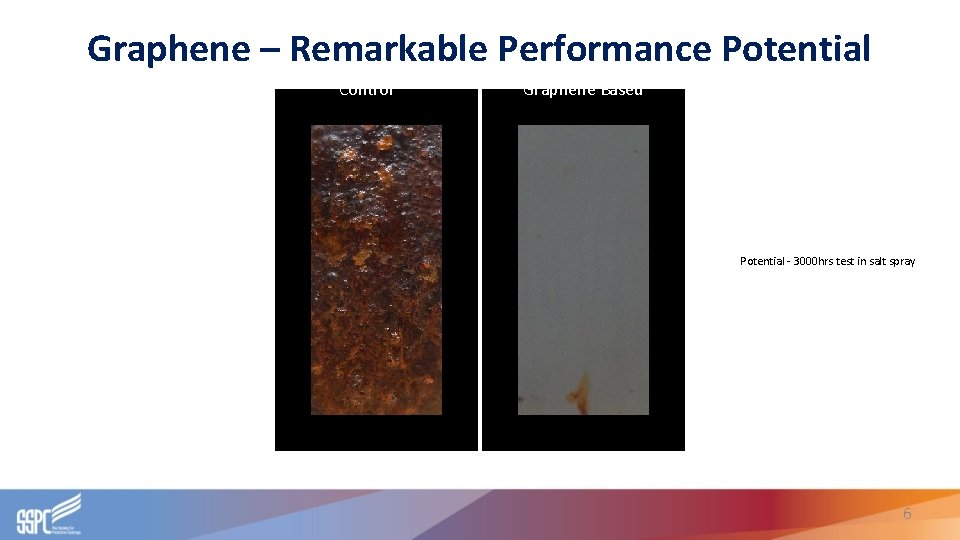
Graphene – Remarkable Performance Potential Control Graphene Based Potential - 3000 hrs test in salt spray 6
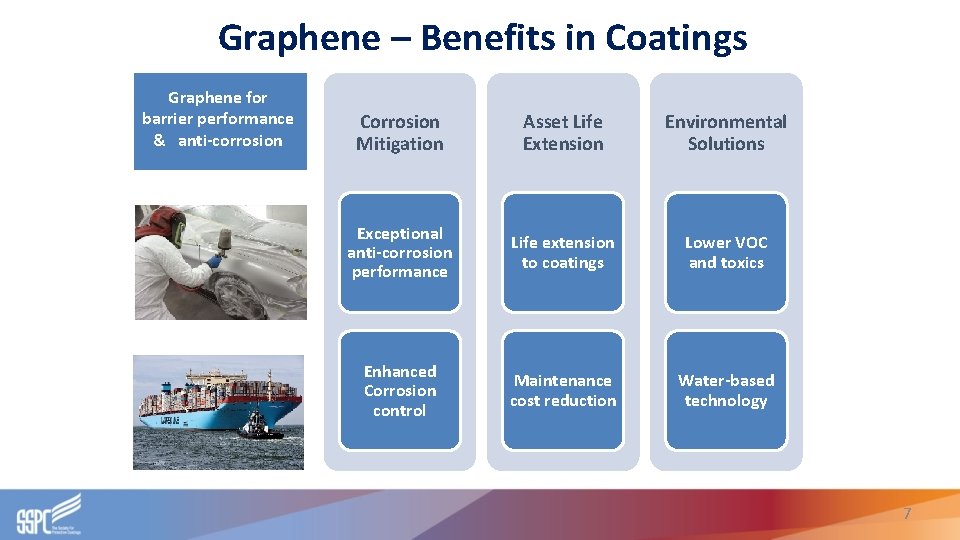
Graphene – Benefits in Coatings Graphene for barrier performance & anti-corrosion Corrosion Mitigation Functional Asset Life materials Extension Environmental Solutions Exceptional anti-corrosion performance Life extension to coatings Lower VOC and toxics Enhanced Corrosion control Maintenance cost reduction Water-based technology 7
Use of Graphene in Coatings A variety of mechanisms are proposed in literature by which graphene delivers anticorrosion performance • a physicochemical process which restricts uptake of water/oxygen and salts. • electrochemical activity. Platelike materials such as glass flake and micas have historically been used as barrier pigments that provide a tortuous path in anticorrosion primers. Graphene offers a step change two-dimensional structure which delivers: • high aspect ratio • large surface area • Low density Although there have been mixed reviews in literature that suggest galvanic corrosion may be an issue with the use of graphene in anticorrosive primers, this has not been observed in our testing. This may be the result of the very low levels of graphene used, which are below the percolation threshold. 8
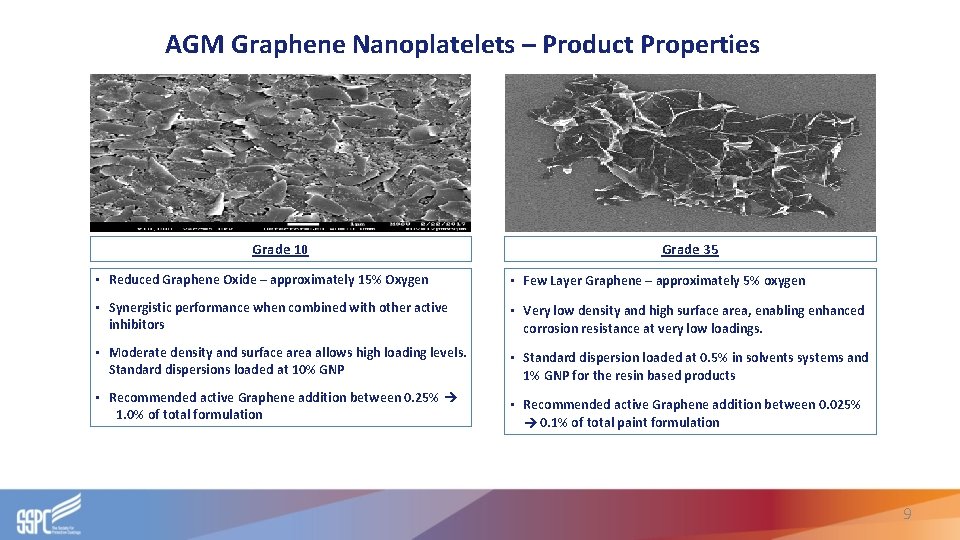
AGM Graphene Nanoplatelets – Product Properties Grade 10 Grade 35 • Reduced Graphene Oxide – approximately 15% Oxygen • Few Layer Graphene – approximately 5% oxygen • Synergistic performance when combined with other active inhibitors • Very low density and high surface area, enabling enhanced corrosion resistance at very low loadings. • Moderate density and surface area allows high loading levels. Standard dispersions loaded at 10% GNP • Standard dispersion loaded at 0. 5% in solvents systems and 1% GNP for the resin based products • Recommended active Graphene addition between 0. 25% 1. 0% of total formulation • Recommended active Graphene addition between 0. 025% 0. 1% of total paint formulation 9
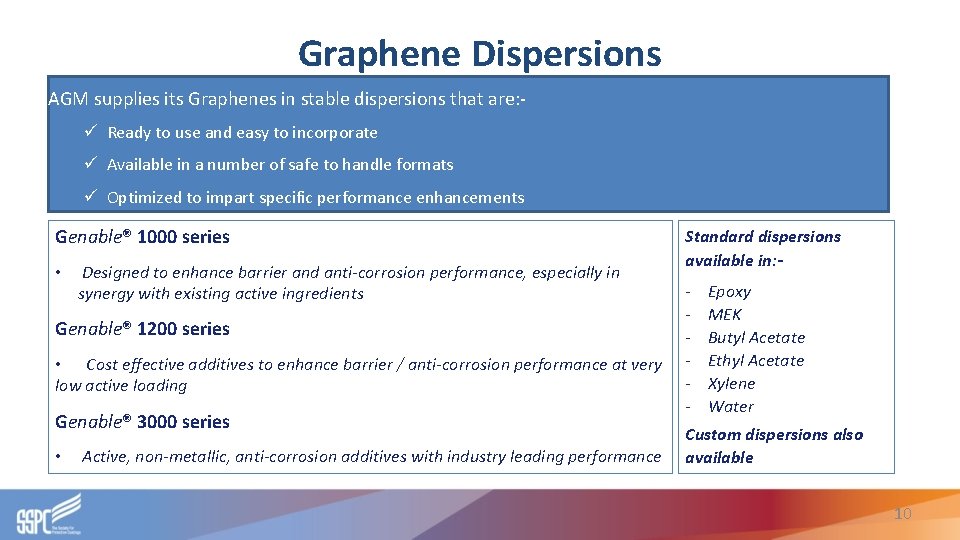
Graphene Dispersions AGM supplies its Graphenes in stable dispersions that are: ü Ready to use and easy to incorporate ü Available in a number of safe to handle formats ü Optimized to impart specific performance enhancements Genable® 1000 series • Designed to enhance barrier and anti-corrosion performance, especially in synergy with existing active ingredients Genable® 1200 series • Cost effective additives to enhance barrier / anti-corrosion performance at very low active loading Genable® 3000 series • Active, non-metallic, anti-corrosion additives with industry leading performance Standard dispersions available in: - - Epoxy - MEK - Butyl Acetate - Ethyl Acetate - Xylene - Water Custom dispersions also available 10
Objectives of this Work Demonstrate improved anticorrosive performance 1. By using commercially available and ready to use Graphene dispersions, optimised for use in existing coatings systems. 2. And identify significant uplifts in life expectancy and performance through use of Graphene nano-platelets 11
Graphene in Industrial Epoxy Primers 12
Test Program Demonstrating anticorrosive performance and extended lifetime in a typical Industrial Epoxy Primer: Water Vapor transmission (WVTR) Testing Prohesion Testing ASTMG 85 annex 5 Panel Preparation • Mild steel panels (CR 4) of dimensions 150 x 100 x 2 mm, grit blasted to SA 2. 5 • Coatings were applied using a Duplicate panels were prepared for assessment at intervals of conventional spray gun equipped with a 500, 1000, 2000, 3000, and 5000 hours 1. 2 mm tip Electrochemical studies Novel Test Method looking at both scribed and unscribed substrates AC Impedance Spectroscopy (AC EIS) • Coating thickness - 100µm DFT • All panels were allowed to cure for a period of 7 days at 23°C (+/-2°C). 13
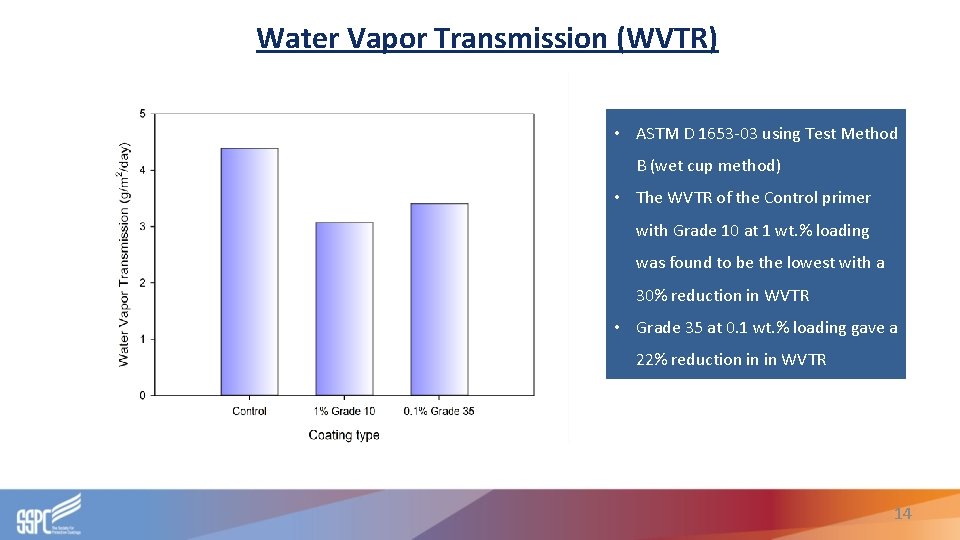
Water Vapor Transmission (WVTR) • ASTM D 1653 -03 using Test Method B (wet cup method) • The WVTR of the Control primer with Grade 10 at 1 wt. % loading was found to be the lowest with a 30% reduction in WVTR • Grade 35 at 0. 1 wt. % loading gave a 22% reduction in in WVTR 14
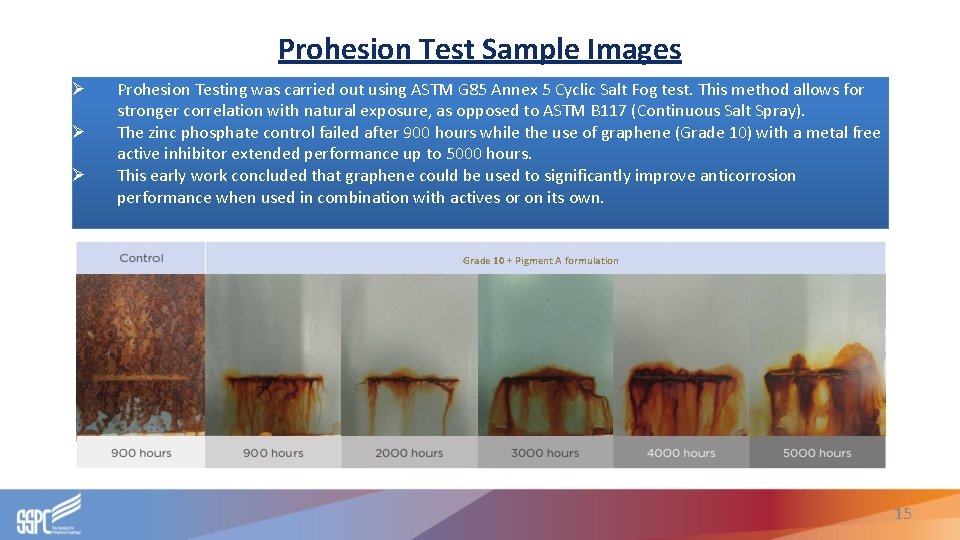
Prohesion Test Sample Images Ø Ø Ø Prohesion Testing was carried out using ASTM G 85 Annex 5 Cyclic Salt Fog test. This method allows for stronger correlation with natural exposure, as opposed to ASTM B 117 (Continuous Salt Spray). The zinc phosphate control failed after 900 hours while the use of graphene (Grade 10) with a metal free active inhibitor extended performance up to 5000 hours. This early work concluded that graphene could be used to significantly improve anticorrosion performance when used in combination with actives or on its own. Grade 10 + Pigment A formulation 15
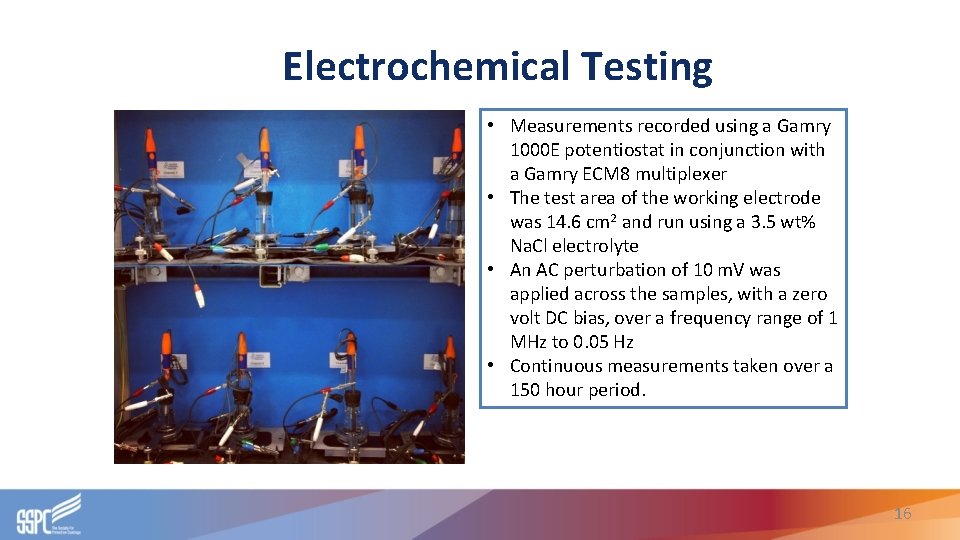
Electrochemical Testing • Measurements recorded using a Gamry 1000 E potentiostat in conjunction with a Gamry ECM 8 multiplexer • The test area of the working electrode was 14. 6 cm 2 and run using a 3. 5 wt% Na. Cl electrolyte • An AC perturbation of 10 m. V was applied across the samples, with a zero volt DC bias, over a frequency range of 1 MHz to 0. 05 Hz • Continuous measurements taken over a 150 hour period. 16
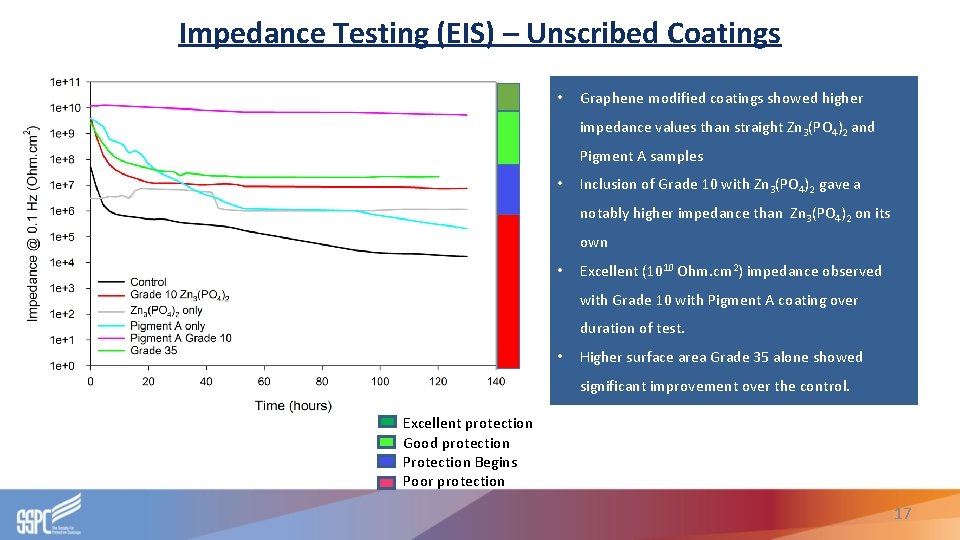
Impedance Testing (EIS) – Unscribed Coatings • Graphene modified coatings showed higher impedance values than straight Zn 3(PO 4)2 and Pigment A samples • Inclusion of Grade 10 with Zn 3(PO 4)2 gave a notably higher impedance than Zn 3(PO 4)2 on its own • Excellent (1010 Ohm. cm 2) impedance observed with Grade 10 with Pigment A coating over duration of test. • Higher surface area Grade 35 alone showed significant improvement over the control. Excellent protection Good protection Protection Begins Poor protection 17
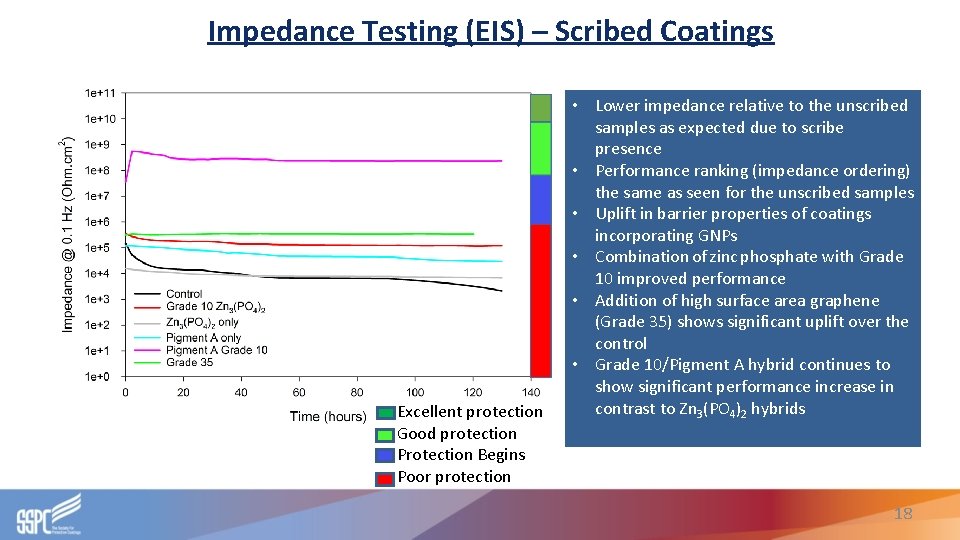
Impedance Testing (EIS) – Scribed Coatings Excellent protection Good protection Protection Begins Poor protection • Lower impedance relative to the unscribed samples as expected due to scribe presence • Performance ranking (impedance ordering) the same as seen for the unscribed samples • Uplift in barrier properties of coatings incorporating GNPs • Combination of zinc phosphate with Grade 10 improved performance • Addition of high surface area graphene (Grade 35) shows significant uplift over the control • Grade 10/Pigment A hybrid continues to show significant performance increase in contrast to Zn 3(PO 4)2 hybrids 18
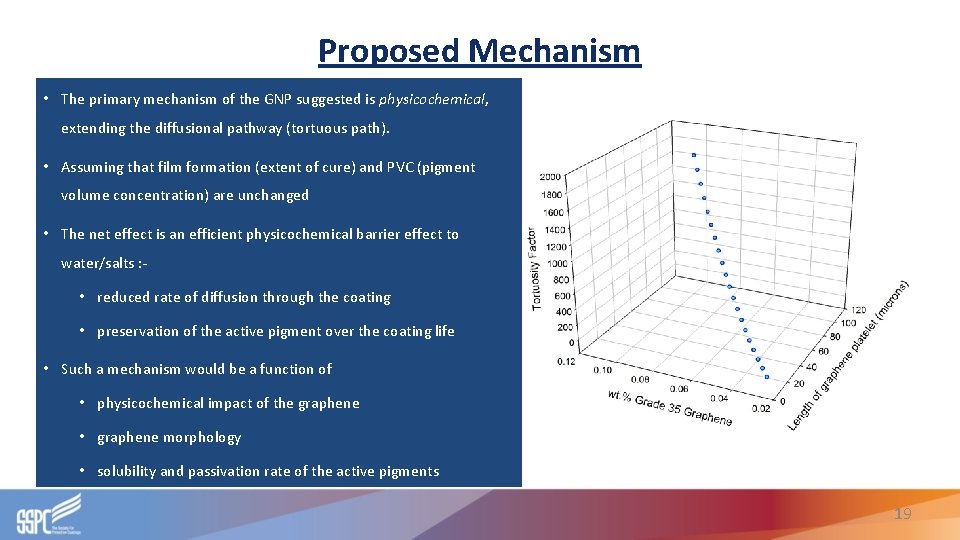
Proposed Mechanism • The primary mechanism of the GNP suggested is physicochemical, extending the diffusional pathway (tortuous path). • Assuming that film formation (extent of cure) and PVC (pigment volume concentration) are unchanged • The net effect is an efficient physicochemical barrier effect to water/salts : - • reduced rate of diffusion through the coating • preservation of the active pigment over the coating life • Such a mechanism would be a function of • physicochemical impact of the graphene • graphene morphology • solubility and passivation rate of the active pigments 19
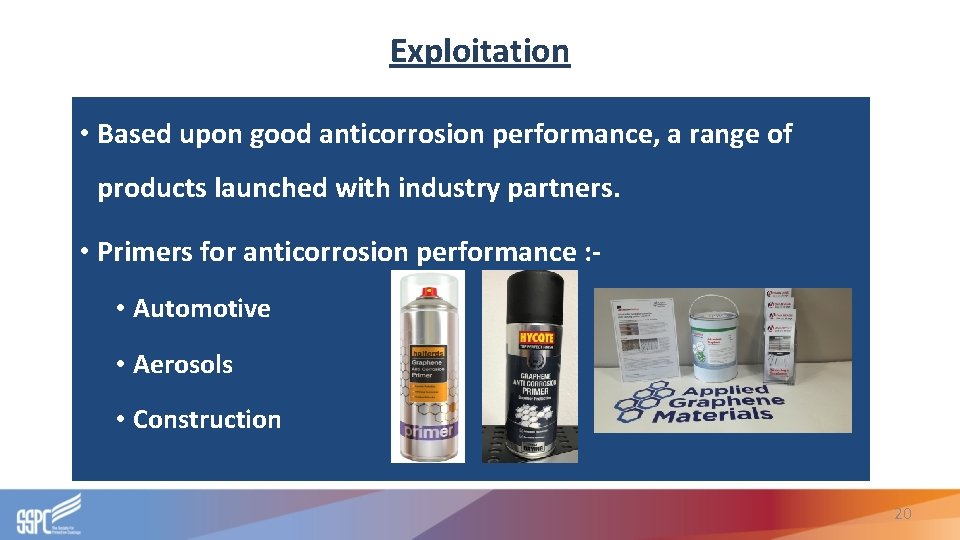
Exploitation • Based upon good anticorrosion performance, a range of products launched with industry partners. • Primers for anticorrosion performance : • Automotive • Aerosols • Construction 20
Extension of Graphene Use into High Corrosivity Environments 21
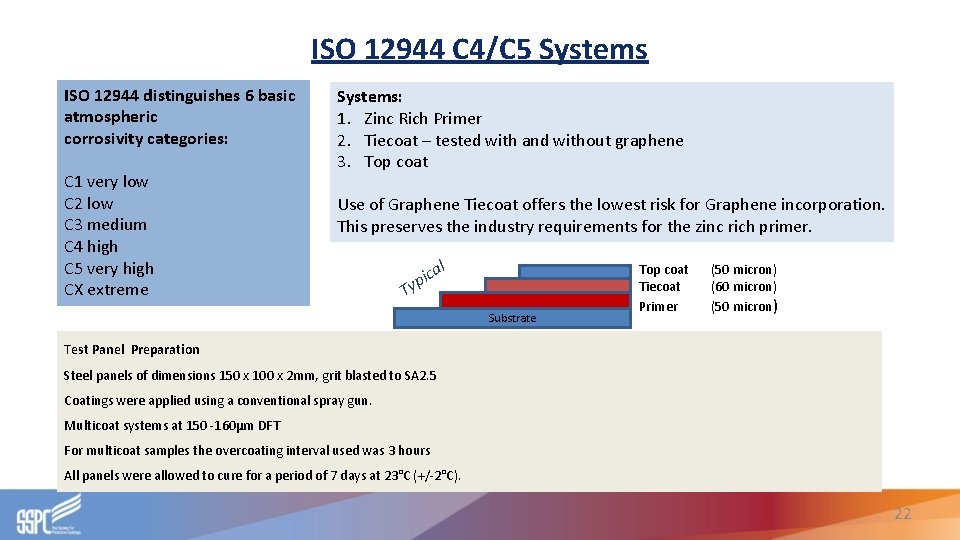
ISO 12944 C 4/C 5 Systems ISO 12944 distinguishes 6 basic atmospheric corrosivity categories: C 1 very low C 2 low C 3 medium C 4 high C 5 very high CX extreme Systems: 1. Zinc Rich Primer 2. Tiecoat – tested with and without graphene 3. Top coat Use of Graphene Tiecoat offers the lowest risk for Graphene incorporation. This preserves the industry requirements for the zinc rich primer. al c i p Ty Substrate Top coat Tiecoat Primer (50 micron) (60 micron) (50 micron) Test Panel Preparation Steel panels of dimensions 150 x 100 x 2 mm, grit blasted to SA 2. 5 Coatings were applied using a conventional spray gun. Multicoat systems at 150 -160µm DFT For multicoat samples the overcoating interval used was 3 hours All panels were allowed to cure for a period of 7 days at 23°C (+/-2°C). 22
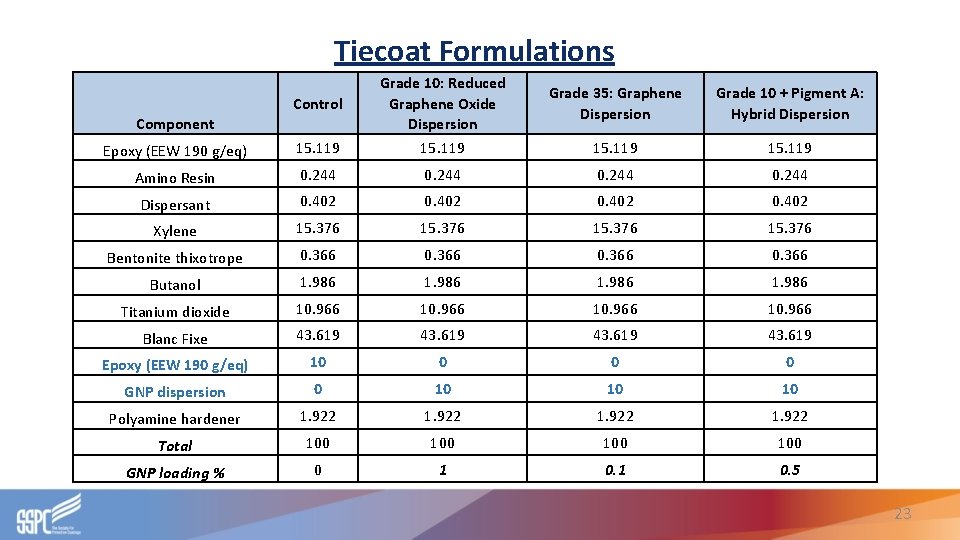
Tiecoat Formulations Epoxy (EEW 190 g/eq) 15. 119 Grade 10: Reduced Graphene Oxide Dispersion 15. 119 Amino Resin 0. 244 Dispersant 0. 402 Xylene 15. 376 Bentonite thixotrope 0. 366 Butanol 1. 986 Titanium dioxide 10. 966 Blanc Fixe 43. 619 Epoxy (EEW 190 g/eq) 10 0 GNP dispersion 0 10 10 10 Polyamine hardener 1. 922 Total 100 100 GNP loading % 0 1 0. 5 Control Component Grade 35: Graphene Dispersion Grade 10 + Pigment A: Hybrid Dispersion 15. 119 23
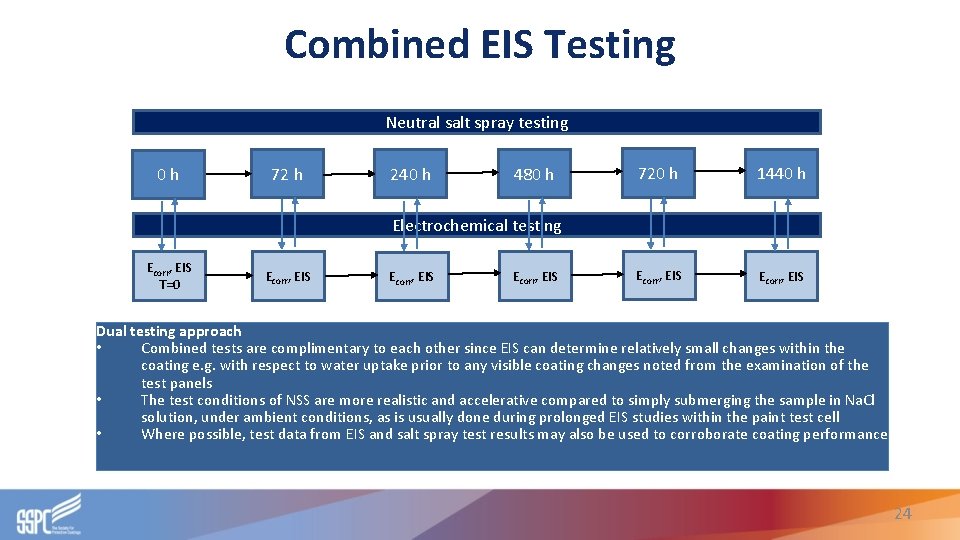
Combined EIS Testing Neutral salt spray testing 0 h 72 h 240 h 480 h 720 h 1440 h Ecorr, EIS Electrochemical testing Ecorr, EIS T=0 Ecorr, EIS Dual testing approach • Combined tests are complimentary to each other since EIS can determine relatively small changes within the coating e. g. with respect to water uptake prior to any visible coating changes noted from the examination of the test panels • The test conditions of NSS are more realistic and accelerative compared to simply submerging the sample in Na. Cl solution, under ambient conditions, as is usually done during prolonged EIS studies within the paint test cell • Where possible, test data from EIS and salt spray test results may also be used to corroborate coating performance 24
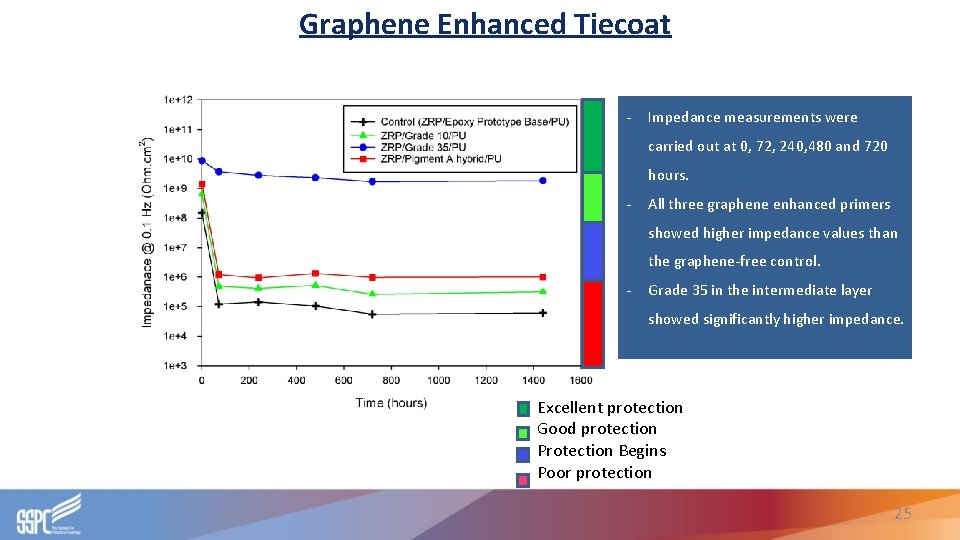
Graphene Enhanced Tiecoat - Impedance measurements were carried out at 0, 72, 240, 480 and 720 hours. - All three graphene enhanced primers showed higher impedance values than the graphene-free control. - Grade 35 in the intermediate layer showed significantly higher impedance. Excellent protection Good protection Protection Begins Poor protection 25
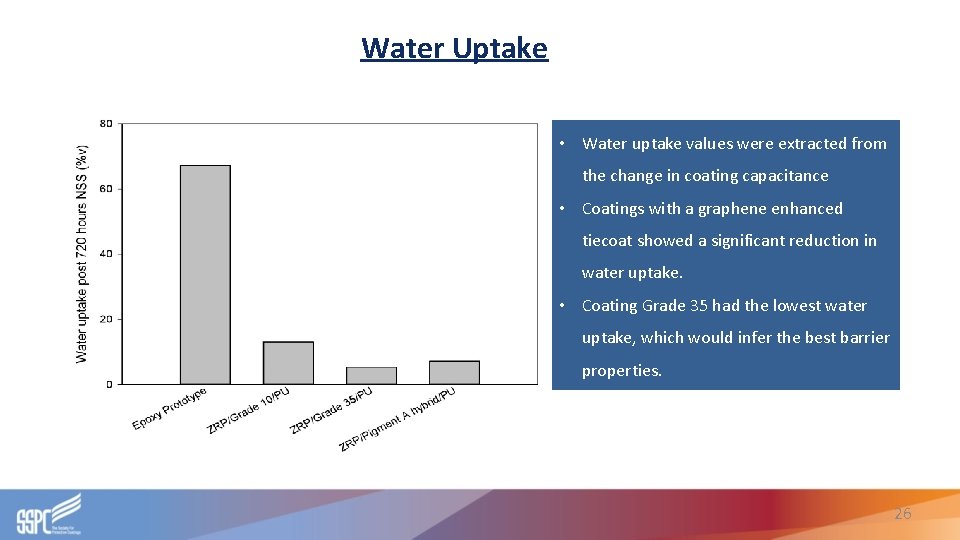
Water Uptake • Water uptake values were extracted from the change in coating capacitance • Coatings with a graphene enhanced tiecoat showed a significant reduction in water uptake. • Coating Grade 35 had the lowest water uptake, which would infer the best barrier properties. 26
Graphene Enhanced Tiecoat • After 1440 hours (C 5 High testing requirement), the 3 coat systems showed no signs of blistering or corrosion development. • The inclusion of graphene in the tiecoat resulted in improved barrier properties, evidenced by a reduction in water uptake and impedance values higher than the control. • The combination of improved barrier protection offered by the graphene enhanced tiecoat combined with the sacrificial protection offered by the zinc rich primer is expected to further extend coating lifetime. • Particularly high impedance values were observed with the use of Grade 35 as a 2 nd Coat. This is likely an effect of the enhanced barrier properties in the tiecoat as demonstrated by the water uptake results. • EIS data was able to differentiate between systems even though there was no visual difference. 27
Further Work 28
Further Work • CX Environments • Ballast tank coatings • Universal primer systems • Suitable for full immersion • Waterbased developments • To meet ongoing VOC legislative pressure • Waterbased DTM coating based on acrylic alkyd system • Primer based on epoxy / amine technology 29
Summary - Graphene dispersions enable - Ease of use and incorporation - Minimised health and safety issues – encapsulated nanoplatelets - The use of graphene dispersions has shown significant and repeatable improvements in anticorrosive performance, as demonstrated through Salt Spray, EIS Testing and Water Vapor Transmission Rate Tests. - Improvements have been seen in single primer coats applied direct to the substrate and are translated into multilayer systems. - Grade 35 graphene based coating showed exceptional performance on EIS and is expected to show extended system performance. - It is likely that the combination of the sacrificial zinc rich layer and the barrier protection from the graphene enhanced coatings gives extended coating durability and lifetime. 30
Further info • • • Email contact info adrian. potts@appliedgraphenematerials. com lynn. chikosha@appliedgraphenematerials. com • • General info www. appliedgraphenematerials. com • • Technical Application info https: //www. appliedgraphenematerials. com/applications/paints-andcoatings/ 31