
Graph Theory Topological Analysis Terms Topological Analysis General
- Slides: 19
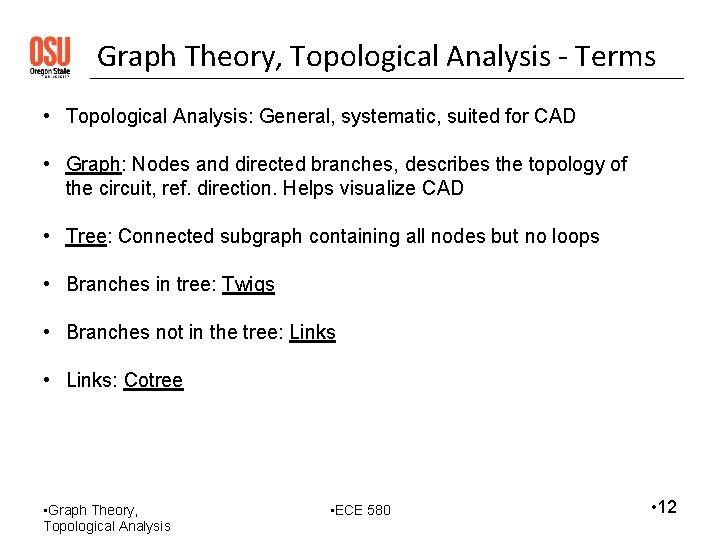
Graph Theory, Topological Analysis - Terms • Topological Analysis: General, systematic, suited for CAD • Graph: Nodes and directed branches, describes the topology of the circuit, ref. direction. Helps visualize CAD • Tree: Connected subgraph containing all nodes but no loops • Branches in tree: Twigs • Branches not in the tree: Links • Links: Cotree • Graph Theory, Topological Analysis • ECE 580 • 12
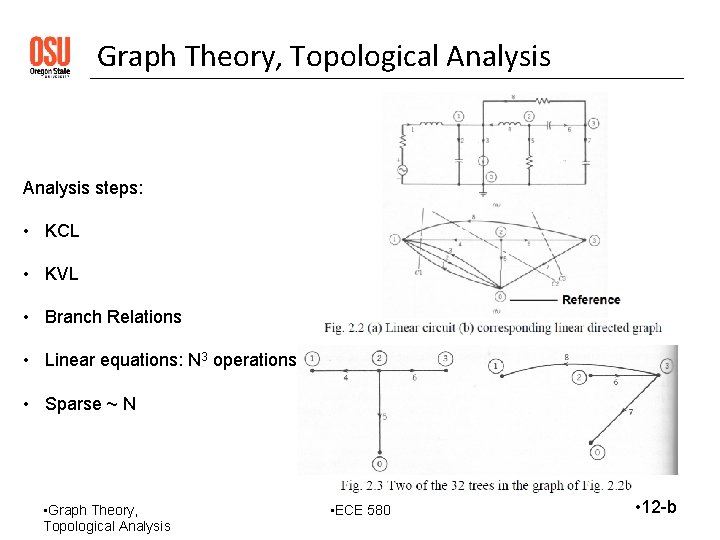
Graph Theory, Topological Analysis steps: • KCL • KVL • Branch Relations • Linear equations: N 3 operations • Sparse ~ N • Graph Theory, Topological Analysis • ECE 580 • 12 -b
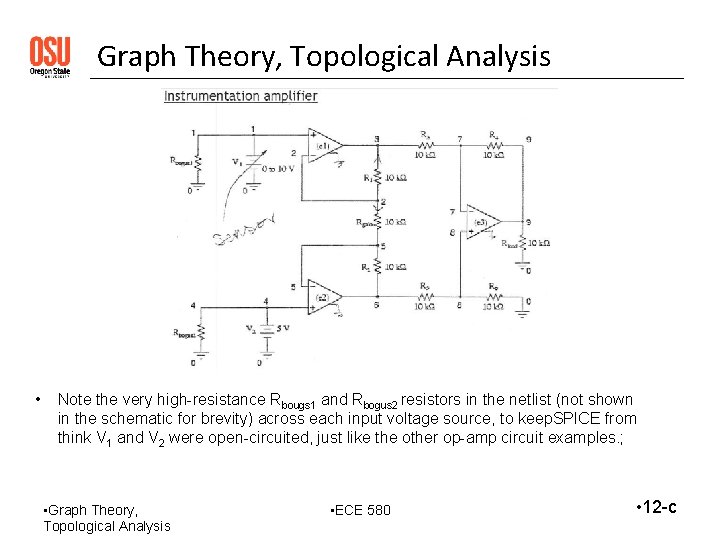
Graph Theory, Topological Analysis • Note the very high-resistance Rbougs 1 and Rbogus 2 resistors in the netlist (not shown in the schematic for brevity) across each input voltage source, to keep. SPICE from think V 1 and V 2 were open-circuited, just like the other op-amp circuit examples. ; • Graph Theory, Topological Analysis • ECE 580 • 12 -c
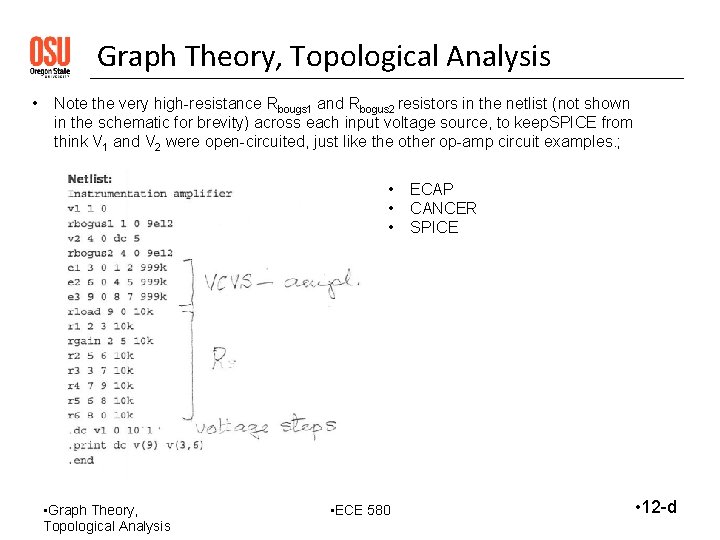
Graph Theory, Topological Analysis • Note the very high-resistance Rbougs 1 and Rbogus 2 resistors in the netlist (not shown in the schematic for brevity) across each input voltage source, to keep. SPICE from think V 1 and V 2 were open-circuited, just like the other op-amp circuit examples. ; • • Graph Theory, Topological Analysis • ECE 580 ECAP CANCER SPICE • 12 -d
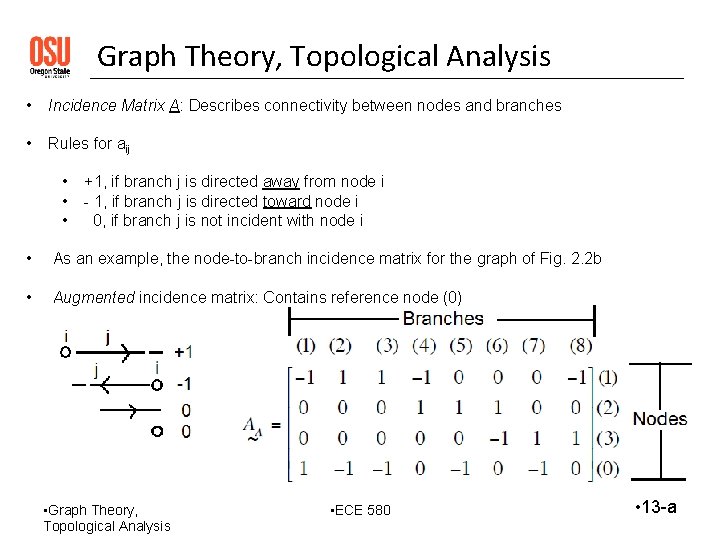
Graph Theory, Topological Analysis • Incidence Matrix A: Describes connectivity between nodes and branches • Rules for aij • • • +1, if branch j is directed away from node i - 1, if branch j is directed toward node i 0, if branch j is not incident with node i • As an example, the node-to-branch incidence matrix for the graph of Fig. 2. 2 b • Augmented incidence matrix: Contains reference node (0) • Graph Theory, Topological Analysis • ECE 580 • 13 -a
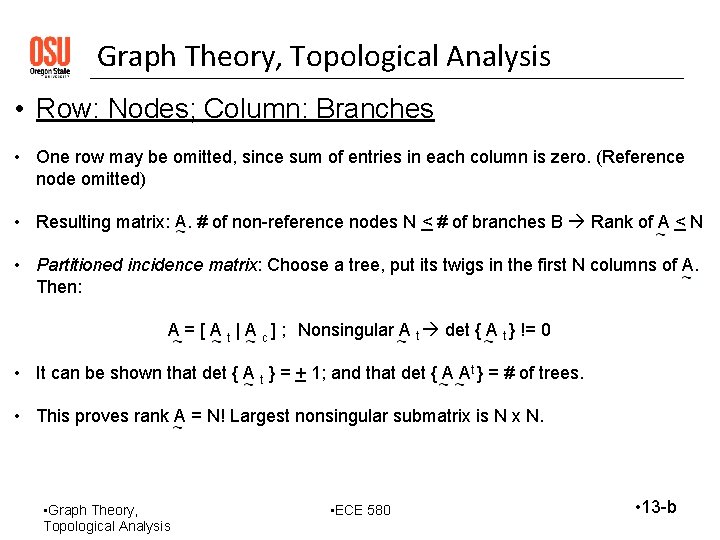
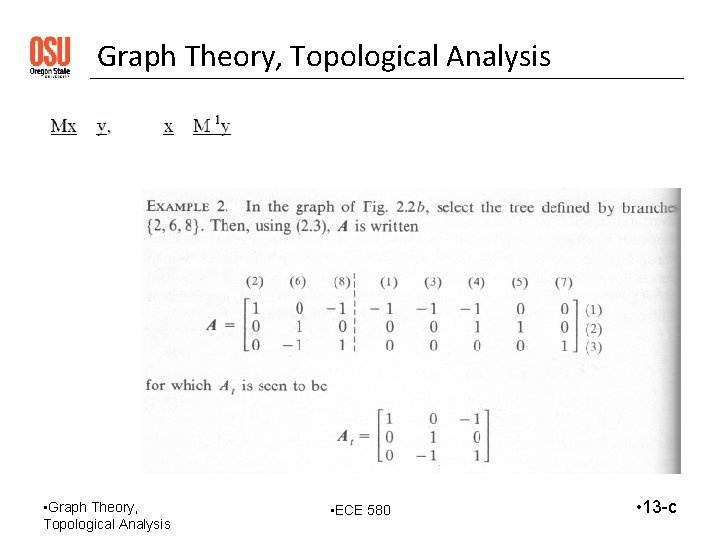
Graph Theory, Topological Analysis • Row: Nodes; Column: Branches • One row may be omitted, since sum of entries in each column is zero. (Reference node omitted) • Resulting matrix: A. # of non-reference nodes N < # of branches B Rank of A < N • Partitioned incidence matrix: Choose a tree, put its twigs in the first N columns of A. Then: A = [ A t | A c ] ; Nonsingular A t det { A t } != 0 • It can be shown that det { A t } = + 1; and that det { A At } = # of trees. • This proves rank A = N! Largest nonsingular submatrix is N x N. • Graph Theory, Topological Analysis • ECE 580 • 13 -b
Graph Theory, Topological Analysis • ECE 580 • 13 -c
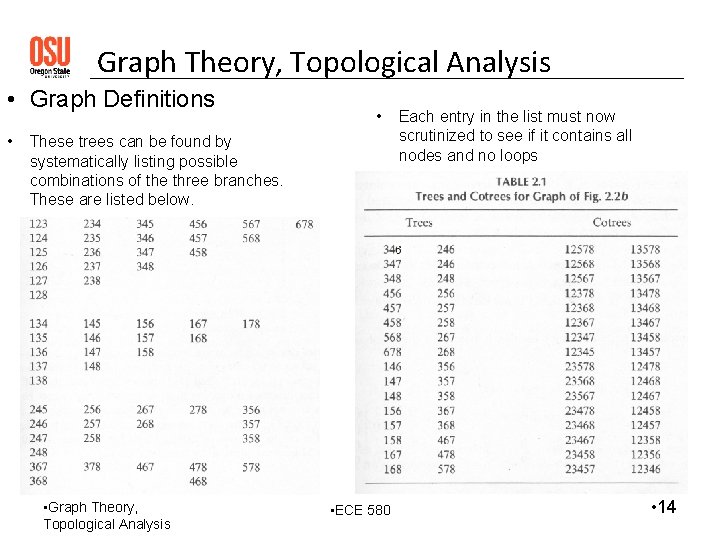
Graph Theory, Topological Analysis • Graph Definitions • • These trees can be found by systematically listing possible combinations of the three branches. These are listed below. • Graph Theory, Topological Analysis • ECE 580 Each entry in the list must now scrutinized to see if it contains all nodes and no loops • 14
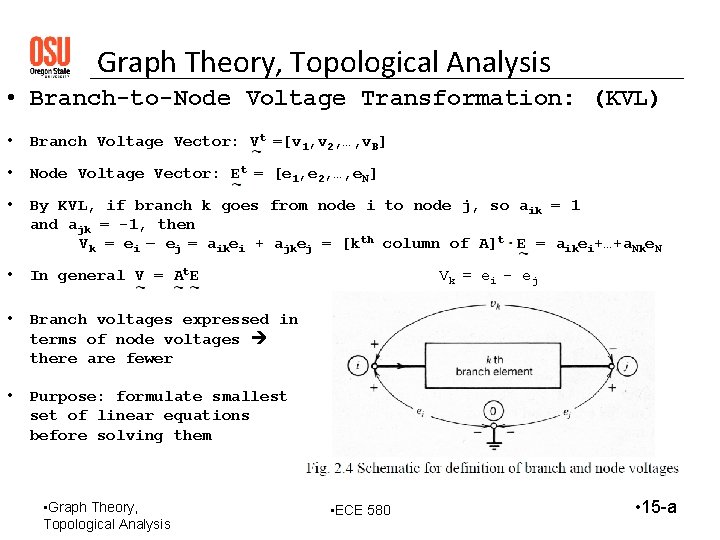
Graph Theory, Topological Analysis • Branch-to-Node Voltage Transformation: (KVL) • Branch Voltage Vector: Vt =[v 1, v 2, …, v. B] • Node Voltage Vector: Et = [e 1, e 2, …, e. N] • By KVL, if branch k goes from node i to node j, so aik = 1 and ajk = -1, then Vk = ei – ej = aikei + ajkej = [kth column of A]t E = aikei+…+a. Nke. N • In general V = At. E • Branch voltages expressed in terms of node voltages there are fewer • Purpose: formulate smallest set of linear equations before solving them • Graph Theory, Topological Analysis Vk = e i - e j • ECE 580 • 15 -a
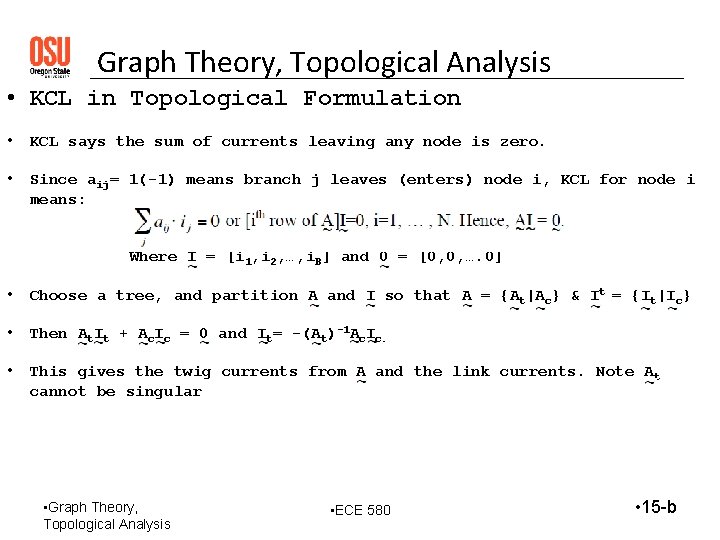
Graph Theory, Topological Analysis • KCL in Topological Formulation • KCL says the sum of currents leaving any node is zero. • Since aij= 1(-1) means branch j leaves (enters) node i, KCL for node i means: Where I = [i 1, i 2, …, i. B] and 0 = [0, 0, …. 0] • Choose a tree, and partition A and I so that A = {At|Ac} & It = {It|Ic} • Then At. It + Ac. Ic = 0 and It= -(At)-1 Ac. Ic. • This gives the twig currents from A and the link currents. Note At cannot be singular • Graph Theory, Topological Analysis • ECE 580 • 15 -b
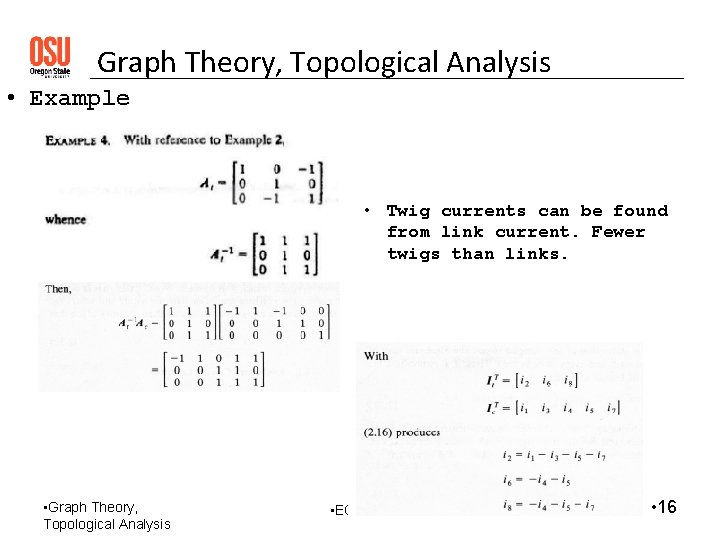
Graph Theory, Topological Analysis • Example • Twig currents can be found from link current. Fewer twigs than links. • Graph Theory, Topological Analysis • ECE 580 • 16
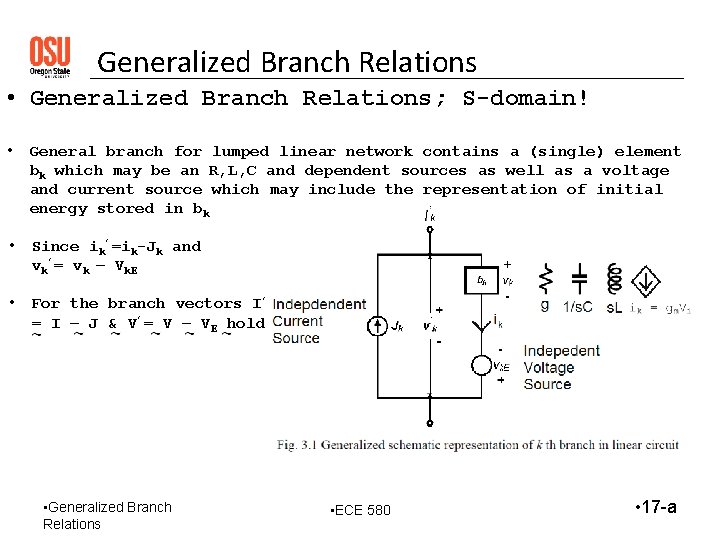
Generalized Branch Relations • Generalized Branch Relations; S-domain! • General branch for lumped linear network contains a (single) element bk which may be an R, L, C and dependent sources as well as a voltage and current source which may include the representation of initial energy stored in bk • Since ik’=ik-Jk and vk’= vk – Vk. E • For the branch vectors I’ = I – J & V’= V – VE hold • Generalized Branch Relations • ECE 580 • 17 -a
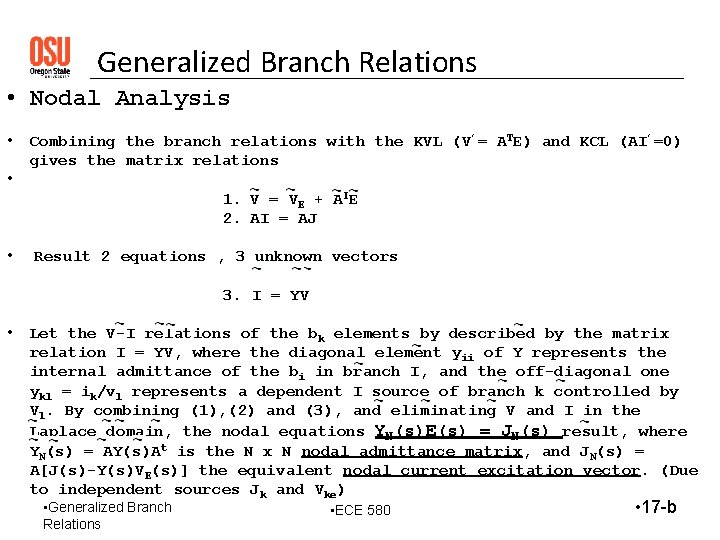
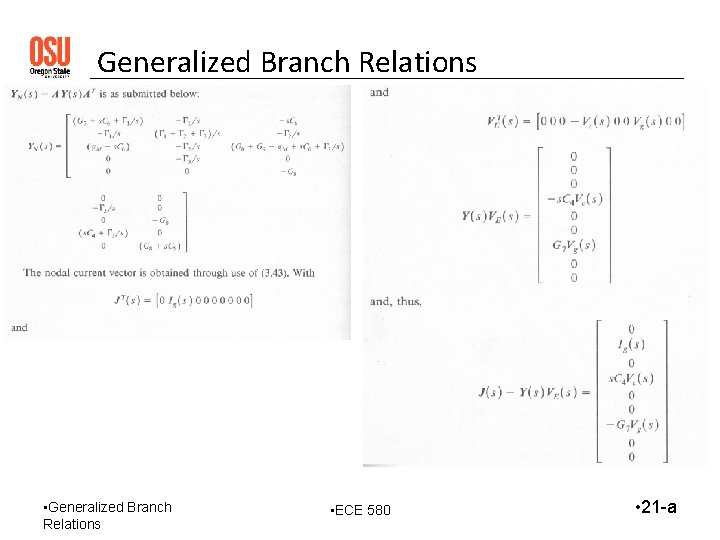
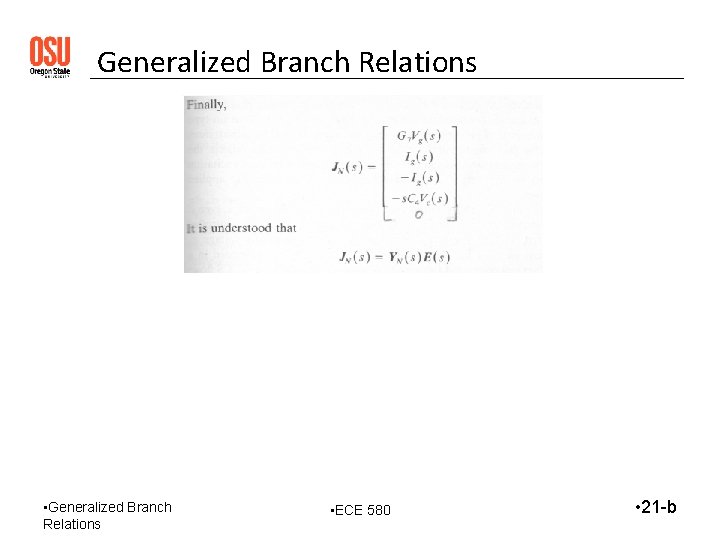
Generalized Branch Relations • Nodal Analysis • • Combining the branch relations with the KVL (V’= ATE) and KCL (AI’=0) gives the matrix relations 1. V = VE + ATE 2. AI = AJ • Result 2 equations , 3 unknown vectors 3. I = YV • Let the V-I relations of the bk elements by described by the matrix relation I = YV, where the diagonal element yii of Y represents the internal admittance of the bi in branch I, and the off-diagonal one ykl = ik/vl represents a dependent I source of branch k controlled by Vl. By combining (1), (2) and (3), and eliminating V and I in the Laplace domain, the nodal equations YN(s)E(s) = JN(s) result, where YN(s) = AY(s)At is the N x N nodal admittance matrix, and JN(s) = A[J(s)-Y(s)VE(s)] the equivalent nodal current excitation vector. (Due to independent sources Jk and Vke) • Generalized Branch Relations • ECE 580 • 17 -b
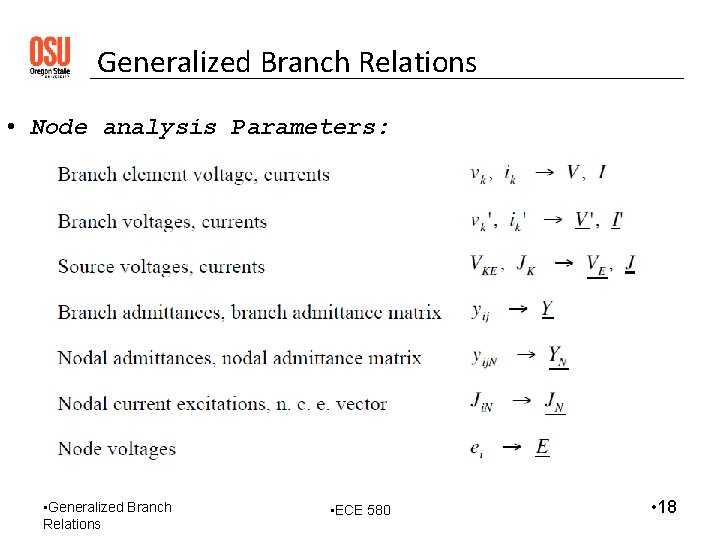
Generalized Branch Relations • Node analysis Parameters: • Generalized Branch Relations • ECE 580 • 18
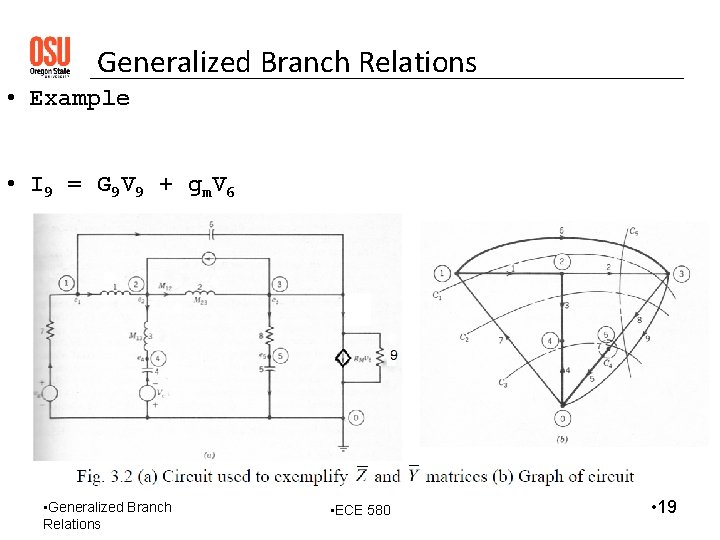
Generalized Branch Relations • Example • I 9 = G 9 V 9 + g m. V 6 • Generalized Branch Relations • ECE 580 • 19
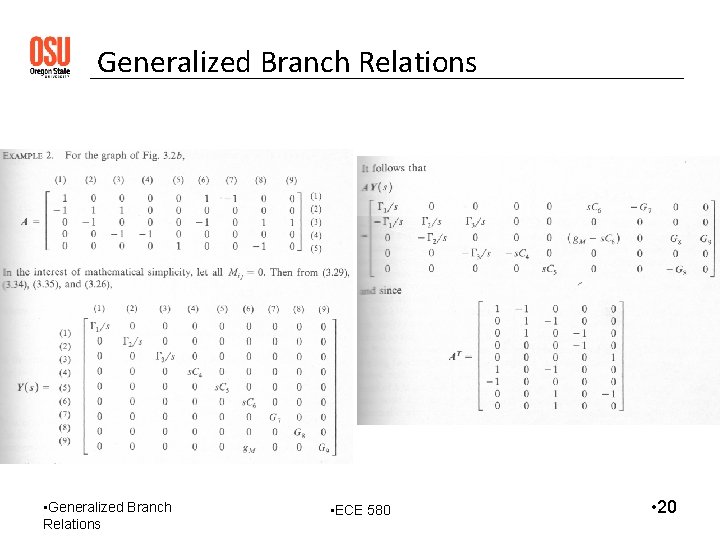
Generalized Branch Relations • ECE 580 • 20
Generalized Branch Relations • ECE 580 • 21 -a
Generalized Branch Relations • ECE 580 • 21 -b
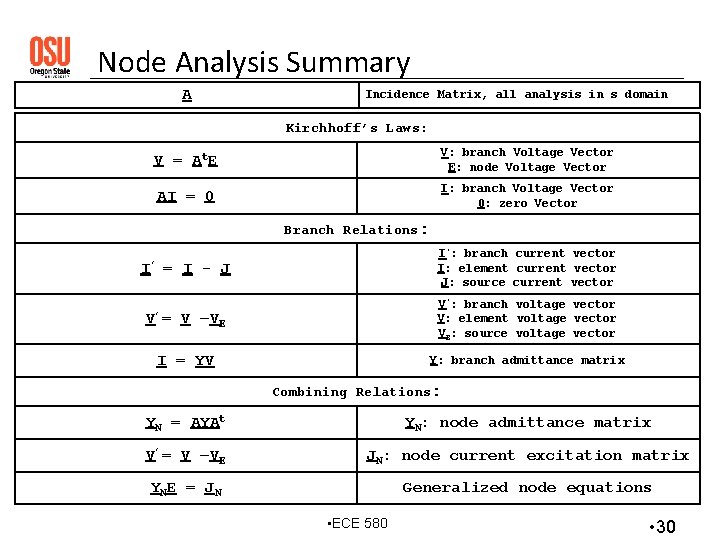
Node Analysis Summary A Incidence Matrix, all analysis in s domain Kirchhoff’s Laws: V = At E V: branch Voltage Vector E: node Voltage Vector AI = 0 I: branch Voltage Vector 0: zero Vector Branch Relations: I’: branch current vector I: element current vector J: source current vector I’ = I - J V’ = V’: branch voltage vector V: element voltage vector VE: source voltage vector V –VE I = YV Y: branch admittance matrix Combining Relations: YN = AYAt YN: node admittance matrix V’= V –VE JN: node current excitation matrix YN E = JN Generalized node equations • ECE 580 • 30