
Graph Theory Essentials Social Network Analysis Lecture 02



- Slides: 28
Graph Theory Essentials Social Network Analysis, Lecture 02 E&K Ch 2. 1 -2. 4 AAIT ITSC Instructor: Dr. Sunkari
Outline • (Review) Syllabus • Graph Theory & Metrics • Basics • Node degree • Paths & distance • Components
Graph, Node, Edge, Adjacency Matrix, Directed, Undirected, Weighted GRAPH THEORY BASICS
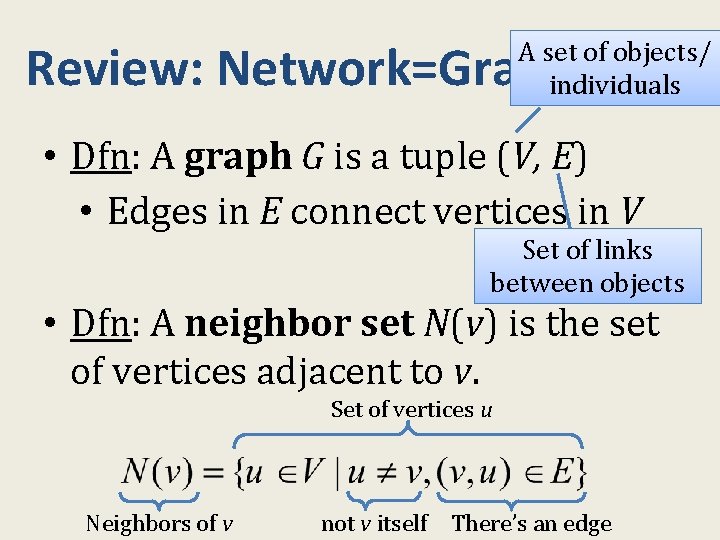
Review: Network=Graph A set of objects/ individuals • Dfn: A graph G is a tuple (V, E) • Edges in E connect vertices in V Set of links between objects • Dfn: A neighbor set N(v) is the set of vertices adjacent to v. Set of vertices u Neighbors of v not v itself There’s an edge
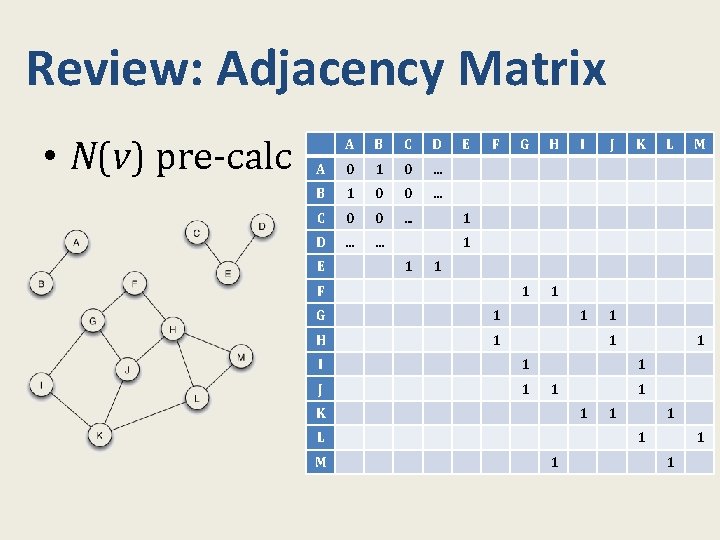
Review: Adjacency Matrix • N(v) pre-calc A B C D A 0 1 0 … B 1 0 0 … C 0 0 . . . D … … E E F G H 1 1 J 1 1 K L M 1 1 F G 1 H 1 1 I 1 J 1 1 K 1 1 L M I 1 1 1
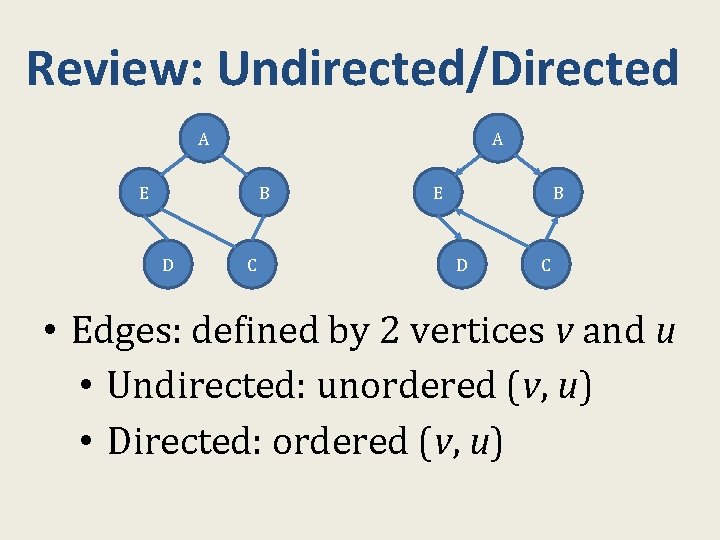
Review: Undirected/Directed A A E B D C • Edges: defined by 2 vertices v and u • Undirected: unordered (v, u) • Directed: ordered (v, u)
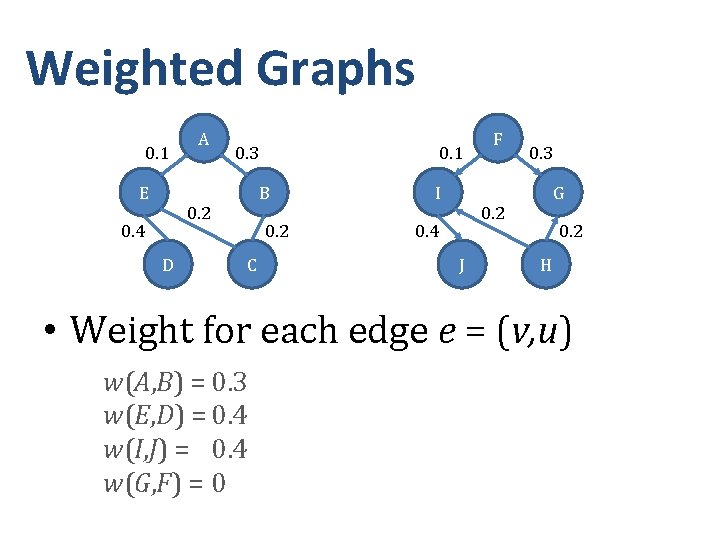
Weighted Graphs 0. 1 E A 0. 3 B 0. 2 0. 4 D 0. 1 0. 2 C I F 0. 3 G 0. 2 0. 4 J 0. 2 H • Weight for each edge e = (v, u) w(A, B) = 0. 3 w(E, D) = 0. 4 w(I, J) = 0. 4 w(G, F) = 0
Node degree, In- and Out-degree, Degree distribution, average degree, connectance, sparse, dense NODE DEGREE
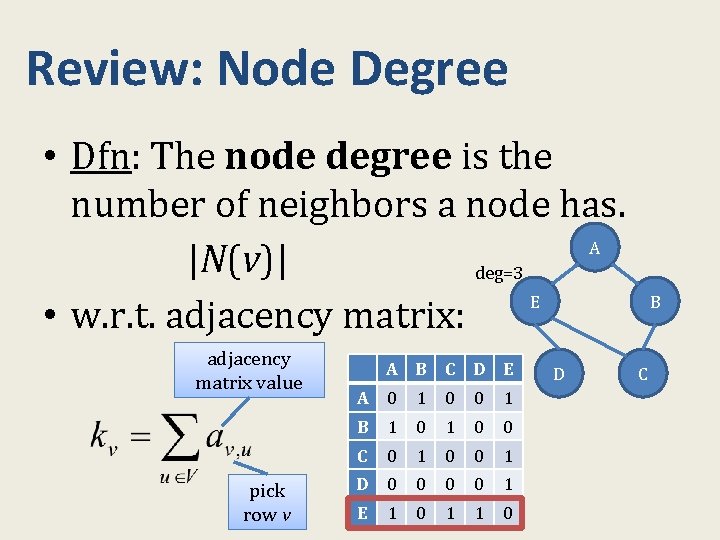
Review: Node Degree • Dfn: The node degree is the number of neighbors a node has. A |N(v)| deg=3 E • w. r. t. adjacency matrix: adjacency matrix value pick row v A B C D E A 0 1 0 0 1 B 1 0 0 C 0 1 0 0 1 D 0 0 1 E 0 1 1 0 1 D B C
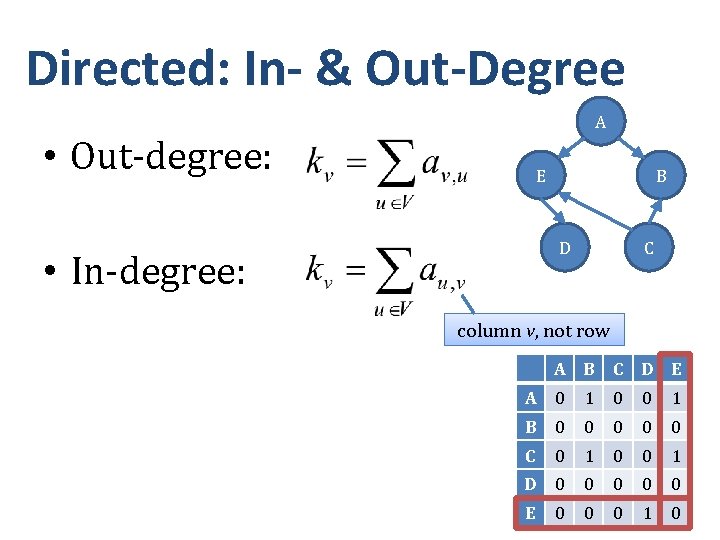
Directed: In- & Out-Degree A • Out-degree: E B D • In-degree: C column v, not row A B C D E A 0 1 0 0 1 B 0 0 0 C 0 1 0 0 1 D 0 0 0 E 0 0 1 0 0
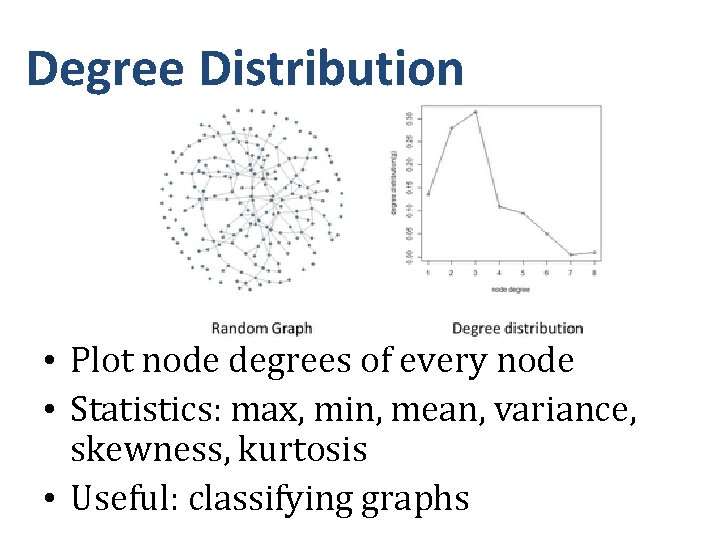
Degree Distribution • Plot node degrees of every node • Statistics: max, min, mean, variance, skewness, kurtosis • Useful: classifying graphs
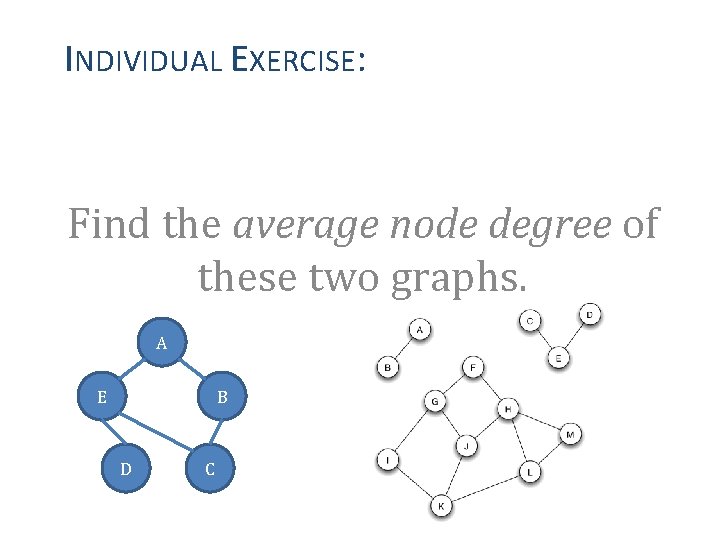
INDIVIDUAL EXERCISE: Find the average node degree of these two graphs. A E B D C
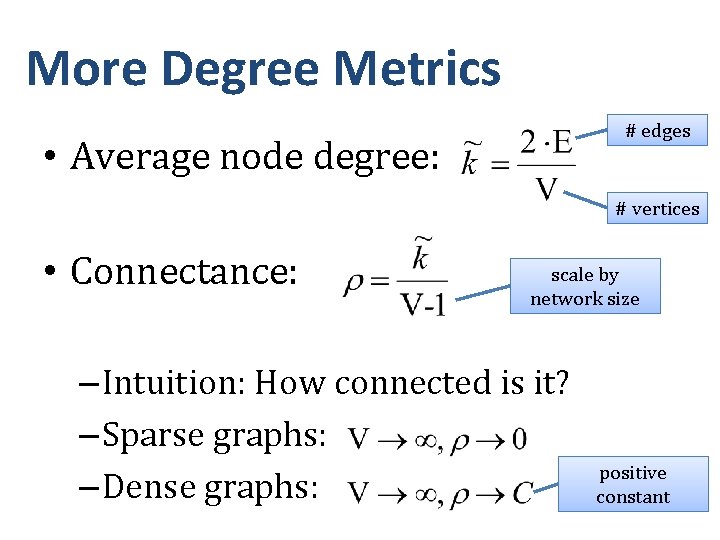
More Degree Metrics # edges • Average node degree: # vertices • Connectance: scale by network size – Intuition: How connected is it? – Sparse graphs: – Dense graphs: positive constant
Paths, cycles, distance, breadth-first search, small world phenomenon, characteristic path length, graph efficiency PATHS AND DISTANCE
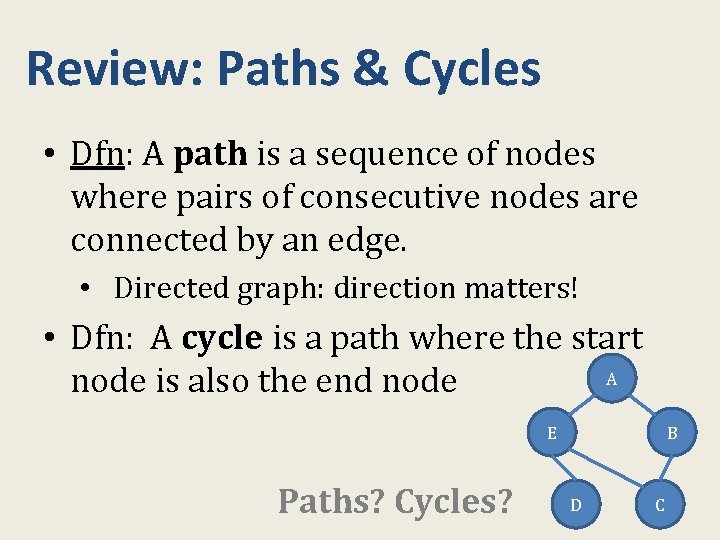
Review: Paths & Cycles • Dfn: A path is a sequence of nodes where pairs of consecutive nodes are connected by an edge. • Directed graph: direction matters! • Dfn: A cycle is a path where the start A node is also the end node E Paths? Cycles? B D C
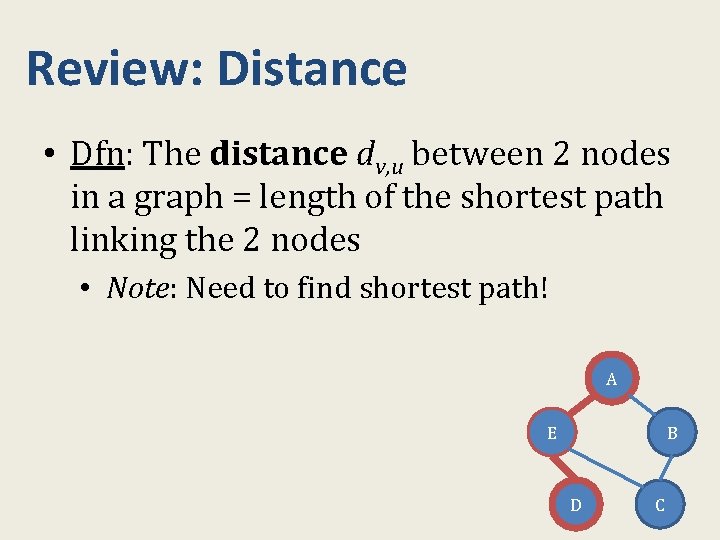
Review: Distance • Dfn: The distance dv, u between 2 nodes in a graph = length of the shortest path linking the 2 nodes • Note: Need to find shortest path! A E B D C
THINK-PAIR-SHARE: How would you calculate the average distance from a node?
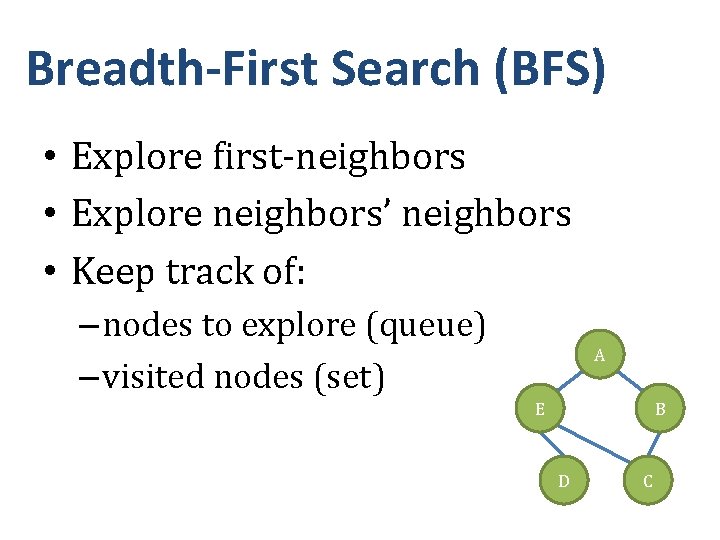
Breadth-First Search (BFS) • Explore first-neighbors • Explore neighbors’ neighbors • Keep track of: – nodes to explore (queue) – visited nodes (set) A E B D C
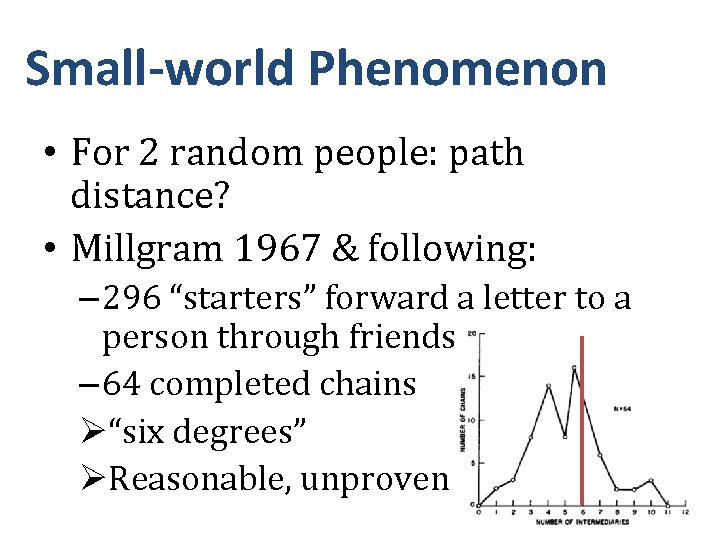
Small-world Phenomenon • For 2 random people: path distance? • Millgram 1967 & following: – 296 “starters” forward a letter to a person through friends – 64 completed chains Ø“six degrees” ØReasonable, unproven
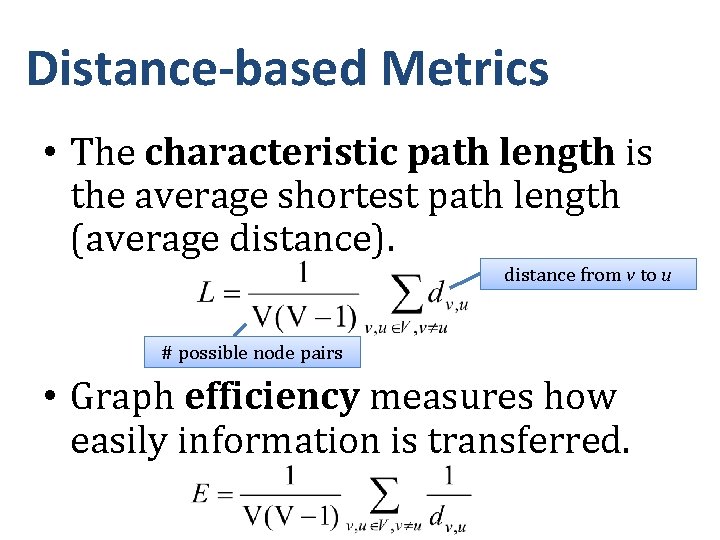
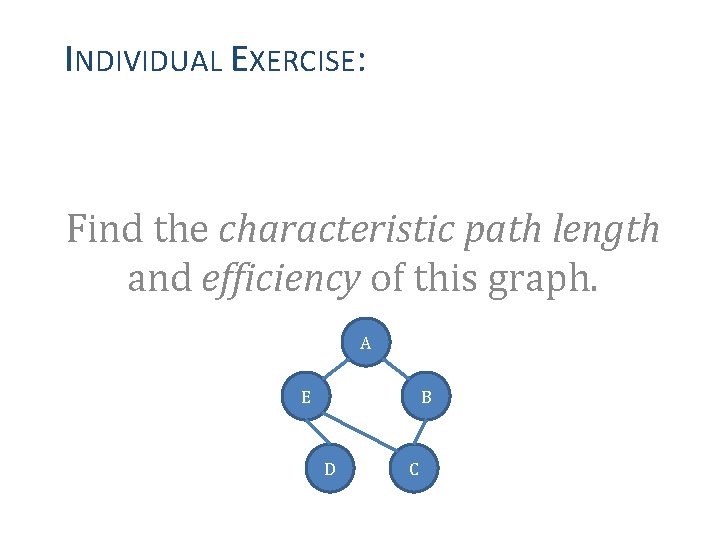
Distance-based Metrics • The characteristic path length is the average shortest path length (average distance). distance from v to u # possible node pairs • Graph efficiency measures how easily information is transferred.
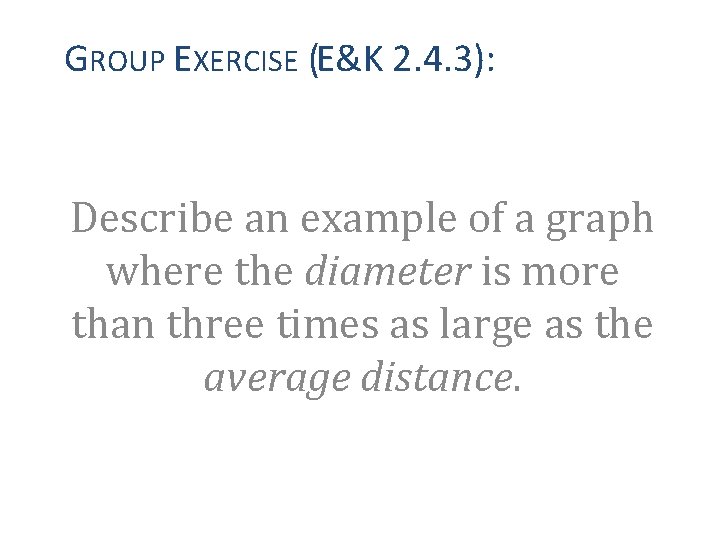
GROUP EXERCISE (E&K 2. 4. 3): Describe an example of a graph where the diameter is more than three times as large as the average distance.
Connectedness, component, giant component COMPONENTS
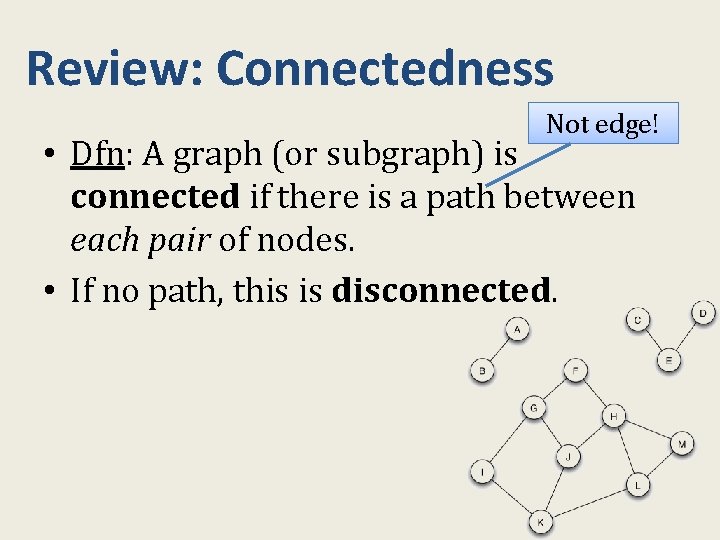
Review: Connectedness Not edge! • Dfn: A graph (or subgraph) is connected if there is a path between each pair of nodes. • If no path, this is disconnected.
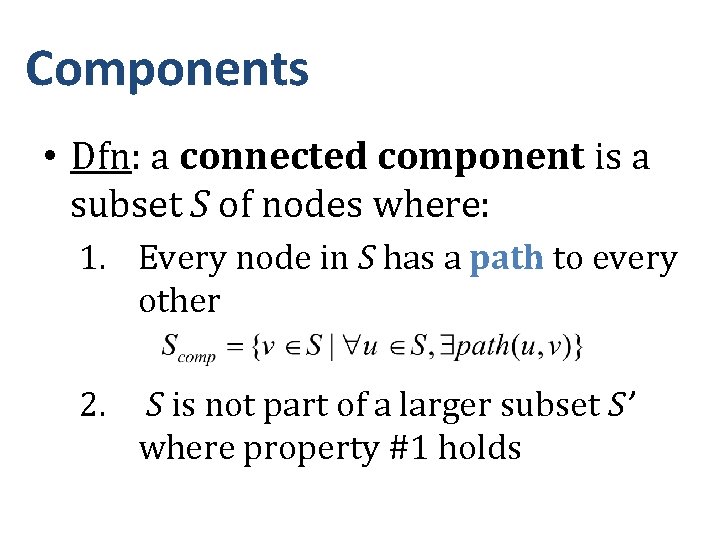
Components • Dfn: a connected component is a subset S of nodes where: 1. Every node in S has a path to every other 2. S is not part of a larger subset S’ where property #1 holds
Giant Components • A giant component: “connected component that contains a significant fraction of all the nodes” • Ex: Real-world • Ex: Random graphs (Erdos-Renyi model – more later)
INDIVIDUAL EXERCISE: Find the characteristic path length and efficiency of this graph. A E B D C
GROUP EXERCISE (E&K 2. 4. 1): A node X is pivotal for a pair of distinct nodes Y and Z if X lies on every shortest path between Y and Z (and X is not equal to either Y or Z). Give an example of a graph in which every node is pivotal for at least two different pairs of nodes. Explain your answer.
GROUP EXERCISE (E&K 2. 4. 2): A node X is a gatekeeper if for some other two nodes Y and Z, every path from Y to Z passes through X. A node X is a local gatekeeper if there are two neighbors of X, say Y and Z, that are not connected by an edge. Give an example (together with an explanation) of a graph in which more than half of all nodes are gatekeepers.