
Graph Theory and Management Science Hamilton Graphs and

- Slides: 23
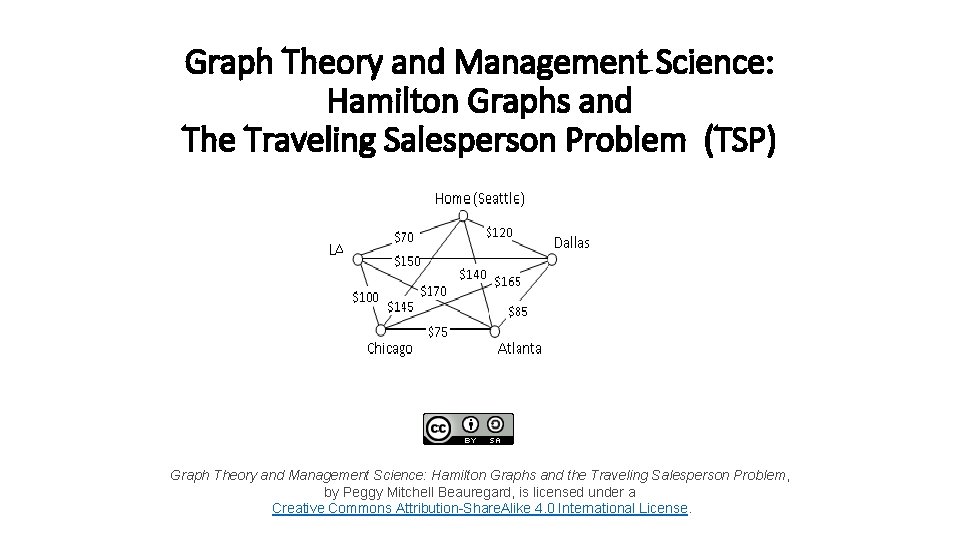
Graph Theory and Management Science: Hamilton Graphs and The Traveling Salesperson Problem (TSP) Graph Theory and Management Science: Hamilton Graphs and the Traveling Salesperson Problem, by Peggy Mitchell Beauregard, is licensed under a Creative Commons Attribution-Share. Alike 4. 0 International License.
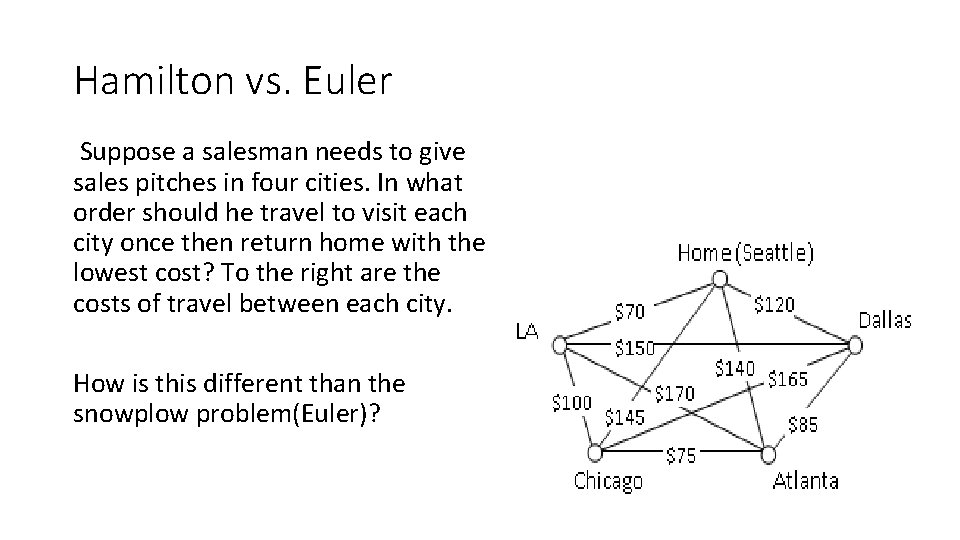
Hamilton vs. Euler Suppose a salesman needs to give sales pitches in four cities. In what order should he travel to visit each city once then return home with the lowest cost? To the right are the costs of travel between each city. How is this different than the snowplow problem(Euler)?
The difference between Euler and Hamilton: Euler covers every EDGE in a graph exactly once. Vertices may be visited more than once. • Snowplow • Security guard • Postman Hamilton visits every VERTEX in a graph exactly once. We do not need to use all the edges • • TSP UPS School bus stops Errands! Whether Hamilton paths/circuits exist has nothing to do with the existence of Euler paths/circuits.
Hamilton Tours…a few ground rules… For simplicity, we will use complete graphs for our Hamilton Problems (each vertex is connected to each other vertex by an edge. ) Hamilton graphs are weighted. The numbers may stand for distance, time, cost…. We are looking for an optimal tour: The Hamilton circuit of least total cost.
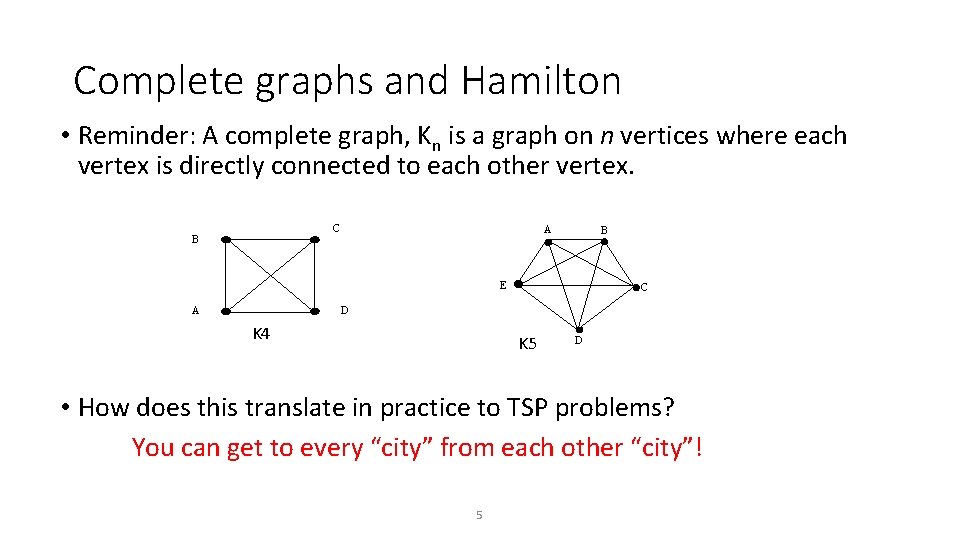
Complete graphs and Hamilton • Reminder: A complete graph, Kn is a graph on n vertices where each vertex is directly connected to each other vertex. C B A B E A C D K 4 K 5 D • How does this translate in practice to TSP problems? You can get to every “city” from each other “city”! 5
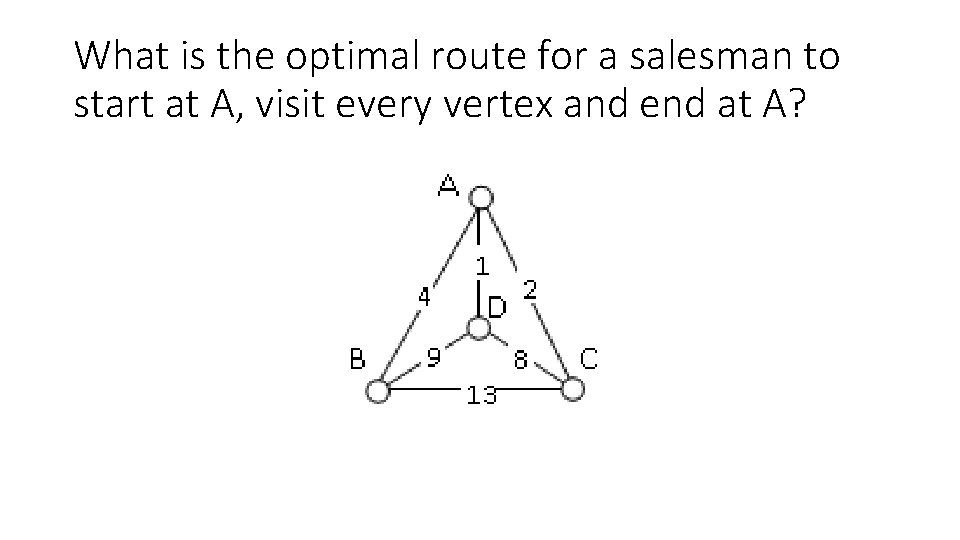
What is the optimal route for a salesman to start at A, visit every vertex and end at A?
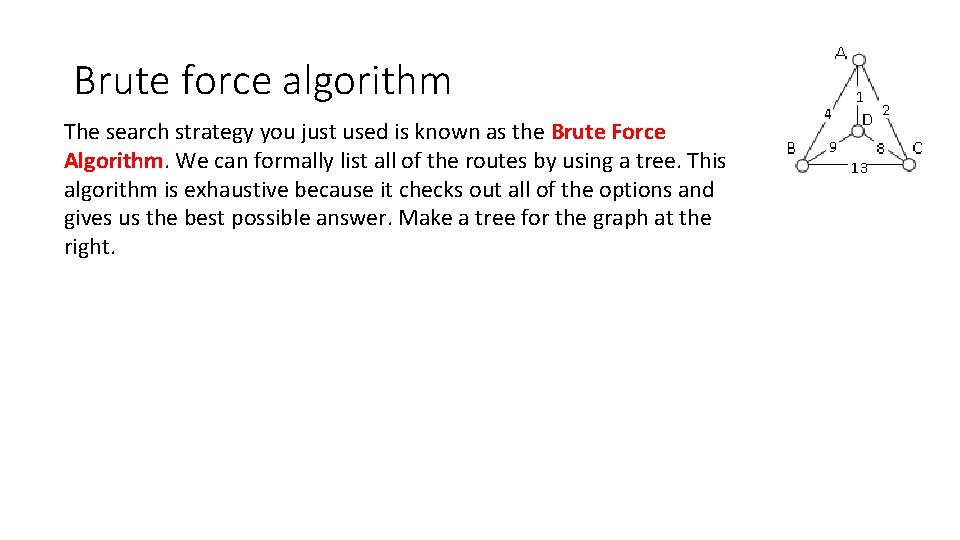
Brute force algorithm The search strategy you just used is known as the Brute Force Algorithm. We can formally list all of the routes by using a tree. This algorithm is exhaustive because it checks out all of the options and gives us the best possible answer. Make a tree for the graph at the right.
Brute Force Algorithm (a. k. a. exhaustive search) • List all possible Hamilton circuits (in a tree diagram) • Find the length of each circuit by adding the edge weights • Select the circuit with minimal total weight. * Note: For a Hamilton Circuit, half of the circuits are reverse of others. They result in the same weights and only have to be calculated once…This cuts our calculations for Hamilton circuits in half!
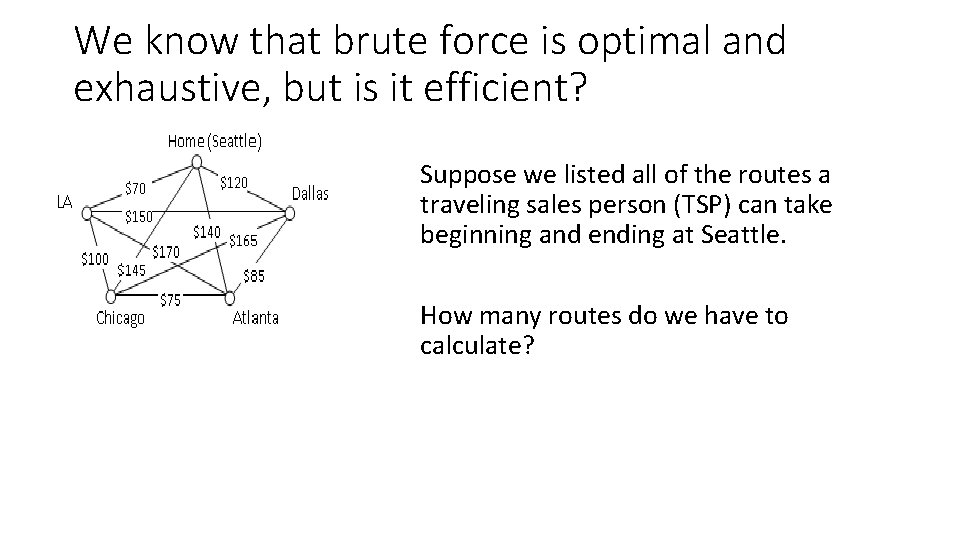
We know that brute force is optimal and exhaustive, but is it efficient? Suppose we listed all of the routes a traveling sales person (TSP) can take beginning and ending at Seattle. How many routes do we have to calculate?
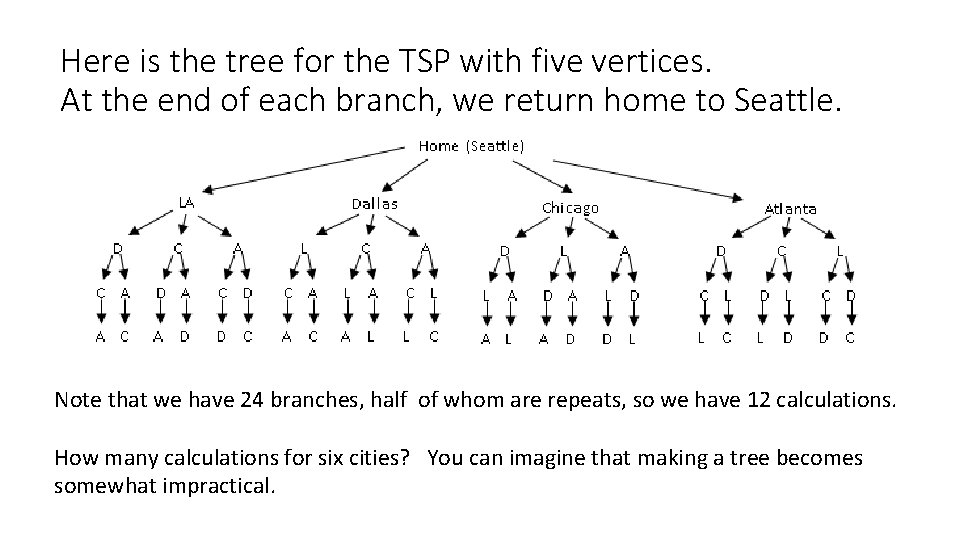
Here is the tree for the TSP with five vertices. At the end of each branch, we return home to Seattle. Note that we have 24 branches, half of whom are repeats, so we have 12 calculations. How many calculations for six cities? You can imagine that making a tree becomes somewhat impractical.
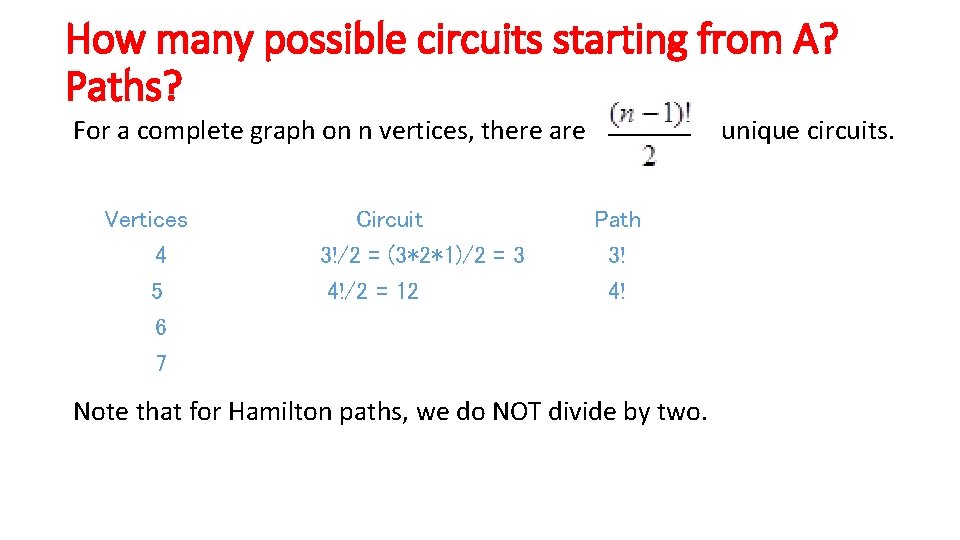
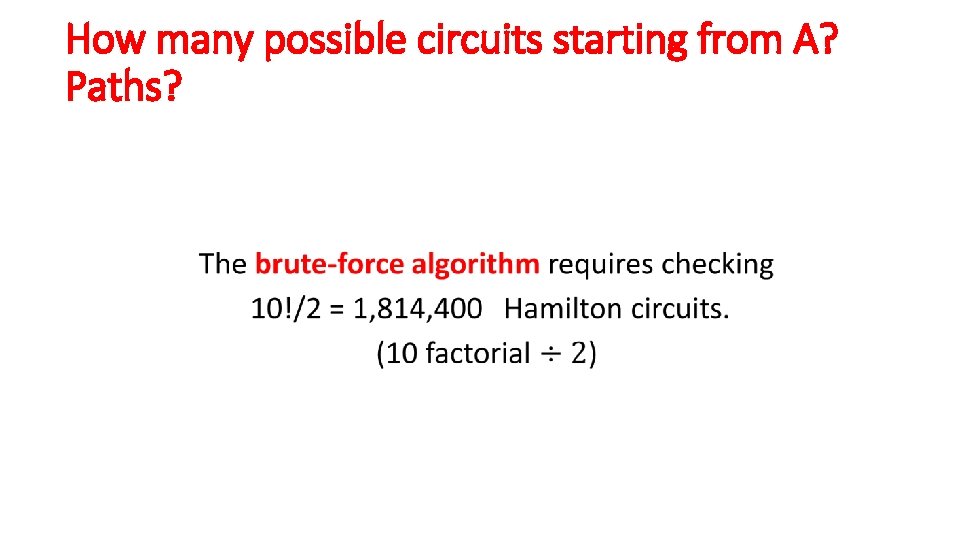
How many possible circuits starting from A? Paths? For a complete graph on n vertices, there are Vertices 4 5 6 7 Circuit 3!/2 = (3*2*1)/2 = 3 4!/2 = 12 unique circuits. Path 3! 4! Note that for Hamilton paths, we do NOT divide by two.
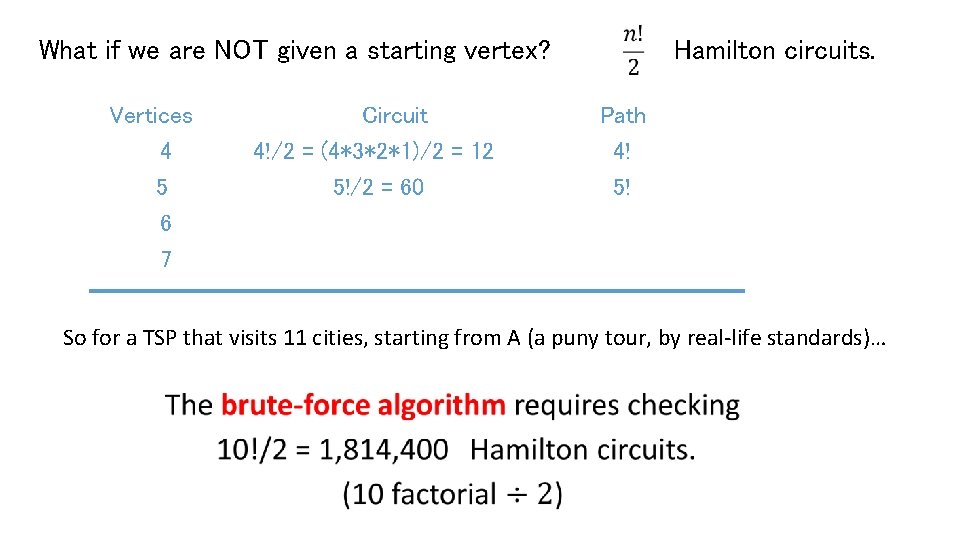
What if we are NOT given a starting vertex? Vertices 4 5 6 7 Circuit 4!/2 = (4*3*2*1)/2 = 12 5!/2 = 60 Hamilton circuits. Path 4! 5! So for a TSP that visits 11 cities, starting from A (a puny tour, by real-life standards)…
How many possible circuits starting from A? Paths?
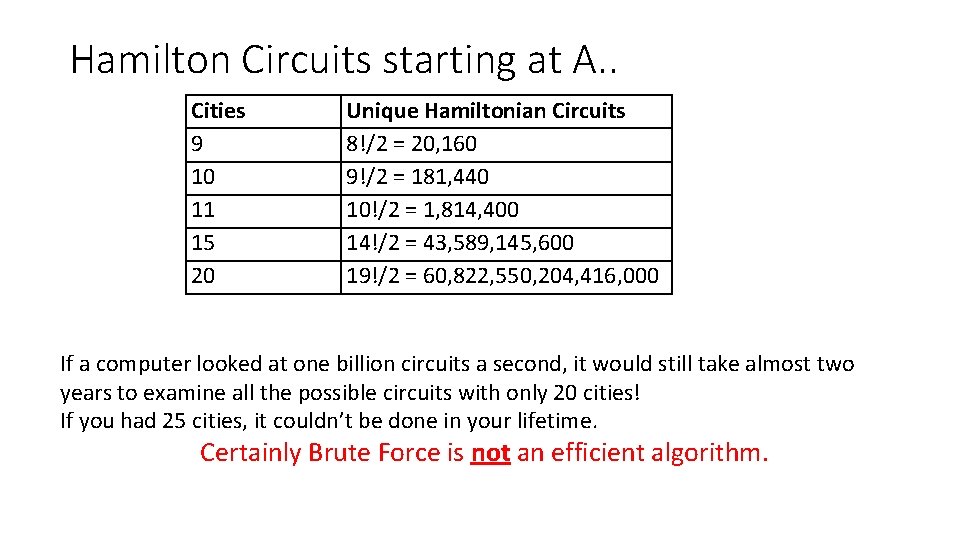
Hamilton Circuits starting at A. . Cities 9 10 11 15 20 Unique Hamiltonian Circuits 8!/2 = 20, 160 9!/2 = 181, 440 10!/2 = 1, 814, 400 14!/2 = 43, 589, 145, 600 19!/2 = 60, 822, 550, 204, 416, 000 If a computer looked at one billion circuits a second, it would still take almost two years to examine all the possible circuits with only 20 cities! If you had 25 cities, it couldn’t be done in your lifetime. Certainly Brute Force is not an efficient algorithm.
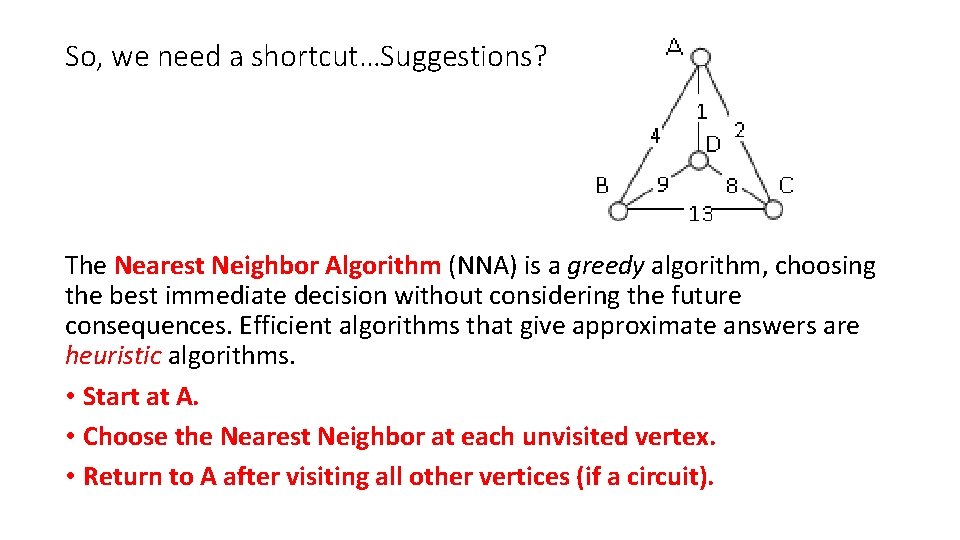
So, we need a shortcut…Suggestions? The Nearest Neighbor Algorithm (NNA) is a greedy algorithm, choosing the best immediate decision without considering the future consequences. Efficient algorithms that give approximate answers are heuristic algorithms. • Start at A. • Choose the Nearest Neighbor at each unvisited vertex. • Return to A after visiting all other vertices (if a circuit).
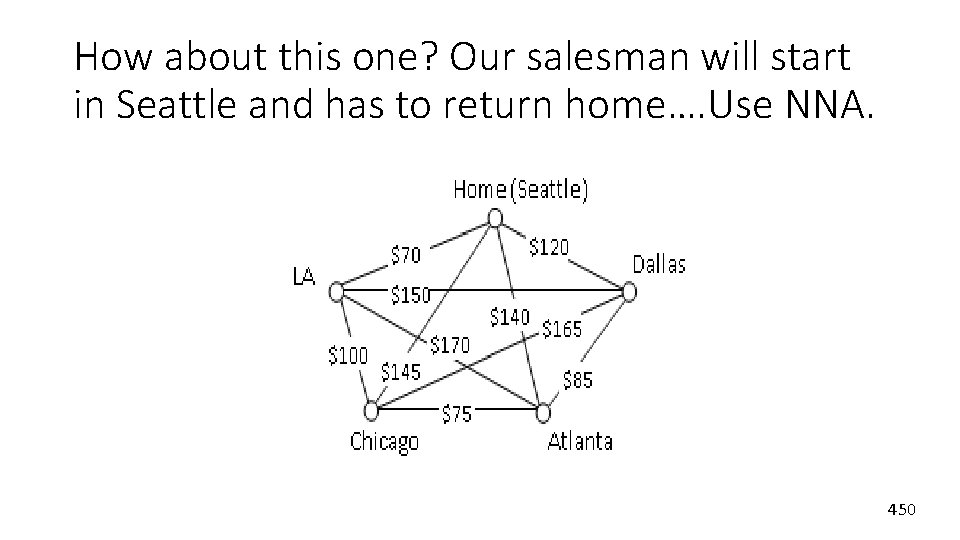
How about this one? Our salesman will start in Seattle and has to return home…. Use NNA. 450
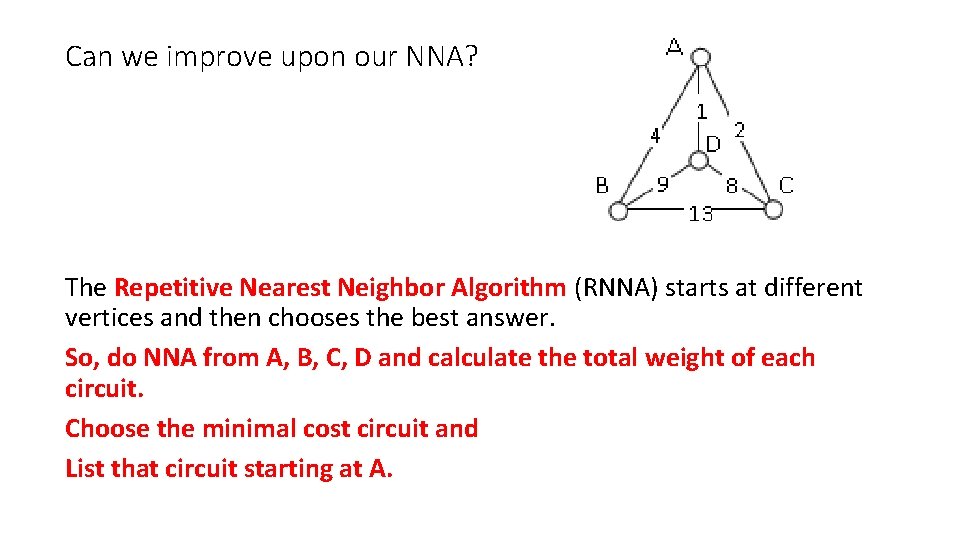
Can we improve upon our NNA? The Repetitive Nearest Neighbor Algorithm (RNNA) starts at different vertices and then chooses the best answer. So, do NNA from A, B, C, D and calculate the total weight of each circuit. Choose the minimal cost circuit and List that circuit starting at A.
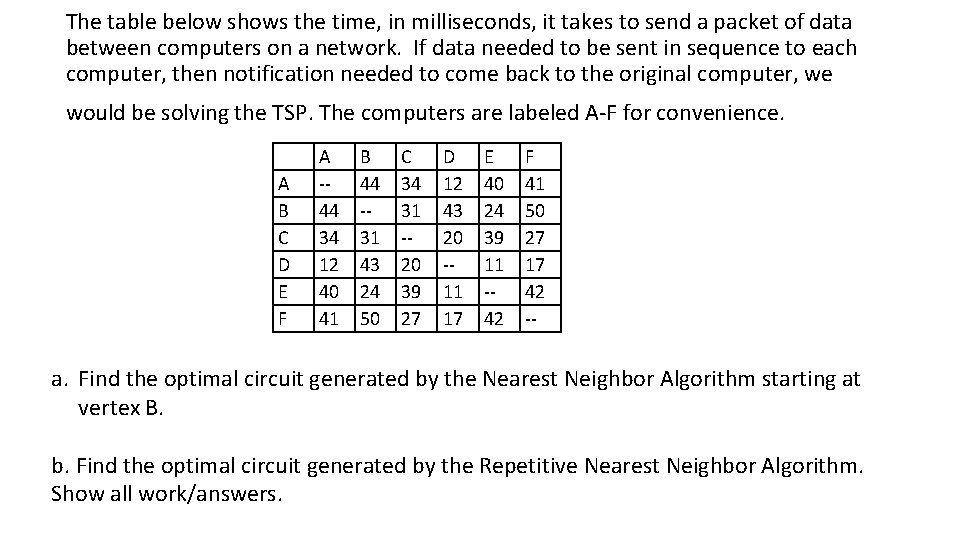
The table below shows the time, in milliseconds, it takes to send a packet of data between computers on a network. If data needed to be sent in sequence to each computer, then notification needed to come back to the original computer, we would be solving the TSP. The computers are labeled A-F for convenience. A B C D E F A -44 34 12 40 41 B 44 -31 43 24 50 C 34 31 -20 39 27 D 12 43 20 -11 17 E 40 24 39 11 -42 F 41 50 27 17 42 -- a. Find the optimal circuit generated by the Nearest Neighbor Algorithm starting at vertex B. b. Find the optimal circuit generated by the Repetitive Nearest Neighbor Algorithm. Show all work/answers.
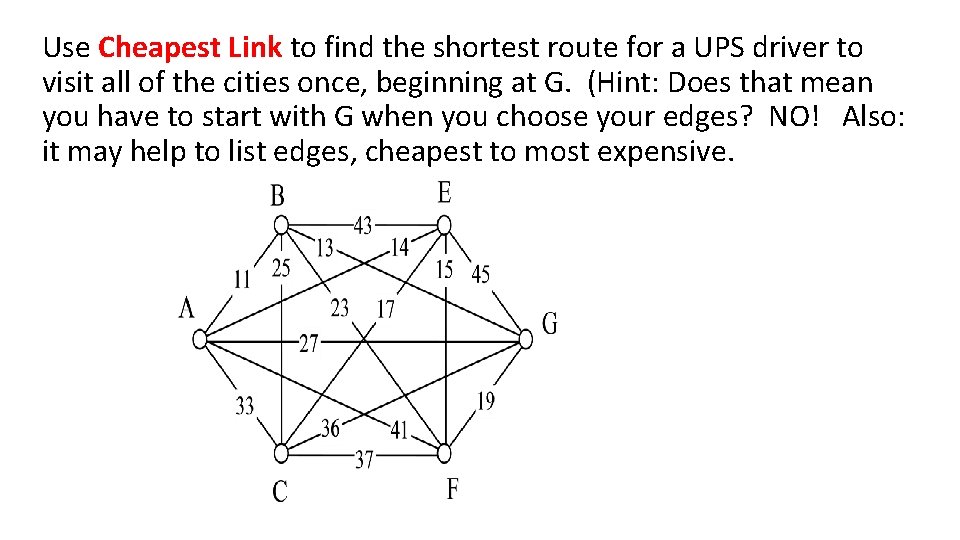
Because we can begin a tour at any vertex and then rewrite the circuit with the desired start, we are led to another, somewhat intuitive algorithm: The Cheapest Link (also called the Sorted Edge Algorithm) The Cheapest Link algorithm steps back and looks at the big picture. 1. Select the cheapest unused edge that does not close a loop or give a vertex degree 3. 2. Repeat until all vertices are connected to the graph, then choose the edge that closes the circuit. 3. Calculate the total cost of the circuit and rewrite it with the desired start vertex.
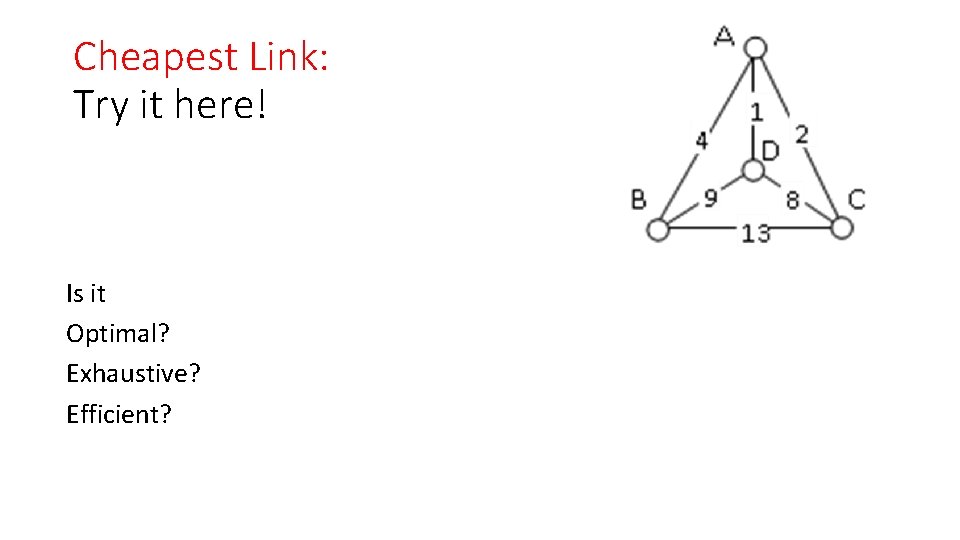
Cheapest Link: Try it here! Is it Optimal? Exhaustive? Efficient?
Use Cheapest Link to find the shortest route for a UPS driver to visit all of the cities once, beginning at G. (Hint: Does that mean you have to start with G when you choose your edges? NO! Also: it may help to list edges, cheapest to most expensive.
Hamilton Circuit/Path algorithms: Advantages/disadvantages? Heuristic algorithm: efficient, giving approximate answers Brute Force Algorithm Nearest Neighbor Algorithm Repetitive Nearest Neighbor Algorithm Cheapest Link Algorithm
Sources: College Mathematics for Everyday Life, Kathryn Kozak et al (Coconino Community College) CC-BY-SA, http: //www. coconino. edu/resources/files/pdfs/academics/arts-andsciences/MAT 142/Chapter_6_Graph. Theory. pdf Math in Society, David Lippman, CC-BY-SA, http: //www. opentextbookstore. com/mathinsociety/