
Graph Frequency Analysis of Learning Progression Name Mentor

- Slides: 7
Graph Frequency Analysis of Learning Progression Name Mentor: Faculty Sponsor:
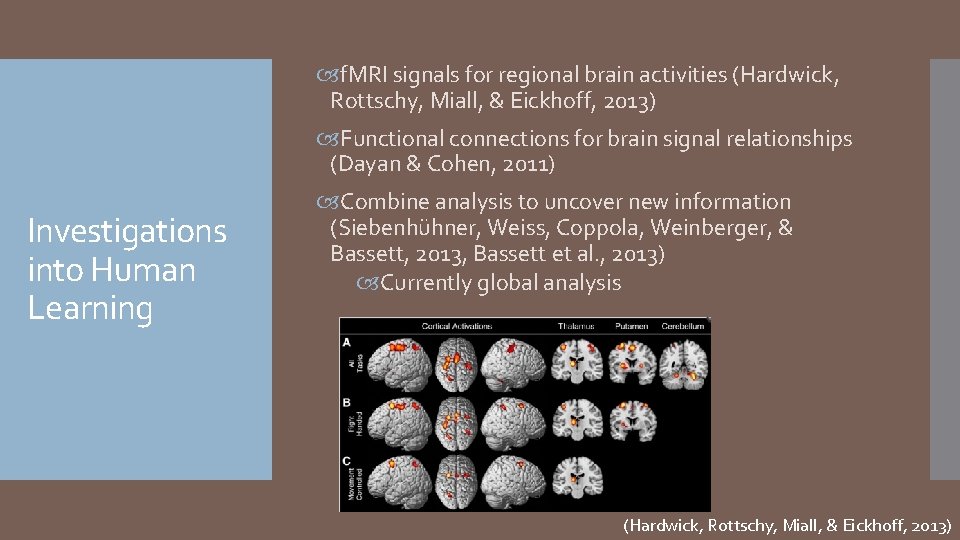
f. MRI signals for regional brain activities (Hardwick, Rottschy, Miall, & Eickhoff, 2013) Functional connections for brain signal relationships (Dayan & Cohen, 2011) Investigations into Human Learning Combine analysis to uncover new information (Siebenhühner, Weiss, Coppola, Weinberger, & Bassett, 2013, Bassett et al. , 2013) Currently global analysis (Hardwick, Rottschy, Miall, & Eickhoff, 2013)
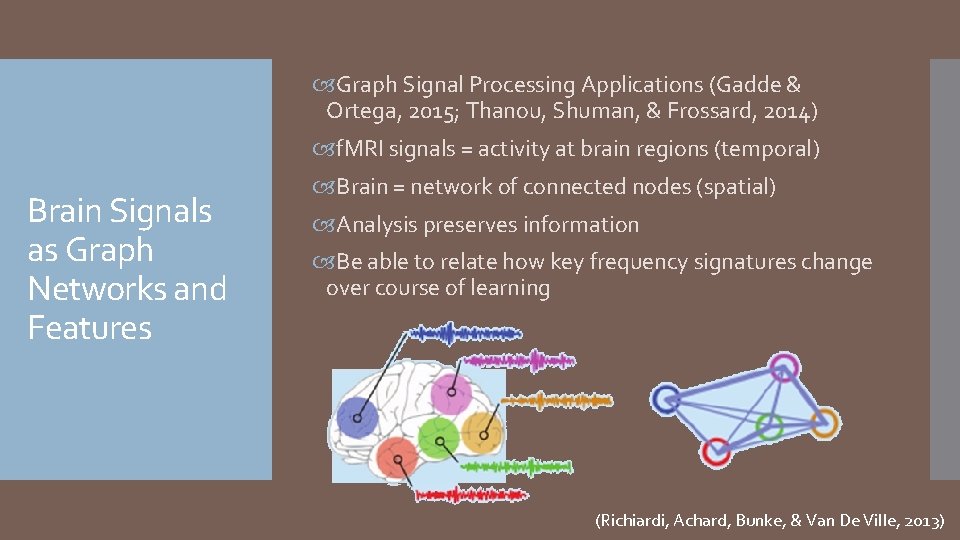
Graph Signal Processing Applications (Gadde & Ortega, 2015; Thanou, Shuman, & Frossard, 2014) f. MRI signals = activity at brain regions (temporal) Brain Signals as Graph Networks and Features Brain = network of connected nodes (spatial) Analysis preserves information Be able to relate how key frequency signatures change over course of learning (Richiardi, Achard, Bunke, & Van De Ville, 2013)
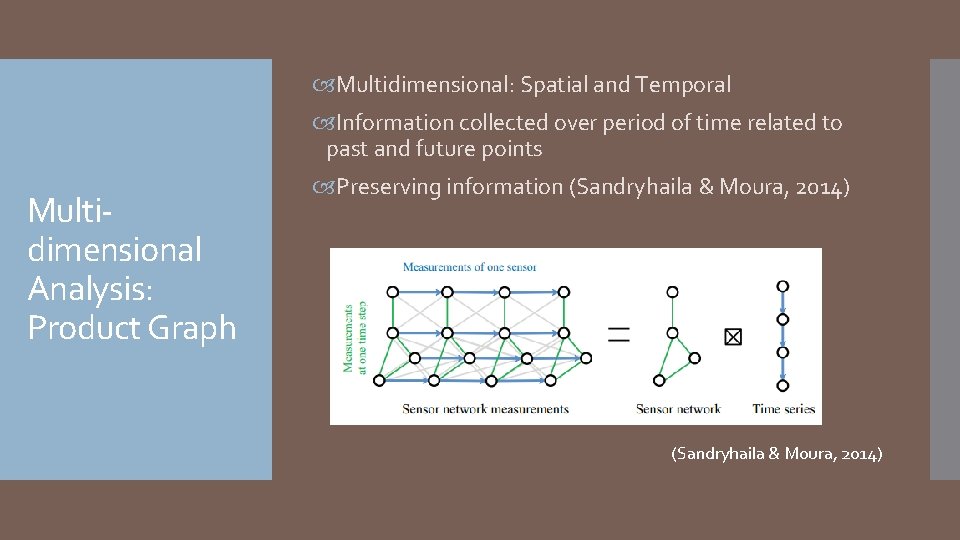
Multidimensional: Spatial and Temporal Information collected over period of time related to past and future points Multidimensional Analysis: Product Graph Preserving information (Sandryhaila & Moura, 2014)
Using Prior Knowledge Information on graph signal processing methods for time series data and graphs (Richiardi, Achard, Bunke, & Van De Ville, 2013) Understand brain region relationships (Sporns, 2011) Support and add to prior information
Verification Methods Documentation Vary frequency analysis range Certain ranges where new information exposed Repeatability Using two different data sets
Bassett, D. S. , Wymbs, N. F. , Rombach, M. P. , Porter, M. A. , Mucha, P. J. , & Grafton, S. T. (2013). Task-based core-periphery organization of human brain dynamics. PLo. S Computational Biology, 9(9), e 1003171. http: //doi. org/10. 1371/journal. pcbi. 1003171 Dayan, E. , & Cohen, L. G. (2011). Neuroplasticity subserving motor skill learning. Neuron, 72(3), 443– 54. http: //doi. org/10. 1016/j. neuron. 2011. 10. 008 Gadde, A. , & Ortega, A. (2015). A probabilistic interpretation of sampling theory of graph signals. In 2015 IEEE International Conference on Acoustics, Speech and Signal Processing (ICASSP) (Vol. 2015 -Augus, pp. 3257– 3261). IEEE. http: //doi. org/10. 1109/ICASSP. 2015. 7178573 Bibliography Hardwick, R. M. , Rottschy, C. , Miall, R. C. , & Eickhoff, S. B. (2013). A quantitative meta-analysis and review of motor learning in the human brain. Neuro. Image, 67, 283– 97. http: //doi. org/10. 1016/j. neuroimage. 2012. 11. 020 O. Sporns, Networks of the Brain. MIT press, 2011. Richiardi, J. , Achard, S. , Bunke, H. , & Van De Ville, D. (2013). Machine Learning with Brain Graphs: Predictive Modeling Approaches for Functional Imaging in Systems Neuroscience. IEEE Signal Processing Magazine, 30(3), 58– 70. http: //doi. org/10. 1109/MSP. 2012. 2233865 Sandryhaila, A. , & Moura, J. M. F. (2014). Big Data Analysis with Signal Processing on Graphs: Representation and processing of massive data sets with irregular structure. IEEE Signal Processing Magazine, 31(5), 80– 90. http: //doi. org/10. 1109/MSP. 2014. 2329213 Siebenhühner, F. , Weiss, S. A. , Coppola, R. , Weinberger, D. R. , & Bassett, D. S. (2013). Intraand inter-frequency brain network structure in health and schizophrenia. Plo. S One, 8(8), e 72351. http: //doi. org/10. 1371/journal. pone. 0072351 Thanou, D. , Shuman, D. I. , & Frossard, P. (2014). Learning Parametric Dictionaries for Signals on Graphs. IEEE Transactions on Signal Processing, 62(15), 3849– 3862. http: //doi. org/10. 1109/TSP. 2014. 2332441