
Graph Coloring and Applications 1 Overview n n
- Slides: 27
Graph Coloring and Applications 1
Overview n n n Graph Coloring Basics Planar/4 -color Graphs Applications Chordal Graphs New Register Allocation Technique 2
Basics n Assignment of "colors" to certain objects in a graph subject to certain constraints n n n Vertex coloring (the default) Edge coloring Face coloring (planar) 3
Not Graph Labeling n Graph coloring n n Just markers to keep track of adjacency or incidence Graph labeling n Calculable problems that satisfy a numerical condition 4
Vertex coloring n n In its simplest form, it is a way of coloring the vertices of a graph such that no two adjacent vertices share the same color Edge and Face coloring can be transformed into Vertex version 5
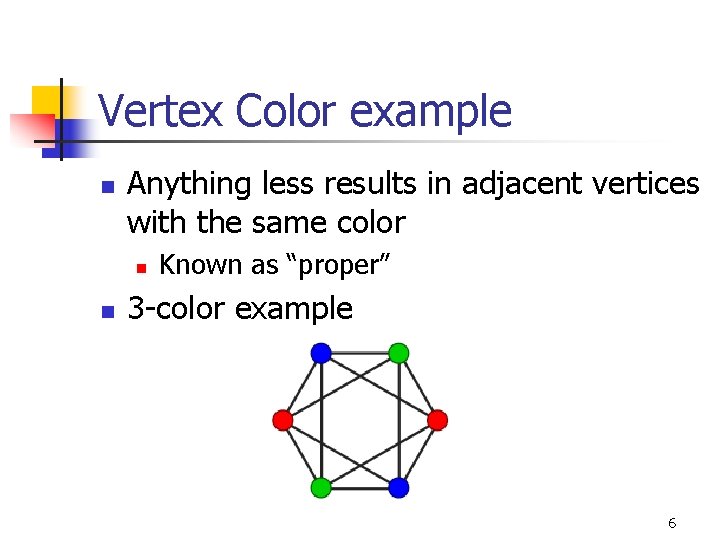
Vertex Color example n Anything less results in adjacent vertices with the same color n n Known as “proper” 3 -color example 6
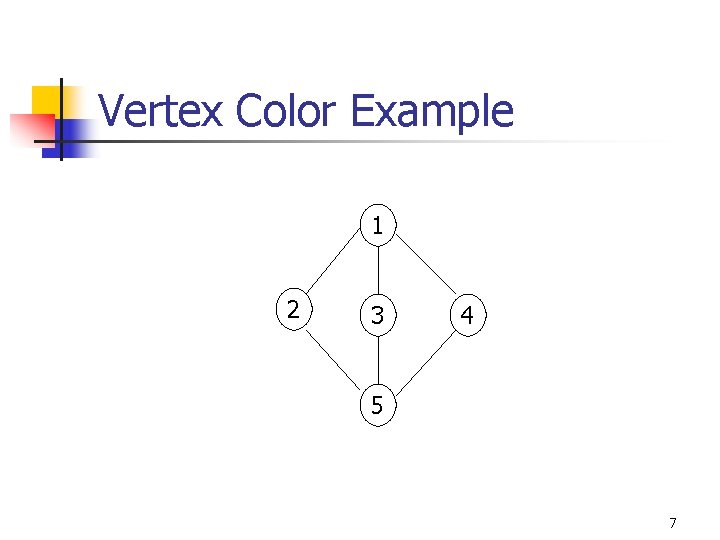
Vertex Color Example 1 2 3 4 5 7
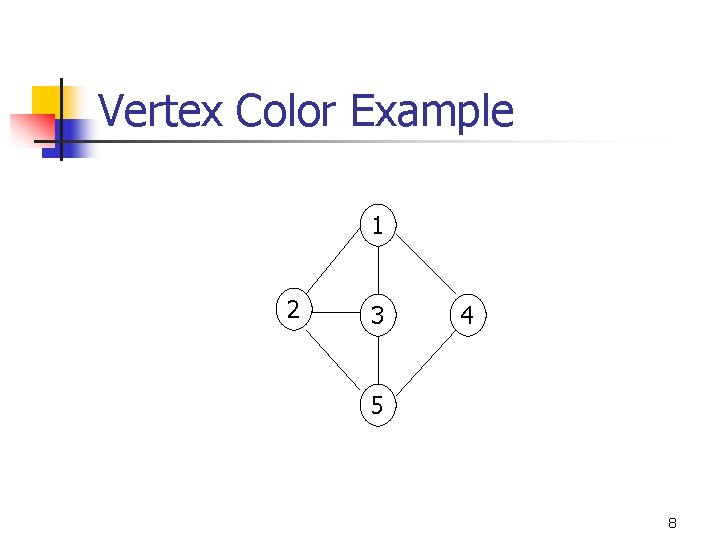
Vertex Color Example 1 2 3 4 5 8
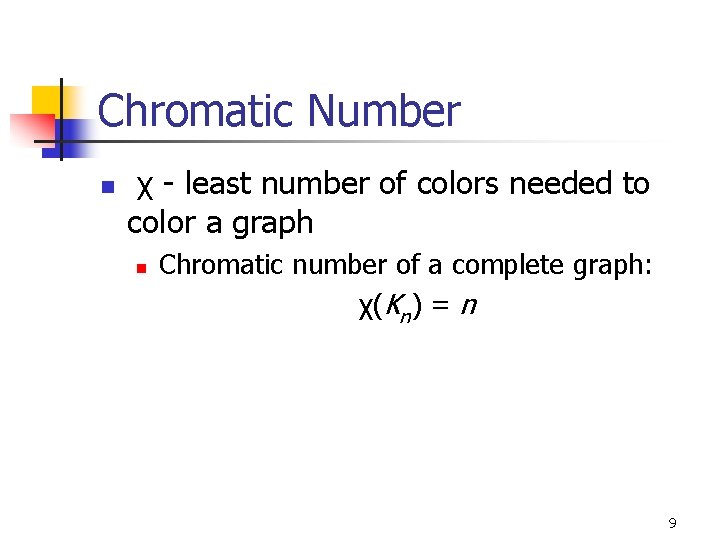
Chromatic Number n χ - least number of colors needed to color a graph n Chromatic number of a complete graph: χ(Kn) = n 9
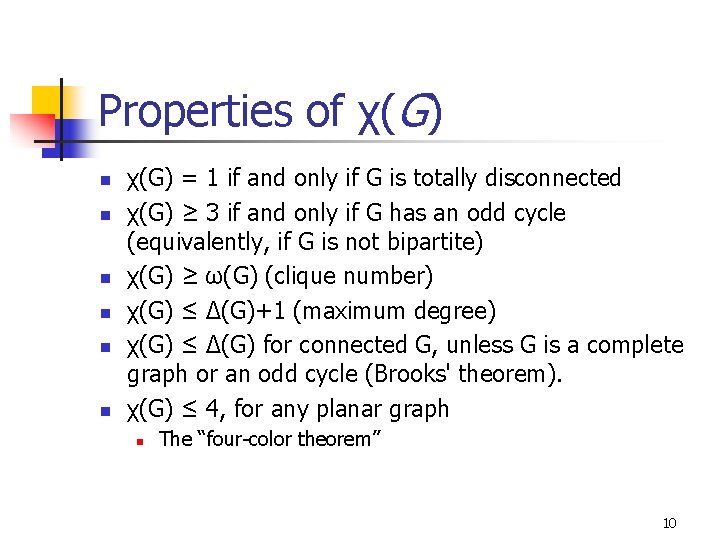
Properties of χ(G) n n n χ(G) = 1 if and only if G is totally disconnected χ(G) ≥ 3 if and only if G has an odd cycle (equivalently, if G is not bipartite) χ(G) ≥ ω(G) (clique number) χ(G) ≤ Δ(G)+1 (maximum degree) χ(G) ≤ Δ(G) for connected G, unless G is a complete graph or an odd cycle (Brooks' theorem). χ(G) ≤ 4, for any planar graph n The “four-color theorem” 10
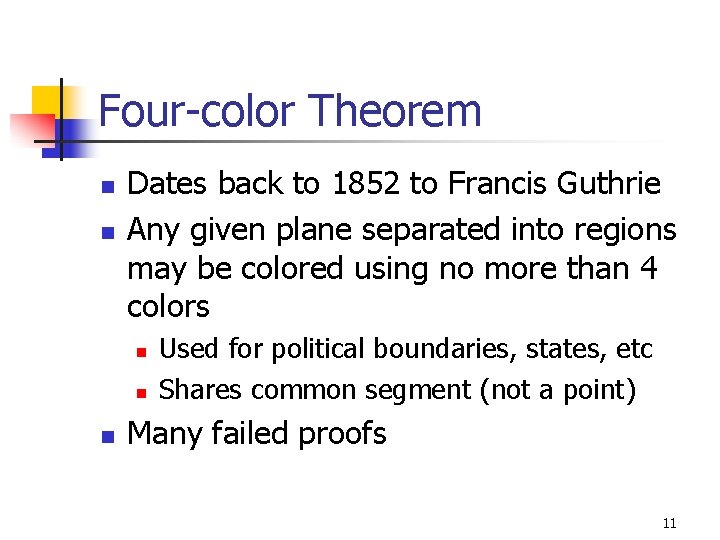
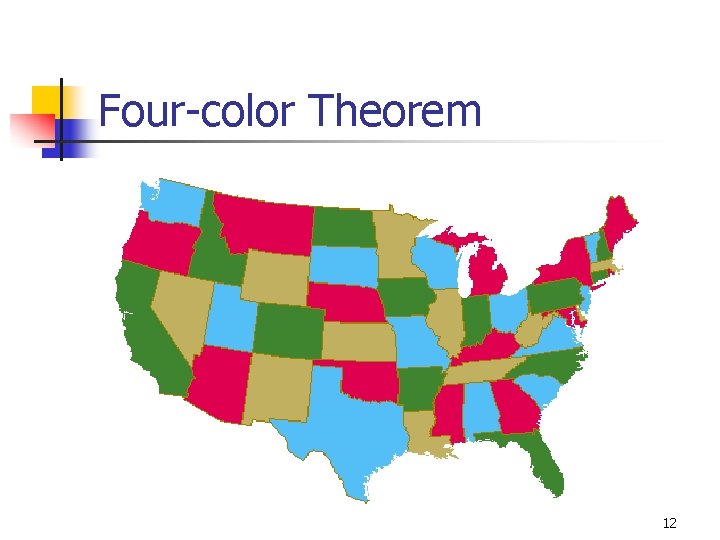
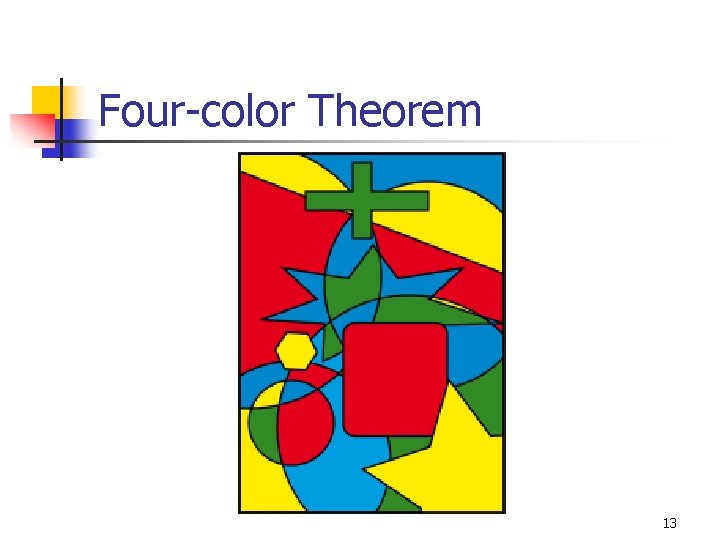
Four-color Theorem n n Dates back to 1852 to Francis Guthrie Any given plane separated into regions may be colored using no more than 4 colors n n n Used for political boundaries, states, etc Shares common segment (not a point) Many failed proofs 11
Four-color Theorem 12
Four-color Theorem 13
Algorithmic complexity n n Finding minimum coloring: NP-hard Decision problem: “is there a coloring which uses at most k colors? ” n Makes it NP-complete 14
Coloring a Graph - Applications n n n Sudoku Scheduling Mobile radio frequency assignment Pattern matching Register Allocation 15
Register Allocation with Graphs Coloring n Register pressure n n n How determine what should be stored in registers Determine what to “spill” to memory Typical RA utilize graph coloring for underlying allocation problem n Build graph to manage conflicts between live ranges 16
Chordal Graphs n n n Each cycle of four or more nodes has a chord Subset of perfect graphs Also known as triangulated graphs 17
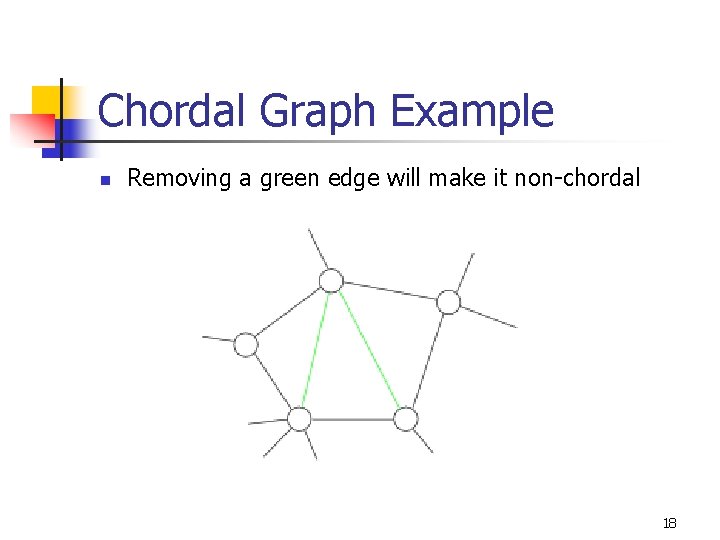
Chordal Graph Example n Removing a green edge will make it non-chordal 18
RA with Chordal Graphs n Normal register allocation was an NPcomplete problem n n Graph coloring If program is in SSA form, it can be accomplished in polynomial time with chordal graphs! n Thereby decreasing need for registers 19
Quick Static Single Assignment Review n SSA Characteristics n n Basic blocks Unique naming for variable assignments Φ-functions used at convergence of control flows Improves optimization n n n constant propagation dead code elimination global value numbering partial redundancy elimination strength reduction register allocation 20
RA with Chordal Graphs n n SSA representation needs fewer registers Key insight: a program in SSA form has a chordal interference graph n Very Recent 21
RA with Chordal Graphs cont n n Result is based on the fact that in strict. SSA form, every variable has a single contiguous live range Variables with overlapping live ranges form cliques in the interference graph 22
RA with Chordal Graphs cont n n n Greedy algorithm can color a chordal graph in linear time New SSA-elimination algorithm done without extra registers Result: n Simple, optimal, polynomial-time algorithm for the core register allocation problem 23
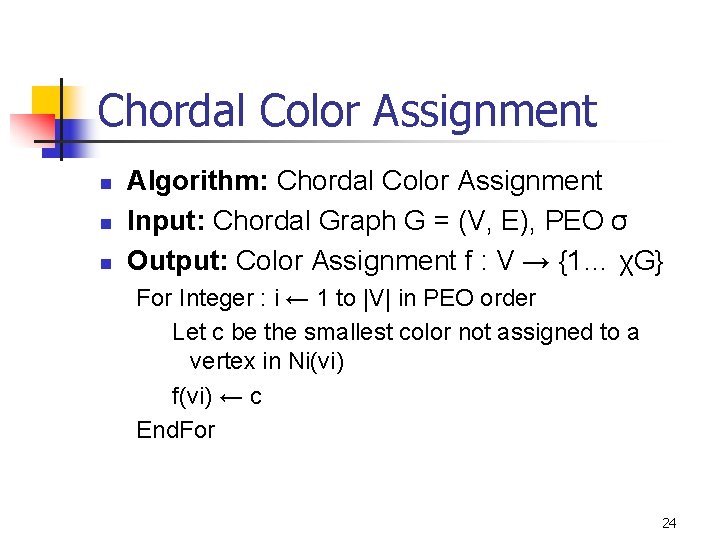
Chordal Color Assignment n n n Algorithm: Chordal Color Assignment Input: Chordal Graph G = (V, E), PEO σ Output: Color Assignment f : V → {1… χG} For Integer : i ← 1 to |V| in PEO order Let c be the smallest color not assigned to a vertex in Ni(vi) f(vi) ← c End. For 24
Conclusion n Graph Coloring Chordal Graphs New Register Allocation Technique n Polynomial time 25
References n http: //en. wikipedia. org n Engineering a Compiler, Keith D. Cooper and Linda n n Torczon, 2004 http: //www. math. gatech. edu/~thomas/FC/fourcolor. html An Optimistic and Conservative Register Assignment Heuristic for Chordal Graphs, Philip Brisk, et. Al. , CASES 07 n Register Allocation via Coloring of Chordal Graphs, Jens Palsberg, CATS 2007 26
Questions? n Thank you 27