
Graph Algorithms 3 CS 202 Fundamental Structures of
- Slides: 63
Graph Algorithms – 3 CS 202 – Fundamental Structures of Computer Science II Bilkent University Computer Engineering Department CS 202, Spring 2003 Fundamental Structures of Computer Science II © Bilkent University 1
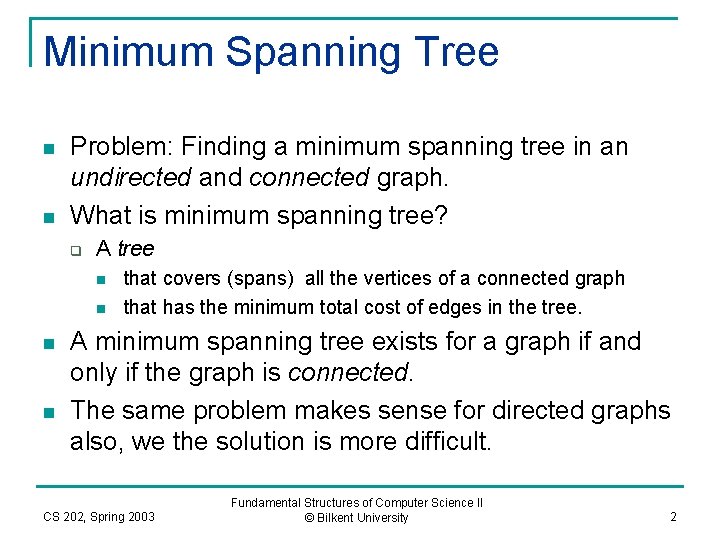
Minimum Spanning Tree n n Problem: Finding a minimum spanning tree in an undirected and connected graph. What is minimum spanning tree? q A tree n n that covers (spans) all the vertices of a connected graph that has the minimum total cost of edges in the tree. A minimum spanning tree exists for a graph if and only if the graph is connected. The same problem makes sense for directed graphs also, we the solution is more difficult. CS 202, Spring 2003 Fundamental Structures of Computer Science II © Bilkent University 2
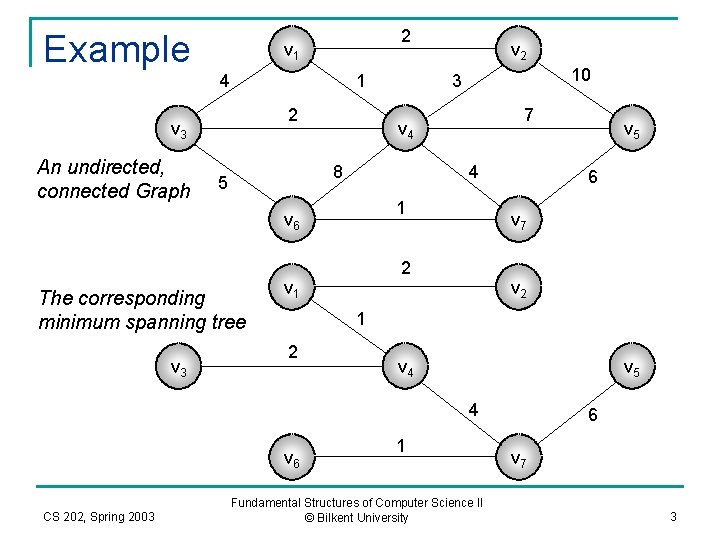
Example 2 v 1 4 1 2 v 3 An undirected, connected Graph v 3 7 v 4 4 1 v 6 The corresponding minimum spanning tree 10 3 8 5 v 2 6 v 7 2 v 1 v 2 1 2 v 4 v 5 4 v 6 CS 202, Spring 2003 v 5 1 Fundamental Structures of Computer Science II © Bilkent University 6 v 7 3
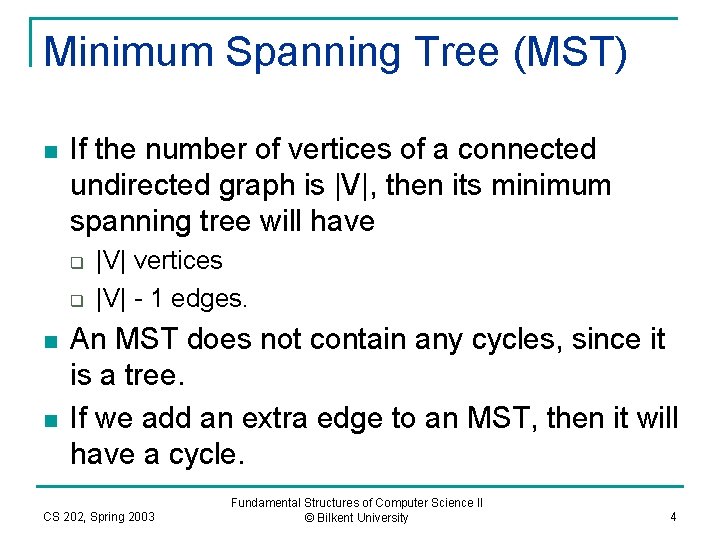
Minimum Spanning Tree (MST) n If the number of vertices of a connected undirected graph is |V|, then its minimum spanning tree will have q q n n |V| vertices |V| - 1 edges. An MST does not contain any cycles, since it is a tree. If we add an extra edge to an MST, then it will have a cycle. CS 202, Spring 2003 Fundamental Structures of Computer Science II © Bilkent University 4
Minimum Spanning Tree (MST) n n n Greedy approach for finding an MST for a graph works! Given a graph G, we start with an initial one vertex MST. At each stage we add one more vertex and one more edge (that connects this vertex to the previous MST), so that the edge has minimum possible value. CS 202, Spring 2003 Fundamental Structures of Computer Science II © Bilkent University 5
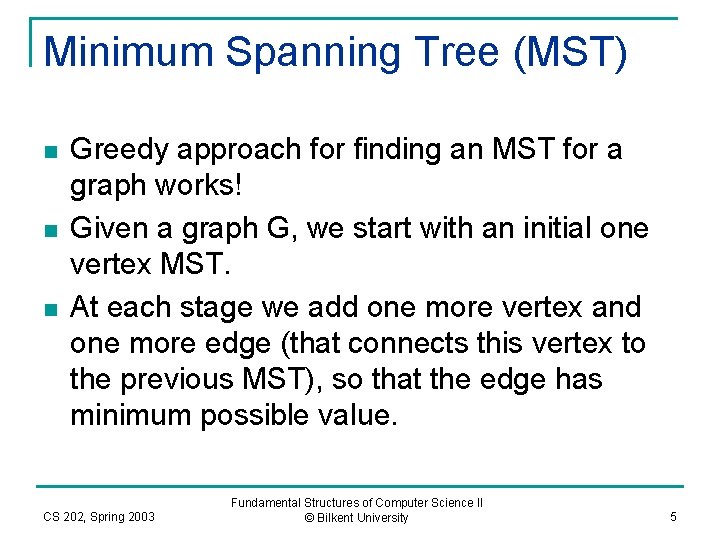
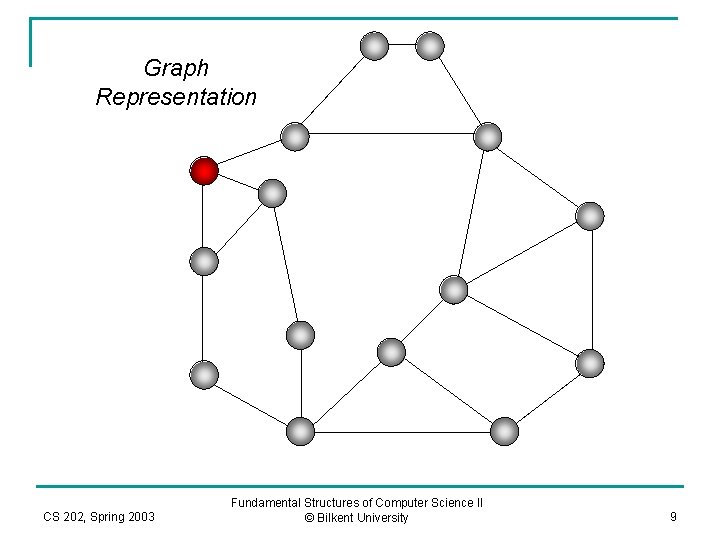
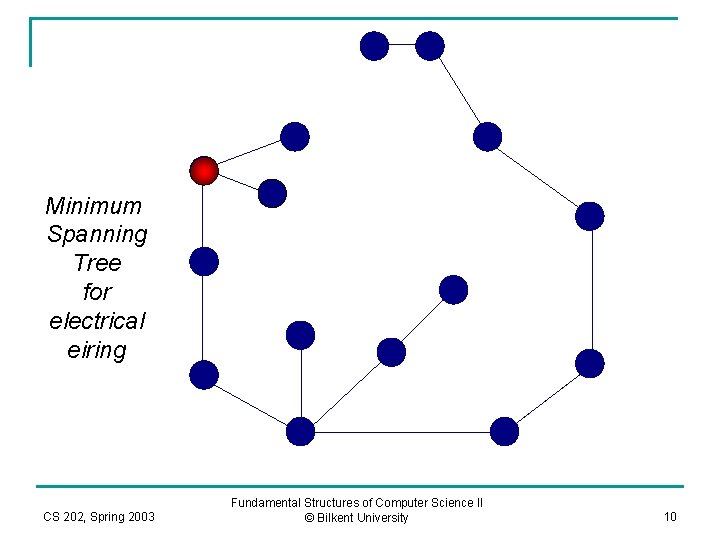
MST Applications power outlet or light Electrical wiring of a house using minimum amount of wires (cables) CS 202, Spring 2003 Fundamental Structures of Computer Science II © Bilkent University 6
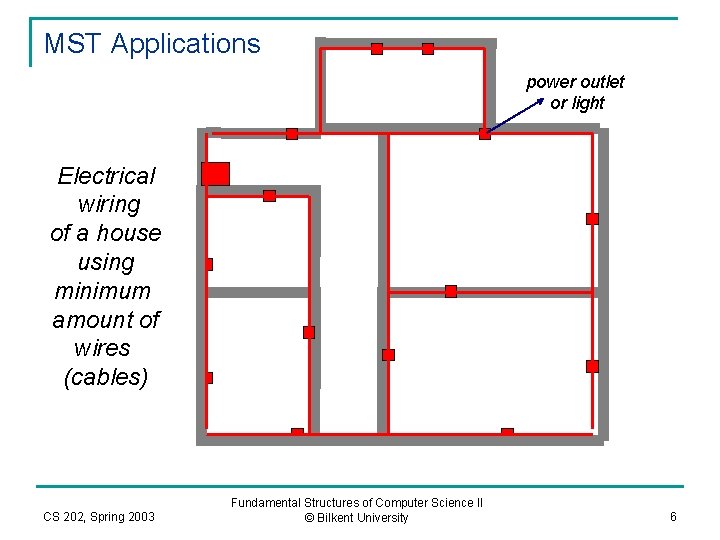
MST Applications CS 202, Spring 2003 Fundamental Structures of Computer Science II © Bilkent University 7
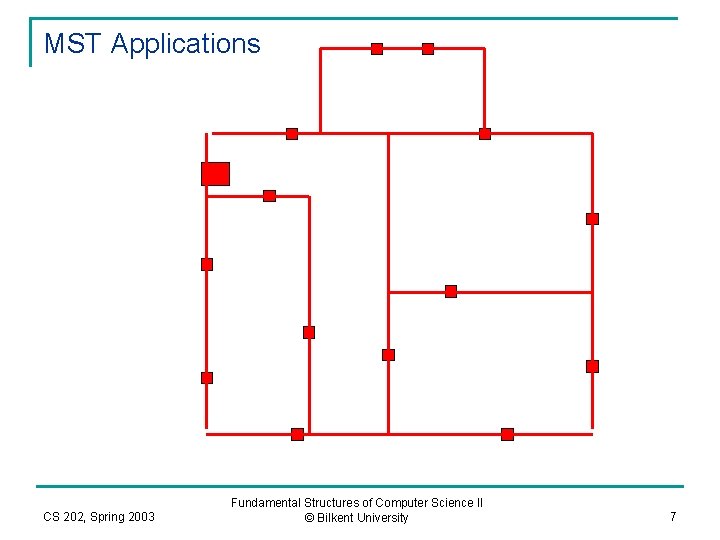
MST Applications CS 202, Spring 2003 Fundamental Structures of Computer Science II © Bilkent University 8
Graph Representation CS 202, Spring 2003 Fundamental Structures of Computer Science II © Bilkent University 9
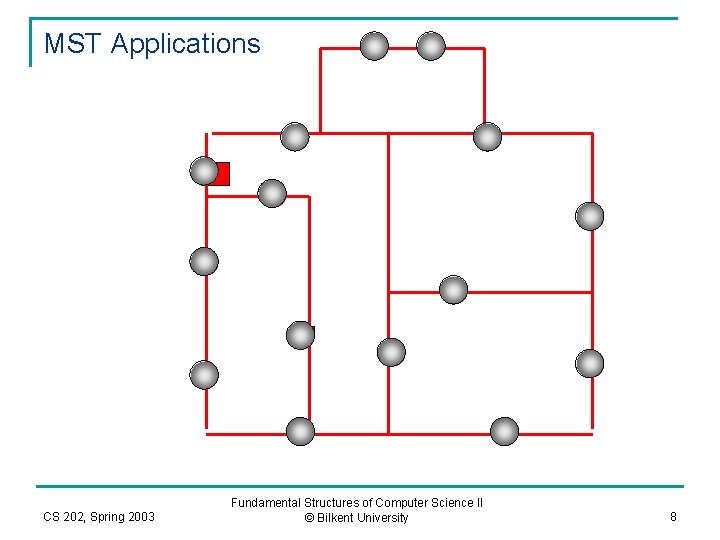
Minimum Spanning Tree for electrical eiring CS 202, Spring 2003 Fundamental Structures of Computer Science II © Bilkent University 10
MST Algorithms n CS 202, Spring 2003 We will see two algorithms q Prim’s Algorithm q Kruskal’s Algorithm Fundamental Structures of Computer Science II © Bilkent University 11
Prim’s Algorithm n n MST is grown in successive stages. At each stage: q A new vertex is added to the tree by choosing the edge (u, v) such that the cost of (u, v) is the smallest among all edges where u is in the tree and v is not. CS 202, Spring 2003 Fundamental Structures of Computer Science II © Bilkent University 12
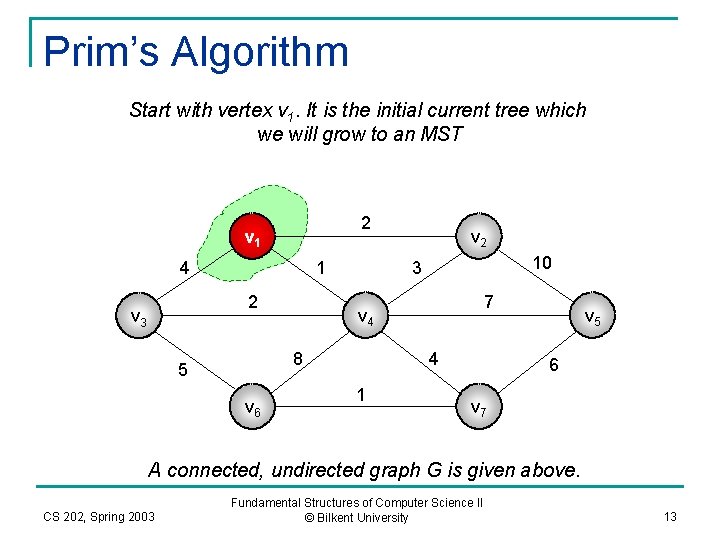
Prim’s Algorithm Start with vertex v 1. It is the initial current tree which we will grow to an MST 2 v 1 4 1 2 v 3 v 6 10 3 7 v 4 8 5 v 2 4 1 v 5 6 v 7 A connected, undirected graph G is given above. CS 202, Spring 2003 Fundamental Structures of Computer Science II © Bilkent University 13
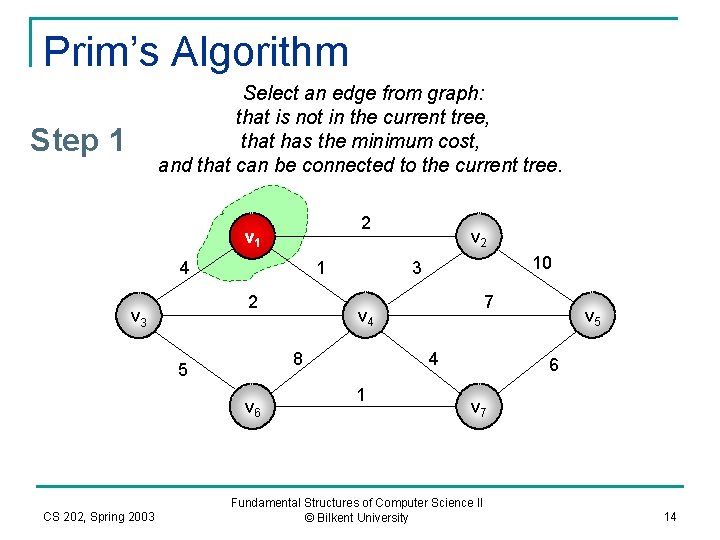
Prim’s Algorithm Select an edge from graph: that is not in the current tree, that has the minimum cost, and that can be connected to the current tree. Step 1 2 v 1 4 1 2 v 3 v 6 CS 202, Spring 2003 10 3 7 v 4 8 5 v 2 4 1 v 5 6 v 7 Fundamental Structures of Computer Science II © Bilkent University 14
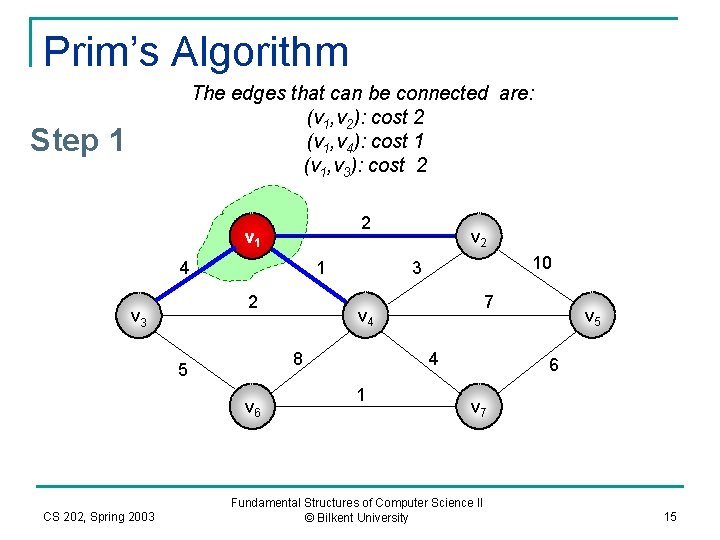
Prim’s Algorithm The edges that can be connected are: (v 1, v 2): cost 2 (v 1, v 4): cost 1 (v 1, v 3): cost 2 Step 1 2 v 1 4 1 2 v 3 v 6 CS 202, Spring 2003 10 3 7 v 4 8 5 v 2 4 1 v 5 6 v 7 Fundamental Structures of Computer Science II © Bilkent University 15
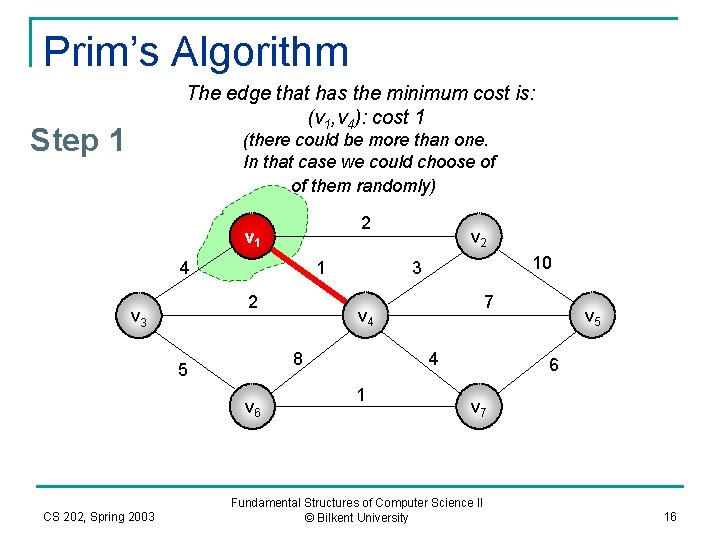
Prim’s Algorithm The edge that has the minimum cost is: (v 1, v 4): cost 1 Step 1 (there could be more than one. In that case we could choose of of them randomly) 2 v 1 4 1 2 v 3 v 6 CS 202, Spring 2003 10 3 7 v 4 8 5 v 2 4 1 v 5 6 v 7 Fundamental Structures of Computer Science II © Bilkent University 16
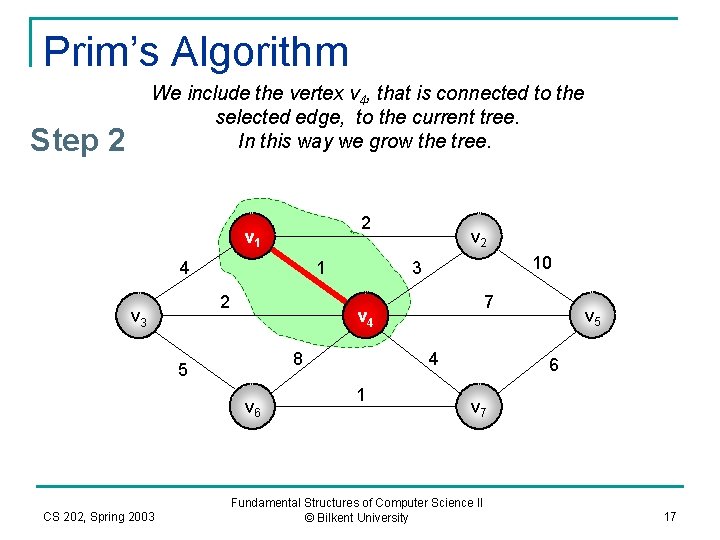
Prim’s Algorithm We include the vertex v 4, that is connected to the selected edge, to the current tree. In this way we grow the tree. Step 2 2 v 1 4 1 2 v 3 10 3 7 v 4 8 5 v 6 CS 202, Spring 2003 v 2 4 1 v 5 6 v 7 Fundamental Structures of Computer Science II © Bilkent University 17
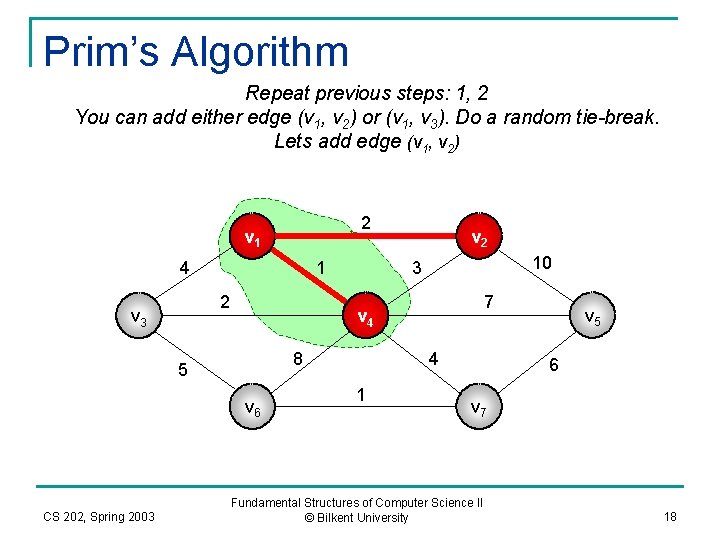
Prim’s Algorithm Repeat previous steps: 1, 2 You can add either edge (v 1, v 2) or (v 1, v 3). Do a random tie-break. Lets add edge (v 1, v 2) 2 v 1 4 1 2 v 3 10 3 7 v 4 8 5 v 6 CS 202, Spring 2003 v 2 4 1 v 5 6 v 7 Fundamental Structures of Computer Science II © Bilkent University 18
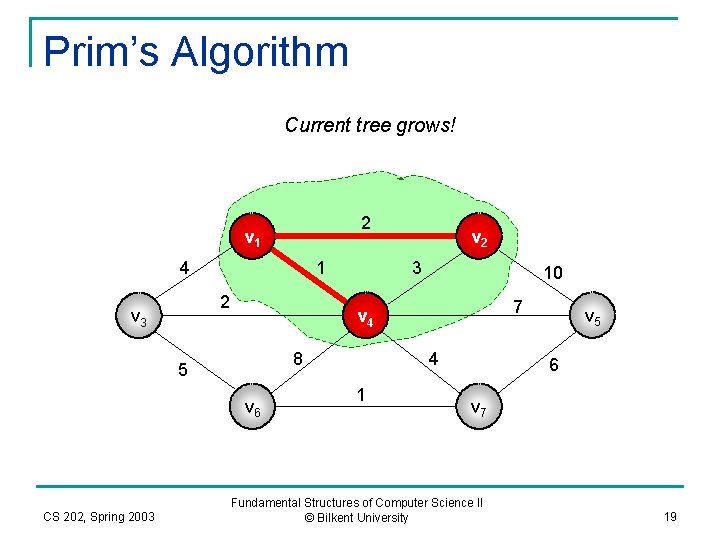
Prim’s Algorithm Current tree grows! 2 v 1 4 1 2 v 3 3 10 7 v 4 8 5 v 6 CS 202, Spring 2003 v 2 4 1 v 5 6 v 7 Fundamental Structures of Computer Science II © Bilkent University 19
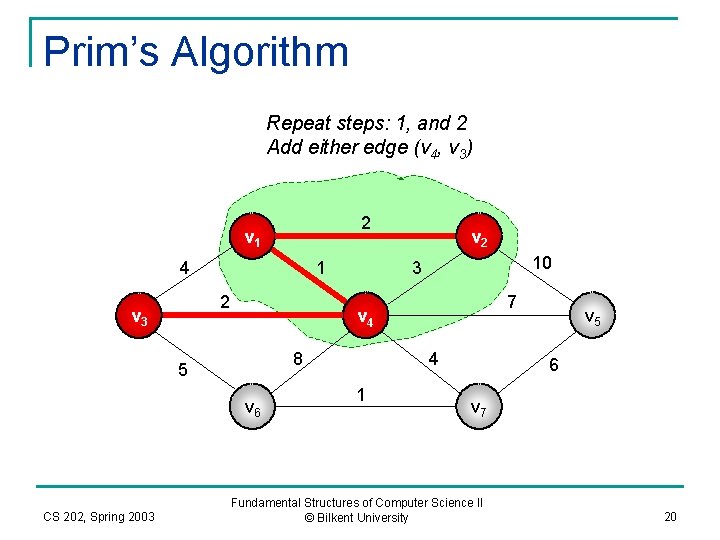
Prim’s Algorithm Repeat steps: 1, and 2 Add either edge (v 4, v 3) 2 v 1 4 1 2 v 3 10 3 7 v 4 8 5 v 6 CS 202, Spring 2003 v 2 4 1 v 5 6 v 7 Fundamental Structures of Computer Science II © Bilkent University 20
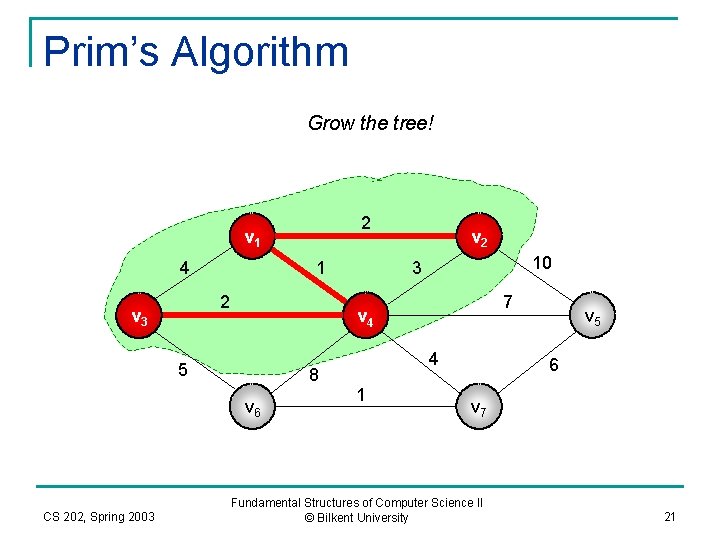
Prim’s Algorithm Grow the tree! 2 v 1 4 1 2 v 3 10 3 7 v 4 5 8 v 6 CS 202, Spring 2003 v 2 4 1 v 5 6 v 7 Fundamental Structures of Computer Science II © Bilkent University 21
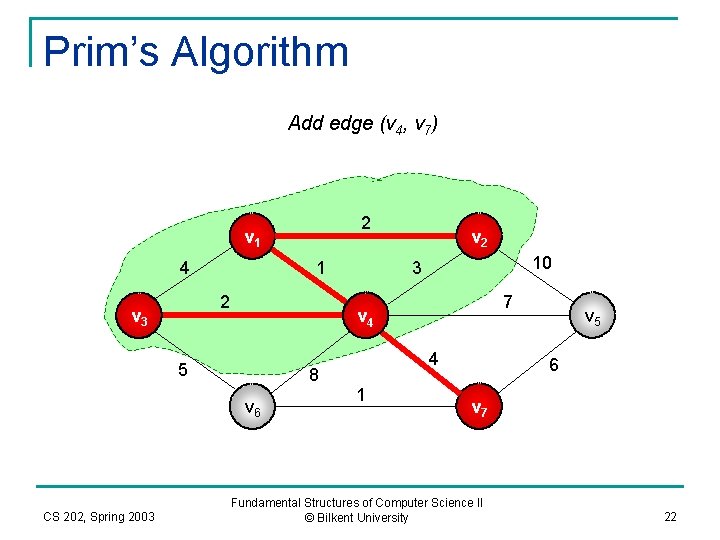
Prim’s Algorithm Add edge (v 4, v 7) 2 v 1 4 1 2 v 3 10 3 7 v 4 5 8 v 6 CS 202, Spring 2003 v 2 4 1 v 5 6 v 7 Fundamental Structures of Computer Science II © Bilkent University 22
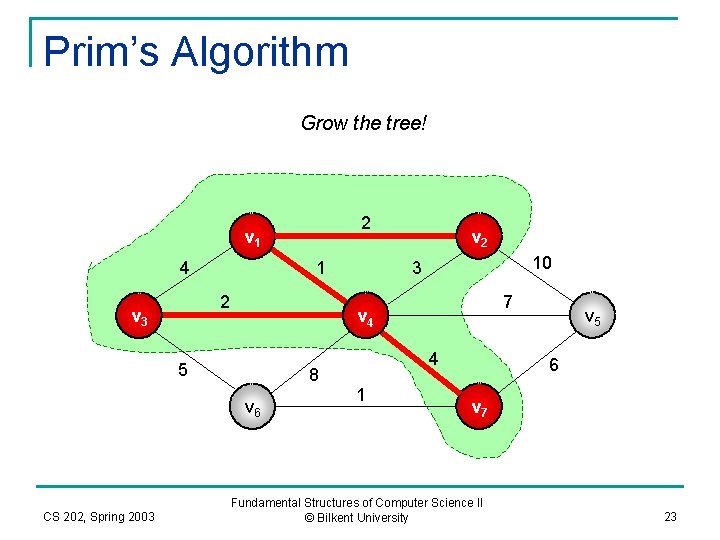
Prim’s Algorithm Grow the tree! 2 v 1 4 1 2 v 3 10 3 7 v 4 5 8 v 6 CS 202, Spring 2003 v 2 4 1 v 5 6 v 7 Fundamental Structures of Computer Science II © Bilkent University 23
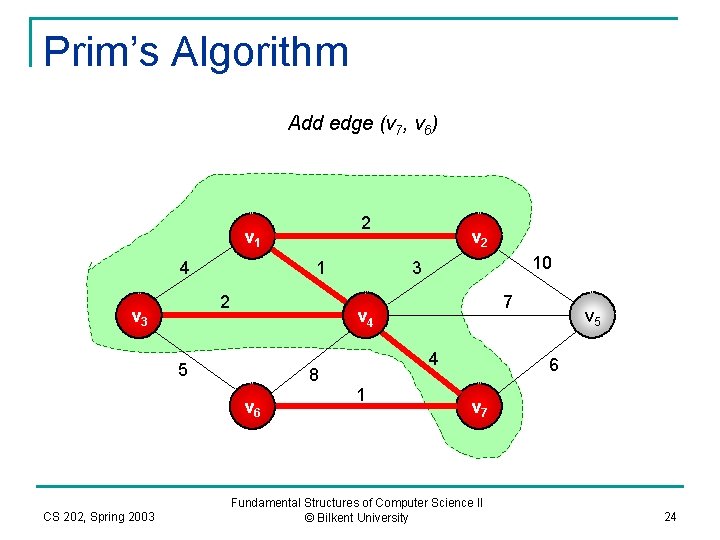
Prim’s Algorithm Add edge (v 7, v 6) 2 v 1 4 1 2 v 3 10 3 7 v 4 5 8 v 6 CS 202, Spring 2003 v 2 4 1 v 5 6 v 7 Fundamental Structures of Computer Science II © Bilkent University 24
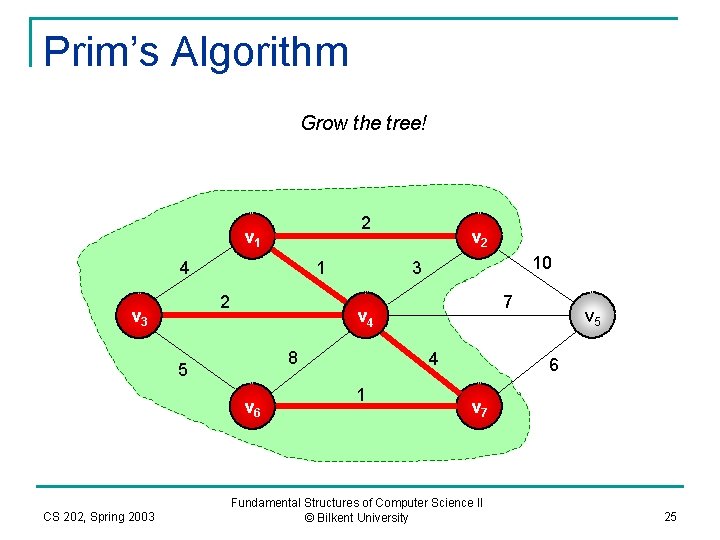
Prim’s Algorithm Grow the tree! 2 v 1 4 1 2 v 3 10 3 7 v 4 8 5 v 6 CS 202, Spring 2003 v 2 4 1 v 5 6 v 7 Fundamental Structures of Computer Science II © Bilkent University 25
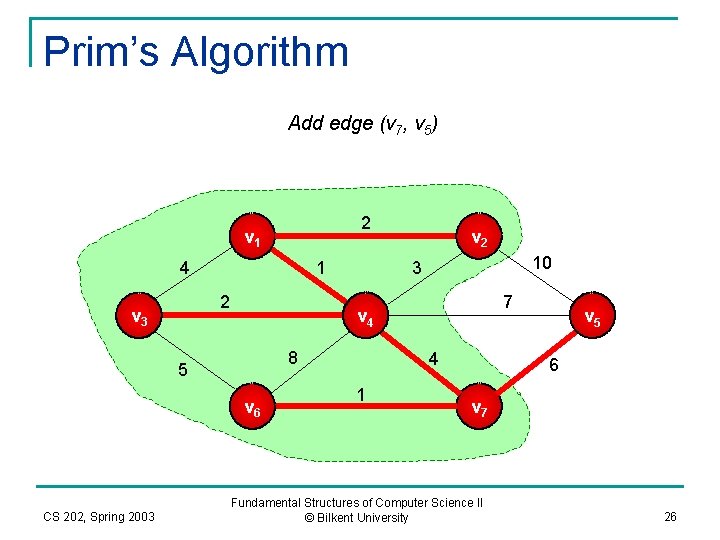
Prim’s Algorithm Add edge (v 7, v 5) 2 v 1 4 1 2 v 3 10 3 7 v 4 8 5 v 6 CS 202, Spring 2003 v 2 4 1 v 5 6 v 7 Fundamental Structures of Computer Science II © Bilkent University 26
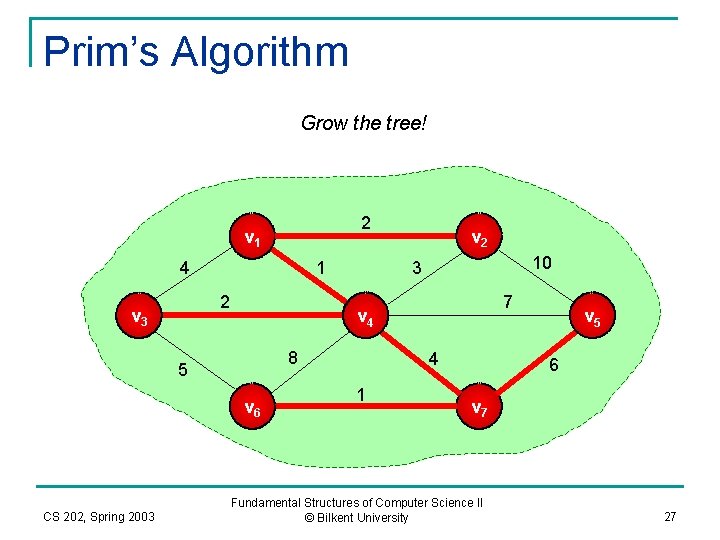
Prim’s Algorithm Grow the tree! 2 v 1 4 1 2 v 3 10 3 7 v 4 8 5 v 6 CS 202, Spring 2003 v 2 4 1 v 5 6 v 7 Fundamental Structures of Computer Science II © Bilkent University 27
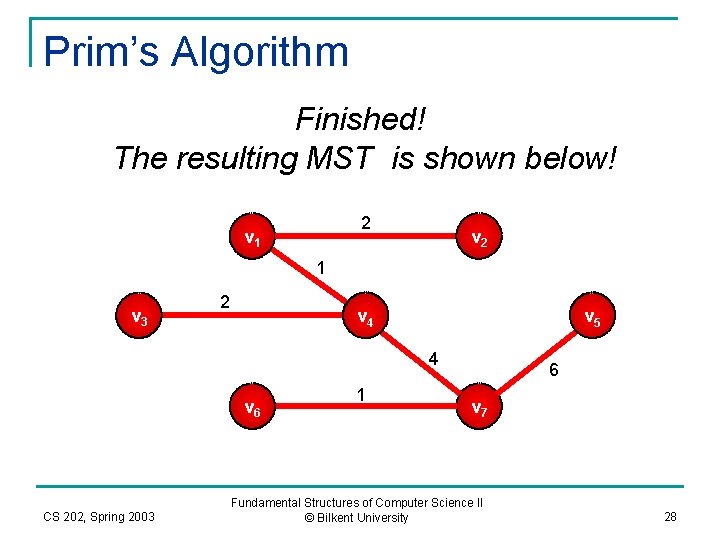
Prim’s Algorithm Finished! The resulting MST is shown below! 2 v 1 v 2 1 v 3 2 v 4 v 5 4 v 6 CS 202, Spring 2003 1 6 v 7 Fundamental Structures of Computer Science II © Bilkent University 28
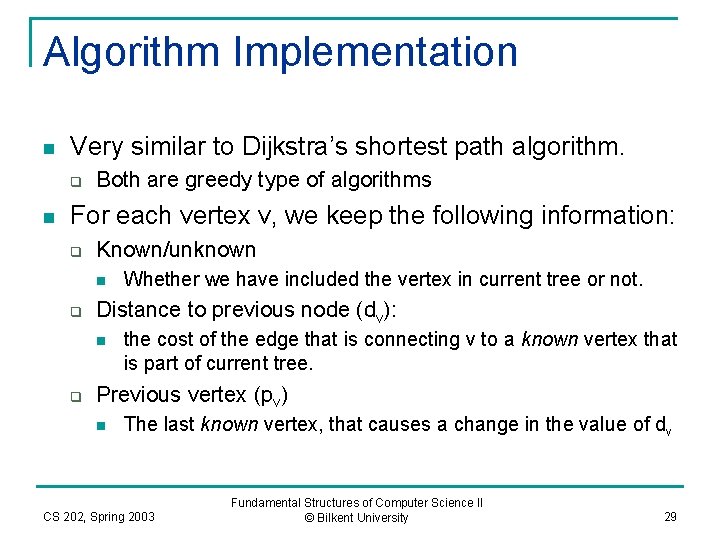
Algorithm Implementation n Very similar to Dijkstra’s shortest path algorithm. q n Both are greedy type of algorithms For each vertex v, we keep the following information: q Known/unknown n q Distance to previous node (dv): n q Whether we have included the vertex in current tree or not. the cost of the edge that is connecting v to a known vertex that is part of current tree. Previous vertex (pv) n The last known vertex, that causes a change in the value of dv CS 202, Spring 2003 Fundamental Structures of Computer Science II © Bilkent University 29
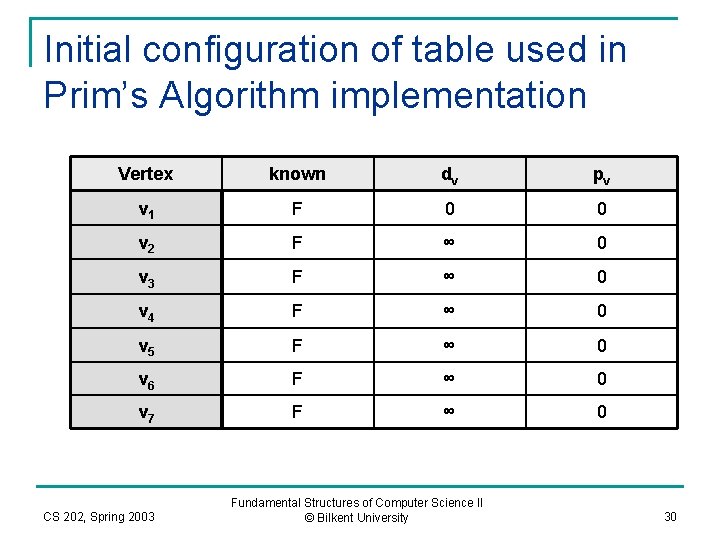
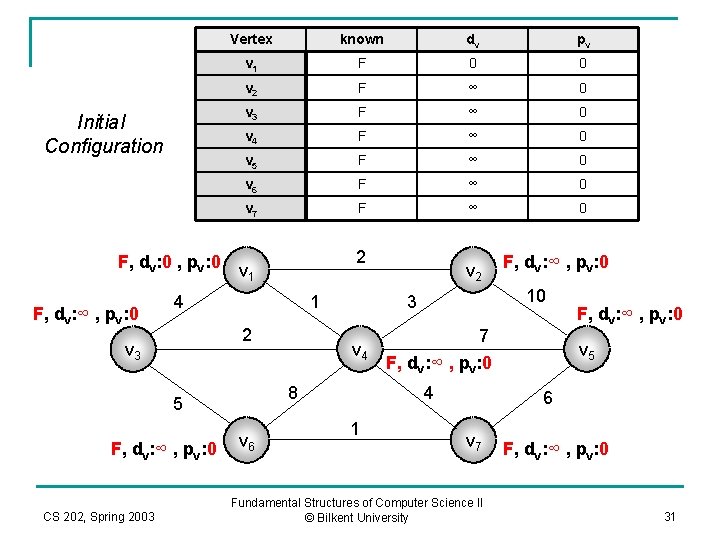
Initial configuration of table used in Prim’s Algorithm implementation Vertex known dv pv v 1 F 0 0 v 2 F ∞ 0 v 3 F ∞ 0 v 4 F ∞ 0 v 5 F ∞ 0 v 6 F ∞ 0 v 7 F ∞ 0 CS 202, Spring 2003 Fundamental Structures of Computer Science II © Bilkent University 30
Vertex known dv pv v 1 F 0 0 v 2 F ∞ 0 v 3 F ∞ 0 v 4 F ∞ 0 v 5 F ∞ 0 v 6 F ∞ 0 v 7 F ∞ 0 F, dv: 0 , pv: 0 v 1 2 Initial Configuration F, dv: ∞ , pv: 0 4 1 2 v 3 F, dv: ∞ , pv: 0 CS 202, Spring 2003 v 4 v 6 7 F, dv: ∞ , pv: 0 4 1 F, dv: ∞ , pv: 0 10 3 8 5 v 2 F, dv: ∞ , pv: 0 v 5 6 v 7 Fundamental Structures of Computer Science II © Bilkent University F, dv: ∞ , pv: 0 31
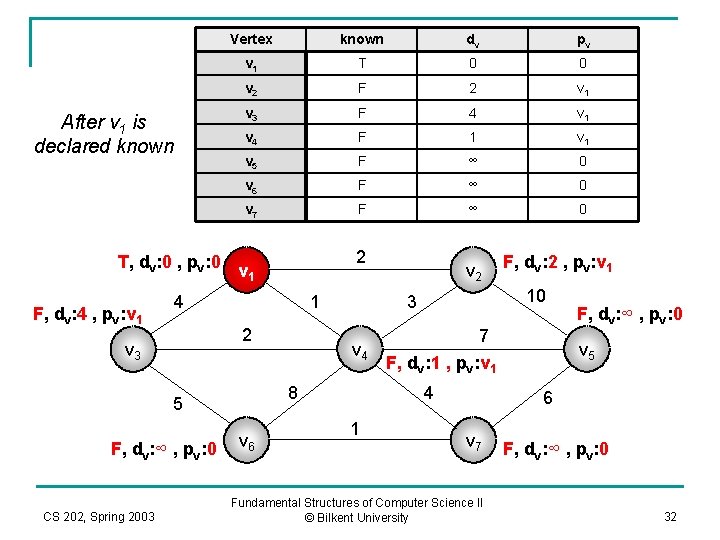
Vertex known dv pv v 1 T 0 0 v 2 F 2 v 1 v 3 F 4 v 1 v 4 F 1 v 5 F ∞ 0 v 6 F ∞ 0 v 7 F ∞ 0 T, dv: 0 , pv: 0 v 1 2 After v 1 is declared known F, dv: 4 , pv: v 1 4 1 2 v 3 F, dv: ∞ , pv: 0 CS 202, Spring 2003 v 4 v 6 7 F, dv: 1 , pv: v 1 4 1 F, dv: 2 , pv: v 1 10 3 8 5 v 2 F, dv: ∞ , pv: 0 v 5 6 v 7 Fundamental Structures of Computer Science II © Bilkent University F, dv: ∞ , pv: 0 32
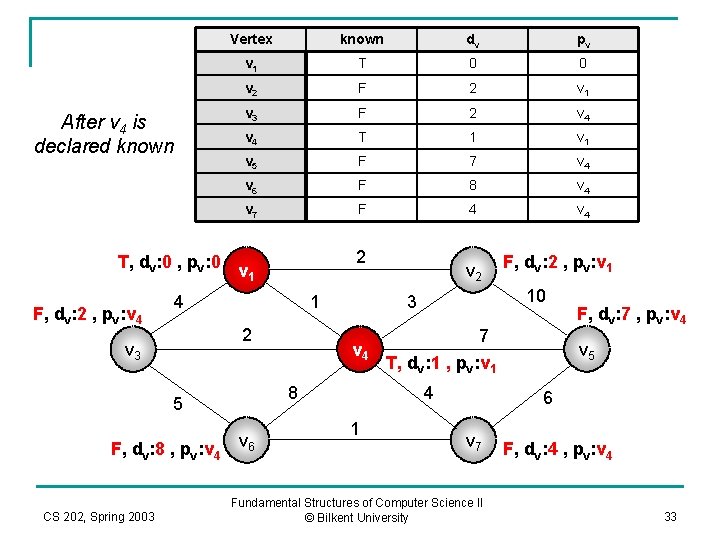
Vertex known dv pv v 1 T 0 0 v 2 F 2 v 1 v 3 F 2 v 4 T 1 v 5 F 7 v 4 v 6 F 8 v 4 v 7 F 4 v 4 T, dv: 0 , pv: 0 v 1 2 After v 4 is declared known F, dv: 2 , pv: v 4 4 1 2 v 3 F, dv: 8 , pv: v 4 CS 202, Spring 2003 v 4 v 6 7 T, dv: 1 , pv: v 1 4 1 F, dv: 2 , pv: v 1 10 3 8 5 v 2 F, dv: 7 , pv: v 4 v 5 6 v 7 Fundamental Structures of Computer Science II © Bilkent University F, dv: 4 , pv: v 4 33
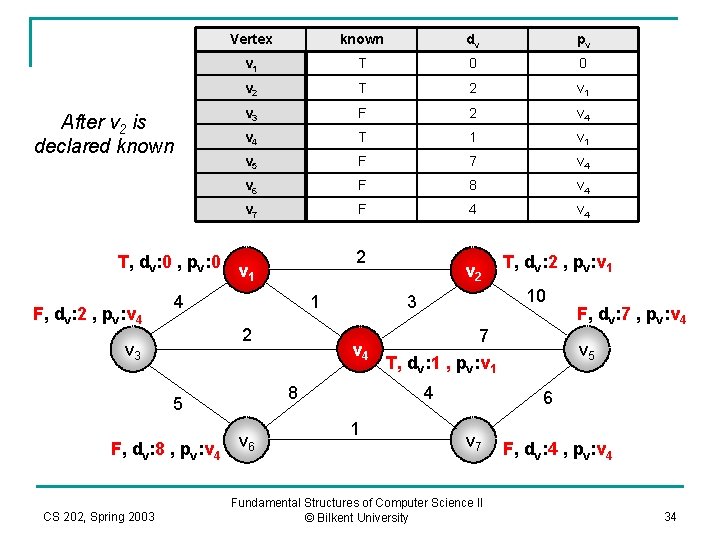
Vertex known dv pv v 1 T 0 0 v 2 T 2 v 1 v 3 F 2 v 4 T 1 v 5 F 7 v 4 v 6 F 8 v 4 v 7 F 4 v 4 T, dv: 0 , pv: 0 v 1 2 After v 2 is declared known F, dv: 2 , pv: v 4 4 1 2 v 3 F, dv: 8 , pv: v 4 CS 202, Spring 2003 v 4 v 6 7 T, dv: 1 , pv: v 1 4 1 T, dv: 2 , pv: v 1 10 3 8 5 v 2 F, dv: 7 , pv: v 4 v 5 6 v 7 Fundamental Structures of Computer Science II © Bilkent University F, dv: 4 , pv: v 4 34
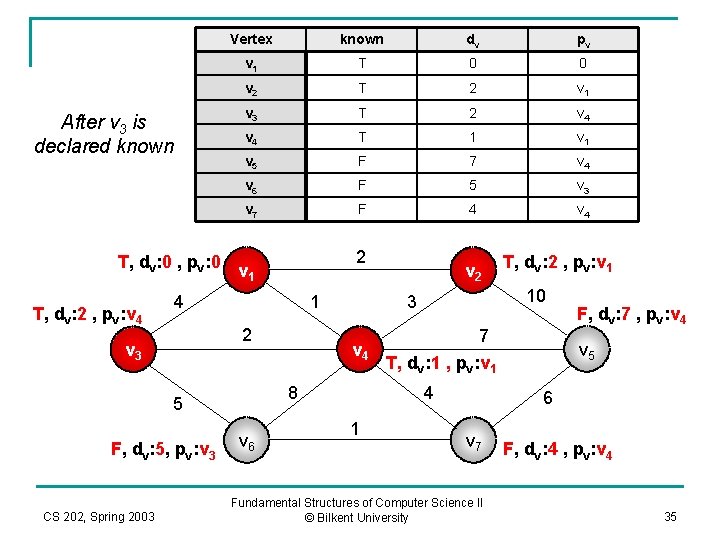
Vertex known dv pv v 1 T 0 0 v 2 T 2 v 1 v 3 T 2 v 4 T 1 v 5 F 7 v 4 v 6 F 5 v 3 v 7 F 4 v 4 T, dv: 0 , pv: 0 v 1 2 After v 3 is declared known T, dv: 2 , pv: v 4 4 1 2 v 3 F, dv: 5, pv: v 3 CS 202, Spring 2003 v 4 v 6 7 T, dv: 1 , pv: v 1 4 1 T, dv: 2 , pv: v 1 10 3 8 5 v 2 F, dv: 7 , pv: v 4 v 5 6 v 7 Fundamental Structures of Computer Science II © Bilkent University F, dv: 4 , pv: v 4 35
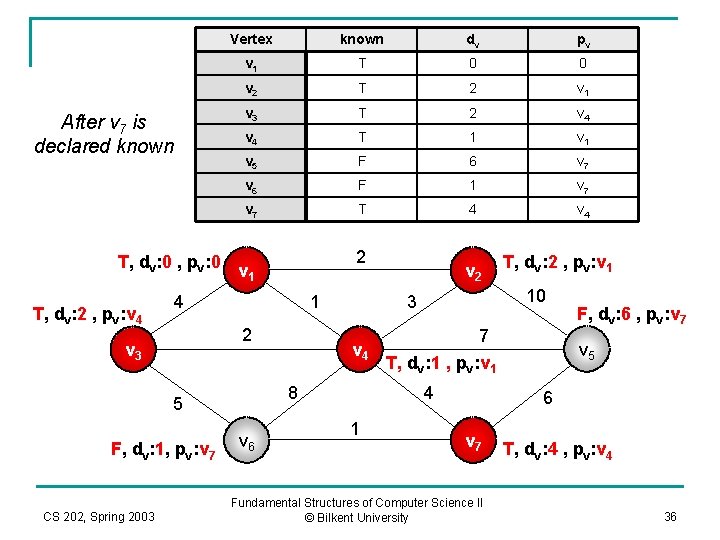
Vertex known dv pv v 1 T 0 0 v 2 T 2 v 1 v 3 T 2 v 4 T 1 v 5 F 6 v 7 v 6 F 1 v 7 T 4 v 4 T, dv: 0 , pv: 0 v 1 2 After v 7 is declared known T, dv: 2 , pv: v 4 4 1 2 v 3 F, dv: 1, pv: v 7 CS 202, Spring 2003 v 4 v 6 7 T, dv: 1 , pv: v 1 4 1 T, dv: 2 , pv: v 1 10 3 8 5 v 2 F, dv: 6 , pv: v 7 v 5 6 v 7 Fundamental Structures of Computer Science II © Bilkent University T, dv: 4 , pv: v 4 36
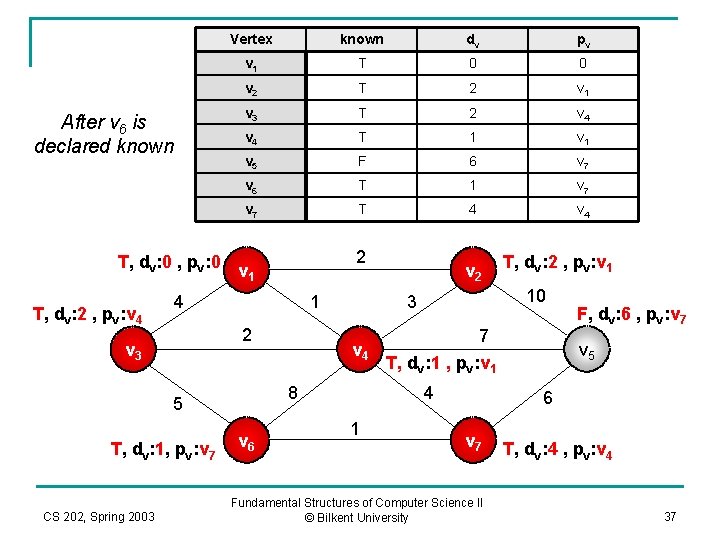
Vertex known dv pv v 1 T 0 0 v 2 T 2 v 1 v 3 T 2 v 4 T 1 v 5 F 6 v 7 v 6 T 1 v 7 T 4 v 4 T, dv: 0 , pv: 0 v 1 2 After v 6 is declared known T, dv: 2 , pv: v 4 4 1 2 v 3 T, dv: 1, pv: v 7 CS 202, Spring 2003 v 4 v 6 7 T, dv: 1 , pv: v 1 4 1 T, dv: 2 , pv: v 1 10 3 8 5 v 2 F, dv: 6 , pv: v 7 v 5 6 v 7 Fundamental Structures of Computer Science II © Bilkent University T, dv: 4 , pv: v 4 37
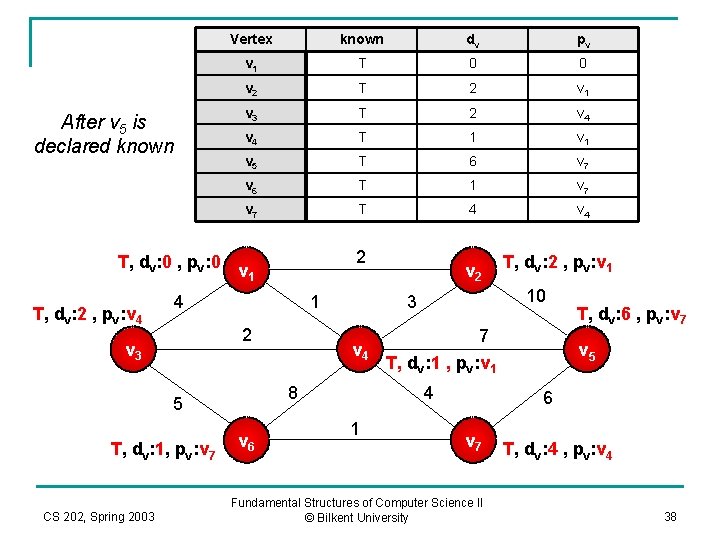
Vertex known dv pv v 1 T 0 0 v 2 T 2 v 1 v 3 T 2 v 4 T 1 v 5 T 6 v 7 v 6 T 1 v 7 T 4 v 4 T, dv: 0 , pv: 0 v 1 2 After v 5 is declared known T, dv: 2 , pv: v 4 4 1 2 v 3 T, dv: 1, pv: v 7 CS 202, Spring 2003 v 4 v 6 7 T, dv: 1 , pv: v 1 4 1 T, dv: 2 , pv: v 1 10 3 8 5 v 2 T, dv: 6 , pv: v 7 v 5 6 v 7 Fundamental Structures of Computer Science II © Bilkent University T, dv: 4 , pv: v 4 38
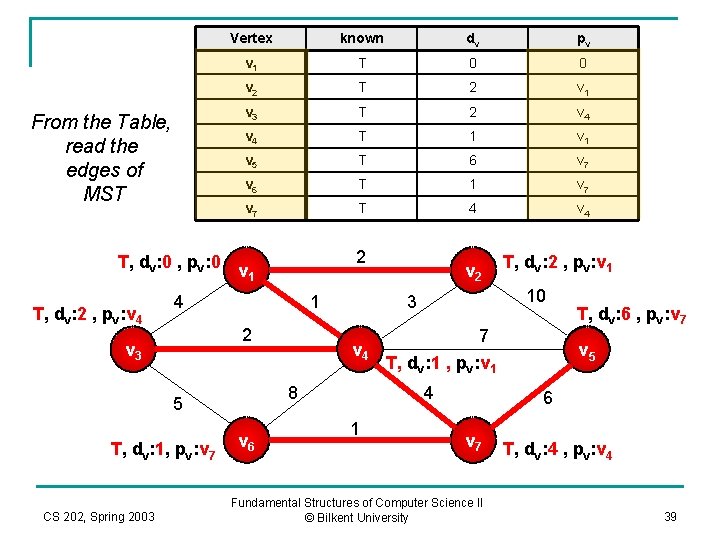
Vertex known dv pv v 1 T 0 0 v 2 T 2 v 1 v 3 T 2 v 4 T 1 v 5 T 6 v 7 v 6 T 1 v 7 T 4 v 4 T, dv: 0 , pv: 0 v 1 2 From the Table, read the edges of MST T, dv: 2 , pv: v 4 4 1 2 v 3 T, dv: 1, pv: v 7 CS 202, Spring 2003 v 4 v 6 7 T, dv: 1 , pv: v 1 4 1 T, dv: 2 , pv: v 1 10 3 8 5 v 2 T, dv: 6 , pv: v 7 v 5 6 v 7 Fundamental Structures of Computer Science II © Bilkent University T, dv: 4 , pv: v 4 39
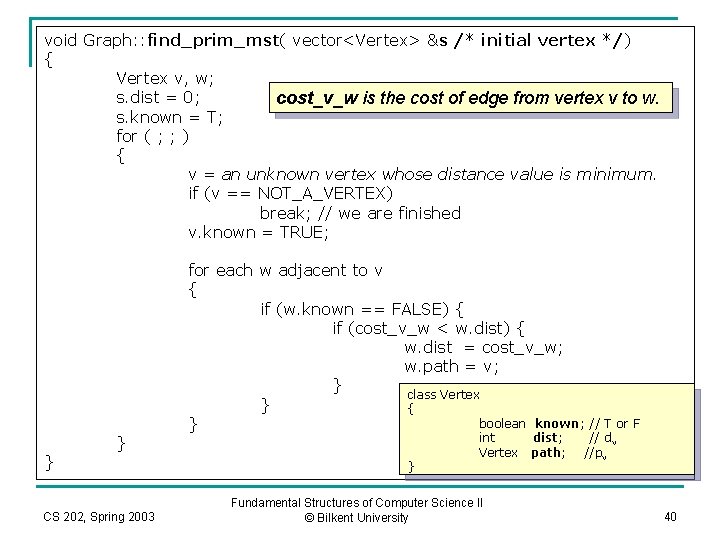
void Graph: : find_prim_mst( vector<Vertex> &s /* initial vertex */) { Vertex v, w; s. dist = 0; cost_v_w is the cost of edge from vertex v to w. s. known = T; for ( ; ; ) { v = an unknown vertex whose distance value is minimum. if (v == NOT_A_VERTEX) break; // we are finished v. known = TRUE; } } CS 202, Spring 2003 for each w adjacent to v { if (w. known == FALSE) { if (cost_v_w < w. dist) { w. dist = cost_v_w; w. path = v; } class Vertex } { boolean known; // T or F } } int Vertex Fundamental Structures of Computer Science II © Bilkent University dist; path; // dv //pv 40
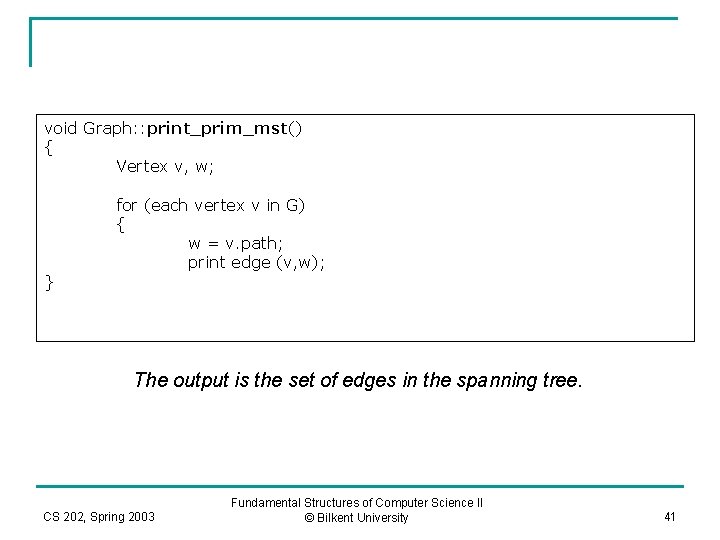
void Graph: : print_prim_mst() { Vertex v, w; } for (each vertex v in G) { w = v. path; print edge (v, w); The output is the set of edges in the spanning tree. CS 202, Spring 2003 Fundamental Structures of Computer Science II © Bilkent University 41
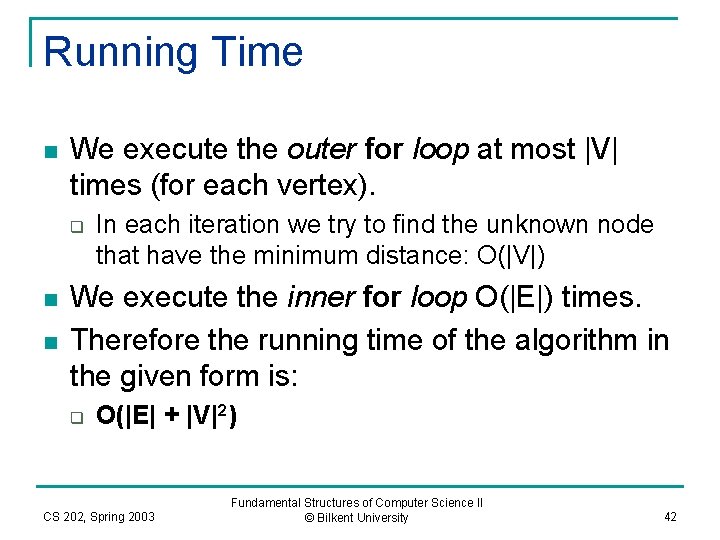
Running Time n We execute the outer for loop at most |V| times (for each vertex). q n n In each iteration we try to find the unknown node that have the minimum distance: O(|V|) We execute the inner for loop O(|E|) times. Therefore the running time of the algorithm in the given form is: q O(|E| + |V|2) CS 202, Spring 2003 Fundamental Structures of Computer Science II © Bilkent University 42
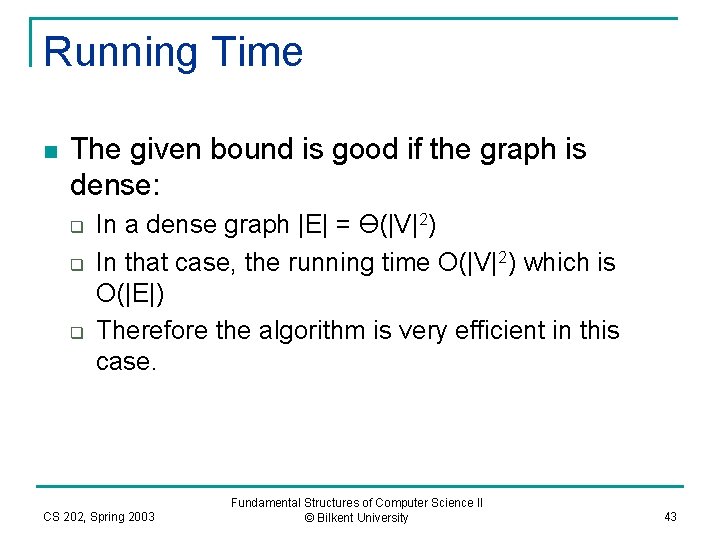
Running Time n The given bound is good if the graph is dense: q q q In a dense graph |E| = Ө(|V|2) In that case, the running time O(|V|2) which is O(|E|) Therefore the algorithm is very efficient in this case. CS 202, Spring 2003 Fundamental Structures of Computer Science II © Bilkent University 43
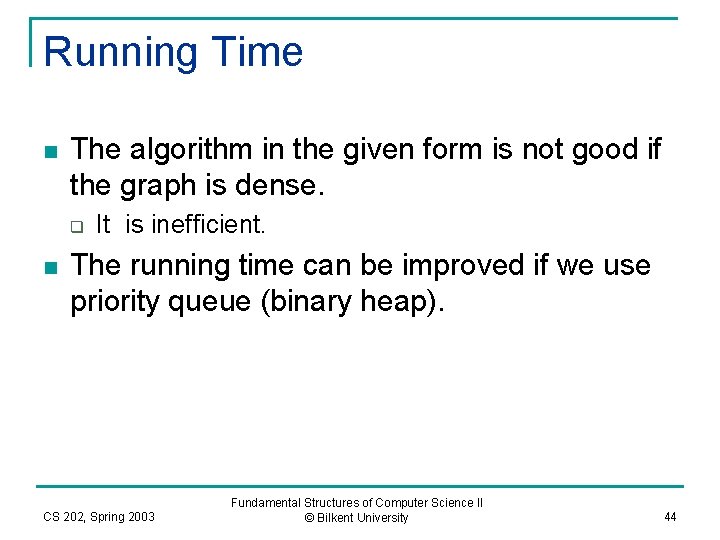
Running Time n The algorithm in the given form is not good if the graph is dense. q n It is inefficient. The running time can be improved if we use priority queue (binary heap). CS 202, Spring 2003 Fundamental Structures of Computer Science II © Bilkent University 44
Running Time n If we use priority queue of vertices q n The outer loop is executed O(|V|) times. q n The vertex with minimum distance is kept at the root of the heap. The search inside the outer for loop for a vertex that has the minimum distance takes O(log|V|) time. The inner loop is executed O(|E|) times. q q The distances can be updates O(|E|) times. The distance value of a vertex can be updated using decrease. Key() operation of binary heaps, which works in O(|V|) time. (|V| is the size of the binary heap). CS 202, Spring 2003 Fundamental Structures of Computer Science II © Bilkent University 45
Running Time n Therefore the running time of MST algorithm using priority queues is: q n If |E| is O(|V|) then q q n O(|V| x log(|V|)+ |E| x log(|V|)) = O(|E| x log(|V|)) Running time is O(|V| x log(|V|) ) This is for sparse graphs. Compare this with the running time of the original algorithm (the one that does not use priority queues) for sparse graphs, which is O(|V|2) CS 202, Spring 2003 Fundamental Structures of Computer Science II © Bilkent University 46
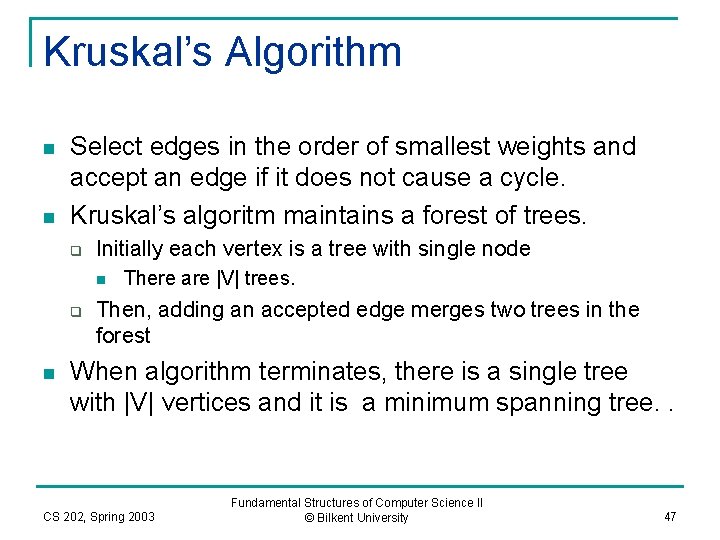
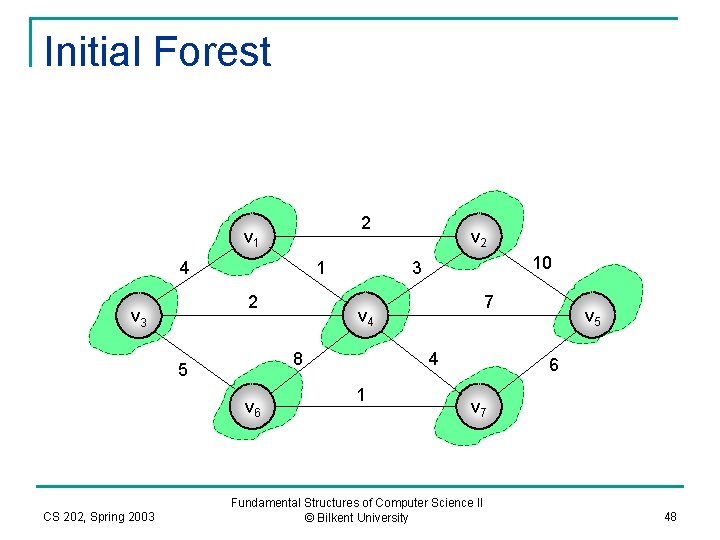
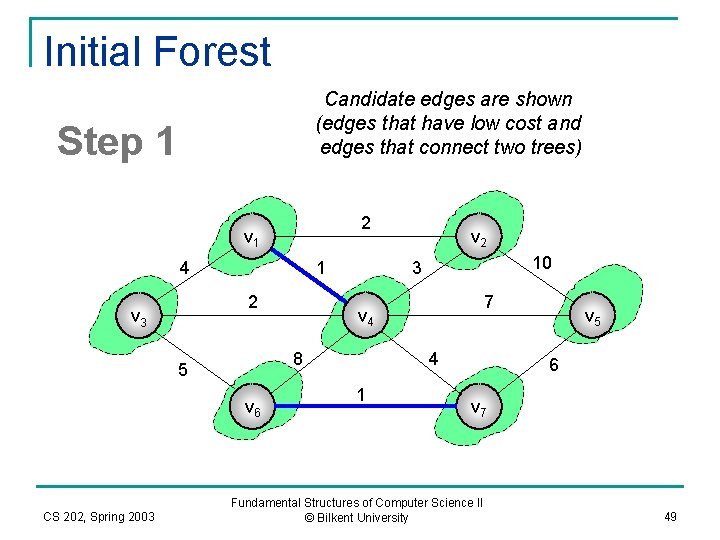
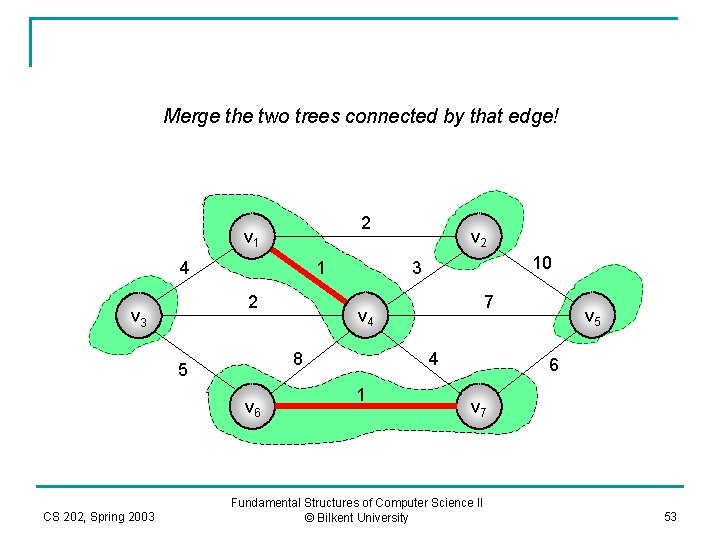
Kruskal’s Algorithm n n Select edges in the order of smallest weights and accept an edge if it does not cause a cycle. Kruskal’s algoritm maintains a forest of trees. q Initially each vertex is a tree with single node n q n There are |V| trees. Then, adding an accepted edge merges two trees in the forest When algorithm terminates, there is a single tree with |V| vertices and it is a minimum spanning tree. . CS 202, Spring 2003 Fundamental Structures of Computer Science II © Bilkent University 47
Initial Forest 2 v 1 4 1 2 v 3 v 6 CS 202, Spring 2003 10 3 7 v 4 8 5 v 2 4 1 v 5 6 v 7 Fundamental Structures of Computer Science II © Bilkent University 48
Initial Forest Candidate edges are shown (edges that have low cost and edges that connect two trees) Step 1 2 v 1 4 1 2 v 3 v 6 CS 202, Spring 2003 10 3 7 v 4 8 5 v 2 4 1 v 5 6 v 7 Fundamental Structures of Computer Science II © Bilkent University 49
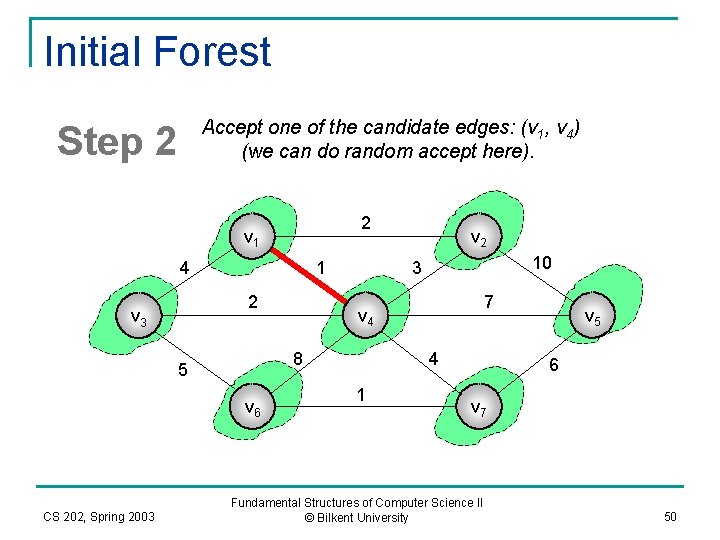
Initial Forest Accept one of the candidate edges: (v 1, v 4) (we can do random accept here). Step 2 2 v 1 4 1 2 v 3 v 6 CS 202, Spring 2003 10 3 7 v 4 8 5 v 2 4 1 v 5 6 v 7 Fundamental Structures of Computer Science II © Bilkent University 50
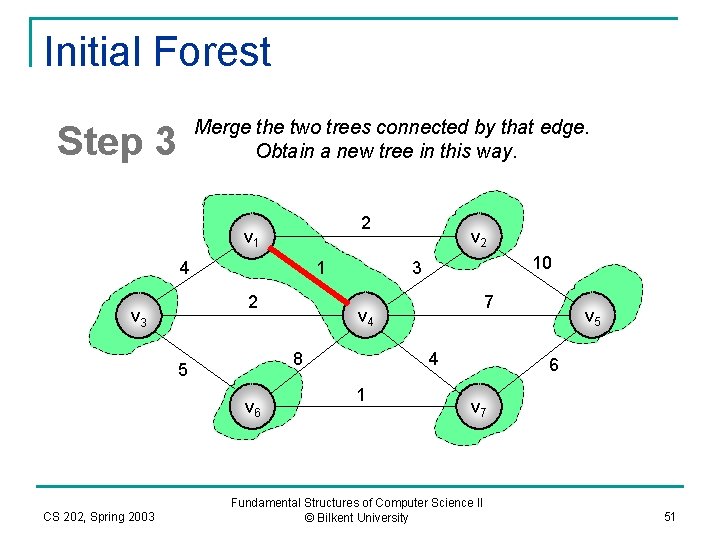
Initial Forest Merge the two trees connected by that edge. Obtain a new tree in this way. Step 3 2 v 1 4 1 2 v 3 v 6 CS 202, Spring 2003 10 3 7 v 4 8 5 v 2 4 1 v 5 6 v 7 Fundamental Structures of Computer Science II © Bilkent University 51
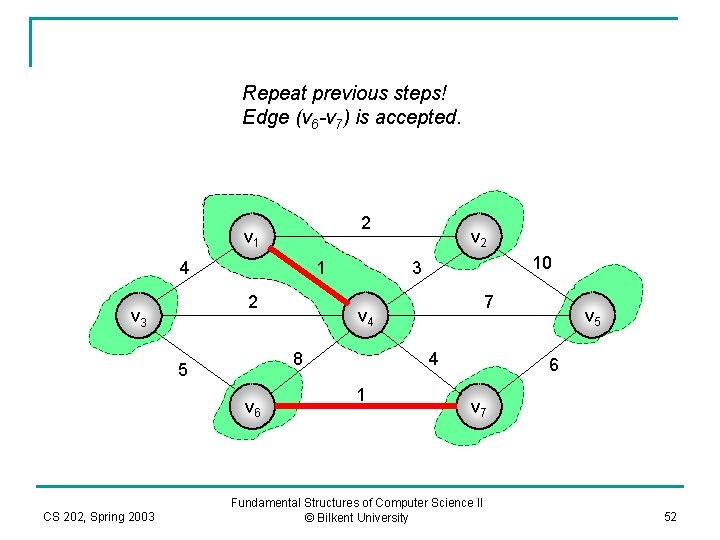
Repeat previous steps! Edge (v 6 -v 7) is accepted. 2 v 1 4 1 2 v 3 v 6 CS 202, Spring 2003 10 3 7 v 4 8 5 v 2 4 1 v 5 6 v 7 Fundamental Structures of Computer Science II © Bilkent University 52
Merge the two trees connected by that edge! 2 v 1 4 1 2 v 3 v 6 CS 202, Spring 2003 10 3 7 v 4 8 5 v 2 4 1 v 5 6 v 7 Fundamental Structures of Computer Science II © Bilkent University 53
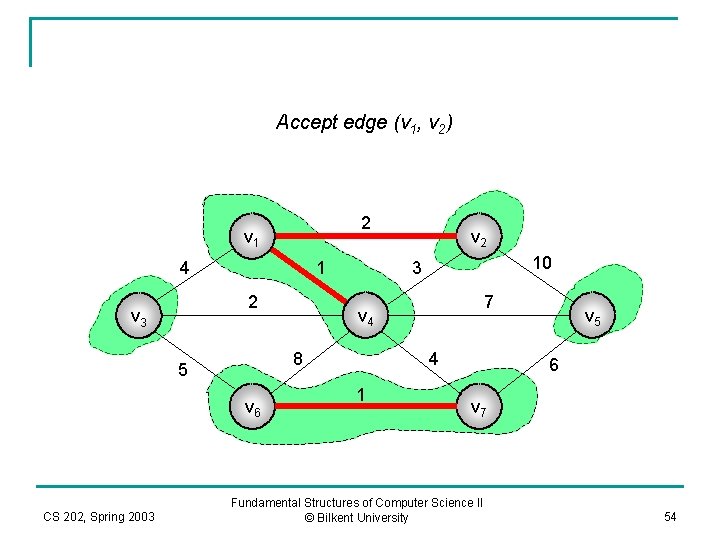
Accept edge (v 1, v 2) 2 v 1 4 1 2 v 3 v 6 CS 202, Spring 2003 10 3 7 v 4 8 5 v 2 4 1 v 5 6 v 7 Fundamental Structures of Computer Science II © Bilkent University 54
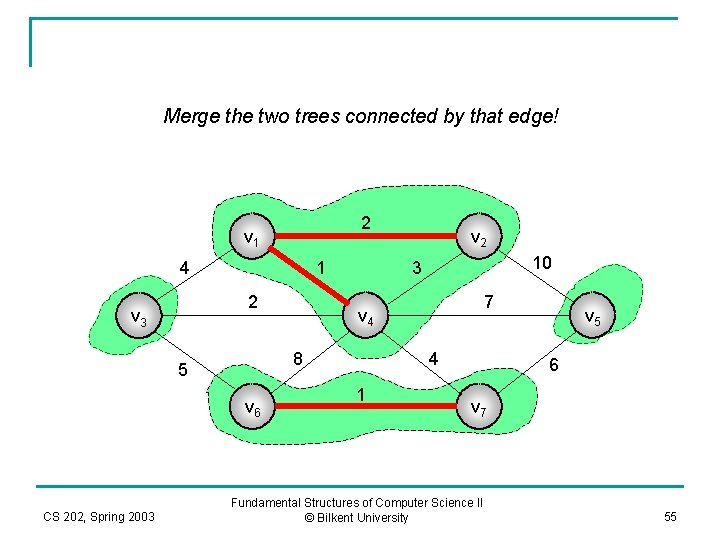
Merge the two trees connected by that edge! 2 v 1 4 1 2 v 3 v 6 CS 202, Spring 2003 10 3 7 v 4 8 5 v 2 4 1 v 5 6 v 7 Fundamental Structures of Computer Science II © Bilkent University 55
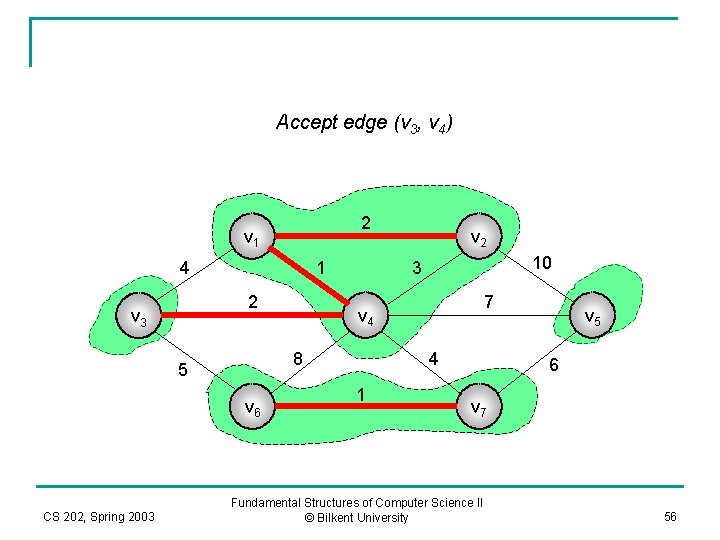
Accept edge (v 3, v 4) 2 v 1 4 1 2 v 3 v 6 CS 202, Spring 2003 10 3 7 v 4 8 5 v 2 4 1 v 5 6 v 7 Fundamental Structures of Computer Science II © Bilkent University 56
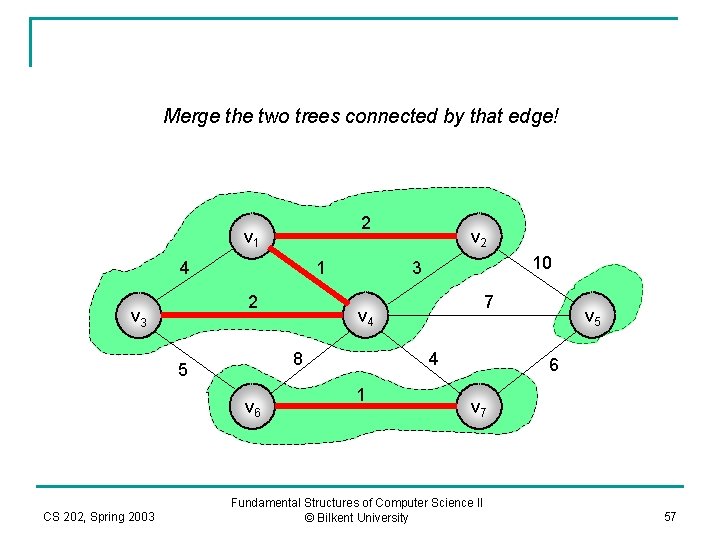
Merge the two trees connected by that edge! 2 v 1 4 1 2 v 3 v 6 CS 202, Spring 2003 10 3 7 v 4 8 5 v 2 4 1 v 5 6 v 7 Fundamental Structures of Computer Science II © Bilkent University 57
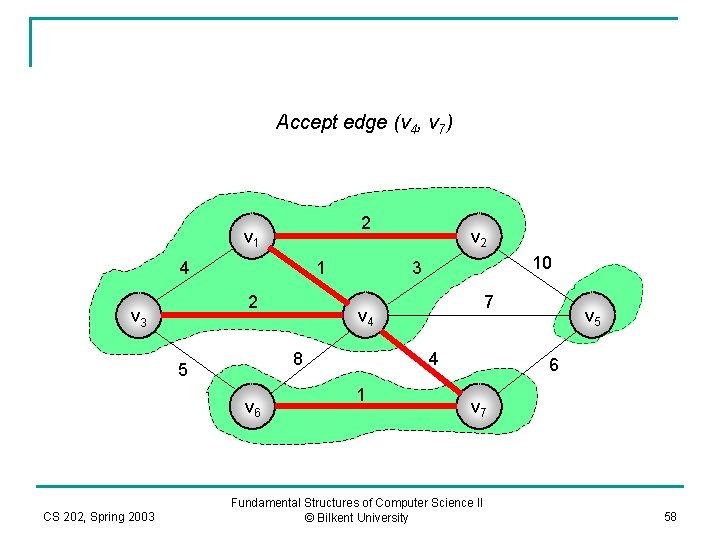
Accept edge (v 4, v 7) 2 v 1 4 1 2 v 3 v 6 CS 202, Spring 2003 10 3 7 v 4 8 5 v 2 4 1 v 5 6 v 7 Fundamental Structures of Computer Science II © Bilkent University 58
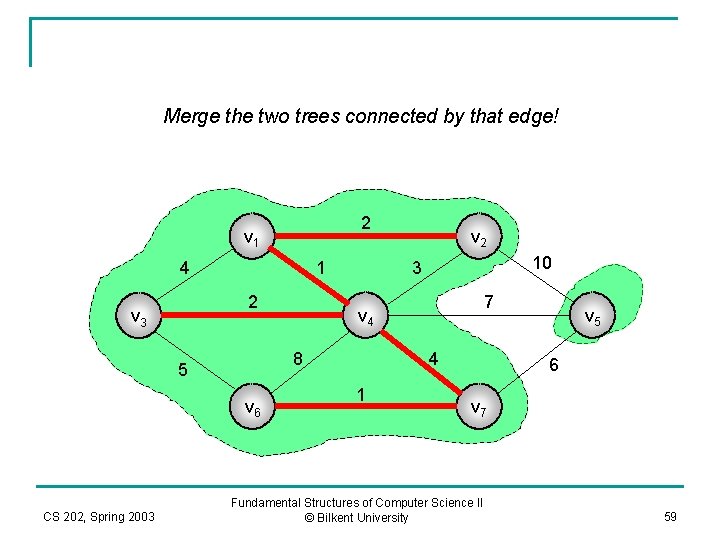
Merge the two trees connected by that edge! 2 v 1 4 1 2 v 3 v 6 CS 202, Spring 2003 10 3 7 v 4 8 5 v 2 4 1 v 5 6 v 7 Fundamental Structures of Computer Science II © Bilkent University 59
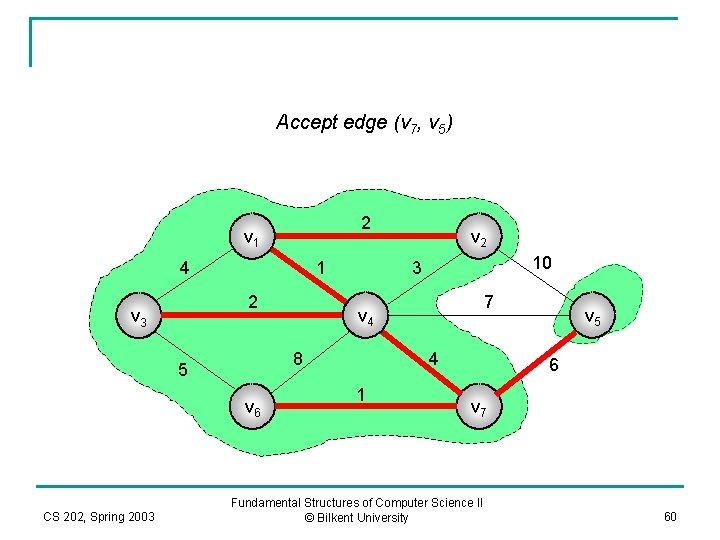
Accept edge (v 7, v 5) 2 v 1 4 1 2 v 3 v 6 CS 202, Spring 2003 10 3 7 v 4 8 5 v 2 4 1 v 5 6 v 7 Fundamental Structures of Computer Science II © Bilkent University 60
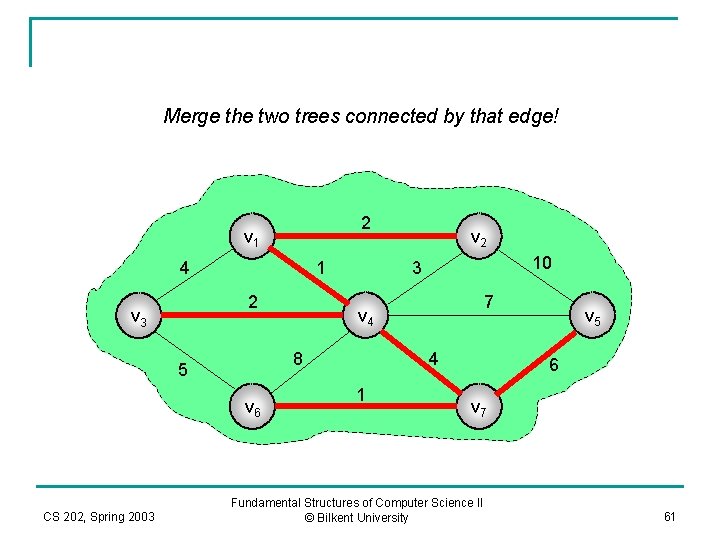
Merge the two trees connected by that edge! 2 v 1 4 1 2 v 3 v 6 CS 202, Spring 2003 10 3 7 v 4 8 5 v 2 4 1 v 5 6 v 7 Fundamental Structures of Computer Science II © Bilkent University 61
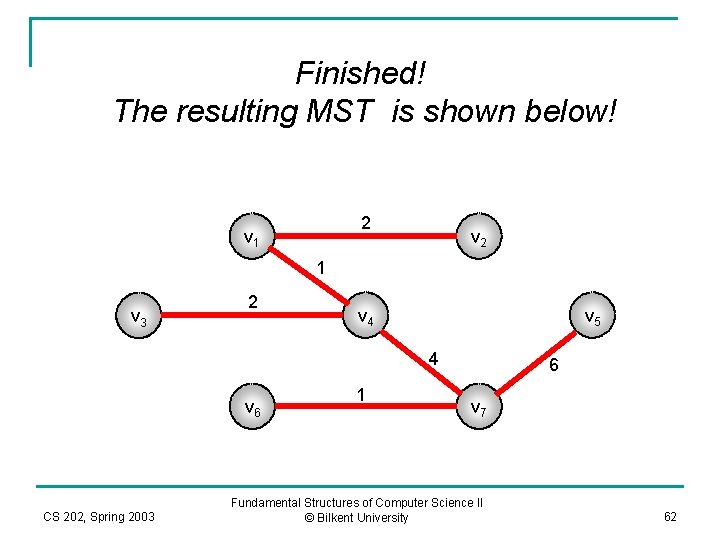
Finished! The resulting MST is shown below! 2 v 1 v 2 1 v 3 2 v 4 v 5 4 v 6 CS 202, Spring 2003 1 6 v 7 Fundamental Structures of Computer Science II © Bilkent University 62
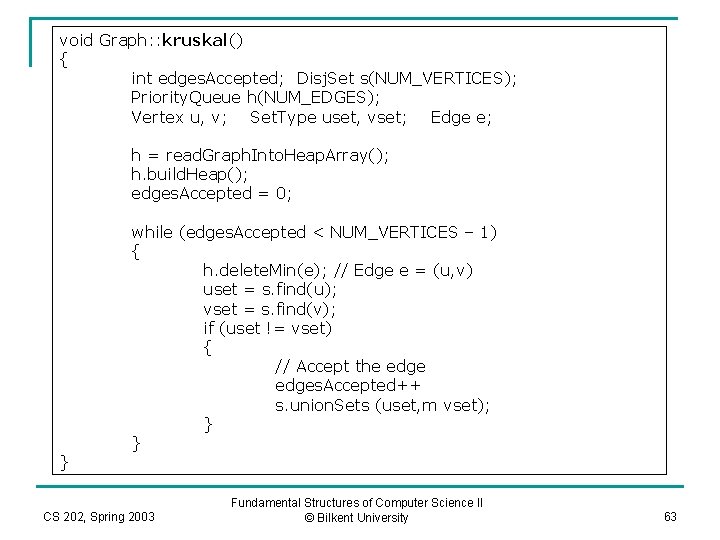
void Graph: : kruskal() { int edges. Accepted; Disj. Set s(NUM_VERTICES); Priority. Queue h(NUM_EDGES); Vertex u, v; Set. Type uset, vset; Edge e; h = read. Graph. Into. Heap. Array(); h. build. Heap(); edges. Accepted = 0; } while (edges. Accepted < NUM_VERTICES – 1) { h. delete. Min(e); // Edge e = (u, v) uset = s. find(u); vset = s. find(v); if (uset != vset) { // Accept the edges. Accepted++ s. union. Sets (uset, m vset); } } CS 202, Spring 2003 Fundamental Structures of Computer Science II © Bilkent University 63