
Granulocytes A collection of white blood cells whose
Granulocytes • A collection of white blood cells whose cytoplasm has a ___________________ ___ when viewed under a microscope • Function: generally _ • Generated in red bone marrow – – –

Granulocytes • Neutrophils • Appearance: – Very fine _ – Multi-lobed nucleus • Aka: PML: Polymorphonuclear Leukocytes • Function – First WBCs to arrive at the infection site – – Phagocytize bacteria and fungus
Neutrophils • Kill bacteria by process called _ – Oxygen is metabolized to form _____________________ by the neutrophil – Able to ________________ offending bacteria

Granulocytes • Eosinophils • Eosin: • Phil: loving • Appearance: – –
Eosinophils • Function: – Lysosome-like: filled with _ – – • tapeworms, flukes, pinworms, hookworms

Granulocytes • Basophils • Baso: basic • Phils: loving • • Appearance: – Bi-lobed nucleus – Fewer, but larger granules… _ • Function – – Promotes inflammation: histamines
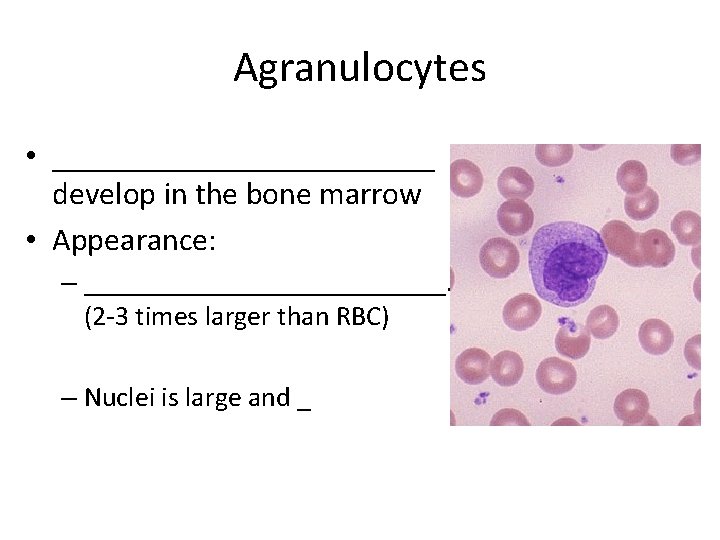
Agranulocytes • ____________ develop in the bone marrow • Appearance: – _____________. (2 -3 times larger than RBC) – Nuclei is large and _
Agranulocytes • Monocytes • Function: – Become ____________________ as they leave the blood stream – Highly mobile, _ – Phagocytize bacteria, viruses, cellular debris
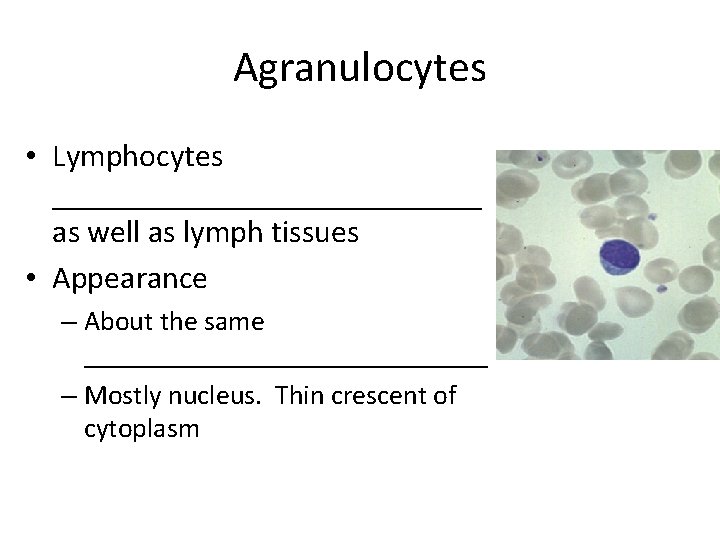
Agranulocytes • Lymphocytes ______________ as well as lymph tissues • Appearance – About the same _______________ – Mostly nucleus. Thin crescent of cytoplasm
Lymphocytes • Function: – _______________: cell mediated responses against _ – _______________: change into plasma cells which release antibodies
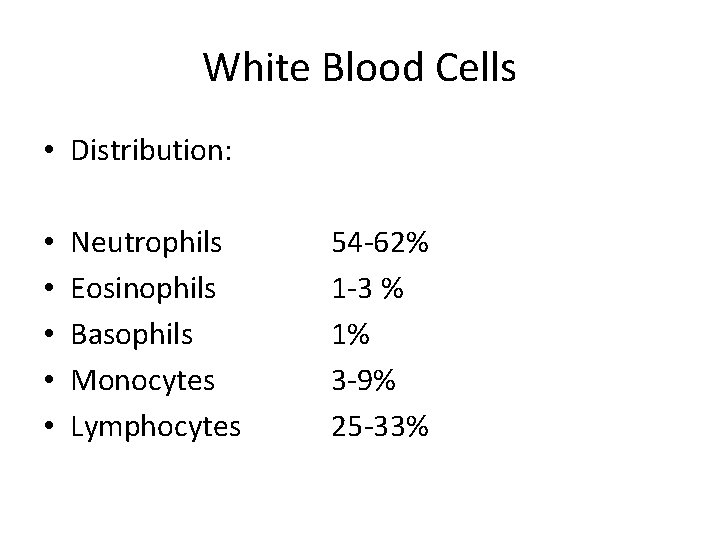
White Blood Cells • Distribution: • • • Neutrophils Eosinophils Basophils Monocytes Lymphocytes 54 -62% 1 -3 % 1% 3 -9% 25 -33%
Leukopoeisis • __________________: production of white blood cells – Stimulated by chemical messengers – Two types of glycoproteins • • Colony Stimulating Factors
Leukopoiesis • Hemocytoblast – • Will give rise to basophils, eosinophils, neutrophils, and monocytes – • Will give rise to _
Leukopoiesis: granulocytes • Myeloid cells _________________ promyelocytes – _________________ myelocytye – _________________________________ myelocyte
Leukopoiesis: monocyte • Hemocytoblast myeloid stem cell myeloblast – Up to this point, no changes from the granular leukocytes – _____________________ __ monocyte
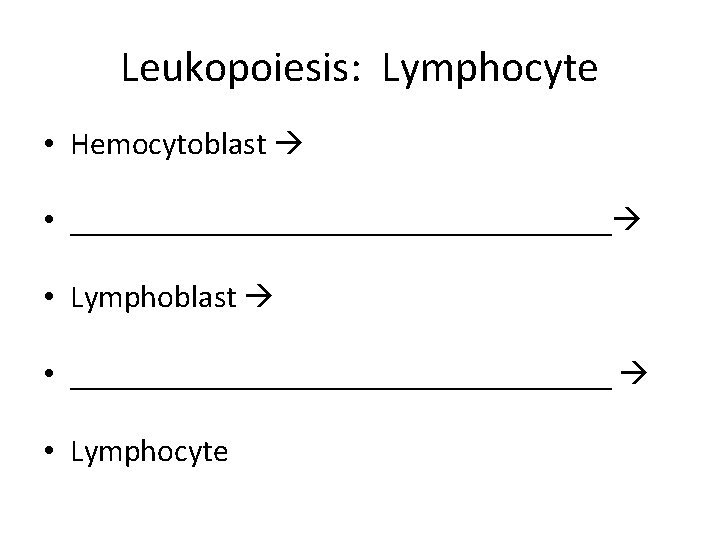
Leukopoiesis: Lymphocyte • Hemocytoblast • __________________________________ • Lymphocyte
White Blood Cell Counts • Percentages of the WBCs are of clinical value • Increased leukocytes (overall) – • May indicate infection, exercise, strong emotions or loss of body fluids
White Blood Cell counts • Decreased Leukocytes – • Penia: _ • Flu, measles, mumps, chicken pox, AIDS, polio • ______________________, lead, arsenic or mercury poisoning
Leukemia • Group of cancerous conditions _ – Increased _ – Impairs bone marrow function • Severe _ – Named according to the _ • Myelocytic: myeloblast descendants: granulocytes and monocytes • Lymphocytic: lymphocytes
Leukemias • – ____________________ advancing – Seen in _ – Seen more in children • – ____________________ advancing – Seen in later cells stages _ – Seen more in elderly
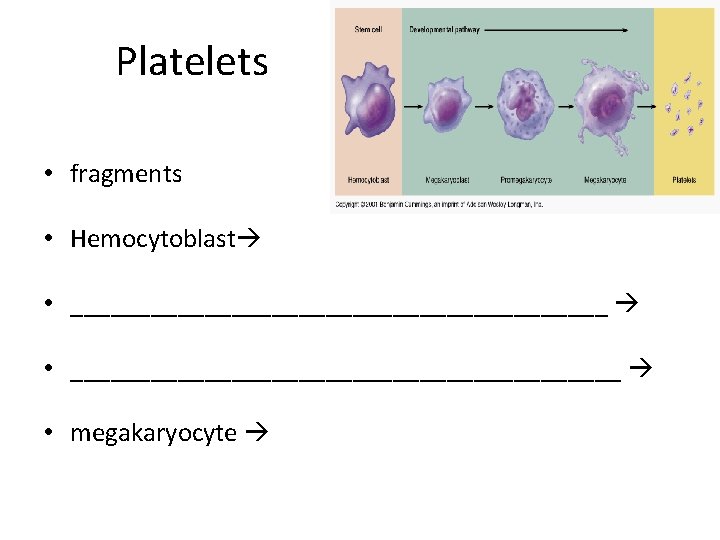
Platelets • fragments • Hemocytoblast • _________________________________________ • megakaryocyte
Hemostasis • Heme: blood stasis: stopping • Process is fast, localized and controlled • Hemostasis causes – – –
Vascular Spasm • Damage to blood vessel stimulates ____________________ results in less blood loss • Allows formation of _ – Platelets release ________________ which further constricts the smooth muscle in the vessel wall.
Platelet Plug Formation • Platelets adhere to _ – Particularly the _________________ in the connective tissue • Platelets + collagen – change in shape – Becomes _ • • Effective for _______________ but not large ones
Blood Coagulation • A set of reactions in which blood is transformed _ • Coagulation follows _
Blood coagulation • Blood coagulation is dependent on balance • The _________________of pro-coagulants and anti-coagulants – Inability to synthesize procoagulants by the ___________________ results in severe bleeding disorders
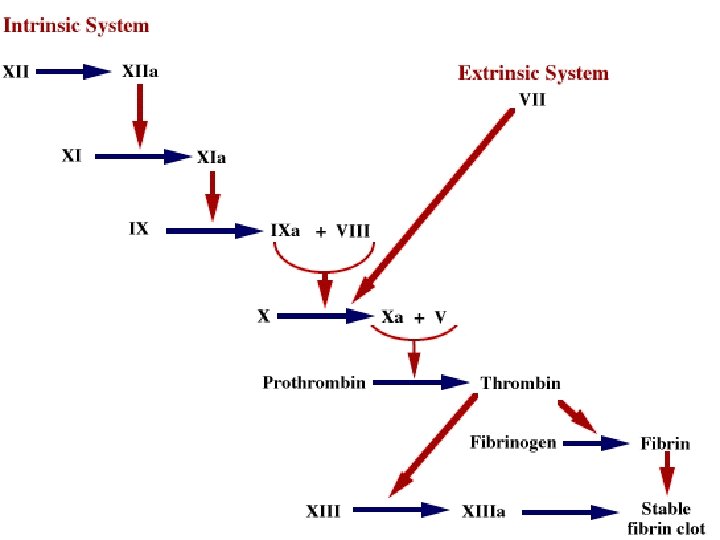
Major event of coagulation • The _______________ of the plasma protein _ • Fibrin is composed of insoluble threads
Extrinsic Clotting Factors • Triggered when contacts – – Any ________________ outside the blood vessels
Extrinsic Clotting • Damaged tissues release thromboplastin also called Factor III • • Depends also on _
Extrinsic Clotting • End result: Fibrinogen pieces _ • Before: soluble • After: Fibrin sticks to exposed surfaces, ___________________, and prevents blood loss
Intrinsic Clotting • Initiated by Factor VII aka Hageman Factor • Due to _________________ in the _ – Foreign substances in the blood – Blood stored in _
Clots • Fibrin prevents blood loss by forming clots • • Plasminogen converted to Plasmin • Plasmin _
Clots • Thrombus: _ – DVT – Deep Vein Thrombosis • Embolus: – if a thrombus fragments or breaks loose and travels through the blood stream, it becomes an embolus
Clots • Embolism: the traveling embolus becomes lodged at a _ – Pulmonary embolism: blood clot gets lodged in lung vessels
Hemostasis Disorders • Disseminated Intravascular Coagulation (DIC): – • Residual blood cannot clot • • Most common as: – A complication of pregnancy – A result of ______________________ or incompatible blood transfusions
Hemostasis Disorders: Bleeding Disorders • Thrombocytopenia – condition where the number of _ – Patients show petechiae due to _ – Caused by suppression or destruction of bone marrow (e. g. , malignancy, radiation) – Platelet counts less than 50, 000/mm 3 is diagnostic for this condition – Treated with _
Hemostasis Disorders: Bleeding Disorders • Hemophilias – hereditary bleeding disorders caused by lack of clotting factors – Symptoms include _
Hemostasis Disorders: Bleeding Disorders • Hemophilia A – ______________________ due to a deficiency of factor VIII • Hemophilia B – due to a deficiency of _ • Hemophilia C – ______________________ __, due to a deficiency of factor XI
Transfusions • Whole blood transfusions – Used _ – Rapid and voluminous blood loss • Infusions – – _____________________ are transferred
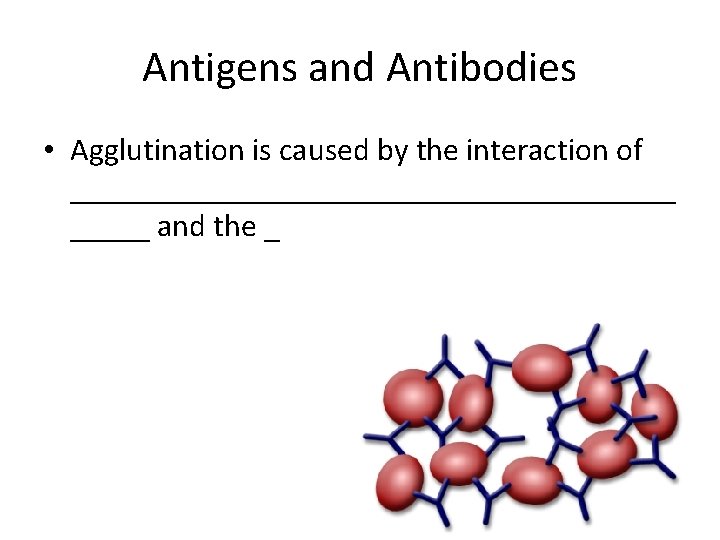
Antigens and Antibodies • Agglutination is caused by the interaction of ___________________ and the _
ABO • Type A Blood: Has _________________ on surface – Has ___________________ in blood plasma, Anti-B – Will agglutinate when exposed to Anti-A
ABO • Type B Blood: Has _____________ on surface – Has Antibody A in blood plasma: Anti-A – Will _
ABO Blood groups • Type AB Blood: Has _ – Will agglutinate when exposed to either –
ABO Blood Groups • Type O Blood: Has neither antigen on the surface – Has both _ –
Rh Factor • Named after _ – Antigen originally found in the monkey, later found in humans as Antigen D • If any of the rhesus antigens are present_ – Antigen D
Rh – • If an Rh – person is exposed to Rh antigens, _ • No complications following first exposure
Rh • If Rh- person again exposed to Rh antigens, _ • Erythroblastosis fetalis: hemolytic disease of newborn. Mother’s antibodies can cross placental barrier and _
- Slides: 48