
Granular Computing and Technical Writing Jing Tao Yao

- Slides: 49
Granular Computing and Technical Writing Jing. Tao Yao 姚静涛 Department of Computer Science, University of Regina jtyao@cs. uregina. ca http: //www 2. cs. uregina. ca/~jtyao J T Yao Gr. C & Research Papers
Acknowledgement • Thanks Professor Xie Keming for inviting me for this talk. • Thanks the Deans of College of Information Engineering, Professor Xie Gan and other colleagues for continuous support. J T Yao Gr. C & Research Papers 2
Part I On Granular Computing J T Yao Gr. C & Research Papers
Introduction • Granular computing (Gr. C) is an umbrella term to cover theories, methodologies, techniques, and tools that make use of granules in problem solving. • Some basic concepts have been studied in other fields such as – belief functions, artificial intelligence, cluster analysis, chunking, data compression, databases, decision trees, divide and conquer, interval computing, machine learning from examples, structure programming, quantization, quotient space theory, and rough set theory. J T Yao Gr. C & Research Papers 4
Gr. C and Fuzzy Sets • • J T Yao 1979, Zadeh first discussed the notion of fuzzy information granulation. 1997, Zadeh discussed information granulation again. 1997, T. Y Lin suggests the term “granular computing” (Gr. C), BISC special interest group (BSIC-Gr. C). 2004, IEEE Computational Intelligence Society, Task Force on Granular Computing. Gr. C & Research Papers 5
Gr. C and Rough Sets • 1982, Pawlak introduced the notion of rough sets. • 1998, the Gr. C view of rough sets was discussed by many researchers (Lin, Pawlak, Skowron, Yao, and many more). • 2003, Rough set conference include Gr. C named Rs. FDGr. C • Rough set theory can be viewed as a concrete example of granular computing. J T Yao Gr. C & Research Papers 6
Current • Fuzzy set and rough set theories are the main driving force of Gr. C. • Most researchers in Gr. C are from fuzzy set or rough set community. • The connections to other fields and the generality, flexibility, and potential of Gr. C are under exploration. • 1 st IEEE Gr. C, July 25 -27, 2005, Beijing J T Yao Gr. C & Research Papers 7
Gr. C Studies • Two levels of study – Philosophical level • Conceptual, abstract, structured thinking – Application level • Problem solving techniques • Basic issues – Components • granule, granulated views and levels, hierarchies, and granular structures – Operations on them • granulation, computing with granules. J T Yao Gr. C & Research Papers 8
Philosophy Level • Human knowledge is normally organized in a multiple level of hierarchy. • The lower (basic) level consists of directly perceivable concepts. • The higher levels consists of more abstract concepts. J T Yao Gr. C & Research Papers 9
Concept Formation & Organization • Concepts are the basic units of human thoughts that are essential for representing knowledge and its communication. • Concepts are coded by natural language words. • Granularity plays a key role in natural language. Some words are more general (in meaning) than some others. J T Yao Gr. C & Research Papers 10
Research Articles • High level of abstraction – title, abstract • Middle levels of abstraction – chapter/section titles – subsubsection titles • Low level of abstraction – Words • 八股文:起承转合,排比对偶 J T Yao Gr. C & Research Papers 11
Human Problem Solving • Human perceives and represents real world at different levels of granularity. • Human understands real world problems, and their solutions, at different levels of abstraction. • Human can focus on the right level of granularity and change granularity easily. J T Yao Gr. C & Research Papers 12
Knowledge Structure and Education • Experts and novices differ in their knowledge organization. • Experts are able to establish multiple representations of the same problem at different levels of granularity. • Experts are able to see the connections between different grain-sized knowledge. • 苏步青读书过程:把书读薄,再读厚 J T Yao Gr. C & Research Papers 13
Structured Programming • Top-down design and step-wise refinement: • Design a program in multiple level of detail. • Formulation, verification and testing of each level. J T Yao Gr. C & Research Papers 14
Granule • Any subset, class, object, or cluster of a universe is called a granule • These granules are composed of finer granules that are drawn together by distinguishability, similarity, and functionality (Zadeh 1996) • Granules may have different formats and meaning when used in different particle models J T Yao Gr. C & Research Papers 15
Granulation • Granulation involves a decomposition of whole into parts. Organization involves an integration of parts into whole (Zadeh 96) • Extended concept: – granulation involves the process of two directions: construction and decomposition J T Yao Gr. C & Research Papers 16
Granulation • Construction involves the process of forming a larger and higher level granule with smaller and lower level sub-granules. – This is a bottom-up process. • The decomposition involves the process of dividing a larger granule into smaller and lower level granules. – This is a top-down process. J T Yao Gr. C & Research Papers 17
Granular Relationship • Intrarelationship: relationships amongst subgranules. • A granule is a clump of points drawn together by similarity, indistinguishability, and functionality. • Interrelationship: relationships amongst granules J T Yao Gr. C & Research Papers 18
Refinement and Coarsening • Comparison of granules • A granule X is a refinement of another granule Y if every sub-granule or element of X is contained in sub-granules of Y. • X is finer than Y, Y is coarser than X J T Yao Gr. C & Research Papers 19
Partitions and Coverings • Following way if a set-theoretical approach • A partition of a set U is a collection of non-empty, and pairwise disjoint subset of U whose union is U. • A covering of a set U is a collection of non-empty subset of U whose union is U. • Partitions are a special case of coverings. • A non-redundant covering – if any collection of subsets of U derived by deleting one or more granules from it is not covering. J T Yao Gr. C & Research Papers 20
Partial Ordering • A granule X is a partial-refinement of another granule Y if some sub-granule or element of X is contained in sub-granules of Y. • X is p-finer than Y, Y is p-coarser than X • A fine relationship can be viewed as a special case of a p-fine relationship. J T Yao Gr. C & Research Papers 21
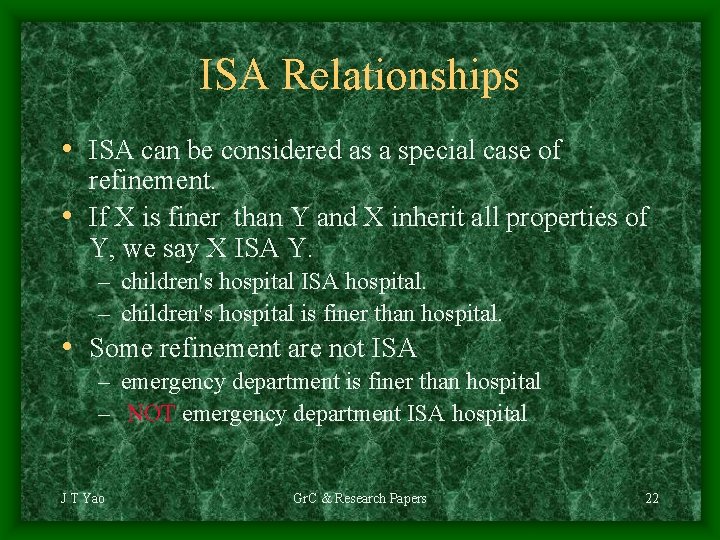
ISA Relationships • ISA can be considered as a special case of refinement. • If X is finer than Y and X inherit all properties of Y, we say X ISA Y. – children's hospital ISA hospital. – children's hospital is finer than hospital. • Some refinement are not ISA – emergency department is finer than hospital – NOT emergency department ISA hospital J T Yao Gr. C & Research Papers 22
Similarity • Inter and/or intra relationship • A key measure to put elements/sub-granule in a granule • Similarity measures: distance • Similarity fuzzy sets J T Yao Gr. C & Research Papers 23
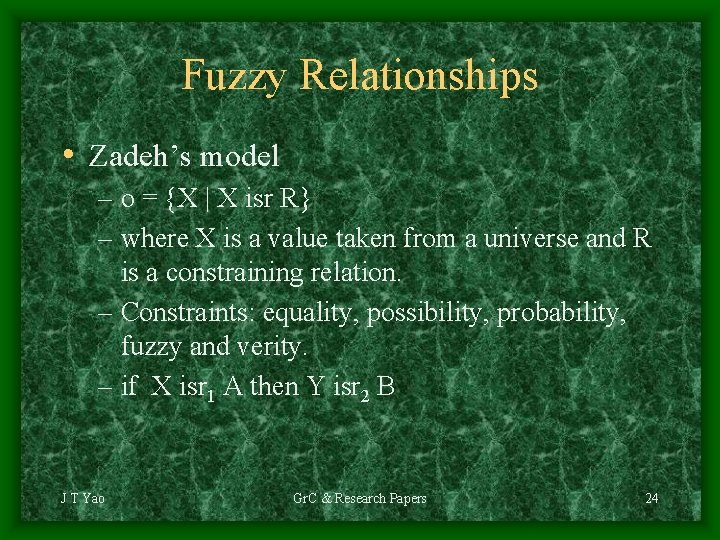
Fuzzy Relationships • Zadeh’s model – o = {X | X isr R} – where X is a value taken from a universe and R is a constraining relation. – Constraints: equality, possibility, probability, fuzzy and verity. – if X isr 1 A then Y isr 2 B J T Yao Gr. C & Research Papers 24
Type of Relationships • Binary: finer • u-nary: covering • Hierarchical: hyperlink J T Yao Gr. C & Research Papers 25
Concluding Remarks • Gr. C is an interesting research area with great potential. • One needs to focus on different levels of study of Gr. C. • The conceptual development. • The formulation of various concrete models (at different levels). J T Yao Gr. C & Research Papers 26
Concluding Remarks • The philosophy and general principles of Gr. C is of fundamental value to effective and efficient problem solving. • Gr. C may play an important role in the design and implementation of next generation information processing systems. J T Yao Gr. C & Research Papers 27
Part II How to Write a Research Article J T Yao Gr. C & Research Papers
Why Publication • Publish or perish • Journal articles, conference paper, technical report. • For whom: – yourself in the future, other researchers, and reviewers. • Acceptance rate/processing time • Use Latex not MS Word J T Yao Gr. C & Research Papers 29
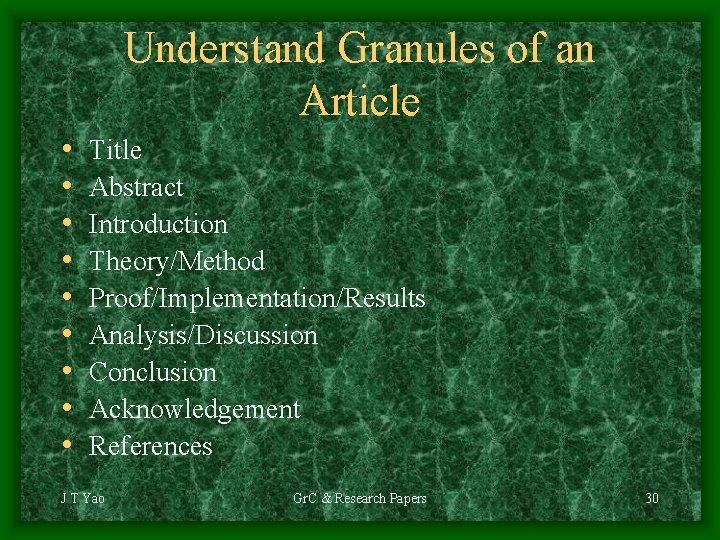
Understand Granules of an Article • • • Title Abstract Introduction Theory/Method Proof/Implementation/Results Analysis/Discussion Conclusion Acknowledgement References J T Yao Gr. C & Research Papers 30
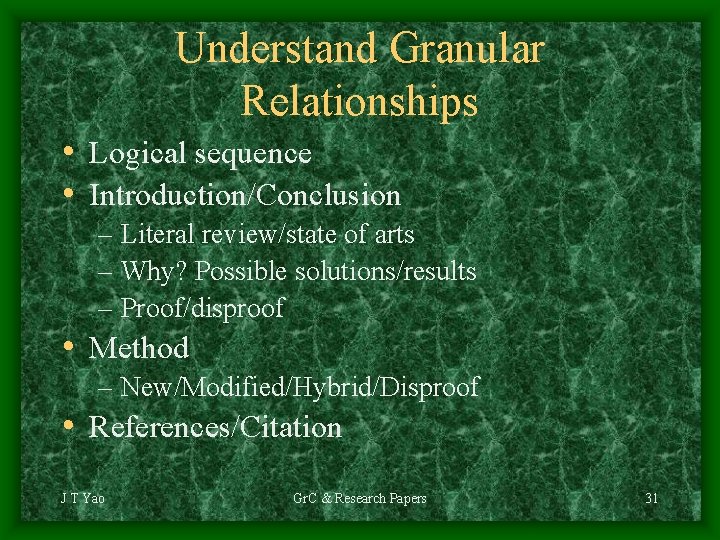
Understand Granular Relationships • Logical sequence • Introduction/Conclusion – Literal review/state of arts – Why? Possible solutions/results – Proof/disproof • Method – New/Modified/Hybrid/Disproof • References/Citation J T Yao Gr. C & Research Papers 31
An example E. Robert Schulman How to Write a Scientific Paper, Annals of Improbable Research, Vol. 2, No. 5, p 8, 1996. J T Yao Gr. C & Research Papers 32
Another Example • SCIgen - An Automatic CS Paper Generator – http: //pdos. csail. mit. edu/scigen/ • Paper 1 Accepted by WMSCI’ 05 • Paper 2 Rejected • A talk at WMSCI J T Yao Gr. C & Research Papers 33
Format and Basic Issues • Learn from our ancestors – 八股文:起承转合,排比对偶 • • • Logic, clarity and precision. Hierarchy of granules Emphasize section title, first and last sentence Use short sentences (S+V+O) No plagiarism All pages should be full (at least ¾) J T Yao Gr. C & Research Papers 34
Title • Short, descriptive, Informative, Eye • • catching Less than 10 words Label, not a sentence Most people read only titles No slang, abbreviations, jargon J T Yao Gr. C & Research Papers 35
Authorship • Only who contributes and takes intellectual responsibility • Order: Alphabetically, degrees of contribution, student/supervisor • Math: sole author, Physics/Chemistry: 100 J T Yao Gr. C & Research Papers 36
Abstract • • Clear, concise summary of entire paper Synopsis of your paper. 100 -200 words. More people read, may be in databases Allow readers to determine quickly and easily the content and results of a paper. • a brief summary of the research, including the purpose, methods, results, and major conclusions. • No citations, no details J T Yao Gr. C & Research Papers 37
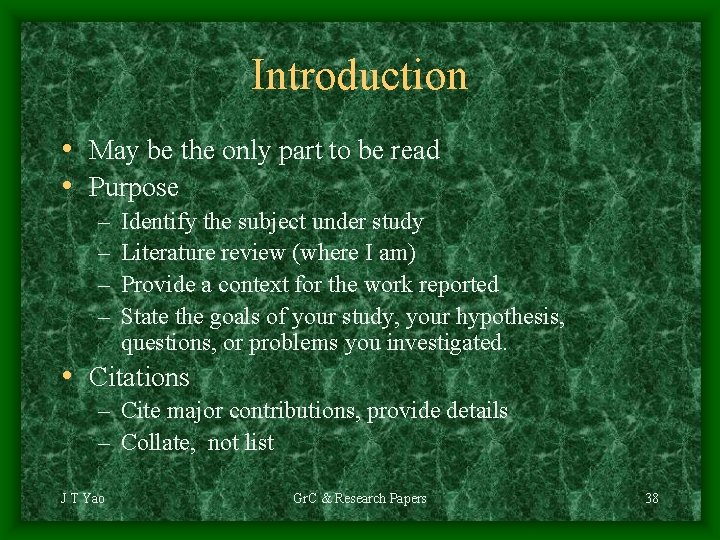
Introduction • May be the only part to be read • Purpose – – Identify the subject under study Literature review (where I am) Provide a context for the work reported State the goals of your study, your hypothesis, questions, or problems you investigated. • Citations – Cite major contributions, provide details – Collate, not list J T Yao Gr. C & Research Papers 38
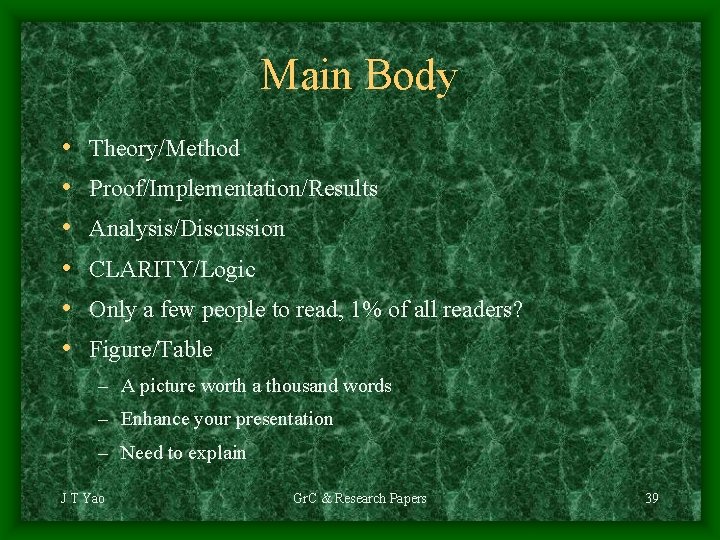
Main Body • • • Theory/Method Proof/Implementation/Results Analysis/Discussion CLARITY/Logic Only a few people to read, 1% of all readers? Figure/Table – A picture worth a thousand words – Enhance your presentation – Need to explain J T Yao Gr. C & Research Papers 39
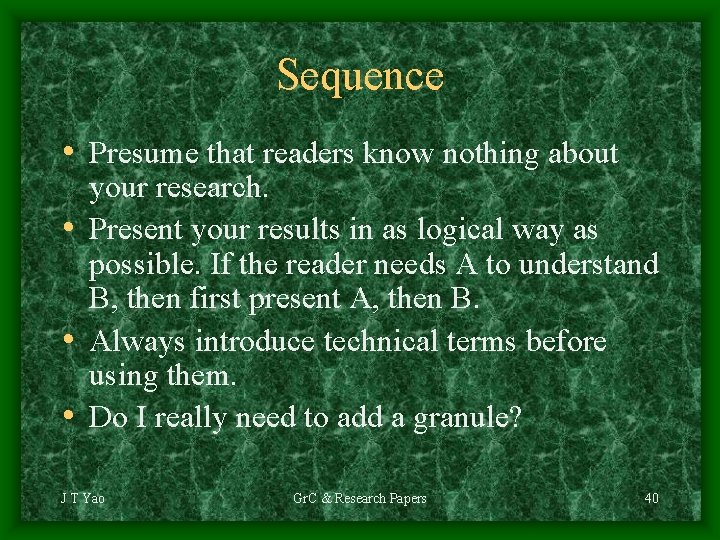
Sequence • Presume that readers know nothing about your research. • Present your results in as logical way as possible. If the reader needs A to understand B, then first present A, then B. • Always introduce technical terms before using them. • Do I really need to add a granule? J T Yao Gr. C & Research Papers 40
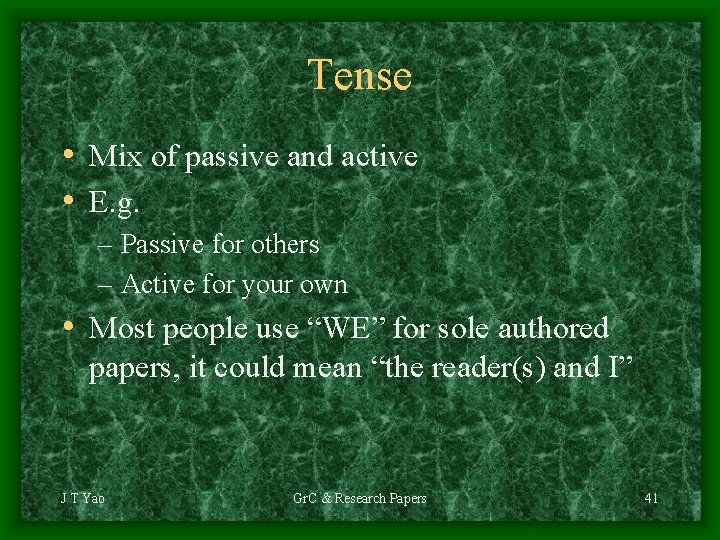
Tense • Mix of passive and active • E. g. – Passive for others – Active for your own • Most people use “WE” for sole authored papers, it could mean “the reader(s) and I” J T Yao Gr. C & Research Papers 41
Related Work • Mandatory • Where do the ideas come from? • Have similar ideas been published or proposed earlier? • What is really new in the paper? • Most likely in introduction, can be a stand alone section. • DO NOT forget others work J T Yao Gr. C & Research Papers 42
Citations • Need references to all statements – 无一字无由来 • Pioneer • YACC • Extension, correction, disproof • Friends, supervisor, potential referees (PC members, editors), yourself J T Yao Gr. C & Research Papers 43
Conclusion • Recapitulates the problem and the contribution • Assesses the significance of the contribution • Suggests and outlines future work – Cite my paper if you follow my thoughts – No. I won’t tell you J T Yao Gr. C & Research Papers 44
Acknowledgement • Funding agencies • Co-workers (not listed as an author) – Co-authors of physical papers • Referees/Editors (anonymous) • Proof reader J T Yao Gr. C & Research Papers 45
References • Accurate, complete, consistent. • Authors, Paper title, Journal/Conference, Volume, Issue, Date, page numbers • Alphabetical order, appearance • Cite by label: [2], (Zadeh 1998) J T Yao Gr. C & Research Papers 46
Ready to Submit? • • NO!! Read, read Proof read, help from colleague, girlfriend/boyfriend, grandma • Reviewers are not proof readers • Revise (accepted, rejected) J T Yao Gr. C & Research Papers 47
Databases • • ISI’s SCI DBLP Citeseer EI J T Yao Gr. C & Research Papers 48
Granular Computing and Technical Writing Jing. Tao Yao 姚静涛 Department of Computer Science, University of Regina jtyao@cs. uregina. ca http: //www 2. cs. uregina. ca/~jtyao J T Yao Gr. C & Research Papers