
Grants Outline 1 The Granting Process 2 Writing



- Slides: 65
Grants
Outline 1. The Granting Process 2. Writing the Grant 2
Why Would You Want to Write a Grant? • To have the Resources and time to pursue a question that you believe is important • To wisely use your time and give you freedom • To pay your salary – Or salary of others • As a measure of academic accomplishment 3
Grants • ~25% of Medical research in the US is funded by the US Government – Likely higher for the other sciences – The rest is paid for and conducted by “industry” • Smaller amount funded by societies and private foundations. 4
Grants • A majority of research at the University level is funded from OUTSIDE of the institution. • An important part of research includes acquiring funds to conduct that research. • Student research grants. 5
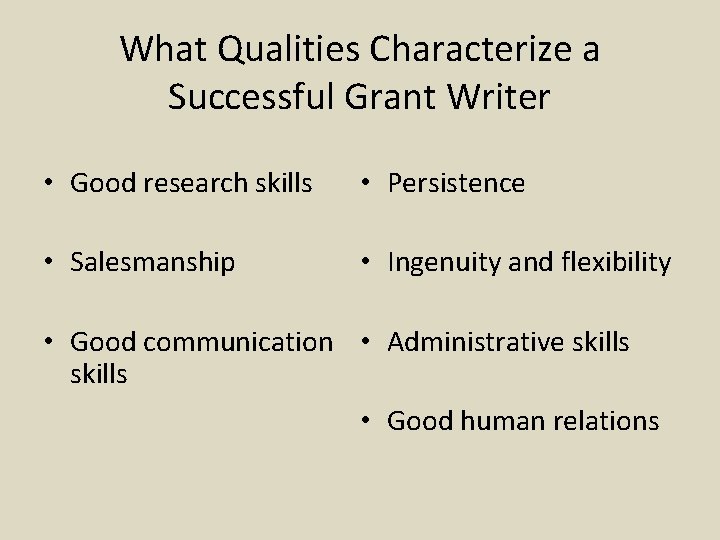
What Qualities Characterize a Successful Grant Writer • Good research skills • Persistence • Salesmanship • Ingenuity and flexibility • Good communication • Administrative skills • Good human relations
Writing Grants • Grant writing is another form of scientific communication • Different from others – Scholarly articles report results – Public articles share info with public 7
Writing Grants • Grants delve in to the unknown. • Asking for money to ask a question – Test the question • You are only presenting results to provide support in asking a new question. 8
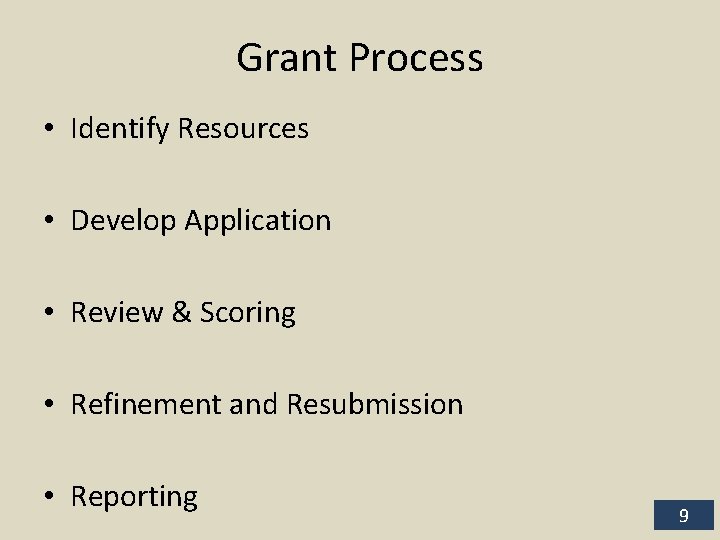
Grant Process • Identify Resources • Develop Application • Review & Scoring • Refinement and Resubmission • Reporting 9
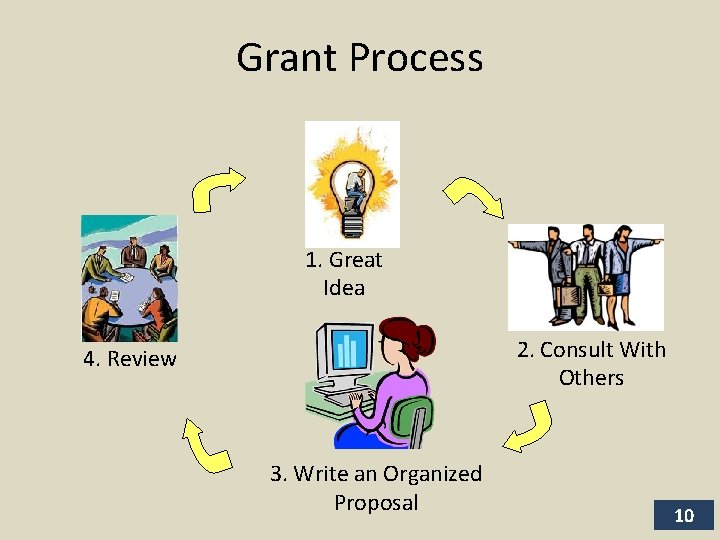
Grant Process 1. Great Idea 2. Consult With Others 4. Review 3. Write an Organized Proposal 10
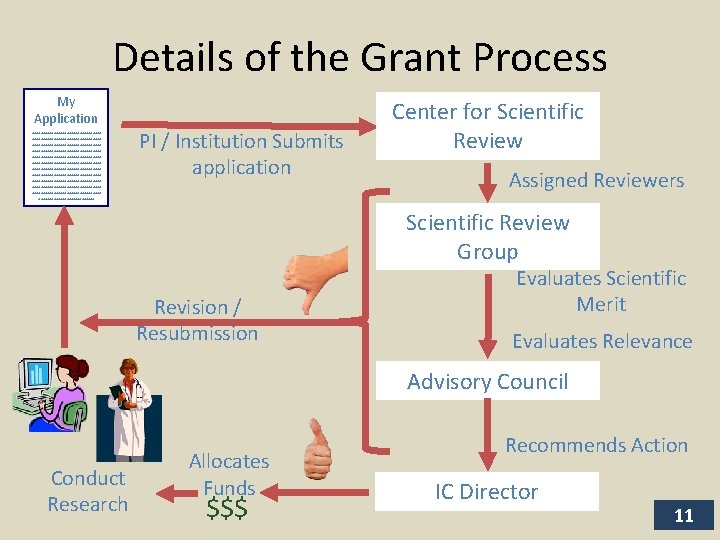
Details of the Grant Process My Application xxxxxxxxxxxxxxxxxxxxxxxxxxxxxxxx xxxxxxxxxxxxxxxxxxxxxxxxxxxxxxxx xxxxxxxxxxxxxxxxxxxxxxxxxxxxxxxx xxxxxxxxxxxxx PI / Institution Submits application Center for Scientific Review Assigned Reviewers Scientific Review Group Revision / Resubmission Evaluates Scientific Merit Evaluates Relevance Advisory Council Conduct Research Allocates Funds $$$ Recommends Action IC Director 11
Where to Begin • Identify grant funding sources • Several databases – Grants. gov • Identify the deadline – Allow yourself several weeks to complete the granting processing – Including asking for letters of recommendation. 12
Identifying Sources • Determine which is right for you • Determine your eligibility – Some grants and sources are targeted at key demographics. • Mission of the Grant or Organization is inline with your goals – i. e. developing resources for 3 rd world nations. 13
Government 14
Academic & Research Societies 15
Private Foundations 16
The Application Package Contains all Necessary Documents • Forms • Written Application – Describing research and goals – Additional written Statements • Budget • Letters of Recommendation • CV and/or Biography 17
The Application Package Make sure you include all necessary documents!!! This is the first thing they check for, and the quickest way to NOT get funded! 18
The Application Package • Most often can be found on the Grant/Organization website. – Along with a lengthy set of instructions • Program office – Federal Grants • Contact Person • Application workshops/Tutorials 19
Developing your application • Start early – Give yourself plenty of time to organize and write – Seek advice from others • Strategize – Look at projects being funded as a guide – Identify Potential research questions – Identify the strengths and weakness of your current research 20
The Application Package Follow the instructions!!! This is the second fastest way to NOT get funded! 21
Developing your application • Identify collaborators that might be able to help fill gaps or weaknesses • Identify other support that might be needed for the project to succeed 22
Developing your application • Your Idea – Should be good • Innovative • Feasible • Conceptually significant – Will benefit the scientific community or public 23
Developing your application • Budget • Grants must include a budget – How much Money do you want? – What is it going to pay for? $$$ 24
Developing your application • Submission • You need to coordinate so all pieces are submitted on time and to the correct place. • Letters of Recommendation • Grants Office/Officer 25
Review & Scoring • After you submit you have to play the waiting game – Usually after several months you receive the decision(Just when you forget you submitted the grant) • Some agencies will provide a score on a arbitrary scale – Based on aggregate scores from reviewers • Some will provide feedback 26
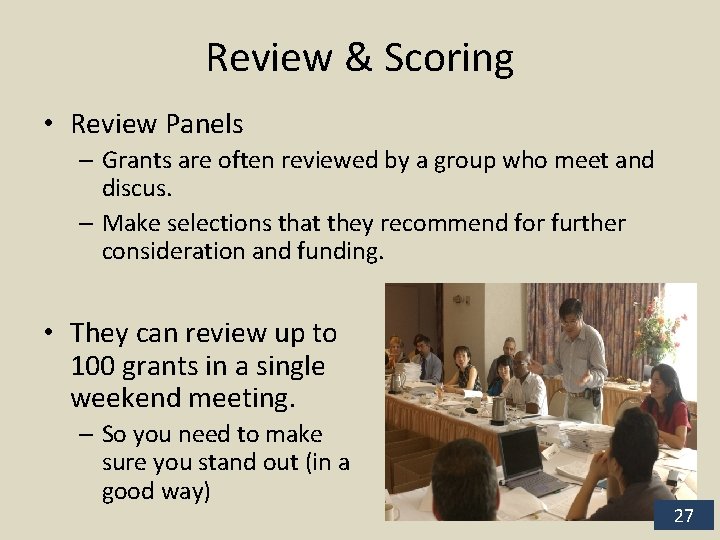
Review & Scoring • Review Panels – Grants are often reviewed by a group who meet and discus. – Make selections that they recommend for further consideration and funding. • They can review up to 100 grants in a single weekend meeting. – So you need to make sure you stand out (in a good way) 27
Study Section Review: Topics in Writeup of a Grant Review Typically scored on the following: • Significance • Innovation • Approach – General feasibility, power, methodological concerns • Other factors – Human studies, productivity or promise of the investigator 28
Priority Scores • 50% of applications are unscored and not further discussed. – Failure to complete application or submit all materials on time. • Priority scores are assigned usually by committee consensus, after airing of reviews. • Summary Statement is prepared, detailing priority results and recommendations for the Institute council. 29
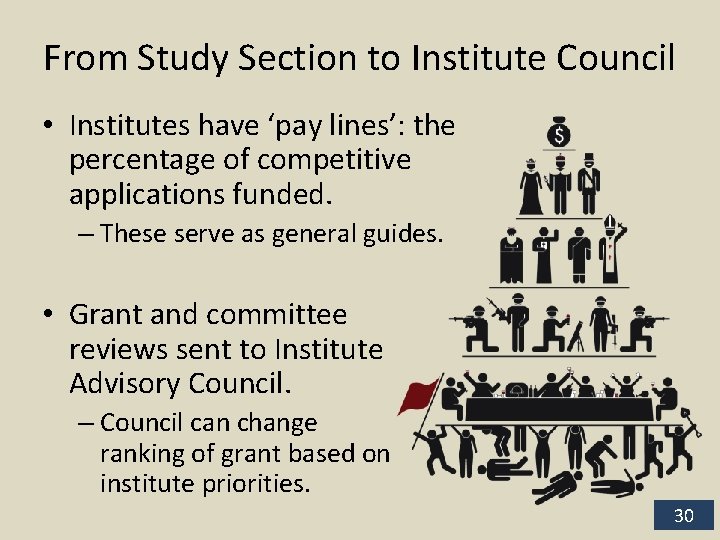
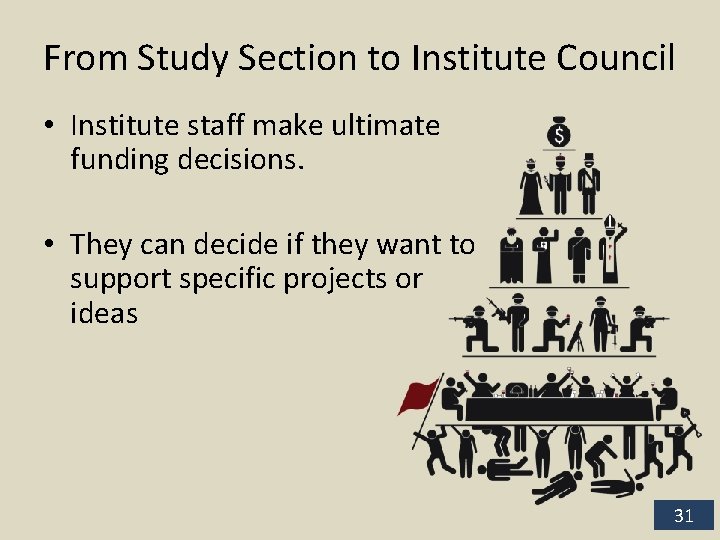
From Study Section to Institute Council • Institutes have ‘pay lines’: the percentage of competitive applications funded. – These serve as general guides. • Grant and committee reviews sent to Institute Advisory Council. – Council can change ranking of grant based on institute priorities. 30
From Study Section to Institute Council • Institute staff make ultimate funding decisions. • They can decide if they want to support specific projects or ideas 31
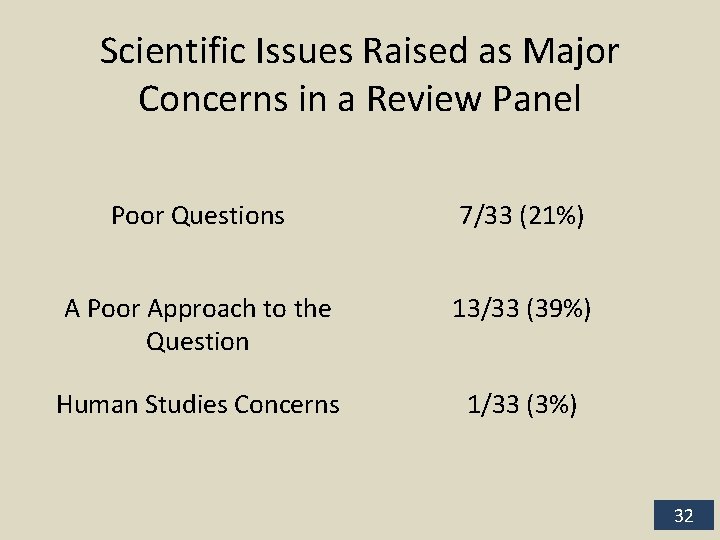
Scientific Issues Raised as Major Concerns in a Review Panel Poor Questions 7/33 (21%) A Poor Approach to the Question 13/33 (39%) Human Studies Concerns 1/33 (3%) 32
Review & Scoring Do not get discouraged! Not every grant will be funded! No one had a perfect track record! 33
Refinement and Resubmission Take the score & comments and use them to your advantage • Make sure you understand the scoring system – Did you score high or low? – Did no you not get funded because of the score or limited funds? • This may mean many or few edits are necessary before you resubmit 34
Refinement and Resubmission Take the score & comments and use them to your advantage • Read the comments – Identify where reviewers saw issues. – Address those issues • Talk to the program officer, get their input 35
Refinement and Resubmission • Make sure to address all comments and concerns before resubmitting – If the reviewers do not understand your project, might need to re-think your explanation or methods. • Many grants have multiple submission cycles each year. – You do not need to rush your editing and refinement – Take the time to do a good job. 36
Refinement and Resubmission • Finally you get funded!!! 37
Reporting • Most granting agencies require reports. • Expected at the end of the grant period – Up to several years later • Must include people who used money from the Grant – Got paid from the grant • Publications that came from the grant 38
Reporting • Recording Keeping – Some require annual financial reports – Fiscal accountability • Progress reports – That show substantial progress – Close to the proposal timeline 39
How to write a successful grant application
Start with a Good Idea • Does it address an important problem? • Will scientific knowledge be advanced? • Does it build upon or expand current knowledge? • Is it feasible … – to implement? – to investigate?
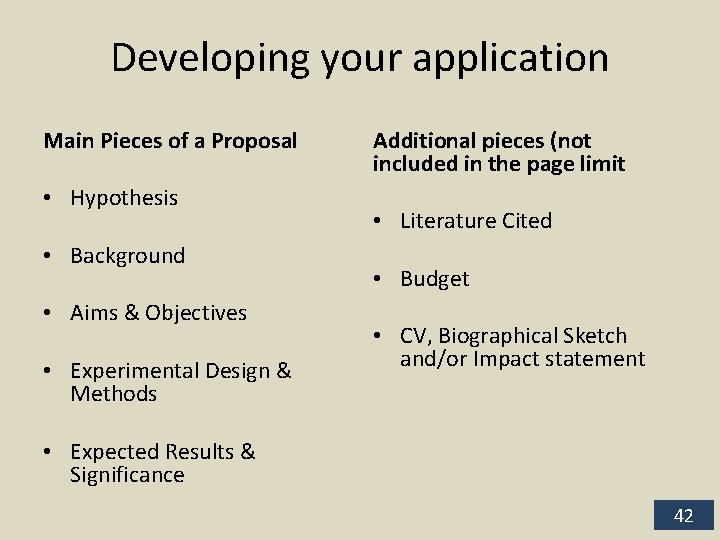
Developing your application Main Pieces of a Proposal • Hypothesis • Background • Aims & Objectives • Experimental Design & Methods Additional pieces (not included in the page limit • Literature Cited • Budget • CV, Biographical Sketch and/or Impact statement • Expected Results & Significance 42
Choosing the right funding source • Make sure to read the objective and guidelines before applying. • Make sure you meet the specification • Make sure your project falls within the objectives of the granting institution • Many a awesome proposals have been rejected because they went to the wrong place. 43
The 4 Questions It is important to address the following questions in your proposal 1. What do you intend to do? 2. Why is the work important? 3. What has already been done? 4. How are you going to do the work? 44
Title & Abstract • Your First Impression • Title – Capture essence of goals and objectives • Abstract – Present your project Concisely – State significance Clearly – State Hypotheses, Research Problem, Solution – Methods and Rationale Write direct, active text: Read aloud. 45
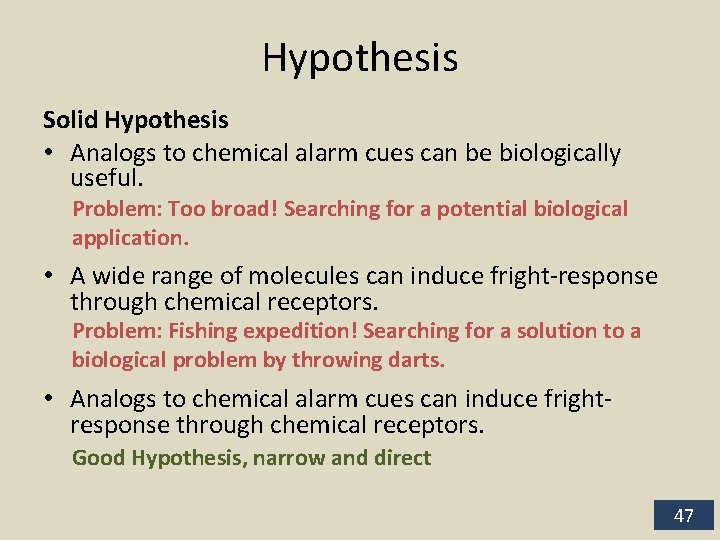
Hypothesis • Develop a solid hypothesis – This is the foundation of your grant – And the high point. • Most grants ask a question that support of refute a hypothesis – Rather than create a method to identify problems and collect information. 46
Hypothesis Solid Hypothesis • Analogs to chemical alarm cues can be biologically useful. Problem: Too broad! Searching for a potential biological application. • A wide range of molecules can induce fright-response through chemical receptors. Problem: Fishing expedition! Searching for a solution to a biological problem by throwing darts. • Analogs to chemical alarm cues can induce frightresponse through chemical receptors. Good Hypothesis, narrow and direct 47
Background • You should provide reasonable background information • Your proposal is based on previous work – Possibly not your own, and that’s ok. • Often graphs can be helpful 48
Background • The goal of this section is to provide the reader with everything they need to know – To understand your proposed project • Should not include lengthy descriptions of basic biological concepts. • Should include: – Background on model organism – Question specific background (key research results) 49
Aims and Objectives • Often a hypothesis can be broken down in to several testable pieces – Aims • Each aim has a separate experiment, or set of experiments to test that aim • Aims should be clearly identified – It might be that not all aims can be tested under a single grant, and that should be identified and explained. 50
Aims and Objectives • Clearly define the goal of this project. • Sometimes this is included in a paragraph with the hypothesis – Sometimes its own section, with a section header • Keep Aims simple and specific! 51
Experimental design • Explain your experimental design • People will not want to fund a project that has not been thought through. • You do not need to have every last detail planned out – But a research plan is a good start 52
Experimental Design • If you have several aims, break up the experimental design to address each aim • Briefly describe methods – Keep it general • Identify controls 53
Expected Results • It is important to identify the expected out come • Explain why it is significant – To greater scientific knowledge • Identify alternative results – What they mean to science • Demonstrates forethought and an ability to assess if the experiment worked. 54
Literature cited • It is important to demonstrate an understanding of your proposed field of research – Grasp on background • Can be seen in the introduction, and background sections • Properly cite primary and secondary scientific literature 55
Budget • Provide clear estimate for the cost of doing proposed research • Does not need to be overly specific – Where every $$ is going • But should be close to what you expect costs to complete the project correctly and completely. 56
Peer Review • Ask a colleague to read it over – Or ask your mom/dad to get an outside opinion • If outside reader can comprehend the ideas you have provided clear background and rational. 57
Overall • Be realistic, not overly ambitious • Be explicit – Reviewers can not read your mind – Do not assume reviewers know what you intend • Be well organized and clear • Dot your i’s and Cross your t’s – Reviewers are looking for reasons to reject your proposal and make their decision easier. 58
Overall • Assume you are not writing for an expert • Emphasize general importance and then specific importance of your topic • Avoid jargon • Avoid selective citation of the literature – Discuss controversies in the area • Make your story interesting- make the reviewer want to read more! • Correct English, grammar, and attention to typographical errors is important. – Reviewers like a “pretty” application. 59
Proposal Review Checklist. • Is the background information sufficient to understand the proposal? • Does the author demonstrate a firm grasp of knowledge in the field? • Does the proposal line up with the objectives of the funding institution? • Are the specific aims clearly stated? • Do the proposed experiments properly address the specific aims? • Are there simpler methods that could have been used? • Are any controls omitted? • Are the expected results logical given the proposed experiments? What is their significance? • Do the results address the specific aims? • Are there obvious alternative results that were not identified? What is their significance? 60
61
Your Grant Proposal • Written towards a research society • 3 -4 page, double-spaced proposal – Intro, background, hypothesis, experimental design, and significance • Budget ($2000) including rationale • Work cited – Primary and secondary literature – Minimum 5 sources 62
Possible project ideas • Effects of ammonia on plant (brassica sp. ) growth • Fish response to food chemical cues • Removal of symbiotic gut bacteria from host organisms on the hosts overall health. • Changes in skull structure of the gray wolf. 63
Remember • Non exploratory – Should have set research goals • Clearly explain background, rationale, important biological concepts, and experimental design • Budget should be general, and reflect your proposed study. 64
Remember • Only include multiple aims (hypotheses within your main hypothesis) if you have separate experiments you are proposing. • Explain each experiment as it relates to the corresponding aim. • For this grant it is ok to have a single hypothesis, and single experimental design/method. • See examples for single hypothesis and multi-aim proposals. 65