
Grant et al 1998 study of Contextdependent memory


- Slides: 16
Grant et al. (1998) study of Context-dependent memory Area: Cognitive area Theme: Memory
Background Have you ever walked into a room and forgotten what you came in for? What did you do?
Background Many studies have shown that recall is better when the participants is in the same environment during recall as they were when the learning occurred. Example: you learn the Grant et al. study in this room. And so, you will have a better recall of the study in this room, than any other. https: //www. youtube. com/watch? v=o. DAKKQu. Bt. Do
Background Previous research Tulving (1972) explained this as a consequence of ‘context-dependency effects’. This suggests that some aspects of the environment during learning are stored (or encoded) with the to-be-remembered items and become part of the memory trace. These extra pieces of information (or cues) then help with the retrieval of the learned items. Thus, when the environment at learning and recall matches, the recall is better than if the two environments are mismatched
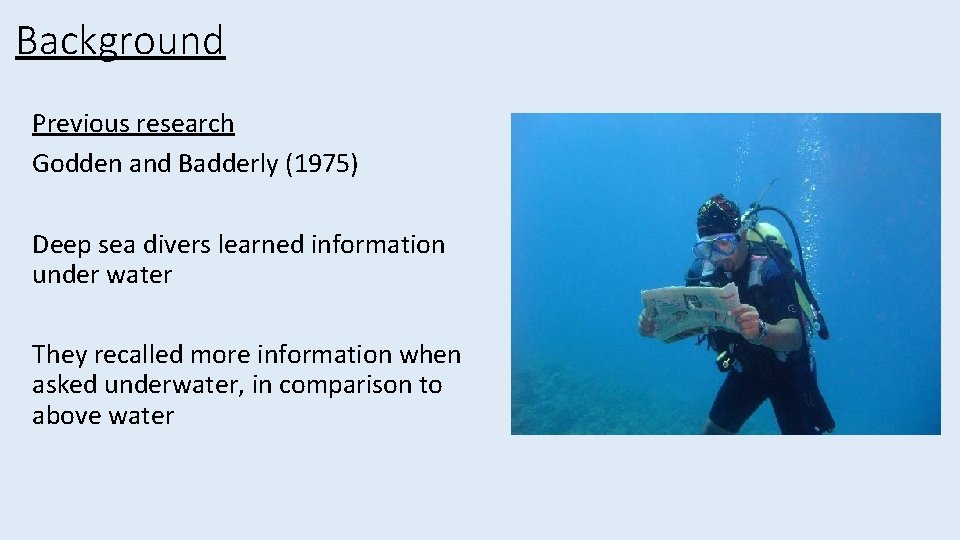
Background Previous research Godden and Badderly (1975) Deep sea divers learned information under water They recalled more information when asked underwater, in comparison to above water
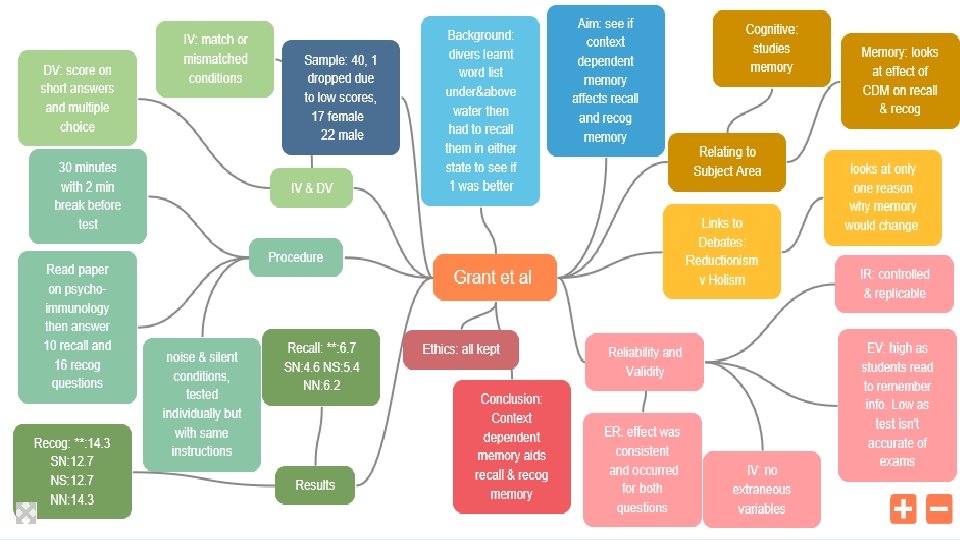
Aim The aim of the study was to test the effect of noise as a source of context on the studying and retrieval of meaningful material in an academic context. A focus on changing learning context was important as students can choose where to study, but not where they are tested.
Method Laboratory experiment • What level of control is there? What kind of relationship does this allow for? • If the environment is false, what can be assumed about participants behaviours? Independent measures design • Do participants complete the task once or twice? What does this eliminate?
Method 39 participants aged 17 -56 (17 females and 23 males) • Is this representative? Recruited through opportunity sample – eight psychology students, each acting as psychologists, each found five acquaintances who would be participants • Evaluate the sampling method One participant was excluded
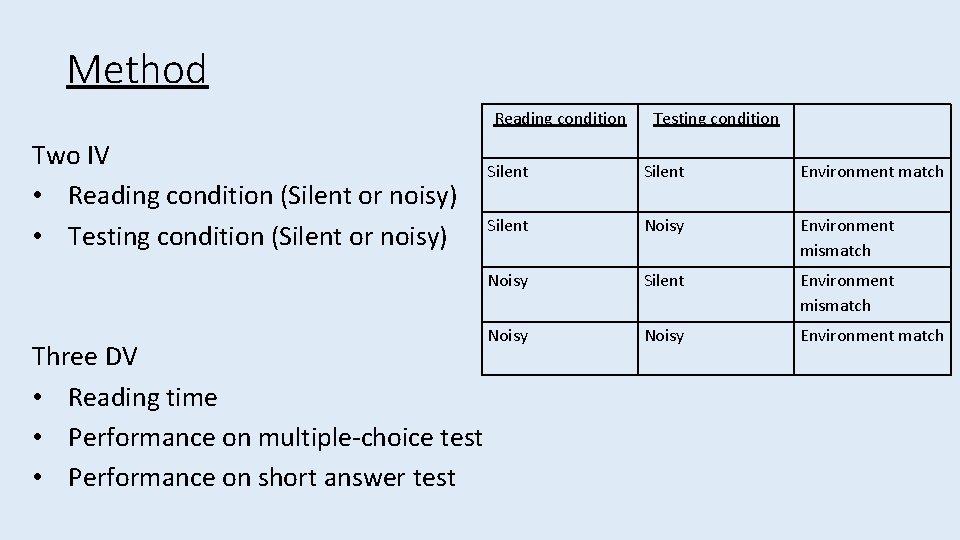
Method Reading condition Two IV • Reading condition (Silent or noisy) • Testing condition (Silent or noisy) Three DV • Reading time • Performance on multiple-choice test • Performance on short answer test Testing condition Silent Environment match Silent Noisy Environment mismatch Noisy Silent Environment mismatch Noisy Environment match
Method • In the noisy conditions, background noise was played. The background noise was a tape made in the university cafeteria at lunchtime with the hum of conversation, occasional words but no audible sentences and the sound of chairs and dishes. It was played moderately loudly through headphones
Method • Participants were given a two page article on psychoimmunology, which was interesting, understandable and unfamiliar. The reading time for each participant was recorded but not controlled (DV 1). Participants all wore headphones (regardless of noisy or silent condition). Once participants had finished reading the article they were given a two minute break. After the two minutes had passed participants were given two tests to answer.
Method • Test 1: Short answer question (DV 3). This was to ensure any material being recalled from the article was their memory recall, rather than information provided in multiple choice questions. This test measured their recall. • Test 2: Multiple choice questions (DV 2). This measured their retrieval of information.
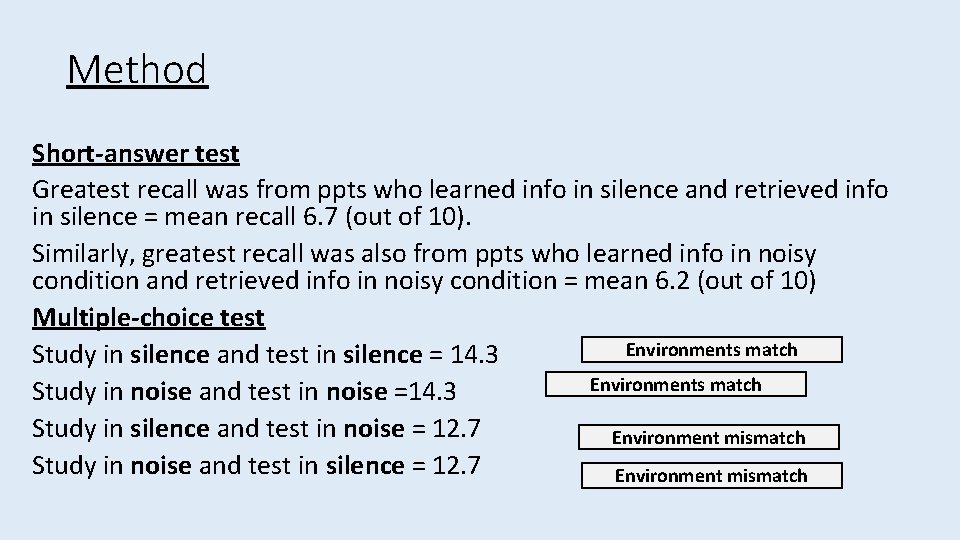
Method Short-answer test Greatest recall was from ppts who learned info in silence and retrieved info in silence = mean recall 6. 7 (out of 10). Similarly, greatest recall was also from ppts who learned info in noisy condition and retrieved info in noisy condition = mean 6. 2 (out of 10) Multiple-choice test Environments match Study in silence and test in silence = 14. 3 Environments match Study in noise and test in noise =14. 3 Study in silence and test in noise = 12. 7 Environment mismatch Study in noise and test in silence = 12. 7 Environment mismatch
Conclusion 1. As there was no independent effect of noise on performance, it can be concluded that noise does not affect capacity to study 2. Context dependence affects the retrieval in both short answer questions and multiple choice questions. And so, students should study in environments which reflect the environment where they will retrieve information. For example, in a silent library as exams are held in silence
Evaluation 1. Complete evaluation 2. Answer practice questions