
GRANT CONTRACT FRAUD WASTE ABUSE Tricia Hyland Senior
GRANT & CONTRACT FRAUD, WASTE, & ABUSE Tricia Hyland Senior Development Specialist
AGENDA: Ø Defining Grant & Contract Fraud, Waste, & Abuse Ø Case Studies of Grant & Contract Fraud Ø Grant Management Best Practices to Prevent Fraud, Waste, & Abuse Ø Ø Grant Accountability and Transparency Act (GATA) Ø CMAP Whistleblower Protection Policy Ø How to report Grant and Contract Fraud Q&A
THE IMPACT OF FRAUD, WASTE, ABUSE AND MISMANAGEMENT IS FELT GOVERNMENT-WIDE. Ø The public sent 2, 097 complaints to GAO’s Fraud. Net in FY 2015. Ø Of those complaints, 1, 066 were considered to be allegations worth pursuing. Ø In FY 2015, $3. 5 Billion was recovered by the Department of Justice from civil cases involving fraud. SOURCE: www. gao. gov/fraudnet
DEFINITION: GRANT & CONTRACT FRAUD, WASTE, & ABUSE Ø A violation of any law, rule or regulation Ø Gross mismanagement Ø A gross waste of funds Ø An abuse of authority Ø A substantial and specific danger to public health or safety
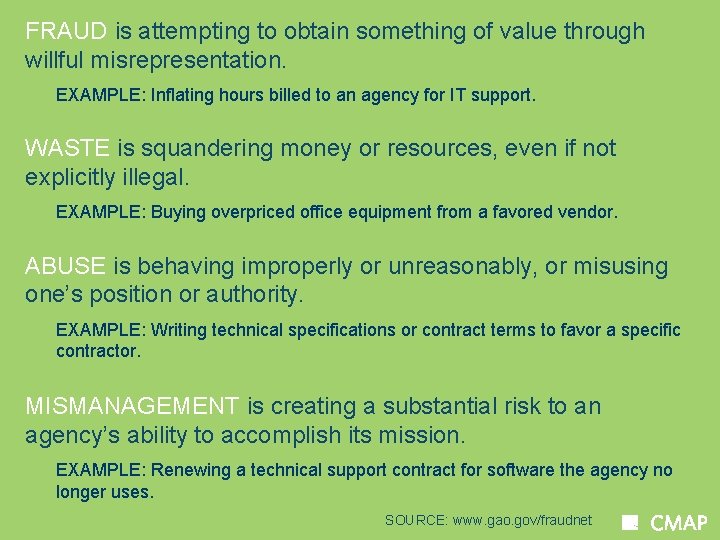
FRAUD is attempting to obtain something of value through willful misrepresentation. EXAMPLE: Inflating hours billed to an agency for IT support. WASTE is squandering money or resources, even if not explicitly illegal. EXAMPLE: Buying overpriced office equipment from a favored vendor. ABUSE is behaving improperly or unreasonably, or misusing one’s position or authority. EXAMPLE: Writing technical specifications or contract terms to favor a specific contractor. MISMANAGEMENT is creating a substantial risk to an agency’s ability to accomplish its mission. EXAMPLE: Renewing a technical support contract for software the agency no longer uses. SOURCE: www. gao. gov/fraudnet
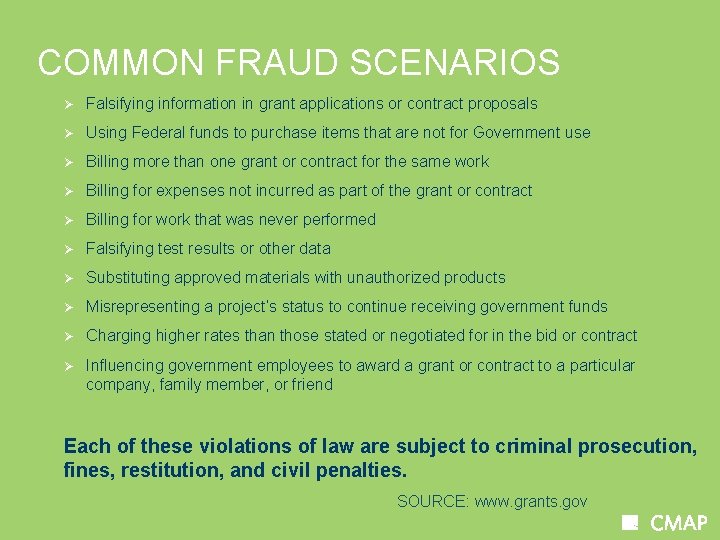
COMMON FRAUD SCENARIOS Ø Falsifying information in grant applications or contract proposals Ø Using Federal funds to purchase items that are not for Government use Ø Billing more than one grant or contract for the same work Ø Billing for expenses not incurred as part of the grant or contract Ø Billing for work that was never performed Ø Falsifying test results or other data Ø Substituting approved materials with unauthorized products Ø Misrepresenting a project’s status to continue receiving government funds Ø Charging higher rates than those stated or negotiated for in the bid or contract Ø Influencing government employees to award a grant or contract to a particular company, family member, or friend Each of these violations of law are subject to criminal prosecution, fines, restitution, and civil penalties. SOURCE: www. grants. gov
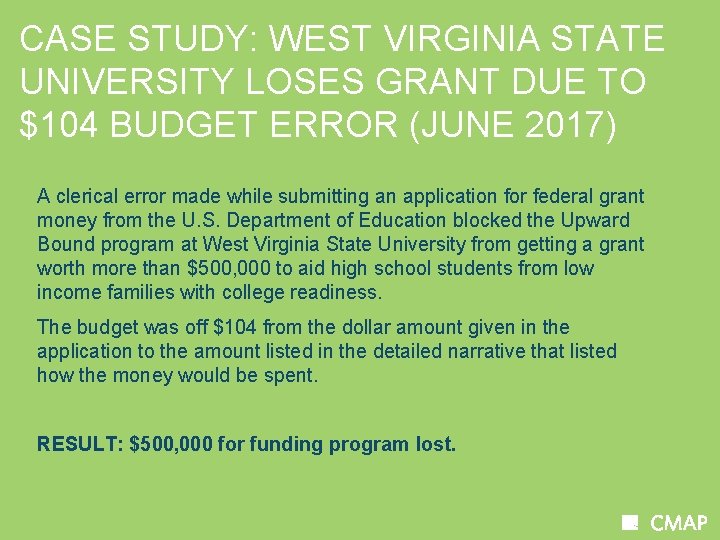
CASE STUDY: WEST VIRGINIA STATE UNIVERSITY LOSES GRANT DUE TO $104 BUDGET ERROR (JUNE 2017) A clerical error made while submitting an application for federal grant money from the U. S. Department of Education blocked the Upward Bound program at West Virginia State University from getting a grant worth more than $500, 000 to aid high school students from low income families with college readiness. The budget was off $104 from the dollar amount given in the application to the amount listed in the detailed narrative that listed how the money would be spent. RESULT: $500, 000 for funding program lost.
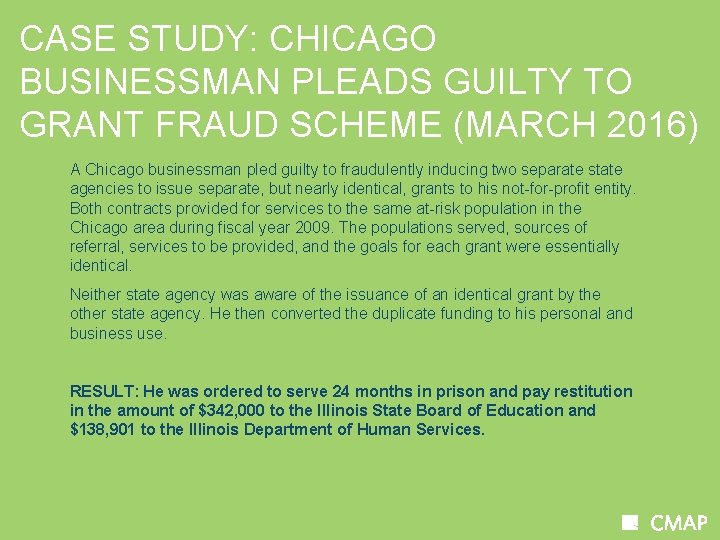
CASE STUDY: CHICAGO BUSINESSMAN PLEADS GUILTY TO GRANT FRAUD SCHEME (MARCH 2016) A Chicago businessman pled guilty to fraudulently inducing two separate state agencies to issue separate, but nearly identical, grants to his not-for-profit entity. Both contracts provided for services to the same at-risk population in the Chicago area during fiscal year 2009. The populations served, sources of referral, services to be provided, and the goals for each grant were essentially identical. Neither state agency was aware of the issuance of an identical grant by the other state agency. He then converted the duplicate funding to his personal and business use. RESULT: He was ordered to serve 24 months in prison and pay restitution in the amount of $342, 000 to the Illinois State Board of Education and $138, 901 to the Illinois Department of Human Services.
CASE STUDY: NORTHWESTERN UNIVERSITY SETTLES GRANT FRAUD WHISTLEBLOWER LAWSUIT FOR $3 MILLION (AUGUST 2013) Northwestern University agreed to pay $3 Million to settle a whistleblower lawsuit alleging misuse of medical research grant funding awarded for cancer research. The lawsuit was filed by a former employee in 2009 alleging that fraud occurred when a doctor employed by the university submitted improper claims for reimbursement – including consulting services, subcontracts, food, hotels, travel and other expenses, which were not covered by the National Institutes of Health’s medical research grant. RESULT: Northwestern paid the United States $2. 93 million to settle claims of cancer research grant fraud by a former researcher and physician. The former physician individually paid the United States a $475, 000 settlement.
“INTERNAL CONTROLS IN YOUR GRANT AND CONTRACT MANAGEMENT ARE A BACKBONE OF EFFECTIVE OPERATIONS AND FEDERALLY REQUIRED. ”
GRANT RECIPIENT RESPONSIBILITIES: Recipients of federal grants have been awarded funds to carry out the goals and objectives identified in the grant. These funds are subject to certain regulations, oversight, and audit. Ø Grant recipients are stewards of funds. Ø Grant dollars must be used for their intended purpose. Ø Grant recipients must account for costs and justify expenditures. Using government grant dollars for unjust enrichment, personal gain, or other than their intended use is a form of theft, subject to criminal and civil prosecution.
PROJECT MANAGER ACCOUNTABILITY & RESPONSIBILITY The below statement accompanies your signature on all reports and payment requests attesting its validity. BE THOROUGH! By signing this report/payment request, I certify to the best of my knowledge and belief that the report is true, complete, and accurate, and the expenditures, disbursements and cash receipts are for the purposes and objectives set forth in the terms and conditions of the Federal or State award. I am aware that any false, fictitious, or fraudulent information, or the omission of any material fact, may subject me to criminal, civil or administrative penalties for fraud, false statements, false claims or otherwise. (U. S. Code Title 18, Section 1001 and Title 31, Sections 3729 -3730 and 3801 -3812).
WAYS TO MITIGATE FRAUD RISKS Ø Examine your project operations to determine your fraud vulnerabilities. Ø Implement specific fraud prevention strategies including educating employees of risks. Ø Maintain a well designed and tested system of internal controls. Ø Ensure all financial or other certifications and progress reports are adequately supported with appropriate documentation and evidence. Ø Identify any potential conflicts of interest issues and disclose them to the granting agency for specific guidance and advice. Ø Follow a fair and transparent procurement process especially when utilizing consultants. Ensure the rate of pay is accurate and that the work product is well-defined and documented. The rate of pay on submitted invoices must match the rate of pay in the initial proposal. SOURCE: U. S. Department of Justice, Office of the Inspector General
GOVERNMENT ACCOUNTABILITY AND TRANSPARENCY ACT (GATA) OVERVIEW: The Illinois Grant Accountability and Transparency Act is the first state legislation in the nation to require the adoption and implementation of a comprehensive set of standards that mandate accountability and transparency throughout the entire life cycle of a grant. GATA is intended to build capacity of the grantee community by mandating grant-related training, and providing guidance and support to correct occurrences of non-compliance with fiscal, administrative and programmatic requirements. Source: www. Illinois. gov
GATA & GRANT FRAUD Ø GATA provides a framework for cross-agency information sharing to improve risk assessment processes and enhance fiscal management. Ø It is estimated that 6% of total revenues are lost to fraud, waste and abuse. Federal grant estimates of fraud, waste and abuse range from 10% to 26%. A mere 1% to 2% return on investment for Illinois would net $500 million to $1 billion. Ø GATA provides a framework to allow state agencies to more readily identify anomalies that may lead to occurrences of fraud, waste and abuse. Ø In conclusion, new GATA forms need to be carefully reviewed for accuracy and consistency throughout the agency.
CMAP’S WHISTLEBLOWER PROTECTION POLICY Ø CMAP’s policy is in compliance with the Whistleblower Act which protects every citizen, including state and local government employees, when reporting government corruption. Ø It is the practice of CMAP not to allow retaliation for reports of wrongdoing, fraud, corruption or waste made in good faith and it is the duty of every CMAP employee to report suspected improprieties. Ø It is, at the same time, unacceptable to file a report knowing it is false.
HOW TO REPORT GRANT FRAUD: CMAP Ethics Officer: Melissa Porter Chief of Staff Email: mporter@cmap. Illinois. gov Tel: 312. 386. 8662
QUESTIONS?
EDUCATE YOURSELF, PROTECT YOURSELF! TRICIA HYLAND 312. 386. 8676 THYLAND@CMAP. ILLINOIS. GOV
- Slides: 19