
Granite magma formation transport and emplacement in the
- Slides: 12
Granite magma formation, transport and emplacement in the Earth’s crust. N. Petford, A. R. Cruden, K. J. W. Mc. Caffrey & J. -L. Vigneresse
Main topics • • Partial melting of continental crust Melt transport Emplacement Three-dimensional shapes of granitic intrusions • Mechanisms of pluton growth • Timescales of pluton growth
Partial melting of continental crust • Temperatures in crust are generally not high enough to melt crustal rocks • Only <25% partial melt obtained by fluidpresent melting • More efficient way: heat obtained from mantle by basaltic underplating • This type of partial melting is more rapid • Amphibole and mica breakdown is NB formation of granitic melts (fluid absent conditions) • Compositions of granitic melt differ with higher temperatures
• Positive volume changes in fluid-absent melting • Volume changes, deviatoric stress gradients and regional tectonic strain lead to higher fracture permeability, aiding in melt segregation
Melt transport • Transport process uses 2 length scales: (i) SEGREGATION-small (dm or cm) (ii) ASCENT – large (km) • SEGREGATION - the physical properties of a granitic melt determines its ability to segregate mechanically from its matrix - viscosity and density
• ASCENT - Gravity is the most obvious driving force for large vertical magma transport in continental crust. - Self-propagating dykes along faults
Emplacement Definition: Switch from upward to horizontal flow 1 • Final stage of granite formation in continental crust • Mechanical interactions and density effects control the emplacement of granites • Episodic processes • Space for incoming magma needs to be created
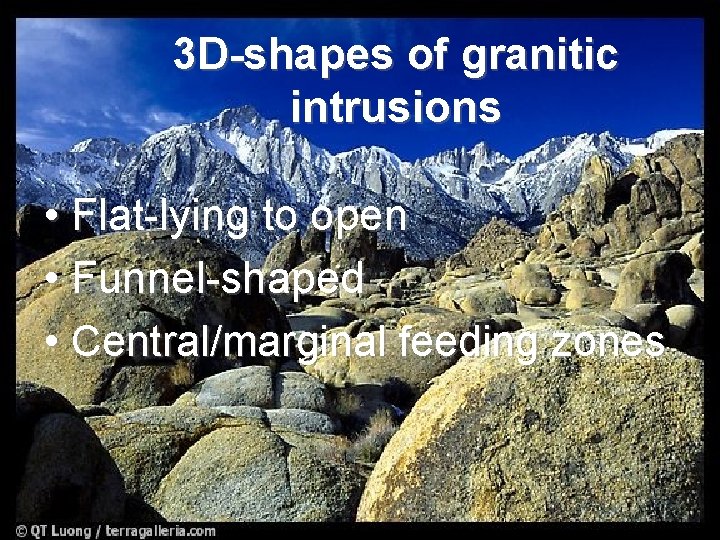
3 D-shapes of granitic intrusions • Flat-lying to open • Funnel-shaped • Central/marginal feeding zones
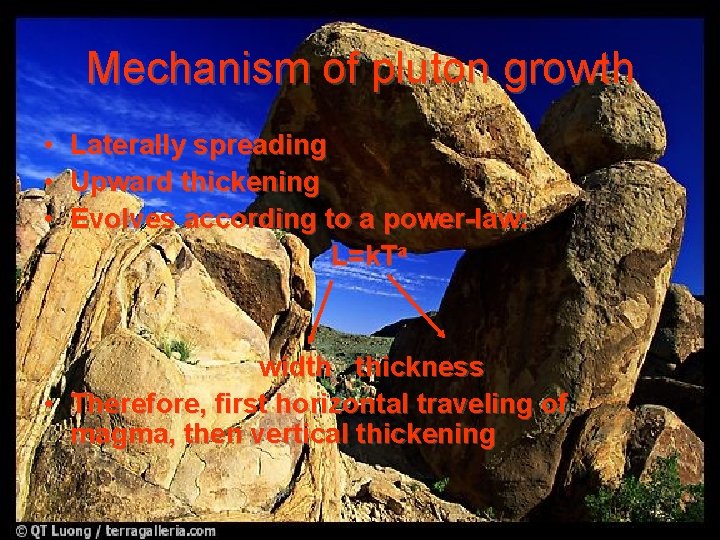
Mechanism of pluton growth • • • Laterally spreading Upward thickening Evolves according to a power-law: L=k. Ta width thickness • Therefore, first horizontal traveling of magma, then vertical thickening
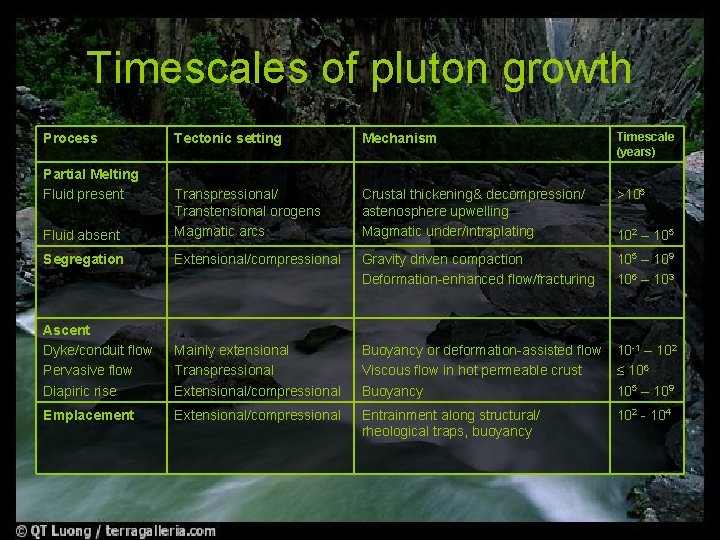
Timescales of pluton growth Tectonic setting Mechanism Timescale (years) Crustal thickening& decompression/ astenosphere upwelling Magmatic under/intraplating >105 Fluid absent Transpressional/ Transtensional orogens Magmatic arcs Segregation Extensional/compressional Gravity driven compaction Deformation-enhanced flow/fracturing 105 – 109 106 – 103 Ascent Dyke/conduit flow Pervasive flow Diapiric rise Mainly extensional Transpressional Extensional/compressional Buoyancy or deformation-assisted flow Viscous flow in hot permeable crust Buoyancy 10 -1 – 102 ≤ 106 105 – 109 Emplacement Extensional/compressional Entrainment along structural/ rheological traps, buoyancy 102 - 104 Process Partial Melting Fluid present 102 – 105
Conclusion Formation of granite intrusions in middle-upper crust is goverened by 4 processes each with their own timescale and environment (as seen in foregoing table)
References 1. Granite magma formation, transport and emplacement in the Earth’s crust - 2. 3. 4. N. Petford, A. R. Cruden, K. J. W. Mc. Caffrey & J. -L. Vigneresse http: //terragalleria. com/pictures-subjects/granite. 9. html The rapid formation of granitic rocks: more evidence - John Woodmorappe Analogue modelling of segregation and ascent of magma - Bons, P. D. , Elburg, M. A. and Dougherty-Page, J. 2001. In: Ailleres, L. and Rawling, T. 2001.