
Grand Chapter Order Eastern Star Of Virginia PHA

- Slides: 24
Grand Chapter Order Eastern Star Of Virginia, PHA TEAMWORK, MOTIVATION, AND LEADERSHIP
“The price of greatness is responsibility. ” Sir Winston Churchill 2
OBJECTIVES • Define a team and its function • Identify the characteristics of team players • Describe the elements of successful presentations and meetings • Describe what motivates team players • Identify the characteristics of effective leadership • Identify leadership styles • Describe ways to develop leadership skills 3
TEAMS AND PERFORMANCE • Group—one leader with two or more people who share a common goal • Teams—two or more people, all lead and share a common goal – In a team setting, every member has a sense of ownership and responsibility 4
TEAMS AND PERFORMANCE Types of Teams • Formal teams: developed within the formal organizational structure – Functional (e. g. , within a department) – Cross-functional (e. g. , from different departments) • Informal teams: individuals who get together outside the formal structure to accomplish a goal 5
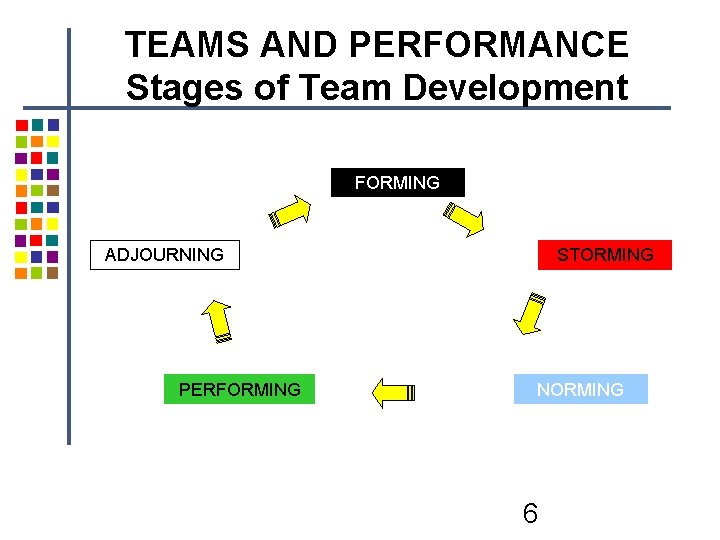
TEAMS AND PERFORMANCE Stages of Team Development FORMING ADJOURNING PERFORMING STORMING NORMING 6
TEAMS AND PERFORMANCE Stages of Team Development • Forming stage: getting to know and form initial opinions about team members • Storming stage: some team members begin to have conflict with each other • Norming stage: team members accept each other and overcome the conflict • Performing stage: team works on task • Adjourning stage: team completes task and brings closure to the project 7
CHARACTERISTICS OF A TEAM MEMBER • Know team goals and objectives • Every activity should contribute to team goals and objectives • Team member characteristics: – – Trustworthy Performer Efficient Communicator 8
CHARACTERISTICS OF A TEAM MEMBER • Synergy: the extra excitement that occurs when people are truly working together as a team • Brainstorming: a problem-solving method that involves identifying alternatives that allow members to freely add ideas while other members withhold comments on the alternatives 9
CHARACTERISTICS OF A GOOD TEAM MEMBER - Teams & Conflict • Do not make assumptions • If you disagree with the team, voice your opinion and state why • If the team decides to go in a direction other than what you wanted, respect and support the team’s decision 10
CHARACTERISTICS OF A TEAM MEMBER - The Problem Member • • Trust as a foundation Do not dump work on others Work around a lazy team member Team will eventually dismiss a poor performer • Address performance issues in a respectful and diplomatic manner 11
MEETINGS • A meeting is a common form of team interaction and workplace communication • Types of meetings: – – Informational Discussion driven Decisional Combination • Formal or informal 12
MEETINGS • Meeting agenda: an outline of major topics and activities that are scheduled to be addressed during a meeting – Normally distributed to all attendees prior to the meeting – Read agenda prior to meeting – Notify person in charge of meeting if you would like item placed on agenda – If you are presenting, plan ahead and prepare handouts for each attendee if necessary 13
MEETINGS • Face-to-face meetings – Most common – Arrive early – Do not sit at head of table unless invited • Meeting Chair: individual in charge of meeting • Roberts Rules of Order: a guide to running meetings (also called Parliamentary Procedure) 14
TEAM PRESENATIONS • Steps to successful team presentations: – Agree on the presentation goal – Create a presentation outline – Discuss and agree upon verbal, visual, and support content • Each member needs to take responsibility and be accountable to each other • Each member must communicate, share duties, and behave in a respectful and professional manner 15
MOTIVATION • Motivation: an internal drive that causes people to behave in a certain way to meet a need • Team members must be motivated to achieve success • Motivation comes from within 16
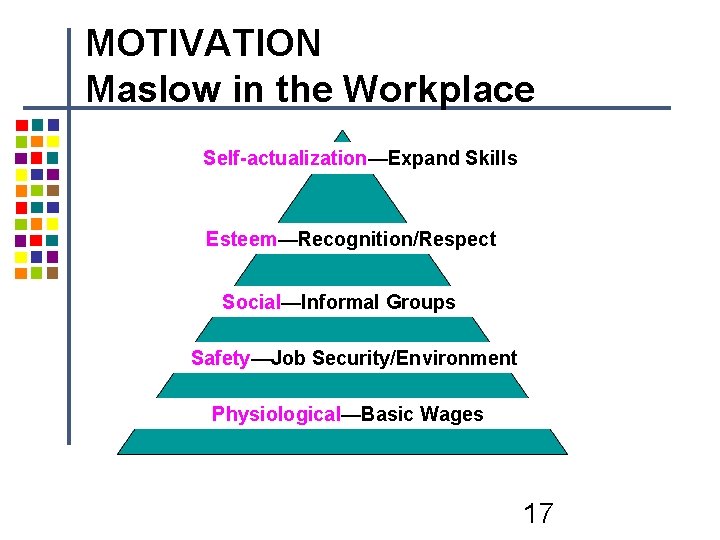
MOTIVATION Maslow in the Workplace Self-actualization—Expand Skills Esteem—Recognition/Respect Social—Informal Groups Safety—Job Security/Environment Physiological—Basic Wages 17
TALK IT OUT Where is the majority of the class currently on Maslow’s hierarchy? 18
LEADERSHIP • Leadership: the process of one person guiding (influencing) one or more individuals toward a specific goal • We are all leaders • Leaders are not just managers and supervisors • Not all bosses are leaders 19
LEADERSHIP • Primary leadership styles: – Autocratic leaders: authoritarian, they make decisions on their own without input from others – Democratic leaders: make decisions based upon input from others – Laissez-faire leaders: allow team members to make their own decisions without input from the leader 20
LEADERSHIP • Guide and motivate others by relationships • Relationships are built on: – Trust – Professionalism – Mutual respect • Leaders help others succeed 21
TALK IT OUT What leadership style is most appropriate: • For a football team? • For a gaming designer? • For rearranging office space? Explain your answers 22
BECOMING A LEADER • Begin acting like a leader today • Continuously develop leadership skills • Observe others, and learn from their successes and failures • Display leadership characteristics: – – Excellent communication skills Ability to work with and earn the trust of others Consistently ethical Have focus and vision 23
SHARE THE KNOWLEDGE 24