
Grand Challenge Problem Model Check Concurrent Software Edmund
Grand Challenge Problem: Model Check Concurrent Software Edmund M. Clarke Department of Computer Science Carnegie Mellon University
Temporal Logic Model Checking • Model checking is an automatic verification technique for finite state concurrent systems. • Developed independently by Clarke, Emerson, and Sistla and by Queille and Sifakis in early 1980’s. • Specifications are written in propositional temporal logic. • Verification procedure is an exhaustive search of the state space of the design.
Advantages of Model Checking • No proofs!!! • Fast (compared to other rigorous methods such as theorem proving) • Diagnostic counterexamples • No problem with partial specifications • Logics can easily express many concurrency properties
Main Disadvantage State Explosion Problem: • Too many processes • Complex data structures Much progress has been made on this problem recently!
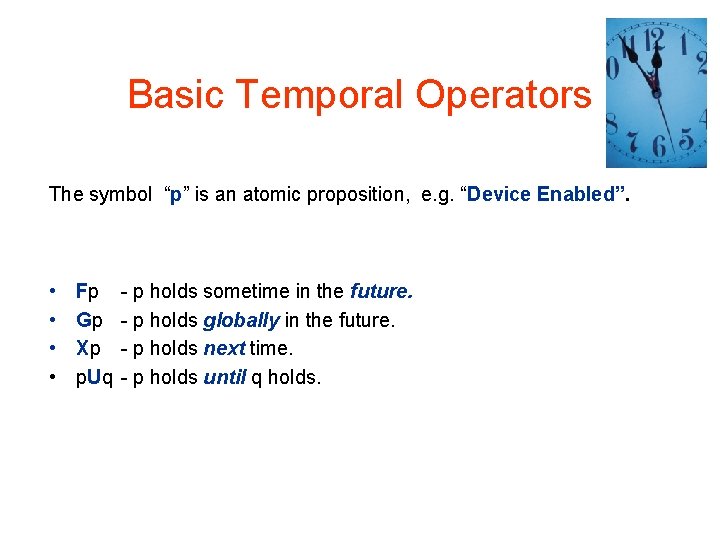
Basic Temporal Operators The symbol “p” is an atomic proposition, e. g. “Device Enabled”. • • Fp Gp Xp p. Uq - p holds sometime in the future. - p holds globally in the future. - p holds next time. - p holds until q holds.
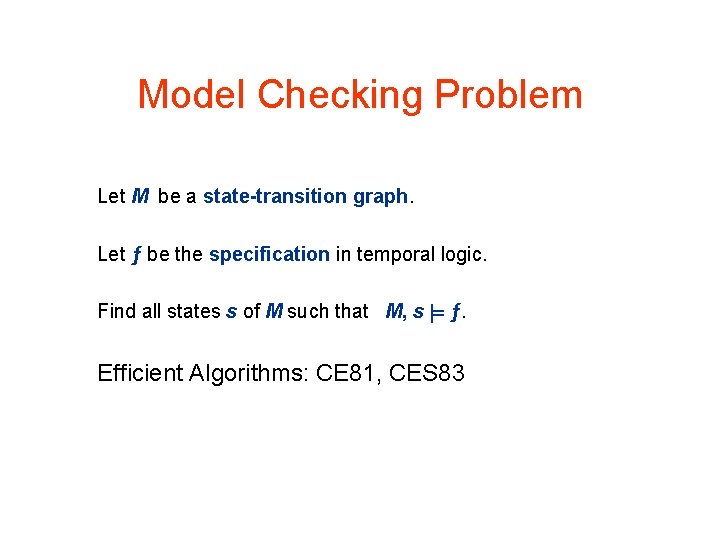
Model Checking Problem Let M be a state-transition graph. Let ƒ be the specification in temporal logic. Find all states s of M such that M, s ƒ. Efficient Algorithms: CE 81, CES 83
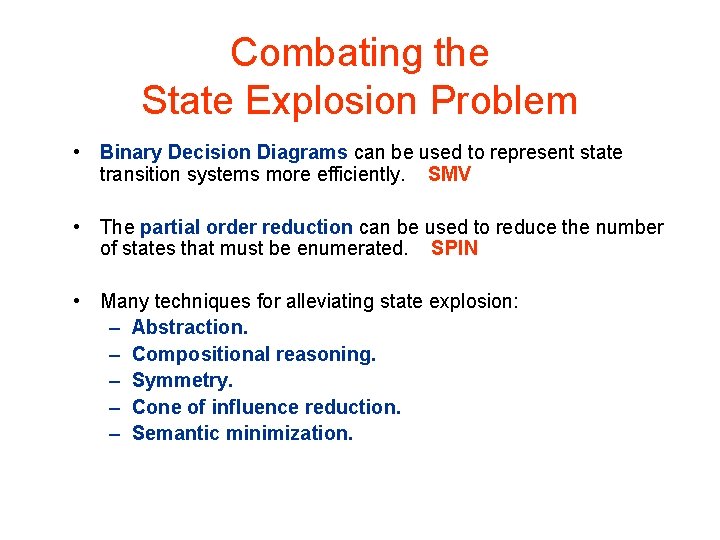
Combating the State Explosion Problem • Binary Decision Diagrams can be used to represent state transition systems more efficiently. SMV • The partial order reduction can be used to reduce the number of states that must be enumerated. SPIN • Many techniques for alleviating state explosion: – Abstraction. – Compositional reasoning. – Symmetry. – Cone of influence reduction. – Semantic minimization.
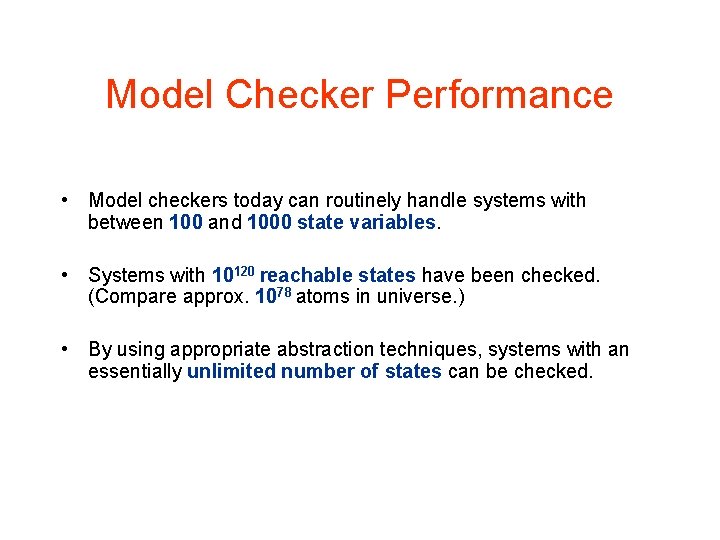
Model Checker Performance • Model checkers today can routinely handle systems with between 100 and 1000 state variables. • Systems with 10120 reachable states have been checked. (Compare approx. 1078 atoms in universe. ) • By using appropriate abstraction techniques, systems with an essentially unlimited number of states can be checked.
Model Checking Systems • There are many successful examples of the use of model checking in hardware and protocol verification. • The fact that industry (INTEL, IBM, MOTOROLA) is starting to use model checking is encouraging.
Notable Example. IEEE Futurebus+ • In 1992 Clarke and his students at CMU used SMV to verify the IEEE Future+ cache coherence protocol. • They found a number of previously undetected errors in the design of the protocol. • This was the first time that formal methods have been used to find errors in an IEEE standard. • Although the development of the protocol began in 1988, all previous attempts to validate it were based entirely on informal techniques.
Grand Challenge: Model Check Software ! What makes Software Model Checking different ?
What Makes Software Model Checking Different ? • • Large/unbounded base types: int, float, string User-defined types/classes Pointers/aliasing + unbounded #’s of heap-allocated cells Procedure calls/recursion/calls through pointers/dynamic method lookup/overloading • Concurrency + unbounded #’s of threads
What Makes Software Model Checking Different ? • • • Templates/generics/include files Interrupts/exceptions/callbacks Use of secondary storage: files, databases Absent source code for: libraries, system calls, mobile code Esoteric features: continuations, self-modifying code Size (e. g. , MS Word = 1. 4 MLOC)
What Does It Mean to Model Check Software? 1. Combine static analysis and model checking Use static analysis to extract a model K from a boolean abstraction of the program. Then check that f is true in K (K ² f), where f is the specification of the program. ² SLAM (Microsoft) ² Bandera (Kansas State) ² Java Path. Finder (NASA Ames) ² MAGIC (CMU)
What Does It Mean to Model Check Software? 2. Simulate program along all paths in computation tree ² Source code + backtracking (e. g. , Verisoft) ² Source code + symbolic execution + backtracking (e. g. , MS/Intrinsa Prefix) 3. Use finite-state machine to look for patterns in control-flow graph [Engler]
What Does It Mean to Model Check Software? 4. Design with Finite-State Software Models Finite state software models can act as “missing link” between transition graphs and complex software. ² Statecharts ² Esterel
What Does It Mean to Model Check Software? 5. Use Bounded Model Checking and SAT (Kroening) • Problem: How to compute set of reachable states? Fixpoint computation is too expensive. • Restrict search to states that are reachable from initial state within fixed number n of transitions • Implemented by unwinding program and using SAT solver
Key techniques for Software Model Checking • Counterexample Guided Abstraction Refinement (Kurshan, Yuan Lu, Ball et al. ) • Predicate Abstraction (Graf and Saidi, Ball et al, Chaki et al, Kroening)
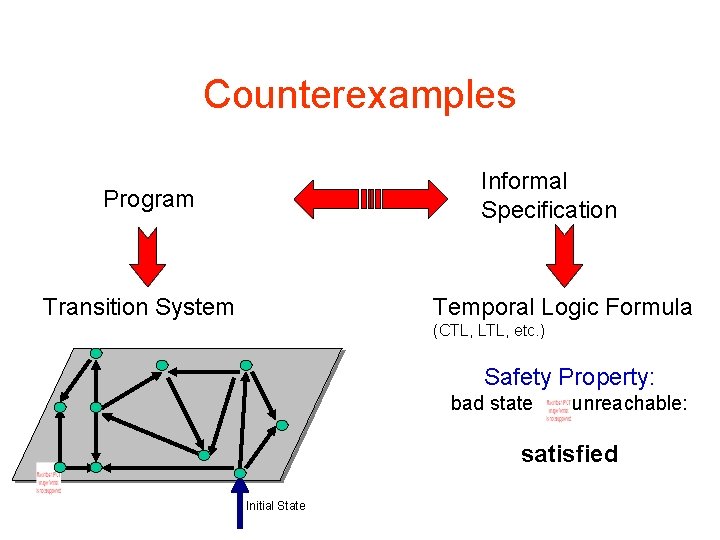
Counterexamples Informal Specification Program Transition System Temporal Logic Formula (CTL, LTL, etc. ) Safety Property: bad state unreachable: satisfied Initial State
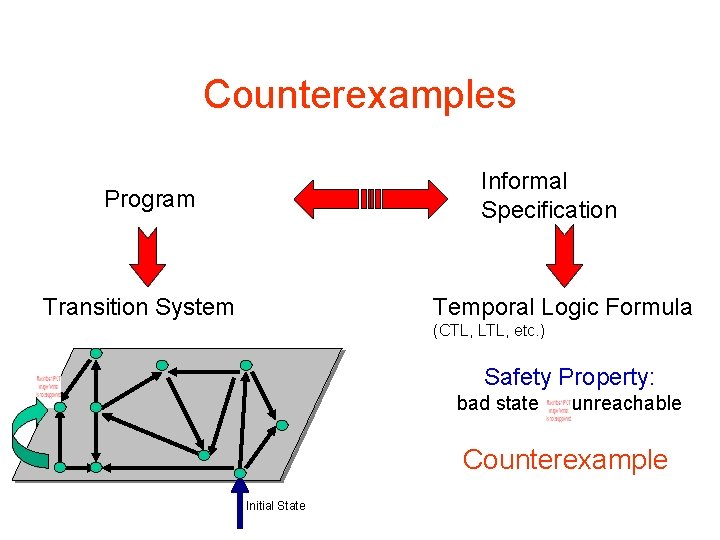
Counterexamples Informal Specification Program Transition System Temporal Logic Formula (CTL, LTL, etc. ) Safety Property: bad state unreachable Counterexample Initial State
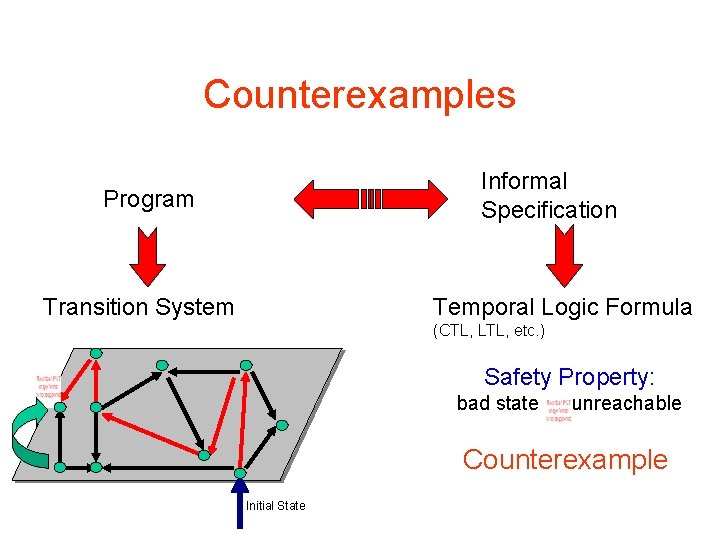
Counterexamples Informal Specification Program Transition System Temporal Logic Formula (CTL, LTL, etc. ) Safety Property: bad state unreachable Counterexample Initial State
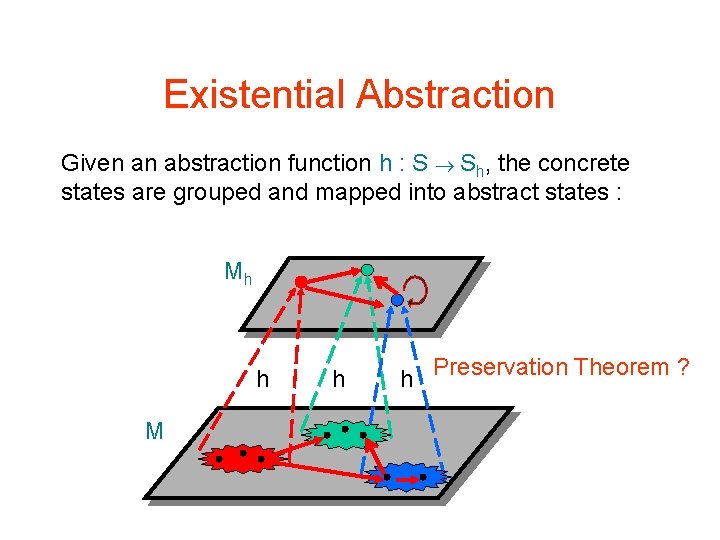
Existential Abstraction Given an abstraction function h : S Sh, the concrete states are grouped and mapped into abstract states : Mh h M h h Preservation Theorem ?
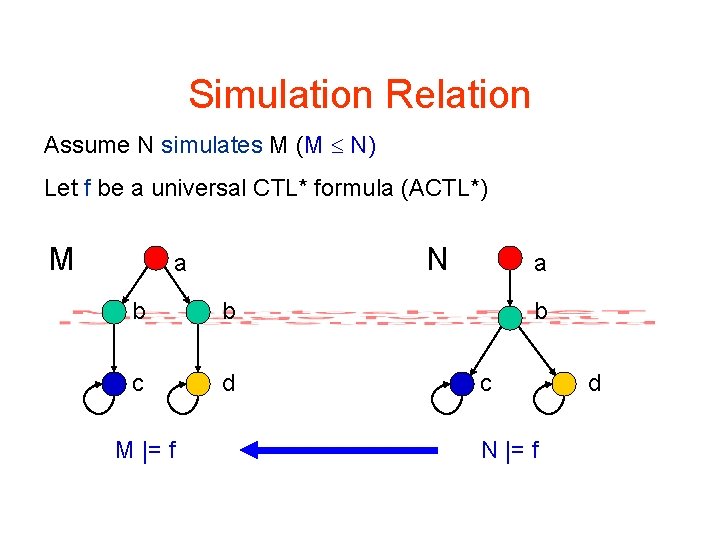
Simulation Relation Assume N simulates M (M N) Let f be a universal CTL* formula (ACTL*) M N a b b c d M |= f a b c N |= f d
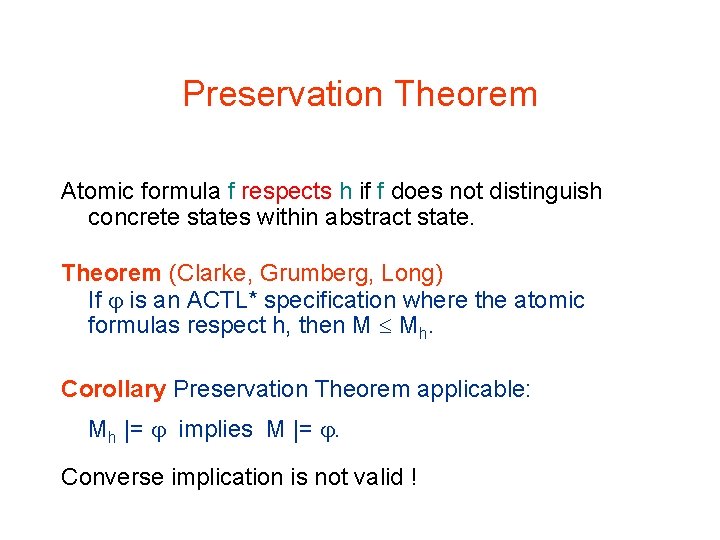
Preservation Theorem Atomic formula f respects h if f does not distinguish concrete states within abstract state. Theorem (Clarke, Grumberg, Long) If is an ACTL* specification where the atomic formulas respect h, then M Mh. Corollary Preservation Theorem applicable: Mh |= implies M |= . Converse implication is not valid !
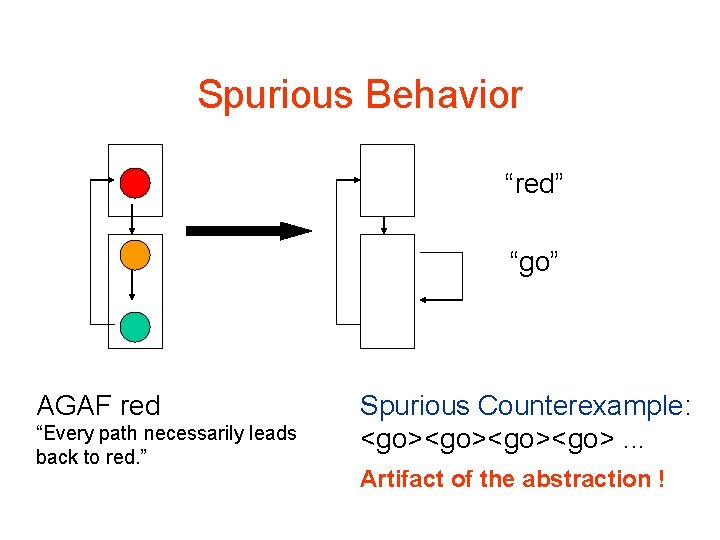
Spurious Behavior “red” “go” AGAF red “Every path necessarily leads back to red. ” Spurious Counterexample: <go><go>. . . Artifact of the abstraction !
How to define Abstraction Functions ? Abstraction too fine State Explosion Abstraction too coarse Information Loss Automatic Abstraction Methodology
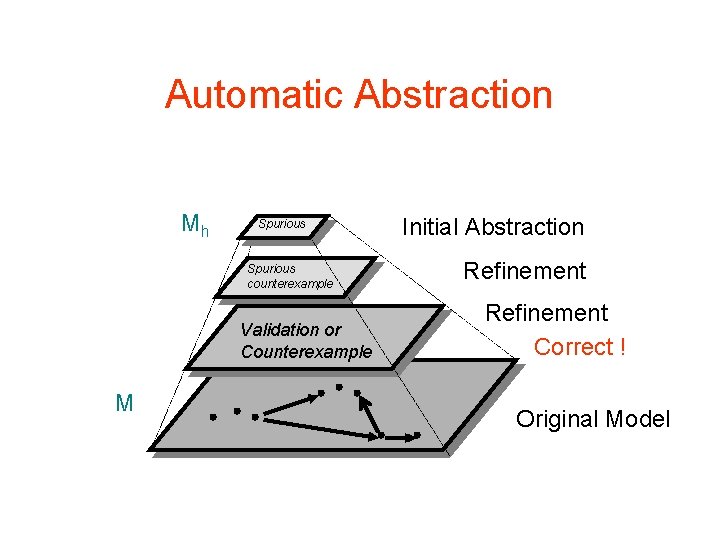
Automatic Abstraction Mh Spurious counterexample Validation or Counterexample M Initial Abstraction Refinement Correct ! Original Model
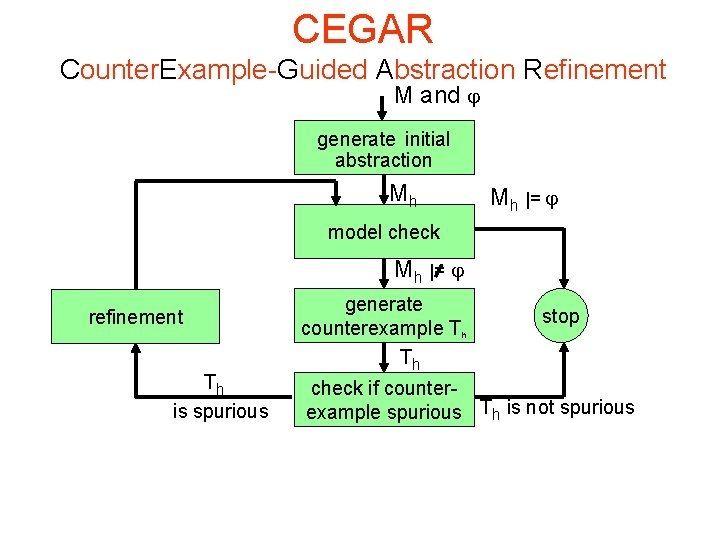
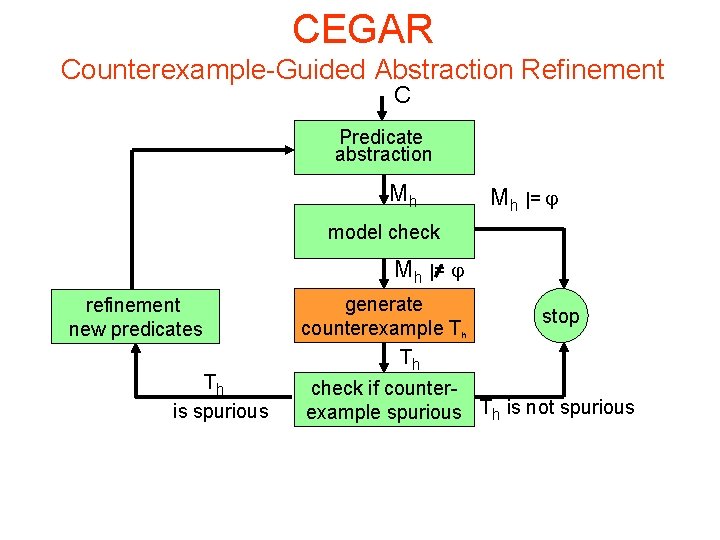
CEGAR Counter. Example-Guided Abstraction Refinement M and generate initial abstraction Mh Mh |= model check Mh |= refinement Th is spurious generate counterexample Th Th stop check if counterexample spurious Th is not spurious
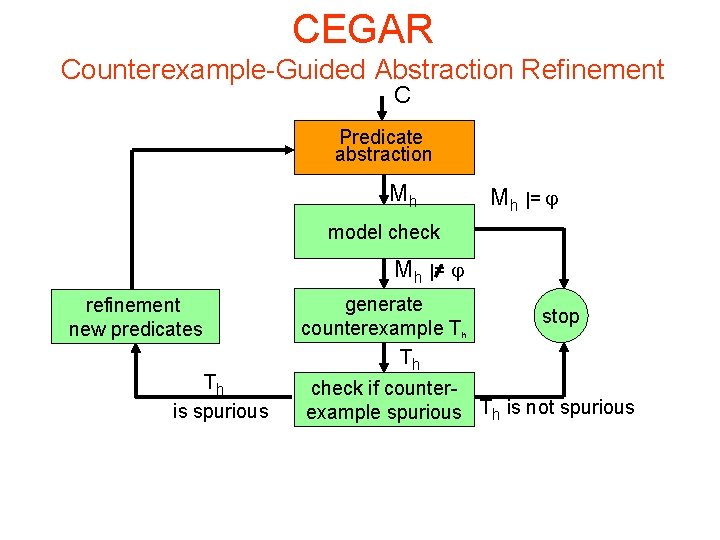
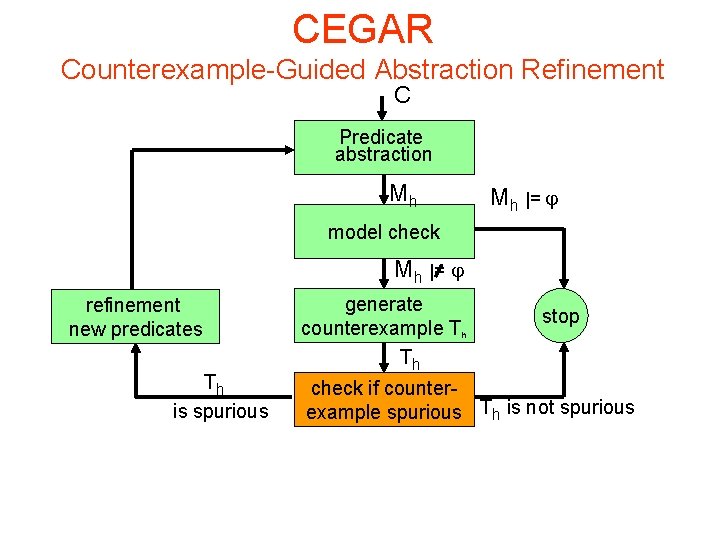
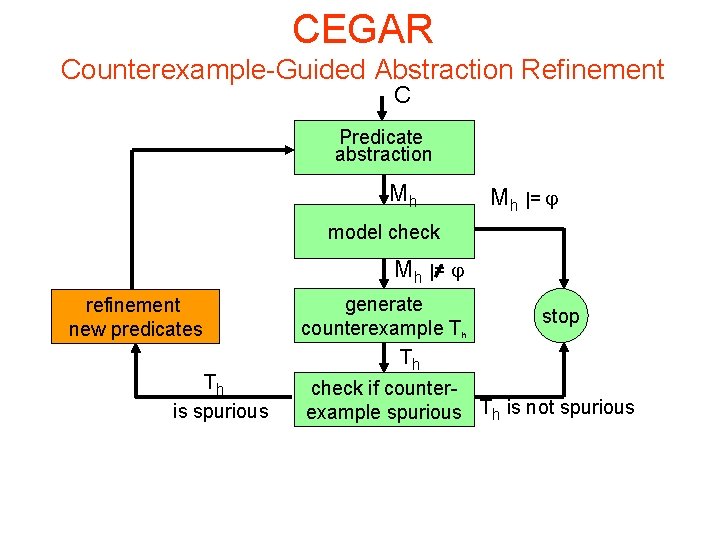
CEGAR Counterexample-Guided Abstraction Refinement C Predicate abstraction Mh Mh |= model check Mh |= refinement new predicates Th is spurious generate counterexample Th Th stop check if counterexample spurious Th is not spurious
Predicate Abstraction • Use predicate abstraction to prove assertions or safety properties • Successfully applied for verification of C programs (SLAM, MAGIC, BLAST) • Predicate abstraction produces over-approximation
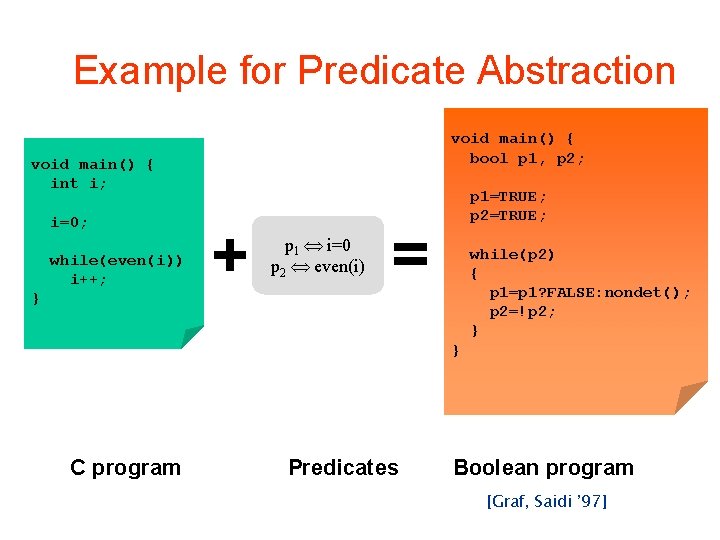
Example for Predicate Abstraction void main() { bool p 1, p 2; void main() { int i; i=0; while(even(i)) i++; } + p 1 i=0 p 2 even(i) p 1=TRUE; p 2=TRUE; = while(p 2) { p 1=p 1? FALSE: nondet(); p 2=!p 2; } } C program Predicates Boolean program [Graf, Saidi ’ 97]
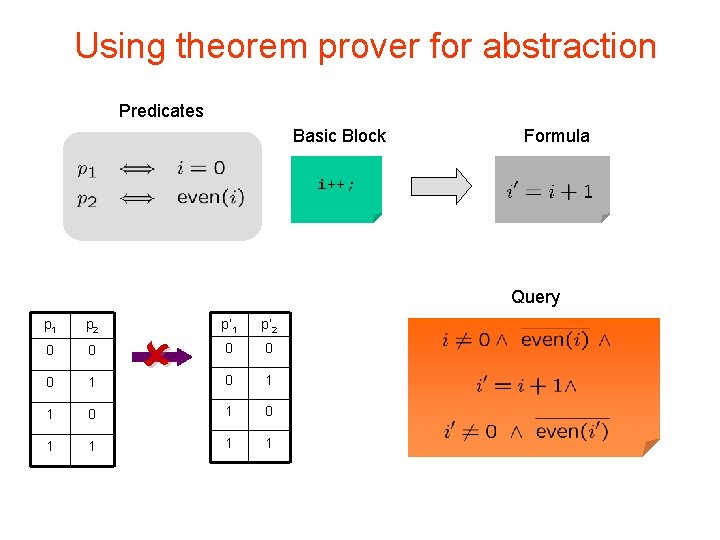
Using theorem prover for abstraction Predicates Basic Block Formula i++; Query p 1 p 2 p’ 1 p’ 2 0 0 0 1 0 1 1 1 1
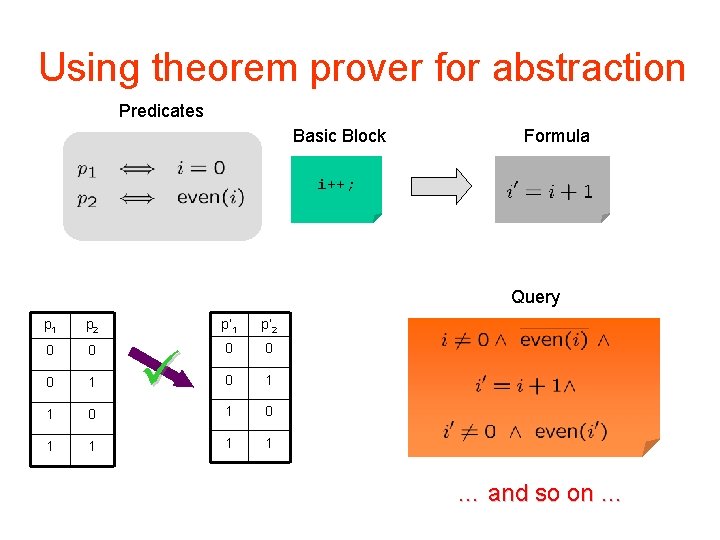
Using theorem prover for abstraction Predicates Basic Block Formula i++; Query p 1 p 2 p’ 1 p’ 2 0 0 0 1 0 1 1 1 1 … and so on …
Problems with existing tools • Large number of expensive theorem prover calls – slow (2 n £ 2 n ) • Theorem prover works on natural numbers, but programs uses bit-vectors false positives • Most theorem provers support only few operators (+, -, <, ≤, …), no bitwise operators
Abstraction of a basic block • Use a SAT solver for computing abstraction of a basic block • Successfully used for abstraction of C programs • Create a SAT instance which relates: – Initial value of predicates – Basic block – Final value of predicates
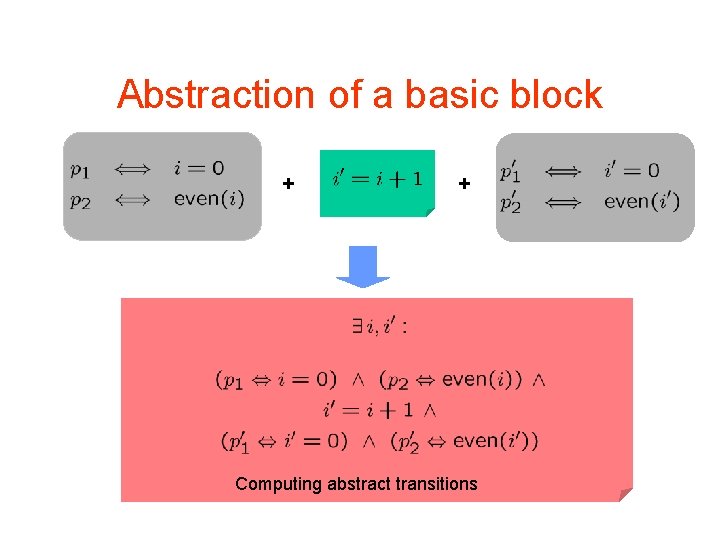
Abstraction of a basic block + + Computing abstract transitions
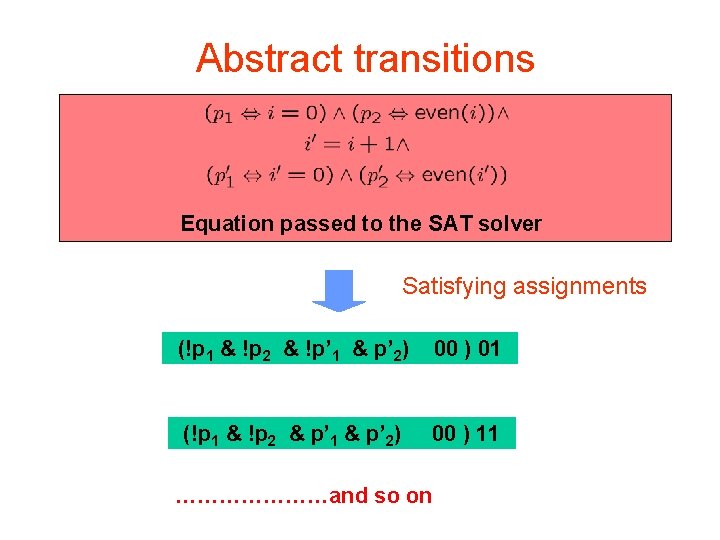
Abstract transitions Equation passed to the SAT solver Satisfying assignments (!p 1 & !p 2 & !p’ 1 & p’ 2) 00 ) 01 (!p 1 & !p 2 & p’ 1 & p’ 2) 00 ) 11 …………………and so on
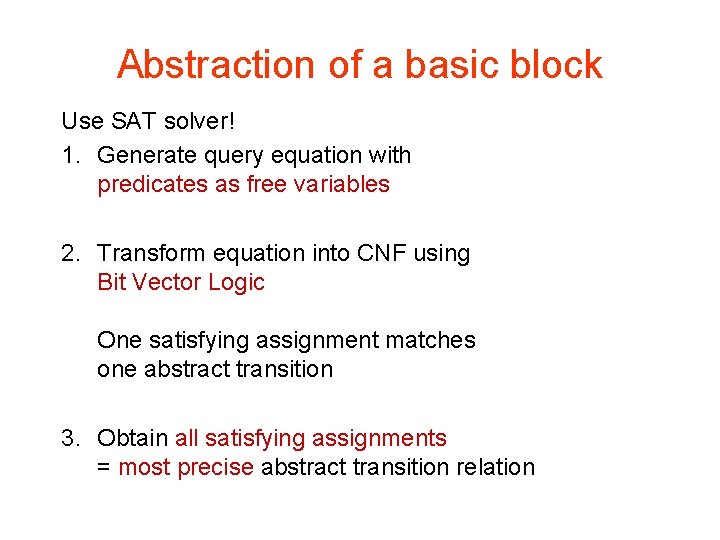
Abstraction of a basic block Use SAT solver! 1. Generate query equation with predicates as free variables 2. Transform equation into CNF using Bit Vector Logic One satisfying assignment matches one abstract transition 3. Obtain all satisfying assignments = most precise abstract transition relation
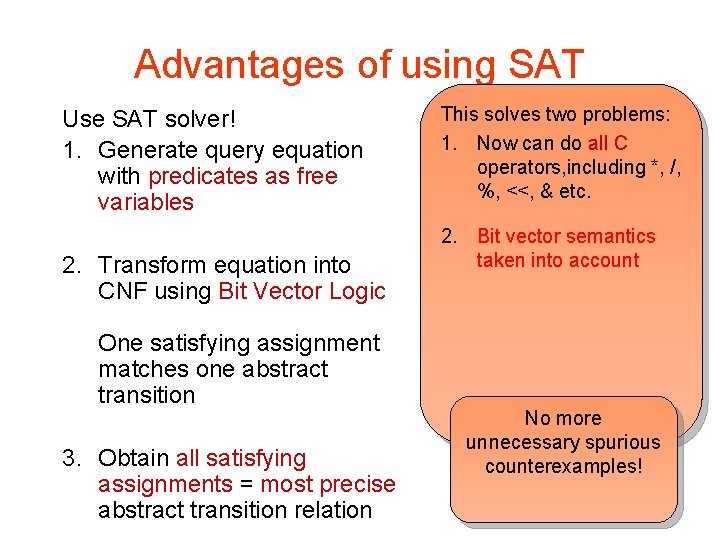
Advantages of using SAT Use SAT solver! 1. Generate query equation with predicates as free variables 2. Transform equation into CNF using Bit Vector Logic One satisfying assignment matches one abstract transition 3. Obtain all satisfying assignments = most precise abstract transition relation This solves two problems: 1. Now can do all C operators, including *, /, %, <<, & etc. 2. Bit vector semantics taken into account No more unnecessary spurious counterexamples!
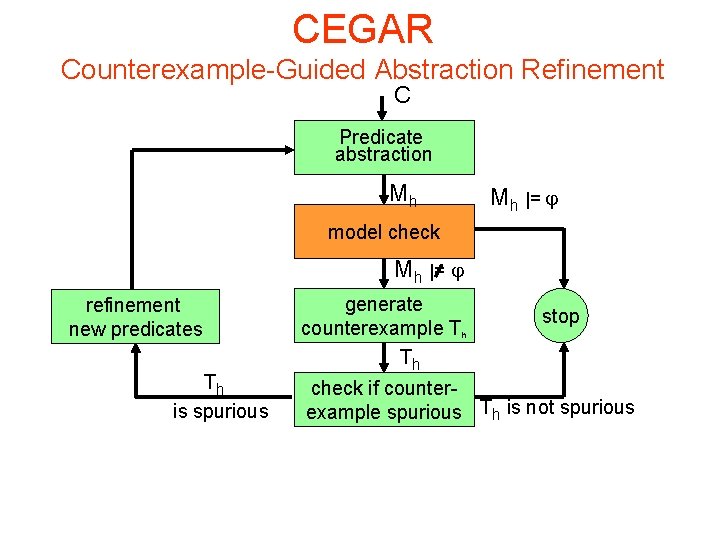
CEGAR Counterexample-Guided Abstraction Refinement C Predicate abstraction Mh Mh |= model check Mh |= refinement new predicates Th is spurious generate counterexample Th Th stop check if counterexample spurious Th is not spurious
CEGAR Counterexample-Guided Abstraction Refinement C Predicate abstraction Mh Mh |= model check Mh |= refinement new predicates Th is spurious generate counterexample Th Th stop check if counterexample spurious Th is not spurious
CEGAR Counterexample-Guided Abstraction Refinement C Predicate abstraction Mh Mh |= model check Mh |= refinement new predicates Th is spurious generate counterexample Th Th stop check if counterexample spurious Th is not spurious
CEGAR Counterexample-Guided Abstraction Refinement C Predicate abstraction Mh Mh |= model check Mh |= refinement new predicates Th is spurious generate counterexample Th Th stop check if counterexample spurious Th is not spurious
Future research directions • Data Structures • Pointers • Concurrency • Object Oriented Software • Scaling up!!
References Counterexample-Guided Abstraction Refinement. CAV’ 00 & JACM. Modular Verification of Software Components in C. ICSE 2003 Predicate Abstraction with Minimum Predicates. CHARME 2003 Predicate Abstraction of ANSI-C Programs Using SAT. FMSD 2004 A Tool for Checking ANSI-C Programs , TACAS 2004 Joint Work with O. Grumberg, H. Veith, D. Kroening, Sagar Chaki, Natasha Sharygina, Karen Yorav, Himanshu Jain QUESTIONS?
- Slides: 45