
Grammatical structure of the English language Theme The
- Slides: 22
Grammatical structure of the English language Theme: The Plan of the lesson: 1. Definition of the notion of “structure” 2. Grammatical means of English language: order of words , functional words, inflexions, sound change (or law), suppletion, the roles of suprasegmentals
The central concept in linguistic analyses is structure, by which is meant the ordered or patterned rules which are discoverable in a language, whether in the units of sound, grammatical inflexions, the syntactical arrangements, and the meanings of linguistic forms. Grammar consists of two fundamental categories- morphology and syntax and together they help us to identify grammatical forms which serve to enhance and sharpen the expression of meaning.
In order to make up a real sensible sentence there are some procedures one ought to fulfill: • to choose the necessary notional words; • to keep the word order according to the prescriptive norms of the learning language; • to combine the necessary function (or grammatical) words; • to connect notional words by means of inflexions (or grammatical morphemes); • to use proper stress, pause and intonation patterns.
A study of grammar reveals a structure and regularity, which lies at the basis of language and enables us to talk of the language system. Grammatical structure of any language may be expressed in different ways. Here are certain grammatical means or parameters which are used in grammar: • • • the order of words inflections grammatical (or form) words sound change Suppletion stress and intonation
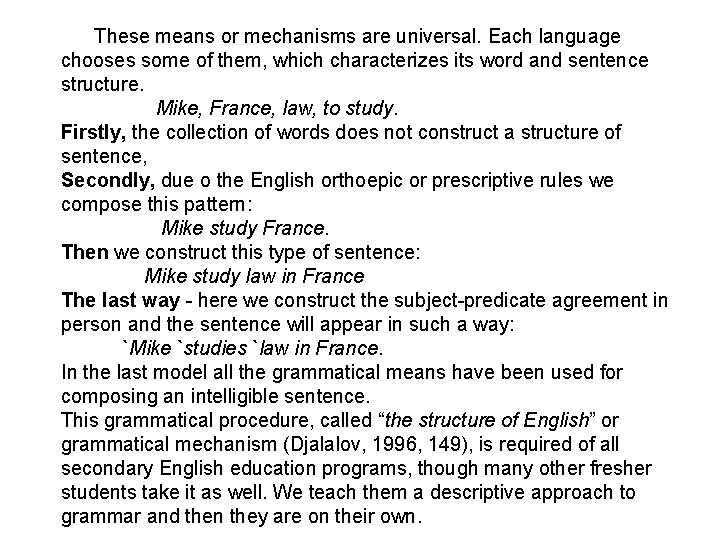
These means or mechanisms are universal. Each language chooses some of them, which characterizes its word and sentence structure. Mike, France, law, to study. Firstly, the collection of words does not construct a structure of sentence, Secondly, due o the English orthoepic or prescriptive rules we compose this pattern: Mike study France. Then we construct this type of sentence: Mike study law in France The last way - here we construct the subject-predicate agreement in person and the sentence will appear in such a way: `Mike `studies `law in France. In the last model all the grammatical means have been used for composing an intelligible sentence. This grammatical procedure, called “the structure of English” or grammatical mechanism (Djalalov, 1996, 149), is required of all secondary English education programs, though many other fresher students take it as well. We teach them a descriptive approach to grammar and then they are on their own.
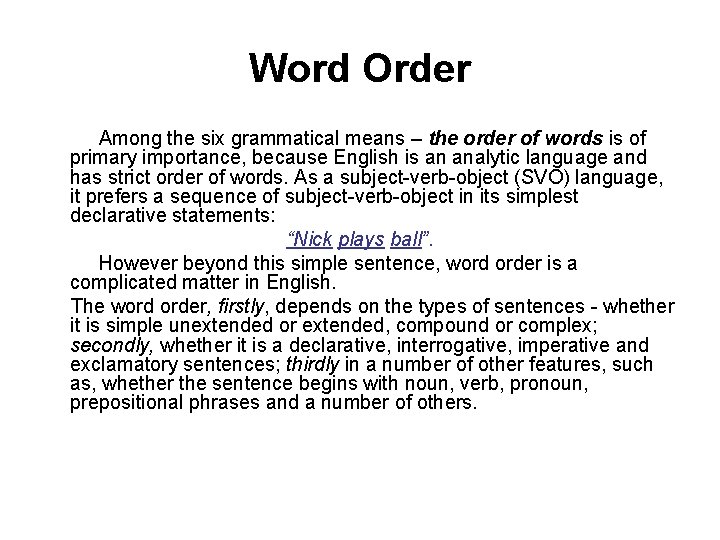
Word Order Among the six grammatical means – the order of words is of primary importance, because English is an analytic language and has strict order of words. As a subject-verb-object (SVO) language, it prefers a sequence of subject-verb-object in its simplest declarative statements: “Nick plays ball”. However beyond this simple sentence, word order is a complicated matter in English. The word order, firstly, depends on the types of sentences - whether it is simple unextended or extended, compound or complex; secondly, whether it is a declarative, interrogative, imperative and exclamatory sentences; thirdly in a number of other features, such as, whether the sentence begins with noun, verb, pronoun, prepositional phrases and a number of others.
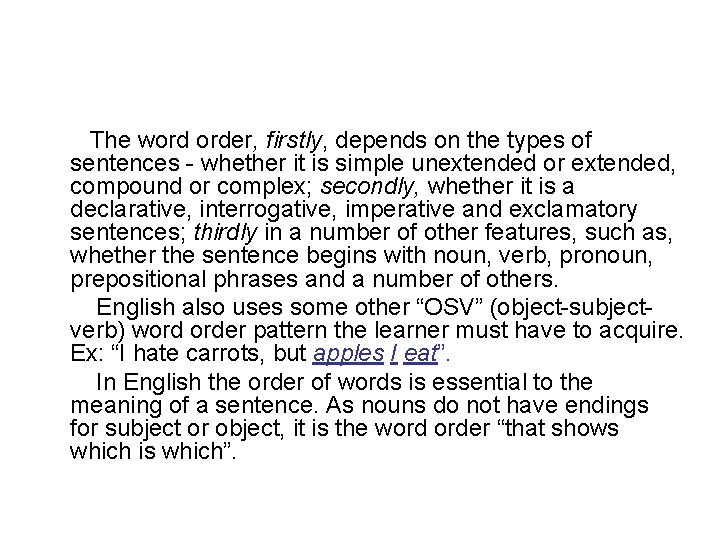
The word order, firstly, depends on the types of sentences - whether it is simple unextended or extended, compound or complex; secondly, whether it is a declarative, interrogative, imperative and exclamatory sentences; thirdly in a number of other features, such as, whether the sentence begins with noun, verb, pronoun, prepositional phrases and a number of others. English also uses some other “OSV” (object-subjectverb) word order pattern the learner must have to acquire. Ex: “I hate carrots, but apples I eat”. In English the order of words is essential to the meaning of a sentence. As nouns do not have endings for subject or object, it is the word order “that shows which is which”.
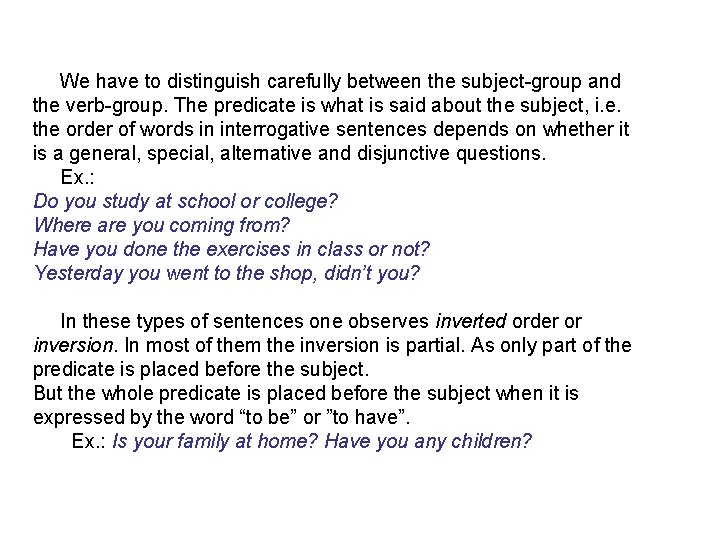
We have to distinguish carefully between the subject-group and the verb-group. The predicate is what is said about the subject, i. e. the order of words in interrogative sentences depends on whether it is a general, special, alternative and disjunctive questions. Ex. : Do you study at school or college? Where are you coming from? Have you done the exercises in class or not? Yesterday you went to the shop, didn’t you? In these types of sentences one observes inverted order or inversion. In most of them the inversion is partial. As only part of the predicate is placed before the subject. But the whole predicate is placed before the subject when it is expressed by the word “to be” or ”to have”. Ex. : Is your family at home? Have you any children?
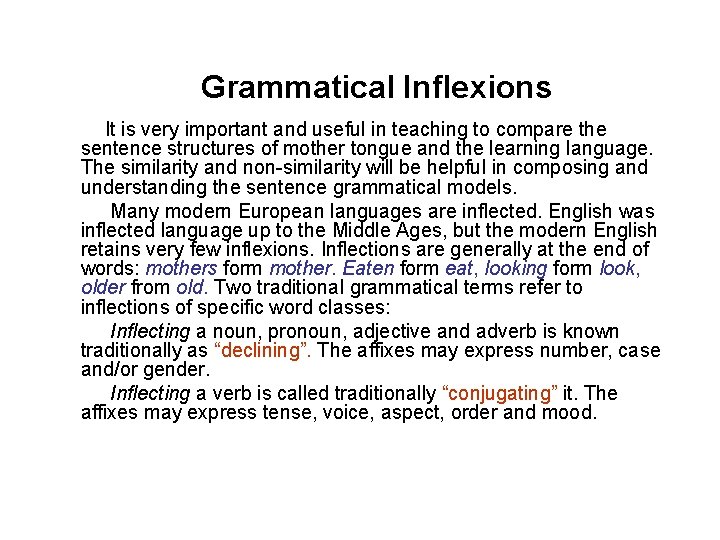
Grammatical Inflexions It is very important and useful in teaching to compare the sentence structures of mother tongue and the learning language. The similarity and non-similarity will be helpful in composing and understanding the sentence grammatical models. Many modern European languages are inflected. English was inflected language up to the Middle Ages, but the modern English retains very few inflexions. Inflections are generally at the end of words: mothers form mother. Eaten form eat, looking form look, older from old. Two traditional grammatical terms refer to inflections of specific word classes: Inflecting a noun, pronoun, adjective and adverb is known traditionally as “declining”. The affixes may express number, case and/or gender. Inflecting a verb is called traditionally “conjugating” it. The affixes may express tense, voice, aspect, order and mood.
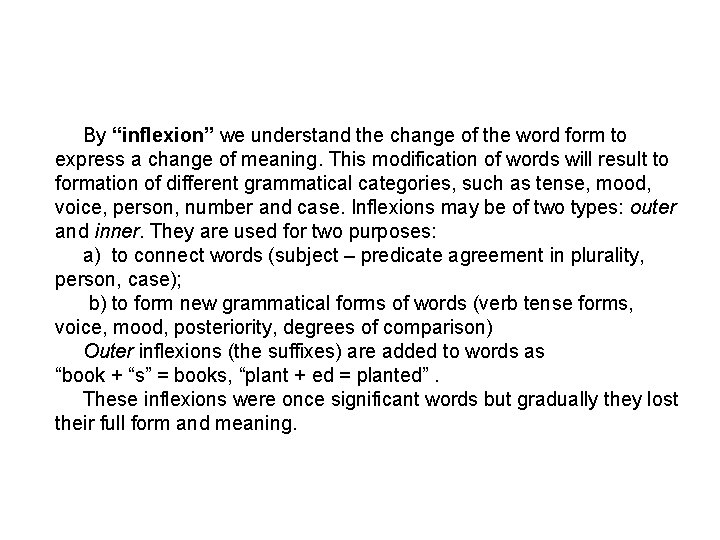
By “inflexion” we understand the change of the word form to express a change of meaning. This modification of words will result to formation of different grammatical categories, such as tense, mood, voice, person, number and case. Inflexions may be of two types: outer and inner. They are used for two purposes: a) to connect words (subject – predicate agreement in plurality, person, case); b) to form new grammatical forms of words (verb tense forms, voice, mood, posteriority, degrees of comparison) Outer inflexions (the suffixes) are added to words as “book + “s” = books, “plant + ed = planted”. These inflexions were once significant words but gradually they lost their full form and meaning.
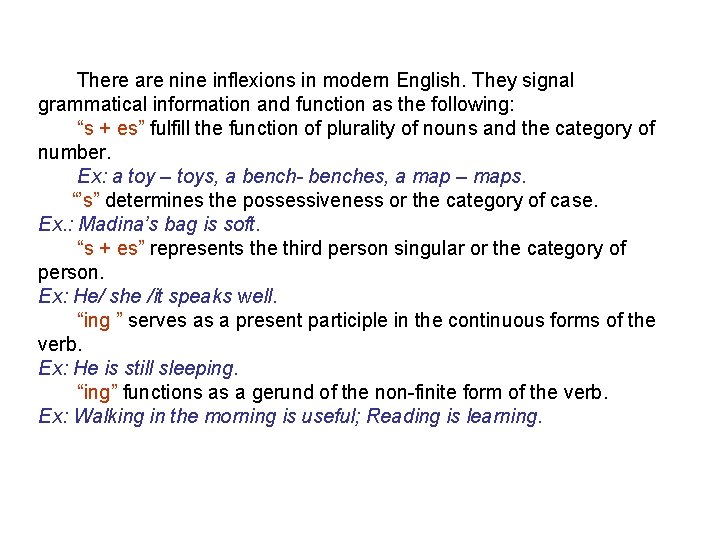
There are nine inflexions in modern English. They signal grammatical information and function as the following: “s + es” fulfill the function of plurality of nouns and the category of number. Ex: a toy – toys, a bench- benches, a map – maps. “’s” determines the possessiveness or the category of case. Ex. : Madina’s bag is soft. “s + es” represents the third person singular or the category of person. Ex: He/ she /it speaks well. “ing ” serves as a present participle in the continuous forms of the verb. Ex: He is still sleeping. “ing” functions as a gerund of the non-finite form of the verb. Ex: Walking in the morning is useful; Reading is learning.
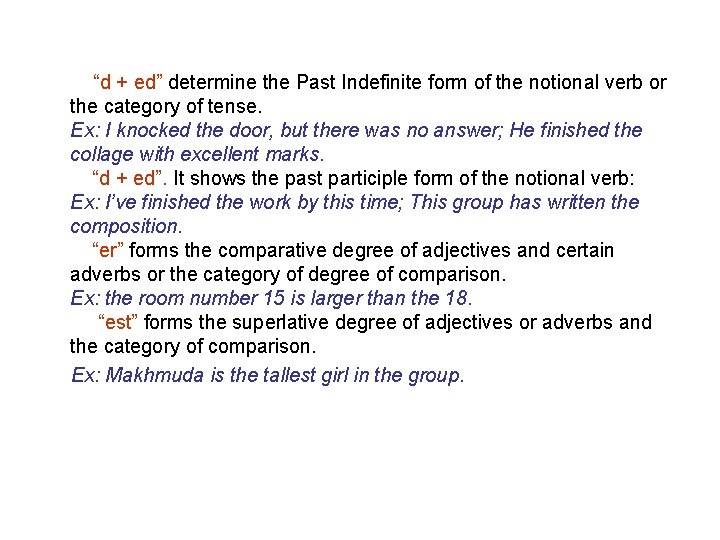
“d + ed” determine the Past Indefinite form of the notional verb or the category of tense. Ex: I knocked the door, but there was no answer; He finished the collage with excellent marks. “d + ed”. It shows the past participle form of the notional verb: Ex: I’ve finished the work by this time; This group has written the composition. “er” forms the comparative degree of adjectives and certain adverbs or the category of degree of comparison. Ex: the room number 15 is larger than the 18. “est” forms the superlative degree of adjectives or adverbs and the category of comparison. Ex: Makhmuda is the tallest girl in the group.
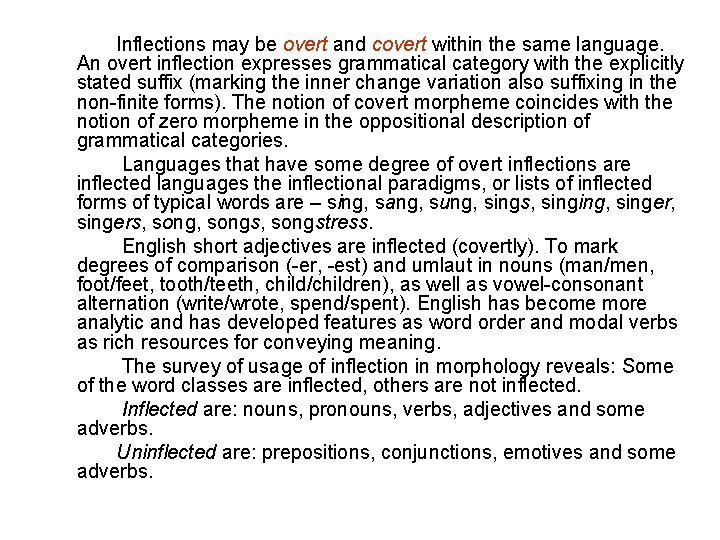
Inflections may be overt and covert within the same language. An overt inflection expresses grammatical category with the explicitly stated suffix (marking the inner change variation also suffixing in the non-finite forms). The notion of covert morpheme coincides with the notion of zero morpheme in the oppositional description of grammatical categories. Languages that have some degree of overt inflections are inflected languages the inflectional paradigms, or lists of inflected forms of typical words are – sing, sang, sung, sings, singing, singers, songs, songstress. English short adjectives are inflected (covertly). To mark degrees of comparison (-er, -est) and umlaut in nouns (man/men, foot/feet, tooth/teeth, child/children), as well as vowel-consonant alternation (write/wrote, spend/spent). English has become more analytic and has developed features as word order and modal verbs as rich resources for conveying meaning. The survey of usage of inflection in morphology reveals: Some of the word classes are inflected, others are not inflected. Inflected are: nouns, pronouns, verbs, adjectives and some adverbs. Uninflected are: prepositions, conjunctions, emotives and some adverbs.
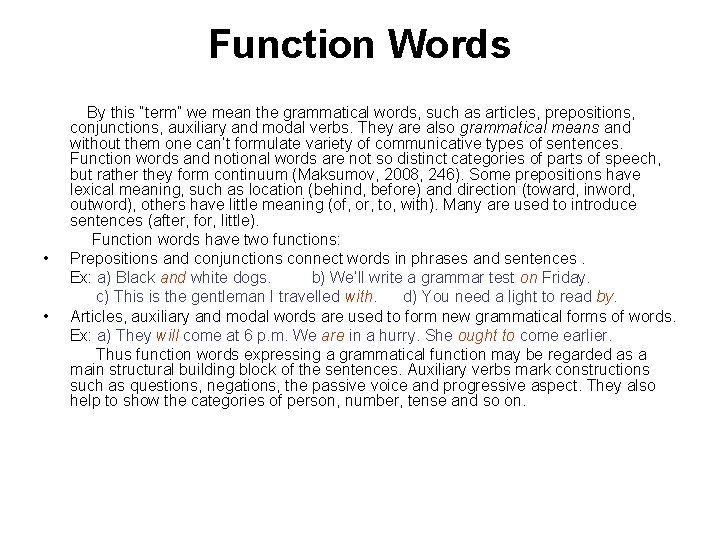
Function Words • • By this “term” we mean the grammatical words, such as articles, prepositions, conjunctions, auxiliary and modal verbs. They are also grammatical means and without them one can’t formulate variety of communicative types of sentences. Function words and notional words are not so distinct categories of parts of speech, but rather they form continuum (Maksumov, 2008, 246). Some prepositions have lexical meaning, such as location (behind, before) and direction (toward, inword, outword), others have little meaning (of, or, to, with). Many are used to introduce sentences (after, for, little). Function words have two functions: Prepositions and conjunctions connect words in phrases and sentences. Ex: a) Black and white dogs. b) We’ll write a grammar test on Friday. c) This is the gentleman I travelled with. d) You need a light to read by. Articles, auxiliary and modal words are used to form new grammatical forms of words. Ex: a) They will come at 6 p. m. We are in a hurry. She ought to come earlier. Thus function words expressing a grammatical function may be regarded as a main structural building block of the sentences. Auxiliary verbs mark constructions such as questions, negations, the passive voice and progressive aspect. They also help to show the categories of person, number, tense and so on.
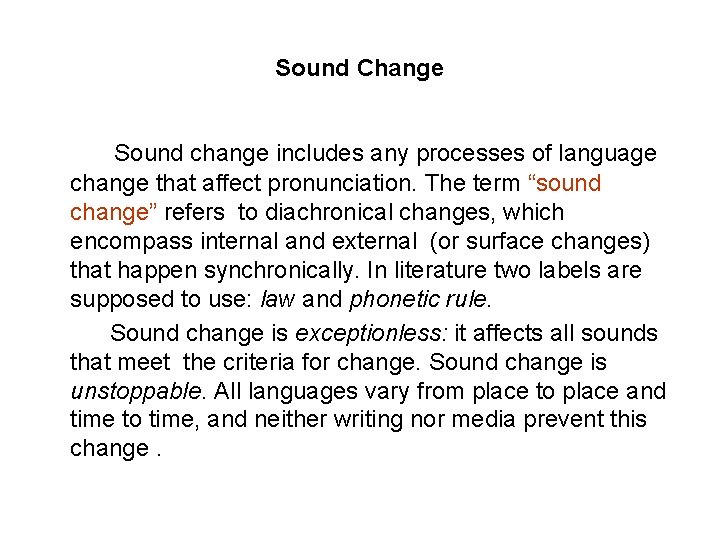
Sound Change Sound change includes any processes of language change that affect pronunciation. The term “sound change” refers to diachronical changes, which encompass internal and external (or surface changes) that happen synchronically. In literature two labels are supposed to use: law and phonetic rule. Sound change is exceptionless: it affects all sounds that meet the criteria for change. Sound change is unstoppable. All languages vary from place to place and time to time, and neither writing nor media prevent this change.
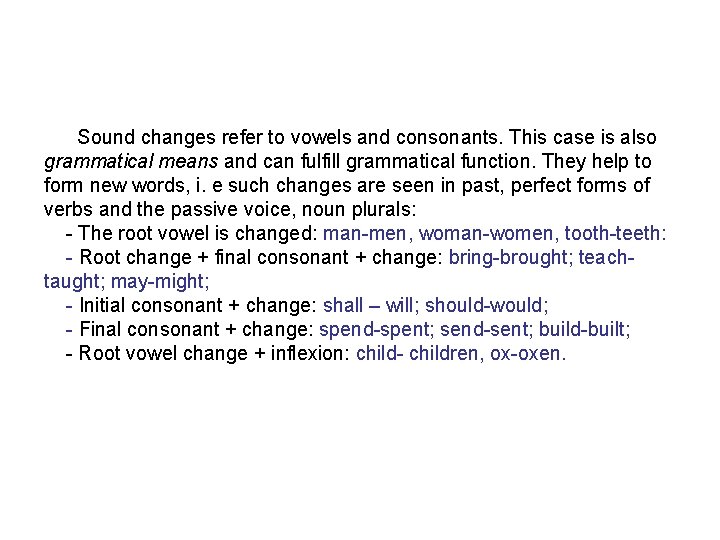
Sound changes refer to vowels and consonants. This case is also grammatical means and can fulfill grammatical function. They help to form new words, i. e such changes are seen in past, perfect forms of verbs and the passive voice, noun plurals: - The root vowel is changed: man-men, woman-women, tooth-teeth: - Root change + final consonant + change: bring-brought; teachtaught; may-might; - Initial consonant + change: shall – will; should-would; - Final consonant + change: spend-spent; send-sent; build-built; - Root vowel change + inflexion: child- children, ox-oxen.
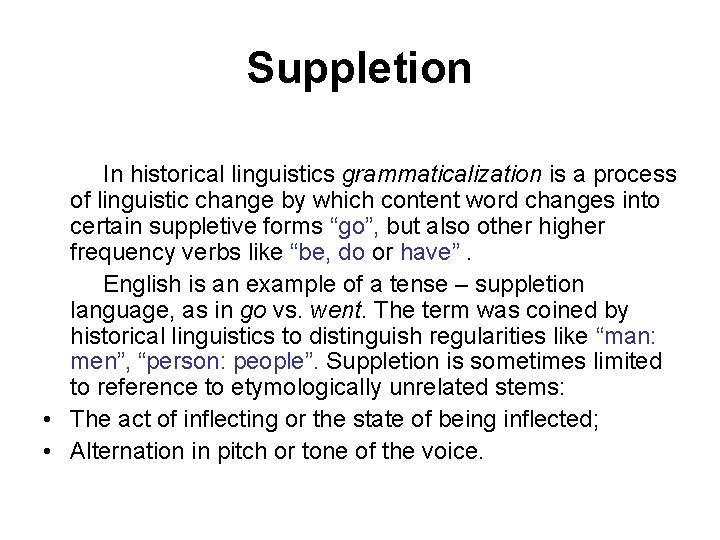
Suppletion In historical linguistics grammaticalization is a process of linguistic change by which content word changes into certain suppletive forms “go”, but also other higher frequency verbs like “be, do or have”. English is an example of a tense – suppletion language, as in go vs. went. The term was coined by historical linguistics to distinguish regularities like “man: men”, “person: people”. Suppletion is sometimes limited to reference to etymologically unrelated stems: • The act of inflecting or the state of being inflected; • Alternation in pitch or tone of the voice.
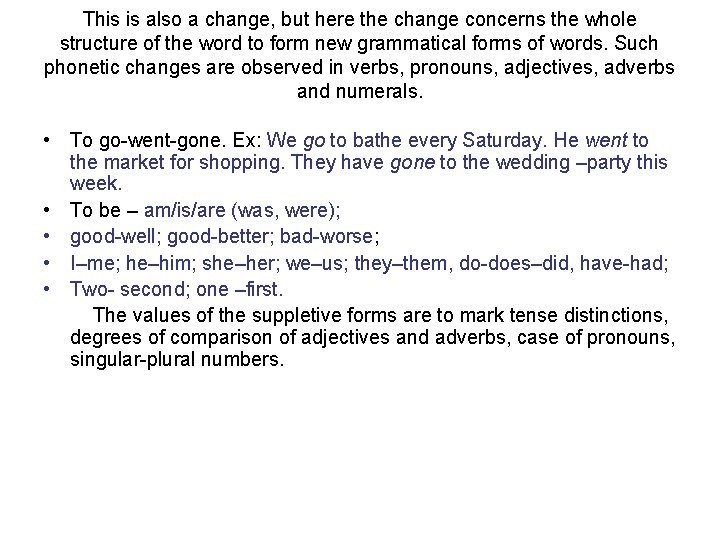
This is also a change, but here the change concerns the whole structure of the word to form new grammatical forms of words. Such phonetic changes are observed in verbs, pronouns, adjectives, adverbs and numerals. • To go-went-gone. Ex: We go to bathe every Saturday. He went to the market for shopping. They have gone to the wedding –party this week. • To be – am/is/are (was, were); • good-well; good-better; bad-worse; • I–me; he–him; she–her; we–us; they–them, do-does–did, have-had; • Two- second; one –first. The values of the suppletive forms are to mark tense distinctions, degrees of comparison of adjectives and adverbs, case of pronouns, singular-plural numbers.
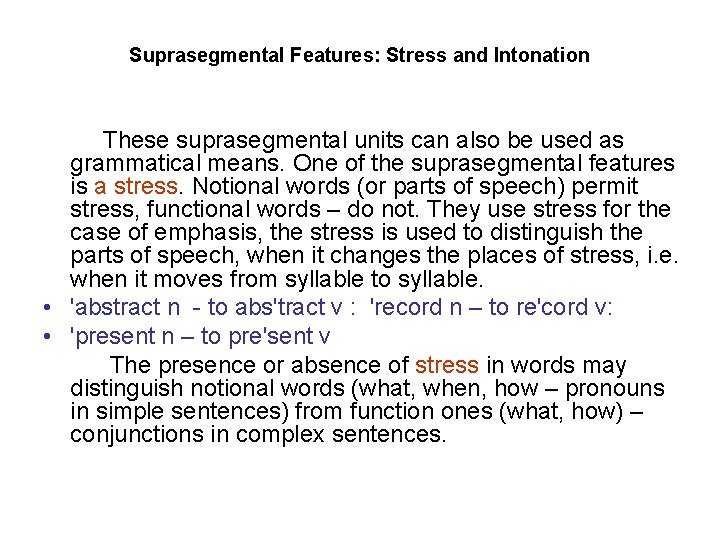
Suprasegmental Features: Stress and Intonation These suprasegmental units can also be used as grammatical means. One of the suprasegmental features is a stress. Notional words (or parts of speech) permit stress, functional words – do not. They use stress for the case of emphasis, the stress is used to distinguish the parts of speech, when it changes the places of stress, i. e. when it moves from syllable to syllable. • 'abstract n - to abs'tract v : 'record n – to re'cord v: • 'present n – to pre'sent v The presence or absence of stress in words may distinguish notional words (what, when, how – pronouns in simple sentences) from function ones (what, how) – conjunctions in complex sentences.
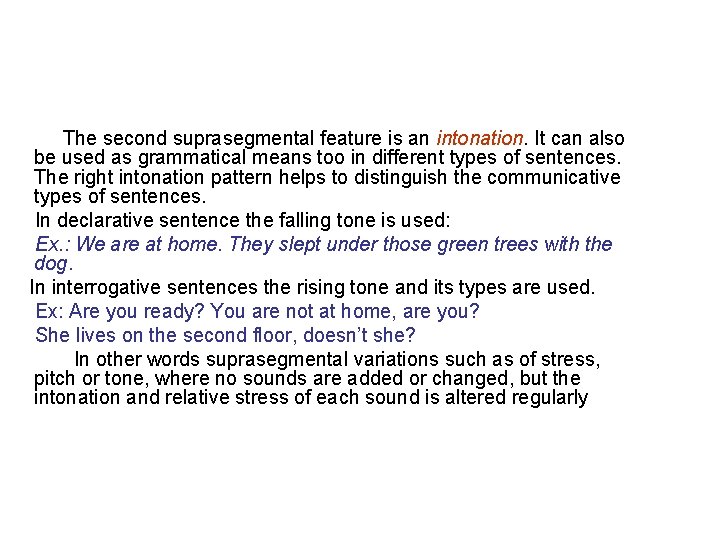
The second suprasegmental feature is an intonation. It can also be used as grammatical means too in different types of sentences. The right intonation pattern helps to distinguish the communicative types of sentences. In declarative sentence the falling tone is used: Ex. : We are at home. They slept under those green trees with the dog. In interrogative sentences the rising tone and its types are used. Ex: Are you ready? You are not at home, are you? She lives on the second floor, doesn’t she? In other words suprasegmental variations such as of stress, pitch or tone, where no sounds are added or changed, but the intonation and relative stress of each sound is altered regularly
Conclusion • Thus, grammatical structure is a system of means used in turning linguistic units into communicative ones. In other words the units of language into the units of speech. A short survey of description of grammatical means brings to such conclusion. • Grammatical meanings are expressed in the following ways • by means of word forms • by means of function words • by the use of word order • by the suppletion form of words • By means of inner inflections or sound change • By using the suprasegmental units or means (stress and intonation patterns) or means in connected speech.
The business of grammarian is the identification of word forms and their value in word classes, and arrangements apart from lexical meanings of the words, i. e. the significance of free and bound morphemes, complete and partial sound changes (suppletive forms of verbs, pronouns, numerals, degrees of comparison). Morphological processes involve changes of stress in words and various intonation patterns for types of sentences. In special literature it is said that “if words are language’s bricks, the syntax is the wall”. Thus, to know the grammar of the English language implies to be aware of the notion of the grammatical means of the learning language, their functions, then be able to use them due to certain orthoepic and prescriptive rules in different communicative types of sentences. Only in this case the learners will acquire the proficiency and become proficient in this domane.