
GRAMMATICAL FUNCTIONS Subject Oblique Object Complement Grammatical Description
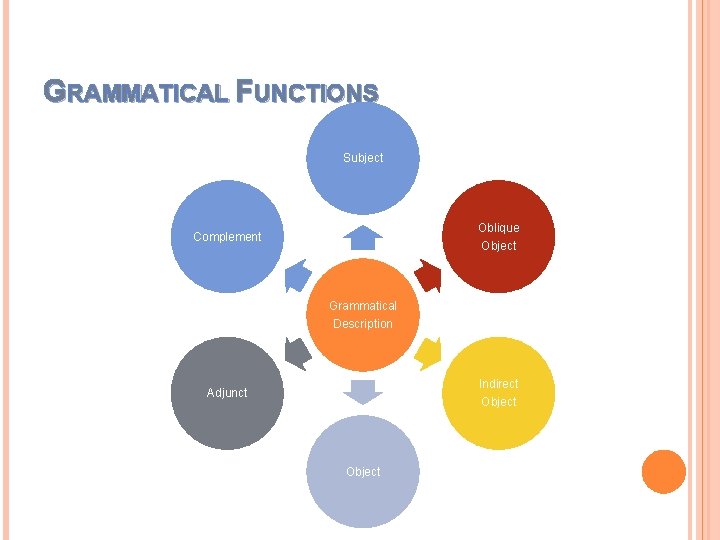
GRAMMATICAL FUNCTIONS Subject Oblique Object Complement Grammatical Description Indirect Object Adjunct Object
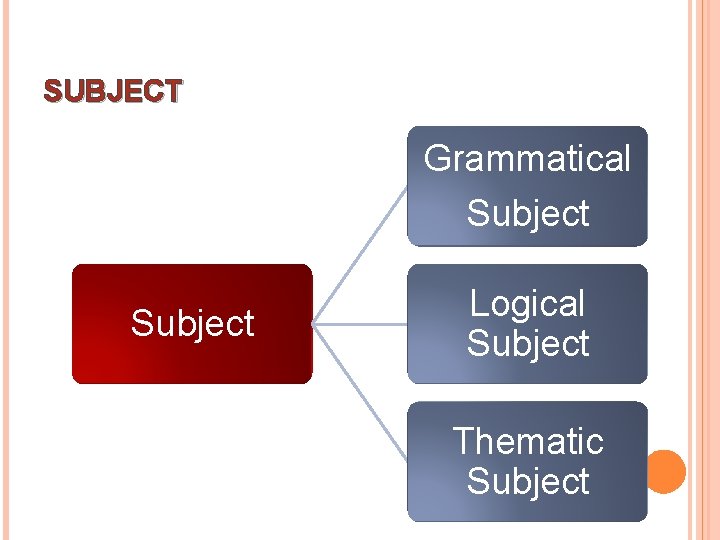
SUBJECT Grammatical Subject Logical Subject Thematic Subject
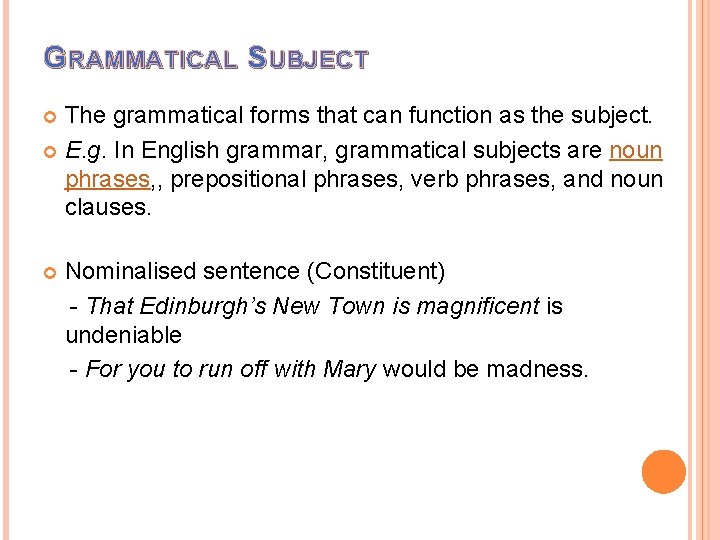
G RAMMATICAL S UBJECT The grammatical forms that can function as the subject. E. g. In English grammar, grammatical subjects are noun phrases, , prepositional phrases, verb phrases, and noun clauses. Nominalised sentence (Constituent) - That Edinburgh’s New Town is magnificent is undeniable - For you to run off with Mary would be madness.

Dummy no constituent. E. g. It is raining Nominalized sentence is extraposed. E. g. That Edinburgh’s New Town is magnificent is undeniable It is undeniable that Edinburgh’s New Town • Existential asserts the existence of something Eg. There are glasses in the drinks cupboard. • Deictic point something Eg. There is the glass

DEICTIC VS EXISTENTIAL Deictic • pronounced with nonreduced form. E. g. there is /ðɛəriz/, there are /ðɛəra/. • There need not be a subject • There can be questioned. • Definite NP Existential • pronounced with reduced form. Eg. there is /ðəz/, there are /ðəra/. • There must be a subject • There can’t be questioned. • Indefinite NP
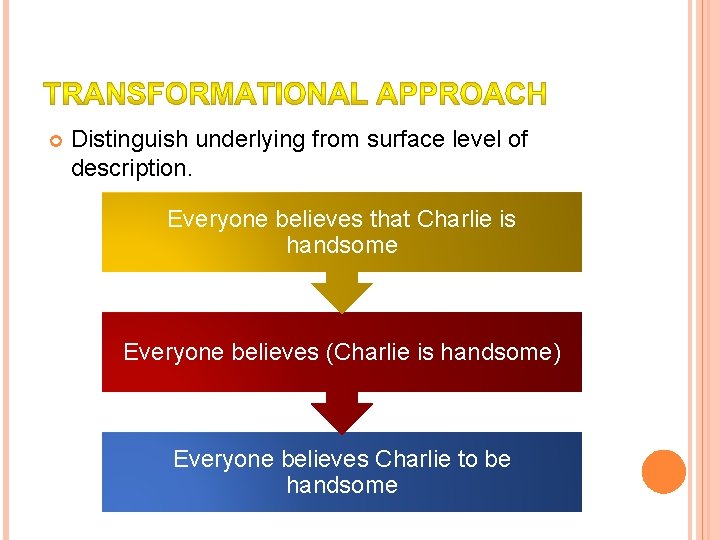
Distinguish underlying from surface level of description. Everyone believes that Charlie is handsome Everyone believes (Charlie is handsome) Everyone believes Charlie to be handsome
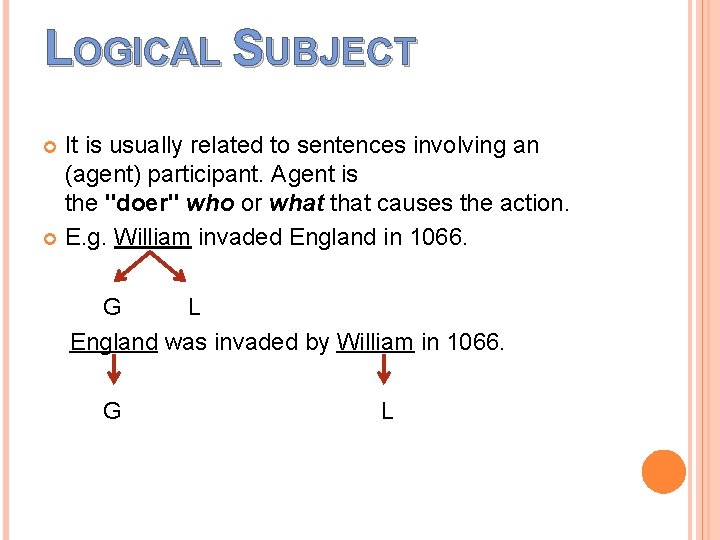
LOGICAL SUBJECT It is usually related to sentences involving an (agent) participant. Agent is the "doer" who or what that causes the action. E. g. William invaded England in 1066. G L England was invaded by William in 1066. G L
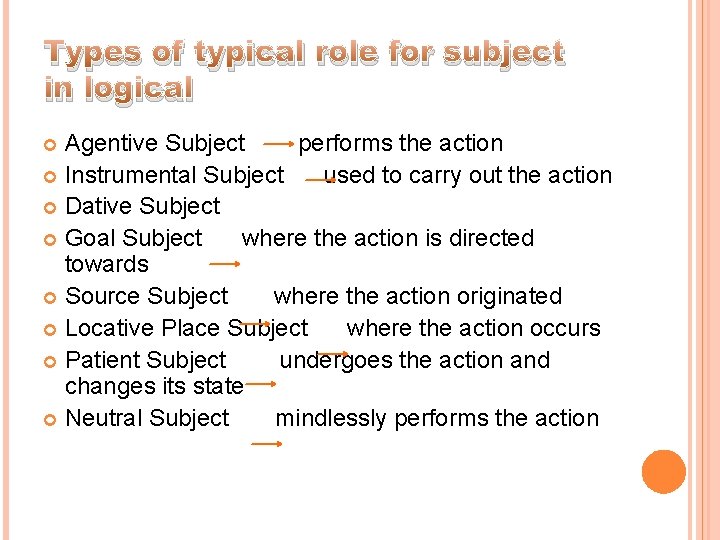
Types of typical role for subject in logical Agentive Subject performs the action Instrumental Subject used to carry out the action Dative Subject Goal Subject where the action is directed towards Source Subject where the action originated Locative Place Subject where the action occurs Patient Subject undergoes the action and changes its state Neutral Subject mindlessly performs the action
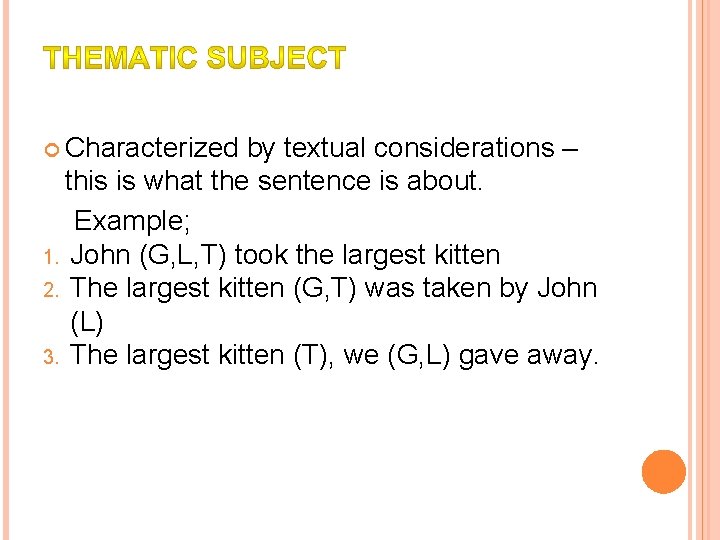
Characterized by textual considerations – this is what the sentence is about. Example; 1. John (G, L, T) took the largest kitten 2. The largest kitten (G, T) was taken by John (L) 3. The largest kitten (T), we (G, L) gave away.
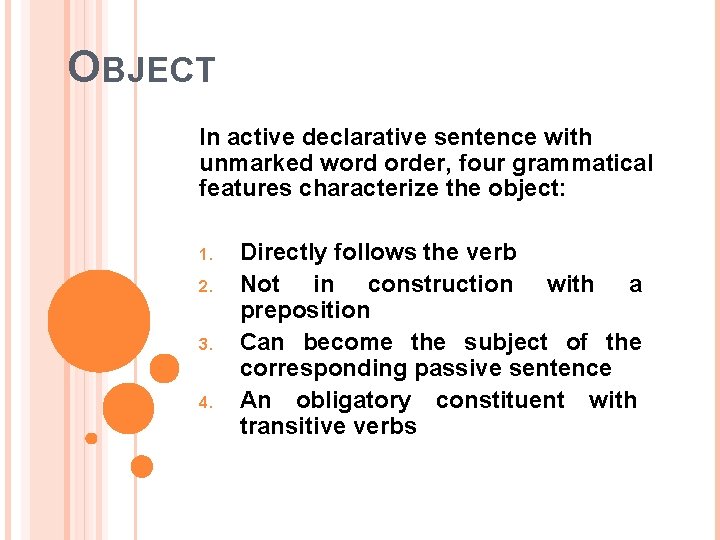
OBJECT In active declarative sentence with unmarked word order, four grammatical features characterize the object: 1. 2. 3. 4. Directly follows the verb Not in construction with a preposition Can become the subject of the corresponding passive sentence An obligatory constituent with transitive verbs
OBJECT OF RESULT also called an ‘effected’ or ‘factitive’ object: e. g. Maggie moves the table The workmen are cleaning the horse cages it can become the subject of a passive sentence, and there are no paraphrases involving preposition.
COGNATE OBJECT The relevant NP in this object usually contains a noun morphologically derived from (and hence cognate with) the verb stem e. g. Mother sewn a sewing. She draw a beautiful drawing. Lucky painted an awful painting.
OBJECT OF CONCERN They are clearly neither affected (direct) nor effected (resultant) objects. e. g. Nunung is sipping his coffee Nindi is watching Troy
THERE IS A HIERARCHY OF ‘OBJECTHOOD’. THE CONSIDERABLE EXAMPLE IS THE DIRECT OBJECT (DO). THE CHARACTERISTICS ARE: Has a particularly close tie to the main verb Is an obligatory sentence constituent Immediately follows the main verb Will not occur in a paraphrase involving a preposition Can be the subject of the corresponding passive sentence
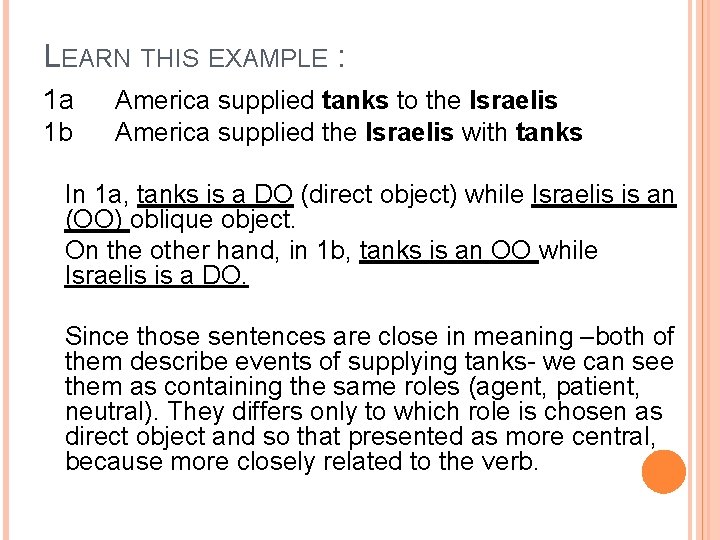
LEARN THIS EXAMPLE : 1 a 1 b America supplied tanks to the Israelis America supplied the Israelis with tanks In 1 a, tanks is a DO (direct object) while Israelis is an (OO) oblique object. On the other hand, in 1 b, tanks is an OO while Israelis is a DO. Since those sentences are close in meaning –both of them describe events of supplying tanks- we can see them as containing the same roles (agent, patient, neutral). They differs only to which role is chosen as direct object and so that presented as more central, because more closely related to the verb.
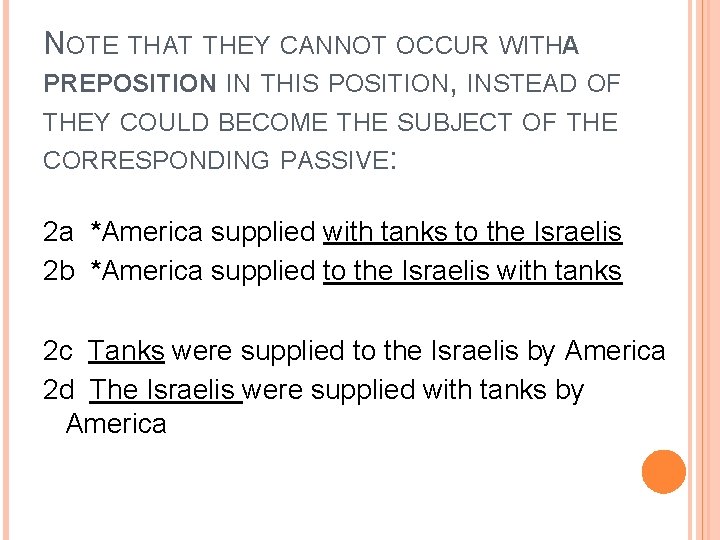
NOTE THAT THEY CANNOT OCCUR WITHA PREPOSITION IN THIS POSITION, INSTEAD OF THEY COULD BECOME THE SUBJECT OF THE CORRESPONDING PASSIVE: 2 a *America supplied with tanks to the Israelis 2 b *America supplied to the Israelis with tanks 2 c Tanks were supplied to the Israelis by America 2 d The Israelis were supplied with tanks by America
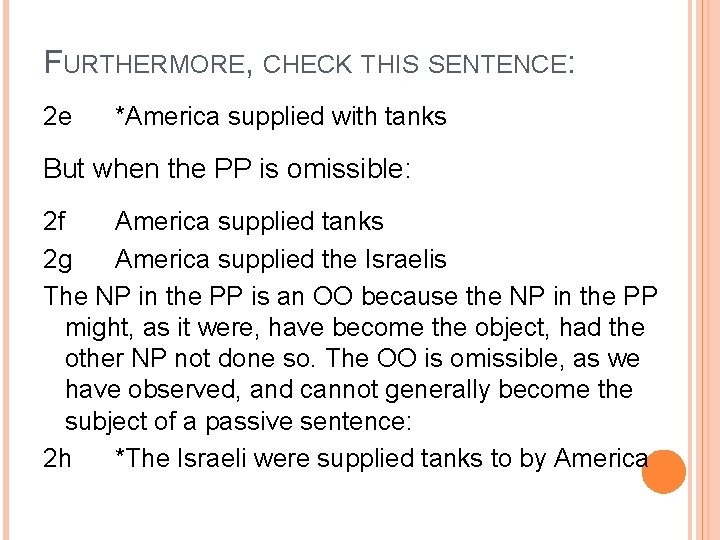
FURTHERMORE, CHECK THIS SENTENCE: 2 e *America supplied with tanks But when the PP is omissible: 2 f America supplied tanks 2 g America supplied the Israelis The NP in the PP is an OO because the NP in the PP might, as it were, have become the object, had the other NP not done so. The OO is omissible, as we have observed, and cannot generally become the subject of a passive sentence: 2 h *The Israeli were supplied tanks to by America
THE EFFECT OF BECOMING AN OBJECT IS IMPORTANT. THE SYNTACTIC EFFECT HAS BEEN DISCUSSED; BUT THERE IS ALSO A SEMANTIC EFFECT, WHICH VARIES FROM CASES LIKE NUMBER 2.
INDIRECT OBJECT (IO) Exist when a verb is followed by two NPs, neither of which is associated with a preposition. See this sentence: 3. Yucha gives Nindy (IO) a candy (DO) May occur as an OO (Oblique Object), and can usually be omitted without affecting the grammaticality of the sentence, whereas the DO cannot be omitted [see the example on page 326328]
PASSIVE FORMATION CASES ON DO AND IO 4 a Nunung lent that map (DO) to Yuni (OO) 4 b That map was given to Yuni by Nunung While: 4 c Nunung lent Yuni (IO) that map (DO) 4 d Yuni was lent that map by Nunung But not always: 5 a Nindy asked Yucha a help 5 b ? Yucha was asked a help by Nindy And: 6 a Sister played me Dakon 6 b *I was played Dakon by sister
The NP that immediately follow the verb has a privileged status, both syntactically and semantically. When only one NP is available for this role (that is, in two-place propositions) there would seem to be a hierarchy of ‘objecthood’. When two NPs are available for the role in three-place propositions, the situation is more complex.
COMPLEMENT These sentences below are Attributive complement because they describe the class membership of the subject noun, or ascribe an attribute to it: 7 a Cinderella was pretty 7 b Cinderella was a princess Those can also be called ‘subject complement’ cause it relate back to the subject noun. Then, in 7 b the noun ‘a princess’ is a ‘nominal complement’. Those complements are ‘state complements’ since they are found in stative sentences and describe states.
Those sentences below are ‘result complements’: 8 a the mangoes are turning yellow 8 b Yucha became a bachelor of english department The complement cannot become the subject of a passive sentence.
The identify complement can be shown in: 9 a Nunung is the man with a bunch of dollar in his wallet. The NP is always a definite NP. That sentence can be reversed: 9 b The man with a bunch of dollar in his wallet is Nunung. Study this: 9 c Nunung is (to be identified as) the man with a bunch of dollar in his wallet.
The locative complement can be shown in: 10 Yuni is in her study room Locative complement is usually a prepositional phrase. Sometimes it use a place adverb. Corresponding on that, we can also recognize a ‘directional complement’ in sentences like: 11 Nindy hid under the table 12 Yucha walked across the hospital Directional complements only occur in nonstate sentences
The italicized constituents in the sentences in 12 are also often called complements: 12 a Nunung comes back home safe 12 b Yuni talked the issue honest 12 c Nindy always buys her spinach fresh 12 d Yucha coloured her book green 12 a and 12 b are intensive to the subject, then others to the object. In some cases, they can be subtituted by adverbs. We can also make paraphrase constructions like: 12 e Nindy always buys her spinach in fresh condition 12 f Yuni was honest when she talked the issue, etc.
ADJUNCTS Adjuncts are usually adverbials, whether they are adverb phrases, PP, adverbs, or subordinate clauses of time, place, manner, and so on, that distributionally function like adverbials. Adjuncts are clearly a rather ‘mixed bag’, in that syntactically there are numerous subclasses which have different and overlapping distribution, and they fill a variety of semantic roles.
MORPHOLOGICAL MAPPING GRAMMATICAL FUNTIONS OF
1. Introduction 2. Predicates, Arguments, and Lexical Entries 3. Theta-Roles and Lexical Entries 4. Grammatical Relations
Introduction How are grammatical functions mapped onto morphological representations? a. Introduce the notions of thematic roles, grammatical relations and theory of case assignment b. Explore the morphological effects of syntactic rules that change the canonical pairing of thematic roles with grammatical function c. Discussion further afield through an investigation of the phenomenon of incorporation whereby the syntax requires the inclusion of one word within another
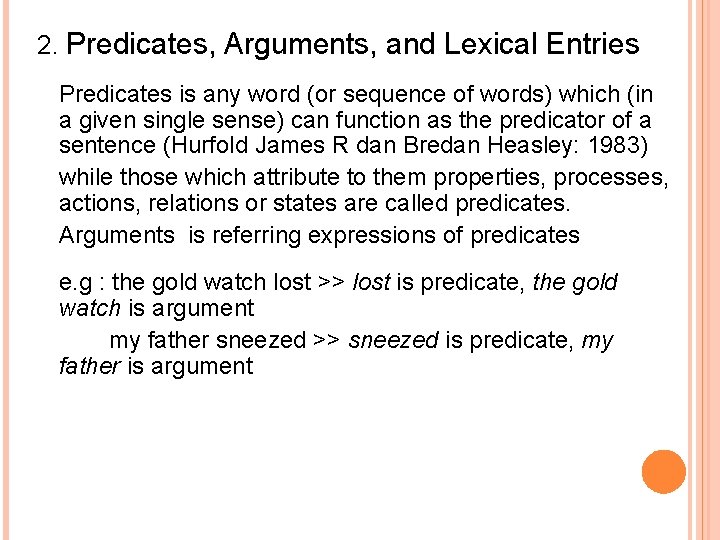
2. Predicates, Arguments, and Lexical Entries Predicates is any word (or sequence of words) which (in a given single sense) can function as the predicator of a sentence (Hurfold James R dan Bredan Heasley: 1983) while those which attribute to them properties, processes, actions, relations or states are called predicates. Arguments is referring expressions of predicates e. g : the gold watch lost >> lost is predicate, the gold watch is argument my father sneezed >> sneezed is predicate, my father is argument
3. Theta-Roles and Lexical Entries Language use syntax and inflectional morphology to encode some of the semantics relations which obtain in sentence between a predicate and its arguments. We will use the term theta-roles (0 -rules) for these semantic relations. (they are also called (abstract) case relations or thematic relations in the literature. ) Recognition of 0 -rules is essentially based on the intuition which is widely shared among linguists that there is a relatively small number of syntactically relevant semantic properties that play a role in the transitivity systems of language.
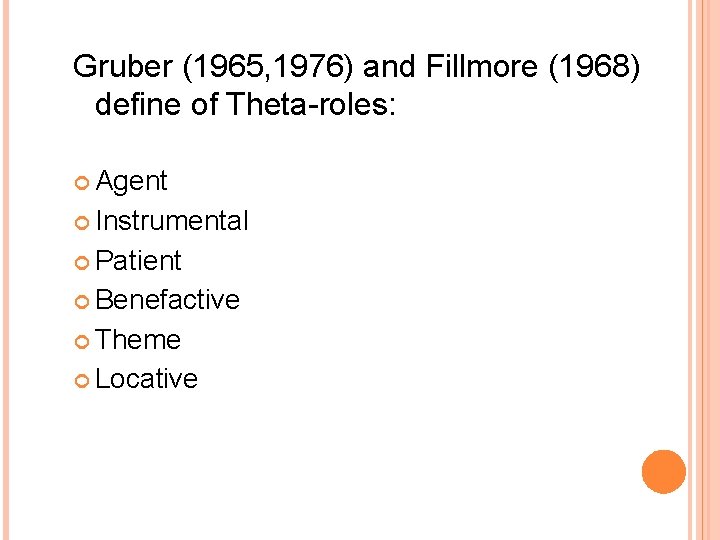
Gruber (1965, 1976) and Fillmore (1968) define of Theta-roles: Agent Instrumental Patient Benefactive Theme Locative
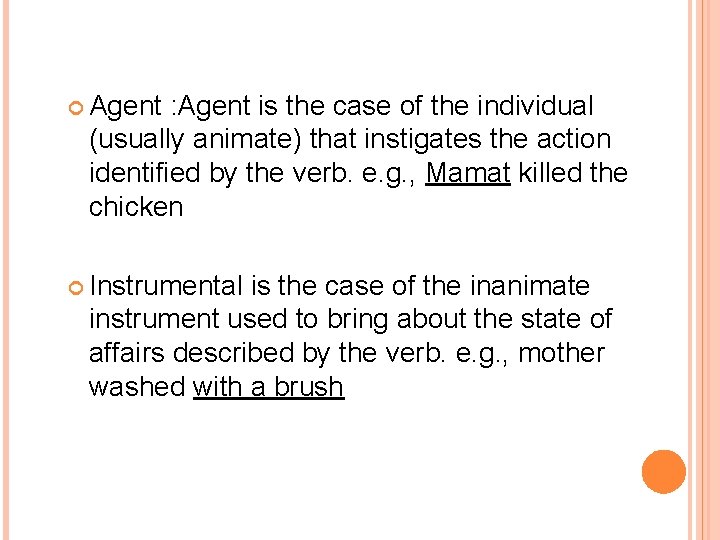
Agent : Agent is the case of the individual (usually animate) that instigates the action identified by the verb. e. g. , Mamat killed the chicken Instrumental is the case of the inanimate instrument used to bring about the state of affairs described by the verb. e. g. , mother washed with a brush
Patient is the case of the entity or individual that undergoes the process or action described by the verb. e. g. Toni punched the board Benefactive is the case of the individual who gains from the action or process described by the verb. e. g. Andi gave his girlfriend a letter.

Punya yucha belum, she said mungkin bisanya selesai nanti malam

MORFOSINTAKSIS MIRROR PRINCIPLES
THE MIRROR PRINCIPLE (MP, BAKER, 1985) The order of affixes reflects the order in which the associated syntactic ‘operations’ apply. There is a close parallelism between morphology and syntax Syntax operates on both words and morphemes, and a complex word can be formed by syntactic rules, and more specifically head movement, through incorporation of a lexical root to a morpheme Morphological derivations must directly reflect syntactic derivation (and vice versa) The order of morphemes in a complex word reflects the natural syntactic embedding of the heads that correspond to those morphemes”
If causative creates a transitive verb from an intransitive verb and only transitive verbs can passivise, causative must apply before passive. The morphological consequences: the causative suffix is attached first, and is closer to the verb root than the passive suffix. The syntactic derivation is isomorphic with the morphological derivation. Mirror principle
COUNTER ARGUMENTS ON MIRROR PRINCIPLE Mirror principle work well where affixation is cyclic such that each syntactic process trigger a round of affixation starting near the root and going outward Mirror principle doesn’t work if the language have noncyclic affixation The use of mirror principle is the default case, applies if neither morphological positioning nor phonological factors dictate a particular order of morphemes Mirror Principle is nothing but a consequence of the fact that Agree relations are subject to Relativized Minimality conditions.
RECIPROCALITATION : DERIVES AN INTRANSITIVE VERB FROM AN UNDERLYING TRANSITIVE VERBS Before Reciprocalitation: two sentences with transitive verbs that have subjects and objects in agent and patient role who do something to each other: Bill punched Paul – Paul punched Bill After Reciprocalitation: The two sentences are conflated and the subject of the verb refer to two or more participants and the object function is eliminated, rendering the derived verb intransitive. Bill and Paul punched each other
THIS IS END OF THE SHOW Thank you for the attention So far, is there any question please?
- Slides: 42