
Grammatical Categories and Markers Lecture 3 Which are
- Slides: 24
Grammatical Categories and Markers Lecture 3
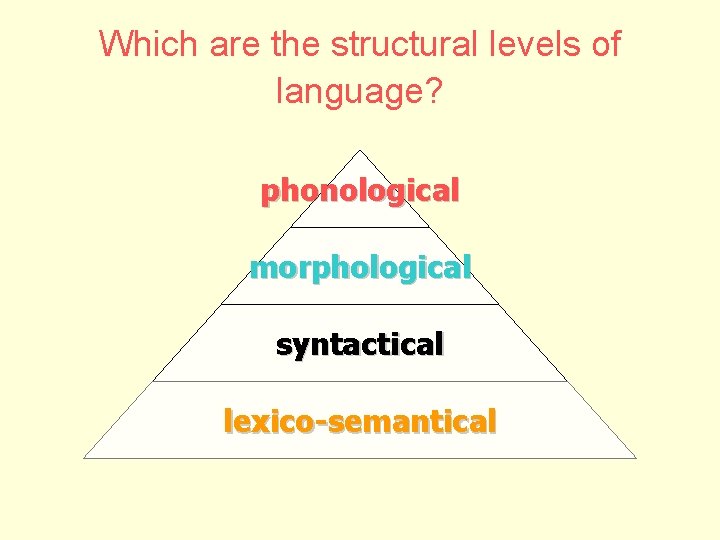
Which are the structural levels of language? phonological morphological syntactical lexico-semantical
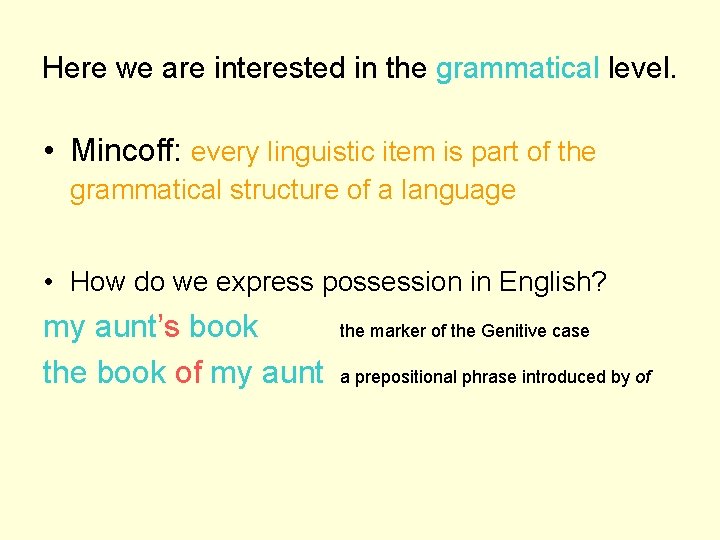
Here we are interested in the grammatical level. • Mincoff: every linguistic item is part of the grammatical structure of a language • How do we express possession in English? my aunt’s book the book of my aunt the marker of the Genitive case a prepositional phrase introduced by of
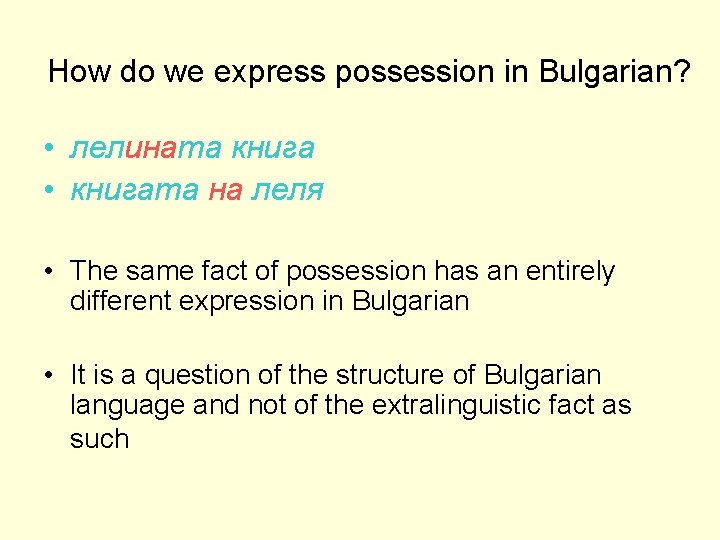
How do we express possession in Bulgarian? • лелината книга • книгата на леля • The same fact of possession has an entirely different expression in Bulgarian • It is a question of the structure of Bulgarian language and not of the extralinguistic fact as such
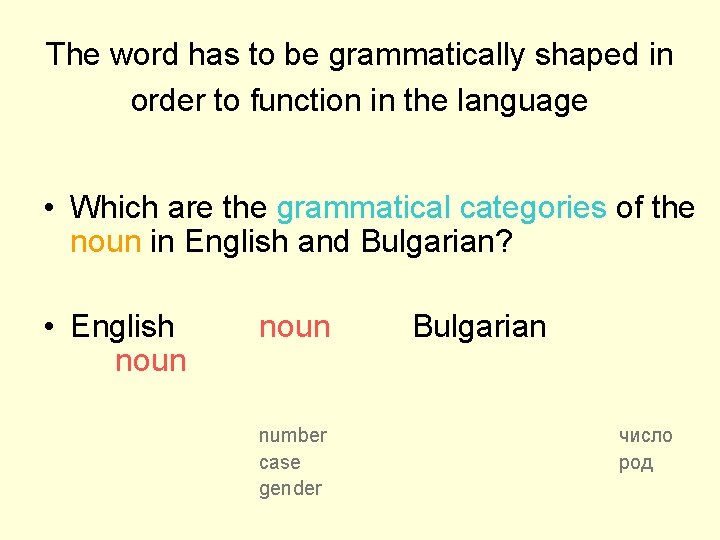
The word has to be grammatically shaped in order to function in the language • Which are the grammatical categories of the noun in English and Bulgarian? • English noun number case gender Bulgarian число род
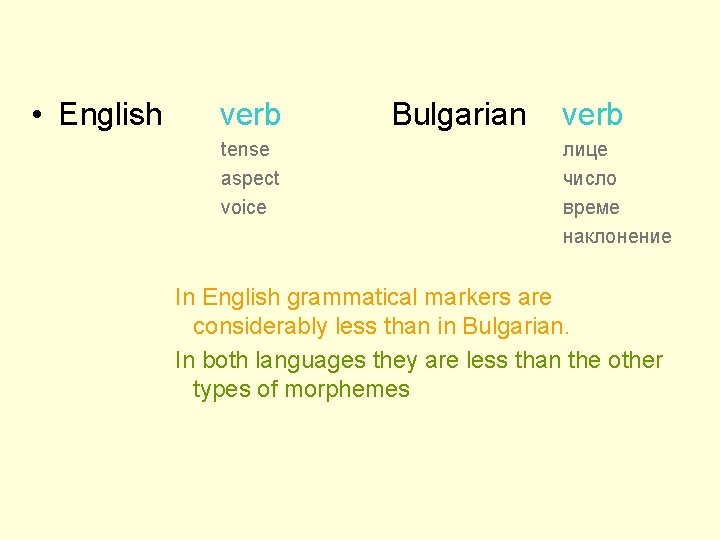
• English verb tense aspect voice Bulgarian verb лице число време наклонение In English grammatical markers are considerably less than in Bulgarian. In both languages they are less than the other types of morphemes
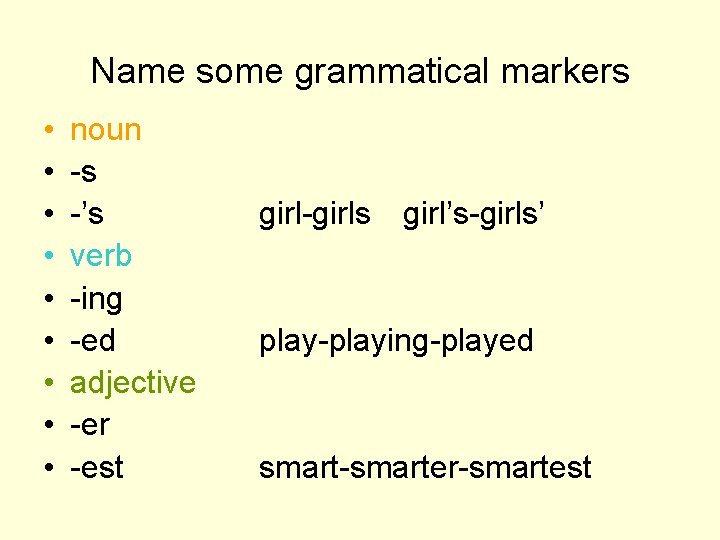
Name some grammatical markers • • • noun -s -’s verb -ing -ed adjective -er -est girl-girls girl’s-girls’ play-playing-played smart-smarter-smartest
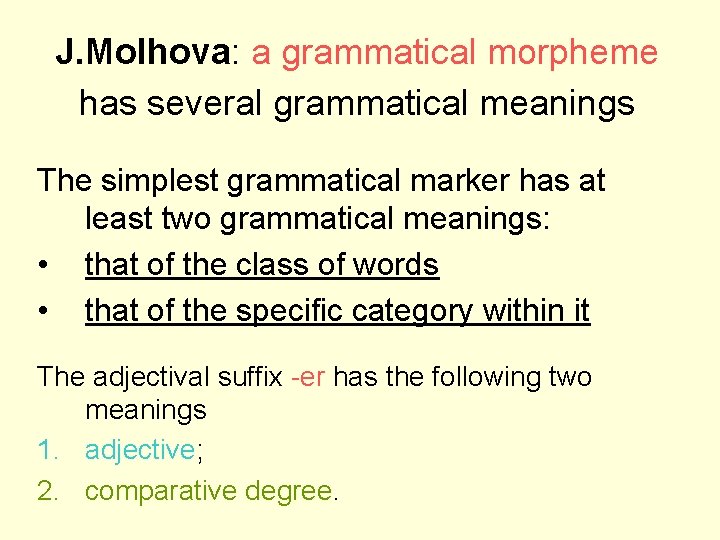
J. Molhova: a grammatical morpheme has several grammatical meanings The simplest grammatical marker has at least two grammatical meanings: • that of the class of words • that of the specific category within it The adjectival suffix -er has the following two meanings 1. adjective; 2. comparative degree.
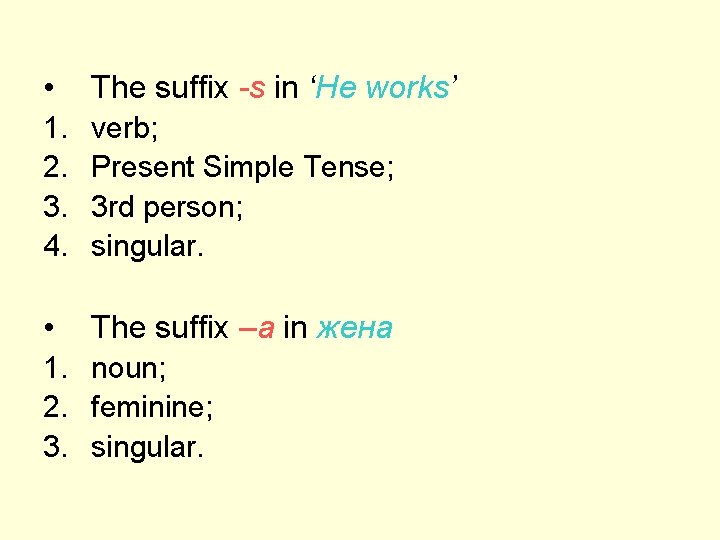
• The suffix -s in ‘He works’ 1. 2. 3. 4. verb; Present Simple Tense; 3 rd person; singular. • The suffix –a in жeнa 1. noun; 2. feminine; 3. singular.
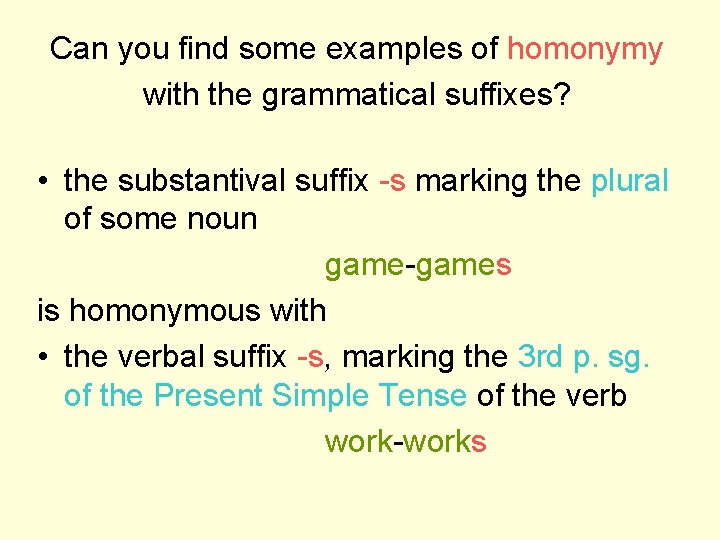
Can you find some examples of homonymy with the grammatical suffixes? • the substantival suffix -s marking the plural of some noun game-games is homonymous with • the verbal suffix -s, marking the 3 rd p. sg. of the Present Simple Tense of the verb work-works
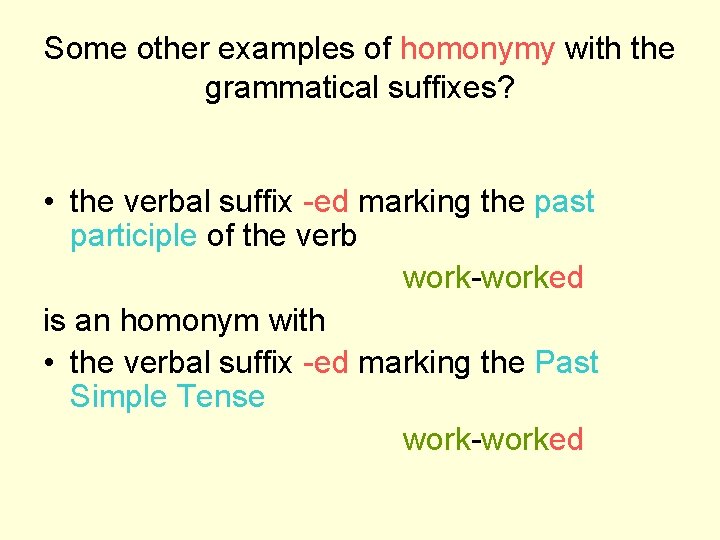
Some other examples of homonymy with the grammatical suffixes? • the verbal suffix -ed marking the past participle of the verb work-worked is an homonym with • the verbal suffix -ed marking the Past Simple Tense work-worked
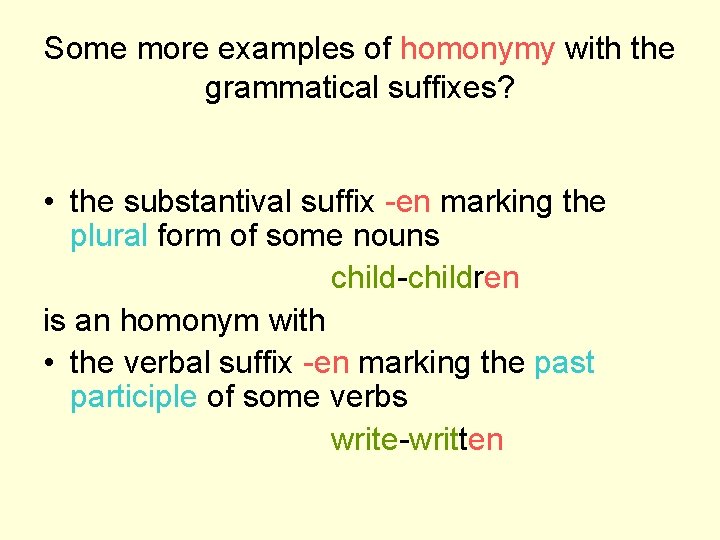
Some more examples of homonymy with the grammatical suffixes? • the substantival suffix -en marking the plural form of some nouns child-children is an homonym with • the verbal suffix -en marking the past participle of some verbs write-written
And more examples of homonymy with the grammatical suffixes? • the gerundial suffix -ing reading is an homonym with • the suffix -ing marking the present participle reading
Can you find some examples of synonymy with the grammatical suffixes? • the substantival suffix -s marking the plural of some nouns cow-cows is synonymous with • the suffix -en also marking the plural of some nouns ox-oxen
Are there other examples of synonymy with the grammatical suffixes? • the suffix -ed marking the past participle of some verbs play-played is synonymous with • the suffix -en with the same meaning write-written
Can you find some antonyms among the grammatical markers? • Due to the nature of the meanings of a grammatical morpheme one can hardly speak of antonyms • unless the various cases of forms in binary opposition are considered to be antonyms, since they exclude each other
Can you find some antonyms among the grammatical markers? • the presence of the -s morpheme marking the plural form of the noun could be considered to be an antonym to • the zero morpheme pointing to the form of the singular table 0º-tables
Can you find other antonyms among the grammatical markers? • the presence of the -s morpheme in a verbal form marks the 3 rd p. sg. of the Present Simple Tense • the zero morpheme, points to a form which is not the 3 rd p. sg. of the Present Simple Tense, etc. work-works
There are several instances of fluctuation with grammatical morphemes • A grammatical morpheme can preserve its grammatical meaning and at the same time it can acquire a lexical one • Example: the substantival suffix -s marking the plural of some nouns in English
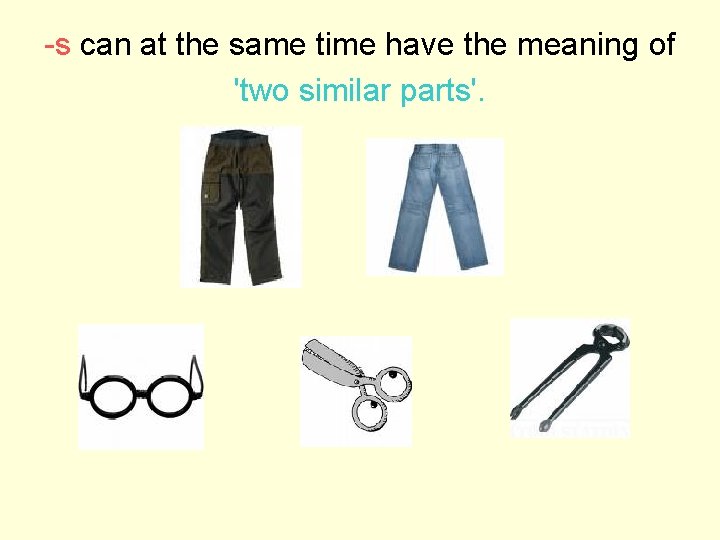
-s can at the same time have the meaning of 'two similar parts'.
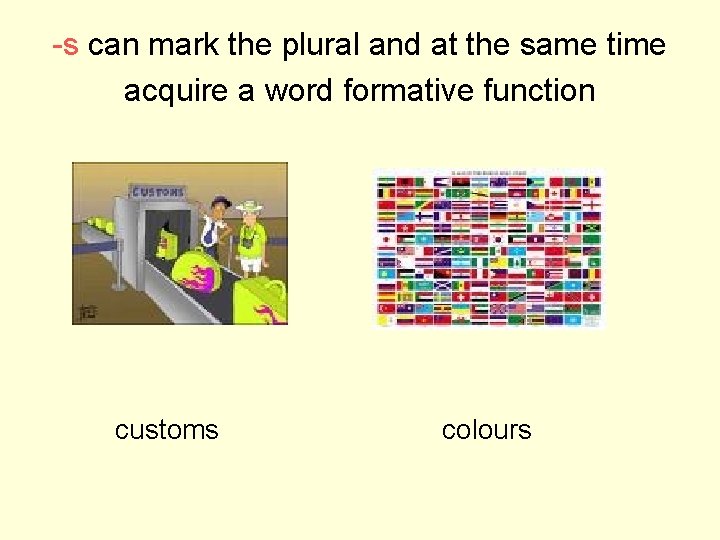
-s can mark the plural and at the same time acquire a word formative function customs colours
The same suffix can be traced in words like • linguistics • logics • mathematics ‘science of ’
A different case is the word • the former suffix -s has lost its nature of a morpheme entirely and has merged with the preceding morpheme, thus becoming part of it
J. Molhova calls this process degrammatization (or lexicalization) of grammatical markers.