
GRAMMARSTAGE 6 Imperfect and Perfect Tenses PAST TENSES


- Slides: 14
GRAMMAR-STAGE 6 Imperfect and Perfect Tenses
“PAST TENSES” in LATIN • 2 types: • Imperfect tense – For action in the past that was repeated, continuous or habitual – Marcus was doing something, or Marcus used to do something – Imperfect actually means incomplete • Perfect tense – for action that happened once, and then was over, or completed. – Marcus did something, or has done something.
PRINCIPAL PARTS OF A LATIN VERB • Most Latin verbs have 4 principal parts. You see them when you look a verb up in a Latin dictionary • Example: amō, amāre, amāvī, amātus
PRINCIPAL PARTS OF A LATIN VERB • 1 st Principal part – amō – Present tense-1 st person singular. “I love” or “I am loving”
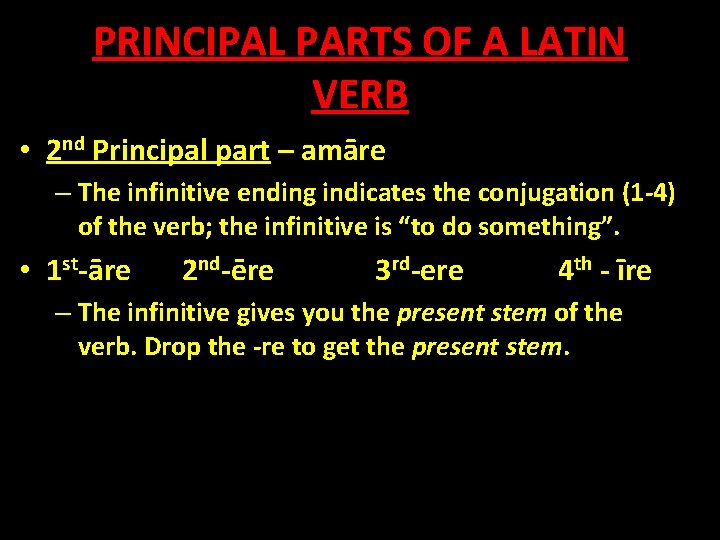
PRINCIPAL PARTS OF A LATIN VERB • 2 nd Principal part – amāre – The infinitive ending indicates the conjugation (1 -4) of the verb; the infinitive is “to do something”. • 1 st-āre 2 nd-ēre 3 rd-ere 4 th - īre – The infinitive gives you the present stem of the verb. Drop the -re to get the present stem.
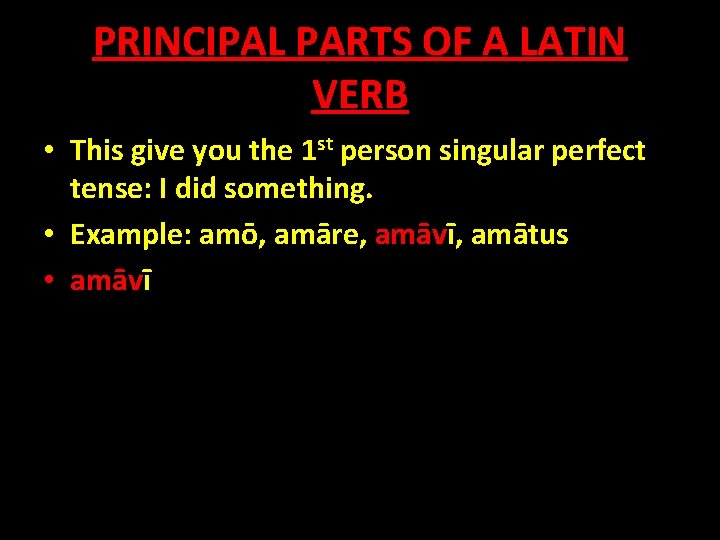
PRINCIPAL PARTS OF A LATIN VERB • This give you the 1 st person singular perfect tense: I did something. • Example: amō, amāre, amāvī, amātus • amāvī
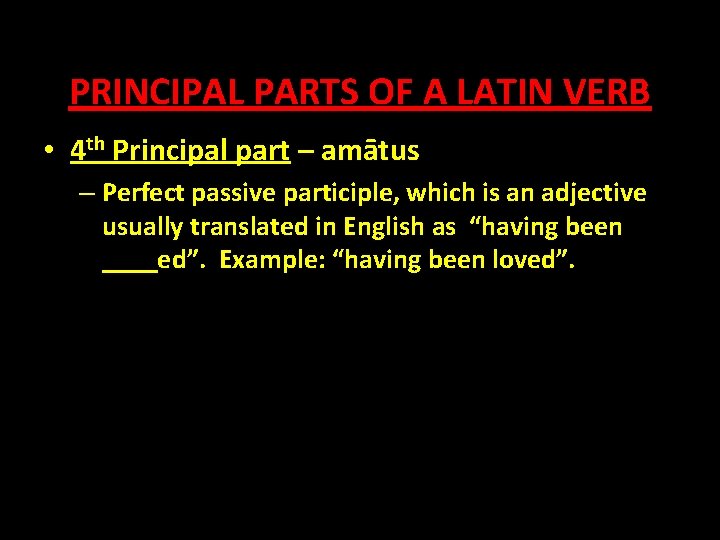
PRINCIPAL PARTS OF A LATIN VERB • 4 th Principal part – amātus – Perfect passive participle, which is an adjective usually translated in English as “having been ____ed”. Example: “having been loved”.
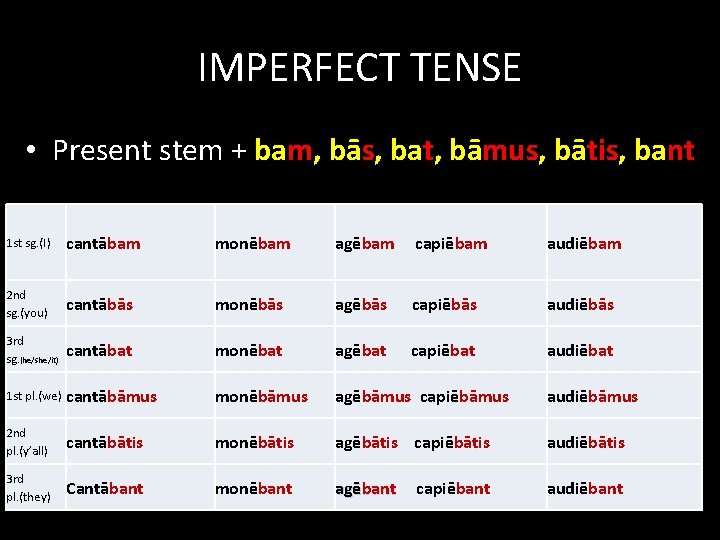
IMPERFECT TENSE • Present stem + bam, bās, bat, bāmus, bātis, bant 1 st sg. (I) cantābam monēbam agēbam capiēbam audiēbam 2 nd sg. (you) cantābās monēbās agēbās capiēbās audiēbās 3 rd sg. (he/she/it) cantābat monēbat agēbat capiēbat audiēbat 1 st pl. (we) cantābāmus monēbāmus agēbāmus capiēbāmus audiēbāmus 2 nd pl. (y’all) cantābātis monēbātis agēbātis capiēbātis audiēbātis 3 rd pl. (they) Cantābant monēbant agēbant audiēbant capiēbant
“ba”-the imperfect
Ba Ba Remix
Latin Tutorial Imperfect
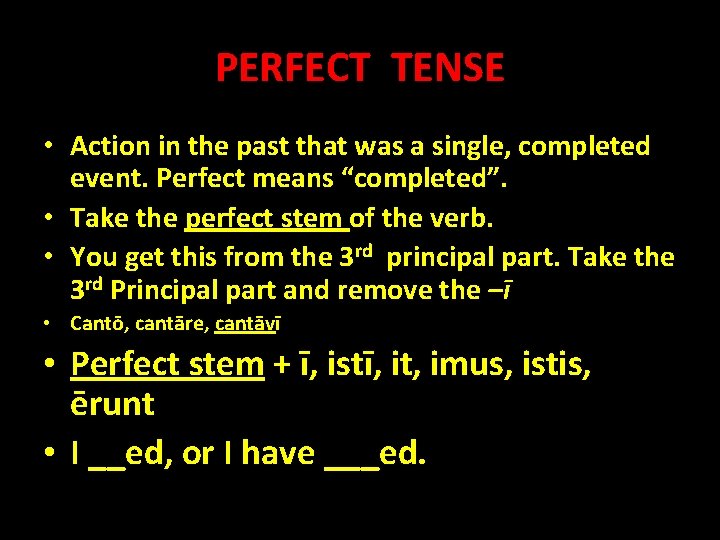
PERFECT TENSE • Action in the past that was a single, completed event. Perfect means “completed”. • Take the perfect stem of the verb. • You get this from the 3 rd principal part. Take the 3 rd Principal part and remove the –ī • Cantō, cantāre, cantāvī • Perfect stem + ī, istī, it, imus, istis, ērunt • I __ed, or I have ___ed.
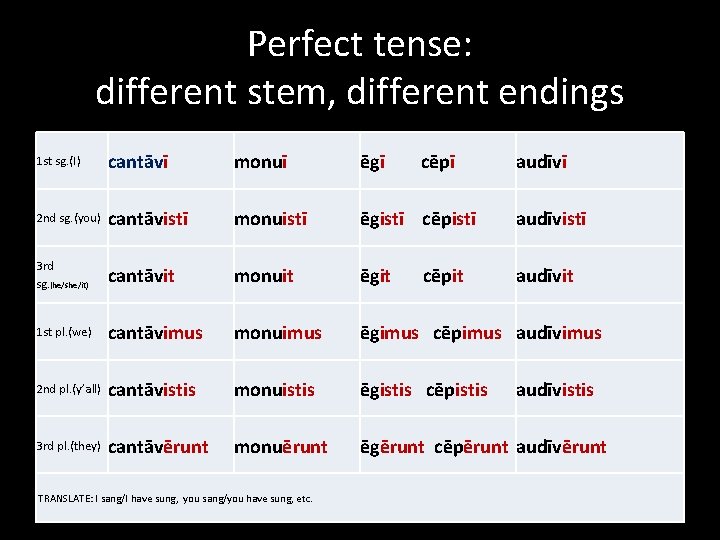
Perfect tense: different stem, different endings 1 st sg. (I) cantāvī monuī ēgī 2 nd sg. (you) cantāvistī monuistī ēgistī cēpistī audīvistī 3 rd sg. (he/she/it) cantāvit monuit ēgit audīvit 1 st pl. (we) cantāvimus monuimus ēgimus cēpimus audīvimus 2 nd pl. (y’all) cantāvistis monuistis ēgistis cēpistis 3 rd pl. (they) cantāvērunt monuērunt ēgērunt cēpērunt audīvērunt TRANSLATE: I sang/I have sung, you sang/you have sung, etc. cēpī cēpit audīvī audīvistis
Latin Tutorial-Perfect tense