
Grammars Languages Natural languages language spoken or written
- Slides: 33
Grammars
Languages • Natural languages – language spoken or written by humans • English, French, Italian, Spanish, … – English and other natural languages clearly have structure • subjects, nouns, verbs, … • In contrast we have programming languages – languages used to communicate with computers • Java, C, C++, … – programming languages also have structure • expressions, statements, methods, …
Grammars • A formal definition of the syntactic structure of a language • Set of rules that tell you whether a sentence is correctly structured • A sentence is a well-formed string in the language • Production rules specify the order of components and their sub-components in a sentence • Top-level rule – one production rule designated as the “start rule” – provides the structure for an entire sentence
Production rules • Production rules specify a syntactic category and assign to it a sequence of zero or more symbols • Symbols are either terminal or non-terminal • Terminal symbols – correspond to components of the sentence with no internal syntactic structure • Non-terminal symbols – any symbol assigned values by a production rule
Sentence parsing and generation • A grammar can be used to parse a sentence or to generate one • Parsing begins with a sentence and ends with the top level rule – at lowest level sentence is composed of terminal symbols, first assign a terminal syntactic category to each component – assign non-terminal symbols to each appropriate group of terminals, up to the level of entire sentence • Generation starts from the top-level rule and chooses one alternative production wherever there is a choice
Example • The English grammar – a set of rules for combining words into well-formed phrases and clauses
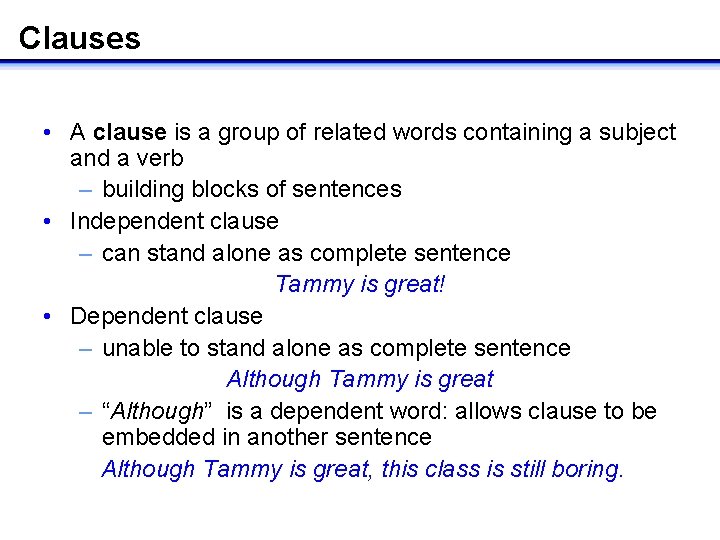
Clauses • A clause is a group of related words containing a subject and a verb – building blocks of sentences • Independent clause – can stand alone as complete sentence Tammy is great! • Dependent clause – unable to stand alone as complete sentence Although Tammy is great – “Although” is a dependent word: allows clause to be embedded in another sentence Although Tammy is great, this class is still boring.
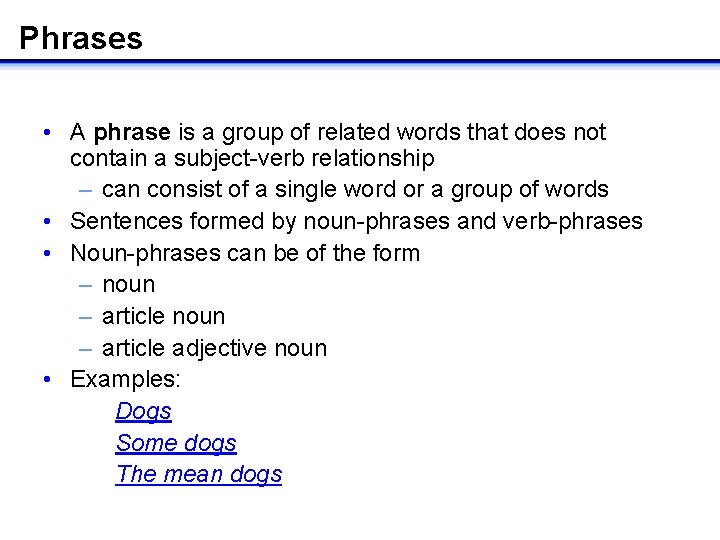
Phrases • A phrase is a group of related words that does not contain a subject-verb relationship – can consist of a single word or a group of words • Sentences formed by noun-phrases and verb-phrases • Noun-phrases can be of the form – noun – article adjective noun • Examples: Dogs. Some dogs. The mean dogs.
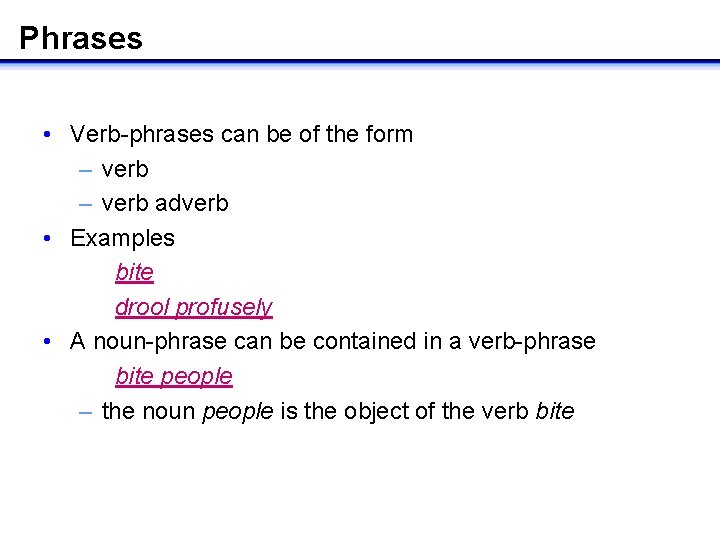
Phrases • Verb-phrases can be of the form – verb adverb • Examples bite. drool profusely • A noun-phrase can be contained in a verb-phrase bite people – the noun people is the object of the verb bite
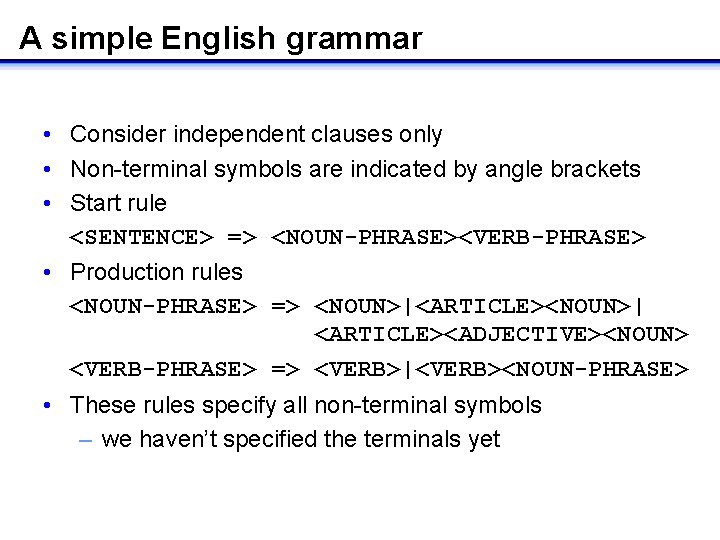
A simple English grammar • Consider independent clauses only • Non-terminal symbols are indicated by angle brackets • Start rule <SENTENCE> => <NOUN-PHRASE><VERB-PHRASE> • Production rules <NOUN-PHRASE> => <NOUN>|<ARTICLE><NOUN>| <ARTICLE><ADJECTIVE><NOUN> <VERB-PHRASE> => <VERB>|<VERB><NOUN-PHRASE> • These rules specify all non-terminal symbols – we haven’t specified the terminals yet
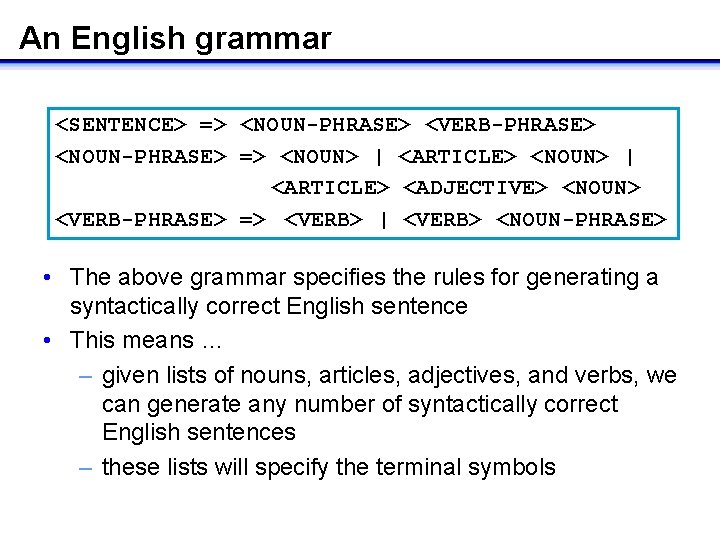
An English grammar <SENTENCE> => <NOUN-PHRASE> <VERB-PHRASE> <NOUN-PHRASE> => <NOUN> | <ARTICLE> <ADJECTIVE> <NOUN> <VERB-PHRASE> => <VERB> | <VERB> <NOUN-PHRASE> • The above grammar specifies the rules for generating a syntactically correct English sentence • This means … – given lists of nouns, articles, adjectives, and verbs, we can generate any number of syntactically correct English sentences – these lists will specify the terminal symbols
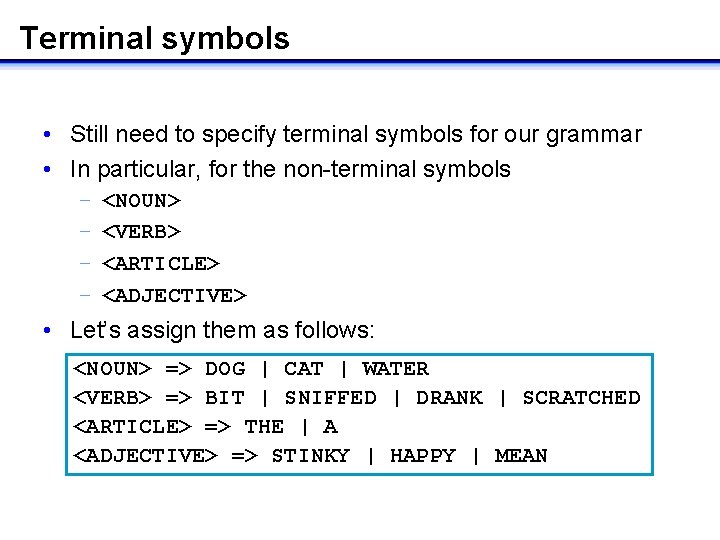
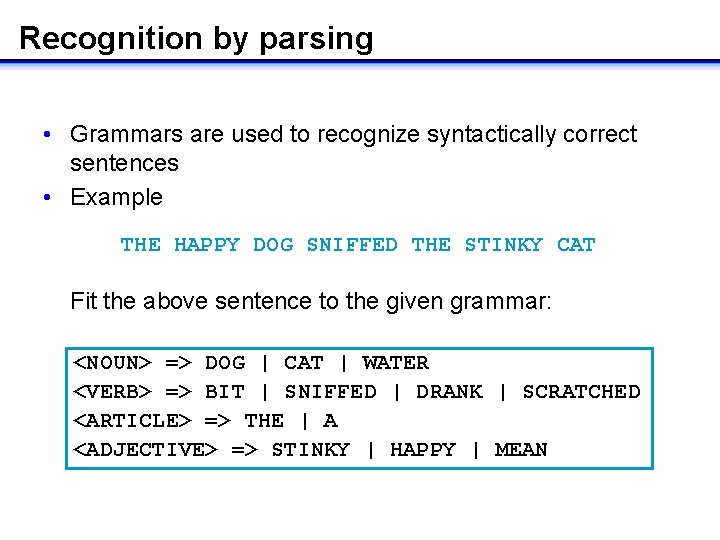
Terminal symbols • Still need to specify terminal symbols for our grammar • In particular, for the non-terminal symbols – <NOUN> – <VERB> – <ARTICLE> – <ADJECTIVE> • Let’s assign them as follows: <NOUN> => DOG | CAT | WATER <VERB> => BIT | SNIFFED | DRANK | SCRATCHED <ARTICLE> => THE | A <ADJECTIVE> => STINKY | HAPPY | MEAN
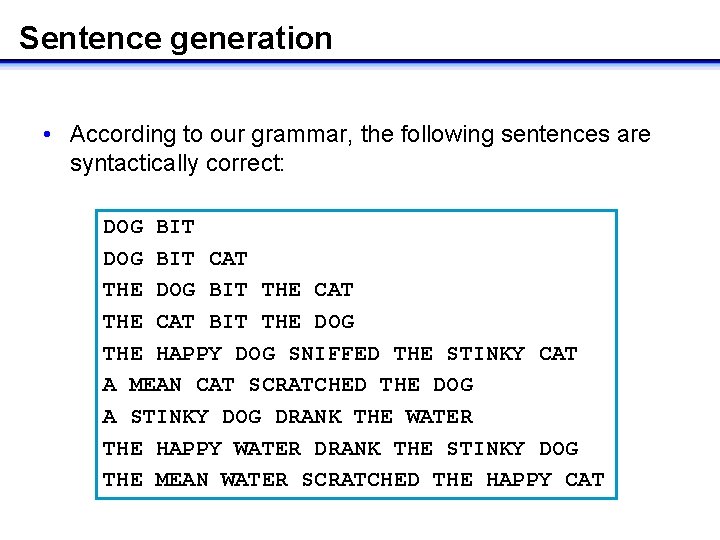
Sentence generation • According to our grammar, the following sentences are syntactically correct: DOG BIT DOG BIT CAT THE DOG BIT THE CAT BIT THE DOG THE HAPPY DOG SNIFFED THE STINKY CAT A MEAN CAT SCRATCHED THE DOG A STINKY DOG DRANK THE WATER THE HAPPY WATER DRANK THE STINKY DOG THE MEAN WATER SCRATCHED THE HAPPY CAT
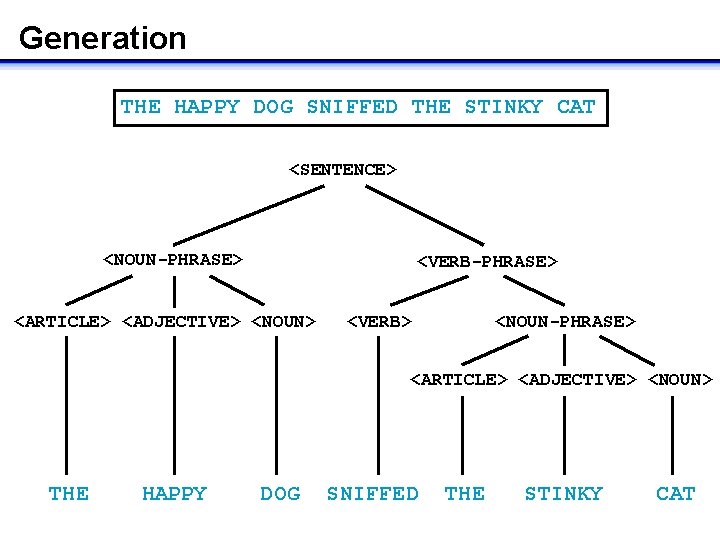
Generation THE HAPPY DOG SNIFFED THE STINKY CAT <SENTENCE> <NOUN-PHRASE> <VERB-PHRASE> <ARTICLE> <ADJECTIVE> <NOUN> <VERB> <NOUN-PHRASE> <ARTICLE> <ADJECTIVE> <NOUN> THE HAPPY DOG SNIFFED THE STINKY CAT
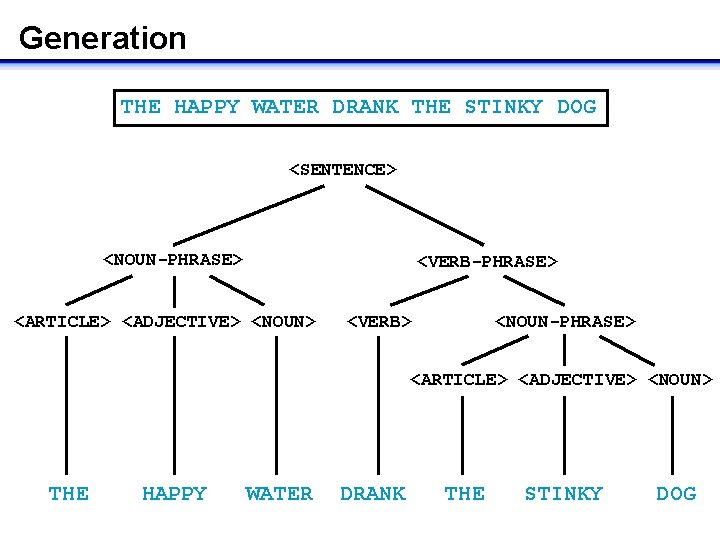
Generation THE HAPPY WATER DRANK THE STINKY DOG <SENTENCE> <NOUN-PHRASE> <VERB-PHRASE> <ARTICLE> <ADJECTIVE> <NOUN> <VERB> <NOUN-PHRASE> <ARTICLE> <ADJECTIVE> <NOUN> THE HAPPY WATER DRANK THE STINKY DOG
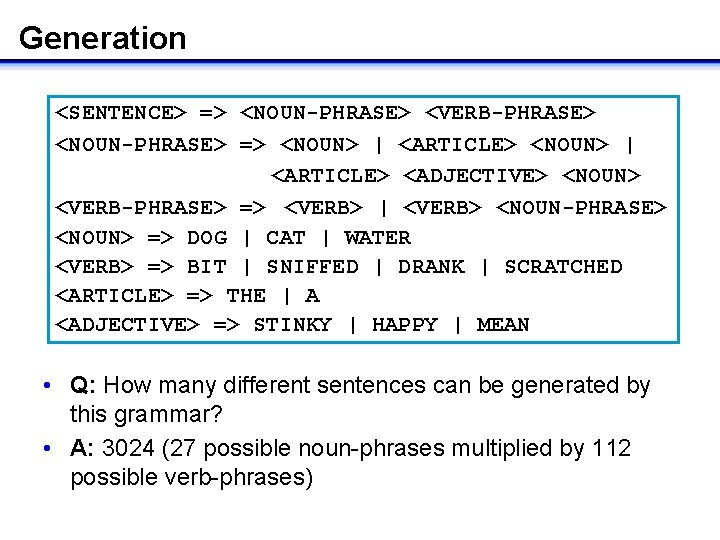
Generation <SENTENCE> => <NOUN-PHRASE> <VERB-PHRASE> <NOUN-PHRASE> => <NOUN> | <ARTICLE> <ADJECTIVE> <NOUN> <VERB-PHRASE> => <VERB> | <VERB> <NOUN-PHRASE> <NOUN> => DOG | CAT | WATER <VERB> => BIT | SNIFFED | DRANK | SCRATCHED <ARTICLE> => THE | A <ADJECTIVE> => STINKY | HAPPY | MEAN • Q: How many different sentences can be generated by this grammar? • A: 3024 (27 possible noun-phrases multiplied by 112 possible verb-phrases)
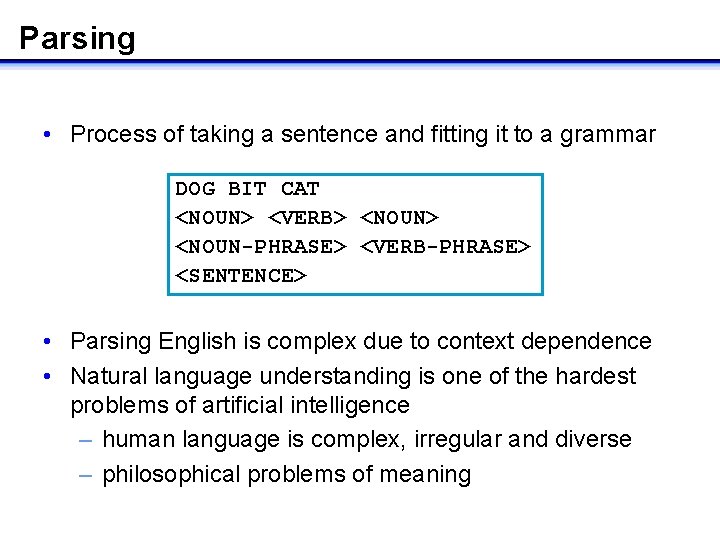
Parsing • Process of taking a sentence and fitting it to a grammar DOG BIT CAT <NOUN> <VERB> <NOUN> <NOUN-PHRASE> <VERB-PHRASE> <SENTENCE> • Parsing English is complex due to context dependence • Natural language understanding is one of the hardest problems of artificial intelligence – human language is complex, irregular and diverse – philosophical problems of meaning
Recognition by parsing • Grammars are used to recognize syntactically correct sentences • Example THE HAPPY DOG SNIFFED THE STINKY CAT Fit the above sentence to the given grammar: <NOUN> => DOG | CAT | WATER <VERB> => BIT | SNIFFED | DRANK | SCRATCHED <ARTICLE> => THE | A <ADJECTIVE> => STINKY | HAPPY | MEAN
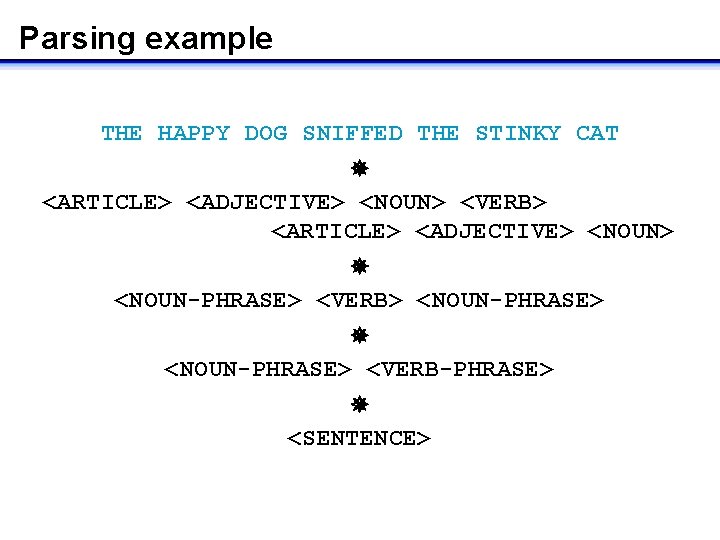
Parsing example THE HAPPY DOG SNIFFED THE STINKY CAT <ARTICLE> <ADJECTIVE> <NOUN> <VERB> <ARTICLE> <ADJECTIVE> <NOUN> <NOUN-PHRASE> <VERB> <NOUN-PHRASE> <VERB-PHRASE> <SENTENCE>
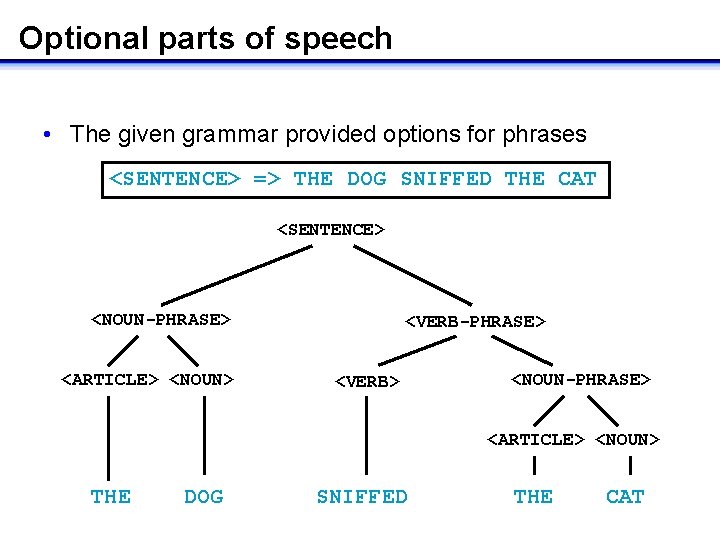
Optional parts of speech • The given grammar provided options for phrases <SENTENCE> => THE DOG SNIFFED THE CAT <SENTENCE> <NOUN-PHRASE> <ARTICLE> <NOUN> <VERB-PHRASE> <VERB> <NOUN-PHRASE> <ARTICLE> <NOUN> THE DOG SNIFFED THE CAT
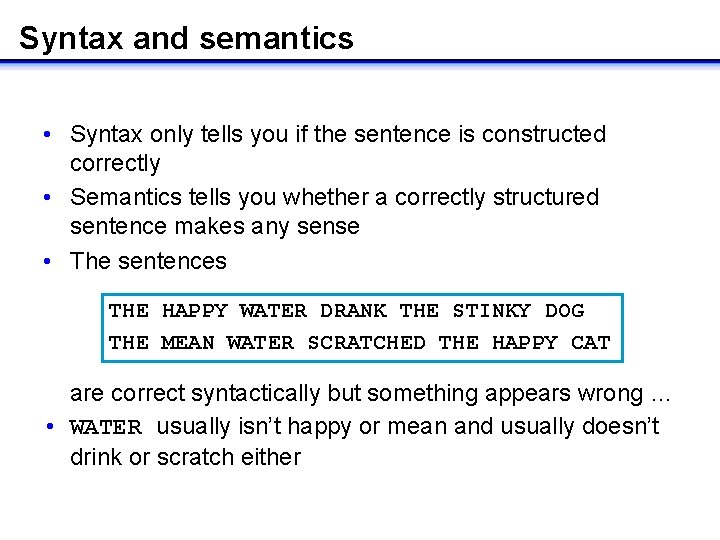
Syntax and semantics • Syntax only tells you if the sentence is constructed correctly • Semantics tells you whether a correctly structured sentence makes any sense • The sentences THE HAPPY WATER DRANK THE STINKY DOG THE MEAN WATER SCRATCHED THE HAPPY CAT are correct syntactically but something appears wrong … • WATER usually isn’t happy or mean and usually doesn’t drink or scratch either
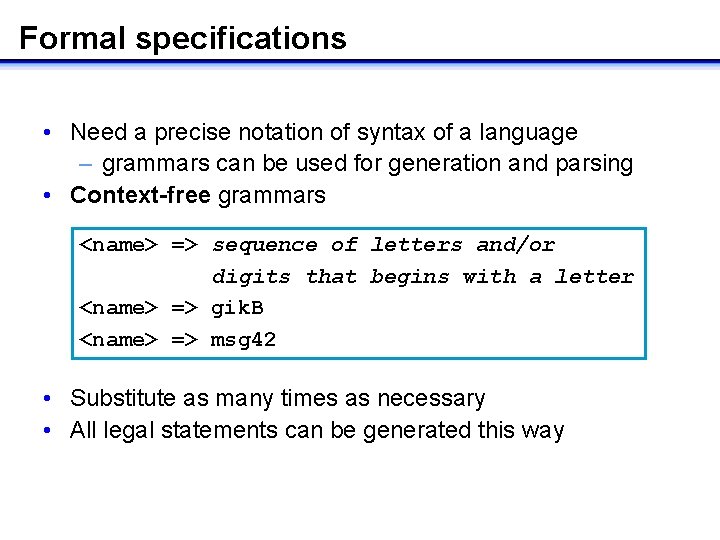
Formal specifications • Need a precise notation of syntax of a language – grammars can be used for generation and parsing • Context-free grammars <name> => sequence of letters and/or digits that begins with a letter <name> => gik. B <name> => msg 42 • Substitute as many times as necessary • All legal statements can be generated this way
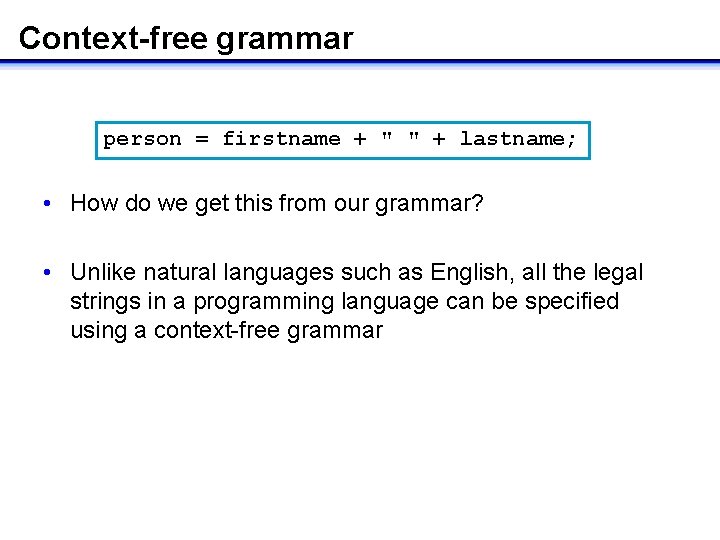
Context-free grammar person = firstname + " " + lastname; • How do we get this from our grammar? • Unlike natural languages such as English, all the legal strings in a programming language can be specified using a context-free grammar
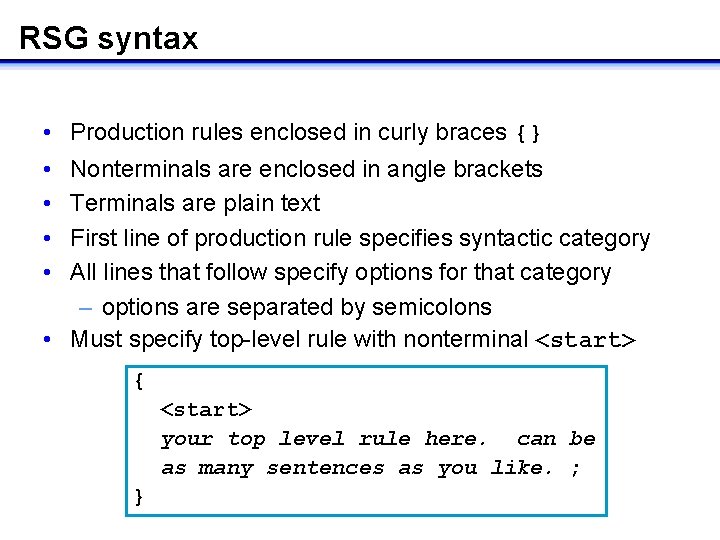
Recursive Sentence Generator (RSG) • Constructs sentences, paragraphs, and even papers that fit a prescribed format • RSG demo applet, courtesy of Prof. Forbes, Duke CS http: //www. duke. edu/web/cps 001/code/RSG. html • The format is specified by a user-defined grammar • You will define your own grammars in Lab 9 • Some example grammars are here: http: //www. duke. edu/web/cps 001/code/grammars/ • We will go over the poem grammar (Poem. g)
RSG syntax • • • Production rules enclosed in curly braces {} Nonterminals are enclosed in angle brackets Terminals are plain text First line of production rule specifies syntactic category All lines that follow specify options for that category – options are separated by semicolons • Must specify top-level rule with nonterminal <start> { <start> your top level rule here. can be as many sentences as you like. ; }
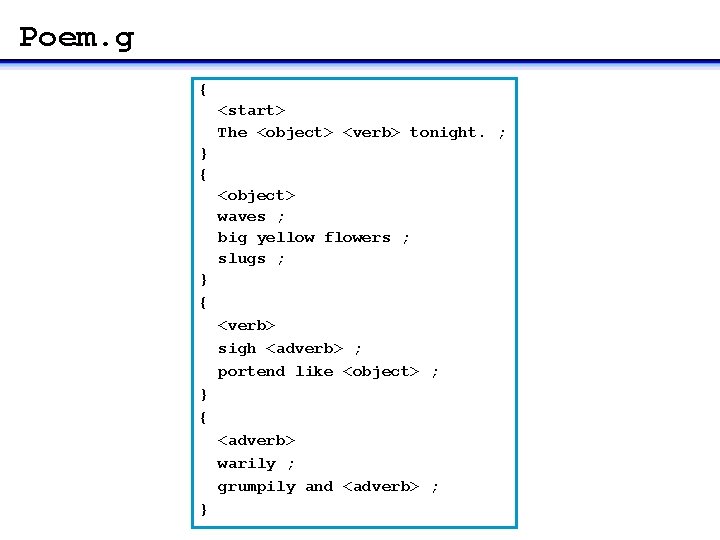
Poem. g { <start> The <object> <verb> tonight. ; } { <object> waves ; big yellow flowers ; slugs ; } { <verb> sigh <adverb> ; portend like <object> ; } { <adverb> warily ; grumpily and <adverb> ; }
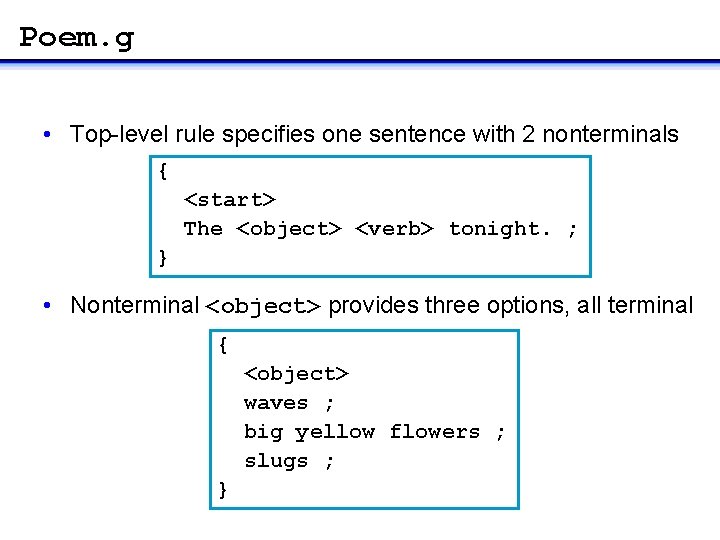
Poem. g • Top-level rule specifies one sentence with 2 nonterminals { <start> The <object> <verb> tonight. ; } • Nonterminal <object> provides three options, all terminal { <object> waves ; big yellow flowers ; slugs ; }
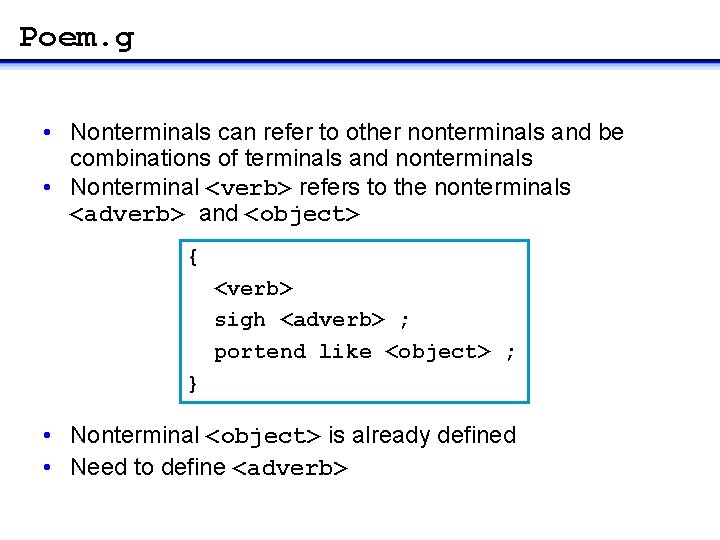
Poem. g • Nonterminals can refer to other nonterminals and be combinations of terminals and nonterminals • Nonterminal <verb> refers to the nonterminals <adverb> and <object> { <verb> sigh <adverb> ; portend like <object> ; } • Nonterminal <object> is already defined • Need to define <adverb>
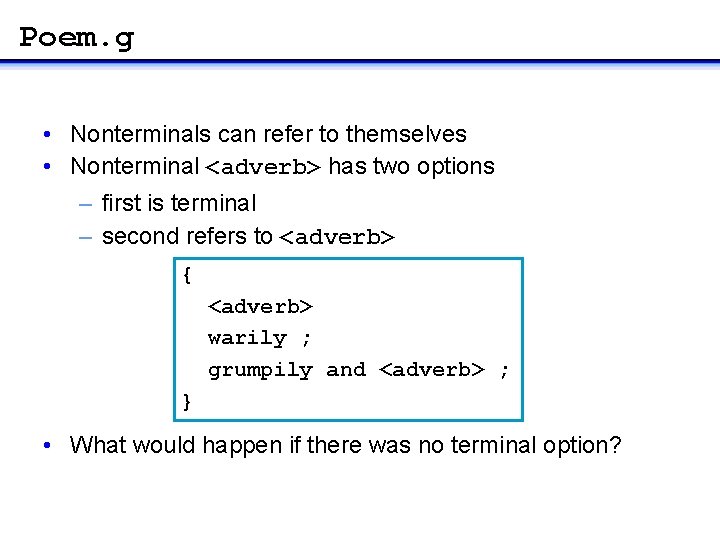
Poem. g • Nonterminals can refer to themselves • Nonterminal <adverb> has two options – first is terminal – second refers to <adverb> { <adverb> warily ; grumpily and <adverb> ; } • What would happen if there was no terminal option?
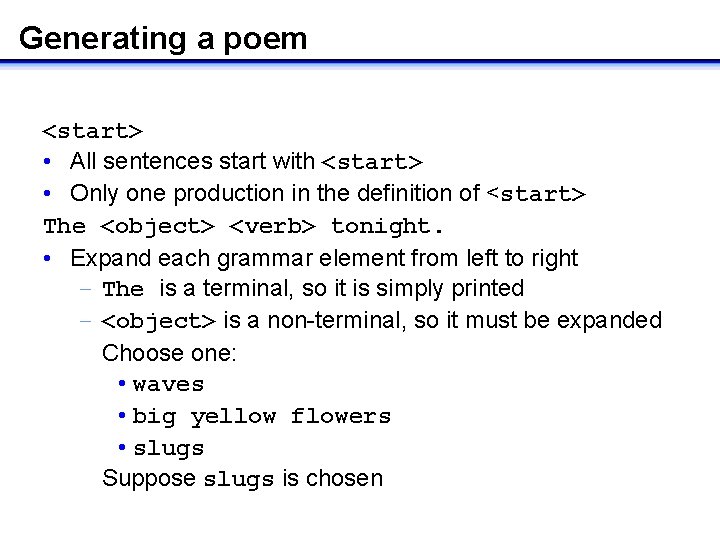
Generating a poem <start> • All sentences start with <start> • Only one production in the definition of <start> The <object> <verb> tonight. • Expand each grammar element from left to right – The is a terminal, so it is simply printed – <object> is a non-terminal, so it must be expanded Choose one: • waves • big yellow flowers • slugs Suppose slugs is chosen
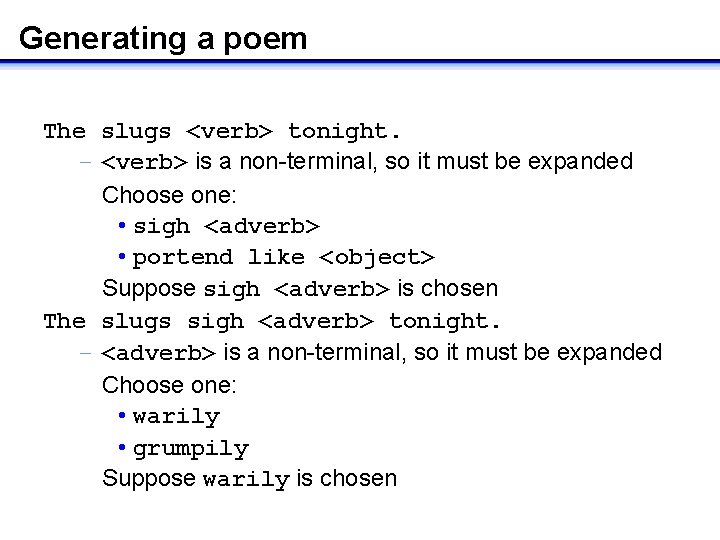
Generating a poem The slugs <verb> tonight. – <verb> is a non-terminal, so it must be expanded Choose one: • sigh <adverb> • portend like <object> Suppose sigh <adverb> is chosen The slugs sigh <adverb> tonight. – <adverb> is a non-terminal, so it must be expanded Choose one: • warily • grumpily Suppose warily is chosen
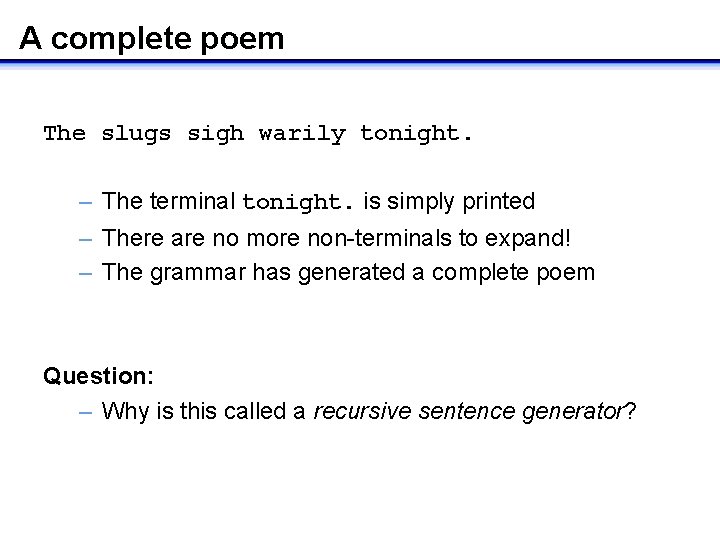
A complete poem The slugs sigh warily tonight. – The terminal tonight. is simply printed – There are no more non-terminals to expand! – The grammar has generated a complete poem Question: – Why is this called a recursive sentence generator?
More poems • Go to the RSG demo applet and select the poem grammar to generate more poems http: //www. duke. edu/web/cps 001/code/RSG. html • How many different poems are possible?