
GrammarinDepth Itpatterns Use of English Introduction Special clause
- Slides: 12
Grammar-in-Depth: It-patterns Use of English
Introduction • Special clause patterns that begin with the word “It” • Carrying no meaning at all. (“Empty-it”) • Only used to fill up the position of subject • “Introductory-it”
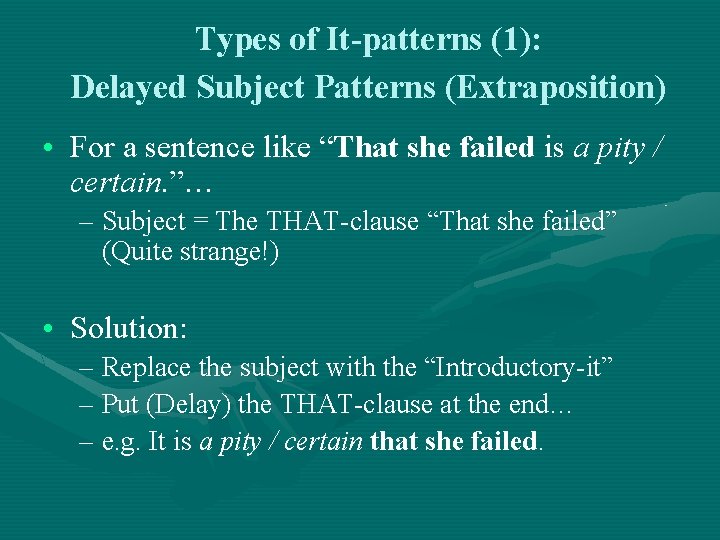
Types of It-patterns (1): Delayed Subject Patterns (Extraposition) • For a sentence like “That she failed is a pity / certain. ”… – Subject = The THAT-clause “That she failed” (Quite strange!) • Solution: – Replace the subject with the “Introductory-it” – Put (Delay) the THAT-clause at the end… – e. g. It is a pity / certain that she failed.
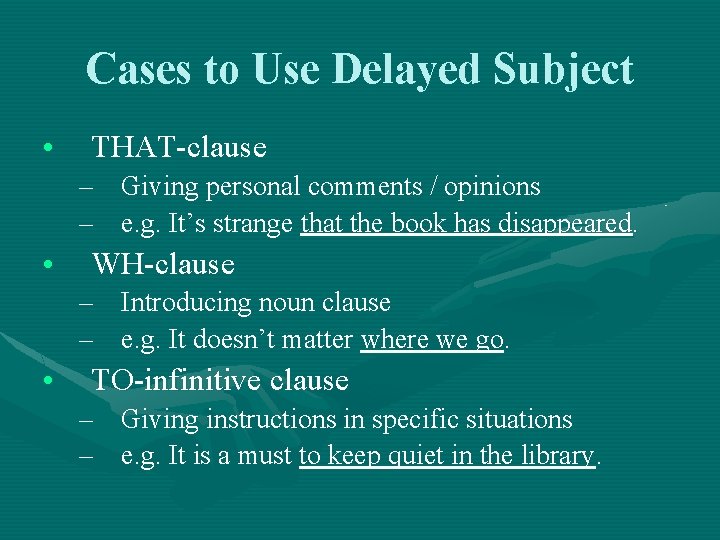
Cases to Use Delayed Subject • THAT-clause – Giving personal comments / opinions – e. g. It’s strange that the book has disappeared. • WH-clause – Introducing noun clause – e. g. It doesn’t matter where we go. • TO-infinitive clause – Giving instructions in specific situations – e. g. It is a must to keep quiet in the library.
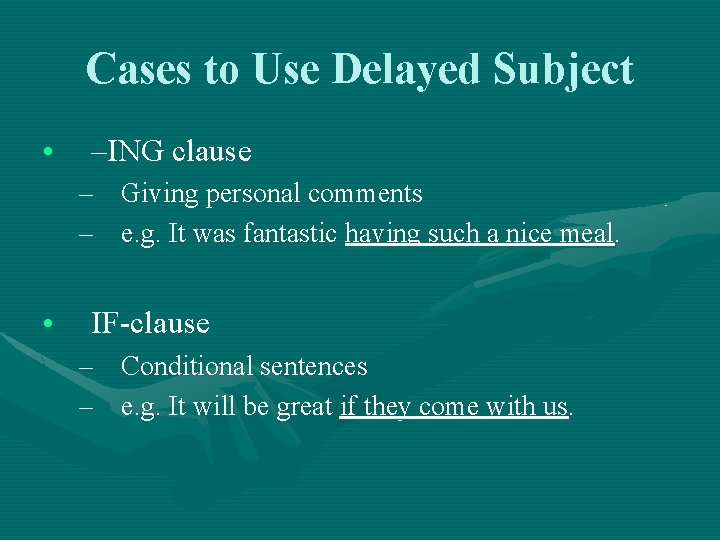
Cases to Use Delayed Subject • –ING clause – Giving personal comments – e. g. It was fantastic having such a nice meal. • IF-clause – Conditional sentences – e. g. It will be great if they come with us.
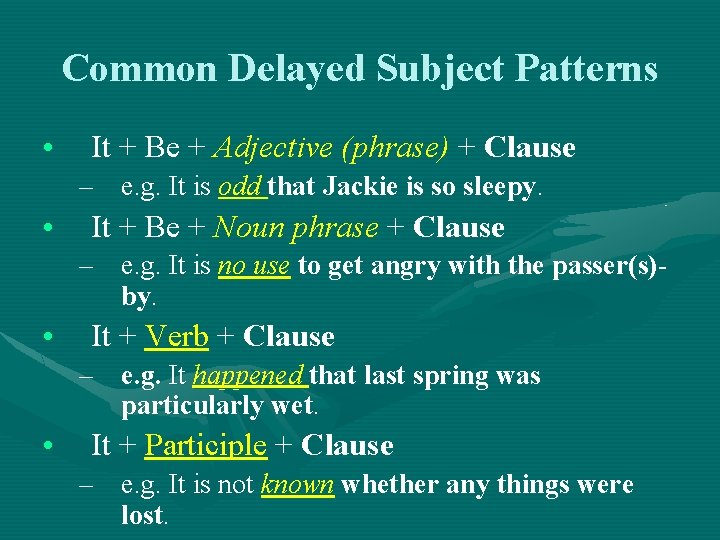
Common Delayed Subject Patterns • It + Be + Adjective (phrase) + Clause – e. g. It is odd that Jackie is so sleepy. • It + Be + Noun phrase + Clause – e. g. It is no use to get angry with the passer(s)by. • It + Verb + Clause – e. g. It happened that last spring was particularly wet. • It + Participle + Clause – e. g. It is not known whether any things were lost.
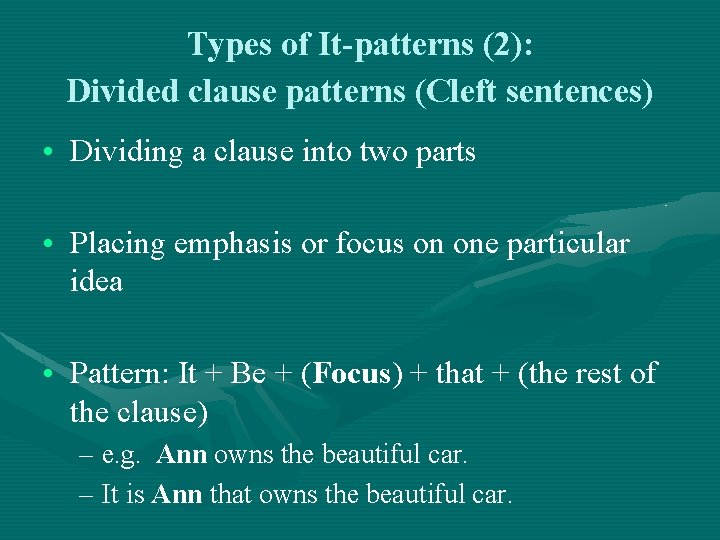
Types of It-patterns (2): Divided clause patterns (Cleft sentences) • Dividing a clause into two parts • Placing emphasis or focus on one particular idea • Pattern: It + Be + (Focus) + that + (the rest of the clause) – e. g. Ann owns the beautiful car. – It is Ann that owns the beautiful car.
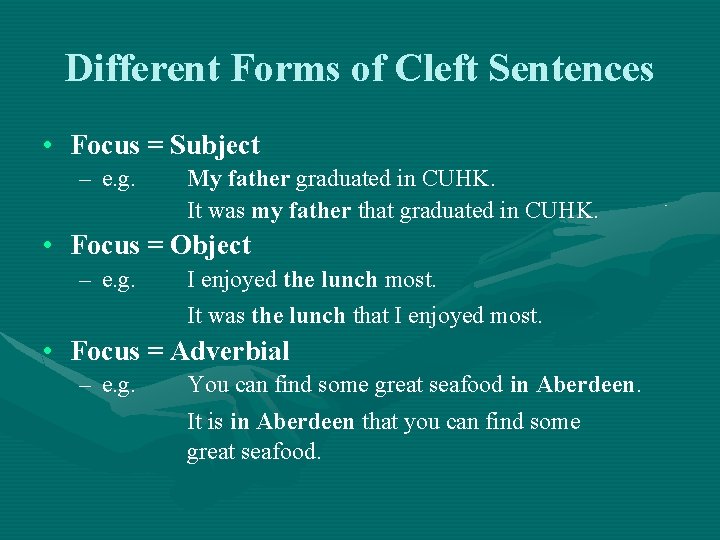
Different Forms of Cleft Sentences • Focus = Subject – e. g. My father graduated in CUHK. It was my father that graduated in CUHK. • Focus = Object – e. g. I enjoyed the lunch most. It was the lunch that I enjoyed most. • Focus = Adverbial – e. g. You can find some great seafood in Aberdeen. It is in Aberdeen that you can find some great seafood.
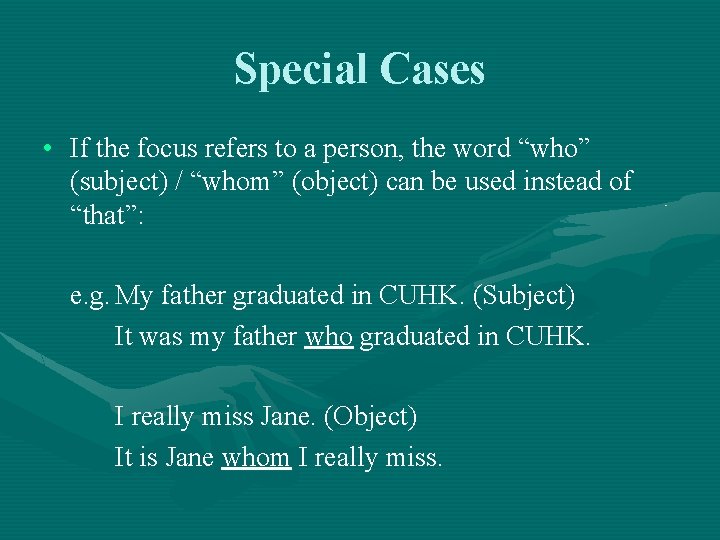
Special Cases • If the focus refers to a person, the word “who” (subject) / “whom” (object) can be used instead of “that”: e. g. My father graduated in CUHK. (Subject) It was my father who graduated in CUHK. I really miss Jane. (Object) It is Jane whom I really miss.
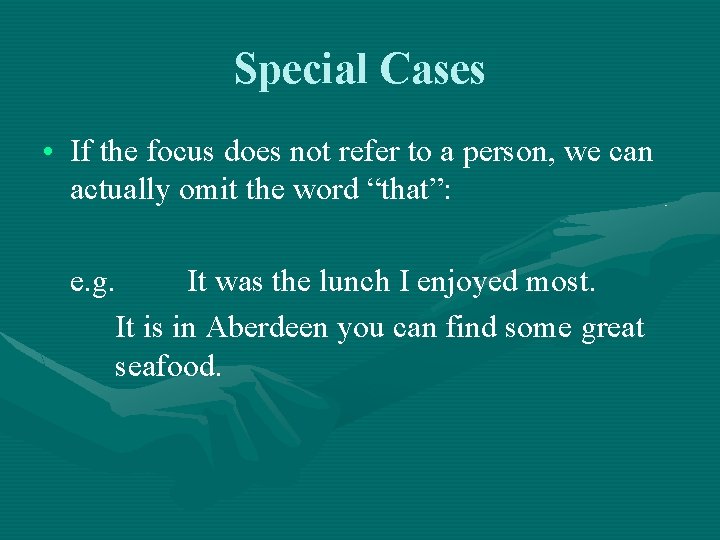
Special Cases • If the focus does not refer to a person, we can actually omit the word “that”: e. g. It was the lunch I enjoyed most. It is in Aberdeen you can find some great seafood.
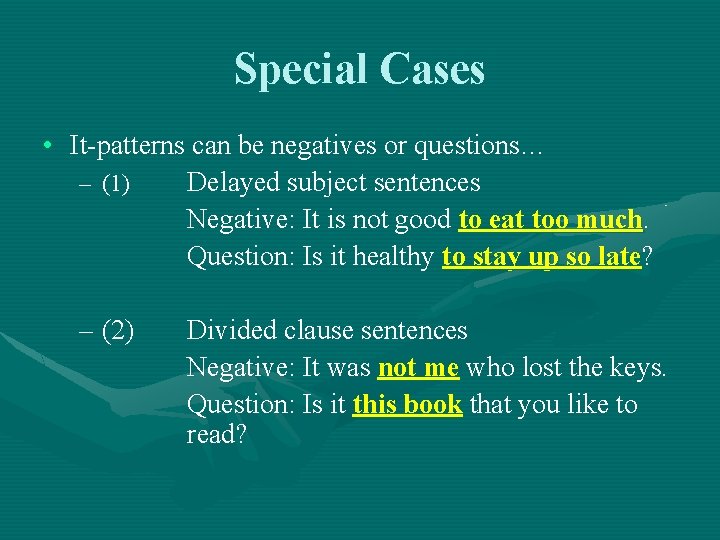
Special Cases • It-patterns can be negatives or questions… – (1) Delayed subject sentences Negative: It is not good to eat too much. Question: Is it healthy to stay up so late? – (2) Divided clause sentences Negative: It was not me who lost the keys. Question: Is it this book that you like to read?
The End