
Grammar Usage and Style English 10 1 Parts
- Slides: 51
Grammar, Usage and Style English 10 -1
Parts of Speech Visit Kahoot. It and join the survey: Parts of Speech With a partner write down what you know about the parts of speech. § Try to provide a name, definition and example for each part of speech. § What is the difference between parts of speech and figures of speech?
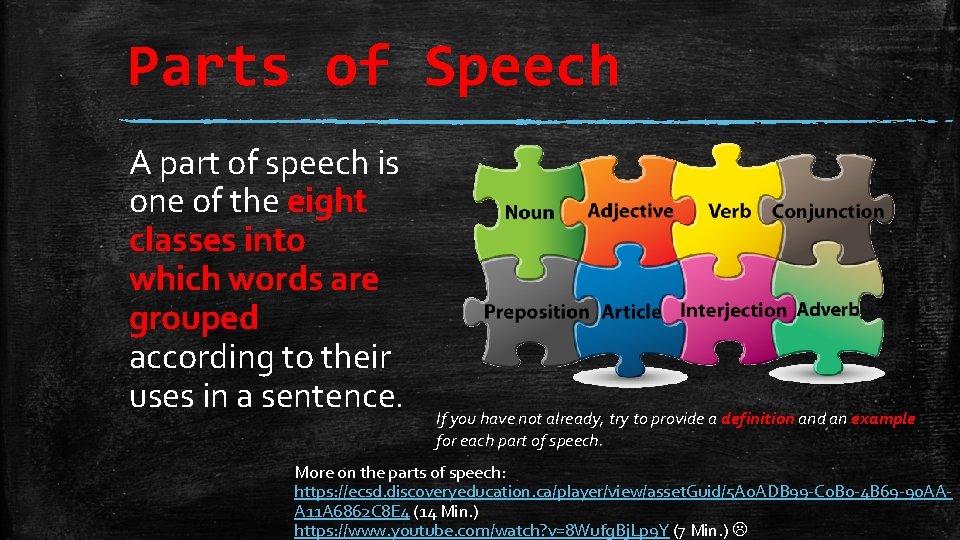
Parts of Speech A part of speech is one of the eight classes into which words are grouped according to their uses in a sentence. If you have not already, try to provide a definition and an example for each part of speech. More on the parts of speech: https: //ecsd. discoveryeducation. ca/player/view/asset. Guid/5 A 0 ADB 99 -C 0 B 0 -4 B 69 -90 AAA 11 A 6862 C 8 E 4 (14 Min. ) https: //www. youtube. com/watch? v=8 Wufg. Bj. Lp 9 Y (7 Min. )
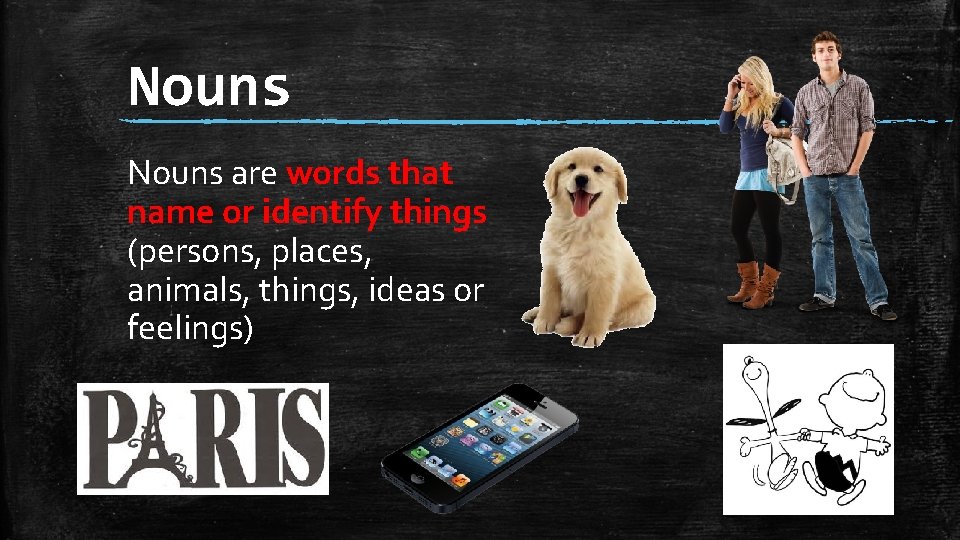
Nouns are words that name or identify things (persons, places, animals, things, ideas or feelings)
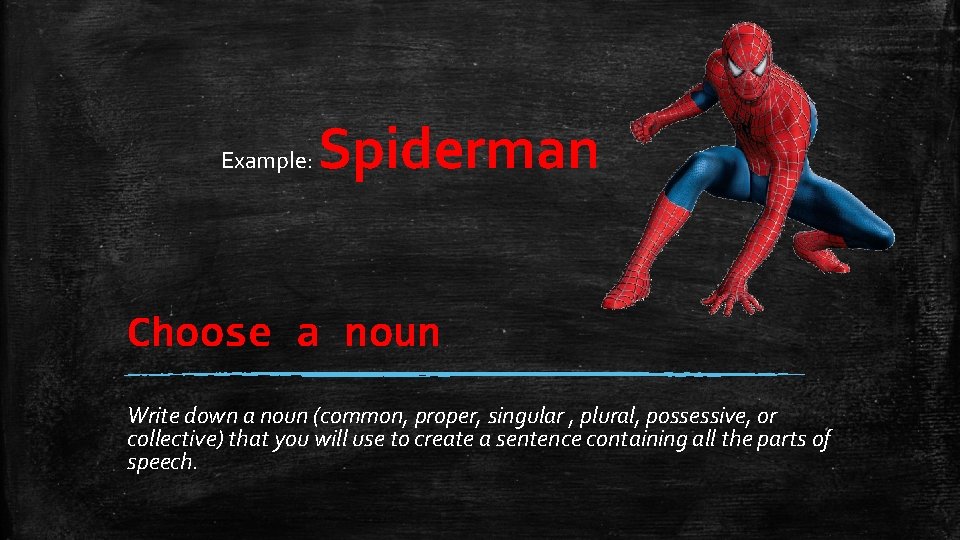
Example: Spiderman Choose a noun Write down a noun (common, proper, singular , plural, possessive, or collective) that you will use to create a sentence containing all the parts of speech.
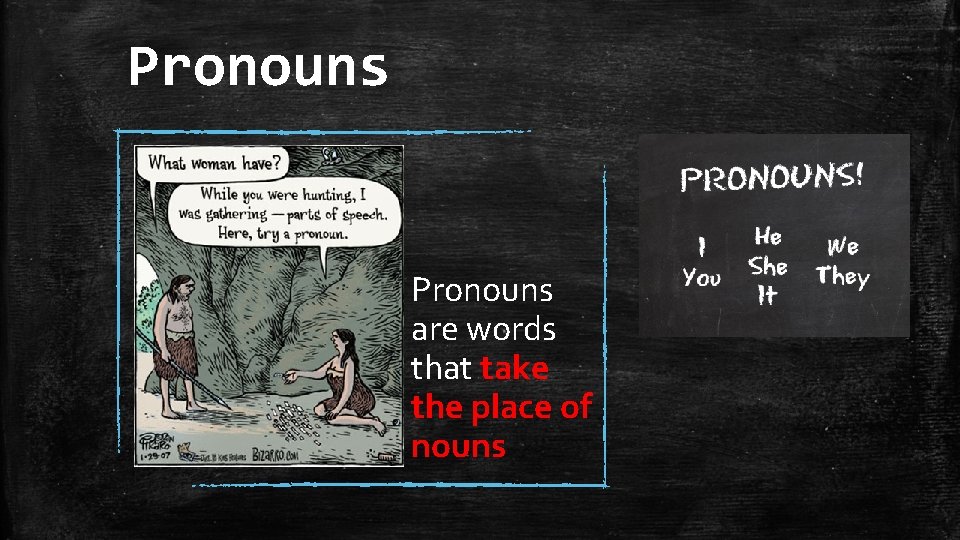
Pronouns are words that take the place of nouns
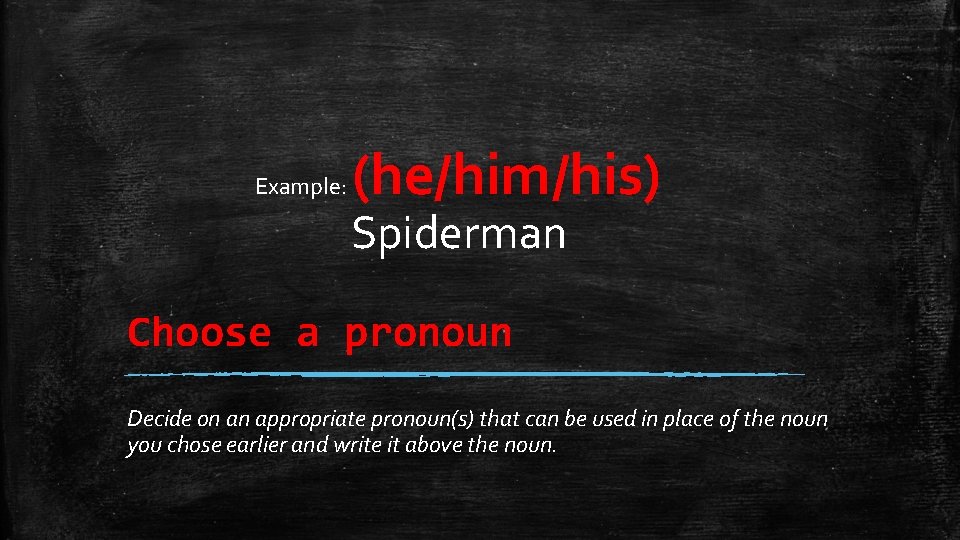
Example: (he/him/his) Spiderman Choose a pronoun Decide on an appropriate pronoun(s) that can be used in place of the noun you chose earlier and write it above the noun.
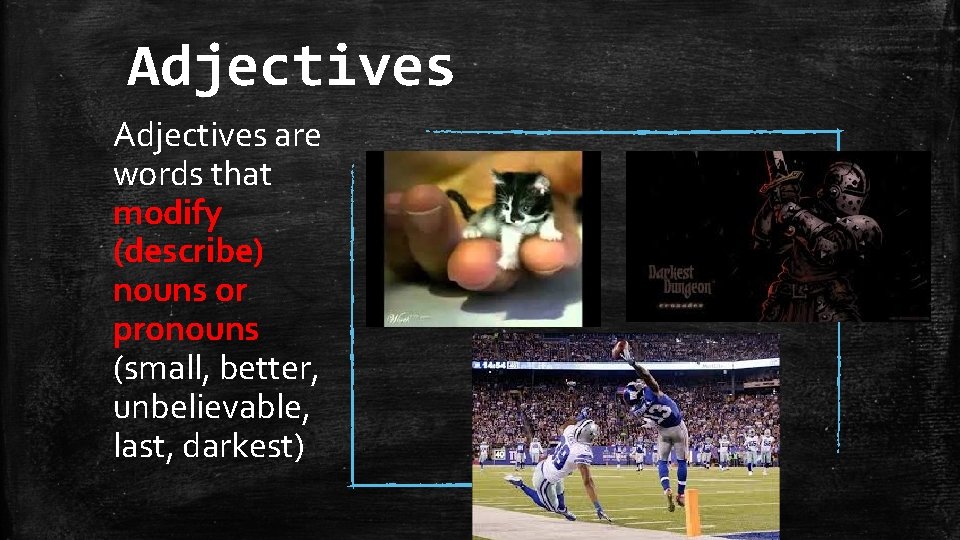
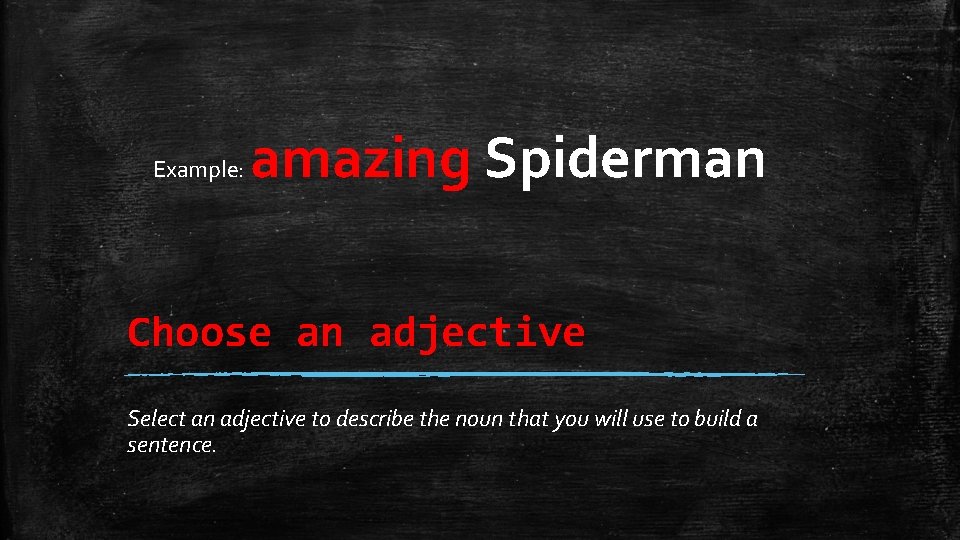
Adjectives are words that modify (describe) nouns or pronouns (small, better, unbelievable, last, darkest)
Example: amazing Spiderman Choose an adjective Select an adjective to describe the noun that you will use to build a sentence.
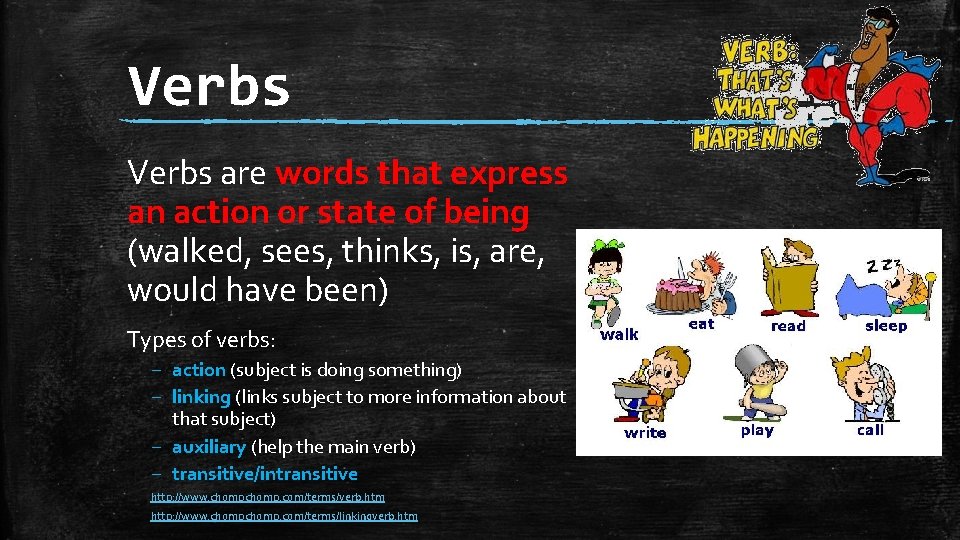
Verbs are words that express an action or state of being (walked, sees, thinks, is, are, would have been) Types of verbs: – action (subject is doing something) – linking (links subject to more information about that subject) – auxiliary (help the main verb) – transitive/intransitive http: //www. chomp. com/terms/verb. htm http: //www. chomp. com/terms/linkingverb. htm
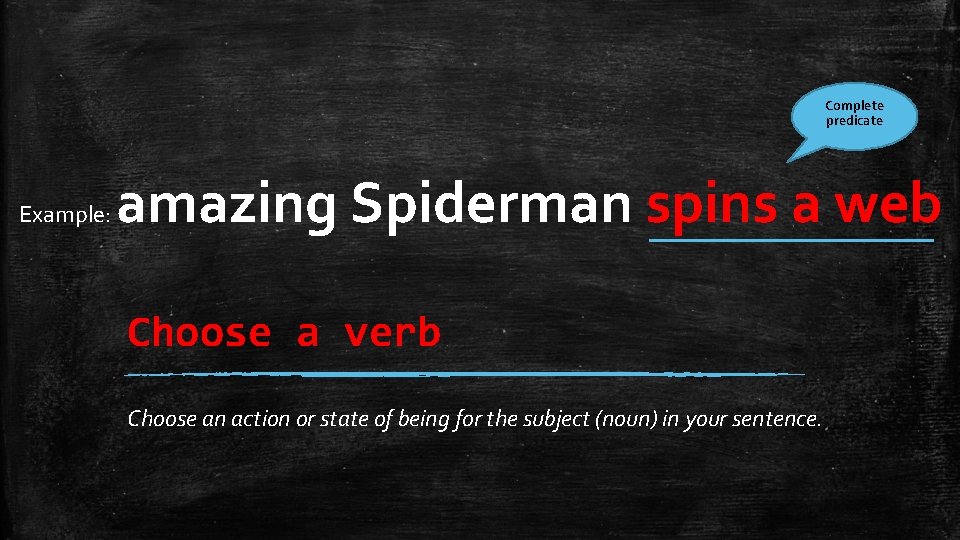
Complete predicate Example: amazing Spiderman spins a web Choose a verb Choose an action or state of being for the subject (noun) in your sentence.
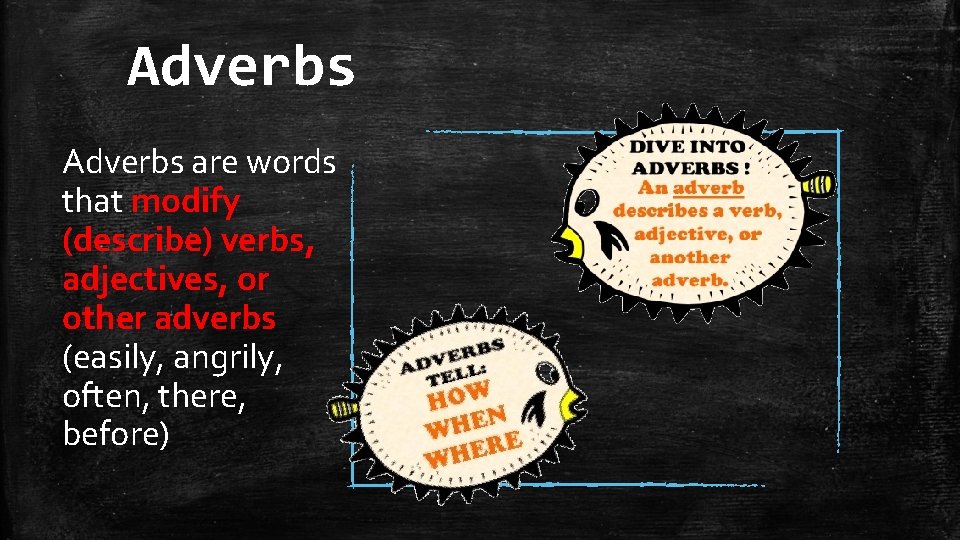
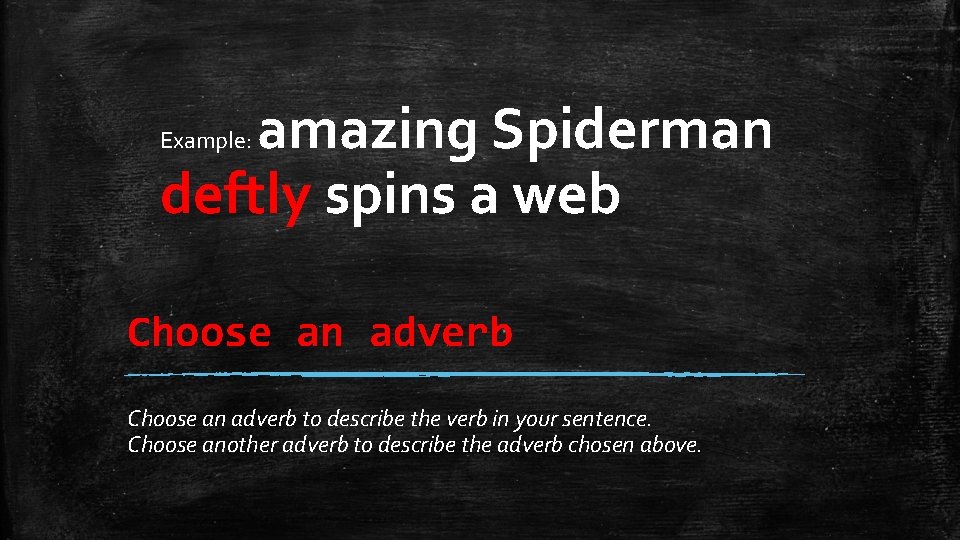
Adverbs are words that modify (describe) verbs, adjectives, or other adverbs (easily, angrily, often, there, before)
amazing Spiderman deftly spins a web Example: Choose an adverb to describe the verb in your sentence. Choose another adverb to describe the adverb chosen above.
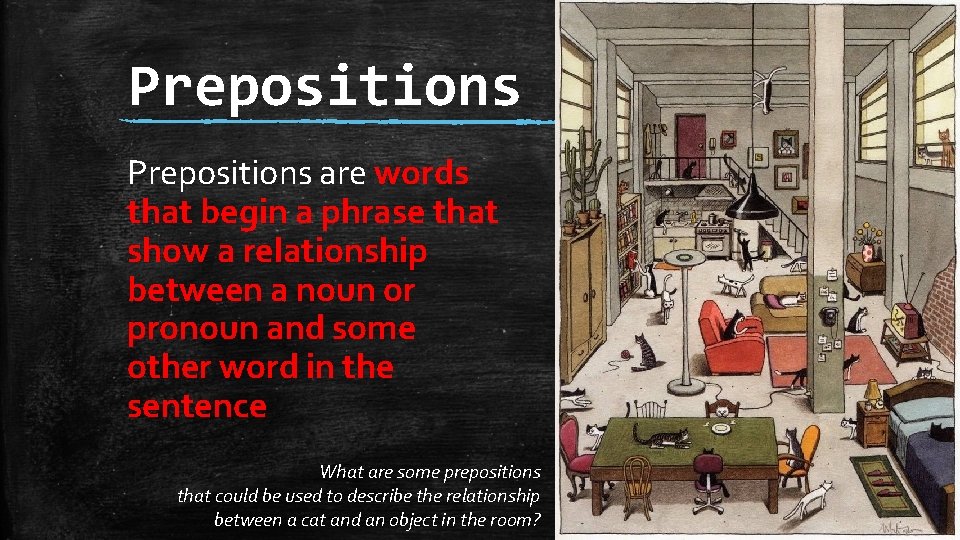
Prepositions are words that begin a phrase that show a relationship between a noun or pronoun and some other word in the sentence What are some prepositions that could be used to describe the relationship between a cat and an object in the room?
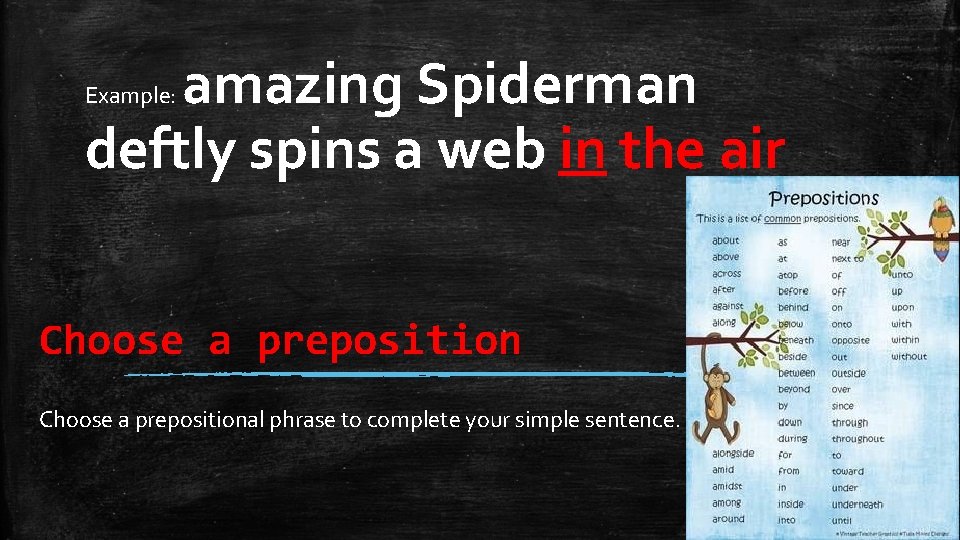
amazing Spiderman deftly spins a web in the air Example: Choose a prepositional phrase to complete your simple sentence.
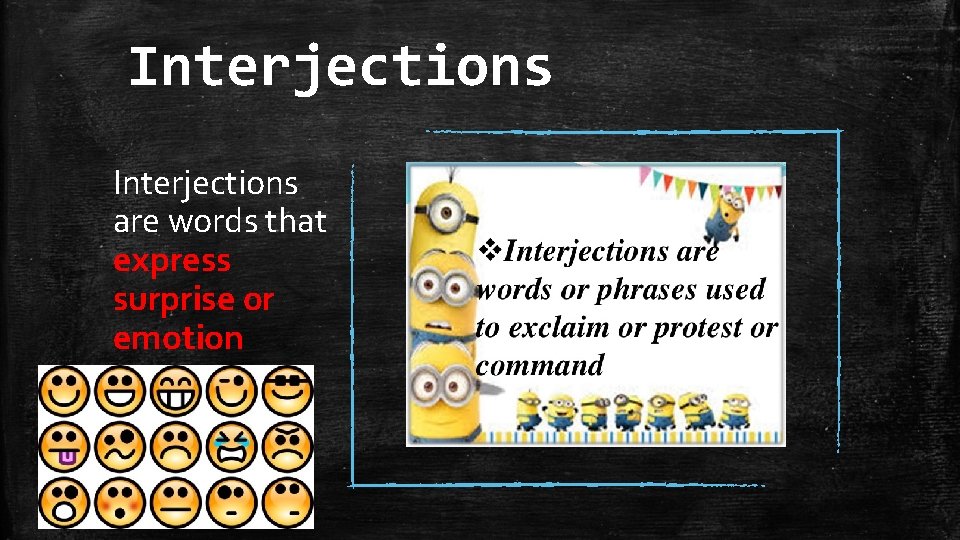
Interjections are words that express surprise or emotion
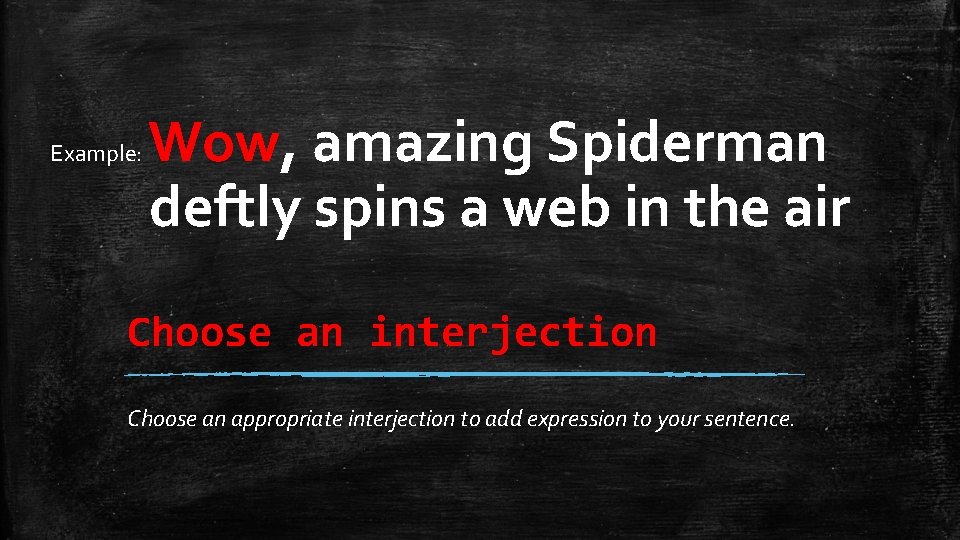
Example: Wow, amazing Spiderman deftly spins a web in the air Choose an interjection Choose an appropriate interjection to add expression to your sentence.
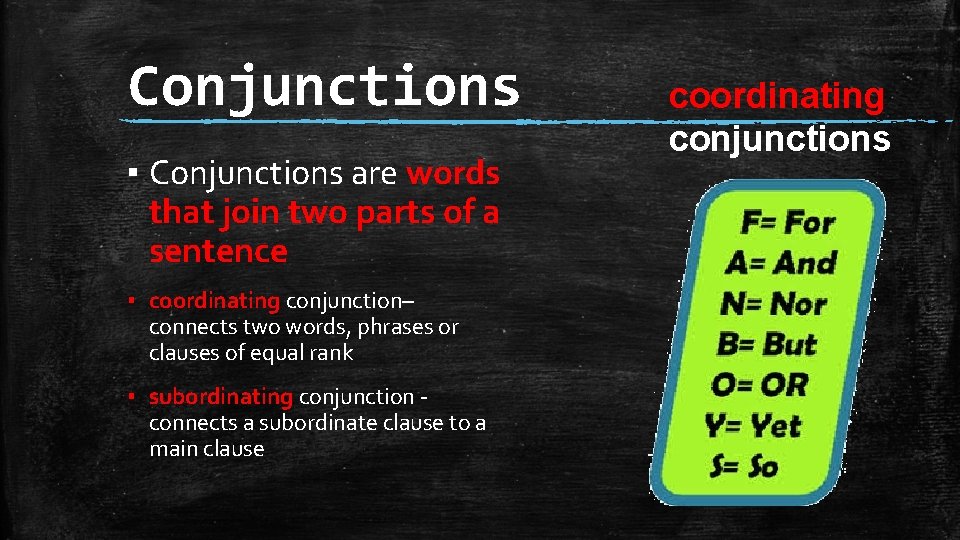
Conjunctions ▪ Conjunctions are words that join two parts of a sentence ▪ coordinating conjunction– connects two words, phrases or clauses of equal rank ▪ subordinating conjunction connects a subordinate clause to a main clause coordinating conjunctions
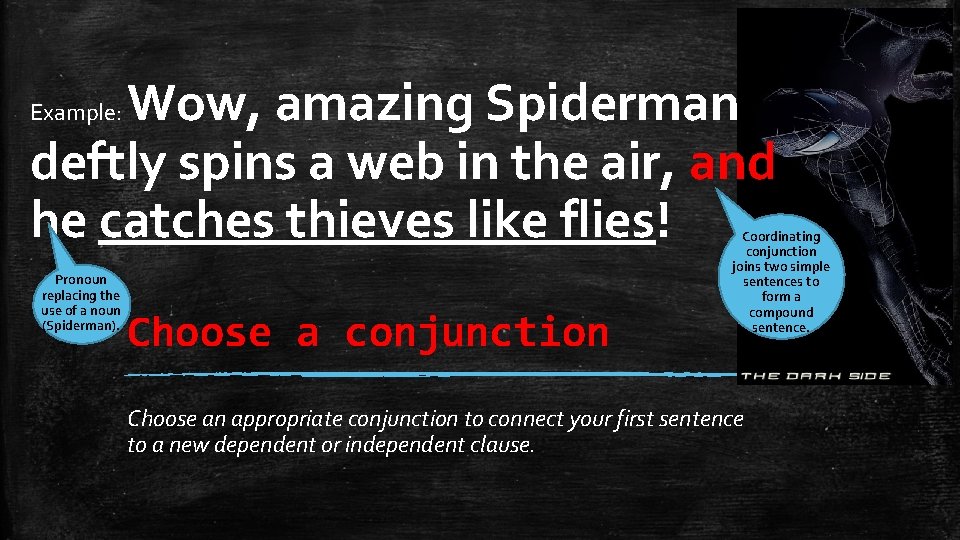
Wow, amazing Spiderman deftly spins a web in the air, and he catches thieves like flies! Example: Pronoun replacing the use of a noun (Spiderman). Choose a conjunction Coordinating conjunction joins two simple sentences to form a compound sentence. Choose an appropriate conjunction to connect your first sentence to a new dependent or independent clause.
Awesome! Now, you have created a sentence using all the parts of speech. Visit Kahoot. It and join the survey: Grammar Ninja
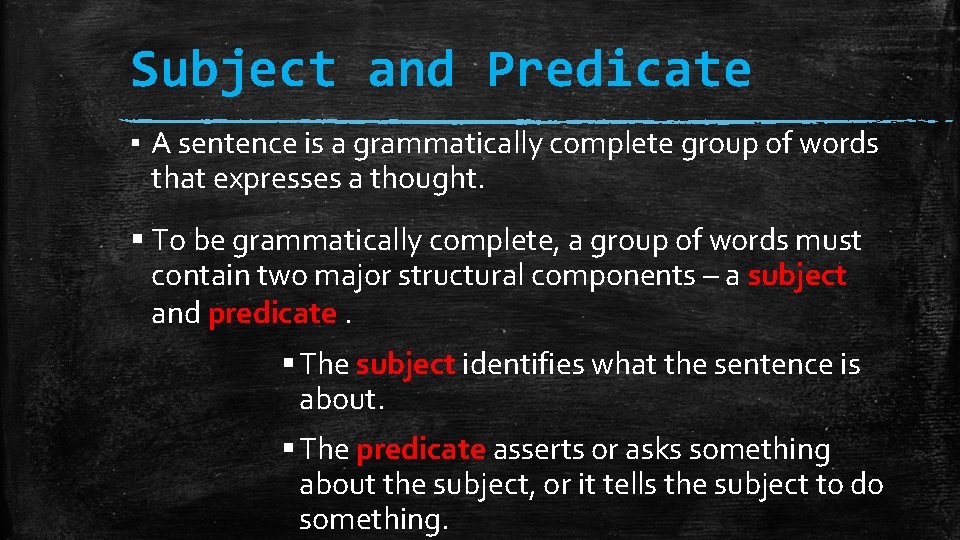
Subject and Predicate ▪ A sentence is a grammatically complete group of words that expresses a thought. § To be grammatically complete, a group of words must contain two major structural components – a subject and predicate. § The subject identifies what the sentence is about. § The predicate asserts or asks something about the subject, or it tells the subject to do something.
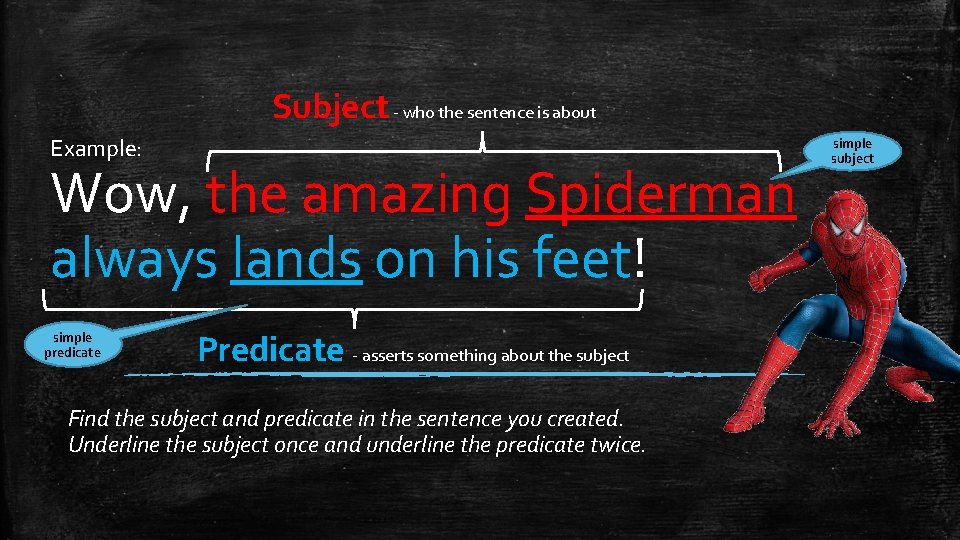
Subject - who the sentence is about Example: Wow, the amazing Spiderman always lands on his feet! simple predicate Predicate - asserts something about the subject Find the subject and predicate in the sentence you created. Underline the subject once and underline the predicate twice. simple subject
Subject and Predicate Someone do something! Play the Subject and Predicate game Fling the Teacher! http: //www. cccs. k 12. in. us/userfiles/10/Subject%20 and%20 Predicate. swf
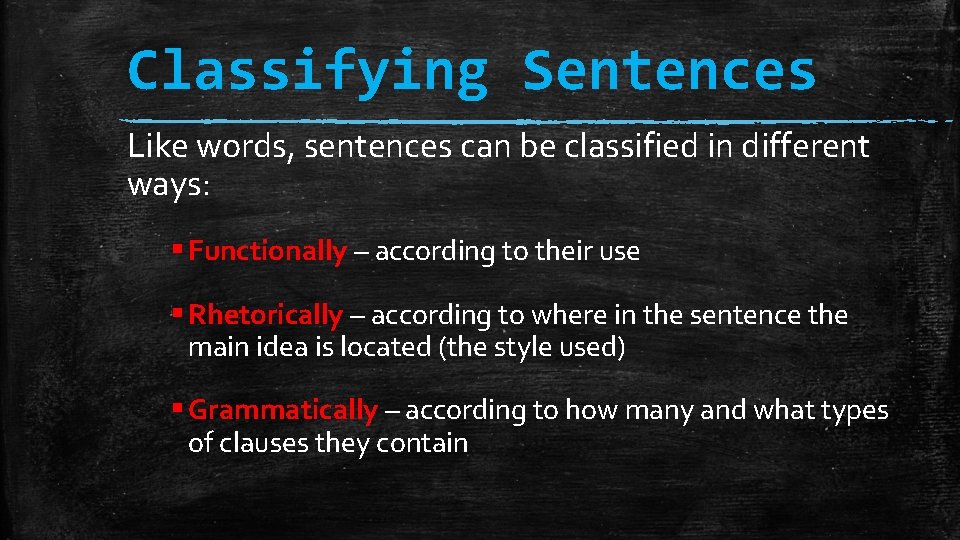
Classifying Sentences Like words, sentences can be classified in different ways: § Functionally – according to their use § Rhetorically – according to where in the sentence the main idea is located (the style used) § Grammatically – according to how many and what types of clauses they contain
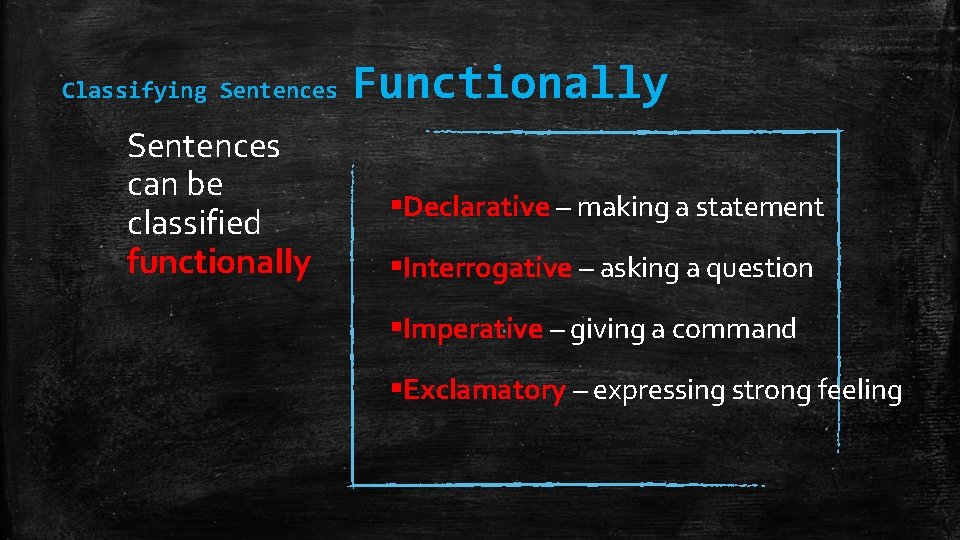
Classifying Sentences can be classified functionally Functionally §Declarative – making a statement §Interrogative – asking a question §Imperative – giving a command §Exclamatory – expressing strong feeling
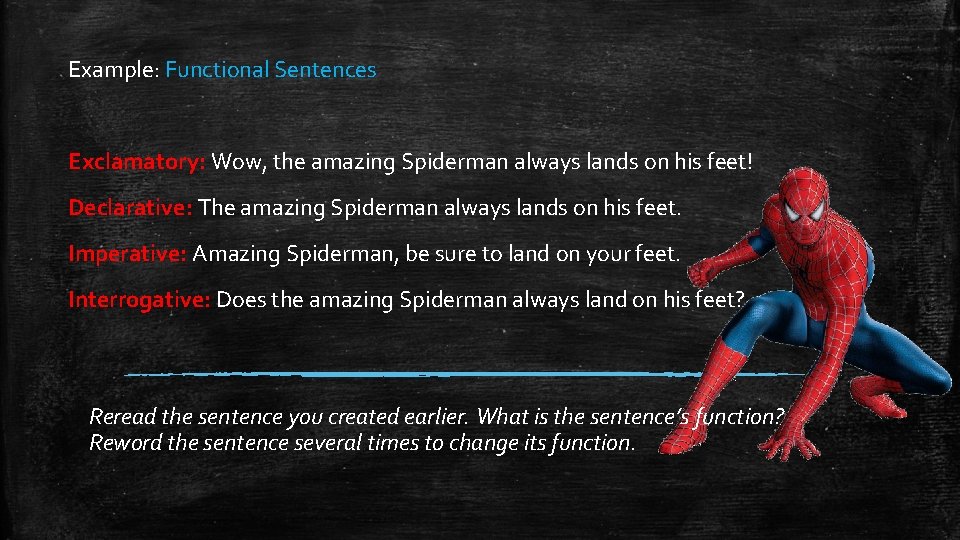
Example: Functional Sentences Exclamatory: Wow, the amazing Spiderman always lands on his feet! Declarative: The amazing Spiderman always lands on his feet. Imperative: Amazing Spiderman, be sure to land on your feet. Interrogative: Does the amazing Spiderman always land on his feet? Reread the sentence you created earlier. What is the sentence’s function? Reword the sentence several times to change its function.
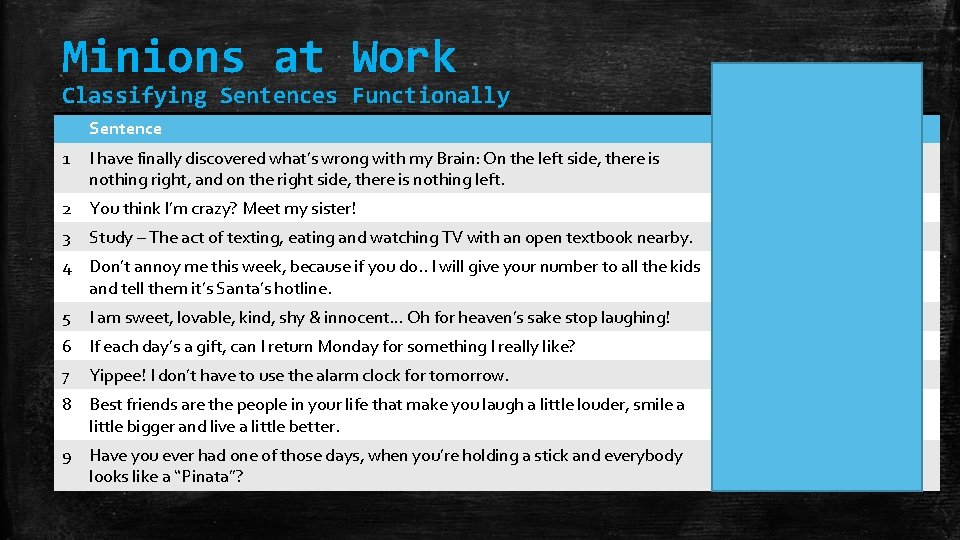
Minions at Work Classifying Sentences Functionally Sentence Function 1 I have finally discovered what’s wrong with my Brain: On the left side, there is nothing right, and on the right side, there is nothing left. Declarative 2 You think I’m crazy? Meet my sister! Interrogative/Exclamatory 3 Study – The act of texting, eating and watching TV with an open textbook nearby. Declarative 4 Don’t annoy me this week, because if you do. . I will give your number to all the kids Imperative and tell them it’s Santa’s hotline. 5 I am sweet, lovable, kind, shy & innocent… Oh for heaven’s sake stop laughing! Imperative/Exclamatory 6 If each day’s a gift, can I return Monday for something I really like? Interrogative 7 Yippee! I don’t have to use the alarm clock for tomorrow. Exclamatory 8 Best friends are the people in your life that make you laugh a little louder, smile a little bigger and live a little better. Declarative 9 Have you ever had one of those days, when you’re holding a stick and everybody looks like a “Pinata”? Interrogative
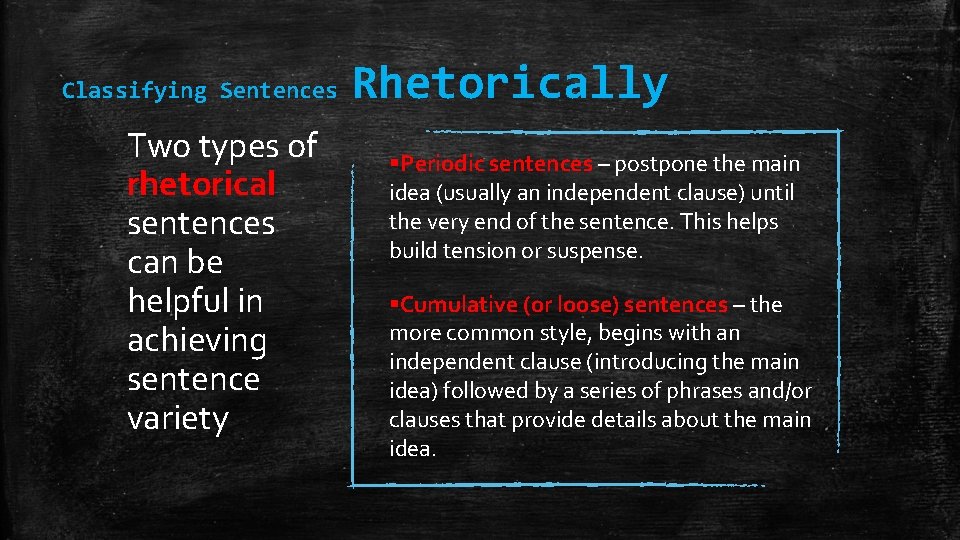
Classifying Sentences Two types of rhetorical sentences can be helpful in achieving sentence variety Rhetorically §Periodic sentences – postpone the main idea (usually an independent clause) until the very end of the sentence. This helps build tension or suspense. §Cumulative (or loose) sentences – the more common style, begins with an independent clause (introducing the main idea) followed by a series of phrases and/or clauses that provide details about the main idea.
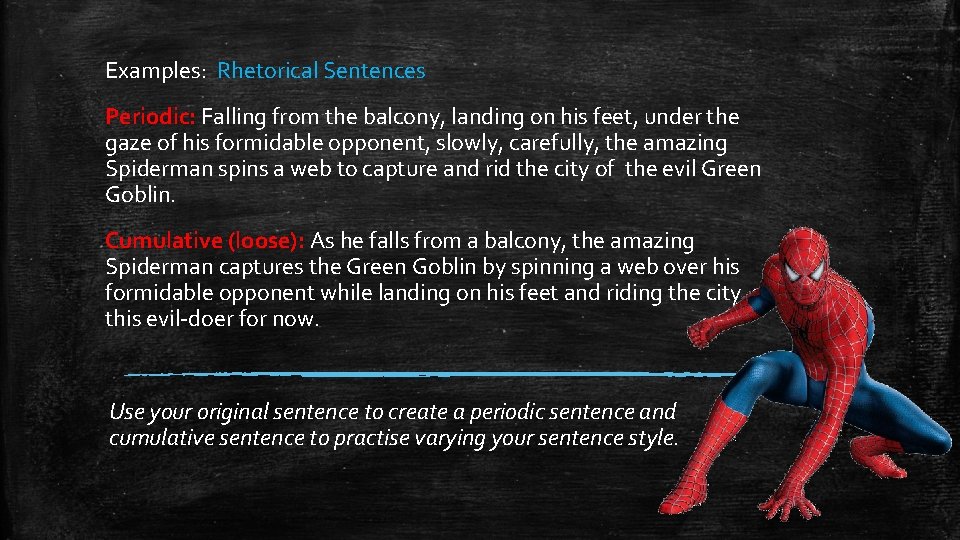
Examples: Rhetorical Sentences Periodic: Falling from the balcony, landing on his feet, under the gaze of his formidable opponent, slowly, carefully, the amazing Spiderman spins a web to capture and rid the city of the evil Green Goblin. Cumulative (loose): As he falls from a balcony, the amazing Spiderman captures the Green Goblin by spinning a web over his formidable opponent while landing on his feet and riding the city of this evil-doer for now. Use your original sentence to create a periodic sentence and cumulative sentence to practise varying your sentence style.
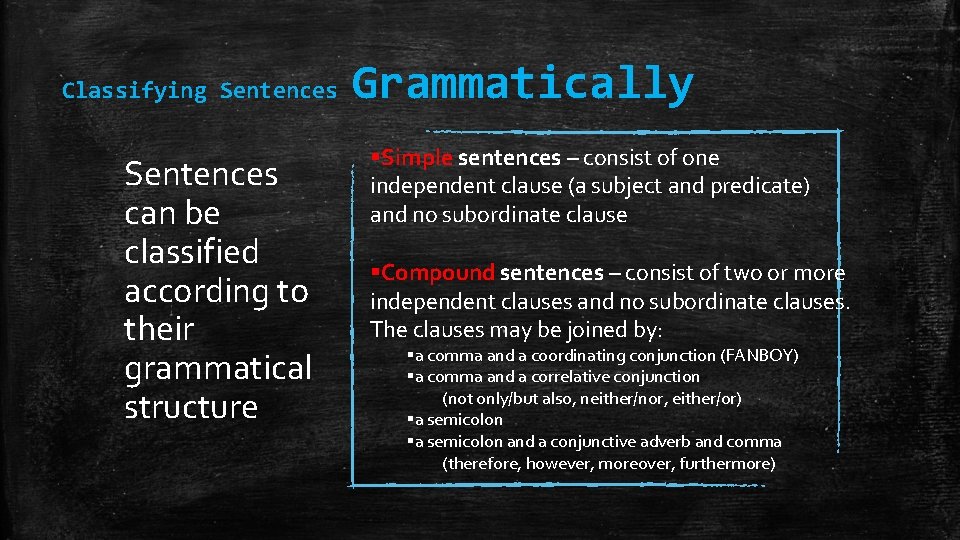
Classifying Sentences can be classified according to their grammatical structure Grammatically §Simple sentences – consist of one independent clause (a subject and predicate) and no subordinate clause §Compound sentences – consist of two or more independent clauses and no subordinate clauses. The clauses may be joined by: §a comma and a coordinating conjunction (FANBOY) §a comma and a correlative conjunction (not only/but also, neither/nor, either/or) §a semicolon and a conjunctive adverb and comma (therefore, however, moreover, furthermore)
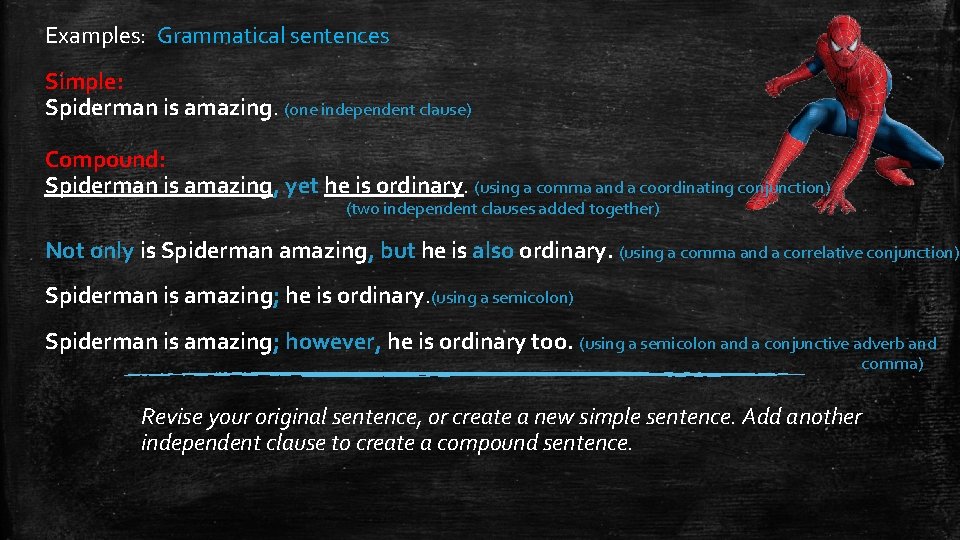
Examples: Grammatical sentences Simple: Spiderman is amazing. (one independent clause) Compound: Spiderman is amazing, yet he is ordinary. (using a comma and a coordinating conjunction) (two independent clauses added together) Not only is Spiderman amazing, but he is also ordinary. (using a comma and a correlative conjunction) Spiderman is amazing; he is ordinary. (using a semicolon) Spiderman is amazing; however, he is ordinary too. (using a semicolon and a conjunctive adverb and comma) Revise your original sentence, or create a new simple sentence. Add another independent clause to create a compound sentence.
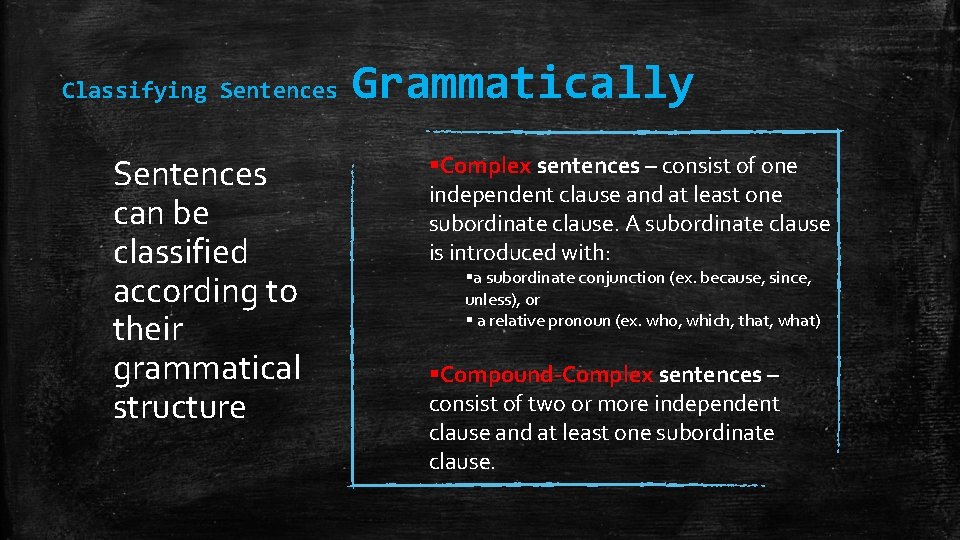
Classifying Sentences can be classified according to their grammatical structure Grammatically §Complex sentences – consist of one independent clause and at least one subordinate clause. A subordinate clause is introduced with: §a subordinate conjunction (ex. because, since, unless), or § a relative pronoun (ex. who, which, that, what) §Compound-Complex sentences – consist of two or more independent clause and at least one subordinate clause.
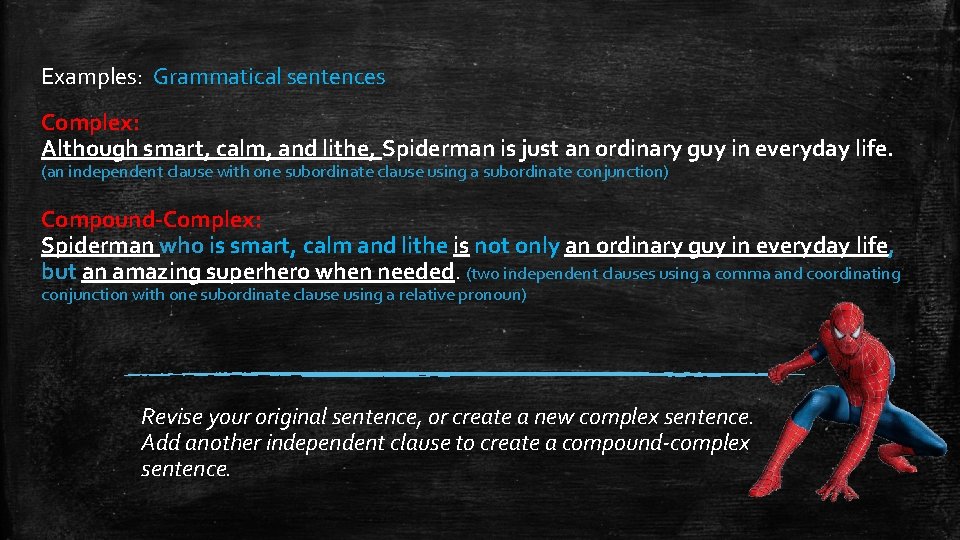
Examples: Grammatical sentences Complex: Although smart, calm, and lithe, Spiderman is just an ordinary guy in everyday life. (an independent clause with one subordinate clause using a subordinate conjunction) Compound-Complex: Spiderman who is smart, calm and lithe is not only an ordinary guy in everyday life, but an amazing superhero when needed. (two independent clauses using a comma and coordinating conjunction with one subordinate clause using a relative pronoun) Revise your original sentence, or create a new complex sentence. Add another independent clause to create a compound-complex sentence.
Grammar, Usage and Style Questions?
Homework • Complete Parts One, Two and Three of the Learning Guide if you haven’t already. Remember, do NOT write in the learning guides. Please provide all answers in the response booklet. • Complete Part Four of learning guide - Exercises from the Canadian Writer's Handbook (1 -9) • Complete Part Five - Practise Test • Show your corrected work to your course advisor • Ask your course advisor for the multiple choice test slip and study for your test • When you are ready, take the test, but no later than Tuesday, September 22 nd to stay on track!