
Grammar Unit 53 Verb ing enjoy doing stop
Grammar – Unit 53 Verb + -ing (enjoy doing / stop doing etc. ) Verb + -ing (enjoy doing/stop doing etc. )
Agenda o Learning Objectives o Example Set A for Verb + -ing o Example Set B for using -ing after o Example Set C for using with some verbs o Example Set D for when talking about finished actions o Example Set E for using “that” after some of the verbs Verb + -ing (enjoy doing/stop doing etc. ) 2
Agenda Ø Learning Objectives o Example Set A for Verb + -ing o Example Set B for using -ing after o Example Set C for using with some verbs o Example Set D for when talking about finished actions o Example Set E for using “that” after some of the verbs Verb + -ing (enjoy doing/stop doing etc. ) 3
Learning Objectives Verb + -ing (enjoy doing / stop doing etc. ) o Using verb + -ing forms o Verb + somebody + ing o Knowing finished actions Verb + -ing (enjoy doing/stop doing etc. ) 4
Agenda ü Learning Objectives Ø Example Set A for Verb + -ing o Example Set B for using -ing after o Example Set C for using with some verbs o Example Set D for when talking about finished actions o Example Set E for using “that” after some of the verbs Verb + -ing (enjoy doing/stop doing etc. ) 5
Example set A – Verb + -ing (enjoy doing/stop doing etc. ) Look at these examples: n I enjoy reading. (not I enjoy to read) n Would you mind closing the door? (not mind to close) n Chris suggested going to the cinema (not suggested to go) Would you mind closing the door? After enjoy, mind and suggest, we use –ing (not to…. . ). Verb + -ing (enjoy doing/stop doing etc. ) 6

Continue… Some more verbs that are followed by –ing: Stop Finish postpone consider admit deny avoid risk imagine fancy ¨ Suddenly everybody stopped talking. There was silence. ¨ I’II do the shopping when I’ve finished cleaning the flat. ¨ He tried to avoid answering my questions. Verb + -ing (enjoy doing/stop doing etc. ) 7
Continue… ¨ I don’t fancy going out this evening. (=I’m not enthusiastic about it) I don’t fancy going out this evening. ¨ Have you ever considered going to live in another country? The negative form is not –ing: ¨ When I’m on holiday, I enjoy not having to get up early. Verb + -ing (enjoy doing/stop doing etc. ) 8
Agenda ü Learning Objectives ü Example Set A for Verb + -ing Ø Example Set B for using -ing after o Example Set C for using with some verbs o Example Set D for when talking about finished actions o Example Set E for using “that” after some of the verbs Verb + -ing (enjoy doing/stop doing etc. ) 9
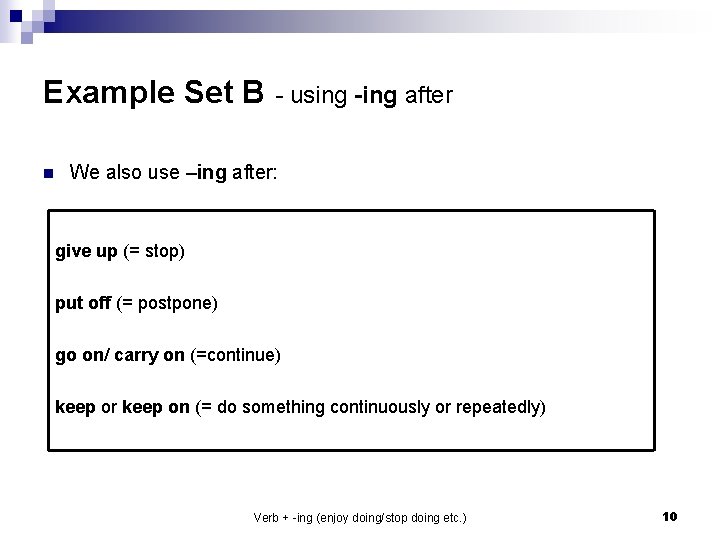
Example Set B n - using -ing after We also use –ing after: give up (= stop) put off (= postpone) go on/ carry on (=continue) keep or keep on (= do something continuously or repeatedly) Verb + -ing (enjoy doing/stop doing etc. ) 10
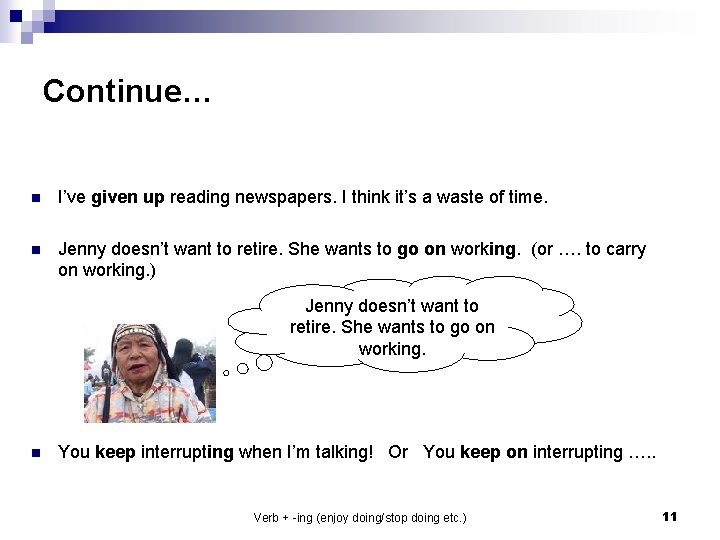
Continue… n I’ve given up reading newspapers. I think it’s a waste of time. n Jenny doesn’t want to retire. She wants to go on working. (or …. to carry on working. ) Jenny doesn’t want to retire. She wants to go on working. n You keep interrupting when I’m talking! Or You keep on interrupting …. . Verb + -ing (enjoy doing/stop doing etc. ) 11
Agenda ü Learning Objectives ü Example Set A for Verb + -ing ü Example Set B for using -ing after Ø Example Set C for using with some verbs o Example Set D for when talking about finished actions o Example Set E for using “that” after some of the verbs Verb + -ing (enjoy doing/stop doing etc. ) 12
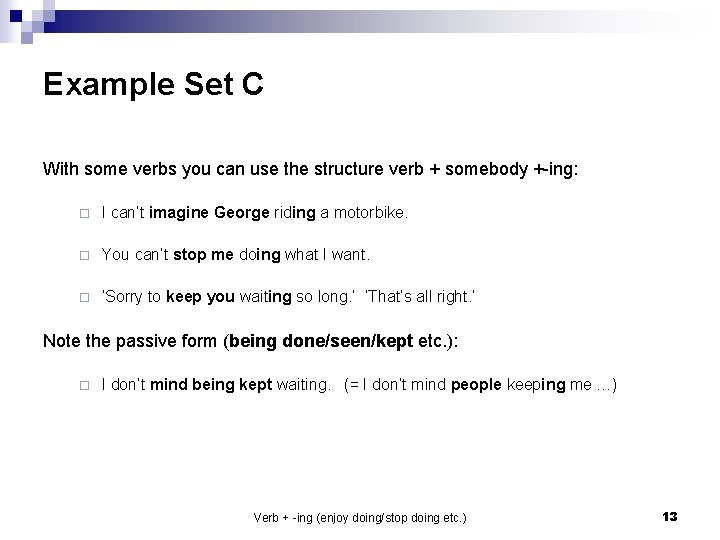
Example Set C With some verbs you can use the structure verb + somebody +-ing: ¨ I can’t imagine George riding a motorbike. ¨ You can’t stop me doing what I want. ¨ ‘Sorry to keep you waiting so long. ’ ‘That’s all right. ’ Note the passive form (being done/seen/kept etc. ): ¨ I don’t mind being kept waiting. (= I don’t mind people keeping me …) Verb + -ing (enjoy doing/stop doing etc. ) 13
Agenda ü Learning Objectives ü Example Set A for Verb + -ing ü Example Set B for using -ing after ü Example Set C for using with some verbs Ø Example Set D for when talking about finished actions o Example Set E for using “that” after some of the verbs Verb + -ing (enjoy doing/stop doing etc. ) 14
Example Set D - when talking about finished actions When you are talking a bout finished actions, you can say having done/stolen/said etc. : ¨ They admitted having stolen the money. But it is not necessary to use having (done). You can also say: ¨ They admitted stealing the money. ¨ I now regret saying (or having said) what I said. Verb + -ing (enjoy doing/stop doing etc. ) 15
Agenda ü Learning Objectives ü Example Set A for Verb + -ing ü Example Set B for using -ing after ü Example Set C for using with some verbs ü Example Set D for when talking about finished actions Ø Example Set E for using “that” after some of the verbs Verb + -ing (enjoy doing/stop doing etc. ) 16
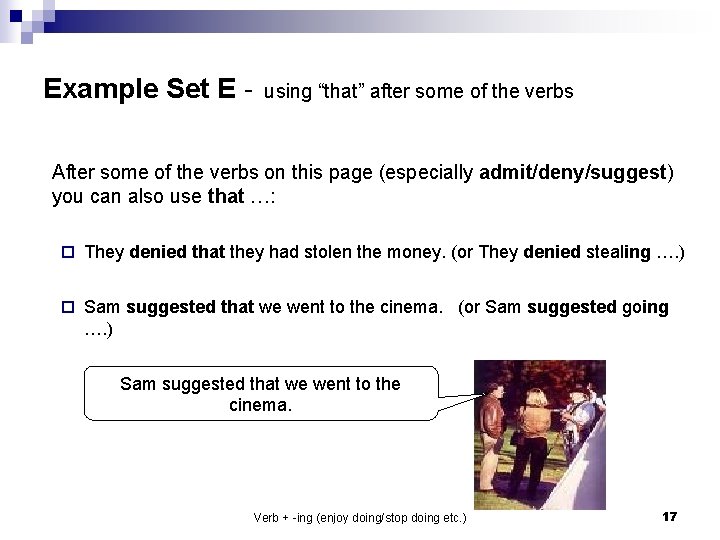
Example Set E - using “that” after some of the verbs After some of the verbs on this page (especially admit/deny/suggest) you can also use that …: ¨ They denied that they had stolen the money. (or They denied stealing …. ) ¨ Sam suggested that we went to the cinema. (or Sam suggested going …. ) Sam suggested that we went to the cinema. Verb + -ing (enjoy doing/stop doing etc. ) 17
Summary ü Learning Objectives ü Example Set A for Verb + -ing ü Example Set B for using -ing after ü Example Set C for using with some verbs ü Example Set D for when talking about finished actions ü Example Set E for using “that” after some of the verbs Verb + -ing (enjoy doing/stop doing etc. ) 18
- Slides: 18