
Grammar Toolkit Sentence ending What are the punctuation
- Slides: 9
Grammar Toolkit Sentence ending What are the punctuation marks for ending sentences?
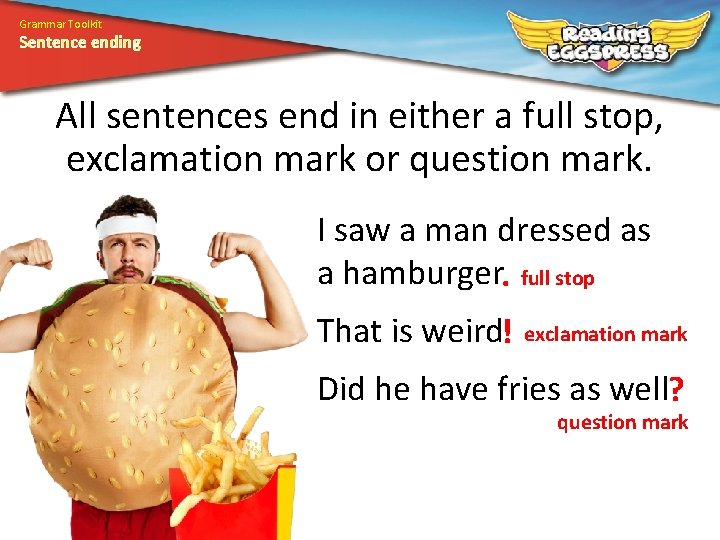
Grammar Toolkit Sentence ending All sentences end in either a full stop, exclamation mark or question mark. I saw a man dressed as a hamburger. full stop That is weird! exclamation mark Did he have fries as well? question mark
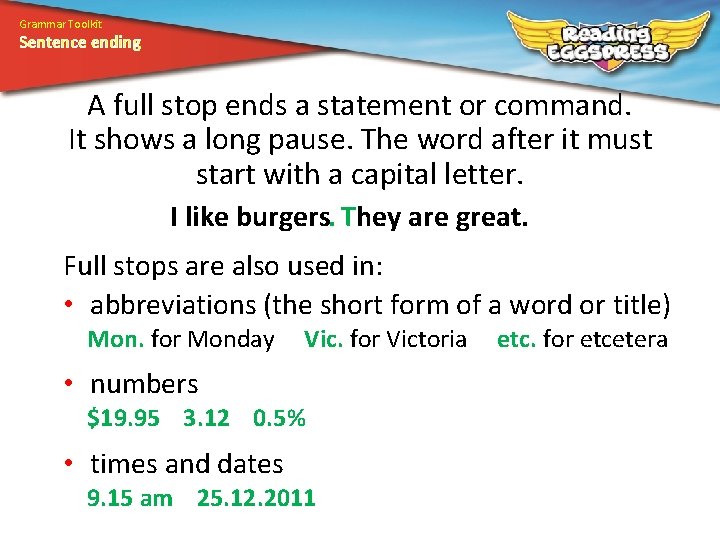
Grammar Toolkit Sentence ending A full stop ends a statement or command. It shows a long pause. The word after it must start with a capital letter. I like burgers. They are great. Full stops are also used in: • abbreviations (the short form of a word or title) Mon. for Monday Vic. for Victoria • numbers $19. 95 3. 12 0. 5% • times and dates 9. 15 am 25. 12. 2011 etc. for etcetera
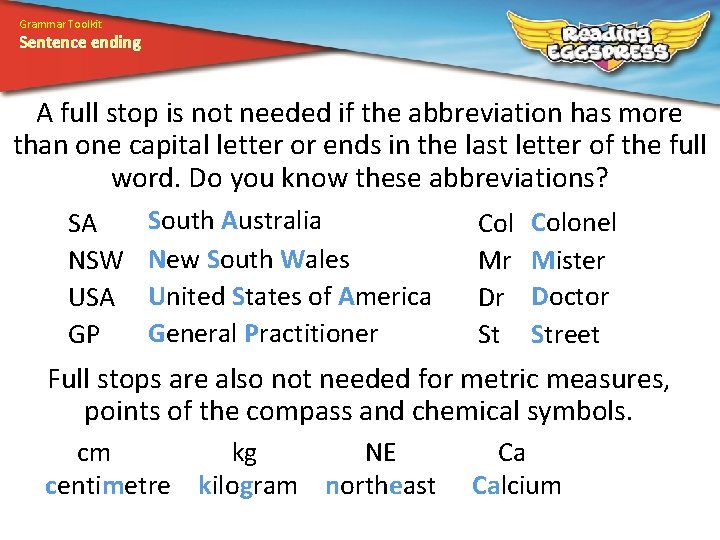
Grammar Toolkit Sentence ending A full stop is not needed if the abbreviation has more than one capital letter or ends in the last letter of the full word. Do you know these abbreviations? SA NSW USA GP South Australia New South Wales United States of America General Practitioner Col Mr Dr St Colonel Mister Doctor Street Full stops are also not needed for metric measures, points of the compass and chemical symbols. cm kg NE centimetre kilogram northeast Ca Calcium
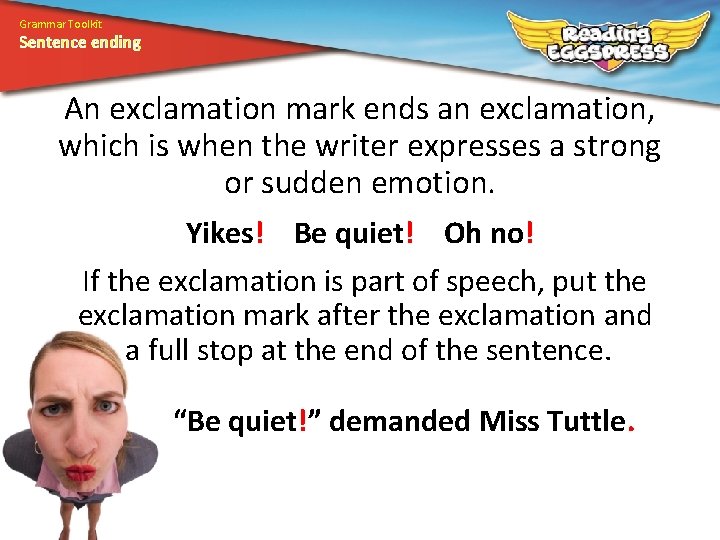
Grammar Toolkit Sentence ending An exclamation mark ends an exclamation, which is when the writer expresses a strong or sudden emotion. Yikes! Be quiet! Oh no! If the exclamation is part of speech, put the exclamation mark after the exclamation and a full stop at the end of the sentence. “Be quiet!” demanded Miss Tuttle.
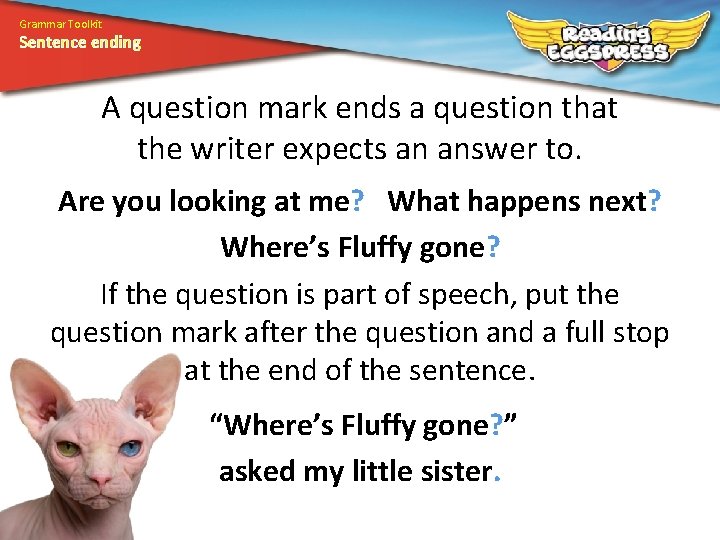
Grammar Toolkit Sentence ending A question mark ends a question that the writer expects an answer to. Are you looking at me? What happens next? Where’s Fluffy gone? If the question is part of speech, put the question mark after the question and a full stop at the end of the sentence. “Where’s Fluffy gone? ” asked my little sister.
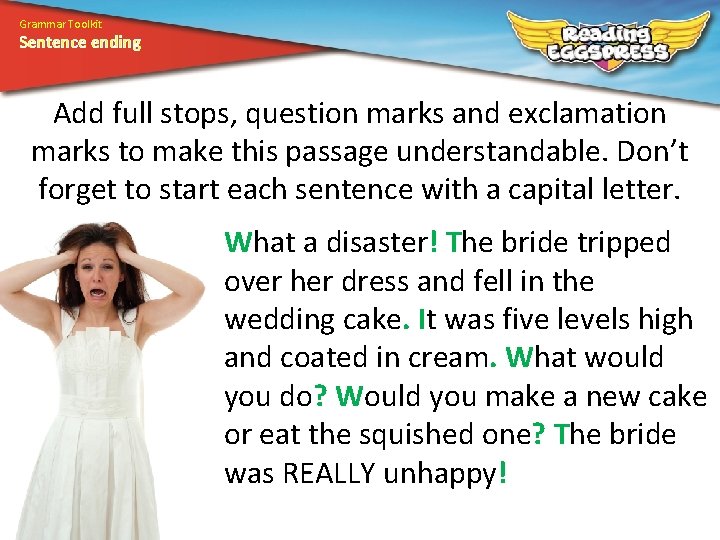
Grammar Toolkit Sentence ending Add full stops, question marks and exclamation marks to make this passage understandable. Don’t forget to start each sentence with a capital letter. what aa disaster! disaster the What Thebridetripped overher herdressand andfellininthe over weddingcake It it was five levels high wedding andcoatedinincream What would and would youdo? do would you Wouldyou youmakeaanew newcake oreat eatthe thesquishedone? one the or Thebride was. REALLYunhappy! unhappy was
Grammar Toolkit Sentence ending • Punctuation helps others to understand our writing. • A full stop (. ) ends a statement or command (e. g. It is finished. ). It is also used in abbreviations (e. g. Feb. for February), numbers and dates (e. g. 4. 30 pm, $0. 99, 12. 6. 2002). Not all abbreviations need full stops. • An exclamation mark (!) ends an exclamation (e. g. What rubbish!). • A question mark (? ) ends a question (e. g. Why are you late? ).
Grammar Toolkit Sentence ending The End