
Grammar Toolkit Conjunctive adverbs What are conjunctive adverbs
Grammar Toolkit Conjunctive adverbs What are conjunctive adverbs?
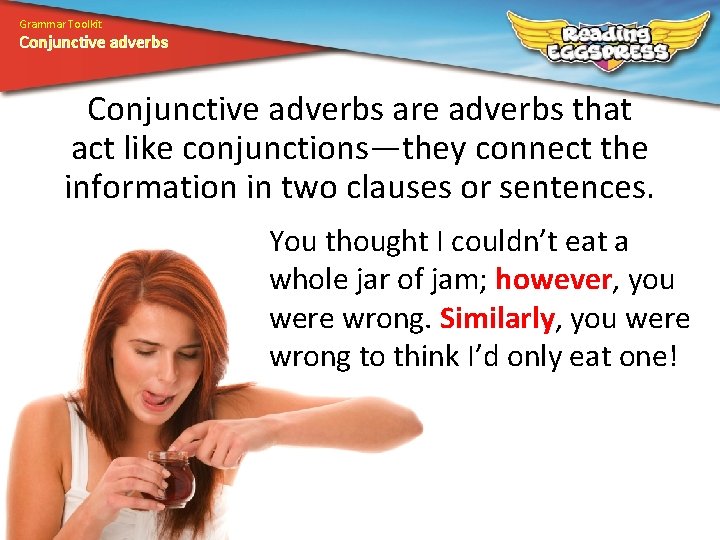
Grammar Toolkit Conjunctive adverbs are adverbs that act like conjunctions—they connect the information in two clauses or sentences. You thought I couldn’t eat a whole jar of jam; however, you were wrong. Similarly, you were wrong to think I’d only eat one!
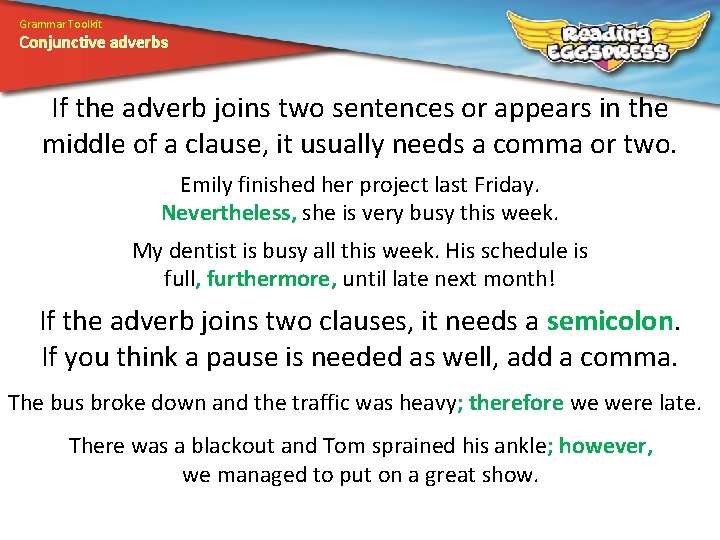
Grammar Toolkit Conjunctive adverbs If the adverb joins two sentences or appears in the middle of a clause, it usually needs a comma or two. Emily finished her project last Friday. Nevertheless, she is very busy this week. My dentist is busy all this week. His schedule is full, furthermore, until late next month! If the adverb joins two clauses, it needs a semicolon. If you think a pause is needed as well, add a comma. The bus broke down and the traffic was heavy; therefore we were late. There was a blackout and Tom sprained his ankle; however, we managed to put on a great show.
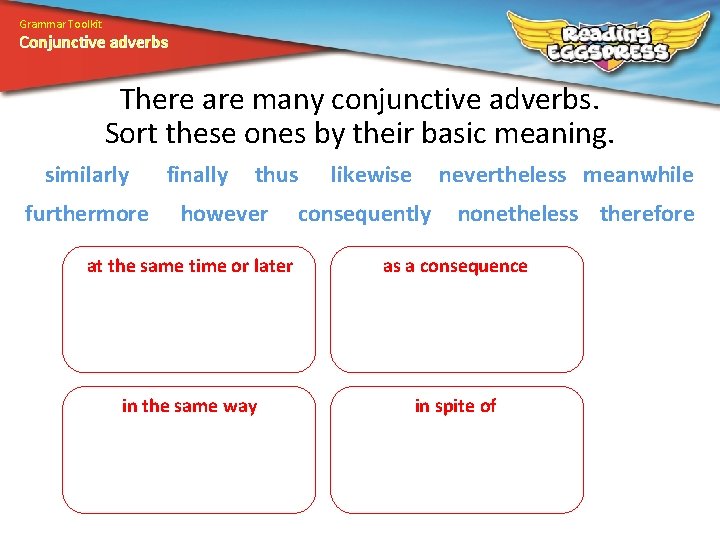
Grammar Toolkit Conjunctive adverbs There are many conjunctive adverbs. Sort these ones by their basic meaning. similarly furthermore finally thus however likewise nevertheless meanwhile consequently nonetheless therefore at the same time or later as a consequence in the same way in spite of
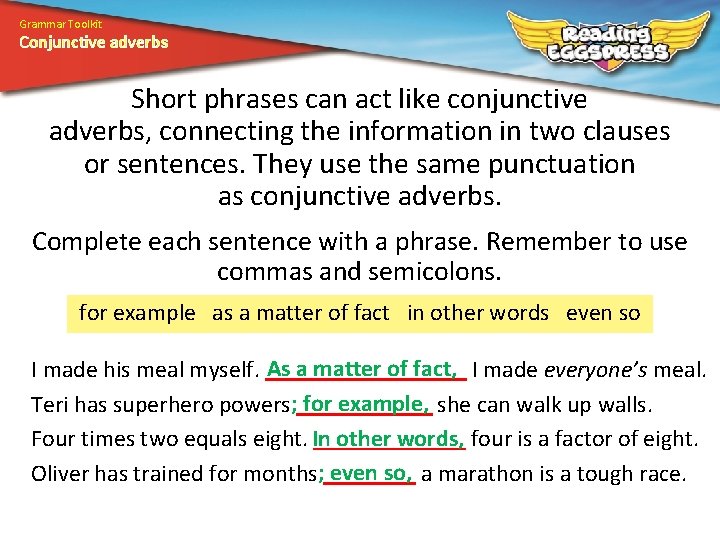
Grammar Toolkit Conjunctive adverbs Short phrases can act like conjunctive adverbs, connecting the information in two clauses or sentences. They use the same punctuation as conjunctive adverbs. Complete each sentence with a phrase. Remember to use commas and semicolons. for example as a matter of fact in other words even so I made his meal myself. As a matter of fact, I made everyone’s meal. Teri has superhero powers; for example, she can walk up walls. Four times two equals eight. In other words, four is a factor of eight. Oliver has trained for months; even so, a marathon is a tough race.
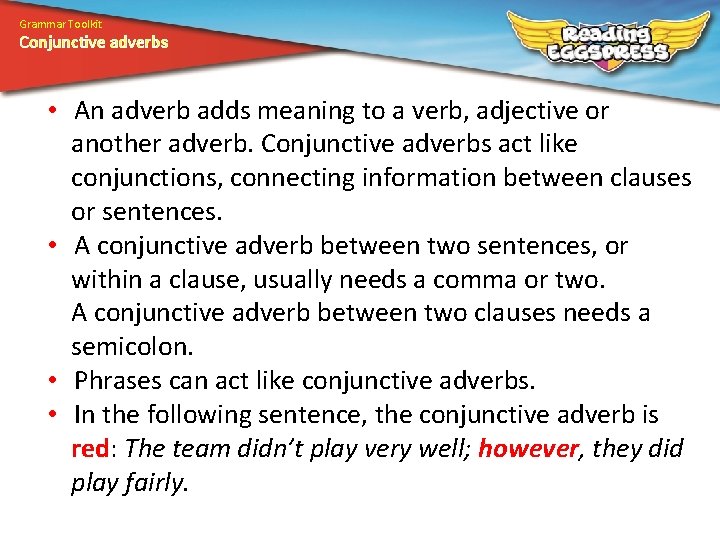
Grammar Toolkit Conjunctive adverbs • An adverb adds meaning to a verb, adjective or another adverb. Conjunctive adverbs act like conjunctions, connecting information between clauses or sentences. • A conjunctive adverb between two sentences, or within a clause, usually needs a comma or two. A conjunctive adverb between two clauses needs a semicolon. • Phrases can act like conjunctive adverbs. • In the following sentence, the conjunctive adverb is red: The team didn’t play very well; however, they did play fairly.

Grammar Toolkit Conjunctive adverbs The End
- Slides: 7