
GRAMMAR THE MAGIC LENS Notes based on Michael
GRAMMAR; THE MAGIC LENS Notes based on Michael clay Thompson’s
OVERVIEW Despite what you’ve heard previously, grammar is really just a way of thinking about language. It may seem like an impossible system of terms and rules with countless exceptions to each rule. However, it isn’t really that bad. We are going to try and approach grammar with simplicity. There are FOUR basic levels of grammar. 1. Parts of Speech 2. Parts of the Sentence 3. Phrases 4. Clauses
LEVEL 1: PARTS OF SPEECH Noun Pronoun Adjective Verb Adverb Preposition
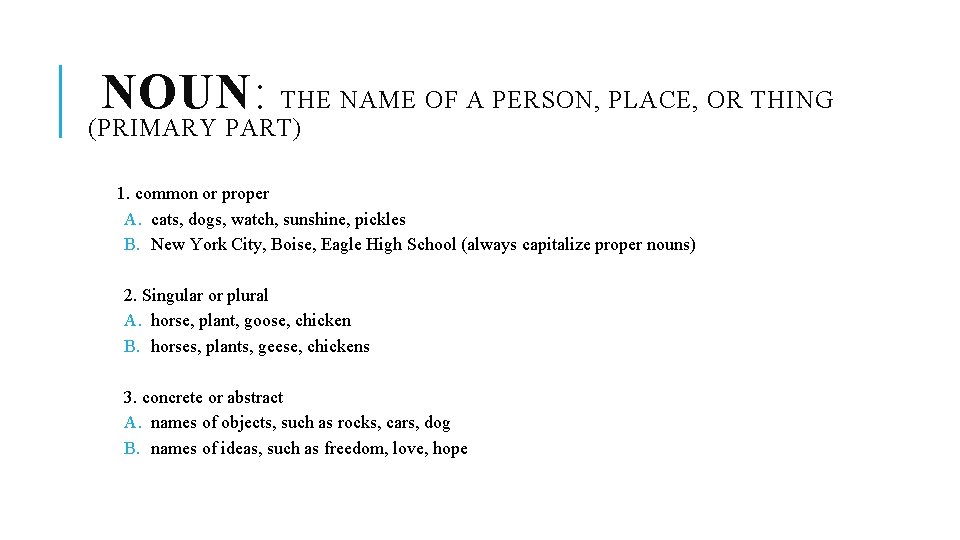
NOUN: THE NAME OF A PERSON, PLACE, OR THING (PRIMARY PART) 1. common or proper A. cats, dogs, watch, sunshine, pickles B. New York City, Boise, Eagle High School (always capitalize proper nouns) 2. Singular or plural A. horse, plant, goose, chicken B. horses, plants, geese, chickens 3. concrete or abstract A. names of objects, such as rocks, cars, dog B. names of ideas, such as freedom, love, hope
PRONOUN: A WORD THAT TAKES THE PLACE OF A NOUN (SUPPORTING PART) 1. Pronouns make language quicker because you don’t have to repeat the noun or antecedent. 2. Subject pronouns are used to make subjects A. includes: I, you, he, she, it, we, you, they B. May also be called nominative case pronouns. 3. Object pronouns are used as objects A. includes: me, you, him, her, it, us, you, them B. May be used a direct objects, indirect objects, and objects of prepositions.
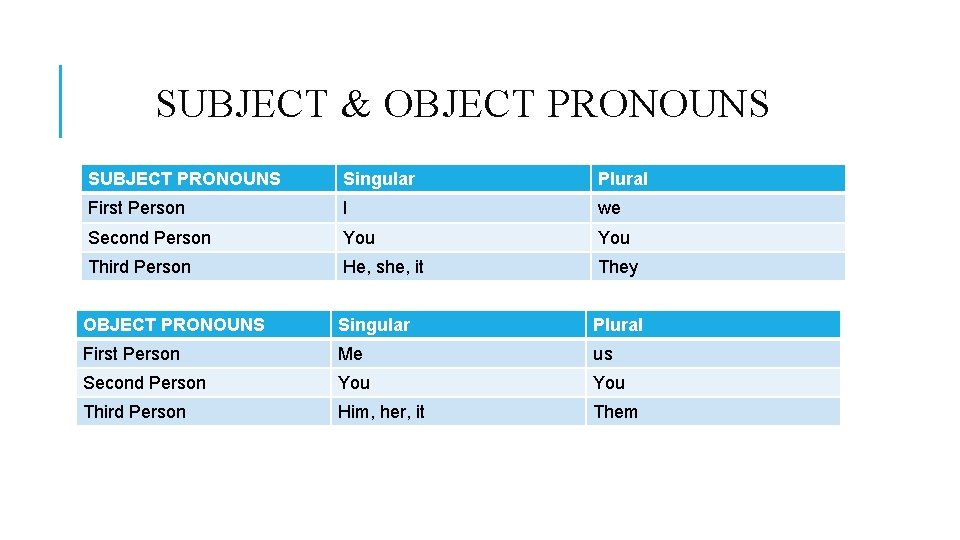
SUBJECT & OBJECT PRONOUNS SUBJECT PRONOUNS Singular Plural First Person I we Second Person You Third Person He, she, it They OBJECT PRONOUNS Singular Plural First Person Me us Second Person You Third Person Him, her, it Them
ADJECTIVE: A WORD THAT MODIFIES A NOUN OR PRONOUN (SUPPORTING PART) 1. Adjectives can change degrees or levels A. Positive (good) B. Comparative (better) C. Superlative (best) 2. Articles are specifics types of adjectives A. Definite article: the *specific* B. Indefinite articles: a, an *not specific*

PRACTICE Directions: Write each sentence and then label the nouns (N), adjectives (Adj), and pronouns (Pro). 1. The bouquet of yellow flowers I sent was delivered. 2. The purple potatoes tasted fresh and natural.
VERB: A WORD THAT SHOWS ACTION, BEING, OR LINKS A SUBJECT TO A SUBJECT COMPLEMENT (PRIMARY PART) 1. A verb is always about the noun in the sentence- that is its job
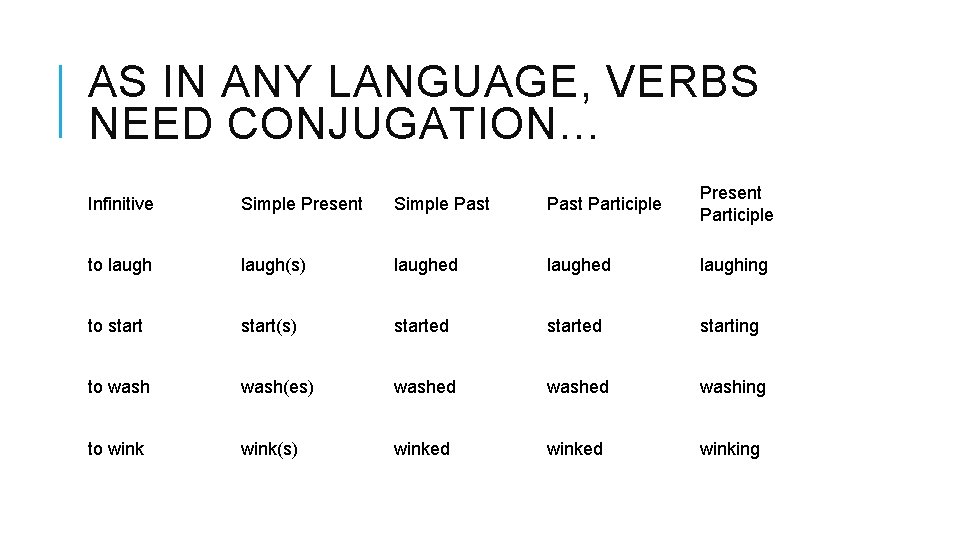
AS IN ANY LANGUAGE, VERBS NEED CONJUGATION… Infinitive Simple Present Simple Past Participle Present Participle to laugh(s) laughed laughing to start(s) started starting to wash(es) washed washing to wink(s) winked winking
VERBS CONTINUED… 3. A verb can either show an action or make an equation. They are action or linking. A. Action verbs can show action on direct objects. Ex: I saw him. B. Linking verbs can link the subject to a complement. Ex: I am tired. 4. Action verbs can be transitive or intransitive A. Transitive: acts on a direct object. Ex: The harpoon hit Moby Dick. B. Intransitive: does not act on a direct object. Ex: The harpoons flew.
VERB CONTINUED… 5. The verb is responsible for setting the time or tense in a sentence. There are 6 tenses. A. Ordinary tenses: present (walk), past (walked), future (will walk) B. Perfect tenses- meaning finished Example: present perfect = I have walked to the store.
VERBS AGAIN… 6. Helping verbs help form the tense of the verb. A. Also called auxiliary verbs B. Example: I will have written a book. C. The tenses of verbs should not change throughout the sentence or longer piece of writing! *Parallelism*
VERB CONTINUED… 7. The use of action verbs determines whether the voice is active or passive A. Active voice shows the subject is acting Ex: The meteor struck the ship. Ex: The Literary Society presented Dickens the award. *Active voice verbs are preferred in writing. B. Passive Voice shows the subject being acted upon. § Ex: The ship was struck by the meteor. § Ex: Dickens was presented with an award. § *Passive voice is often used in scientific writing
ADVERB: A WORD THAT MODIFIES A VERB, AN ADJECTIVE, OR ANOTHER ADVERB (SUPPORTING PART) 1. Adverbs have a more complicated job than adjectives because they can modify verbs, adjectives, or adverbs. Examples: light blue sky, talk quietly, talk very quietly
PREPOSITION: A WORD THAT SHOWS THE RELATIONSHIP BETWEEN ITS OBJECT AND ANOTHER WORD IN THE SENTENCE. 1. Prepositions show time, space, and direction relationships 2. Examples: The book is in the box. The cat ran up the tree. * The bunny rule… the box rule…
- Slides: 16