
Grammar Suqian Sarbrina 1 We use modal verbs
Grammar Suqian Sarbrina
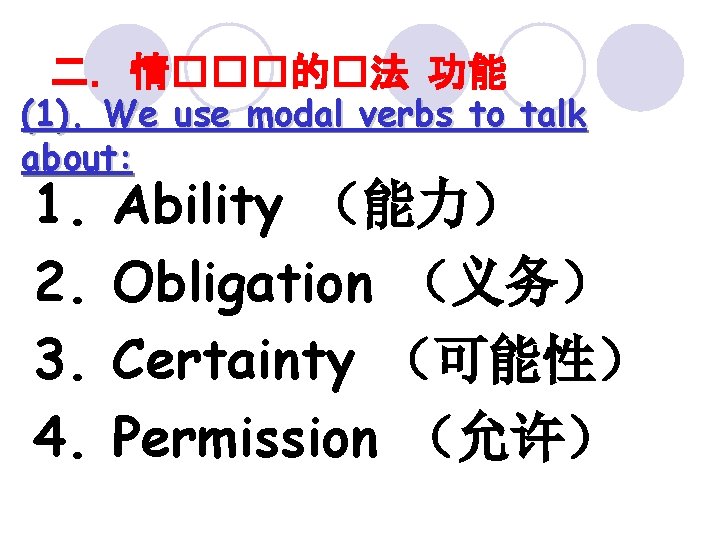
二.情���的�法 功能 (1). We use modal verbs to talk about: 1. 2. 3. 4. Ability (能力) Obligation (义务) Certainty (可能性) Permission (允许)
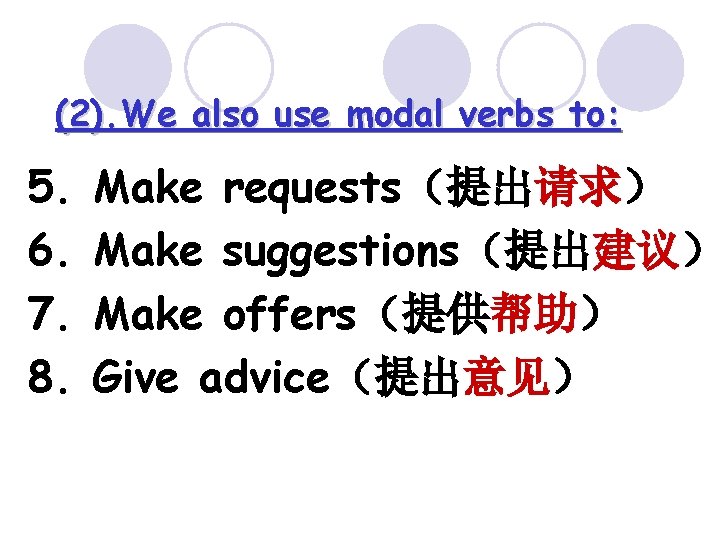
(2). We also use modal verbs to: 5. 6. 7. 8. Make requests(提出请求) Make suggestions(提出建议) Make offers(提供帮助) Give advice(提出意见)
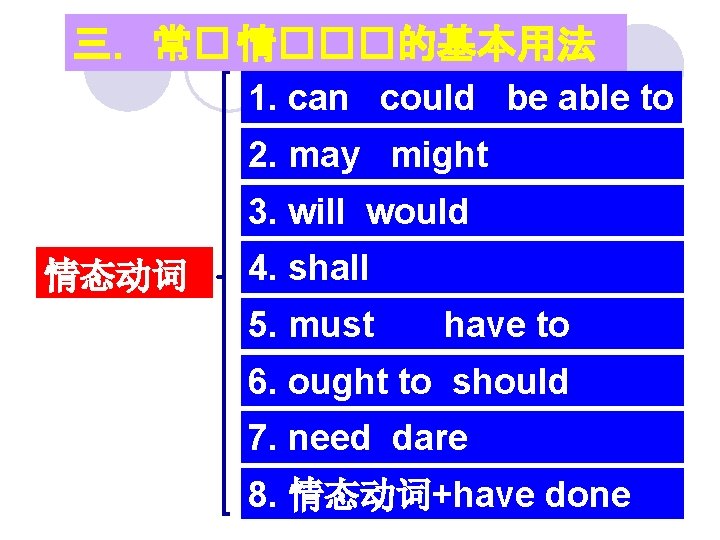
三.常� 情���的基本用法 1. can could be able to 2. may might 3. will would 情态动词 4. shall 5. must have to 6. ought to should 7. need dare 8. 情态动词+have done
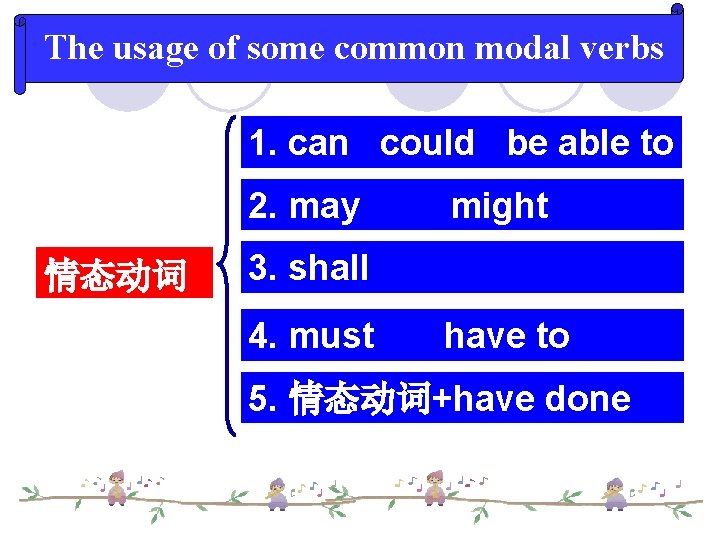
The usage of some common modal verbs 1. can could be able to 2. may might 情态动词 3. shall 4. must have to 5. 情态动词+have done
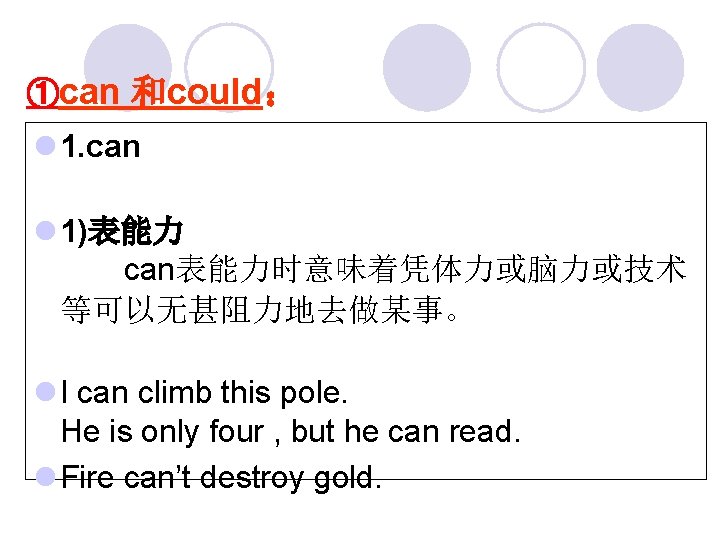
①can 和could: l 1. can l 1)表能力 can表能力时意味着凭体力或脑力或技术 等可以无甚阻力地去做某事。 l I can climb this pole. He is only four , but he can read. l Fire can’t destroy gold.
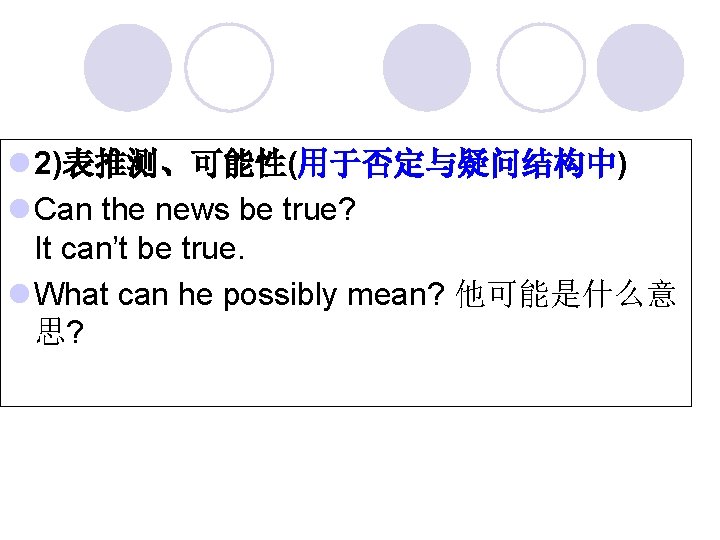
l 2)表推测、可能性(用于否定与疑问结构中) l Can the news be true? It can’t be true. l What can he possibly mean? 他可能是什么意 思?
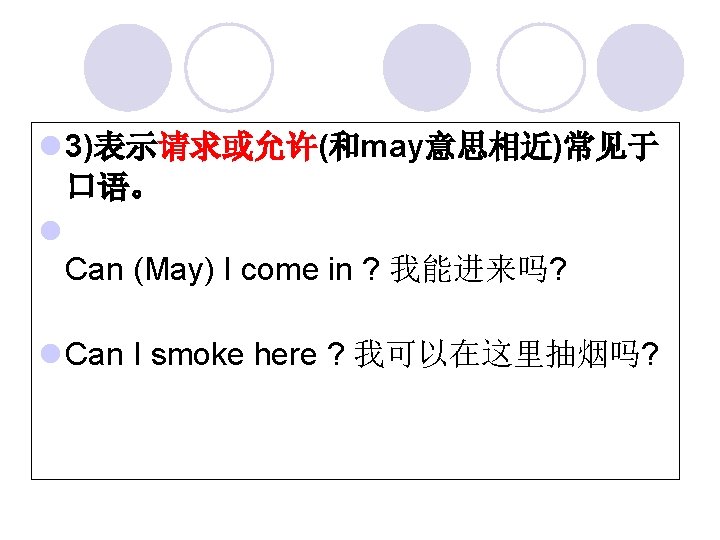
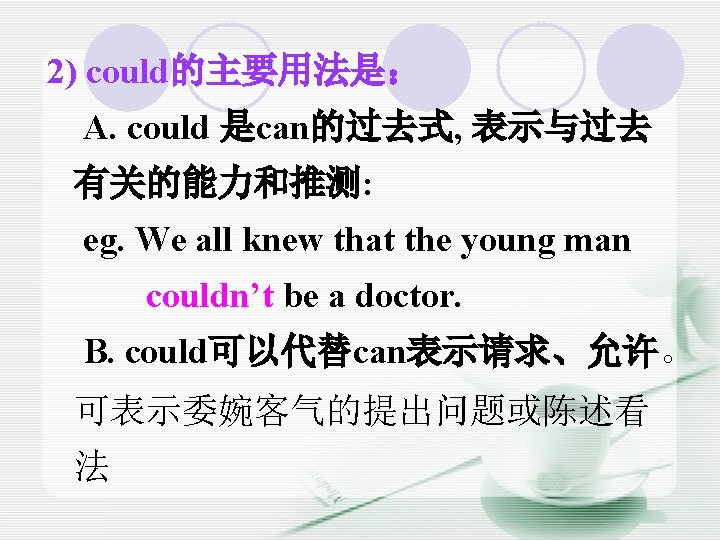
Could you lend me your dictionary? Could I use your bike? Yes, you can. I’m afraid I couldn’t give you an answer today.
Note: 表示特定的某一过去能力或表示成功地做 了某事时,只能用was/were able to, 不 能用could。 He _____ flee Europe before the war broke was able to out.
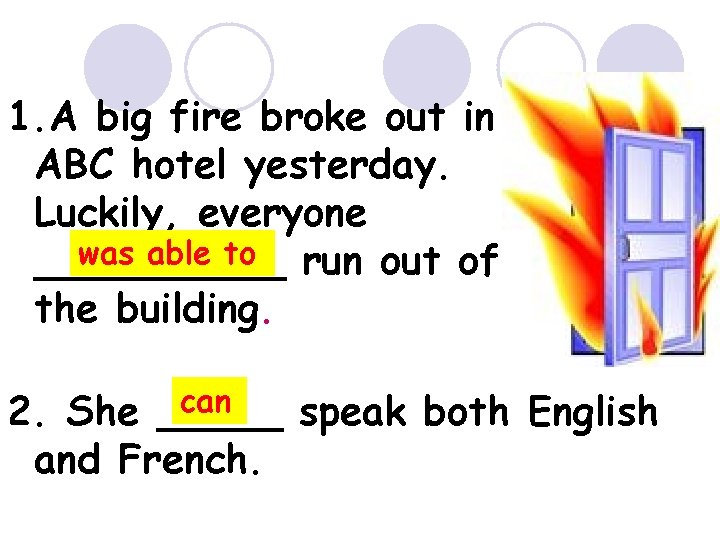
1. A big fire broke out in ABC hotel yesterday. Luckily, everyone was able to run out of _____ the building. can _____ 2. She speak both English and French.
I can’t thank you too much.
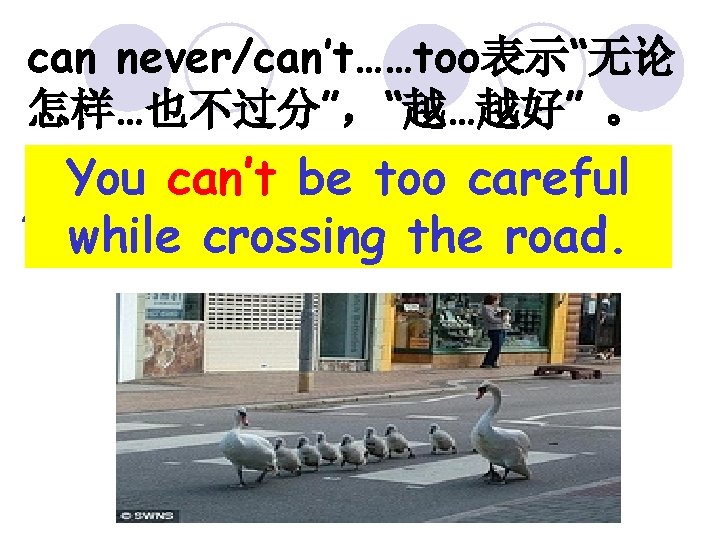
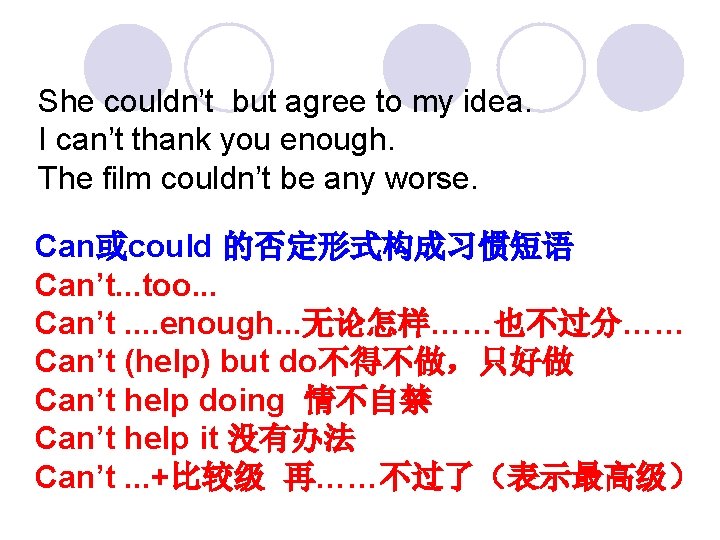
She couldn’t but agree to my idea. I can’t thank you enough. The film couldn’t be any worse. Can或could 的否定形式构成习惯短语 Can’t. . . too. . . Can’t. . enough. . . 无论怎样……也不过分…… Can’t (help) but do不得不做,只好做 Can’t help doing 情不自禁 Can’t help it 没有办法 Can’t. . . +比较级 再……不过了(表示最高级)
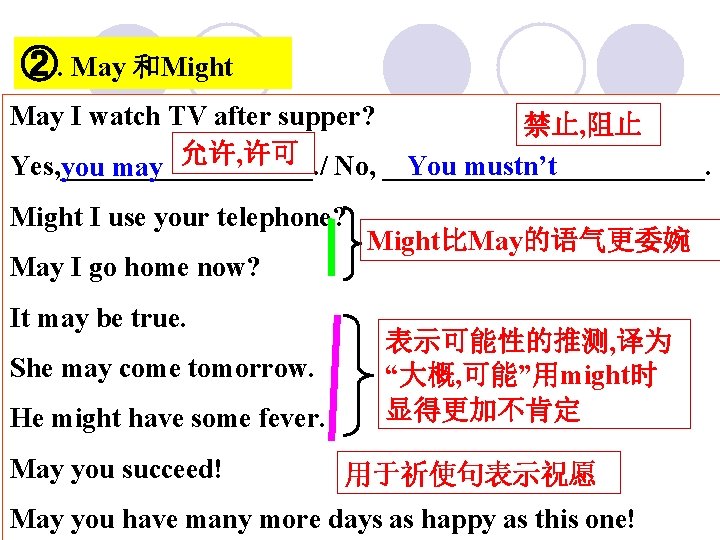
②. May 和Might May I watch TV after supper? 禁止, 阻止 You mustn’t Yes, _________. / No, ____________. you may 允许, 许可 Might I use your telephone? May I go home now? It may be true. She may come tomorrow. He might have some fever. May you succeed! Might比May的语气更委婉 表示可能性的推测, 译为 “大概, 可能”用might时 显得更加不肯定 用于祈使句表示祝愿 May you have many more days as happy as this one!
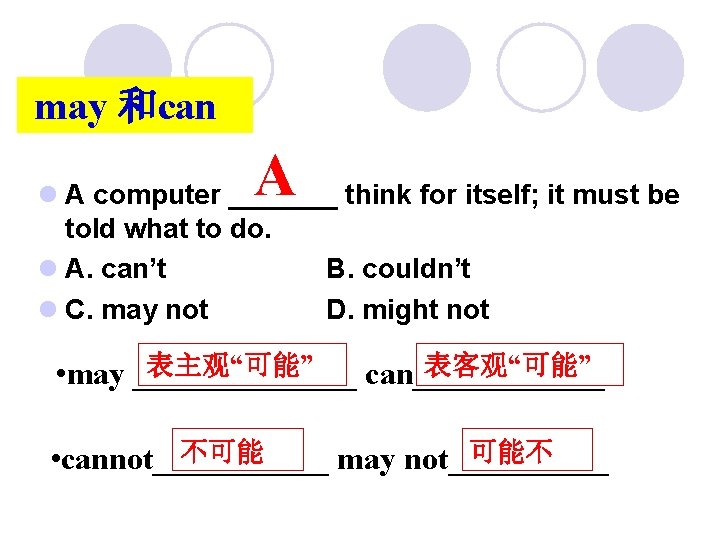
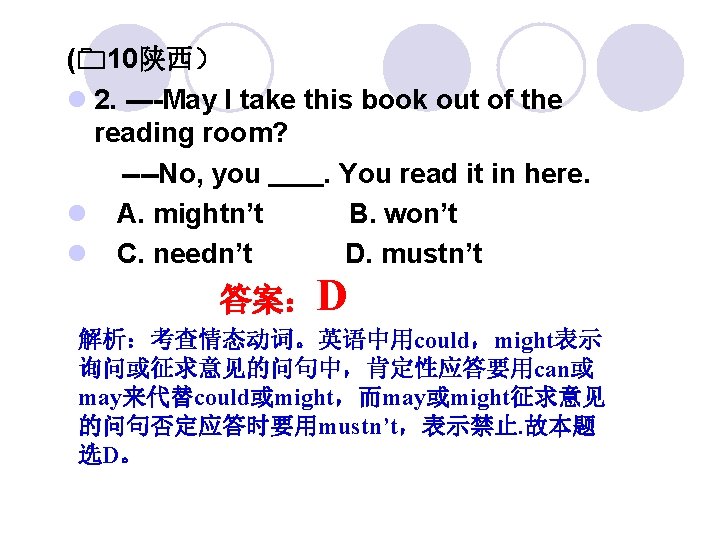
may 和can A l A computer _______ think for itself; it must be told what to do. l A. can’t B. couldn’t l C. may not D. might not 表主观“可能” 表客观“可能” • may _______ can______ 不可能 可能不 • cannot______ may not_____
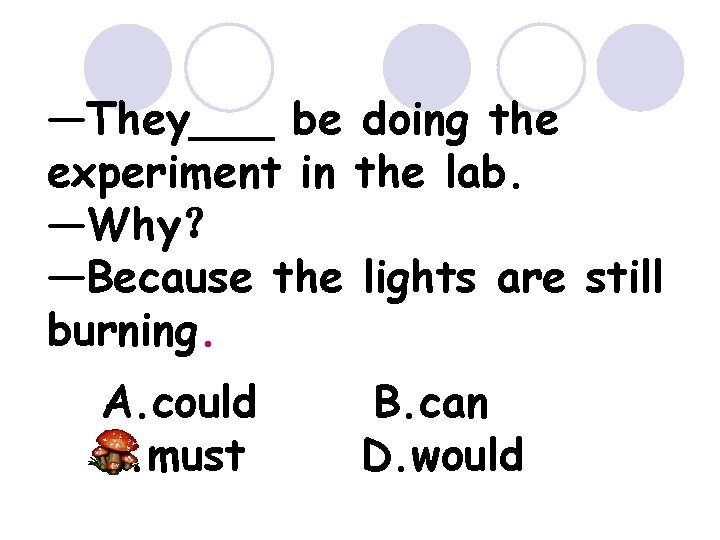
—They___ be doing the experiment in the lab. —Why? —Because the lights are still burning. A. could C. must B. can D. would
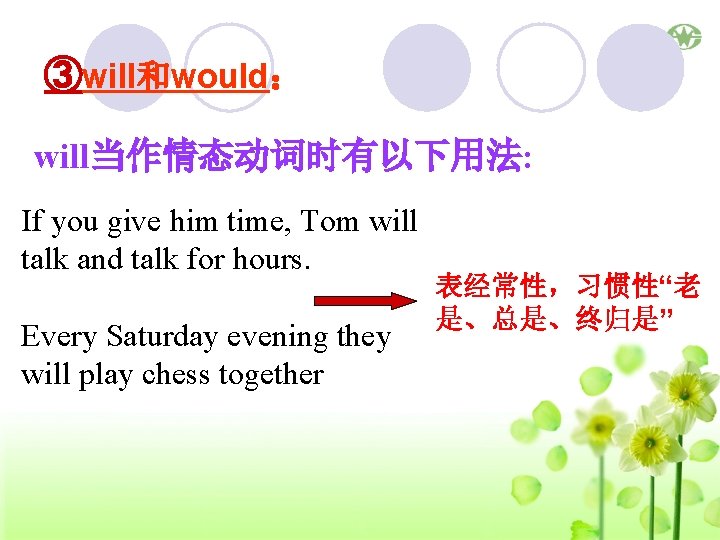
③will和would: will当作情态动词时有以下用法: If you give him time, Tom will talk and talk for hours. Every Saturday evening they will play chess together 表经常性,习惯性“老 是、总是、终归是”
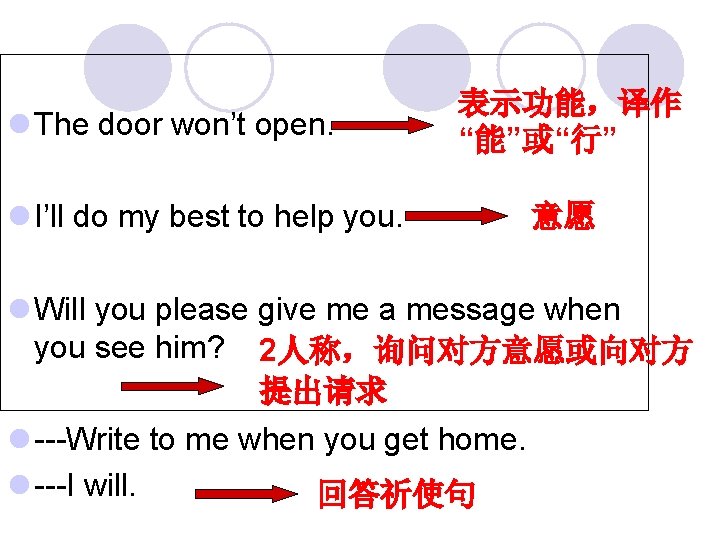
l The door won’t open. l I’ll do my best to help you. 表示功能,译作 “能”或“行” 意愿 l Will you please give me a message when you see him? 2人称,询问对方意愿或向对方 提出请求 l ---Write to me when you get home. l ---I will. 回答祈使句
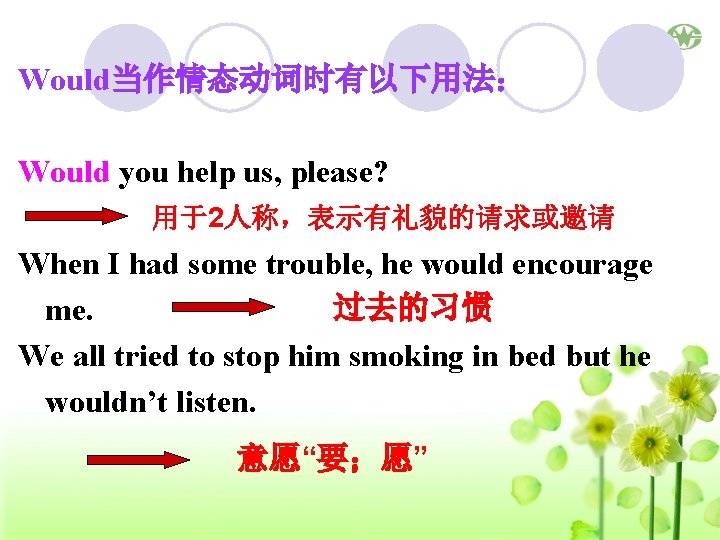
Would当作情态动词时有以下用法: Would you help us, please? 用于2人称,表示有礼貌的请求或邀请 When I had some trouble, he would encourage 过去的习惯 me. We all tried to stop him smoking in bed but he wouldn’t listen. 意愿“要;愿”
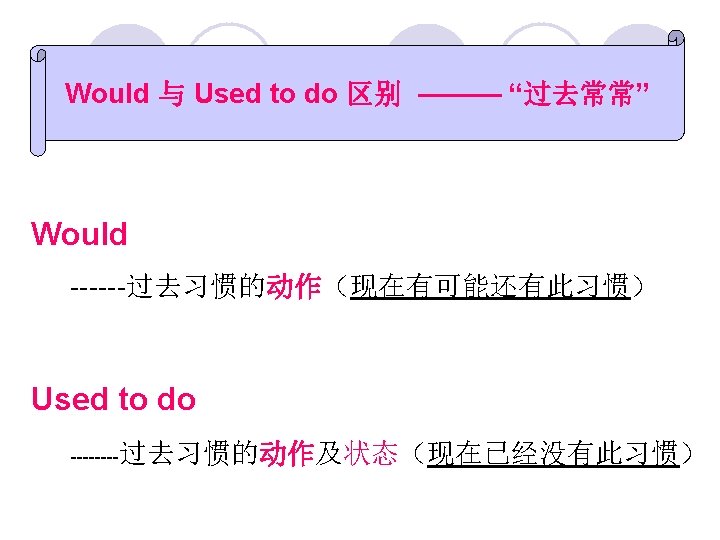
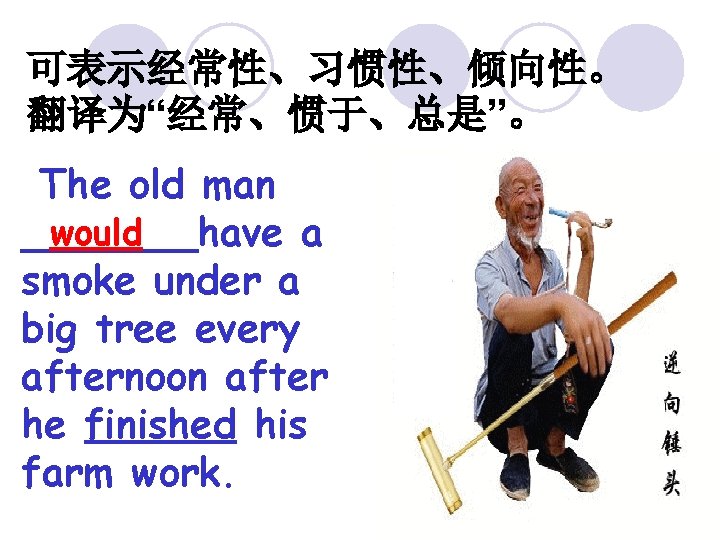
可表示经常性、习惯性、倾向性。 翻译为“经常、惯于、总是”。 The old man would _______have a smoke under a big tree every afternoon after he finished his farm work.
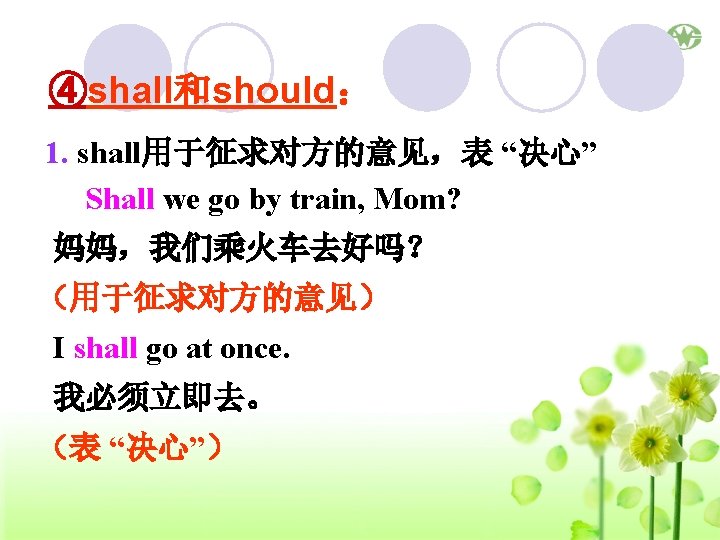
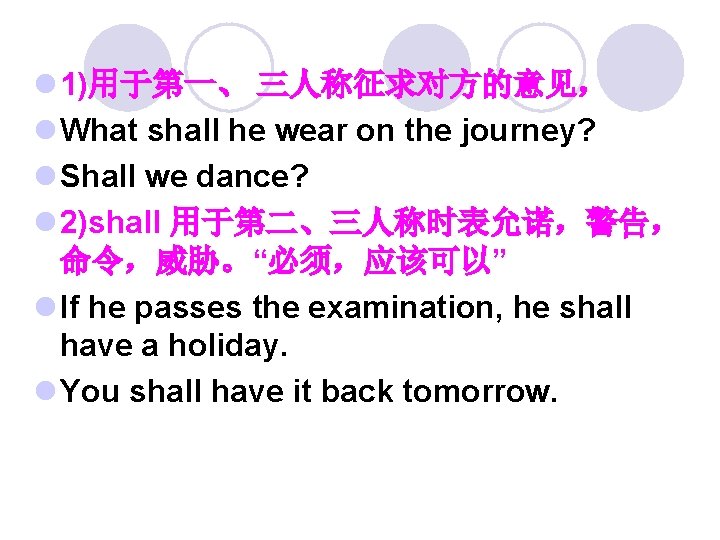
l 1)用于第一、 三人称征求对方的意见, l What shall he wear on the journey? l Shall we dance? l 2)shall 用于第二、三人称时表允诺,警告, 命令,威胁。“必须,应该可以” l If he passes the examination, he shall have a holiday. l You shall have it back tomorrow.
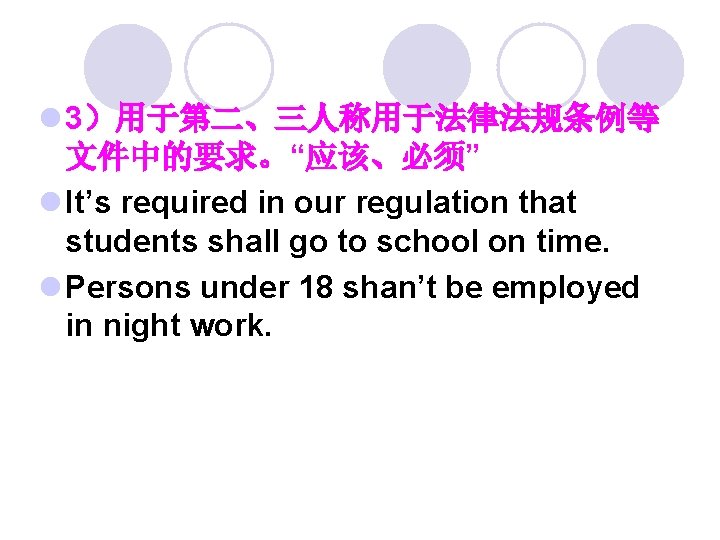
l 3)用于第二、三人称用于法律法规条例等 文件中的要求。“应该、必须” l It’s required in our regulation that students shall go to school on time. l Persons under 18 shan’t be employed in night work.
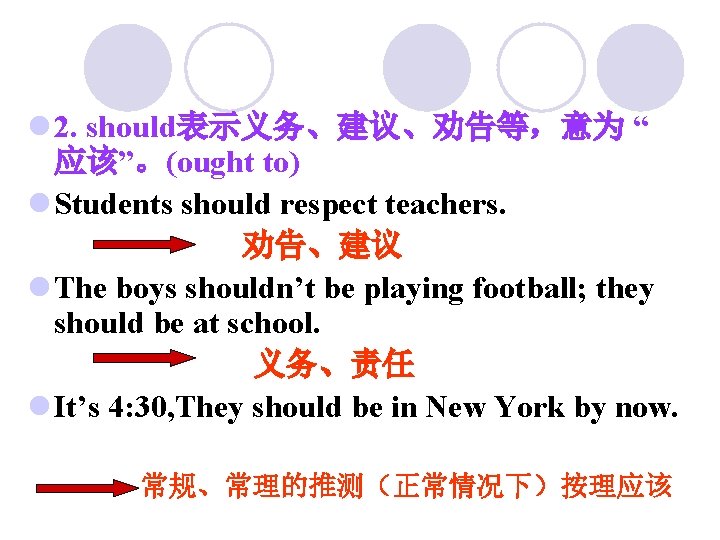
l 2. should表示义务、建议、劝告等,意为 “ 应该”。(ought to) l Students should respect teachers. 劝告、建议 l The boys shouldn’t be playing football; they should be at school. 义务、责任 l It’s 4: 30, They should be in New York by now. 常规、常理的推测(正常情况下)按理应该
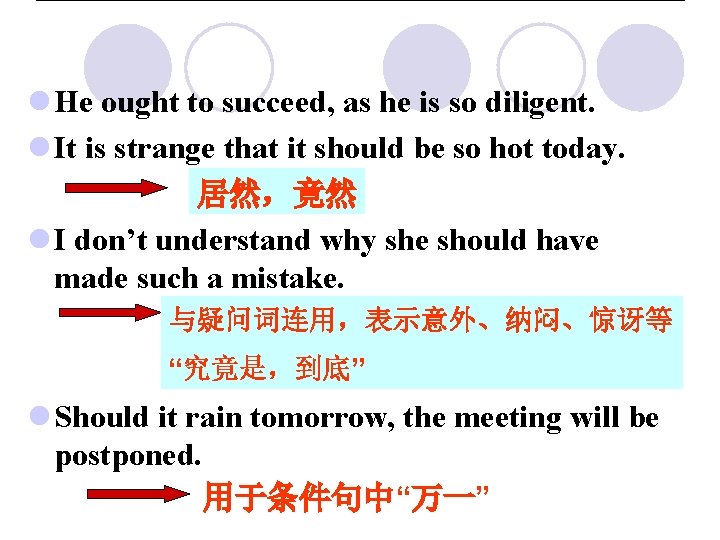
l He ought to succeed, as he is so diligent. l It is strange that it should be so hot today. 居然,竟然 l I don’t understand why she should have made such a mistake. 与疑问词连用,表示意外、纳闷、惊讶等 “究竟是,到底” l Should it rain tomorrow, the meeting will be postponed. 用于条件句中“万一”
Drill(小练) l --- What’s the name? l --- Khulaifi. _______ I spell that for you? A. Shall B. Would C. Can D. Might
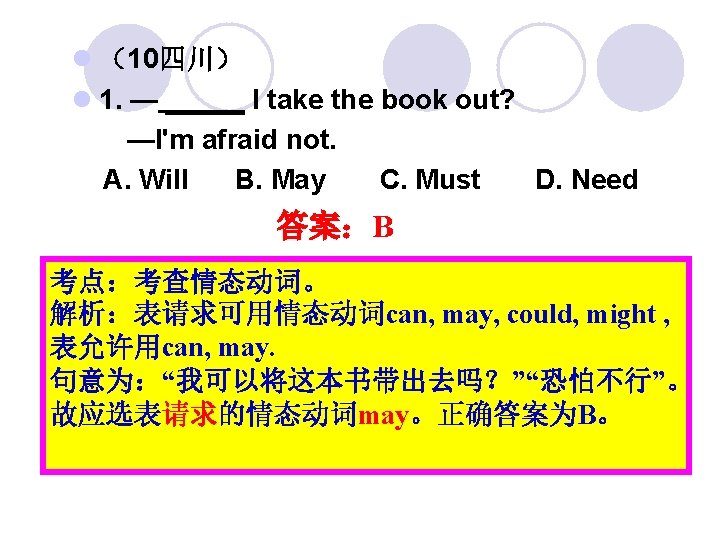
(10江苏) —I haven’t got the reference book yet, but I’ll have a test on the subject next month. —Don’t worry. You______ have it by Friday. A. could B. shall C. must D. may 答案:B 解析:shall在第二人称中表示允诺,还 可以表示强制,命令,威胁,警告。还 有在法律条文中的要求或规定。 你一定会因为你的所作所受到惩罚。 You shall be punished for what you've done.
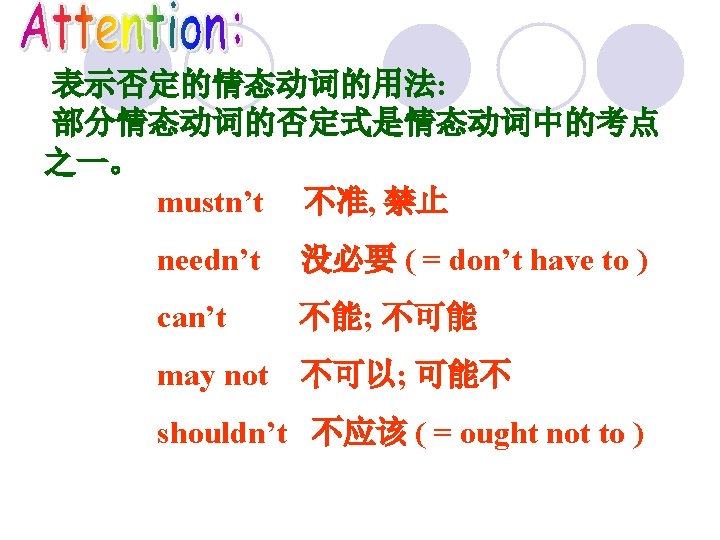
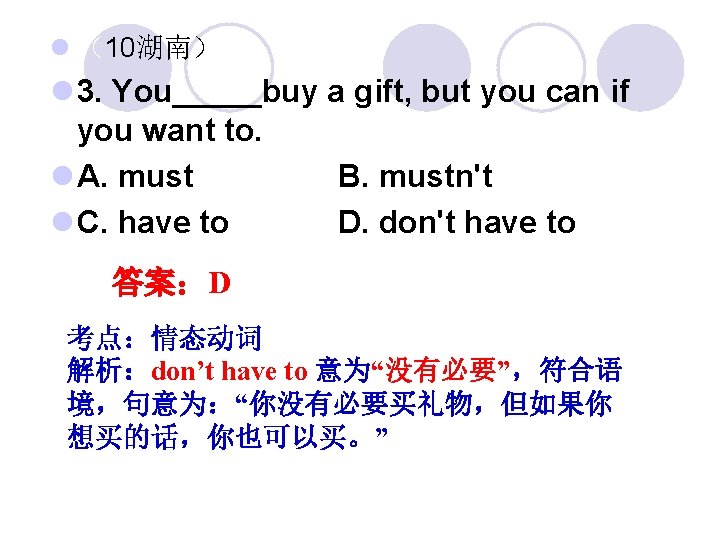
⑤must和 have to 1. must用于一般问句中, 肯定回答用must 否定式用 needn’t或don’t have to,做 “不 必”, mustn’t表示“禁止,不允许” — Must I finish all the work at a time? —Yes, you must. No, you needn't.
2. 表示“必须”这个意思时,must 和 have to 稍有区别。must着重说明主观 看法,have to 强调客观需要。另外, have to 能用于更多时态。 I don’t like this TV set. We must buy a new one. There was no more bus. They had to walk home.
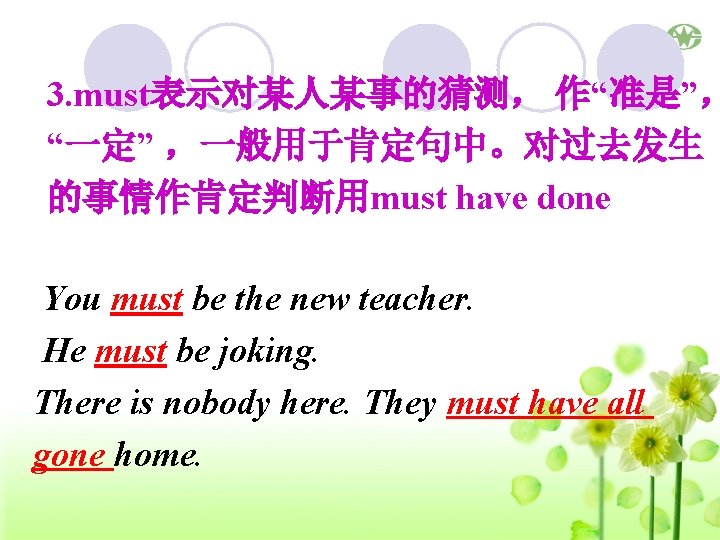
3. must表示对某人某事的猜测, 作“准是”, “一定” ,一般用于肯定句中。对过去发生 的事情作肯定判断用must have done You must be the new teacher. He must be joking. There is nobody here. They must have all gone home.
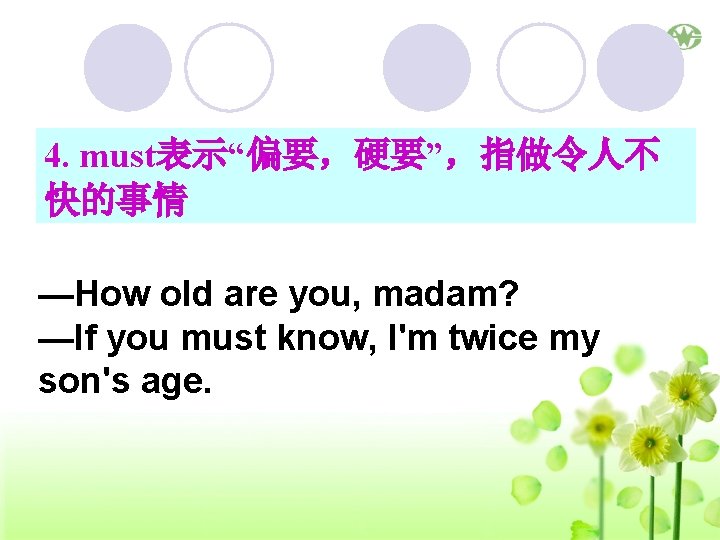
4. must表示“偏要,硬要”,指做令人不 快的事情 —How old are you, madam? —If you must know, I'm twice my son's age.
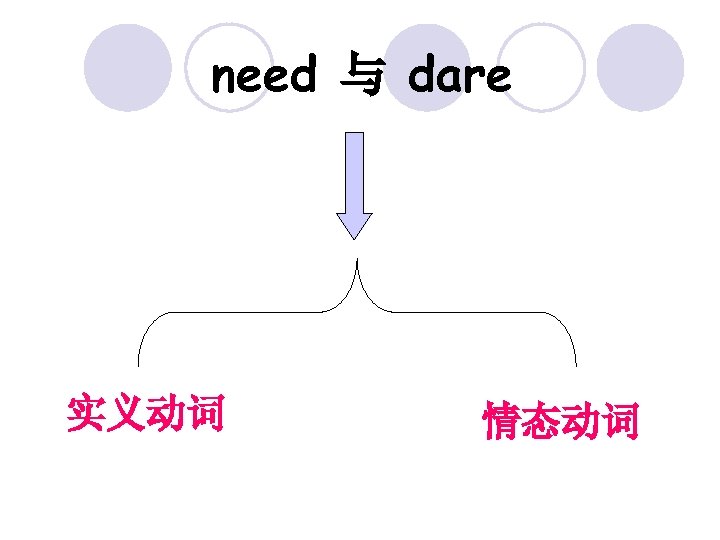
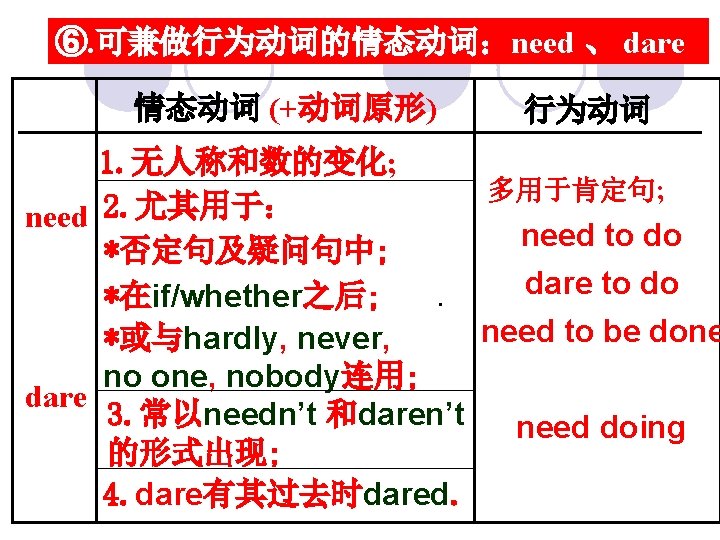
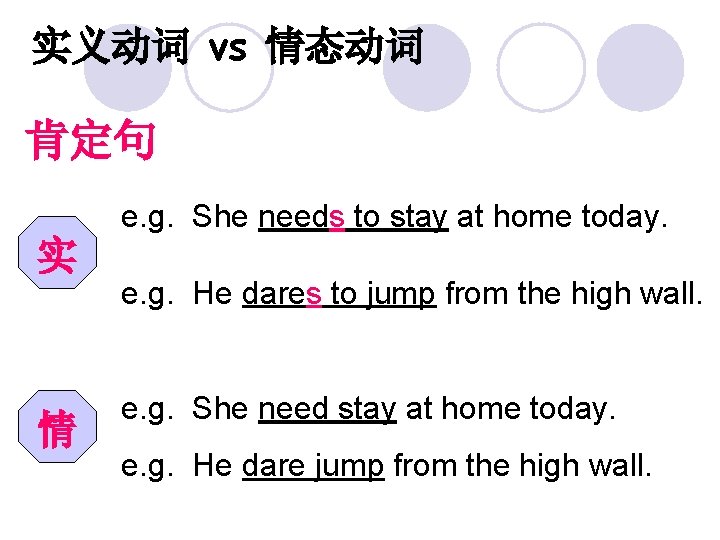
实义动词 vs 情态动词 肯定句 e. g. She needs to stay at home today. 实 情 e. g. He dares to jump from the high wall. e. g. She need stay at home today. e. g. He dare jump from the high wall.
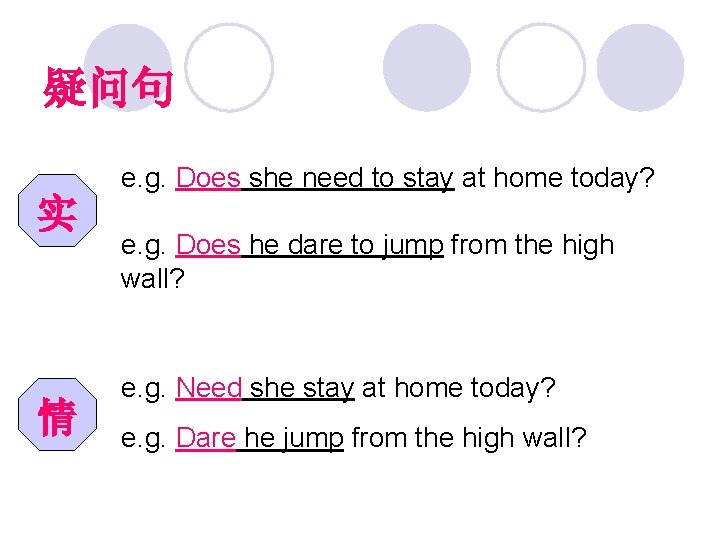
疑问句 实 情 e. g. Does she need to stay at home today? e. g. Does he dare to jump from the high wall? e. g. Need she stay at home today? e. g. Dare he jump from the high wall?
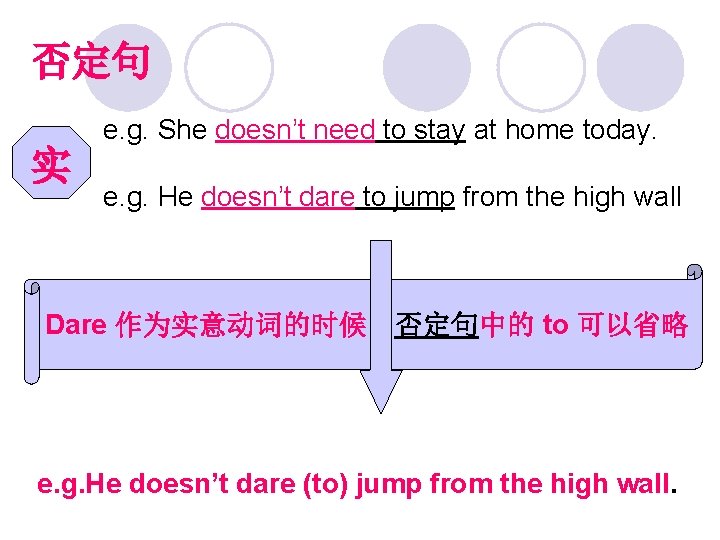
否定句 e. g. She doesn’t need to stay at home today. 实 e. g. He doesn’t dare to jump from the high wall Dare 作为实意动词的时候,否定句中的 to 可以省略 e. g. He doesn’t dare (to) jump from the high wall.
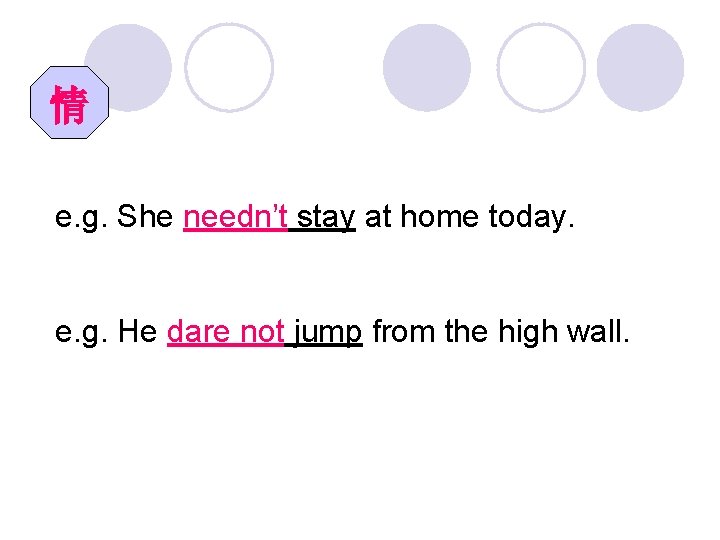
情 e. g. She needn’t stay at home today. e. g. He dare not jump from the high wall.
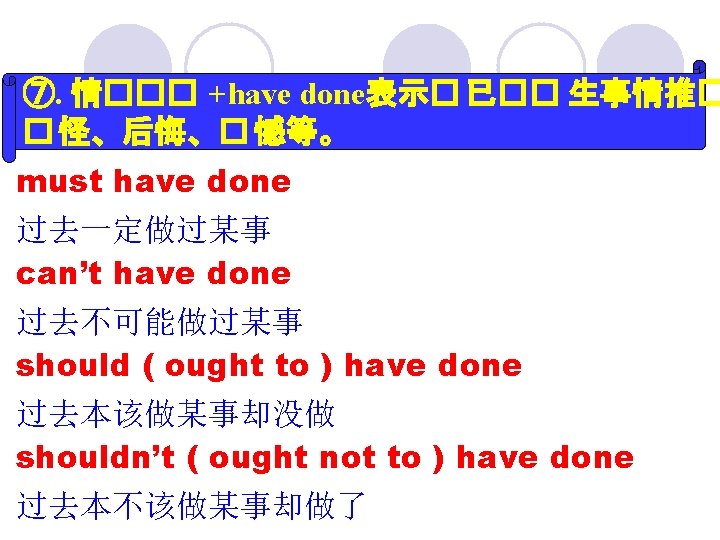
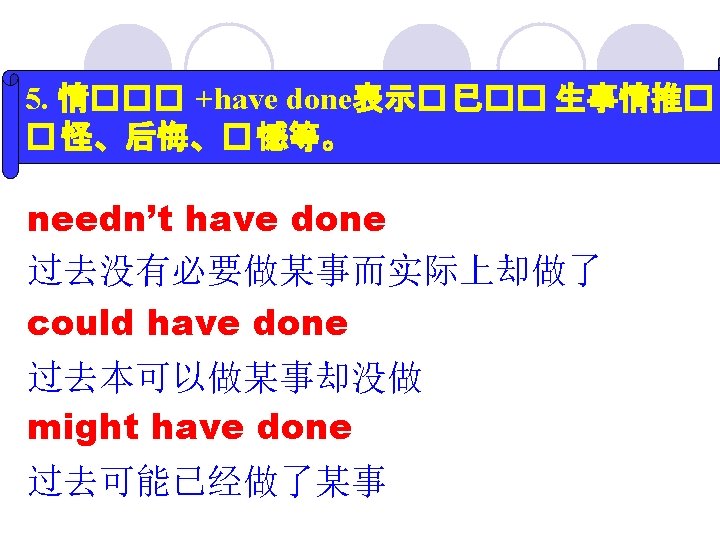
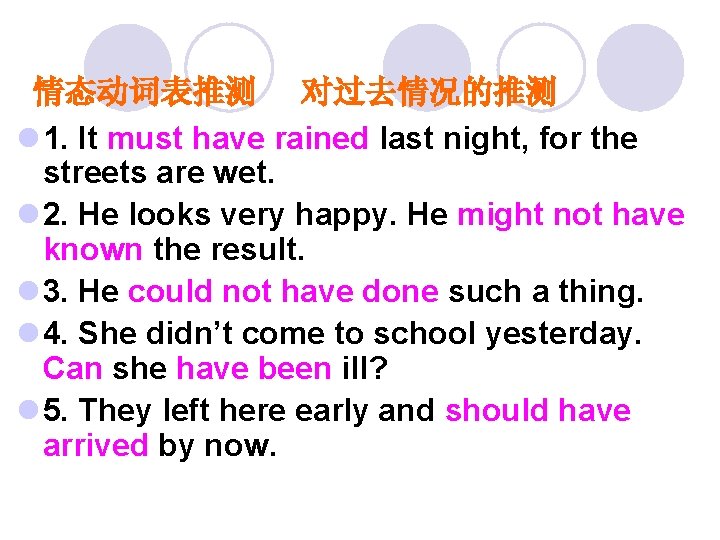
情态动词表推测 对过去情况的推测 l 1. It must have rained last night, for the streets are wet. l 2. He looks very happy. He might not have known the result. l 3. He could not have done such a thing. l 4. She didn’t come to school yesterday. Can she have been ill? l 5. They left here early and should have arrived by now.
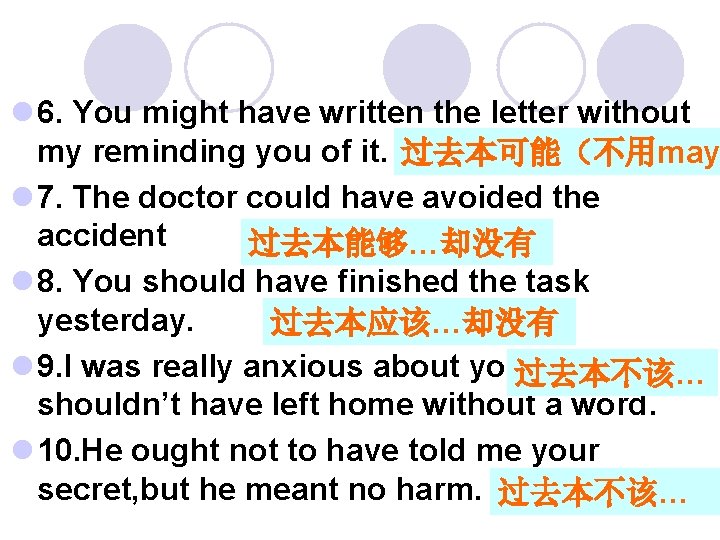
l 6. You might have written the letter without my reminding you of it. 过去本可能(不用may l 7. The doctor could have avoided the accident 过去本能够…却没有 l 8. You should have finished the task yesterday. 过去本应该…却没有 l 9. I was really anxious about you, you 过去本不该… shouldn’t have left home without a word. l 10. He ought not to have told me your secret, but he meant no harm. 过去本不该…
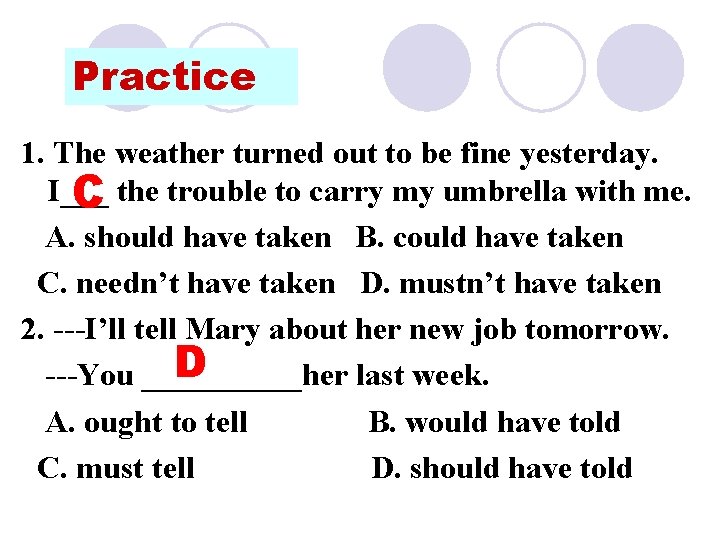
Practice 1. The weather turned out to be fine yesterday. I___ the trouble to carry my umbrella with me. C A. should have taken B. could have taken C. needn’t have taken D. mustn’t have taken 2. ---I’ll tell Mary about her new job tomorrow. D ---You _____her last week. A. ought to tell B. would have told C. must tell D. should have told
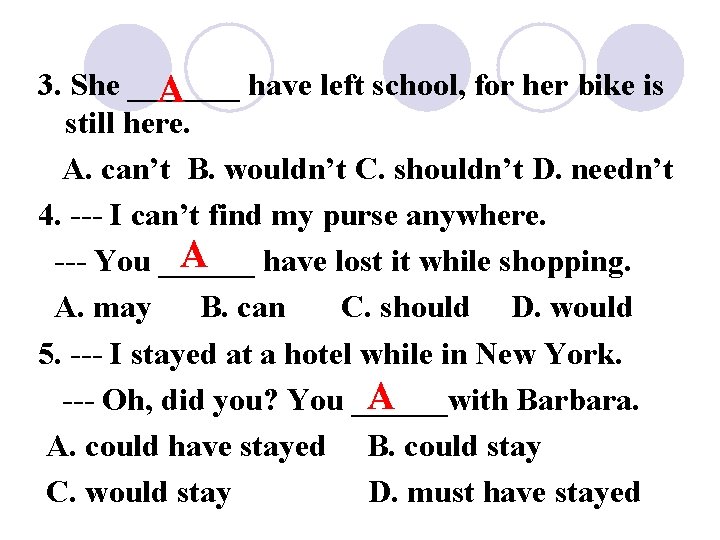
3. She _______ have left school, for her bike is A still here. A. can’t B. wouldn’t C. shouldn’t D. needn’t 4. --- I can’t find my purse anywhere. A --- You ______ have lost it while shopping. A. may B. can C. should D. would 5. --- I stayed at a hotel while in New York. A --- Oh, did you? You ______with Barbara. A. could have stayed B. could stay C. would stay D. must have stayed
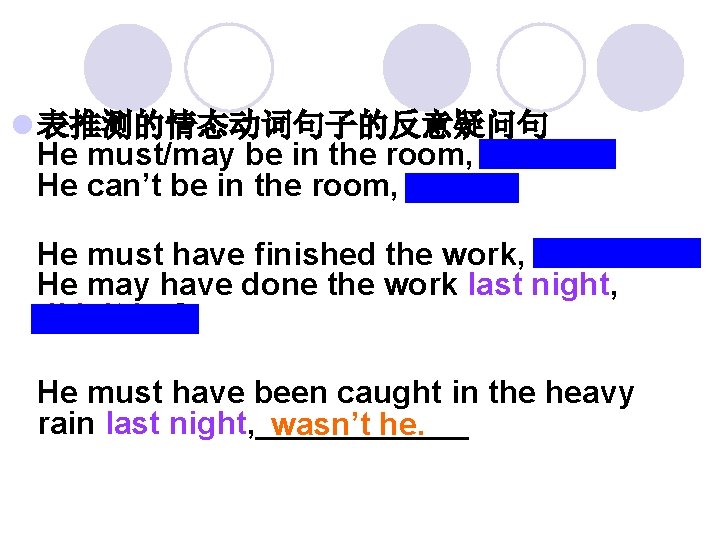
l 表推测的情态动词句子的反意疑问句 He must/may be in the room, isn’t he? He can’t be in the room, is he? He must have finished the work, hasn’t he? He may have done the work last night, didn’t he? He must have been caught in the heavy rain last night, ______ wasn’t he.
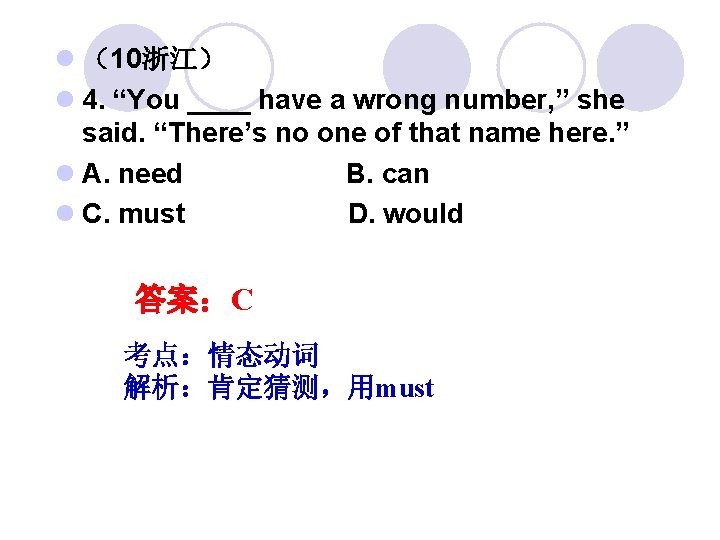
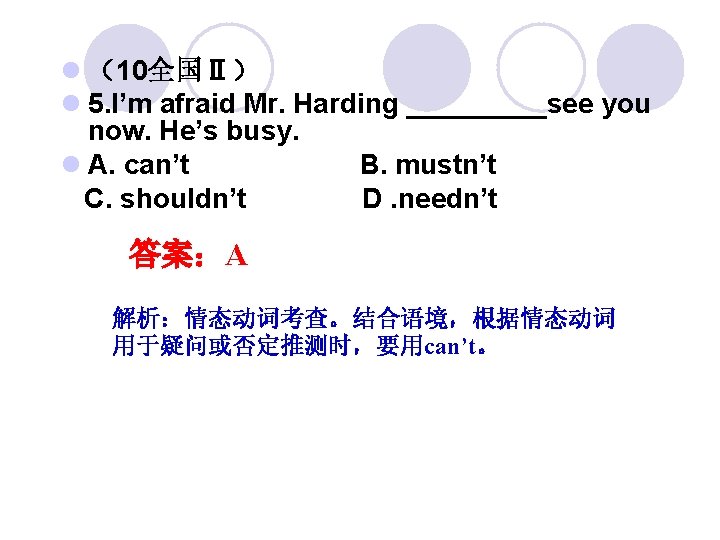
l (10浙江) l 4. “You ____ have a wrong number, ” she said. “There’s no one of that name here. ” l A. need B. can l C. must D. would 答案:C 考点:情态动词 解析:肯定猜测,用must
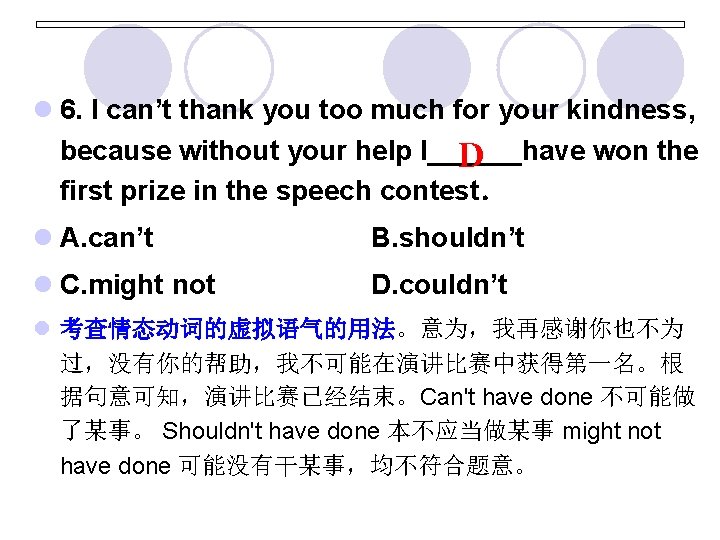
l 6. I can’t thank you too much for your kindness, because without your help I______have won the D first prize in the speech contest. l A. can’t B. shouldn’t l C. might not D. couldn’t l 考查情态动词的虚拟语气的用法。意为,我再感谢你也不为 过,没有你的帮助,我不可能在演讲比赛中获得第一名。根 据句意可知,演讲比赛已经结束。Can't have done 不可能做 了某事。 Shouldn't have done 本不应当做某事 might not have done 可能没有干某事,均不符合题意。
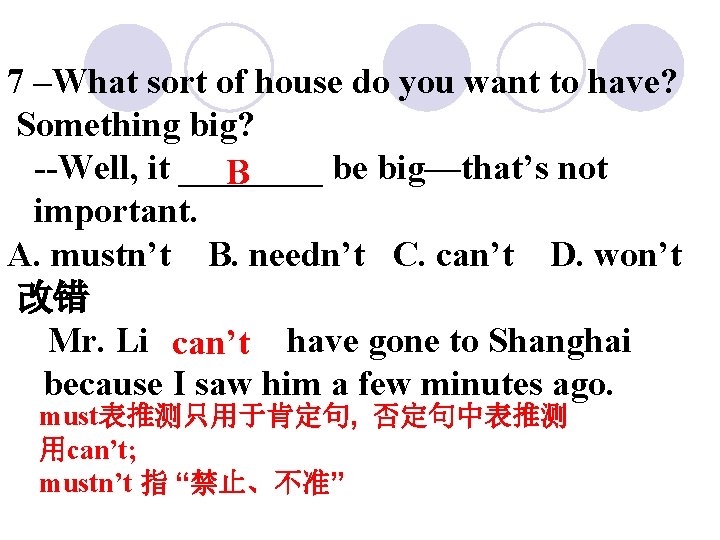
7 –What sort of house do you want to have? Something big? --Well, it ____ be big—that’s not B important. A. mustn’t B. needn’t C. can’t D. won’t 改错 Mr. Li mustn’t have gone to Shanghai can’t because I saw him a few minutes ago. must表推测只用于肯定句, 否定句中表推测 用can’t; mustn’t 指 “禁止、不准”
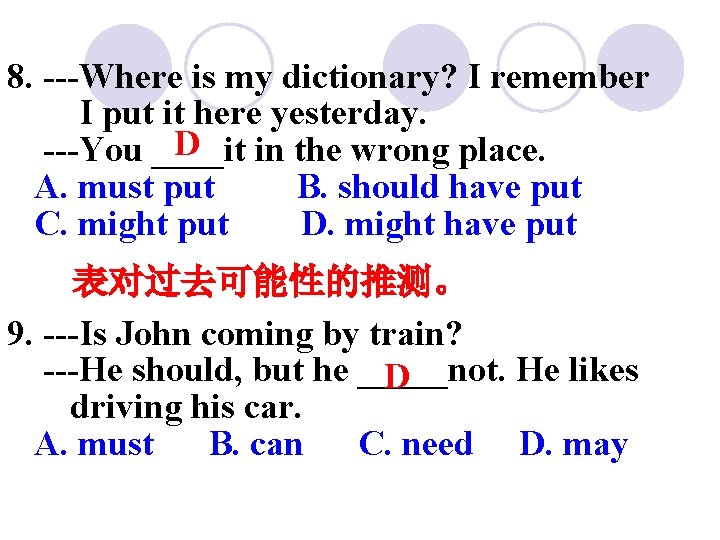
8. ---Where is my dictionary? I remember I put it here yesterday. D ---You ____it in the wrong place. A. must put B. should have put C. might put D. might have put 表对过去可能性的推测。 9. ---Is John coming by train? ---He should, but he _____not. He likes D driving his car. A. must B. can C. need D. may
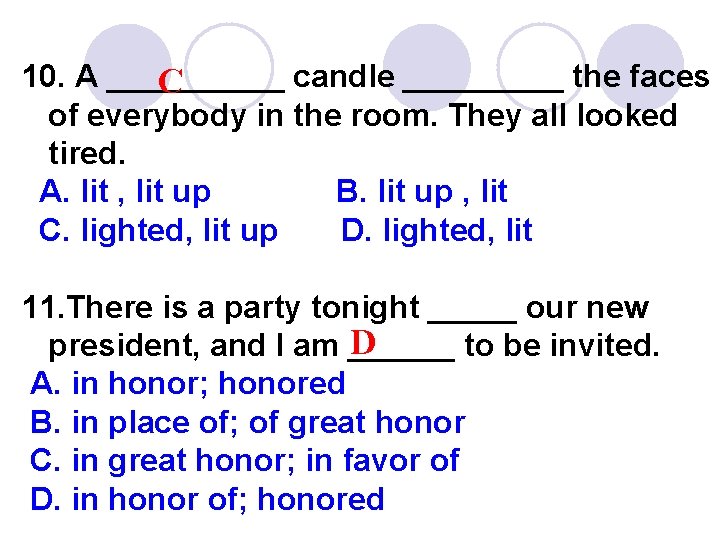
10. A _____ candle _____ the faces C of everybody in the room. They all looked tired. A. lit , lit up B. lit up , lit C. lighted, lit up D. lighted, lit 11. There is a party tonight _____ our new D president, and I am ______ to be invited. A. in honor; honored B. in place of; of great honor C. in great honor; in favor of D. in honor of; honored
- Slides: 61