
Grammar Review 1 The Present Tenses What are
- Slides: 10
Grammar Review 1. The Present. Tenses
What are the “Present” tenses? Simple Continuous Perfect
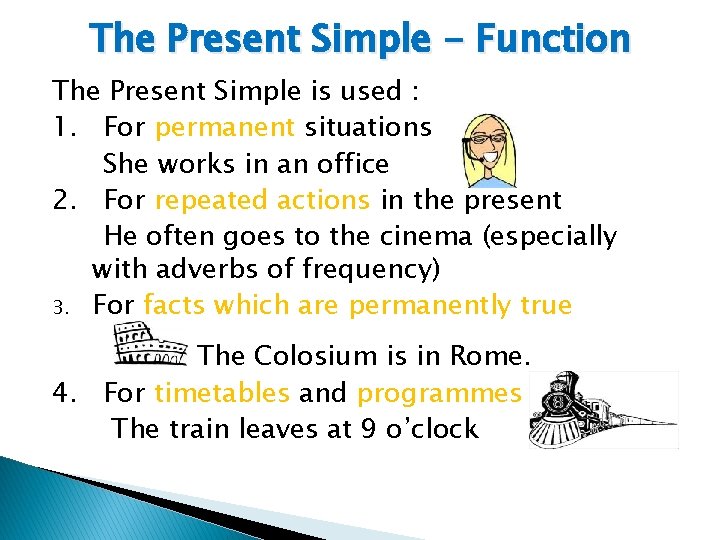
The Present Simple - Function The Present Simple is used : 1. For permanent situations She works in an office 2. For repeated actions in the present He often goes to the cinema (especially with adverbs of frequency) 3. For facts which are permanently true The Colosium is in Rome. 4. For timetables and programmes The train leaves at 9 o’clock
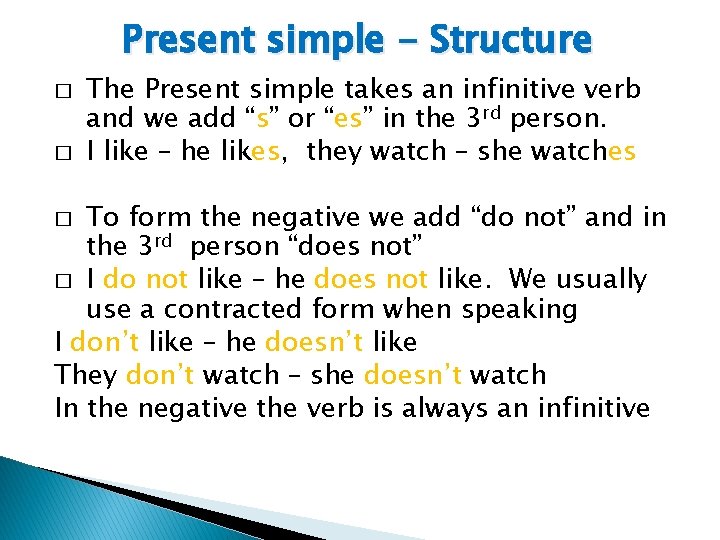
Present simple - Structure � � The Present simple takes an infinitive verb and we add “s” or “es” in the 3 rd person. I like – he likes, they watch – she watches To form the negative we add “do not” and in the 3 rd person “does not” � I do not like – he does not like. We usually use a contracted form when speaking I don’t like – he doesn’t like They don’t watch – she doesn’t watch In the negative the verb is always an infinitive �
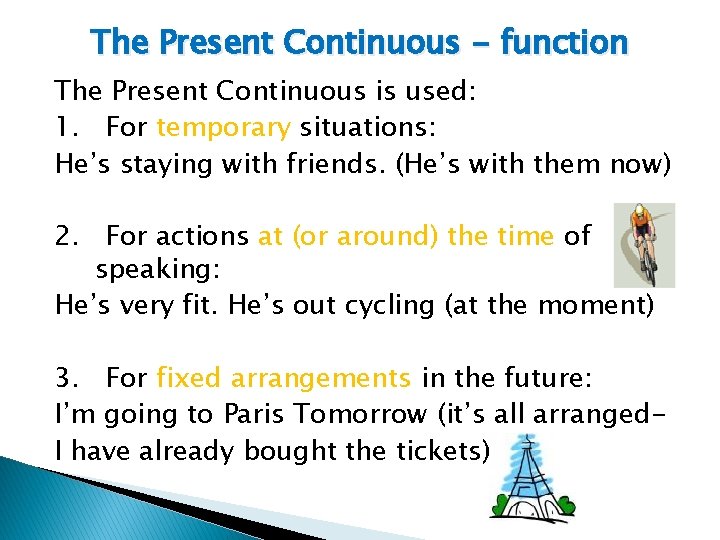
The Present Continuous - function The Present Continuous is used: 1. For temporary situations: He’s staying with friends. (He’s with them now) 2. For actions at (or around) the time of speaking: He’s very fit. He’s out cycling (at the moment) 3. For fixed arrangements in the future: I’m going to Paris Tomorrow (it’s all arranged. I have already bought the tickets)
The Present Continuous - structure The Present continuous is formed with the verb ”to be” (I am, you are, he is, she is, etc) and we add “ing” to the principal verb He is going to London next week In the negative we add “not” (I am not, you are not, he is not, plus the “ing” She is not going to London next week We usually use a contracted form when speaking
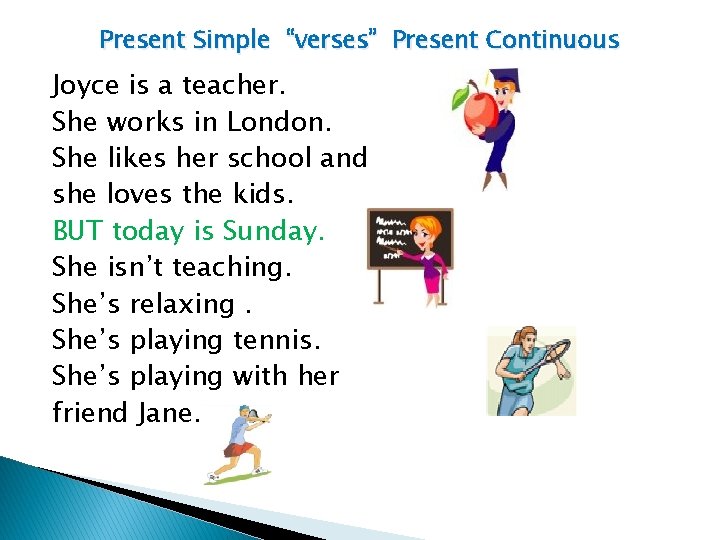
Present Simple “verses” Present Continuous Joyce is a teacher. She works in London. She likes her school and she loves the kids. BUT today is Sunday. She isn’t teaching. She’s relaxing. She’s playing tennis. She’s playing with her friend Jane.
The Present Perfect - Function The Present Perfect is used: 1. For actions which happened at an unstated time in the past. He has sold his car. (When – we don’t know) 2. For actions which started in the past and continue up to the present. She has lived in China for 10 years. (She still lives there) 3. To express actions which have finished so recently that there is evidence in the present It has been raining. (the ground is still wet)
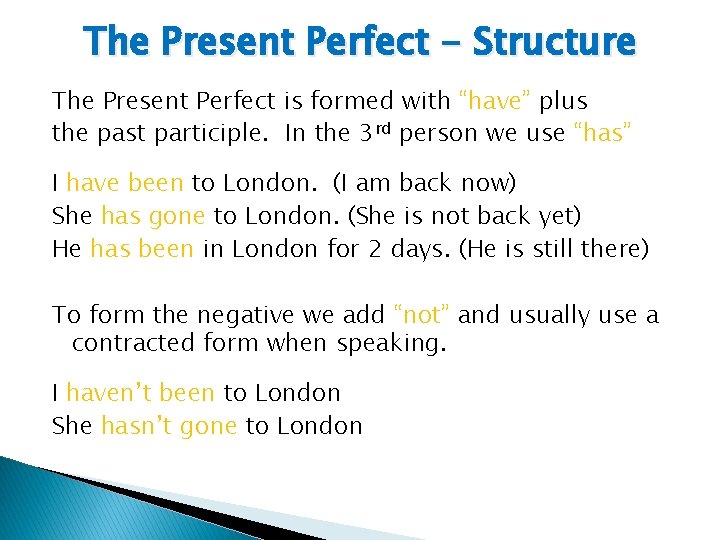
The Present Perfect - Structure The Present Perfect is formed with “have” plus the past participle. In the 3 rd person we use “has” I have been to London. (I am back now) She has gone to London. (She is not back yet) He has been in London for 2 days. (He is still there) To form the negative we add “not” and usually use a contracted form when speaking. I haven’t been to London She hasn’t gone to London
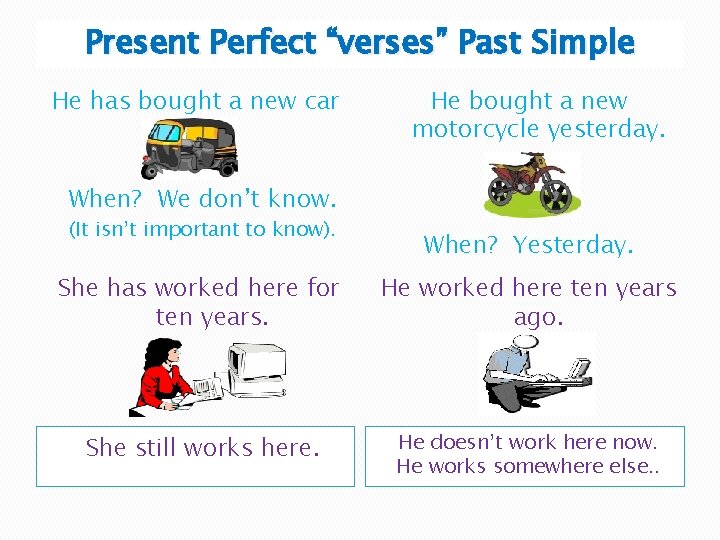
Present Perfect “verses” Past Simple He has bought a new car He bought a new motorcycle yesterday. When? We don’t know. (It isn’t important to know). When? Yesterday. She has worked here for ten years. He worked here ten years ago. She still works here. He doesn’t work here now. He works somewhere else. .