
GRAMMAR PUNCTUATION PARTS OF SPEECH LESSON 1 WRITING





- Slides: 19
GRAMMAR, PUNCTUATION & PARTS OF SPEECH
LESSON #1 WRITING MORE AND WRITING LESS (LESSON 23 -27 LANGUAGE POWER)
SENTENCE FRAGMENTS When typing on computer your word processor does a lot of correcting for you. sentence fragment. “Fragment consider revising” It will not correct a Question: What is a fragment? (talk to your partner) A: Sentence fragments are punctuated like a sentence but lack either a subject or a predicate and are, as a result, incomplete.
LEARNING TO WRITE MORE A teacher told to “write more” give “more details” form “more complex sentences” or “elaborate” Learning Goal: I know how I can write more elaborately
ACTIVITY #1 FORMING A SENTENCE In any sentence you need what the sentence is about (a thing) and what the thing does. 1. First student gives an example of a THING 2. Next student gives an example of an ACTION 3. Third student creates a SUBORDINATE CLAUSE. 4. Third student creates a COMPOUND SENTENCE. The BALL FLIES When I hit it with a bat. And the people cheer. Both Compound sentence forming and adding subordinate clauses double our words and triple interest!!!
PUNCTUATING COMPLEX AND COMPOUND SENTENCES A comma goes between the original “simple” sentence and the new creation
CAPITAL LETTERS LOTS AND LOTS OF RULES
CAPITALIZATION RULES Rule #1 Capitalize the start of the sentence. Rule #2 Capitalize any “made up” names of places, people, things. (this includes nationalities) Rule #3 Capitalize when someone’s made up name describes something “Calvanist theology or Shakespearean play or Polish sausage. Rule #4 Days of the week and months of the year but not seasons!
CAPITALIZATION RULES Rule #5 Titles right before someone’s name. (Uncle Eddy, President Obama, Doctor Klaue) Rule #6 Capitalize family titles when used instead of a name. Rule #7 Geographic regions (Southeast Asia, the West) Rule #8 Knicknames (Scooter, Babykins) Rule #9 First word after a quotation unless the quote receives a seamless transition. Rule #10 In titles only first words and important words get capitals. (The War of the Worlds) Rule #11 Pronouns that replace God or titles of God. (People should serve God because He is loving)
PLEASE DO NOT CAPITALIZE Food names that are not brands. (poutine, moussaka) Moon and sun do not receive capitals but all other planets do. Medical conditions Plant or animal names do not receive capitals unless they have a proper adjective (yellow-belly sap sucker, red hooded woodpecker, Arctic fox) Do not capitalize the word “the” in front of a proper name. (the Calgary Stampede) Occupations do not get capitalized. (petroleum bioengineer) There are unkowns in the capital world, like is it Dominoes pizza or Dominoes Pizza or which words are the important words of a title can be very subjective. Sometimes we do our best.
COMMAS AND PUNCTUATION
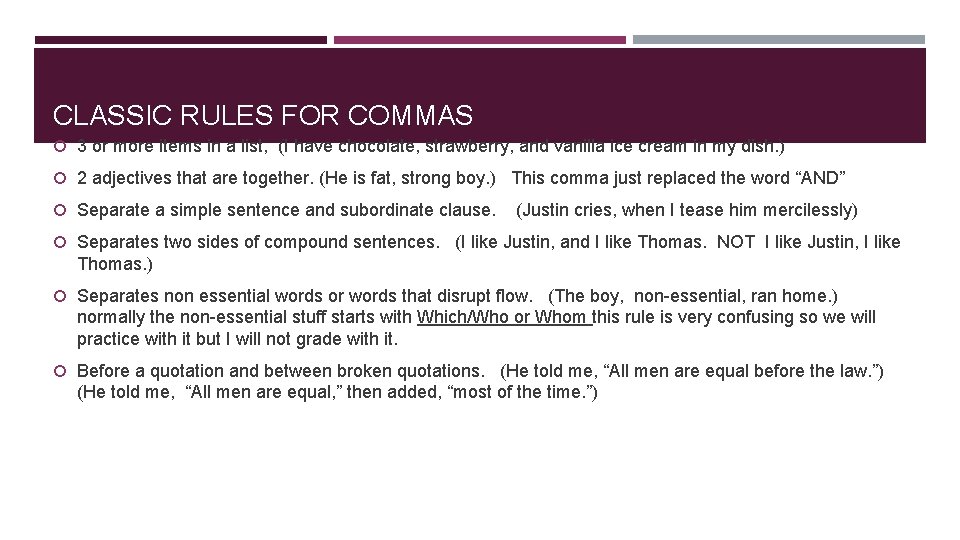
CLASSIC RULES FOR COMMAS 3 or more items in a list, (I have chocolate, strawberry, and vanilla ice cream in my dish. ) 2 adjectives that are together. (He is fat, strong boy. ) This comma just replaced the word “AND” Separate a simple sentence and subordinate clause. (Justin cries, when I tease him mercilessly) Separates two sides of compound sentences. (I like Justin, and I like Thomas. NOT I like Justin, I like Thomas. ) Separates non essential words or words that disrupt flow. (The boy, non-essential, ran home. ) normally the non-essential stuff starts with Which/Who or Whom this rule is very confusing so we will practice with it but I will not grade with it. Before a quotation and between broken quotations. (He told me, “All men are equal before the law. ”) (He told me, “All men are equal, ” then added, “most of the time. ”)
THE ODD COMMAS Between date and year and after the year. (June 7, 2003, is when I was born. In June 2003 I was born. ) Two place names that are back to back. (Victoria, British Columbia is my home)
COMMON WORD CHOICE ERRORS
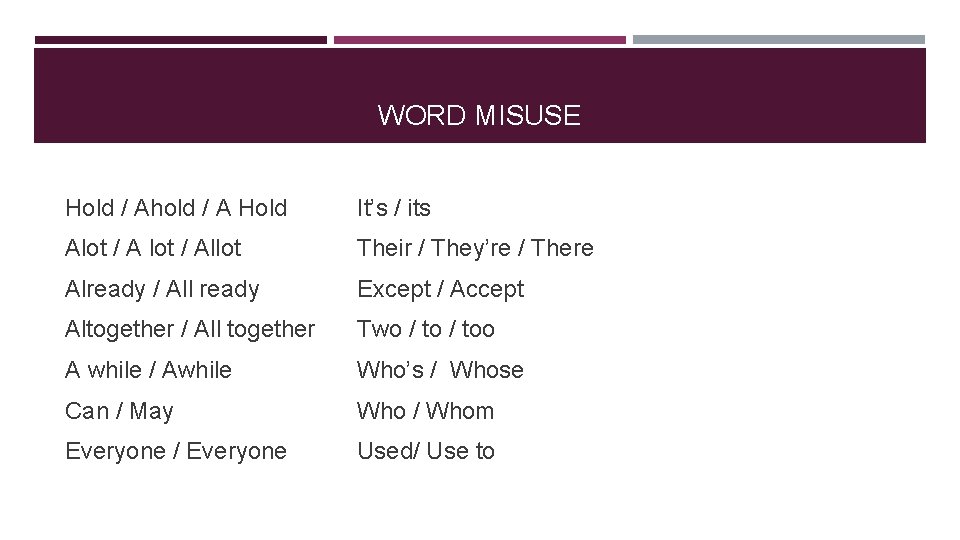
WORD MISUSE Hold / Ahold / A Hold It’s / its Alot / Allot Their / They’re / There Already / All ready Except / Accept Altogether / All together Two / too A while / Awhile Who’s / Whose Can / May Who / Whom Everyone / Everyone Used/ Use to
COMMON PROBLEMS “Can” means, I have the ability to do something. “May” asks for permission to do something. “Can I use the washroom? ” or “May I use the washroom? ”
COMMON PROBLEMS (AFFECT VS EFFECT) “Affect” means, something influences something else. “Effect” is typically referring to lighting effects, sound effects or explosions. It can also be the result of Use “Impact” as your escape. “The weather effects our turnout. ” or “The weather affects our turnout. ” “Our turnout was effected by weather. ” or “Our turnout was affected by weather”
COMMON PROBLEMS (WHO VS WHOM) I /me he/him she/her they/them who/whom Step #1 Does the word he/she or him/her fit? He she = who him/her = whom Step #2 Is the preceding word “with”? With = whom Step #3 Is it the subject of the sentence? Subject = who When in doubt choose “Who” Who is used 75% of the time.
APOSTROPHE PROBLEMS You’re = You are It’s = It is. Your = the object belongs to you. Its = the object belongs to it. “That’s its ball. ” Player’s = The object belongs to one player. Players’ = The object belongs to many players Players = There is more than one player.