
Grammar Notes Week 6 SUBJECTVERB AGREEMENT Definition A

Grammar Notes, Week 6 SUBJECT-VERB AGREEMENT
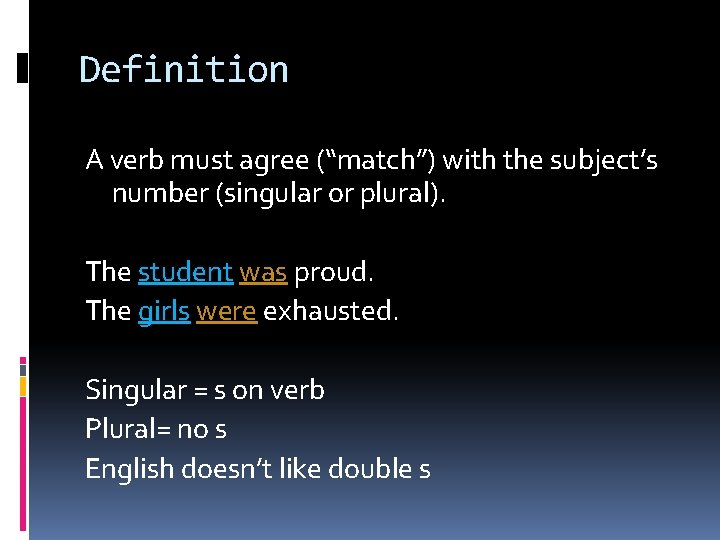
Definition A verb must agree (“match”) with the subject’s number (singular or plural). The student was proud. The girls were exhausted. Singular = s on verb Plural= no s English doesn’t like double s

Junk Don’t be confused by sentence “junk” The manager as well as the players (is/are) required to display good sportsmanship. “as well as the players” is junk (Not the subject, verb, or D. O. )
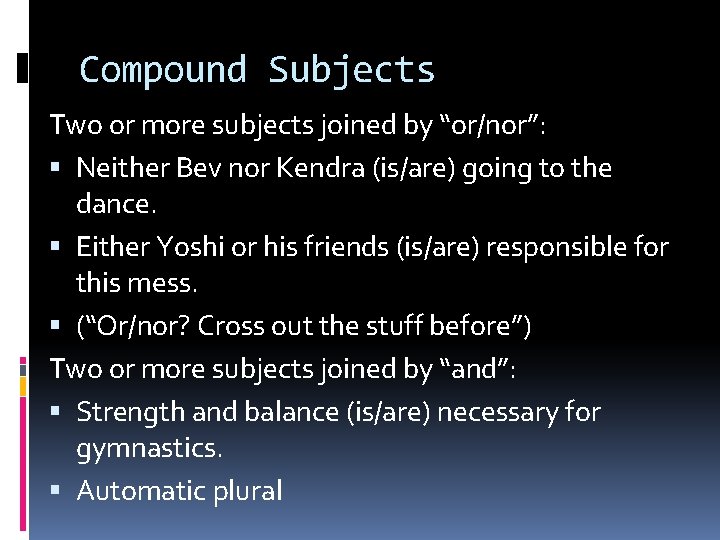
Compound Subjects Two or more subjects joined by “or/nor”: Neither Bev nor Kendra (is/are) going to the dance. Either Yoshi or his friends (is/are) responsible for this mess. (“Or/nor? Cross out the stuff before”) Two or more subjects joined by “and”: Strength and balance (is/are) necessary for gymnastics. Automatic plural

Delayed Subjects Delayed subject = a verb comes before the subject (“There”) Look for what “there” refers to. There (is/are) many hardworking students in our school. (Subject? ) There (is/are) present a will to succeed. (Subject? )

“Be” Verbs When a noun comes before AND after a “be” verb, make sure the verb agrees with the FIRST noun (subject) not the PN The cause of his problem (was/were) the bad brakes. The bad brakes (was/were) the cause of his problem.

Special Cases Some nouns look plural (s), but they’re singular. Measles, mumps, news, mathematics, economics, gallows, shambles Measles (is/are) still considered a serious disease. Some nouns look plural but are singular, yet take a plural verb. Scissors, trousers, tidings The scissors (is/are) missing.
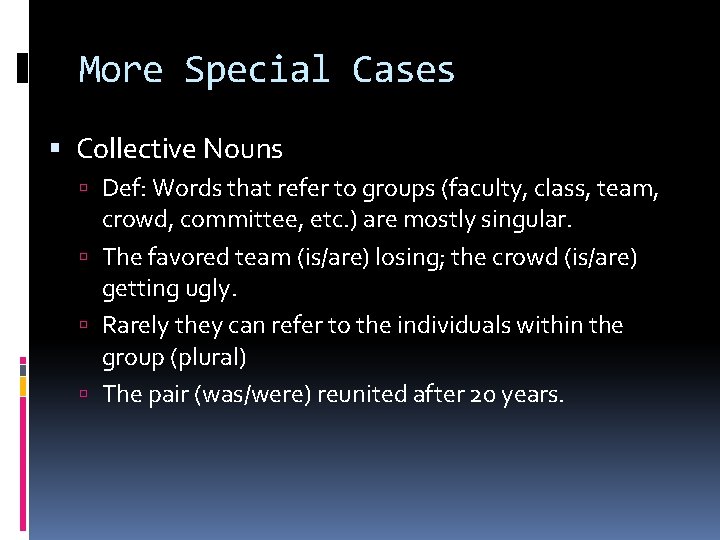
More Special Cases Collective Nouns Def: Words that refer to groups (faculty, class, team, crowd, committee, etc. ) are mostly singular. The favored team (is/are) losing; the crowd (is/are) getting ugly. Rarely they can refer to the individuals within the group (plural) The pair (was/were) reunited after 20 years.
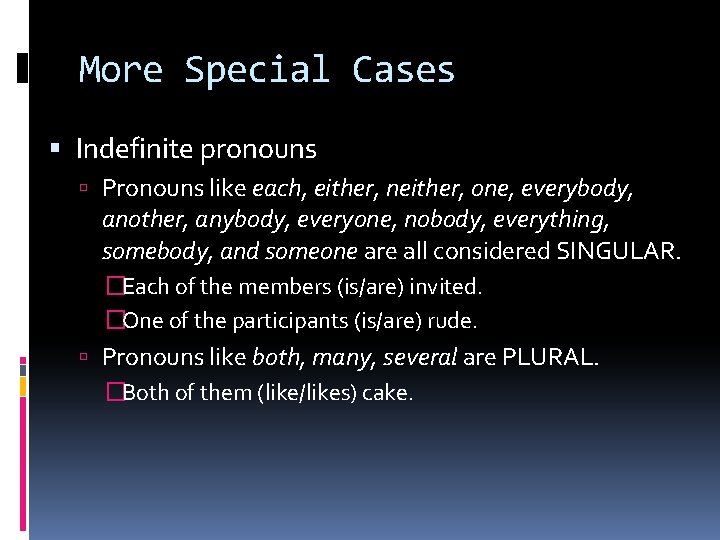
More Special Cases Indefinite pronouns Pronouns like each, either, neither, one, everybody, another, anybody, everyone, nobody, everything, somebody, and someone are all considered SINGULAR. �Each of the members (is/are) invited. �One of the participants (is/are) rude. Pronouns like both, many, several are PLURAL. �Both of them (like/likes) cake.

Practice P. 148 -152 Circle the correct verb Make sure to watch out for special cases/tricks: Sentence junk Delayed subjects Compound subjects “Be” verbs Indefinite pronouns
- Slides: 10