
Grammar Nominative and Objective Pronoun Cases Module 3
Grammar: Nominative and Objective Pronoun Cases Module 3 – Proofreading Prepared by Anna Vinogradova
Case Forms of Pronouns 3 forms of pronoun cases: • Possessive • Nominative • Objective Case simply refers to the relationship of a pronoun to other words in a sentence.
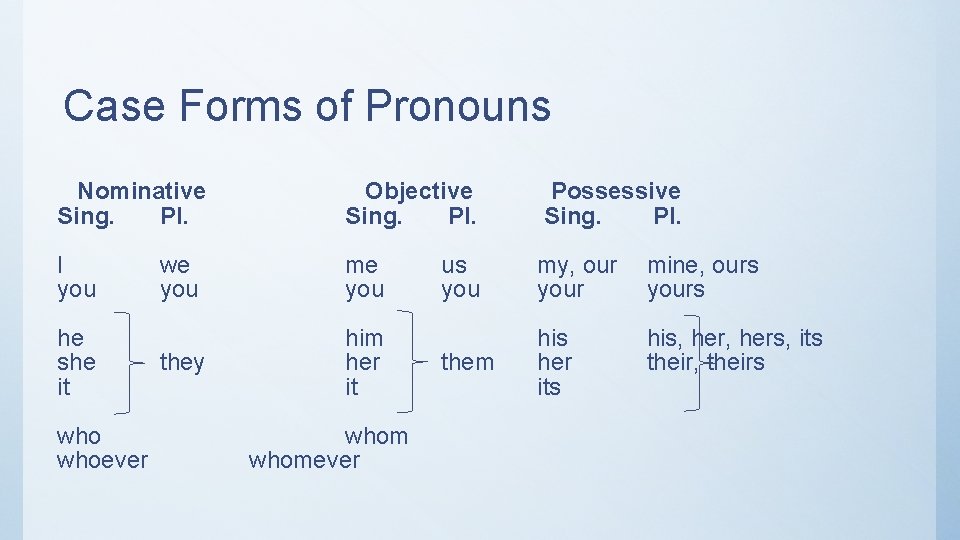
Case Forms of Pronouns Nominative Sing. Pl. Objective Sing. Pl. Possessive Sing. Pl. I you we you me you us you my, our your mine, ours yours they him her it them his her its his, hers, its their, theirs he she it whoever whomever
Why is it important? To be able to avoid and detect all the common errors of pronoun use.
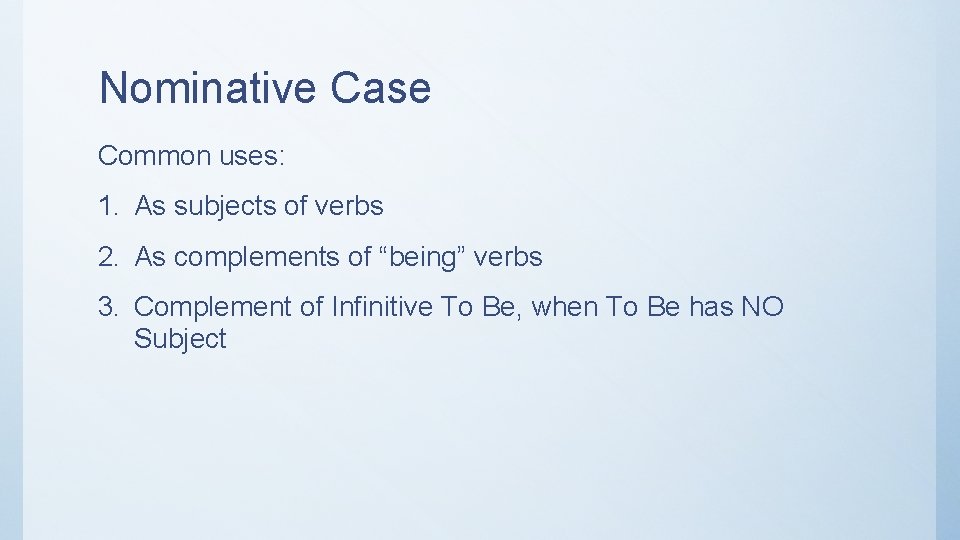
Nominative Case Common uses: 1. As subjects of verbs 2. As complements of “being” verbs 3. Complement of Infinitive To Be, when To Be has NO Subject
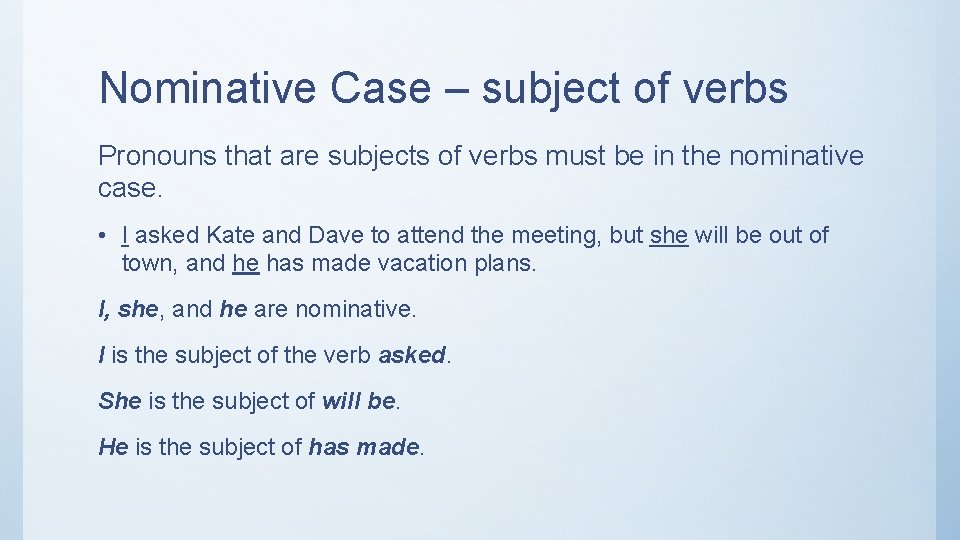
Nominative Case – subject of verbs Pronouns that are subjects of verbs must be in the nominative case. • I asked Kate and Dave to attend the meeting, but she will be out of town, and he has made vacation plans. I, she, and he are nominative. I is the subject of the verb asked. She is the subject of will be. He is the subject of has made.
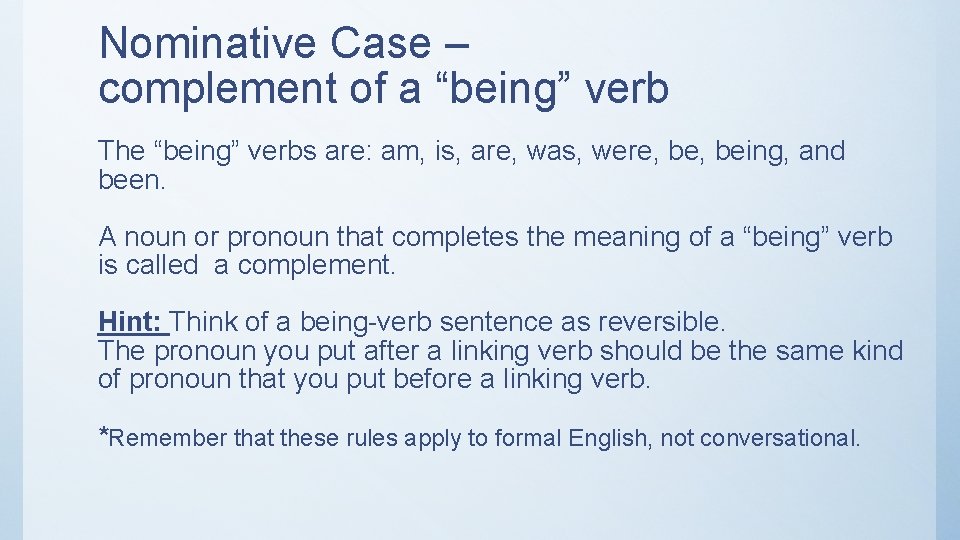
Nominative Case – complement of a “being” verb The “being” verbs are: am, is, are, was, were, being, and been. A noun or pronoun that completes the meaning of a “being” verb is called a complement. Hint: Think of a being-verb sentence as reversible. The pronoun you put after a linking verb should be the same kind of pronoun that you put before a linking verb. *Remember that these rules apply to formal English, not conversational.
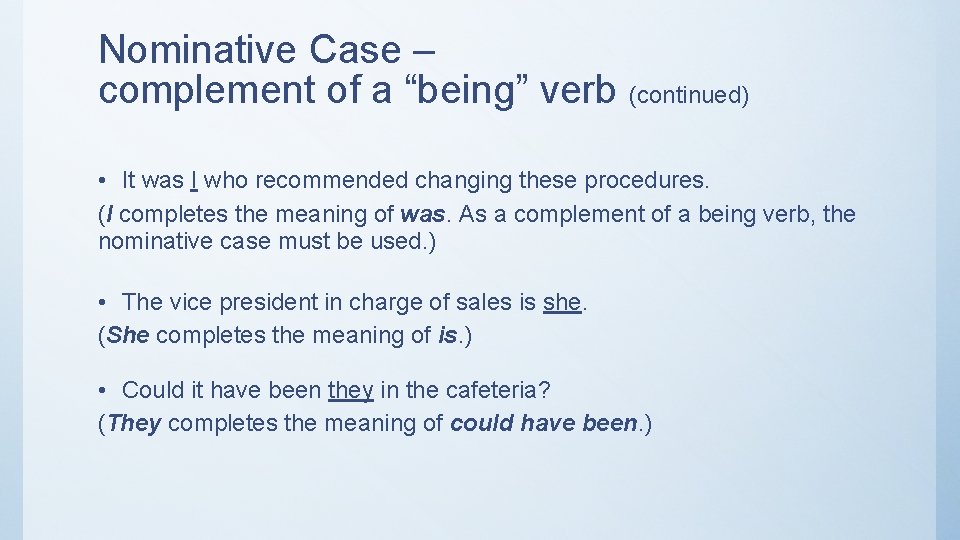
Nominative Case – complement of a “being” verb (continued) • It was I who recommended changing these procedures. (I completes the meaning of was. As a complement of a being verb, the nominative case must be used. ) • The vice president in charge of sales is she. (She completes the meaning of is. ) • Could it have been they in the cafeteria? (They completes the meaning of could have been. )
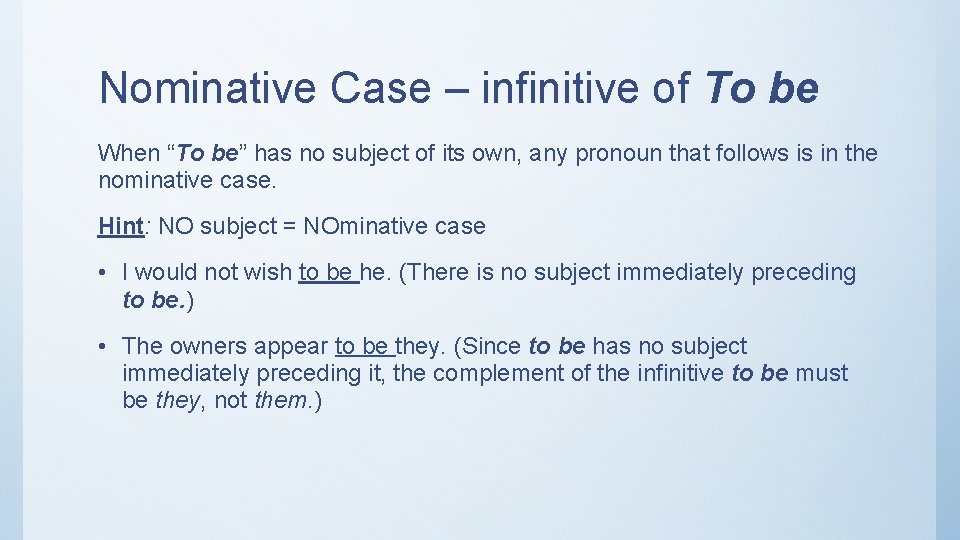
Nominative Case – infinitive of To be When “To be” has no subject of its own, any pronoun that follows is in the nominative case. Hint: NO subject = NOminative case • I would not wish to be he. (There is no subject immediately preceding to be. ) • The owners appear to be they. (Since to be has no subject immediately preceding it, the complement of the infinitive to be must be they, not them. )
Objective Case Common uses: 1. As object of a preposition or of an infinitive 2. As object of a verb
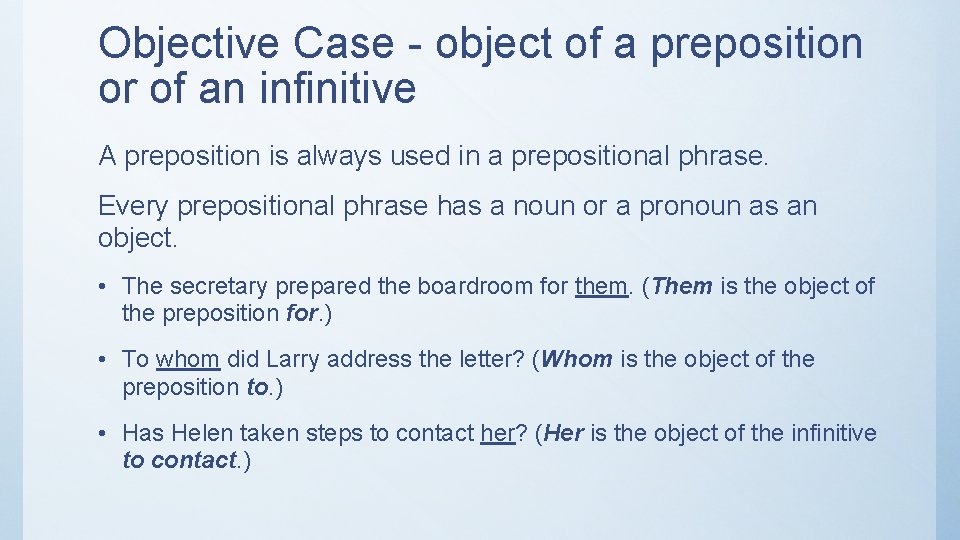
Objective Case - object of a preposition or of an infinitive A preposition is always used in a prepositional phrase. Every prepositional phrase has a noun or a pronoun as an object. • The secretary prepared the boardroom for them. (Them is the object of the preposition for. ) • To whom did Larry address the letter? (Whom is the object of the preposition to. ) • Has Helen taken steps to contact her? (Her is the object of the infinitive to contact. )
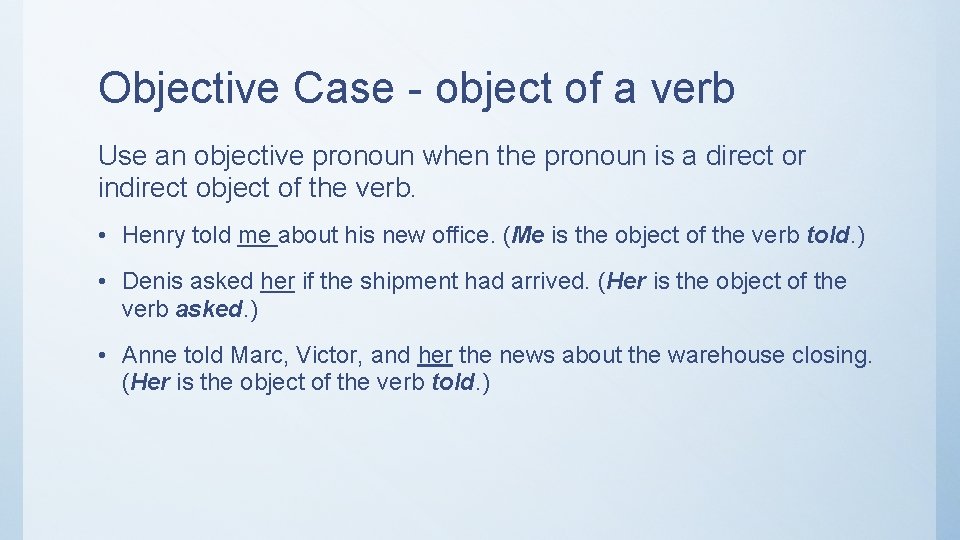
Objective Case - object of a verb Use an objective pronoun when the pronoun is a direct or indirect object of the verb. • Henry told me about his new office. (Me is the object of the verb told. ) • Denis asked her if the shipment had arrived. (Her is the object of the verb asked. ) • Anne told Marc, Victor, and her the news about the warehouse closing. (Her is the object of the verb told. )

Reference: Pitman’s Office Handbook: page 523
- Slides: 13