
Grammar mistakes that make Mrs Bowers cringe in
Grammar mistakes that make Mrs. Bowers cringe in the depths of her soul…¡por el amor de Dios, dejen de cometerlos!
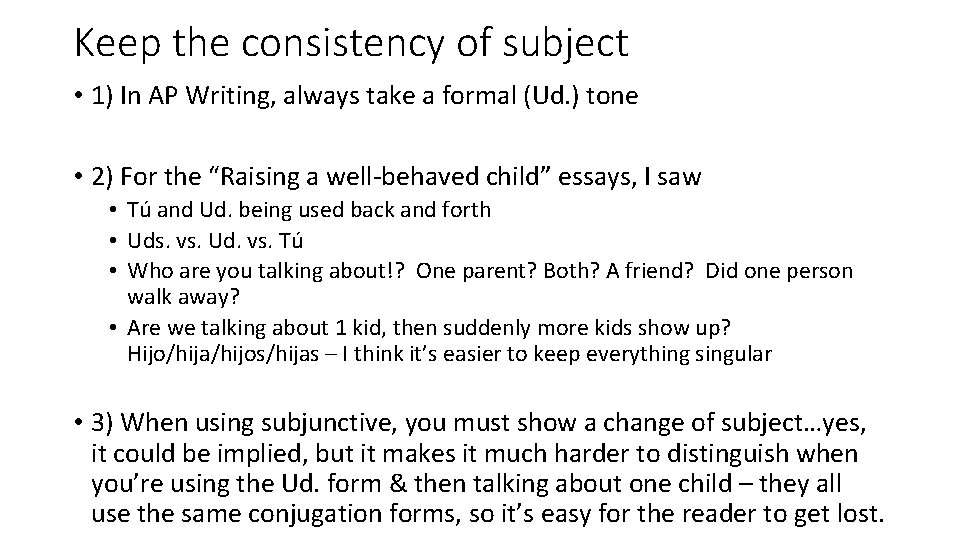
Keep the consistency of subject • 1) In AP Writing, always take a formal (Ud. ) tone • 2) For the “Raising a well-behaved child” essays, I saw • Tú and Ud. being used back and forth • Uds. vs. Ud. vs. Tú • Who are you talking about!? One parent? Both? A friend? Did one person walk away? • Are we talking about 1 kid, then suddenly more kids show up? Hijo/hija/hijos/hijas – I think it’s easier to keep everything singular • 3) When using subjunctive, you must show a change of subject…yes, it could be implied, but it makes it much harder to distinguish when you’re using the Ud. form & then talking about one child – they all use the same conjugation forms, so it’s easy for the reader to get lost.
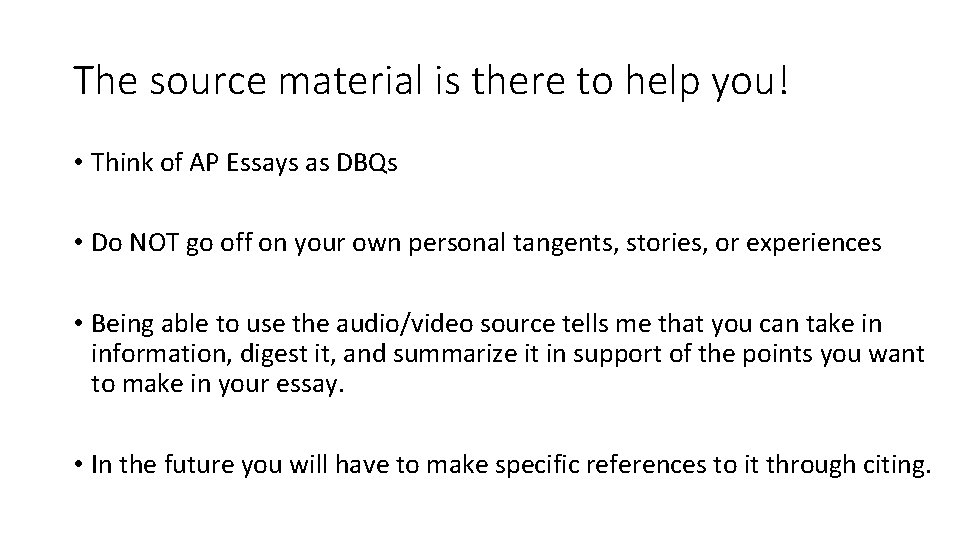
The source material is there to help you! • Think of AP Essays as DBQs • Do NOT go off on your own personal tangents, stories, or experiences • Being able to use the audio/video source tells me that you can take in information, digest it, and summarize it in support of the points you want to make in your essay. • In the future you will have to make specific references to it through citing.
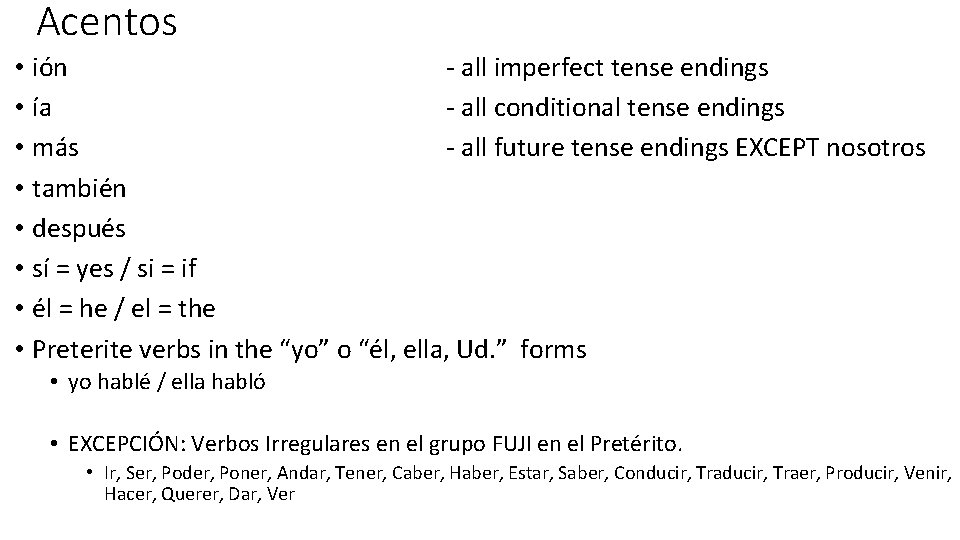
Acentos • ión - all imperfect tense endings • ía - all conditional tense endings • más - all future tense endings EXCEPT nosotros • también • después • sí = yes / si = if • él = he / el = the • Preterite verbs in the “yo” o “él, ella, Ud. ” forms • yo hablé / ella habló • EXCEPCIÓN: Verbos Irregulares en el grupo FUJI en el Pretérito. • Ir, Ser, Poder, Poner, Andar, Tener, Caber, Haber, Estar, Saber, Conducir, Traer, Producir, Venir, Hacer, Querer, Dar, Ver
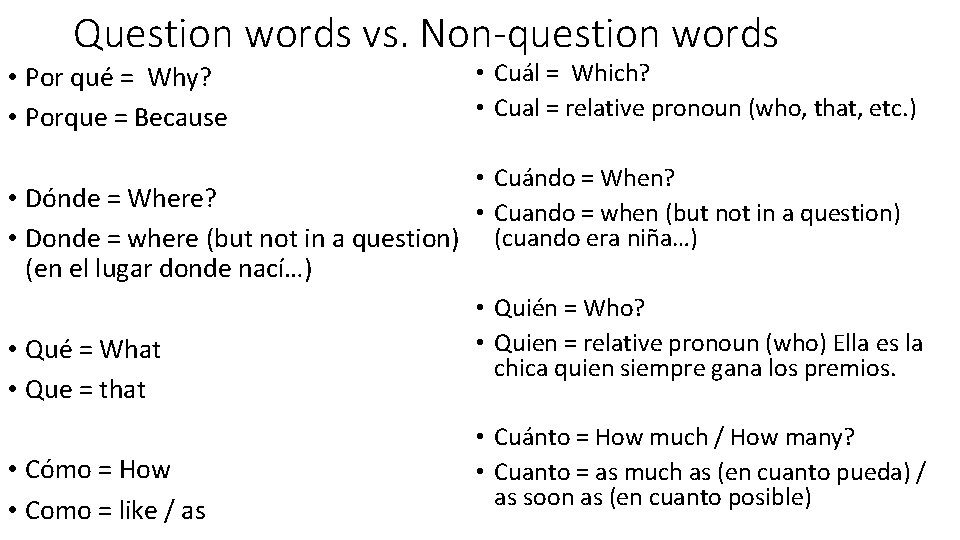
Question words vs. Non-question words • Por qué = Why? • Porque = Because • Cuál = Which? • Cual = relative pronoun (who, that, etc. ) • Cuándo = When? • Dónde = Where? • Cuando = when (but not in a question) • Donde = where (but not in a question) (cuando era niña…) (en el lugar donde nací…) • Qué = What • Que = that • Cómo = How • Como = like / as • Quién = Who? • Quien = relative pronoun (who) Ella es la chica quien siempre gana los premios. • Cuánto = How much / How many? • Cuanto = as much as (en cuanto pueda) / as soon as (en cuanto posible)

Demonstrative Adjectives vs. Pronouns • Este / Esta / Estos / Estas vs. Esto • These are the adjective forms – they are followed by whatever noun they are describing. • If the gender is known, match appropriately • If you’re talking about a nebulous idea or something that isn’t defined, use the “neuter” form “esto” • Ex) Espero que este consejo te ayude. • Ex) Estos chicos han arruinado todo • Éste / Ésta / Éstos / Éstas vs. Esto • These replace the noun • Éste es un teléfono antiguo.

Possessive Adjectives Mi / Mis Tu / Tus Su/Sus Nuestro(a) / Nuestros(as) Vuesto(a) / Vuestros(as) Su/Sus These match the object being possessed/owned. Mi casa / Mis amigos Su hijo / Sus hijos Su carácter / Sus hábitos
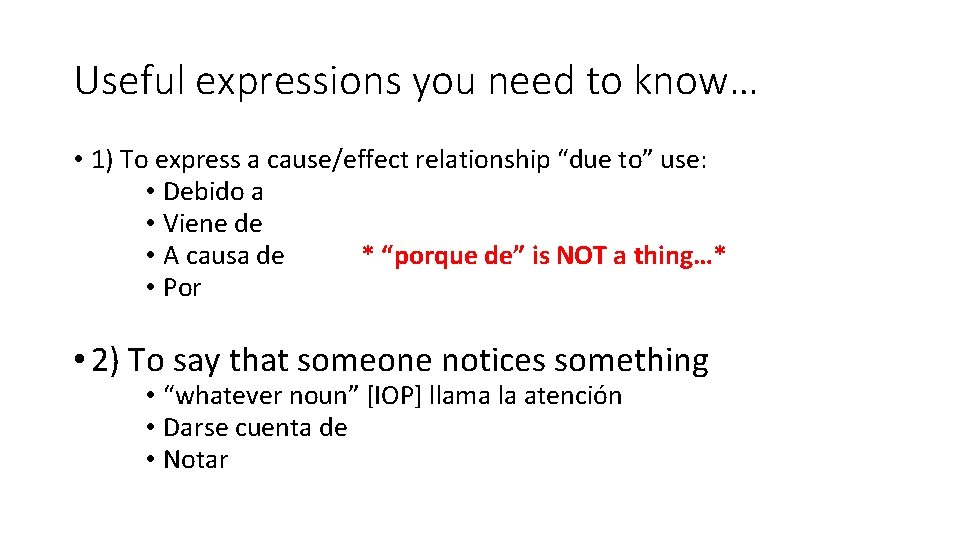
Useful expressions you need to know… • 1) To express a cause/effect relationship “due to” use: • Debido a • Viene de • A causa de * “porque de” is NOT a thing…* • Por • 2) To say that someone notices something • “whatever noun” [IOP] llama la atención • Darse cuenta de • Notar
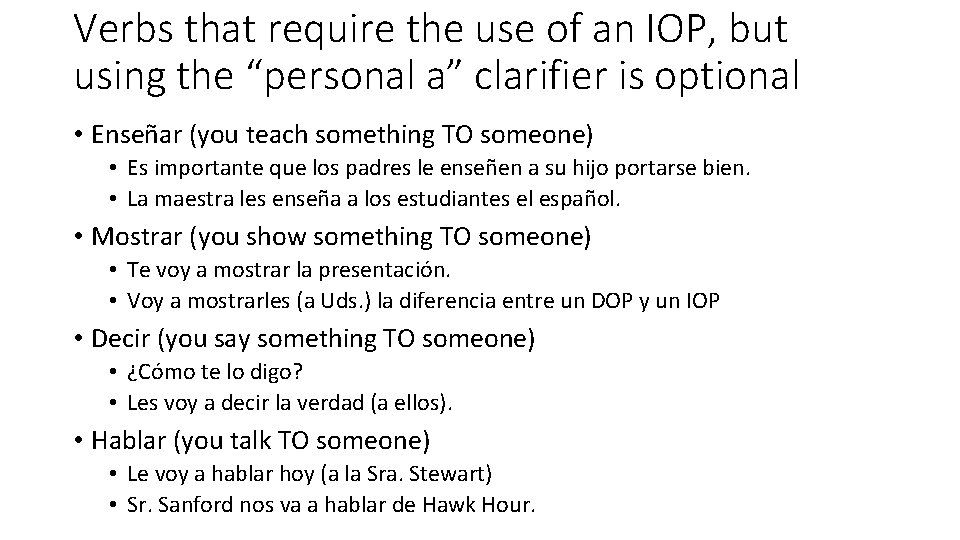
Verbs that require the use of an IOP, but using the “personal a” clarifier is optional • Enseñar (you teach something TO someone) • Es importante que los padres le enseñen a su hijo portarse bien. • La maestra les enseña a los estudiantes el español. • Mostrar (you show something TO someone) • Te voy a mostrar la presentación. • Voy a mostrarles (a Uds. ) la diferencia entre un DOP y un IOP • Decir (you say something TO someone) • ¿Cómo te lo digo? • Les voy a decir la verdad (a ellos). • Hablar (you talk TO someone) • Le voy a hablar hoy (a la Sra. Stewart) • Sr. Sanford nos va a hablar de Hawk Hour.
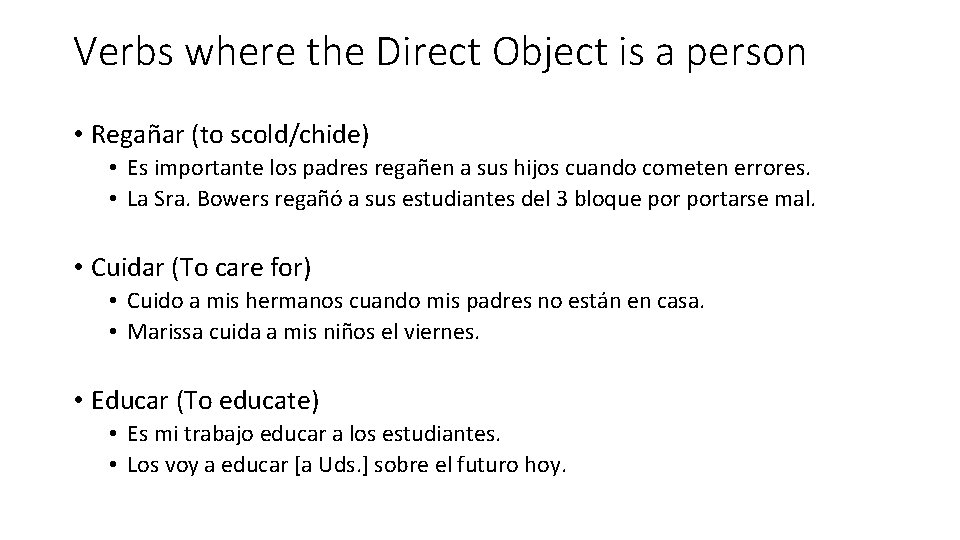
Verbs where the Direct Object is a person • Regañar (to scold/chide) • Es importante los padres regañen a sus hijos cuando cometen errores. • La Sra. Bowers regañó a sus estudiantes del 3 bloque portarse mal. • Cuidar (To care for) • Cuido a mis hermanos cuando mis padres no están en casa. • Marissa cuida a mis niños el viernes. • Educar (To educate) • Es mi trabajo educar a los estudiantes. • Los voy a educar [a Uds. ] sobre el futuro hoy.
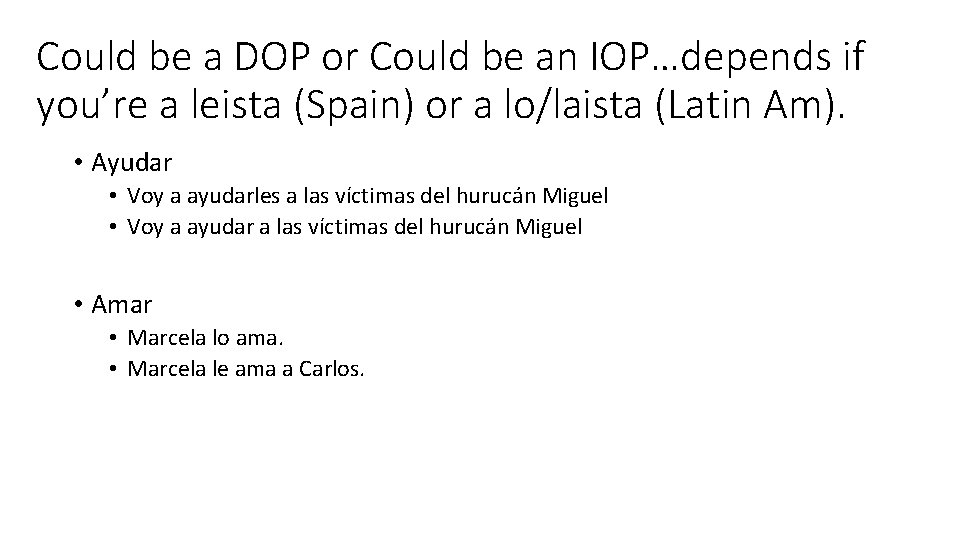
Could be a DOP or Could be an IOP…depends if you’re a leista (Spain) or a lo/laista (Latin Am). • Ayudar • Voy a ayudarles a las víctimas del hurucán Miguel • Voy a ayudar a las víctimas del hurucán Miguel • Amar • Marcela lo ama. • Marcela le ama a Carlos.
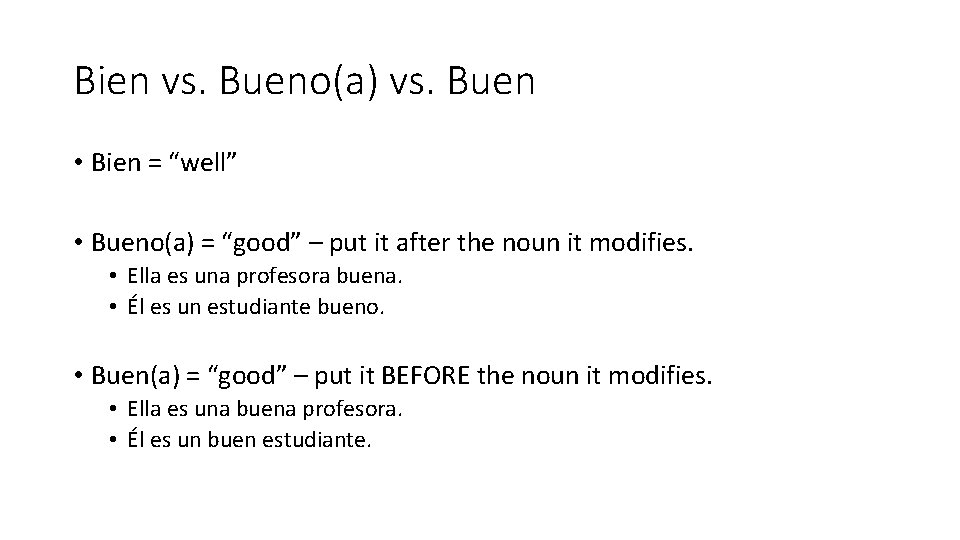
Bien vs. Bueno(a) vs. Buen • Bien = “well” • Bueno(a) = “good” – put it after the noun it modifies. • Ella es una profesora buena. • Él es un estudiante bueno. • Buen(a) = “good” – put it BEFORE the noun it modifies. • Ella es una buena profesora. • Él es un buen estudiante.

Other adjectives that can go BEFORE the noun they modify… • Gran vs. Grande • Gran = great • El Cid fue un gran heroe en la literatura española. • Fue un gran día. • Primer(o/a) / Tercer(o/a) • Take off the –o when it’s in front of a singular/masculine noun • • Mi primer bloque es español. Mi primera clase de español. Mi familia vive en el tercer piso del edificio. Ella vive en la tercera casa a la derecho.
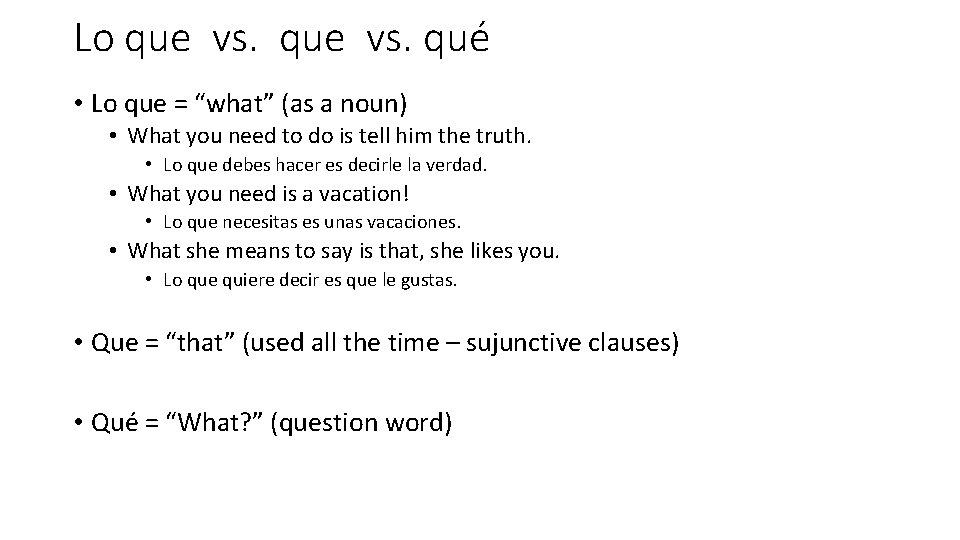
Lo que vs. qué • Lo que = “what” (as a noun) • What you need to do is tell him the truth. • Lo que debes hacer es decirle la verdad. • What you need is a vacation! • Lo que necesitas es unas vacaciones. • What she means to say is that, she likes you. • Lo que quiere decir es que le gustas. • Que = “that” (used all the time – sujunctive clauses) • Qué = “What? ” (question word)
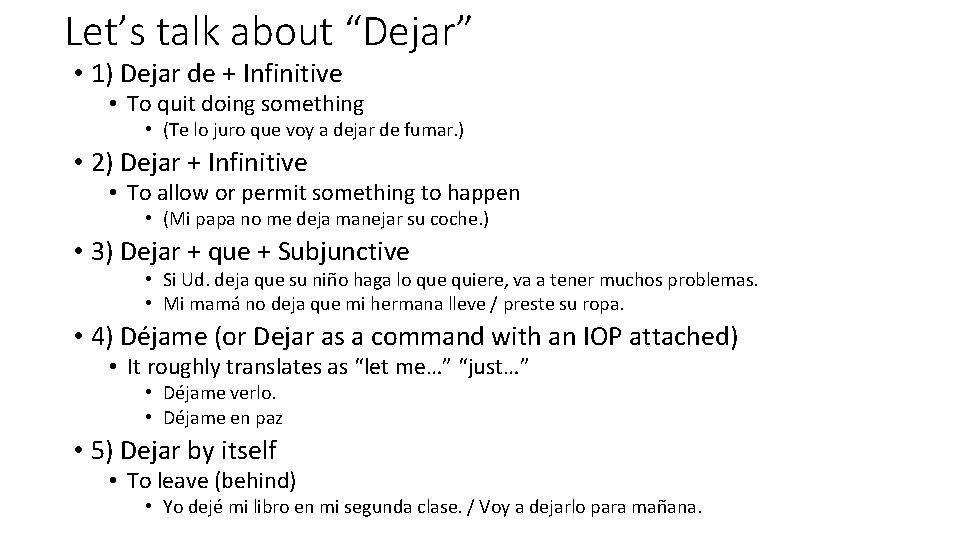
Let’s talk about “Dejar” • 1) Dejar de + Infinitive • To quit doing something • (Te lo juro que voy a dejar de fumar. ) • 2) Dejar + Infinitive • To allow or permit something to happen • (Mi papa no me deja manejar su coche. ) • 3) Dejar + que + Subjunctive • Si Ud. deja que su niño haga lo que quiere, va a tener muchos problemas. • Mi mamá no deja que mi hermana lleve / preste su ropa. • 4) Déjame (or Dejar as a command with an IOP attached) • It roughly translates as “let me…” “just…” • Déjame verlo. • Déjame en paz • 5) Dejar by itself • To leave (behind) • Yo dejé mi libro en mi segunda clase. / Voy a dejarlo para mañana.
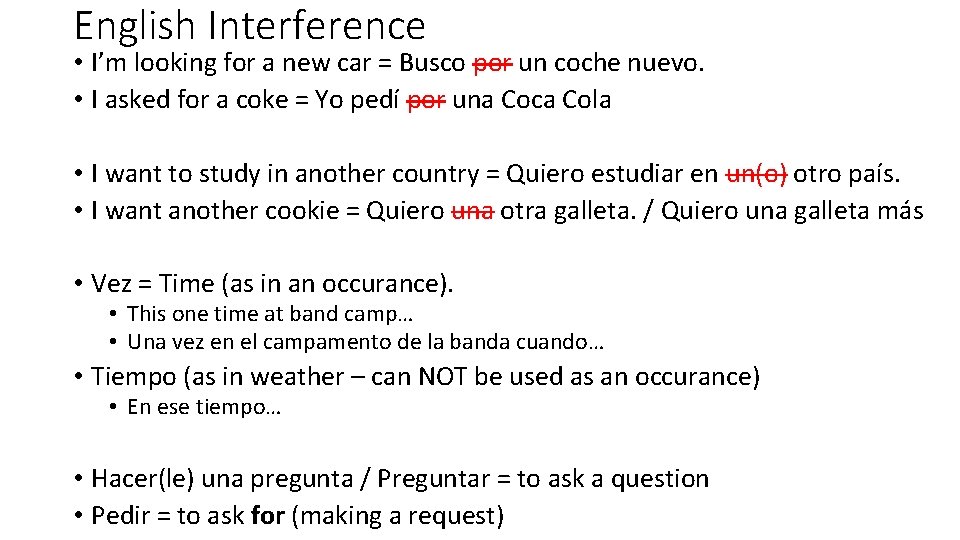
English Interference • I’m looking for a new car = Busco por un coche nuevo. • I asked for a coke = Yo pedí por una Coca Cola • I want to study in another country = Quiero estudiar en un(o) otro país. • I want another cookie = Quiero una otra galleta. / Quiero una galleta más • Vez = Time (as in an occurance). • This one time at band camp… • Una vez en el campamento de la banda cuando… • Tiempo (as in weather – can NOT be used as an occurance) • En ese tiempo… • Hacer(le) una pregunta / Preguntar = to ask a question • Pedir = to ask for (making a request)
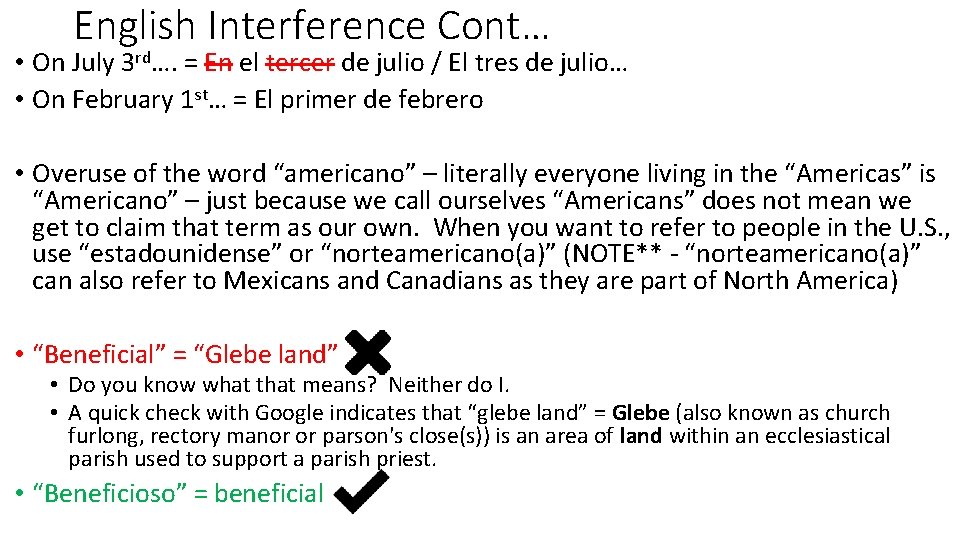
English Interference Cont… • On July 3 rd…. = En el tercer de julio / El tres de julio… • On February 1 st… = El primer de febrero • Overuse of the word “americano” – literally everyone living in the “Americas” is “Americano” – just because we call ourselves “Americans” does not mean we get to claim that term as our own. When you want to refer to people in the U. S. , use “estadounidense” or “norteamericano(a)” (NOTE** - “norteamericano(a)” can also refer to Mexicans and Canadians as they are part of North America) • “Beneficial” = “Glebe land” • Do you know what that means? Neither do I. • A quick check with Google indicates that “glebe land” = Glebe (also known as church furlong, rectory manor or parson's close(s)) is an area of land within an ecclesiastical parish used to support a parish priest. • “Beneficioso” = beneficial
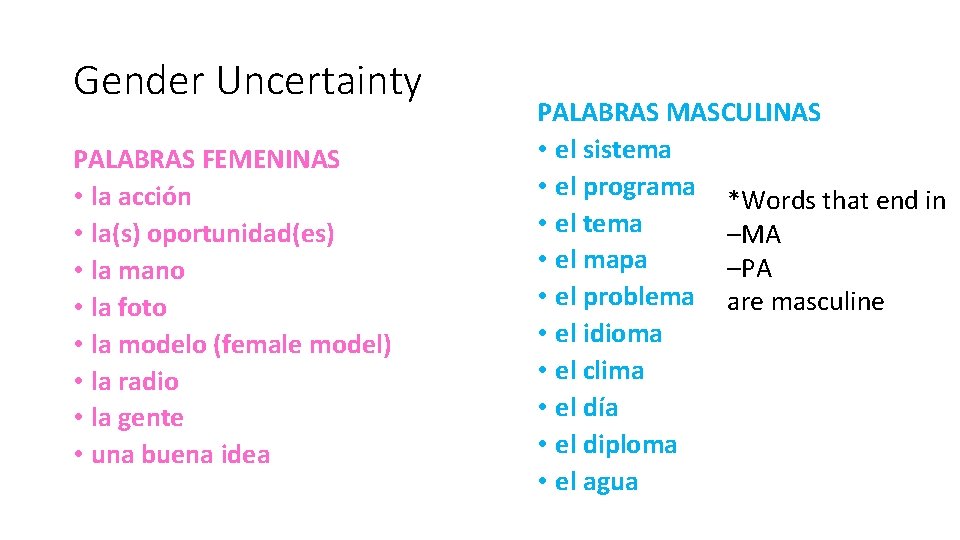
Gender Uncertainty PALABRAS FEMENINAS • la acción • la(s) oportunidad(es) • la mano • la foto • la modelo (female model) • la radio • la gente • una buena idea PALABRAS MASCULINAS • el sistema • el programa *Words that end in • el tema –MA • el mapa –PA • el problema are masculine • el idioma • el clima • el día • el diploma • el agua
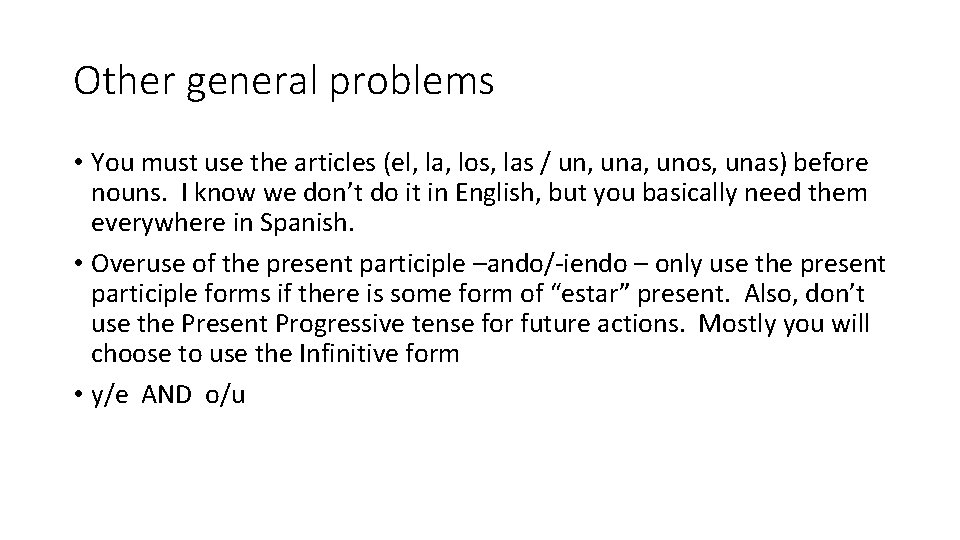
Other general problems • You must use the articles (el, la, los, las / un, una, unos, unas) before nouns. I know we don’t do it in English, but you basically need them everywhere in Spanish. • Overuse of the present participle –ando/-iendo – only use the present participle forms if there is some form of “estar” present. Also, don’t use the Present Progressive tense for future actions. Mostly you will choose to use the Infinitive form • y/e AND o/u
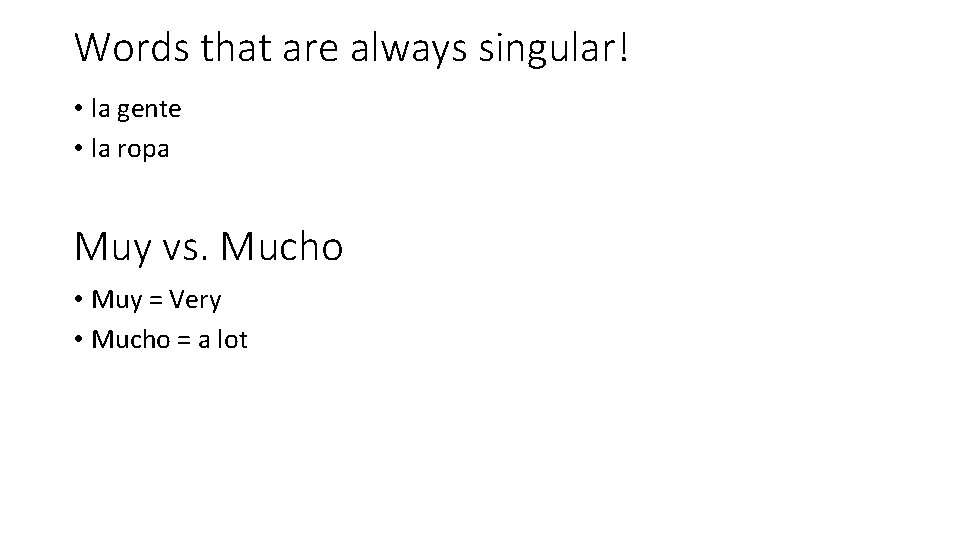
Words that are always singular! • la gente • la ropa Muy vs. Mucho • Muy = Very • Mucho = a lot
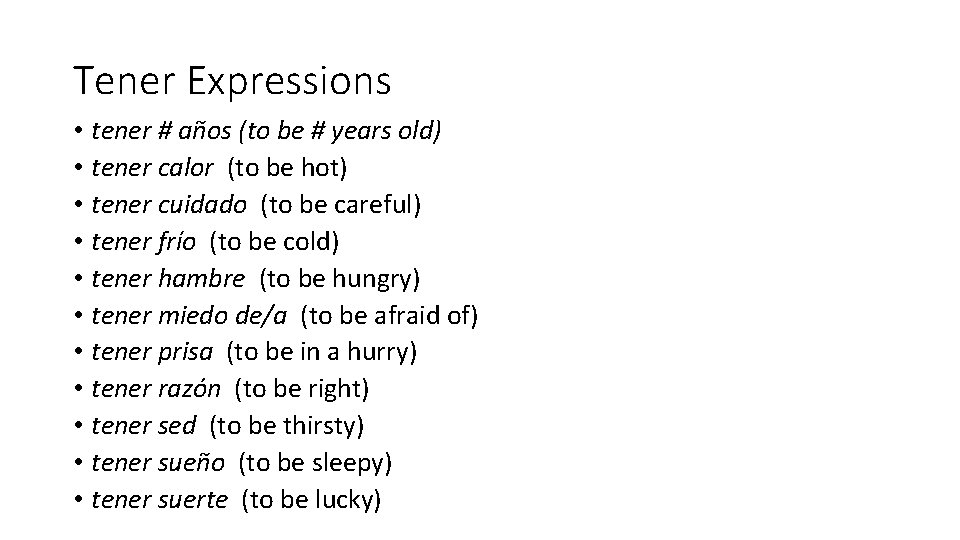
Tener Expressions • tener # años (to be # years old) • tener calor (to be hot) • tener cuidado (to be careful) • tener frío (to be cold) • tener hambre (to be hungry) • tener miedo de/a (to be afraid of) • tener prisa (to be in a hurry) • tener razón (to be right) • tener sed (to be thirsty) • tener sueño (to be sleepy) • tener suerte (to be lucky)
- Slides: 21