
Grammar Clauses and Sentences Clauses A clause is



- Slides: 18
Grammar Clauses and Sentences
Clauses �A clause is a group of words with its own subject and verb. �Clauses, like phrases, are groups of related words, but unlike phrases, they have a subject and a verb. �An independent clause can stand by itself as a complete sentence. �All complete sentences must contain at least one independent clause. �Examples: � My aunt visited Africa for two weeks. (1) � Wilma went to South Africa, and her sister went to Egypt. (2)
Clauses �A dependent clause is CANNOT stand by itself as a complete sentence; it can only be part of a sentence. �Subordinate clauses can be adjectives, adverbs, or nouns. �Examples �We visited Kenya, which is a country in Africa, for two weeks. (Adjective describing Kenya) �Because he woke up late, he missed the flight. (Adverb modifying missed) �They have decided that you should study more. (Noun – direct object)
Adjective Clause �An adjective clause is a subordinate clause that modifies a noun or pronoun by telling what kind? or which one? �Adjective clauses usually begin with a relative pronoun. �that, which, whom, or whose �Sometimes they may begin with a relative adverb such as: �before, since, when, where, or why.
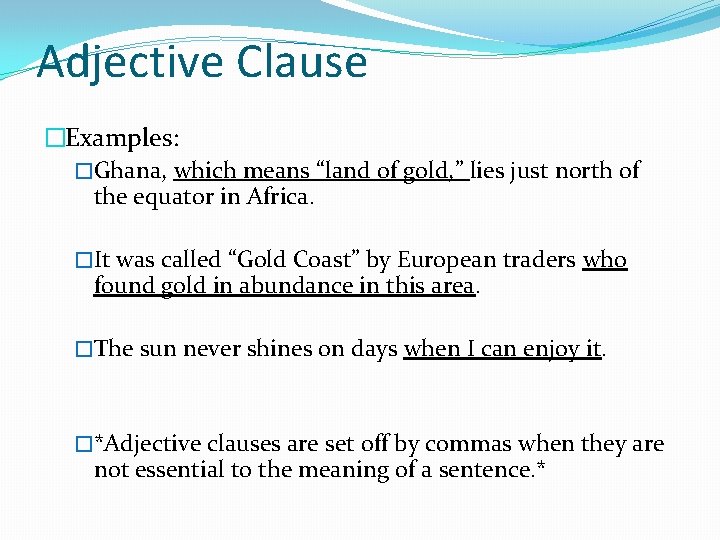
Adjective Clause �Examples: �Ghana, which means “land of gold, ” lies just north of the equator in Africa. �It was called “Gold Coast” by European traders who found gold in abundance in this area. �The sun never shines on days when I can enjoy it. �*Adjective clauses are set off by commas when they are not essential to the meaning of a sentence. *
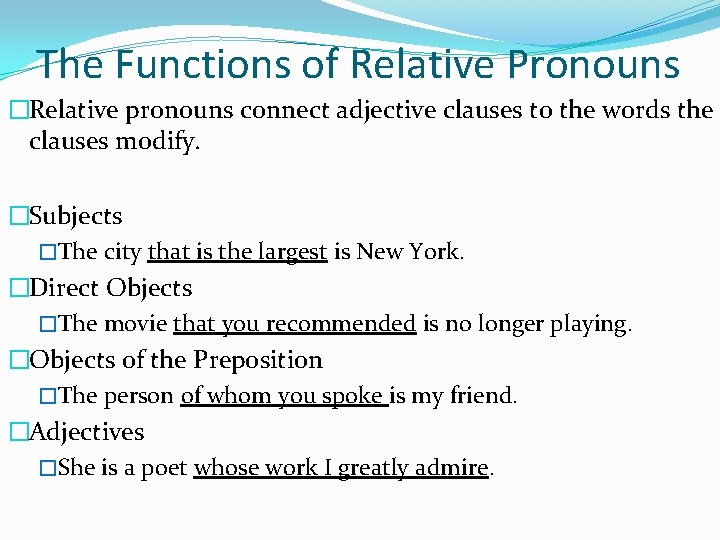
The Functions of Relative Pronouns �Relative pronouns connect adjective clauses to the words the clauses modify. �Subjects �The city that is the largest is New York. �Direct Objects �The movie that you recommended is no longer playing. �Objects of the Preposition �The person of whom you spoke is my friend. �Adjectives �She is a poet whose work I greatly admire.
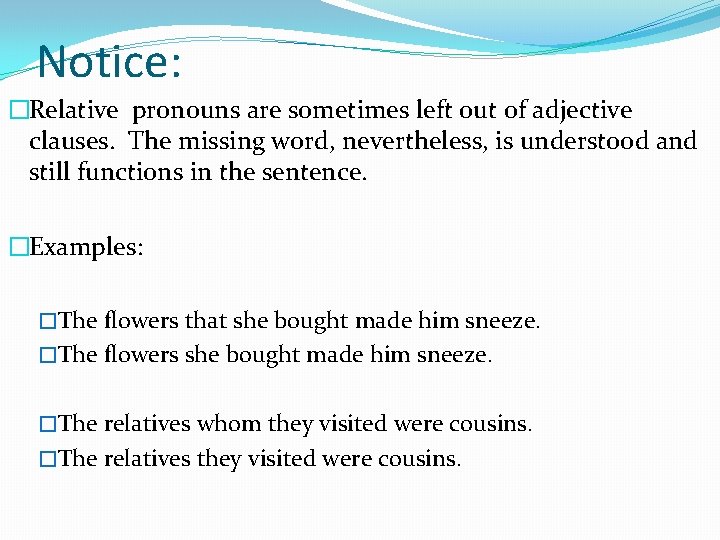
Notice: �Relative pronouns are sometimes left out of adjective clauses. The missing word, nevertheless, is understood and still functions in the sentence. �Examples: �The flowers that she bought made him sneeze. �The flowers she bought made him sneeze. �The relatives whom they visited were cousins. �The relatives they visited were cousins.
Adverb Clauses �An adverb clause is a subordinate clause that modifies a verb, an adjective, an adverb, or a verbal by telling when, where, in what way, to what extent, under what condition, or why. �All adverb clauses begin with subordinating conjunctions. �Most commonly used: �After even though unless �Although if until �As in order that when �As if since whenever �As long as so that where �Because than wherever �Before though while
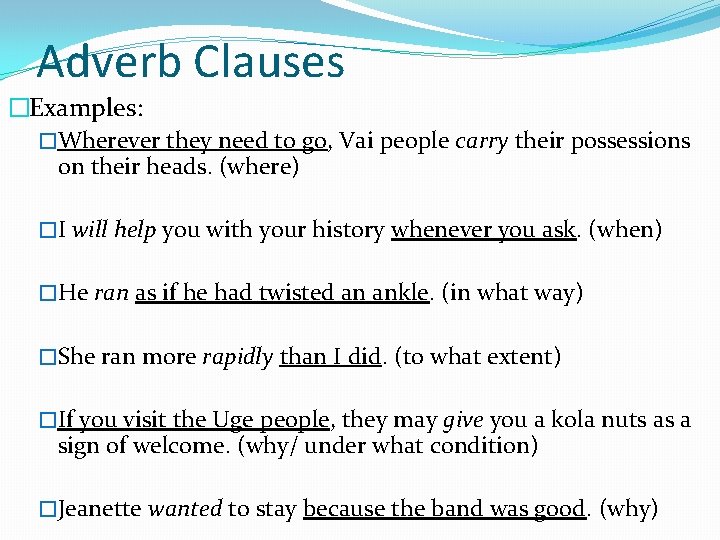
Adverb Clauses �Examples: �Wherever they need to go, Vai people carry their possessions on their heads. (where) �I will help you with your history whenever you ask. (when) �He ran as if he had twisted an ankle. (in what way) �She ran more rapidly than I did. (to what extent) �If you visit the Uge people, they may give you a kola nuts as a sign of welcome. (why/ under what condition) �Jeanette wanted to stay because the band was good. (why)
Adverb Clauses �Examples: �Modifying a Verb � They will be caught unless they can run faster. �Modifying an Adjective � The cheetah is swift because his legs are built for speed. �Modifying an Adverb � The storm struck sooner than the forecasters expected.
Elliptical Clauses �An elliptical clause is a clause in which the verb or the subject and the verb are understood but not actually stated. �When adverb clauses beginning with as or than are used to express comparisons, words are sometimes left out. �Examples: �He runs faster than I run. �He runs faster than I. �I respect her more than I respect him. �I respect her more than him.
Noun Clauses �A noun clause is a subordinate clause that acts as a noun. �Subject: �What happened next surprised us all. �Direct Object: �The nomads find whatever water is in the desert. �Indirect Object: �The teacher gave whoever presented an oral report extra credit. �Predicate Nominative: �The big question is whether he will be allowed to play on the team. �Object of a Preposition: �They store their food in plastic or in whatever containers they have.
Four Sentence Structures �Simple Sentence: single independent clause; no subordinate clause. �Compound Sentence: two or more independent clauses; no subordinate clause. �Complex Sentence: one independent clause and one or more subordinate clauses. �Compound-Complex Sentence: two or more independent clauses at least one subordinate clause.
Four Sentence Structures �Simple Sentence: single independent clause; no subordinate clause. �Simple sentences express one thought and have only ONE subject-verb combination. *(May have compound subjects and predicates. ) �Examples: � Jack walked to Dairy Queen. � Jack dropped his ice cream cone on the sidewalk. � Leslie and Jessica laughed at Jack. � Jack took out his wallet and bought another ice cream cone. � Jack is satisfied.
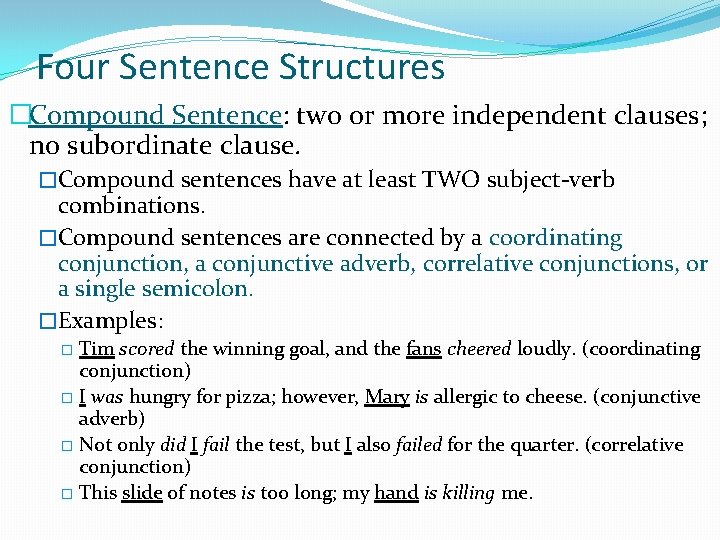
Four Sentence Structures �Compound Sentence: two or more independent clauses; no subordinate clause. �Compound sentences have at least TWO subject-verb combinations. �Compound sentences are connected by a coordinating conjunction, a conjunctive adverb, correlative conjunctions, or a single semicolon. �Examples: Tim scored the winning goal, and the fans cheered loudly. (coordinating conjunction) � I was hungry for pizza; however, Mary is allergic to cheese. (conjunctive adverb) � Not only did I fail the test, but I also failed for the quarter. (correlative conjunction) � This slide of notes is too long; my hand is killing me. �
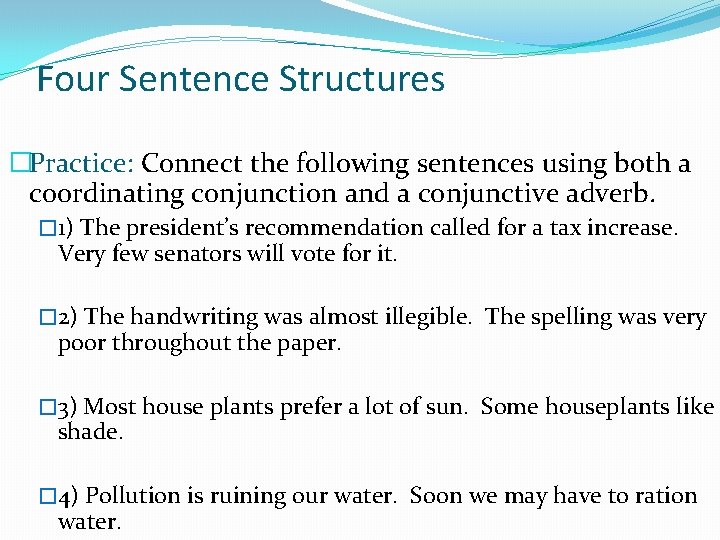
Four Sentence Structures �Practice: Connect the following sentences using both a coordinating conjunction and a conjunctive adverb. � 1) The president’s recommendation called for a tax increase. Very few senators will vote for it. � 2) The handwriting was almost illegible. The spelling was very poor throughout the paper. � 3) Most house plants prefer a lot of sun. Some houseplants like shade. � 4) Pollution is ruining our water. Soon we may have to ration water.
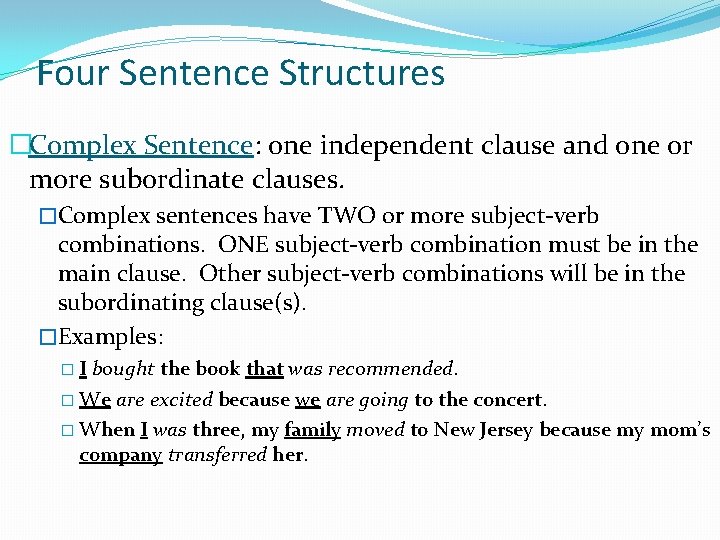
Four Sentence Structures �Complex Sentence: one independent clause and one or more subordinate clauses. �Complex sentences have TWO or more subject-verb combinations. ONE subject-verb combination must be in the main clause. Other subject-verb combinations will be in the subordinating clause(s). �Examples: �I bought the book that was recommended. � We are excited because we are going to the concert. � When I was three, my family moved to New Jersey because my mom’s company transferred her.
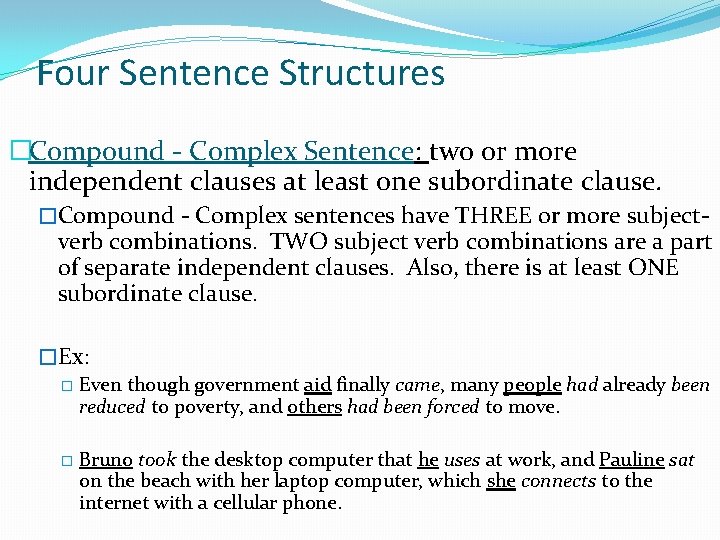
Four Sentence Structures �Compound - Complex Sentence: two or more independent clauses at least one subordinate clause. �Compound - Complex sentences have THREE or more subject- verb combinations. TWO subject verb combinations are a part of separate independent clauses. Also, there is at least ONE subordinate clause. �Ex: � Even though government aid finally came, many people had already been reduced to poverty, and others had been forced to move. � Bruno took the desktop computer that he uses at work, and Pauline sat on the beach with her laptop computer, which she connects to the internet with a cellular phone.