
Grammar and Meaning Clause Complexes Robert Fox Overview
Grammar and Meaning: Clause Complexes Robert Fox

Overview of Clause Complexes Co-ordinated clauses: equal status (paratactic relationship) Sub-ordinated clauses: dependency (hypotactic relationship) N. B. *Embedded (rank shifted) clauses not considered a clause complex

Coordinated Clauses (Paratactic) Clauses of equal status are often joined by conjunctions: FANBOYS: FOR, AND, NOR, BUT, OR, YET, SO AND (additive: addition, time sequence, logical sequence) I love you, and I want to marry you. 1 2 OR (disjunctive: alternation) Are you going out, or are you staying home? 1 2 BUT (adversative: contrast) I like you, but I do not love you. 1 2 SO (consequential, cause and effect) I’ve started, so I’ll finish. 1 2

Subordinated Clauses One Clause can be dependent on another: Dominant clause (alpha) α Dependent clause (beta) β She eats cakes until she feels sick. α β
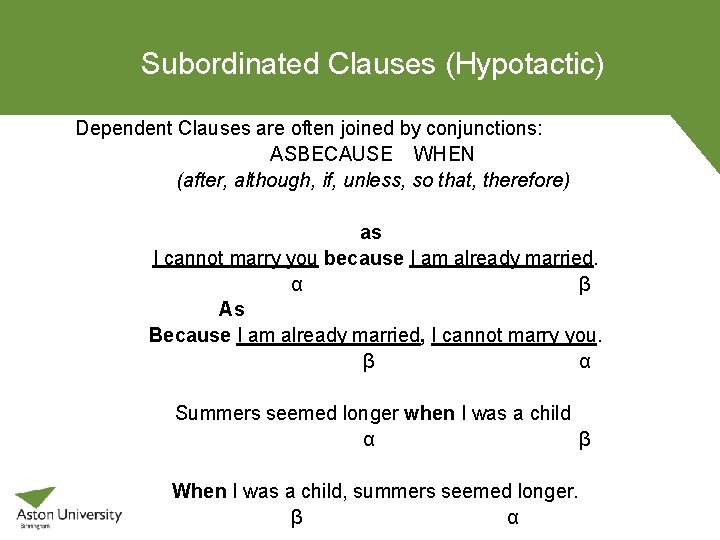
Subordinated Clauses (Hypotactic) Dependent Clauses are often joined by conjunctions: ASBECAUSE WHEN (after, although, if, unless, so that, therefore) as I cannot marry you because I am already married. α β As Because I am already married, I cannot marry you. β α Summers seemed longer when I was a child α β When I was a child, summers seemed longer. β α
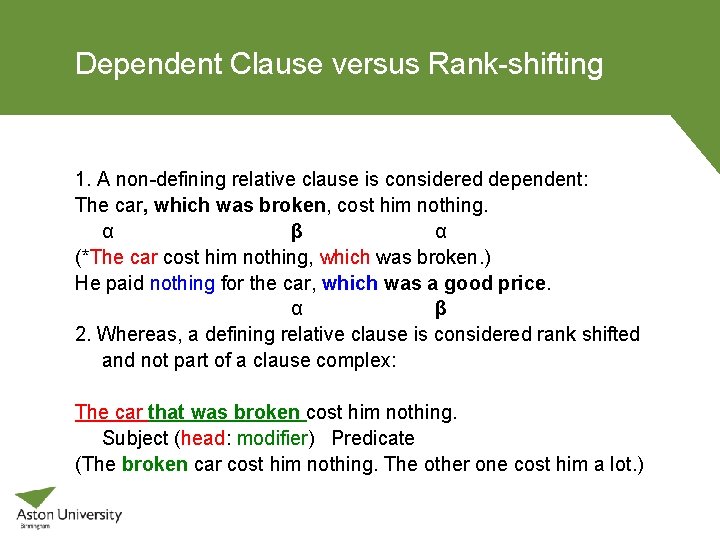
Dependent Clause versus Rank-shifting 1. A non-defining relative clause is considered dependent: The car, which was broken, cost him nothing. α β α (*The car cost him nothing, which was broken. ) He paid nothing for the car, which was a good price. α β 2. Whereas, a defining relative clause is considered rank shifted and not part of a clause complex: The car that was broken cost him nothing. Subject (head: modifier) Predicate (The broken car cost him nothing. The other one cost him a lot. )
References Bloor, T. and Bloor, M. (2004) The Functional Analysis of English: A Hallidayan Approach (2 nd Ed) London: Edward Arnold. HALLIDAY, M. A. K. (1985) An Introduction to Functional Grammar. London: Edward Arnold.
- Slides: 7