
Grammar A 2 past continuous Recommended for Gold
![2. Function: When do we use it? [Reading a book: ] It was a](https://slidetodoc.com/presentation_image_h2/b818a3c99b666230bee3f6846c415cfc/image-5.jpg "2. Function: When do we use it? [Reading a book: ] It was a")
- Slides: 10
Grammar A 2 past continuous Recommended for: Gold Experience Focus High Note 2019 1
The past continuous Let’s look at: 1. When we use the past continuous. 2. The past continuous versus the past simple. 3. How we make sentences in the past continuous. When do we use it? Copyright © 2019 by Pearson Education Gold Experience | Focus | High Note
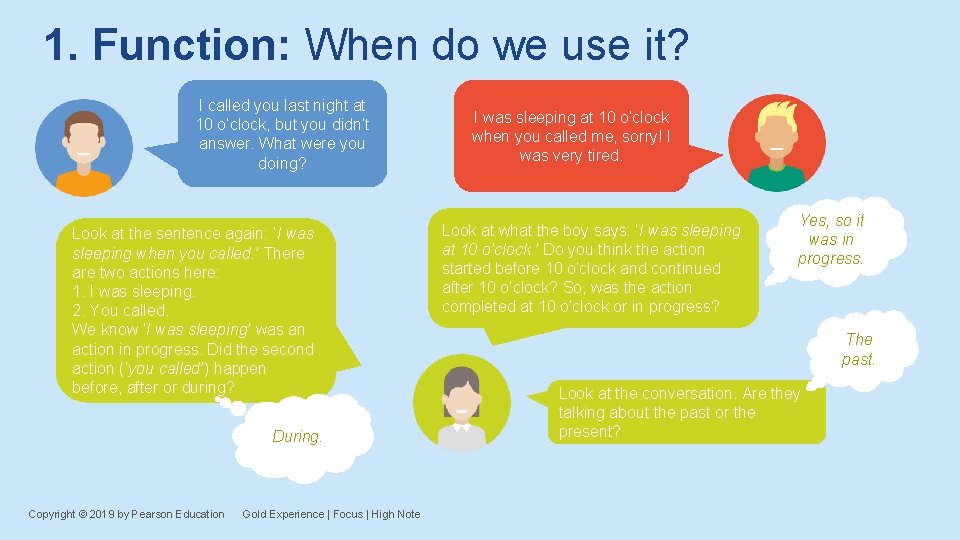
1. Function: When do we use it? I called you last night at 10 o’clock, but you didn’t answer. What were you doing? Look at the sentence again: ‘I was sleeping when you called. ’ There are two actions here: 1. I was sleeping. 2. You called. We know ‘I was sleeping’ was an action in progress. Did the second action (‘you called’) happen before, after or during? During. Copyright © 2019 by Pearson Education Gold Experience | Focus | High Note I was sleeping at 10 o’clock when you called me, sorry! I was very tired. Look at what the boy says: ‘I was sleeping at 10 o’clock. ’ Do you think the action started before 10 o’clock and continued after 10 o’clock? So, was the action completed at 10 o’clock or in progress? Yes, so it was in progress. The past. Look at the conversation. Are they talking about the past or the present?
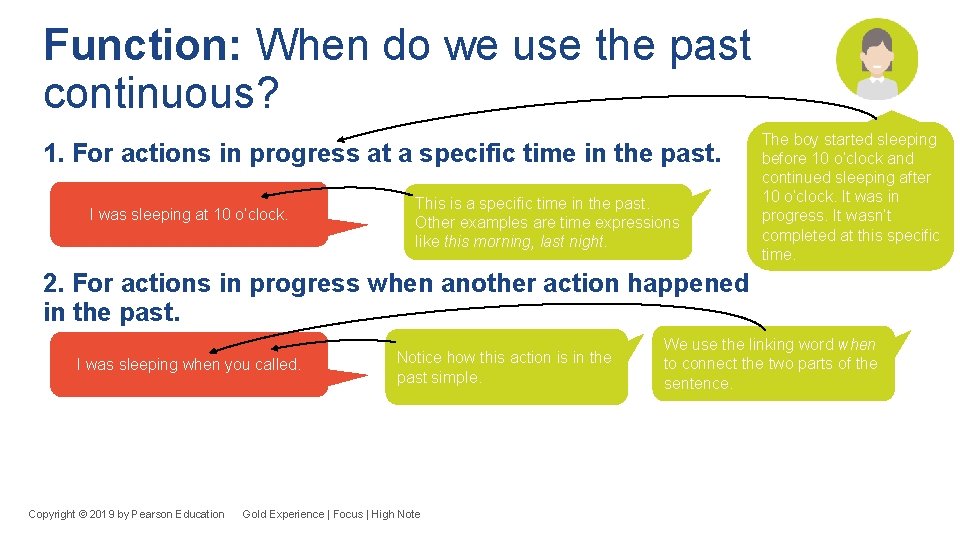
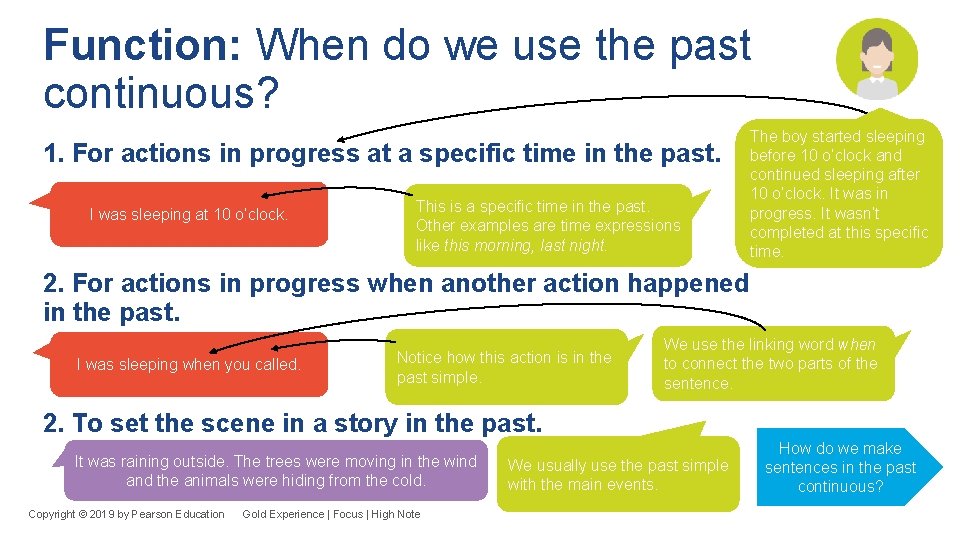
Function: When do we use the past continuous? 1. For actions in progress at a specific time in the past. I was sleeping at 10 o’clock. This is a specific time in the past. Other examples are time expressions like this morning, last night. The boy started sleeping before 10 o’clock and continued sleeping after 10 o’clock. It was in progress. It wasn’t completed at this specific time. 2. For actions in progress when another action happened in the past. I was sleeping when you called. Copyright © 2019 by Pearson Education Notice how this action is in the past simple. Gold Experience | Focus | High Note We use the linking word when to connect the two parts of the sentence.
2. Function: When do we use it? [Reading a book: ] It was a cold dark night and it was raining outside. The trees were moving in the wind and the animals were hiding from the cold. The past continuous. Do you think we usually use the past continuous or the past simple for the main events? Do we use the past simple here to set the scene or the past continuous? Copyright © 2019 by Pearson Education Gold Experience | Focus | High Note The past simple. It is setting the scene. Look at the section from a story above. Do you think this is one of the main events in the story or is it setting the scene?
Function: When do we use the past continuous? 1. For actions in progress at a specific time in the past. I was sleeping at 10 o’clock. This is a specific time in the past. Other examples are time expressions like this morning, last night. The boy started sleeping before 10 o’clock and continued sleeping after 10 o’clock. It was in progress. It wasn’t completed at this specific time. 2. For actions in progress when another action happened in the past. I was sleeping when you called. Notice how this action is in the past simple. We use the linking word when to connect the two parts of the sentence. 2. To set the scene in a story in the past. It was raining outside. The trees were moving in the wind and the animals were hiding from the cold. Copyright © 2019 by Pearson Education Gold Experience | Focus | High Note We usually use the past simple with the main events. How do we make sentences in the past continuous?
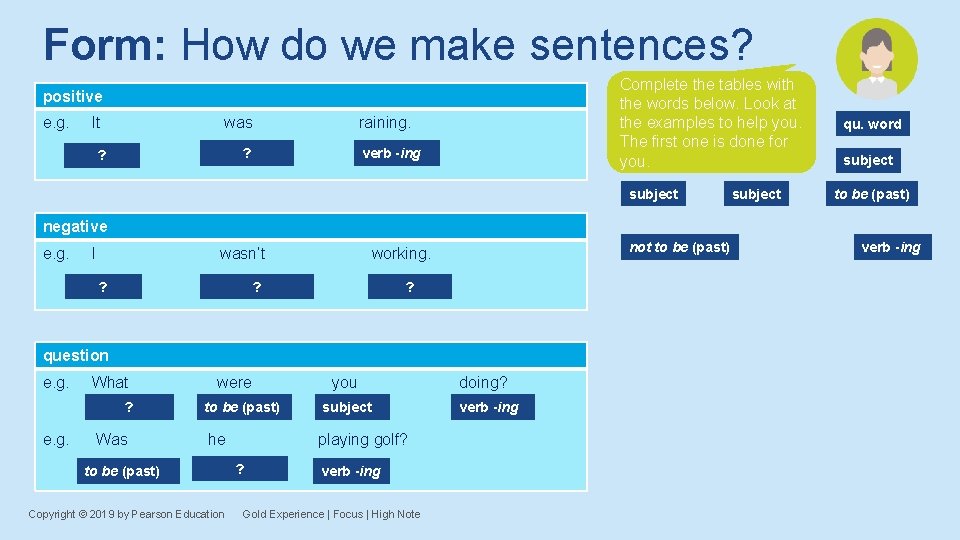
Form: How do we make sentences? Complete the tables with the words below. Look at the examples to help you. The first one is done for you. positive e. g. It was raining. ? ? verb -ing subject qu. word subject to be (past) negative e. g. I wasn’t ? not to be (past) working. ? ? question e. g. What ? e. g. Was were you to be (past) subject he playing golf? to be (past) Copyright © 2019 by Pearson Education ? verb -ing Gold Experience | Focus | High Note doing? verb -ing
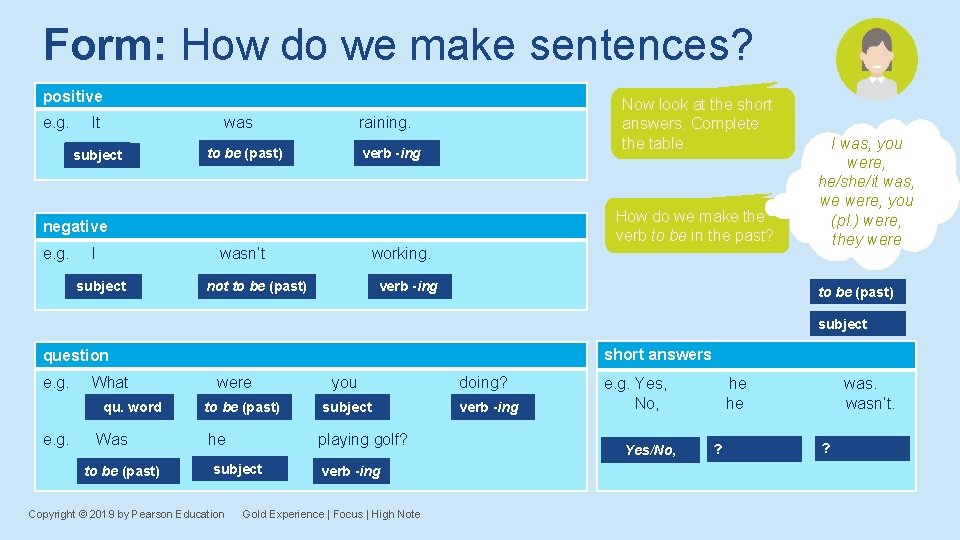
Form: How do we make sentences? positive e. g. It was subject ? Now look at the short answers. Complete the table. raining. to be ? (past) verb -ing How do we make the verb to be in the past? negative e. g. I wasn’t subject ? working. not to be ? (past) verb? -ing I was, you were, he/she/it was, we were, you (pl. ) were, they were to be (past) subject short answers question e. g. What qu. ? word e. g. Was to be (past) were you to be (past) subject he playing golf? ? subject Copyright © 2019 by Pearson Education verb -ing Gold Experience | Focus | High Note doing? verb -ing e. g. Yes, No, Yes/No, he he ? wasn’t. ?
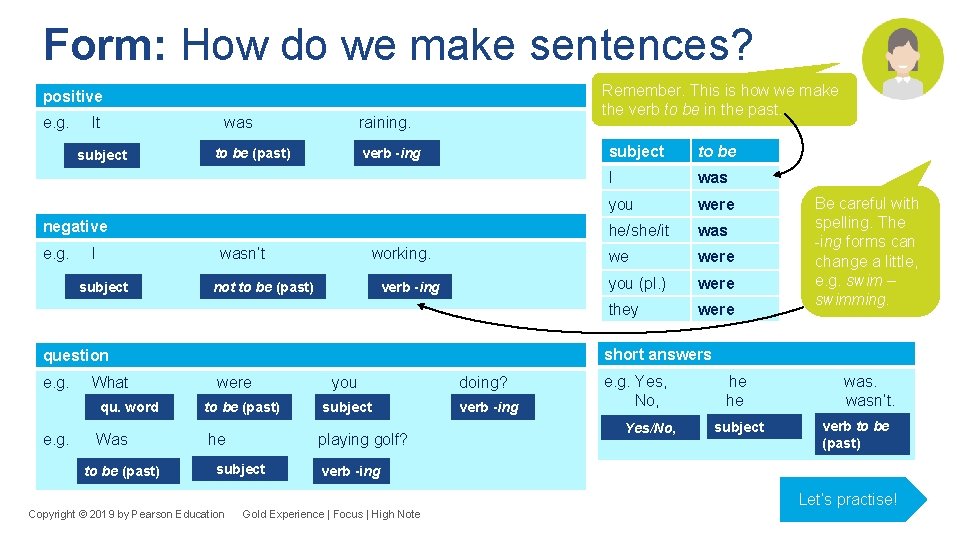
Form: How do we make sentences? Remember. This is how we make the verb to be in the past. positive e. g. It was subject raining. to be (past) verb -ing negative e. g. I wasn’t subject working. not to be (past) verb -ing What qu. word e. g. Was to be (past) to be I was you were he/she/it was we were you (pl. ) were they were Be careful with spelling. The -ing forms can change a little, e. g. swim – swimming. short answers question e. g. subject were to be (past) he subject playing golf? subject Copyright © 2019 by Pearson Education you doing? verb -ing e. g. Yes, No, Yes/No, he he subject wasn’t. verb to be (past) verb -ing Gold Experience | Focus | High Note Let’s practise!
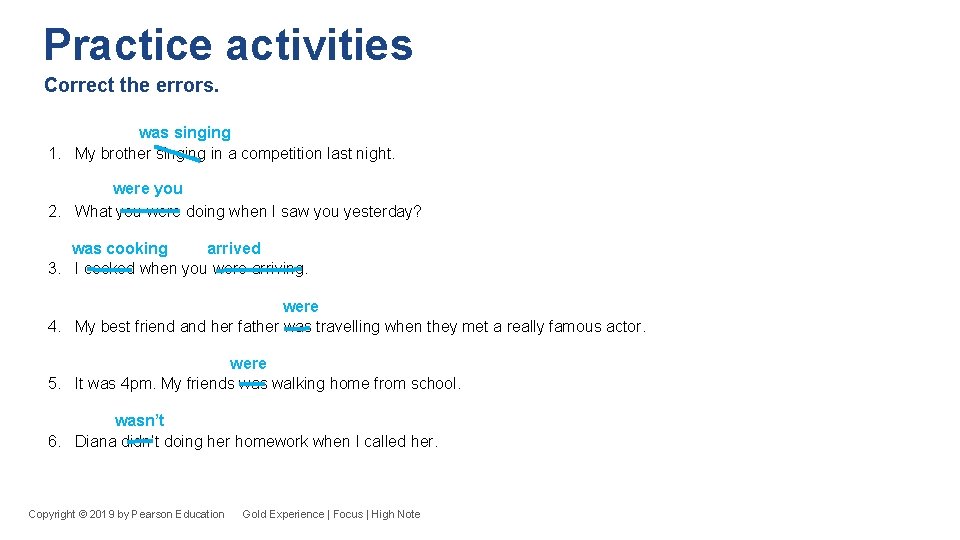
Practice activities Correct the errors. was singing 1. My brother singing in a competition last night. were you 2. What you were doing when I saw you yesterday? was cooking arrived 3. I cooked when you were arriving. were 4. My best friend and her father was travelling when they met a really famous actor. were 5. It was 4 pm. My friends walking home from school. wasn’t 6. Diana didn’t doing her homework when I called her. Copyright © 2019 by Pearson Education Gold Experience | Focus | High Note