
GRAMMAR 4 th Grade SUBJECTVERB CONCORD The most

GRAMMAR 4 th Grade

SUBJECT-VERB CONCORD • The most Common type of concord in English is concord number between subject and verb. (i. e. singular subject with singular verb , plural subject with a plural verb ): • • A singular subject requires a singular verb: • - My Son plays tennis after supper. [singular subject + singular verb] - - My Sons play tennis after supper. . [plural subject + plural verb]
SUBJECT-VERB CONCORD • When the subject is a noun phrase, the phrase is considered as singular if its head is singular: • The blue car is expensive. • If the head is plural, it is considered as plural : • The blue cars are expensive. • Note : If the subject is a clause it is considered as singular: • -To act like that is inhuman.
SUBJECT-VERB CONCORD • Note : when a Prepositional phrase or an adverb functioning as subject, it is considered as singular: • - In the holidays is better. • - After the holiday comes the exams. Note : Nominal relative clauses could have both plural and singular forms: • - What comes to his mind are foolish. • Whatever he says is correct.
SUBJECT-VERB CONCORD Note: Singular nouns ending with –s take a singular verb. • These nouns fall into the following classes: • - e. g. linguistics, mathematics, phonetics, statistics.
SUBJECT-VERB CONCORD • Plural nouns and coordinated nouns are considered as singular if they used as names, titles, quotations: • Tom and Jerry is very popular carton.
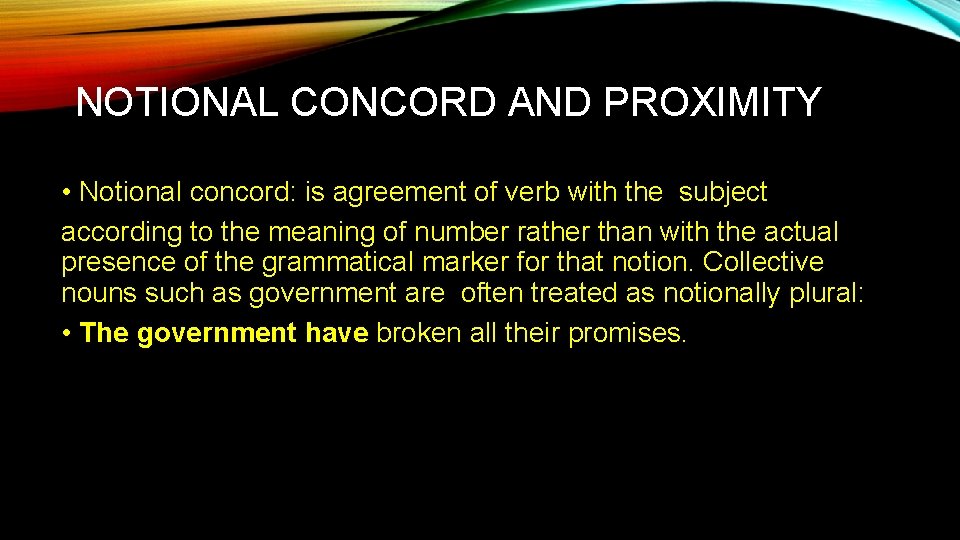
NOTIONAL CONCORD AND PROXIMITY • Notional concord: is agreement of verb with the subject according to the meaning of number rather than with the actual presence of the grammatical marker for that notion. Collective nouns such as government are often treated as notionally plural: • The government have broken all their promises.
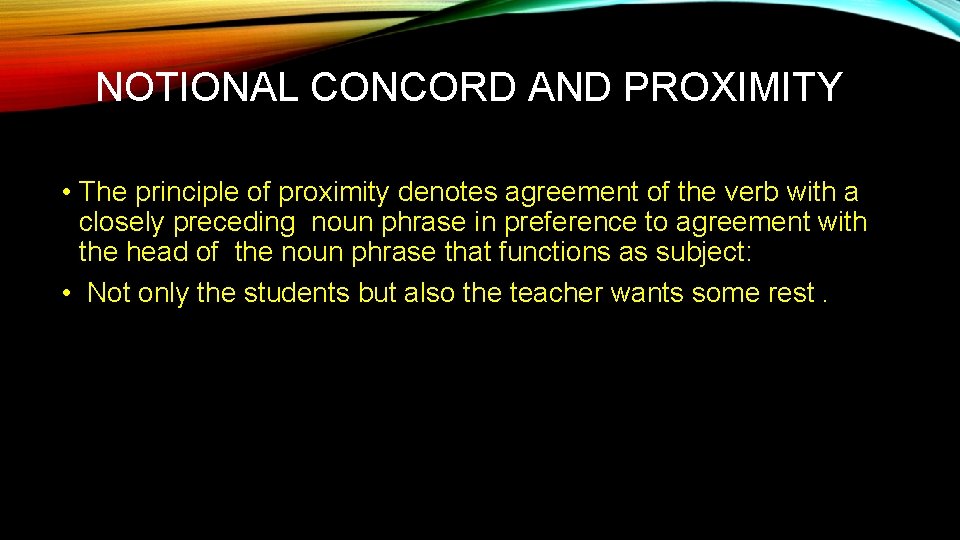
NOTIONAL CONCORD AND PROXIMITY • The principle of proximity denotes agreement of the verb with a closely preceding noun phrase in preference to agreement with the head of the noun phrase that functions as subject: • Not only the students but also the teacher wants some rest.
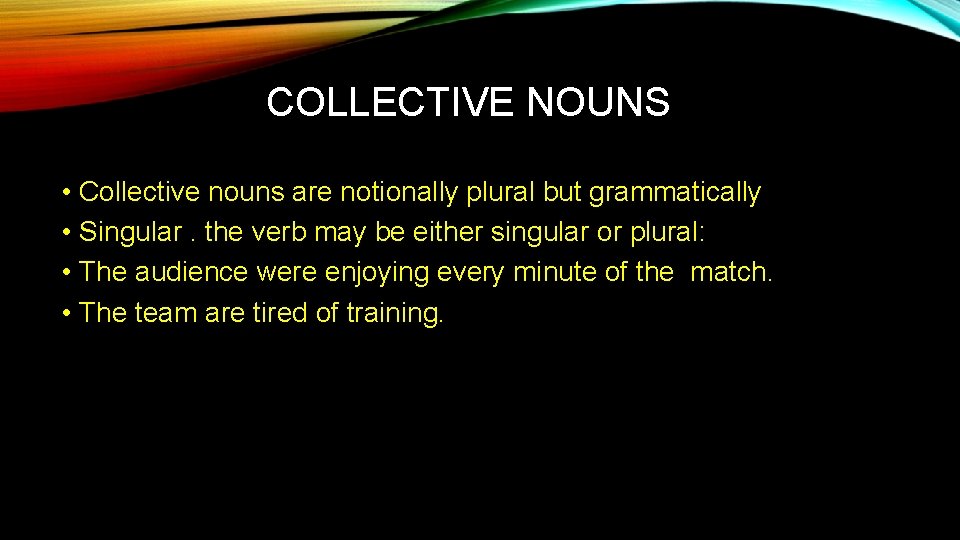
COLLECTIVE NOUNS • Collective nouns are notionally plural but grammatically • Singular. the verb may be either singular or plural: • The audience were enjoying every minute of the match. • The team are tired of training.
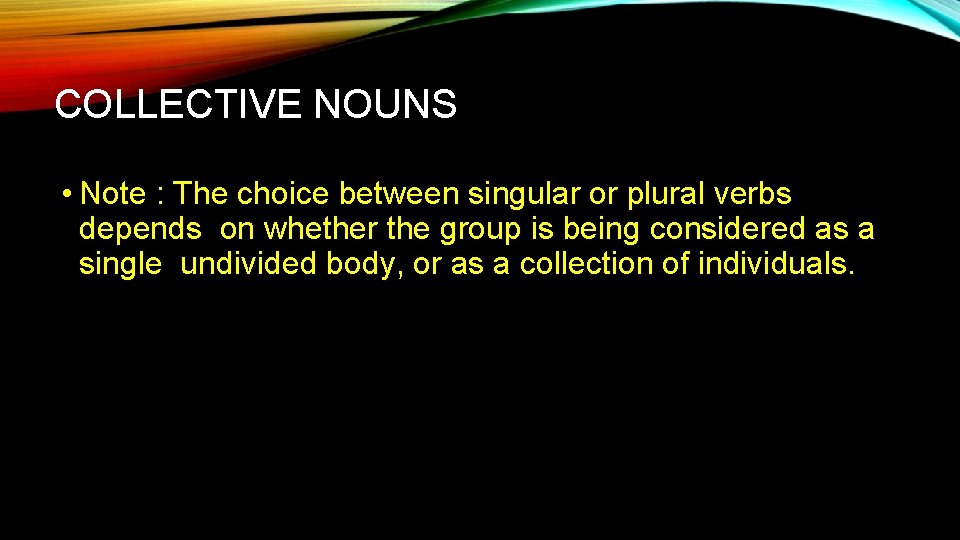
COLLECTIVE NOUNS • Note : The choice between singular or plural verbs depends on whether the group is being considered as a single undivided body, or as a collection of individuals.
- Slides: 10