
Grain Moisture Content Measurement Methods and Traceability in
Grain Moisture Content Measurement Methods and Traceability in China Rui Zhang Heilongjiang Institute of Measurement and Verification P. R. China

National Standards � � � GB/T 21305: 2007 Cereals and cereal products -- Determination of moisture content -- Reference method Method: Heating (oven) methods (130± 3) ℃. Applies to: wheat, rice (paddy, milled), barley, millet, rye, oats, triticale, sorghum in the form of grains, milled grains, semolina or flour. Not applicable to: maize and pulses. Equivalent to: ISO 712: 1998 "Cereals and cereal products -Determination of moisture content -- Reference method"
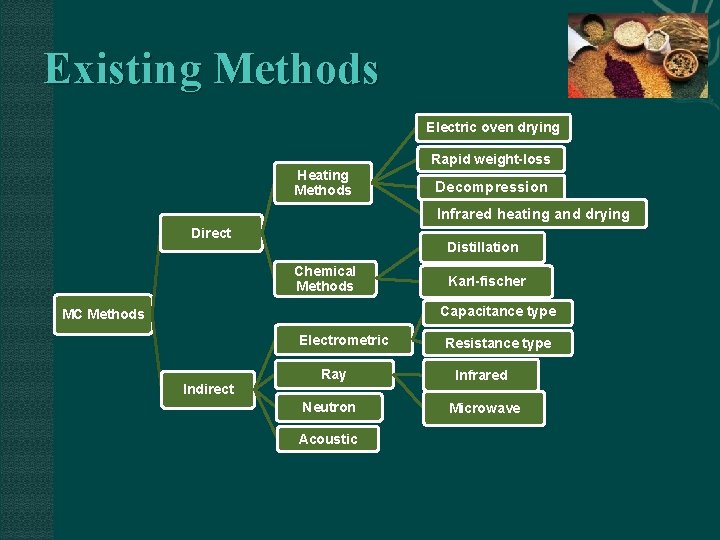
Existing Methods Electric oven drying Rapid weight-loss Heating Methods Decompression Infrared heating and drying Direct Distillation Chemical Methods Karl-fischer Capacitance type MC Methods Electrometric Indirect Ray Neutron Acoustic Resistance type Infrared Microwave
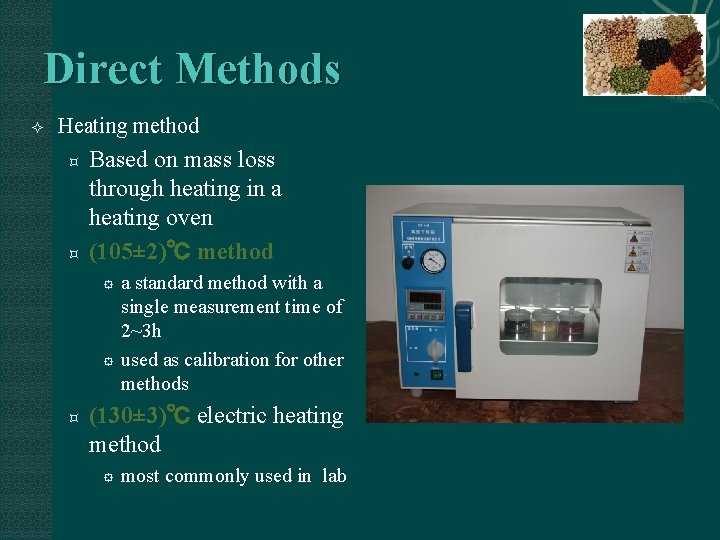
Direct Methods Heating method Based on mass loss through heating in a heating oven (105± 2)℃ method a standard method with a single measurement time of 2~3 h used as calibration for other methods (130± 3)℃ electric heating method most commonly used in lab
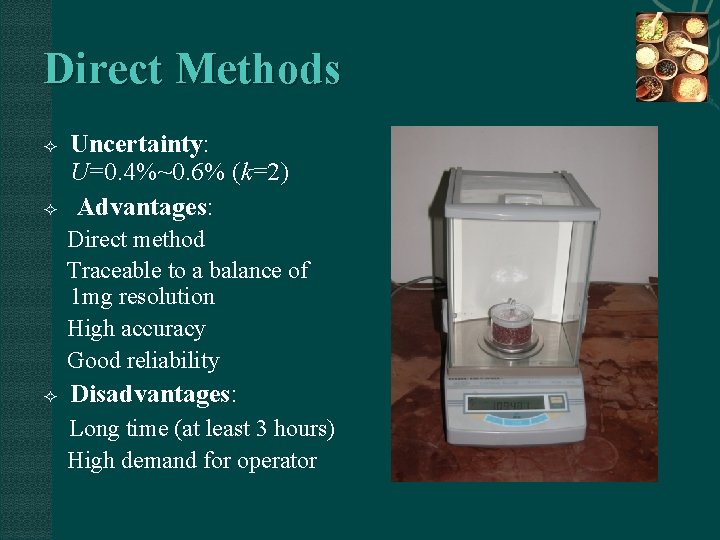
Direct Methods Uncertainty: U=0. 4%~0. 6% (k=2) Advantages: Direct method Traceable to a balance of 1 mg resolution High accuracy Good reliability Disadvantages: Long time (at least 3 hours) High demand for operator
Direct Methods Others Decompression method Not influenced by the shape of grains Free of special pretreatment Ease of operation High reliability Suitable for quality control Infrared heating method Using infrared lamps High precision Easy to use Wide rang of measurement. Time consuming (1030 min).
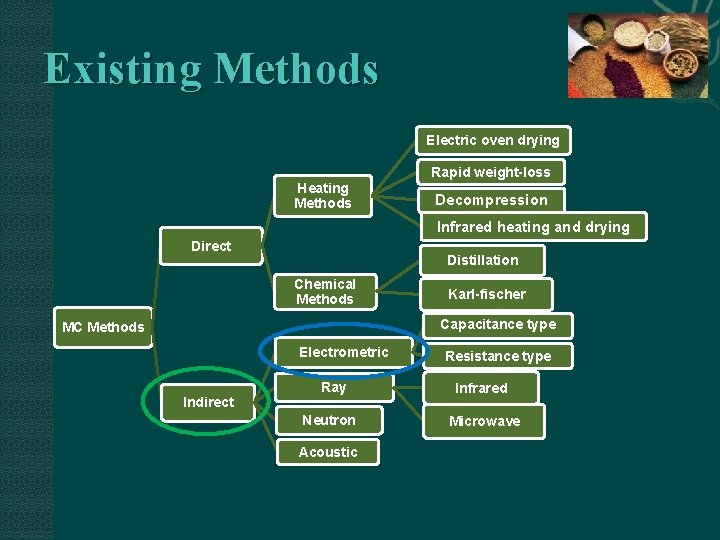
Existing Methods Electric oven drying Rapid weight-loss Heating Methods Decompression Infrared heating and drying Direct Distillation Chemical Methods Karl-fischer Capacitance type MC Methods Electrometric Indirect Ray Neutron Acoustic Resistance type Infrared Microwave

Indirect methods_ Electrometric method Resistance Method Principle Determined according to the changes of conductance. Advantages Fast response Simple structure Easy operation Disadvantages Capacitance Method Principle Determined by measuring the dielectric constant of the grain. Advantages High reliability Low cost Easy operation and maintenance Online determination For high MC samples. Temperature influences the MC results Not suitable for high MC samples and trace water Disadvantages Lots of influencing factor and complex data
Traceability of Moisture Meter � � JJG 891 -1995 Verification Regulation of Instruments for Measuring the Moisture Content of Grain. � Requirement of techniques � Conditions of verification � Methods for verification � Period of verification
Traceability of Moisture Meter � JJG 891 -1995 � Requirement of techniques � Safety requirement � � Resistance between source circuit and insulation > 7 MΩ The instrument shall endure 50 Hz, 1500 V sine wave AC, 5 m. A, 1 min between source circuit and insulation without breakdown and arc. � Measurement time < 5 min � Error indication
Conclusions � � MC plays an important role not only in storage of grain but also in grain marketing and handling. Measurement of grain moisture is not just a technical issue, but also associate with the vital interests of most Chinese farmers. � Standard method (GB/T 21305 -2007) � Verification regulation for instruments (JJG 891 -1995) � Existing methods � Therefore, more accurate, high throughput, more efficient and easier handling methods are in great demand.

THANK YOU!
- Slides: 12