
Grafeemfoneemomzetting voor spraaksynthese Two steps PGE will file

![Korte klinkers voor [-rond] hoog I (bid) [+rond] achter [-rond] [+rond] Y (put) midden](https://slidetodoc.com/presentation_image_h2/7fef494db5ba9fd834d930695f9dd831/image-26.jpg "Korte klinkers voor [-rond] hoog I (bid) [+rond] achter [-rond] [+rond] Y (put) midden")
![Lange klinkers voor [-rond] [+rond] achter [-rond] [+rond] hoog i (bied) y (buut) u](https://slidetodoc.com/presentation_image_h2/7fef494db5ba9fd834d930695f9dd831/image-27.jpg "Lange klinkers voor [-rond] [+rond] achter [-rond] [+rond] hoog i (bied) y (buut) u")
![Tweeklanken voor [-rond] midden Ei (bijt) [+rond] 9 y (buit) achter [-rond] [+rond] Au](https://slidetodoc.com/presentation_image_h2/7fef494db5ba9fd834d930695f9dd831/image-28.jpg "Tweeklanken voor [-rond] midden Ei (bijt) [+rond] 9 y (buit) achter [-rond] [+rond] Au")
![Gekleurde klinkers voor r voor [-rond] midden I: (beer) [+rond] Y: (deur) achter [-rond]](https://slidetodoc.com/presentation_image_h2/7fef494db5ba9fd834d930695f9dd831/image-29.jpg "Gekleurde klinkers voor r voor [-rond] midden I: (beer) [+rond] Y: (deur) achter [-rond]")
![Franse klanken voor [-rond] achter [+rond] E~ Y~ (mannequin) (parfum) [-rond] [+rond] A~ O~](https://slidetodoc.com/presentation_image_h2/7fef494db5ba9fd834d930695f9dd831/image-30.jpg "Franse klanken voor [-rond] achter [+rond] E~ Y~ (mannequin) (parfum) [-rond] [+rond] A~ O~")
- Slides: 30
Grafeem-foneemomzetting voor spraaksynthese
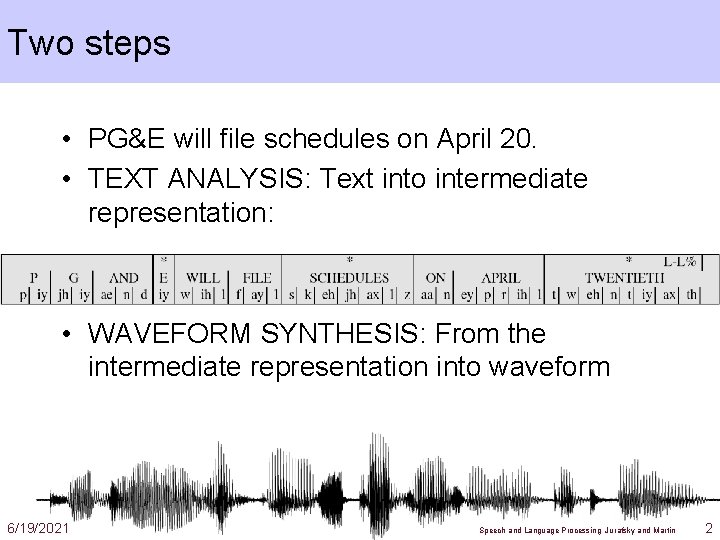
Two steps • PG&E will file schedules on April 20. • TEXT ANALYSIS: Text into intermediate representation: • WAVEFORM SYNTHESIS: From the intermediate representation into waveform 6/19/2021 Speech and Language Processing Jurafsky and Martin 2
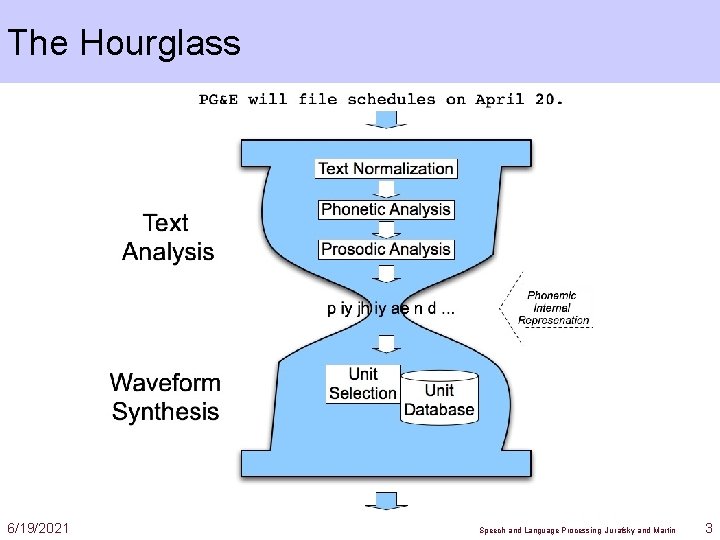
The Hourglass 6/19/2021 Speech and Language Processing Jurafsky and Martin 3
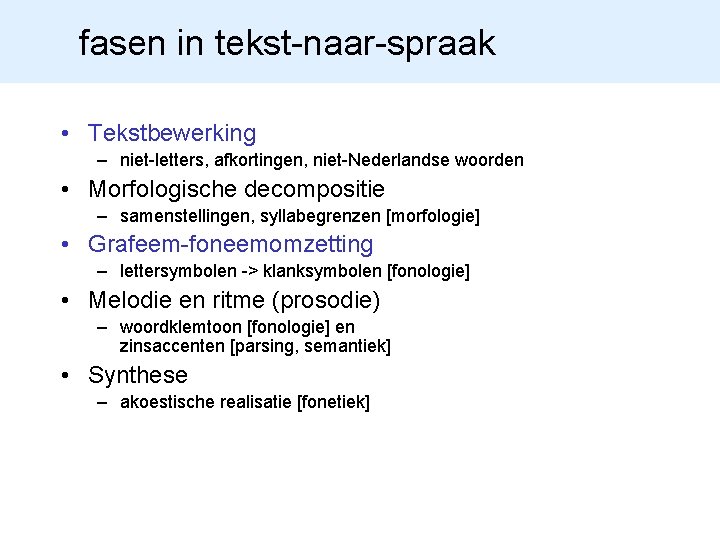
fasen in tekst-naar-spraak • Tekstbewerking – niet-letters, afkortingen, niet-Nederlandse woorden • Morfologische decompositie – samenstellingen, syllabegrenzen [morfologie] • Grafeem-foneemomzetting – lettersymbolen -> klanksymbolen [fonologie] • Melodie en ritme (prosodie) – woordklemtoon [fonologie] en zinsaccenten [parsing, semantiek] • Synthese – akoestische realisatie [fonetiek]
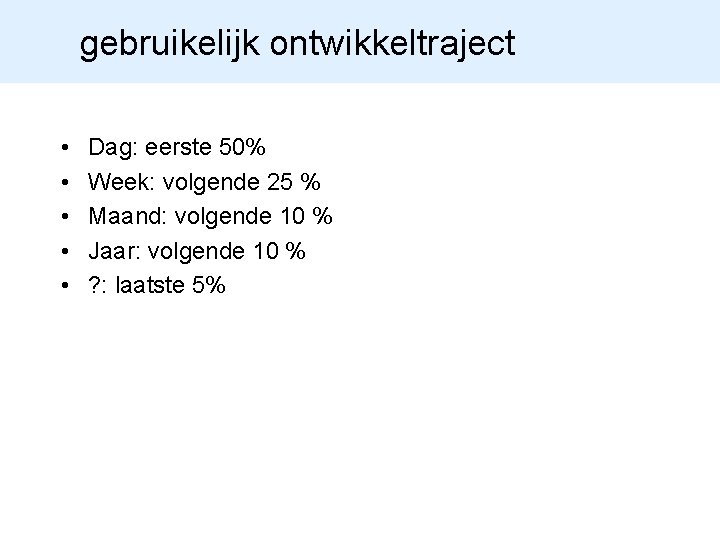
gebruikelijk ontwikkeltraject • • • Dag: eerste 50% Week: volgende 25 % Maand: volgende 10 % Jaar: volgende 10 % ? : laatste 5%
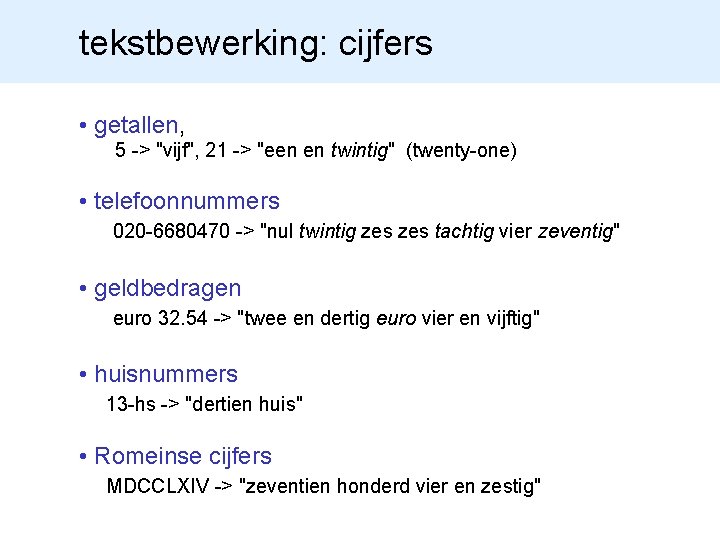
tekstbewerking: cijfers • getallen, 5 -> "vijf", 21 -> "een en twintig" (twenty-one) • telefoonnummers 020 -6680470 -> "nul twintig zes tachtig vier zeventig" • geldbedragen euro 32. 54 -> "twee en dertig euro vier en vijftig" • huisnummers 13 -hs -> "dertien huis" • Romeinse cijfers MDCCLXIV -> "zeventien honderd vier en zestig"
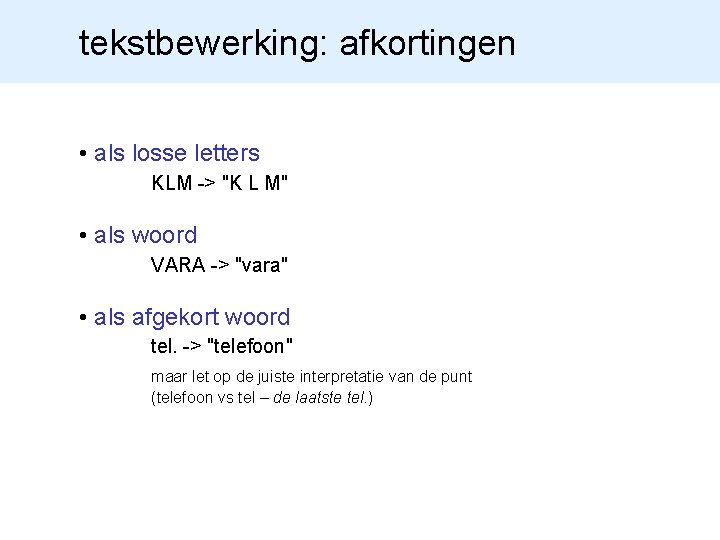
tekstbewerking: afkortingen • als losse letters KLM -> "K L M" • als woord VARA -> "vara" • als afgekort woord tel. -> "telefoon" maar let op de juiste interpretatie van de punt (telefoon vs tel – de laatste tel. )
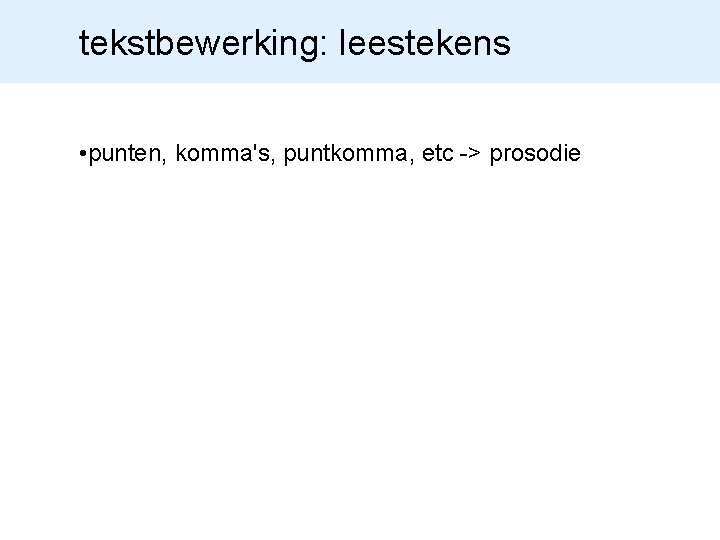
tekstbewerking: leestekens • punten, komma's, puntkomma, etc -> prosodie
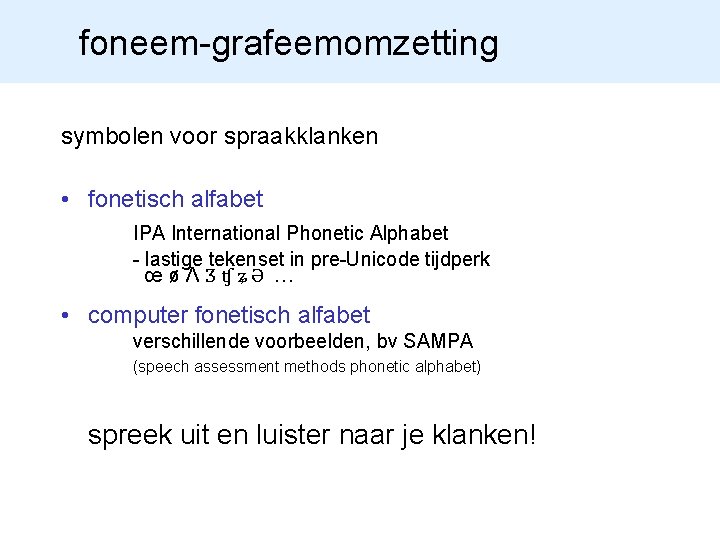
foneem-grafeemomzetting symbolen voor spraakklanken • fonetisch alfabet IPA International Phonetic Alphabet - lastige tekenset in pre-Unicode tijdperk œøΛƷʧʑƏ … • computer fonetisch alfabet verschillende voorbeelden, bv SAMPA (speech assessment methods phonetic alphabet) spreek uit en luister naar je klanken!
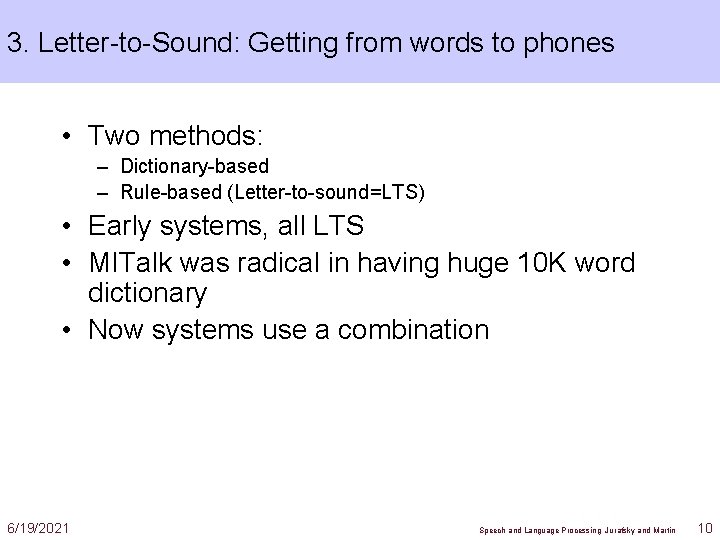
3. Letter-to-Sound: Getting from words to phones • Two methods: – Dictionary-based – Rule-based (Letter-to-sound=LTS) • Early systems, all LTS • MITalk was radical in having huge 10 K word dictionary • Now systems use a combination 6/19/2021 Speech and Language Processing Jurafsky and Martin 10
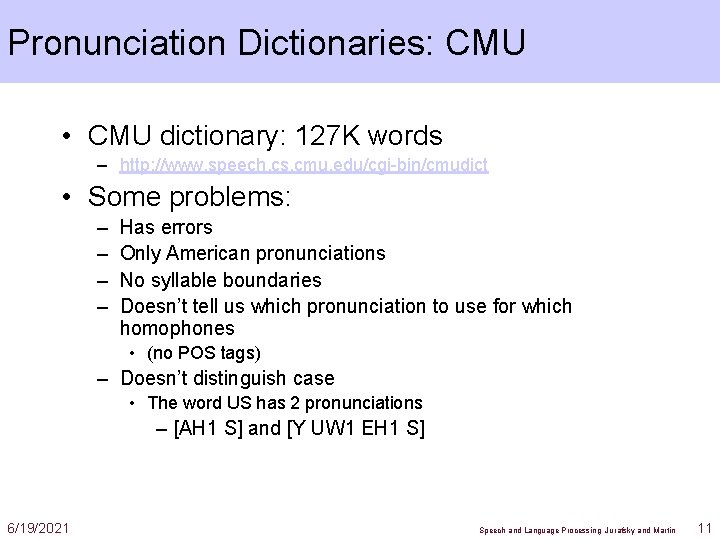
Pronunciation Dictionaries: CMU • CMU dictionary: 127 K words – http: //www. speech. cs. cmu. edu/cgi-bin/cmudict • Some problems: – – Has errors Only American pronunciations No syllable boundaries Doesn’t tell us which pronunciation to use for which homophones • (no POS tags) – Doesn’t distinguish case • The word US has 2 pronunciations – [AH 1 S] and [Y UW 1 EH 1 S] 6/19/2021 Speech and Language Processing Jurafsky and Martin 11
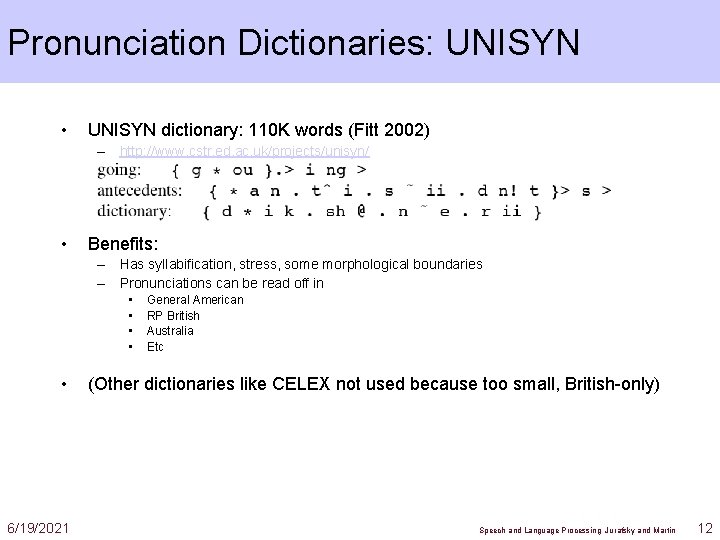
Pronunciation Dictionaries: UNISYN • UNISYN dictionary: 110 K words (Fitt 2002) – http: //www. cstr. ed. ac. uk/projects/unisyn/ • Benefits: – Has syllabification, stress, some morphological boundaries – Pronunciations can be read off in • • • 6/19/2021 General American RP British Australia Etc (Other dictionaries like CELEX not used because too small, British-only) Speech and Language Processing Jurafsky and Martin 12
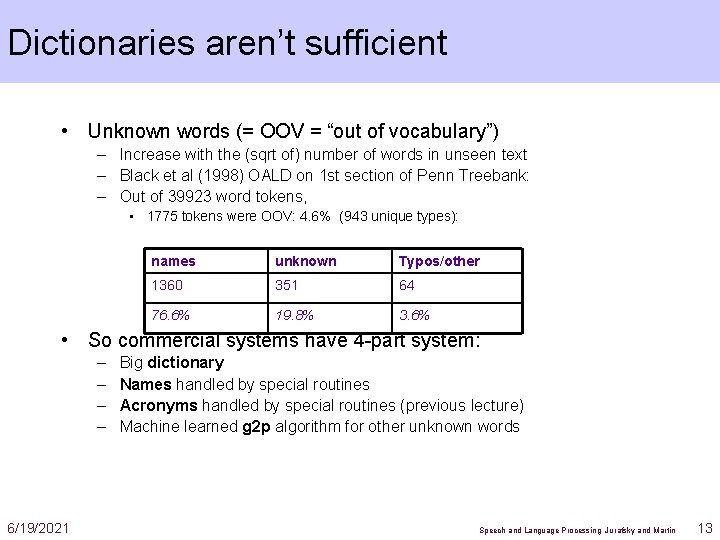
Dictionaries aren’t sufficient • Unknown words (= OOV = “out of vocabulary”) – Increase with the (sqrt of) number of words in unseen text – Black et al (1998) OALD on 1 st section of Penn Treebank: – Out of 39923 word tokens, • 1775 tokens were OOV: 4. 6% (943 unique types): names unknown Typos/other 1360 351 64 76. 6% 19. 8% 3. 6% • So commercial systems have 4 -part system: – – 6/19/2021 Big dictionary Names handled by special routines Acronyms handled by special routines (previous lecture) Machine learned g 2 p algorithm for other unknown words Speech and Language Processing Jurafsky and Martin 13
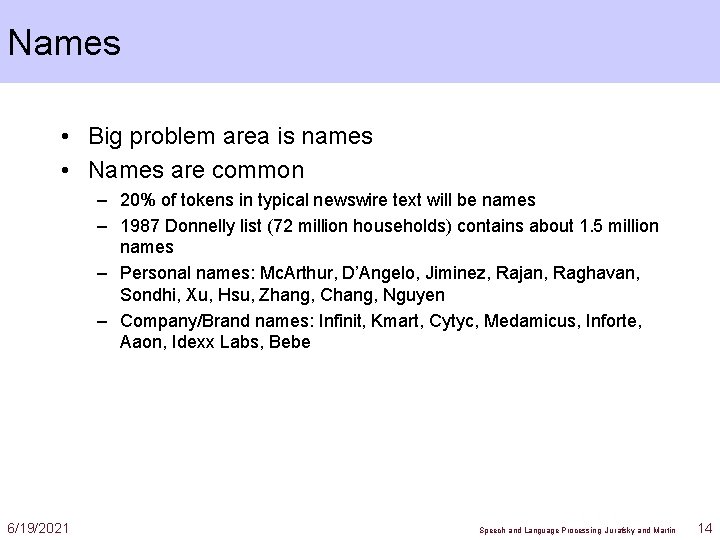
Names • Big problem area is names • Names are common – 20% of tokens in typical newswire text will be names – 1987 Donnelly list (72 million households) contains about 1. 5 million names – Personal names: Mc. Arthur, D’Angelo, Jiminez, Rajan, Raghavan, Sondhi, Xu, Hsu, Zhang, Chang, Nguyen – Company/Brand names: Infinit, Kmart, Cytyc, Medamicus, Inforte, Aaon, Idexx Labs, Bebe 6/19/2021 Speech and Language Processing Jurafsky and Martin 14
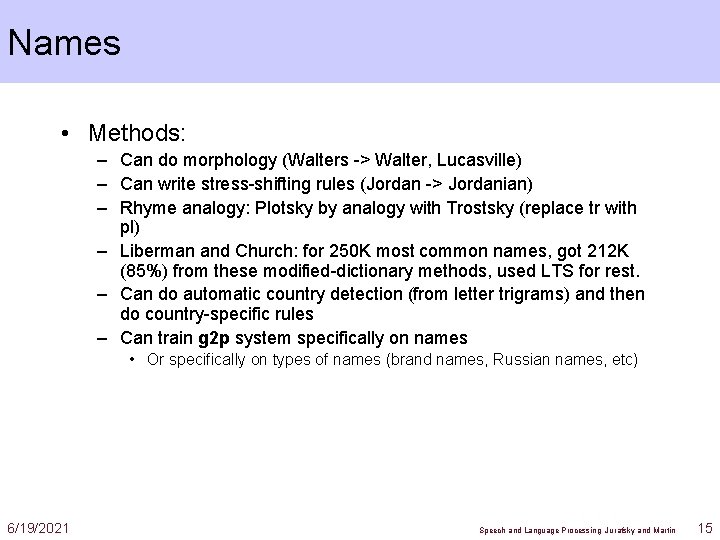
Names • Methods: – Can do morphology (Walters -> Walter, Lucasville) – Can write stress-shifting rules (Jordan -> Jordanian) – Rhyme analogy: Plotsky by analogy with Trostsky (replace tr with pl) – Liberman and Church: for 250 K most common names, got 212 K (85%) from these modified-dictionary methods, used LTS for rest. – Can do automatic country detection (from letter trigrams) and then do country-specific rules – Can train g 2 p system specifically on names • Or specifically on types of names (brand names, Russian names, etc) 6/19/2021 Speech and Language Processing Jurafsky and Martin 15
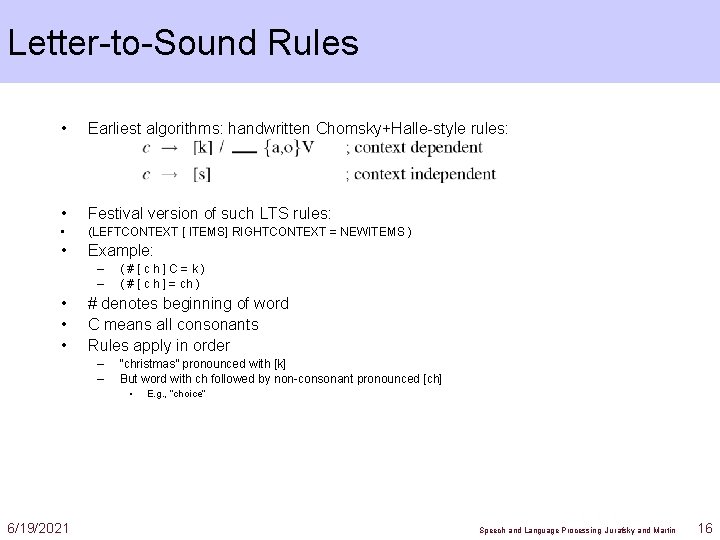
Letter-to-Sound Rules • Earliest algorithms: handwritten Chomsky+Halle-style rules: • Festival version of such LTS rules: • (LEFTCONTEXT [ ITEMS] RIGHTCONTEXT = NEWITEMS ) • Example: – – • • • (#[ch]C=k) ( # [ c h ] = ch ) # denotes beginning of word C means all consonants Rules apply in order – – “christmas” pronounced with [k] But word with ch followed by non-consonant pronounced [ch] • 6/19/2021 E. g. , “choice” Speech and Language Processing Jurafsky and Martin 16
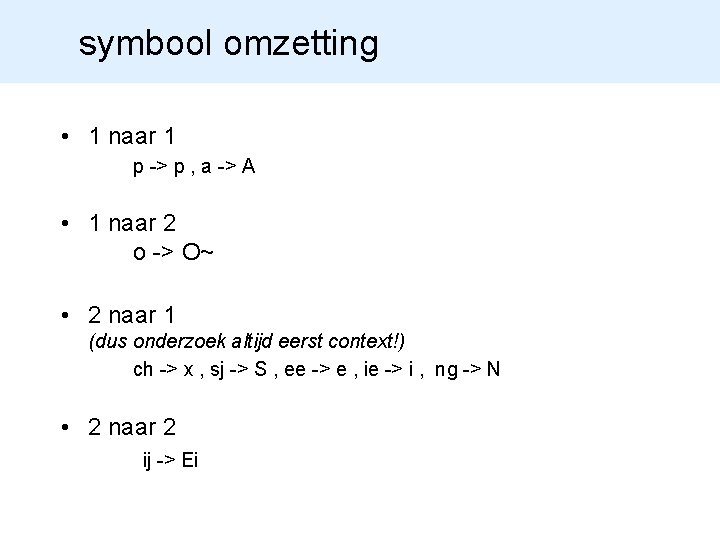
symbool omzetting • 1 naar 1 p -> p , a -> A • 1 naar 2 o -> O~ • 2 naar 1 (dus onderzoek altijd eerst context!) ch -> x , sj -> S , ee -> e , ie -> i , ng -> N • 2 naar 2 ij -> Ei
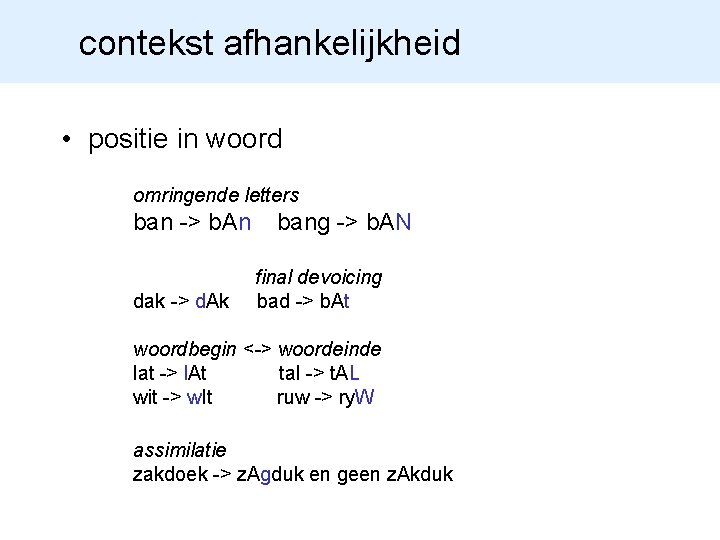
contekst afhankelijkheid • positie in woord omringende letters ban -> b. An dak -> d. Ak bang -> b. AN final devoicing bad -> b. At woordbegin <-> woordeinde lat -> l. At tal -> t. AL wit -> w. It ruw -> ry. W assimilatie zakdoek -> z. Agduk en geen z. Akduk
Voorbeelden
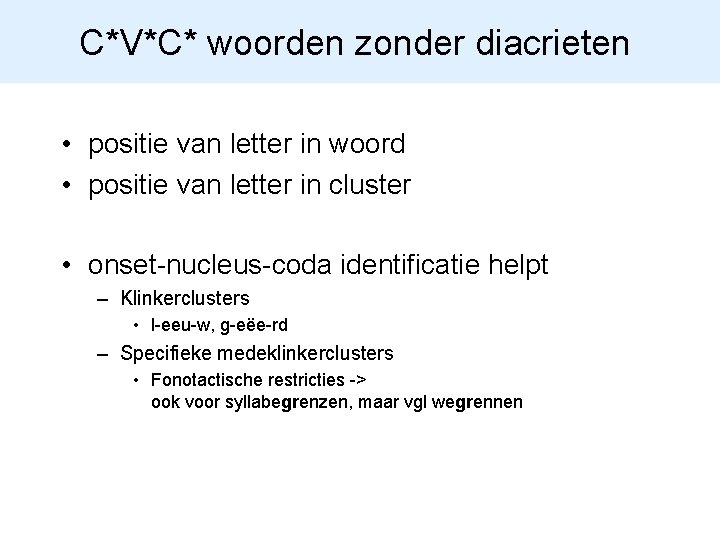
C*V*C* woorden zonder diacrieten • positie van letter in woord • positie van letter in cluster • onset-nucleus-coda identificatie helpt – Klinkerclusters • l-eeu-w, g-eëe-rd – Specifieke medeklinkerclusters • Fonotactische restricties -> ook voor syllabegrenzen, maar vgl wegrennen
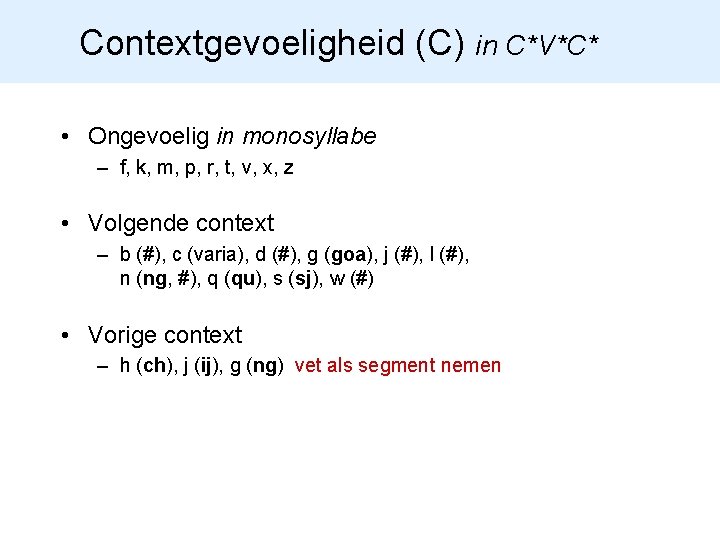
Contextgevoeligheid (C) in C*V*C* • Ongevoelig in monosyllabe – f, k, m, p, r, t, v, x, z • Volgende context – b (#), c (varia), d (#), g (goa), j (#), l (#), n (ng, #), q (qu), s (sj), w (#) • Vorige context – h (ch), j (ij), g (ng) vet als segment nemen
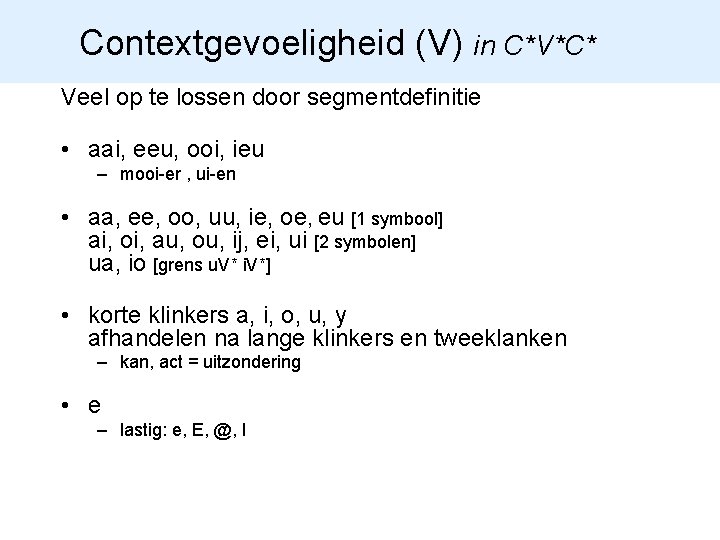
Contextgevoeligheid (V) in C*V*C* Veel op te lossen door segmentdefinitie • aai, eeu, ooi, ieu – mooi-er , ui-en • aa, ee, oo, uu, ie, oe, eu [1 symbool] ai, oi, au, ou, ij, ei, ui [2 symbolen] ua, io [grens u. V* i. V*] • korte klinkers a, i, o, u, y afhandelen na lange klinkers en tweeklanken – kan, act = uitzondering • e – lastig: e, E, @, I
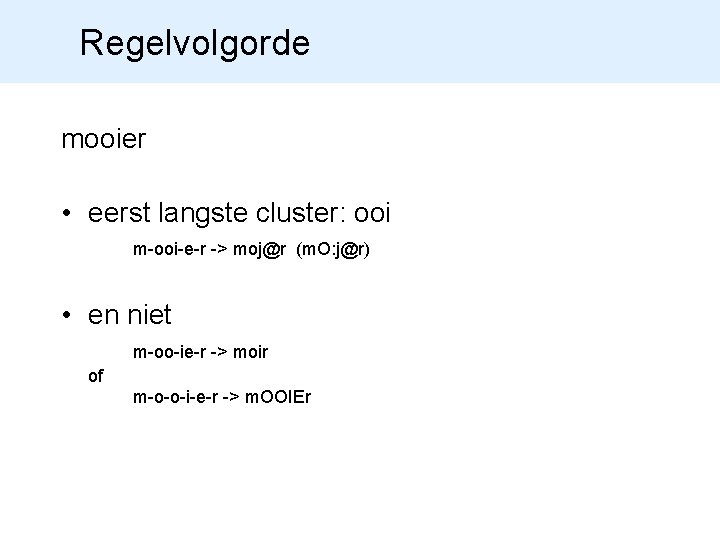
Regelvolgorde mooier • eerst langste cluster: ooi m-ooi-e-r -> moj@r (m. O: j@r) • en niet m-oo-ie-r -> moir of m-o-o-i-e-r -> m. OOIEr
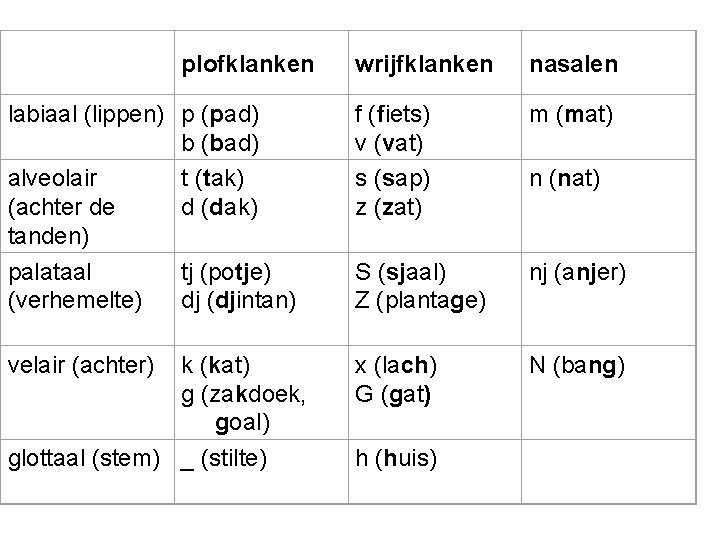
plofklanken wrijfklanken nasalen labiaal (lippen) p (pad) b (bad) alveolair t (tak) (achter de d (dak) tanden) palataal tj (potje) (verhemelte) dj (djintan) f (fiets) v (vat) s (sap) z (zat) m (mat) S (sjaal) Z (plantage) nj (anjer) velair (achter) x (lach) G (gat) N (bang) k (kat) g (zakdoek, goal) glottaal (stem) _ (stilte) h (huis) n (nat)
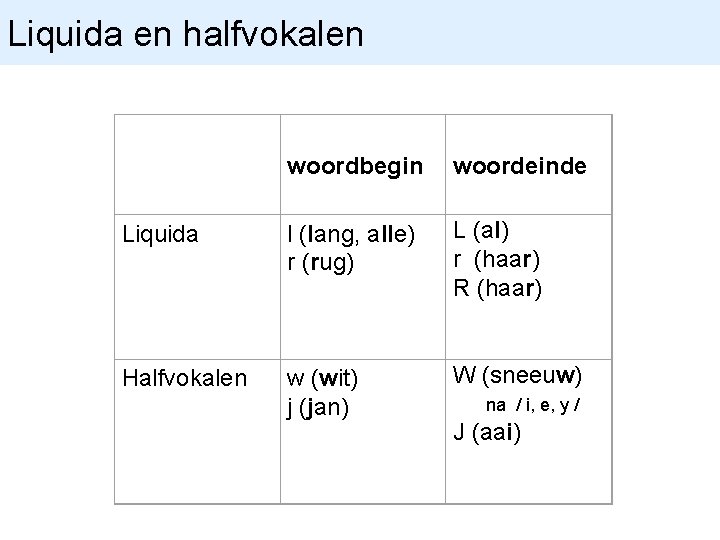
Liquida en halfvokalen woordbegin woordeinde Liquida l (lang, alle) r (rug) L (al) r (haar) R (haar) Halfvokalen w (wit) j (jan) W (sneeuw) na / i, e, y / J (aai)
Korte klinkers voor [-rond] hoog I (bid) [+rond] achter [-rond] [+rond] Y (put) midden E (bed) @ (rede) O (bos) laag A (bak)
Lange klinkers voor [-rond] [+rond] achter [-rond] [+rond] hoog i (bied) y (buut) u (boek) midden e (beet)| 2 (beuk) o (boot) laag a (baat)
Tweeklanken voor [-rond] midden Ei (bijt) [+rond] 9 y (buit) achter [-rond] [+rond] Au (bout)
Gekleurde klinkers voor r voor [-rond] midden I: (beer) [+rond] Y: (deur) achter [-rond] [+rond] O: (door)
Franse klanken voor [-rond] achter [+rond] E~ Y~ (mannequin) (parfum) [-rond] [+rond] A~ O~ (chanson) [Oe] uit freule