
Graduation Project Report II Structural Analysis and Design



- Slides: 65
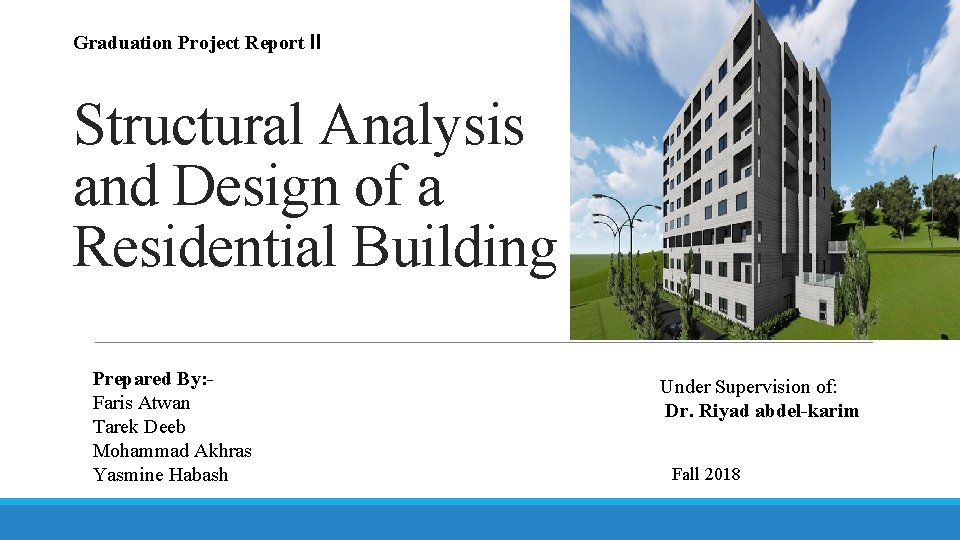
Graduation Project Report II Structural Analysis and Design of a Residential Building Prepared By: Faris Atwan Tarek Deeb Mohammad Akhras Yasmine Habash Under Supervision of: Dr. Riyad abdel-karim Fall 2018
Outline: ØIntroduction. Ø Seismic Analysis Approach. Ø Preliminary Design. Ø 3 D Structural Analysis. Ø Structural design.
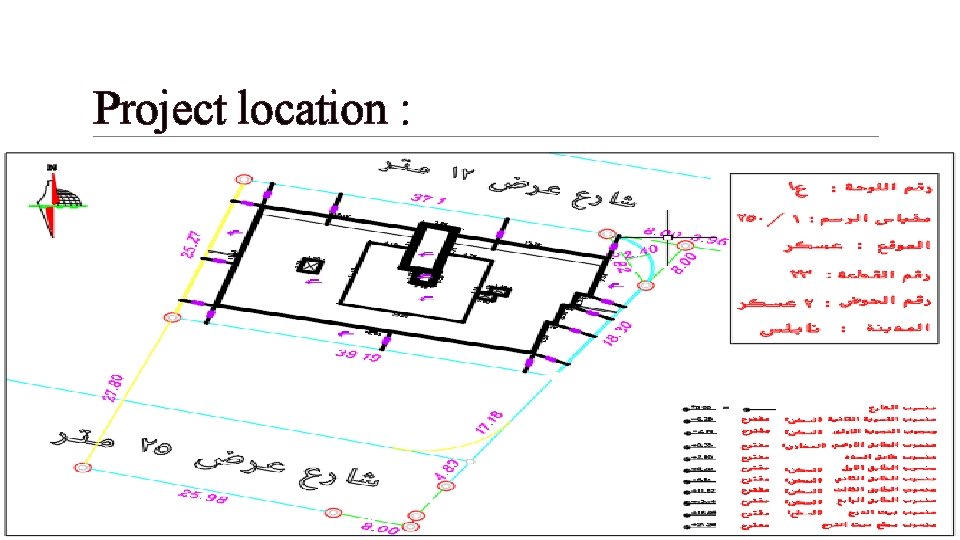
Project location :
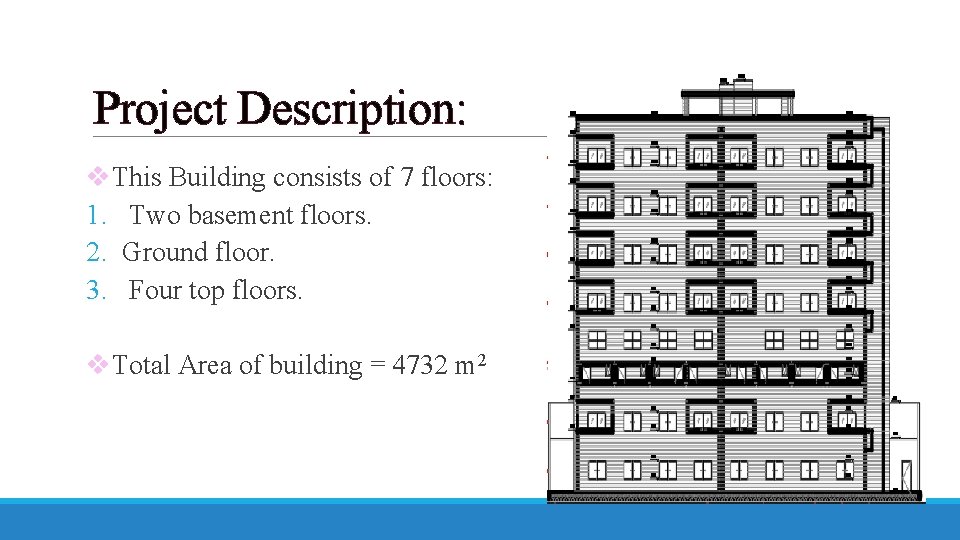
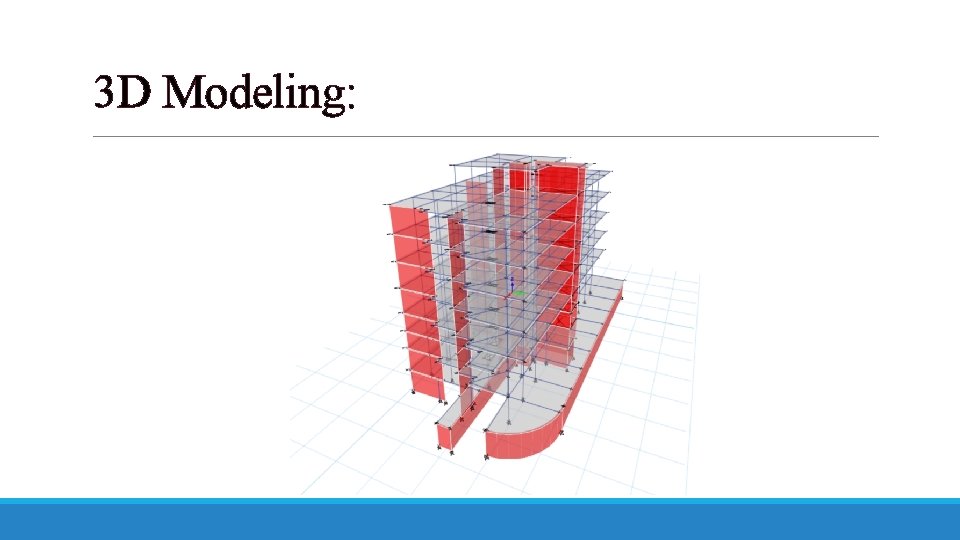
Project Description: v. This Building consists of 7 floors: 1. Two basement floors. 2. Ground floor. 3. Four top floors. v. Total Area of building = 4732 m 2
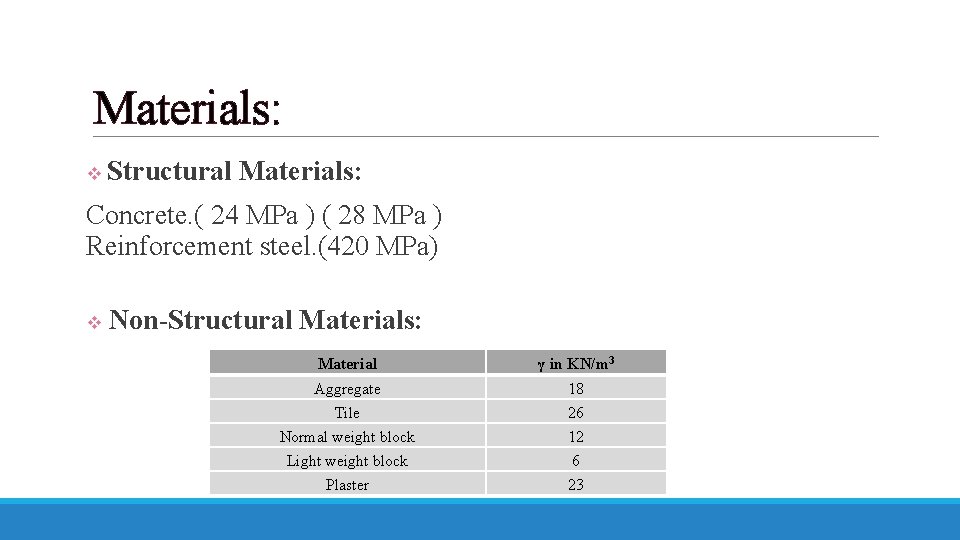
Materials: v Structural Materials: Concrete. ( 24 MPa ) ( 28 MPa ) Reinforcement steel. (420 MPa) v Non-Structural Materials: Material γ in KN/m 3 Aggregate Tile Normal weight block Light weight block Plaster 18 26 12 6 23
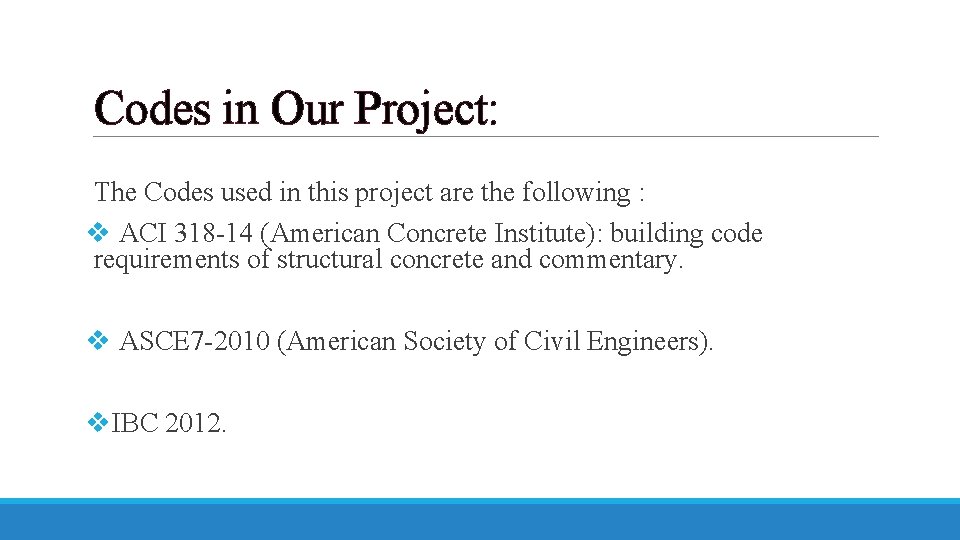
Codes in Our Project: The Codes used in this project are the following : v ACI 318 -14 (American Concrete Institute): building code requirements of structural concrete and commentary. v ASCE 7 -2010 (American Society of Civil Engineers). v. IBC 2012.
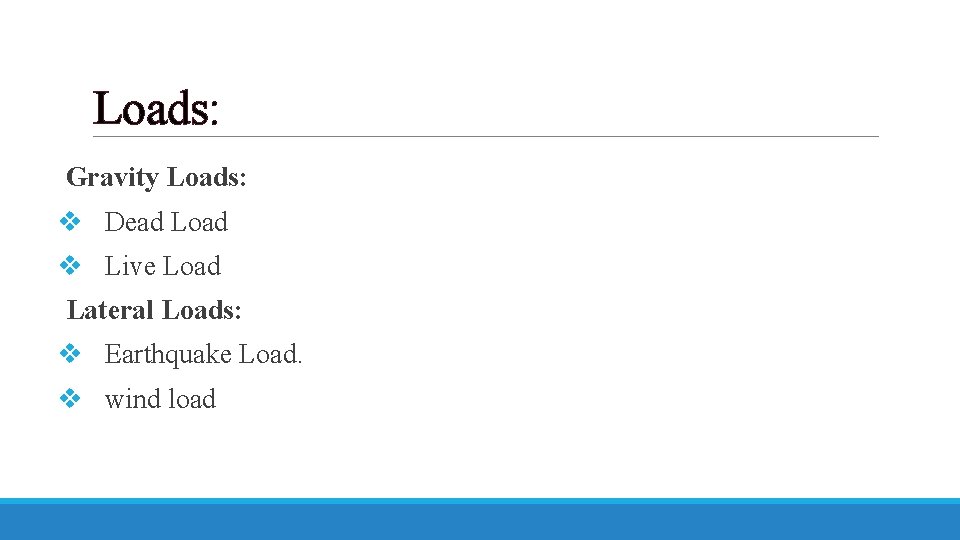
Loads: Gravity Loads: v Dead Load v Live Load Lateral Loads: v Earthquake Load. v wind load
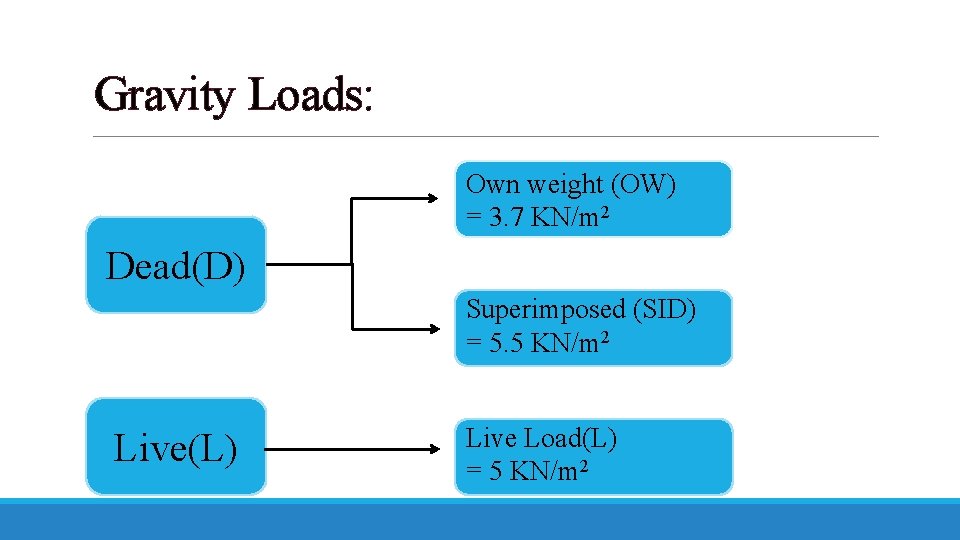
Gravity Loads: Own weight (OW) = 3. 7 KN/m 2 Dead(D) Superimposed (SID) = 5. 5 KN/m 2 Live(L) Live Load(L) = 5 KN/m 2
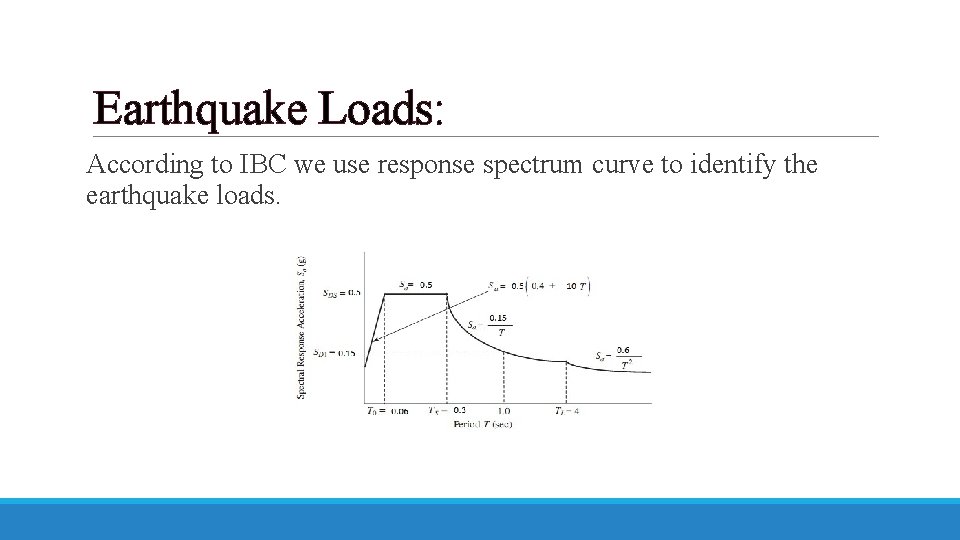
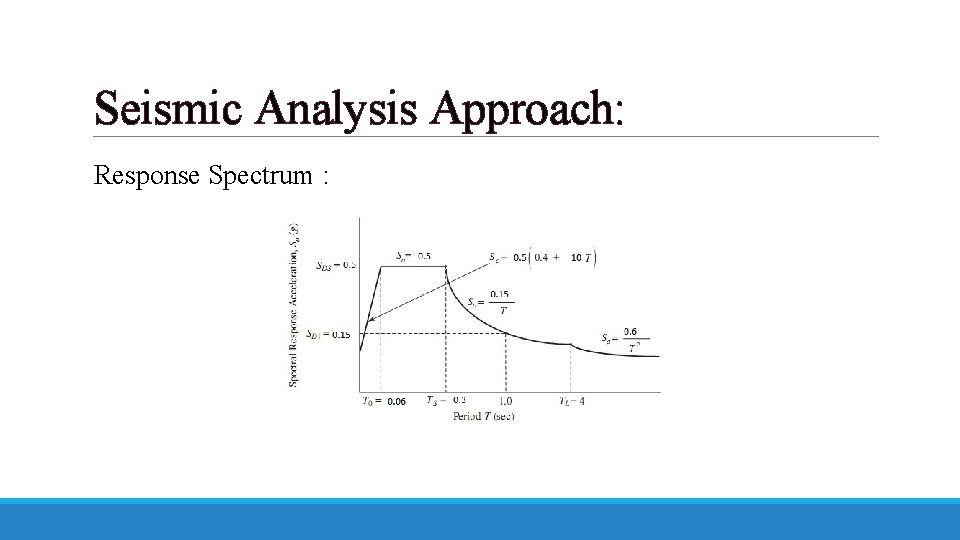
Earthquake Loads: According to IBC we use response spectrum curve to identify the earthquake loads.
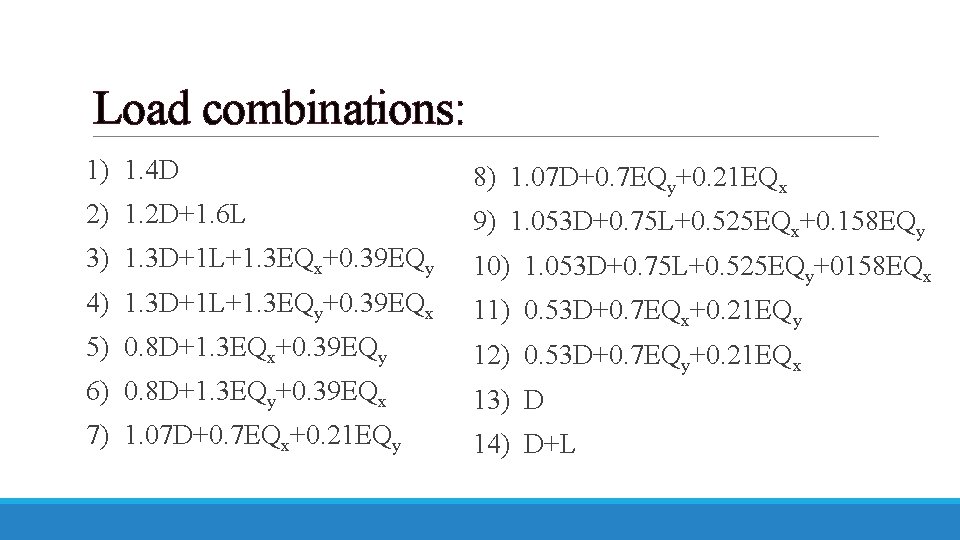
Load combinations: 1) 1. 4 D 8) 1. 07 D+0. 7 EQy+0. 21 EQx 2) 1. 2 D+1. 6 L 9) 1. 053 D+0. 75 L+0. 525 EQx+0. 158 EQy 3) 1. 3 D+1 L+1. 3 EQx+0. 39 EQy 10) 1. 053 D+0. 75 L+0. 525 EQy+0158 EQx 4) 1. 3 D+1 L+1. 3 EQy+0. 39 EQx 11) 0. 53 D+0. 7 EQx+0. 21 EQy 5) 0. 8 D+1. 3 EQx+0. 39 EQy 12) 0. 53 D+0. 7 EQy+0. 21 EQx 6) 0. 8 D+1. 3 EQy+0. 39 EQx 7) 1. 07 D+0. 7 EQx+0. 21 EQy 13) D 14) D+L
Structural System: -The structural system that we use in our project is frame system (slab-beam-column) system. -The slab system used in the building is one way ribbed slab for floors
Software Program:
3 D Modeling:
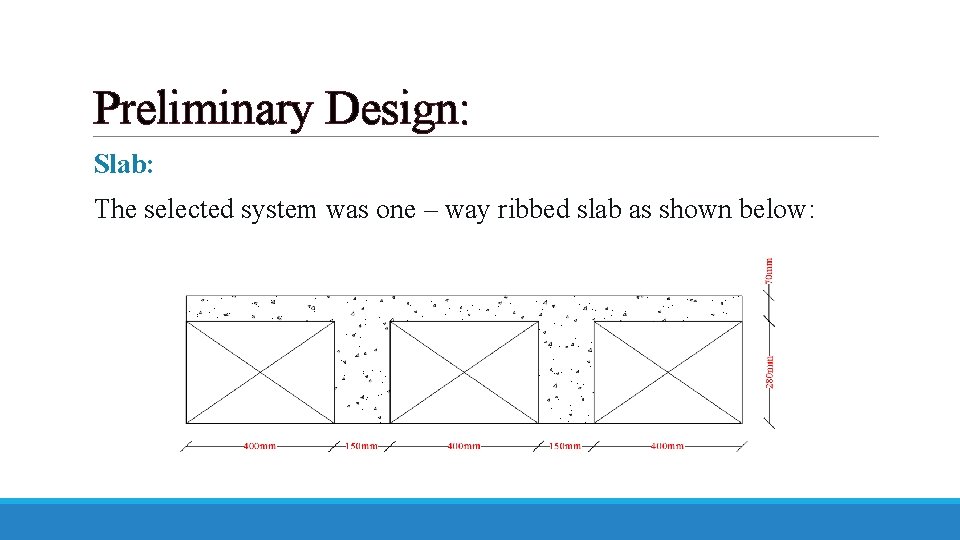
Preliminary Design: Slab: The selected system was one – way ribbed slab as shown below:
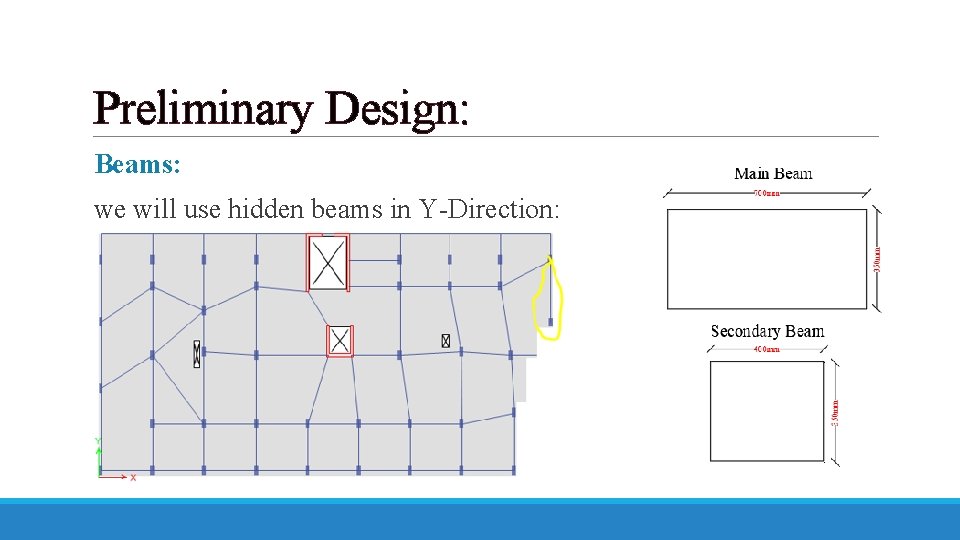
Preliminary Design: Beams: we will use hidden beams in Y-Direction:
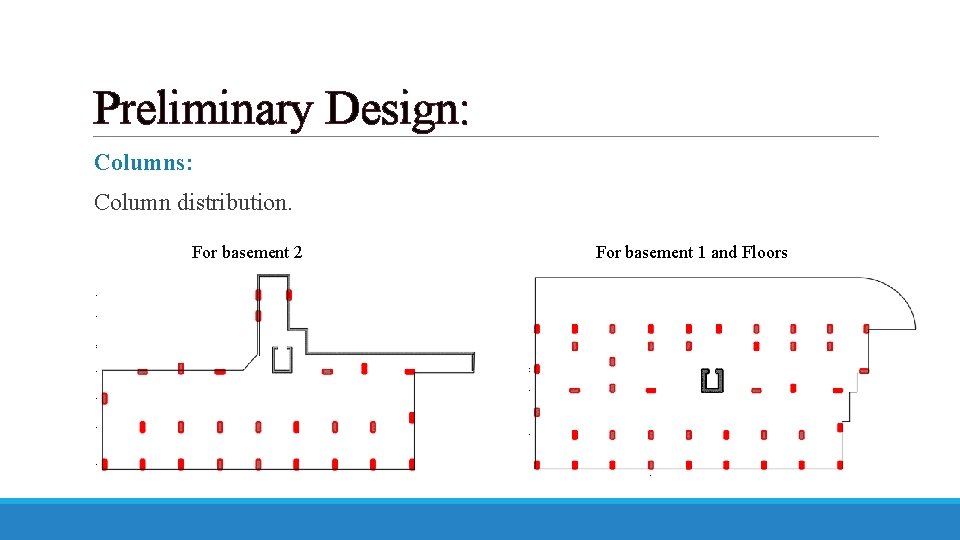
Preliminary Design: Columns: Column distribution. For basement 2 For basement 1 and Floors
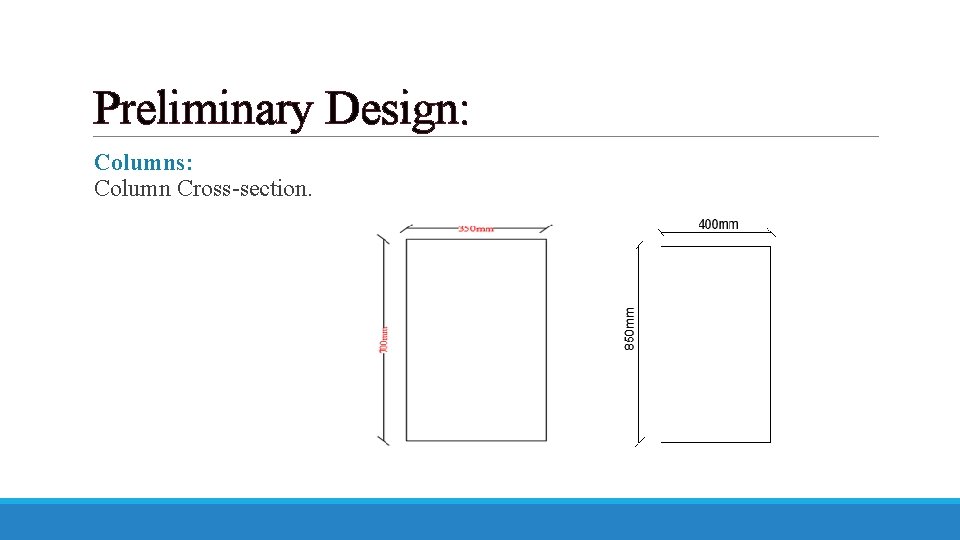
Preliminary Design: Columns: Column Cross-section.
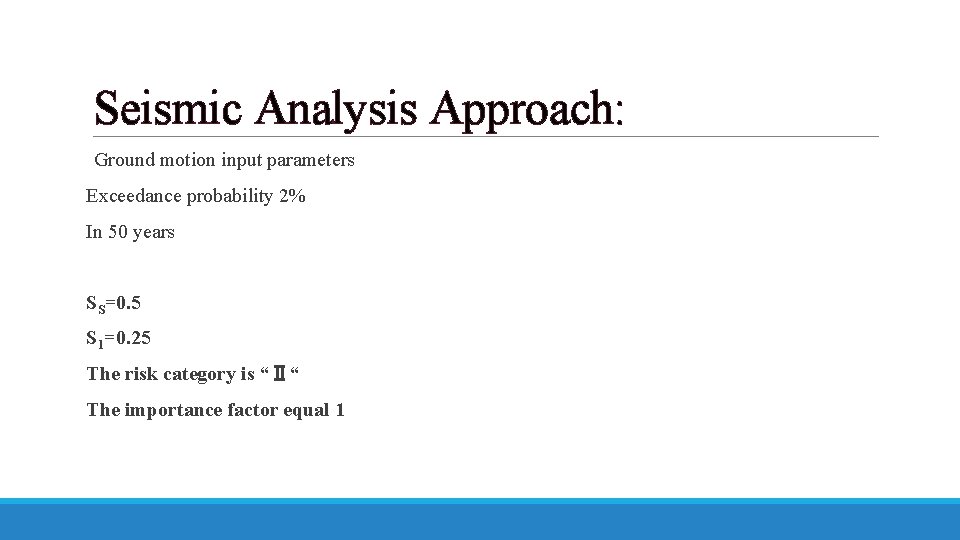
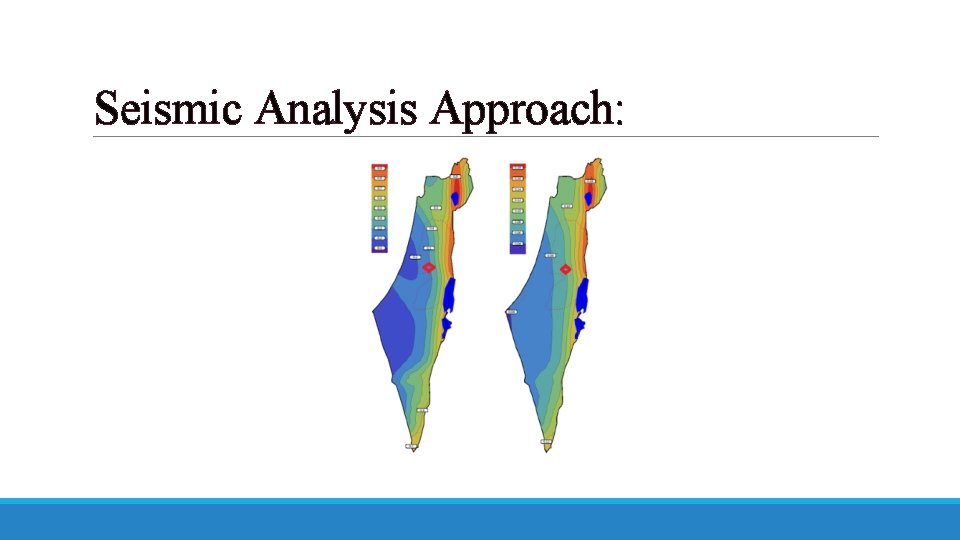
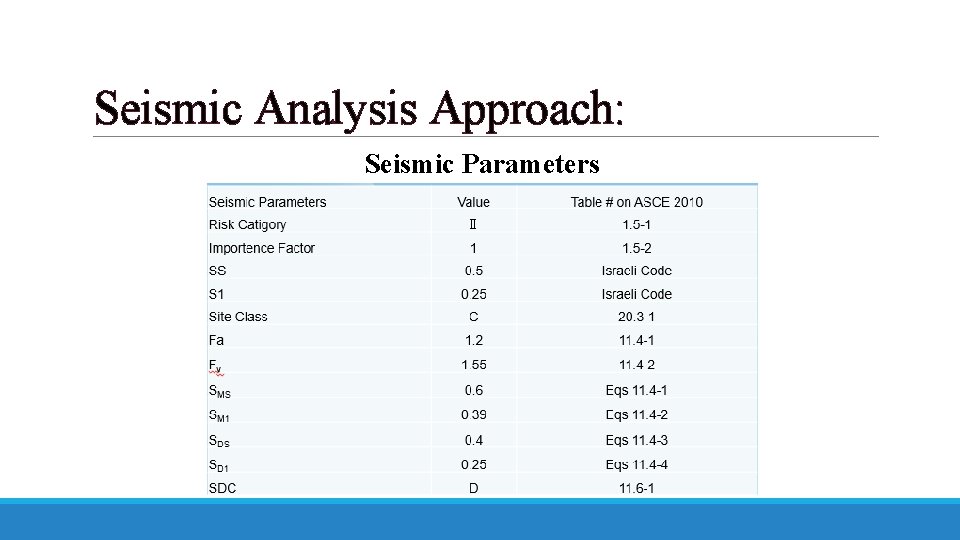
Seismic Analysis Approach: Ground motion input parameters Exceedance probability 2% In 50 years SS=0. 5 S 1=0. 25 The risk category is “Ⅱ“ The importance factor equal 1
Seismic Analysis Approach:
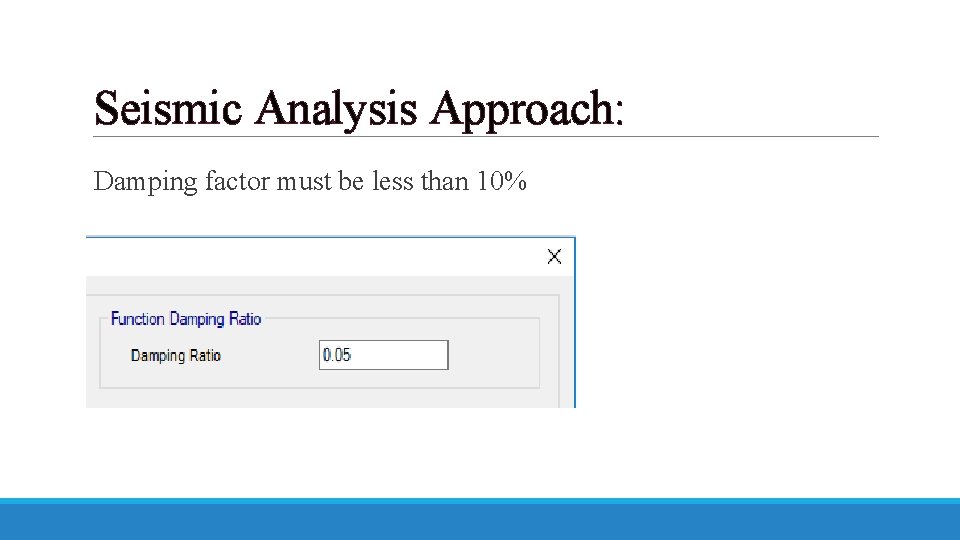
Seismic Analysis Approach: Damping factor must be less than 10%
Seismic Analysis Approach: Seismic Parameters
Seismic Analysis Approach: Response Spectrum :
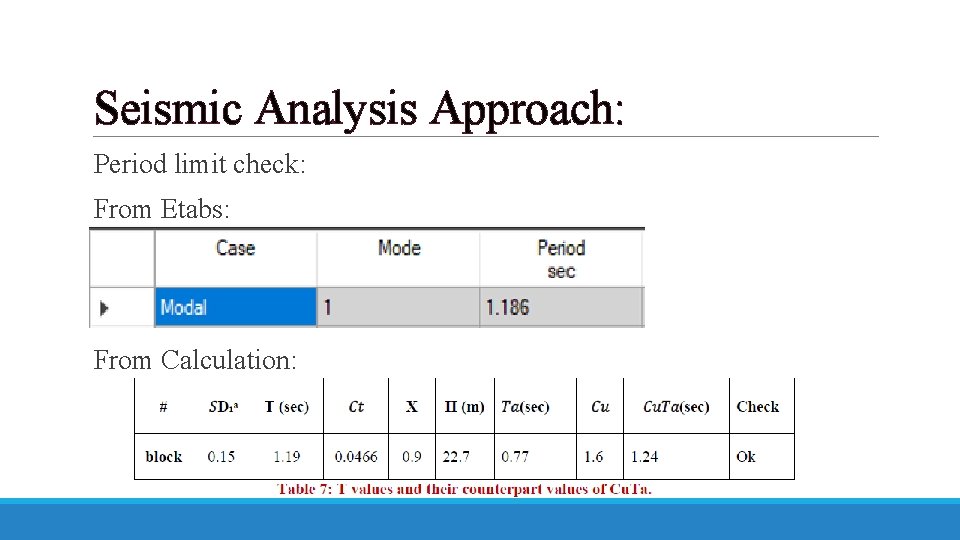
Seismic Analysis Approach: Period limit check: From Etabs: From Calculation:
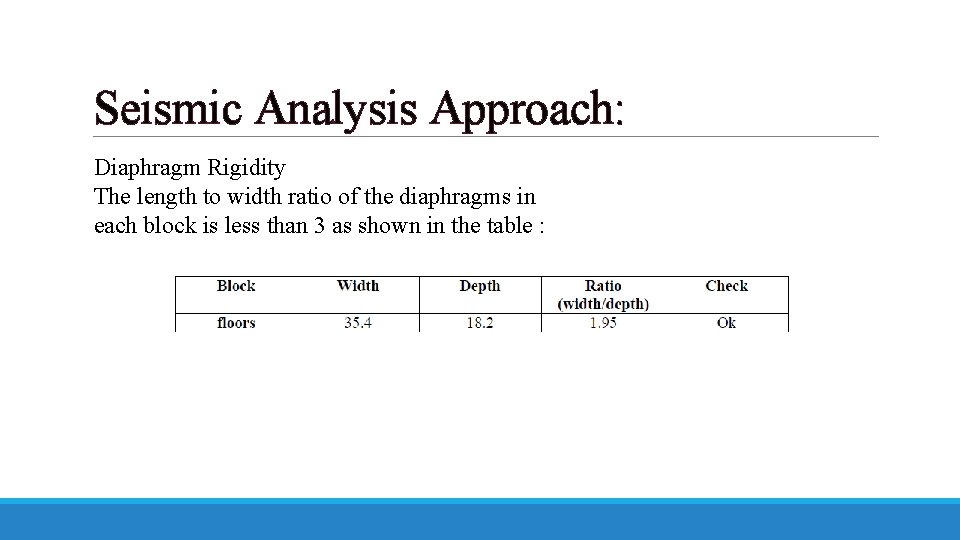
Seismic Analysis Approach: Diaphragm Rigidity The length to width ratio of the diaphragms in each block is less than 3 as shown in the table :
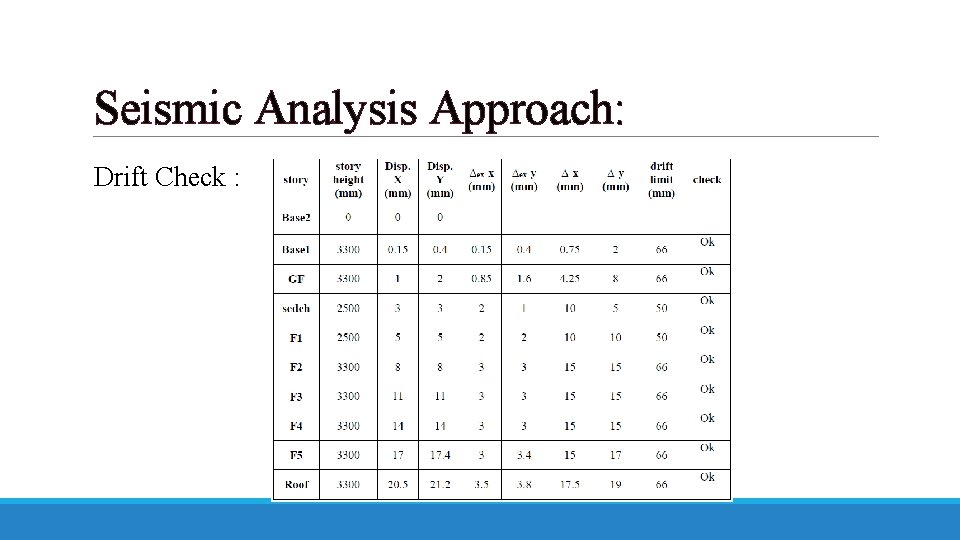
Seismic Analysis Approach: Drift Check :
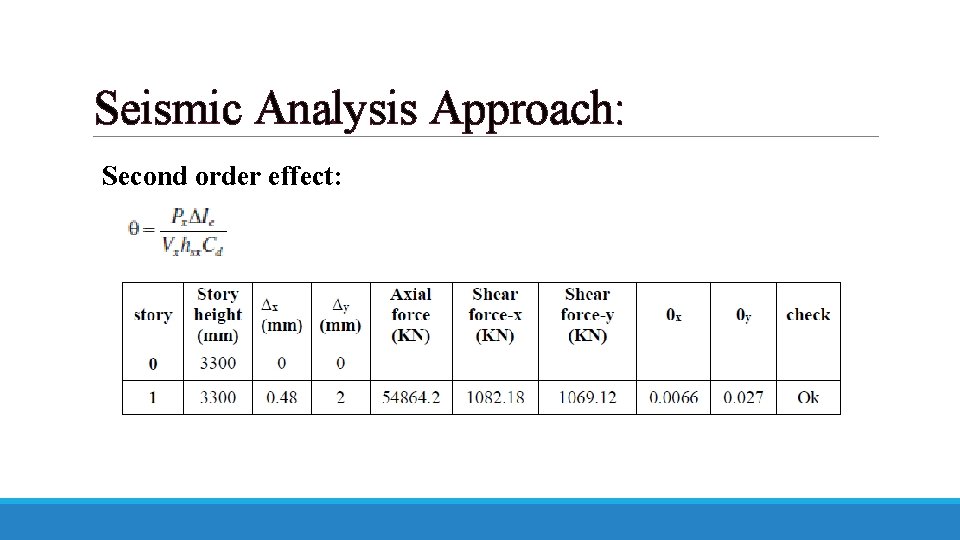
Seismic Analysis Approach: Second order effect:
Seismic Analysis Approach: Irregularity Checks We have 13 checks in ASCE-10 for irregularity Vertical irregularity checks Horizontal irregularity checks
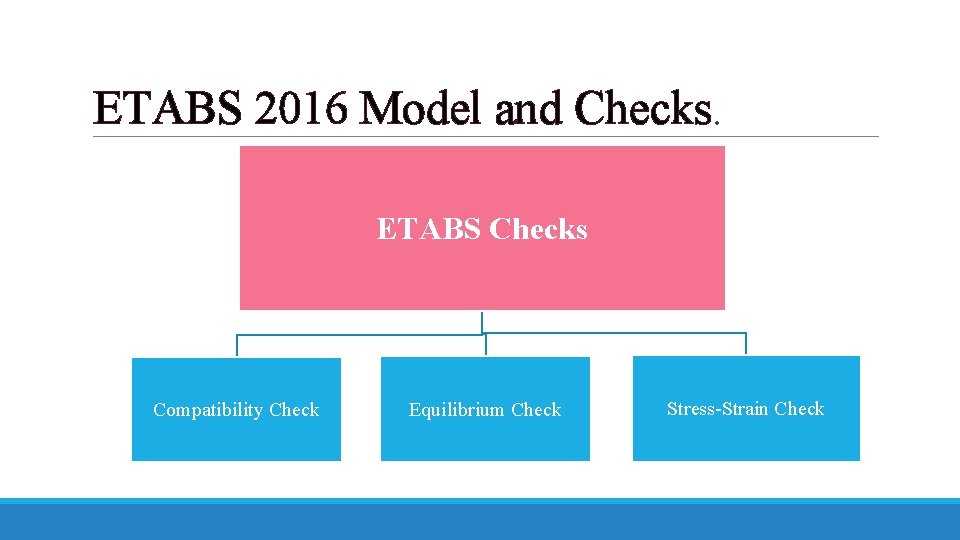
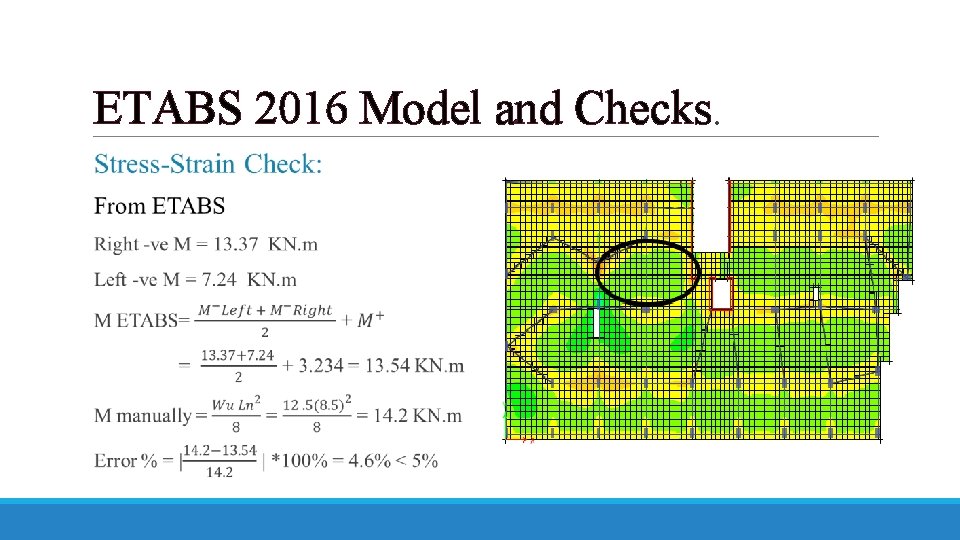
ETABS 2016 Model and Checks. ETABS Checks Compatibility Check Equilibrium Check Stress-Strain Check
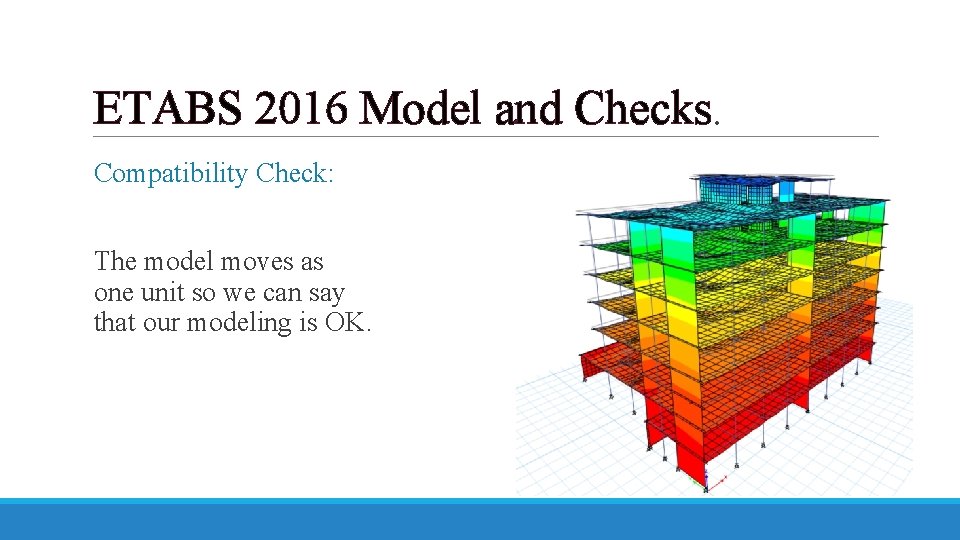
ETABS 2016 Model and Checks. Compatibility Check: The model moves as one unit so we can say that our modeling is OK.
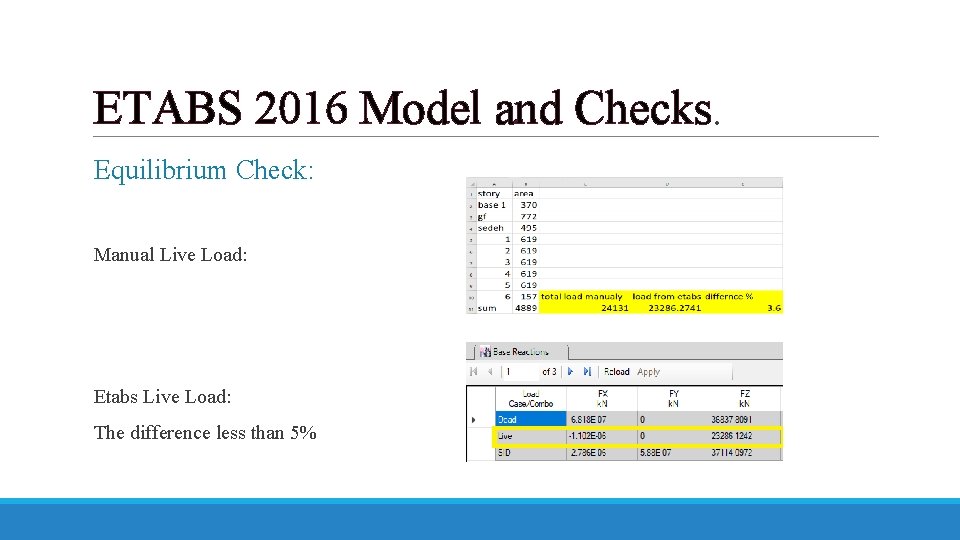
ETABS 2016 Model and Checks. Equilibrium Check: Manual Live Load: Etabs Live Load: The difference less than 5%
ETABS 2016 Model and Checks.
Design: We design all the structural elements in our project: v. Slabs. v. Beams. v. Columns. v. Shear walls. v. Footings.
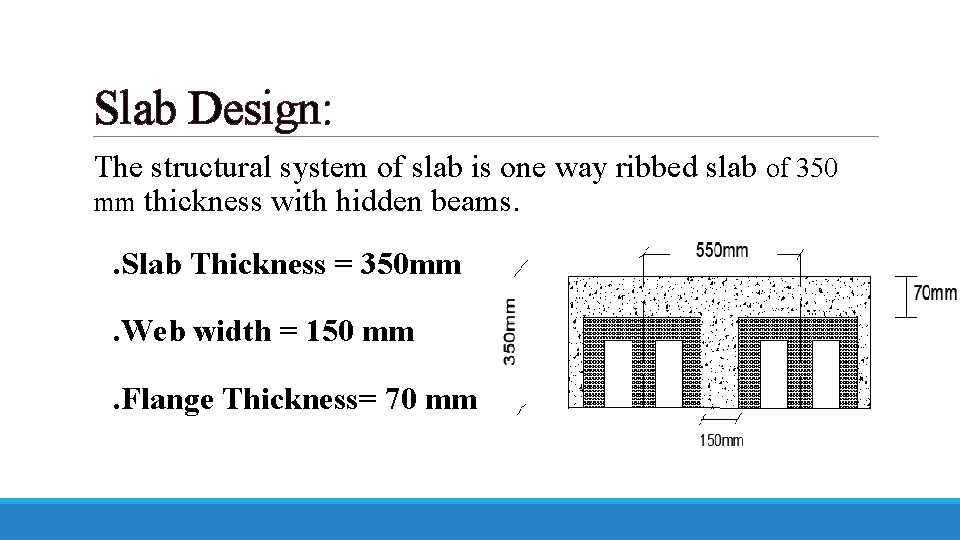
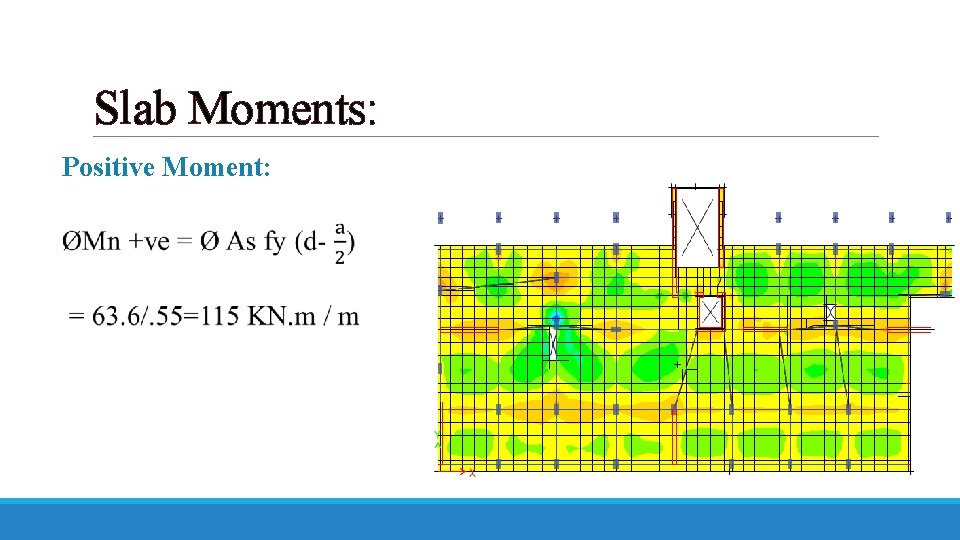
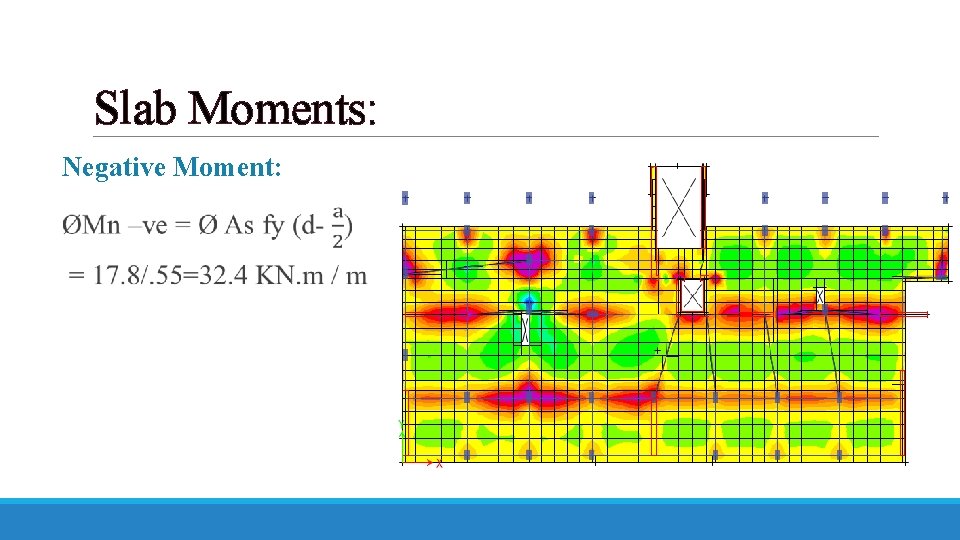
Slab Design: The structural system of slab is one way ribbed slab of 350 mm thickness with hidden beams. . Slab Thickness = 350 mm. Web width = 150 mm. Flange Thickness= 70 mm
Slab Moments: Positive Moment:
Slab Moments: Negative Moment:
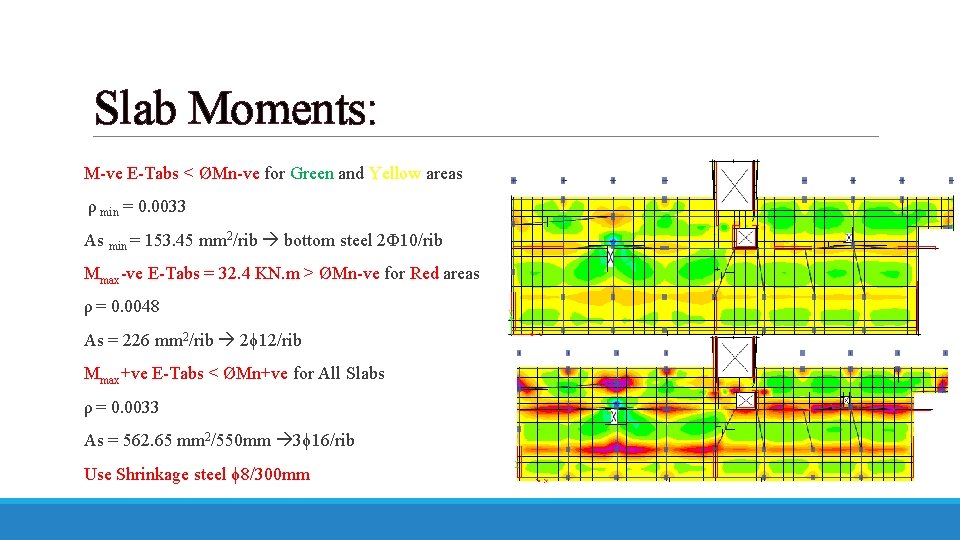
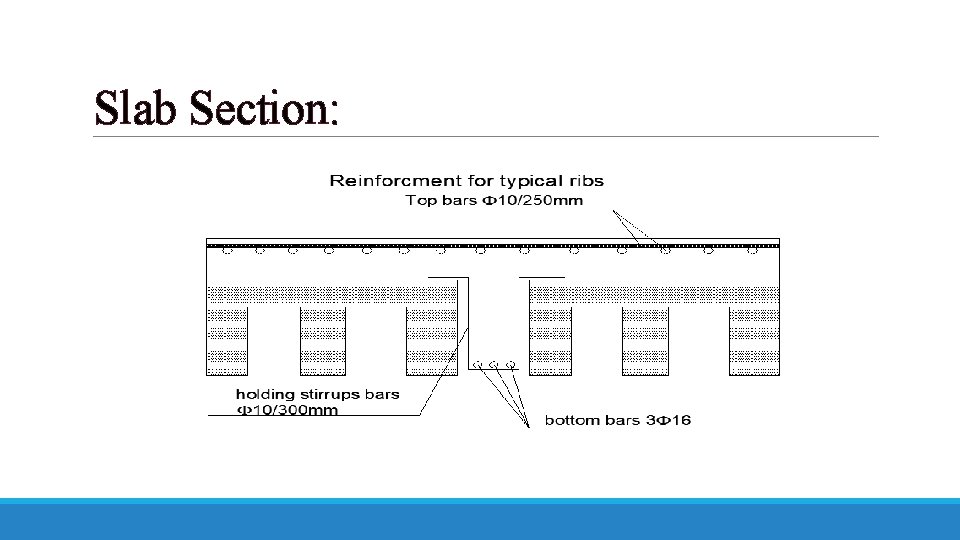
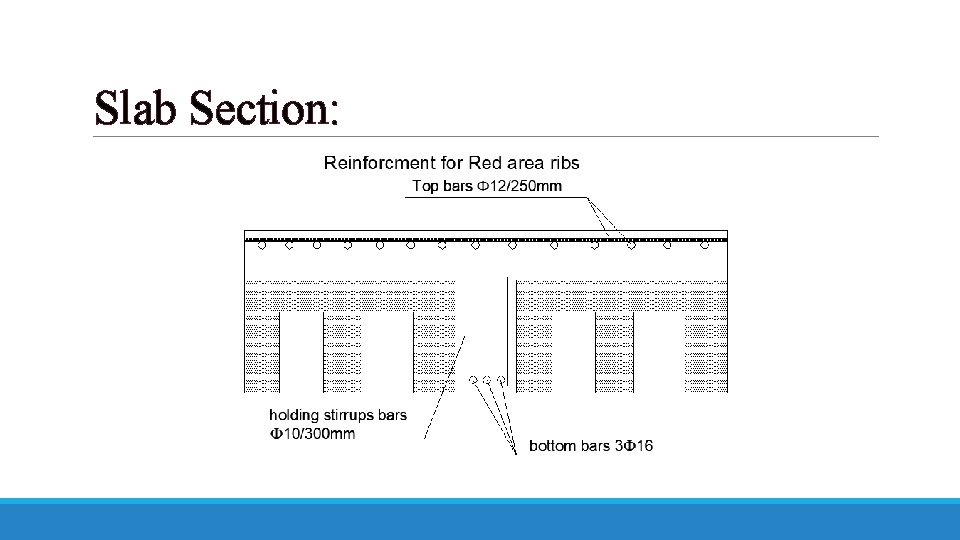
Slab Moments: M-ve E-Tabs < ØMn-ve for Green and Yellow areas ρ min = 0. 0033 As min = 153. 45 mm 2/rib bottom steel 2 Ф 10/rib Mmax-ve E-Tabs = 32. 4 KN. m > ØMn-ve for Red areas ρ = 0. 0048 As = 226 mm 2/rib 2ϕ 12/rib Mmax+ve E-Tabs < ØMn+ve for All Slabs ρ = 0. 0033 As = 562. 65 mm 2/550 mm 3ϕ 16/rib Use Shrinkage steel ϕ 8/300 mm
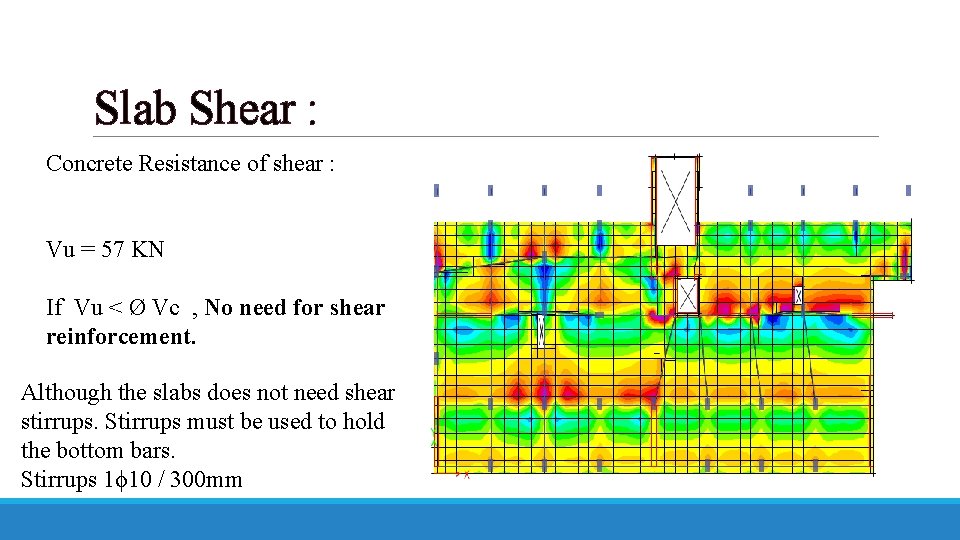
Slab Shear : Concrete Resistance of shear : Vu = 57 KN If Vu < Ø Vc , No need for shear reinforcement. Although the slabs does not need shear stirrups. Stirrups must be used to hold the bottom bars. Stirrups 1ϕ 10 / 300 mm
Slab Section:
Slab Section:
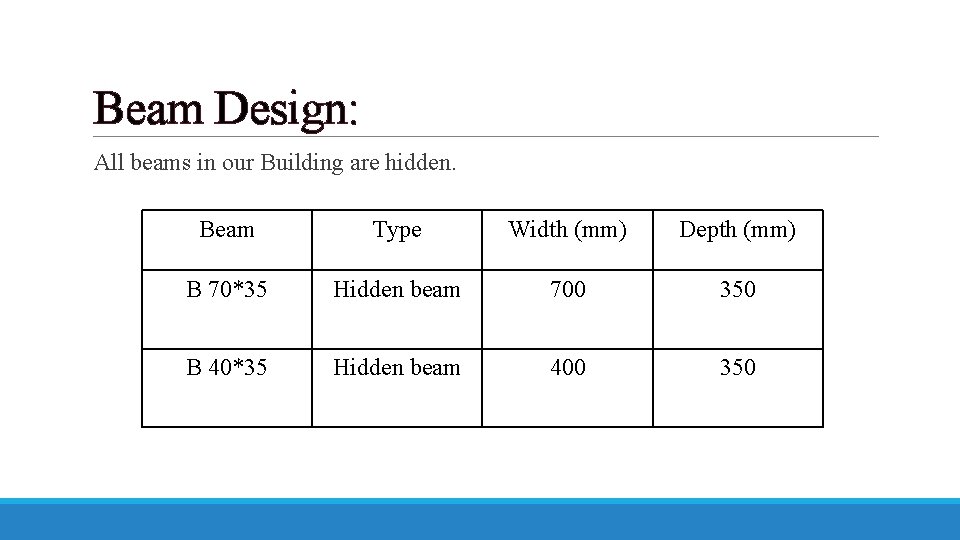
Beam Design: All beams in our Building are hidden. Beam Type Width (mm) Depth (mm) B 70*35 Hidden beam 700 350 B 40*35 Hidden beam 400 350
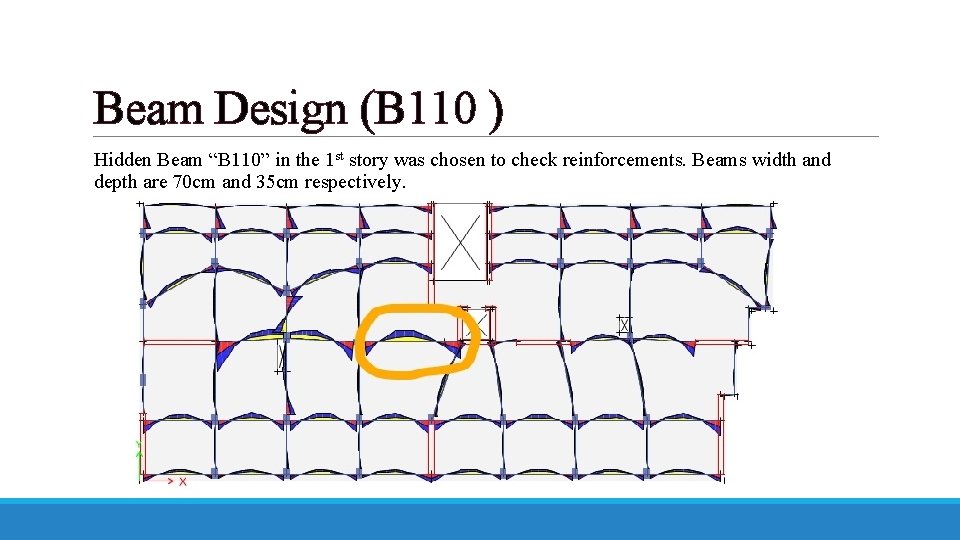
Beam Design (B 110 ) Hidden Beam “B 110” in the 1 st story was chosen to check reinforcements. Beams width and depth are 70 cm and 35 cm respectively.
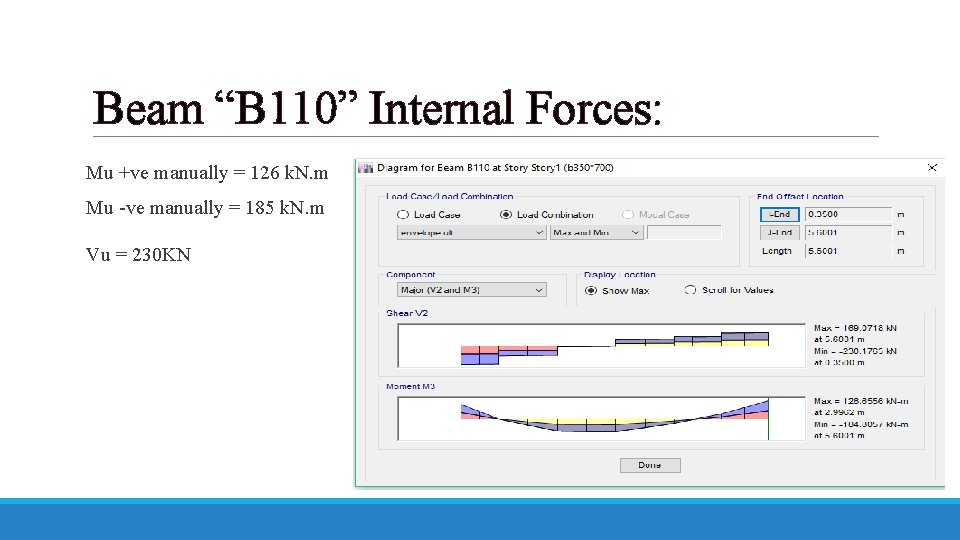
Beam “B 110” Internal Forces: Mu +ve manually = 126 k. N. m Mu -ve manually = 185 k. N. m Vu = 230 KN
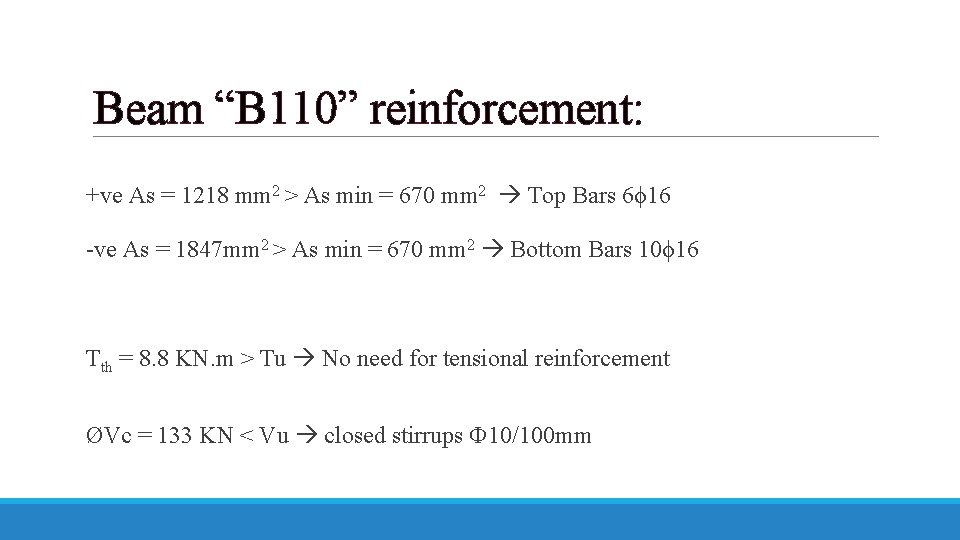
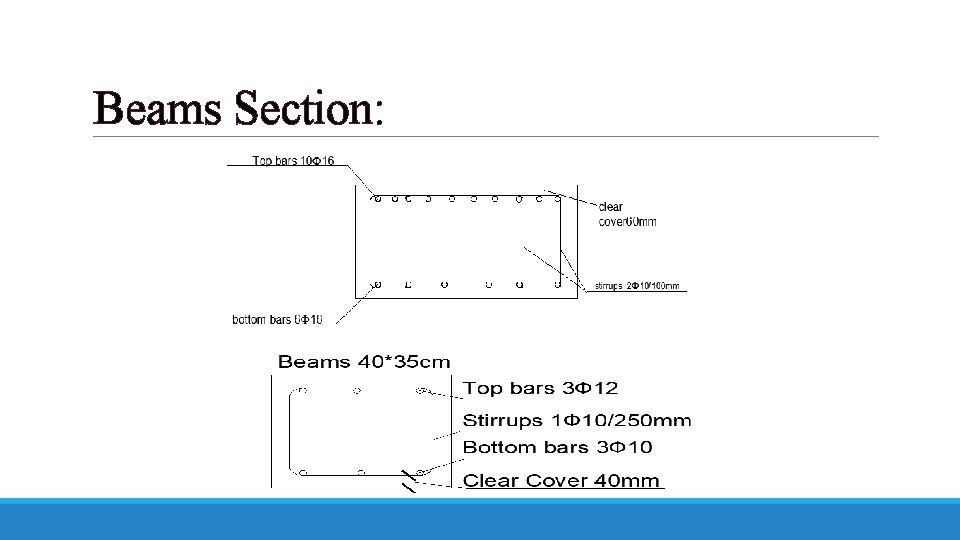
Beam “B 110” reinforcement: +ve As = 1218 mm 2 > As min = 670 mm 2 Top Bars 6ϕ 16 -ve As = 1847 mm 2 > As min = 670 mm 2 Bottom Bars 10ϕ 16 Tth = 8. 8 KN. m > Tu No need for tensional reinforcement ØVc = 133 KN < Vu closed stirrups Ф 10/100 mm
Beams Section:
Columns Design: Two columns in the project differs in dimensions and lengths: Type Length Typical stories 3. 3 m ground floor story 1 st basement story 8 columns are 5. 6 m and the rest is 3. 3 m 2 nd basement story 3. 3 m **the Dimensions of Columns is 700*350 Expect the columns with length 5. 6 m is 850*400
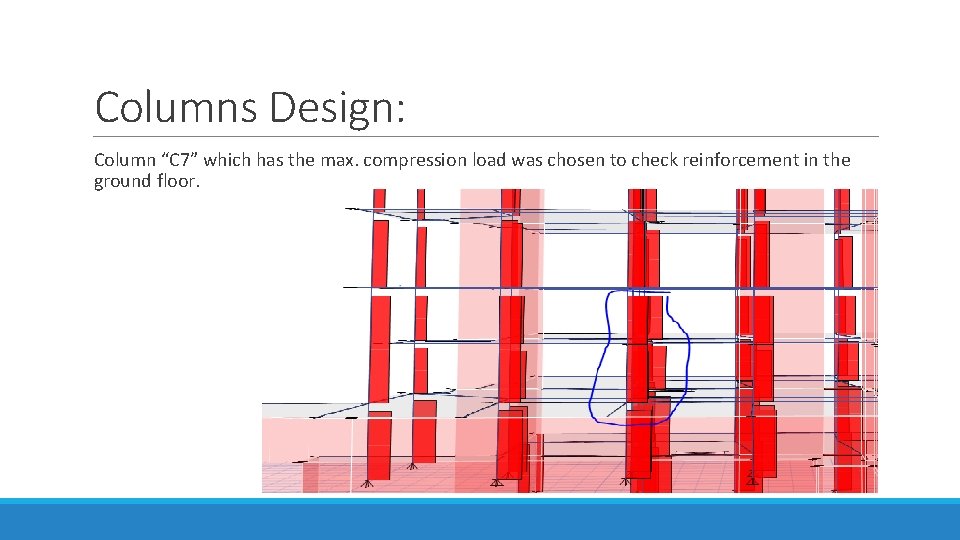
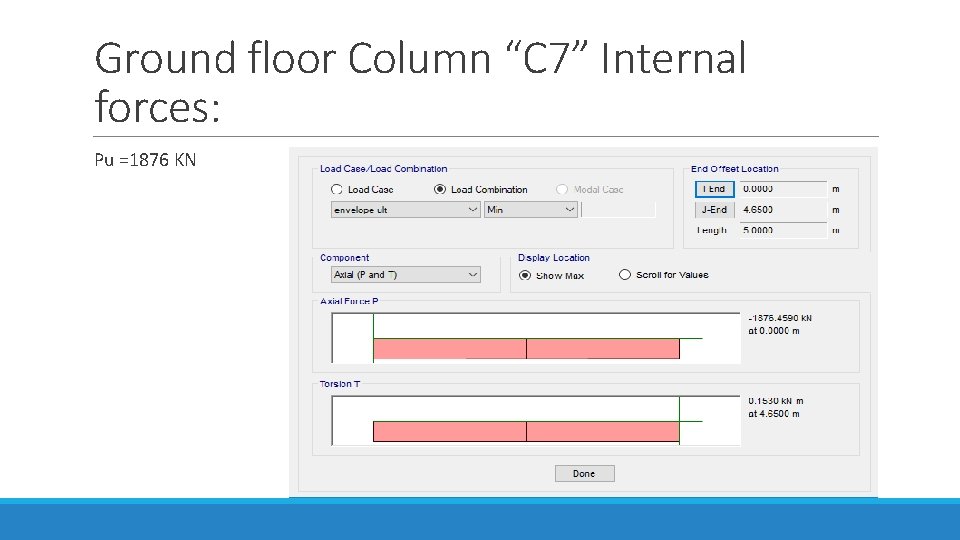
Columns Design: Column “C 7” which has the max. compression load was chosen to check reinforcement in the ground floor.
Ground floor Column “C 7” Internal forces: Pu =1876 KN
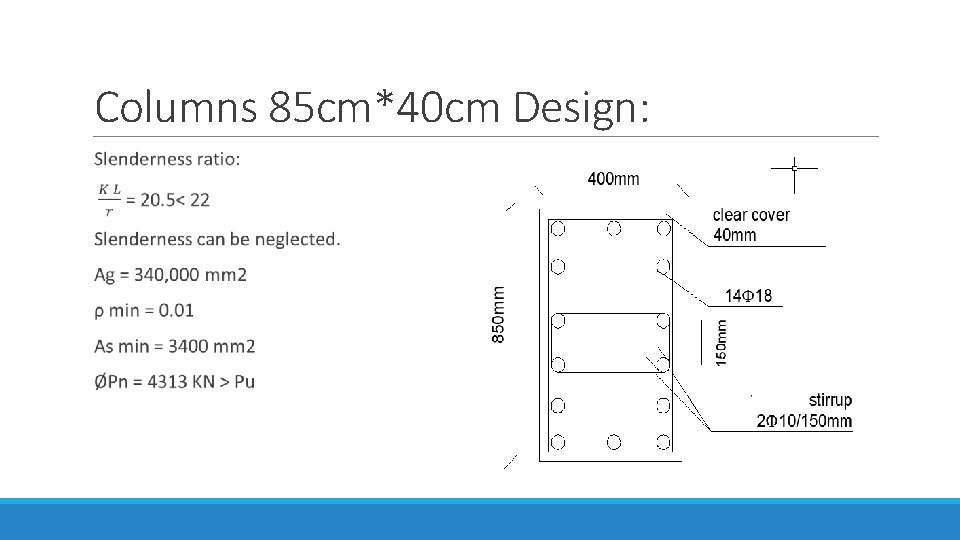
Columns 85 cm*40 cm Design:
Walls Design: Two types of walls in this project • Building Non Bearing walls • Basement Shear walls
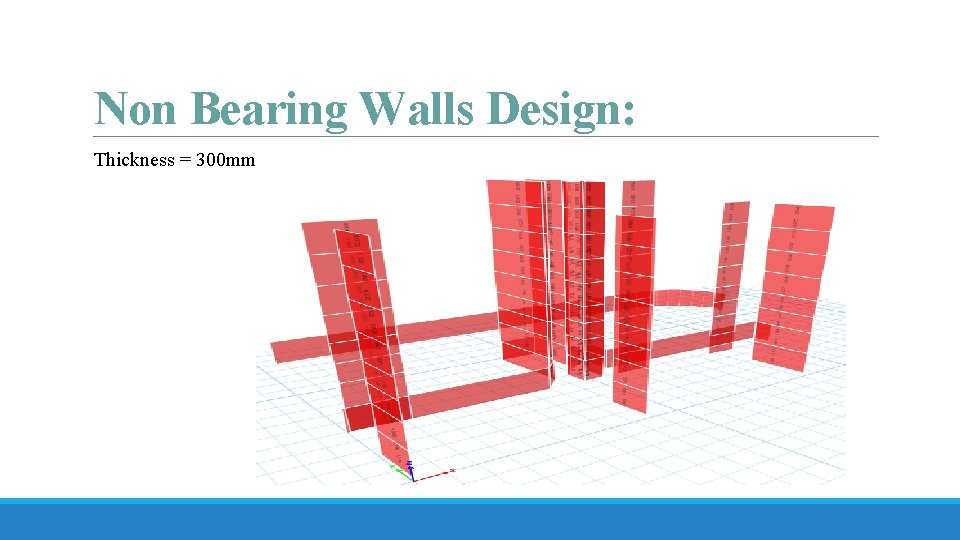
Non Bearing Walls Design: Thickness = 300 mm
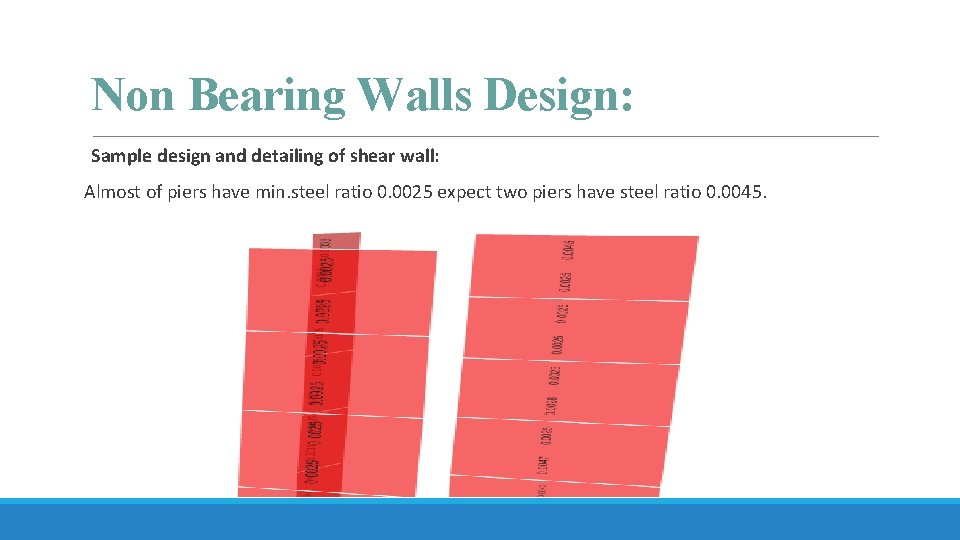
Non Bearing Walls Design: Sample design and detailing of shear wall: Almost of piers have min. steel ratio 0. 0025 expect two piers have steel ratio 0. 0045.
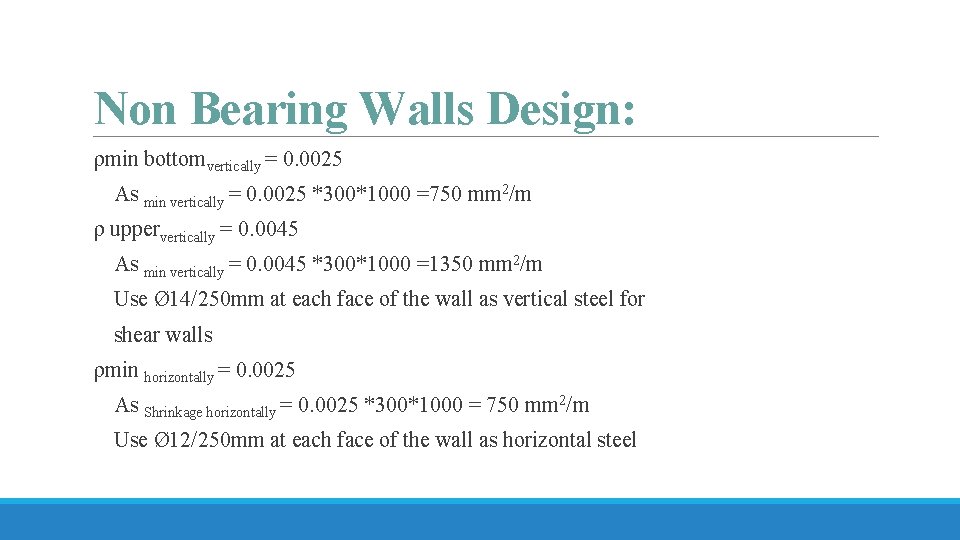
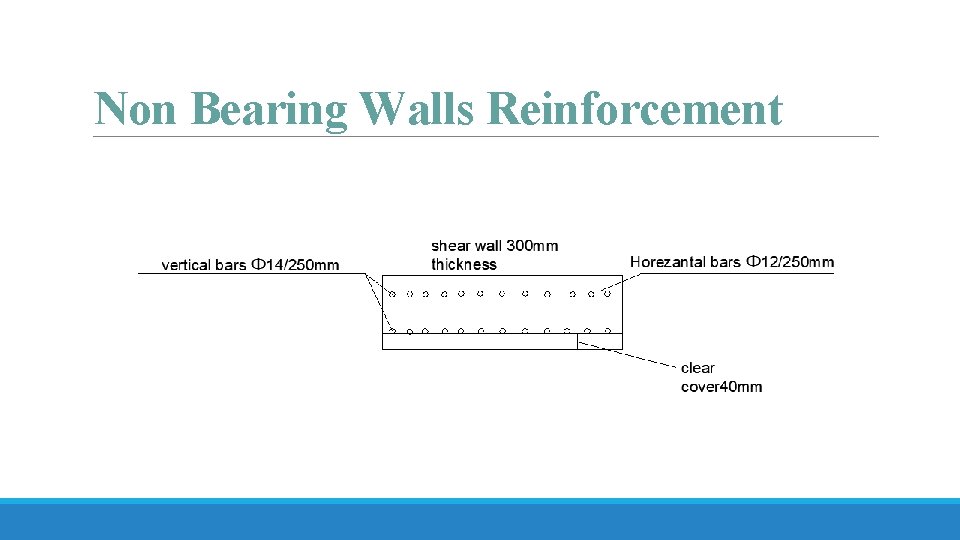
Non Bearing Walls Design: ρmin bottomvertically = 0. 0025 As min vertically = 0. 0025 *300*1000 =750 mm 2/m ρ uppervertically = 0. 0045 As min vertically = 0. 0045 *300*1000 =1350 mm 2/m Use Ø 14/250 mm at each face of the wall as vertical steel for shear walls ρmin horizontally = 0. 0025 As Shrinkage horizontally = 0. 0025 *300*1000 = 750 mm 2/m Use Ø 12/250 mm at each face of the wall as horizontal steel
Non Bearing Walls Reinforcement
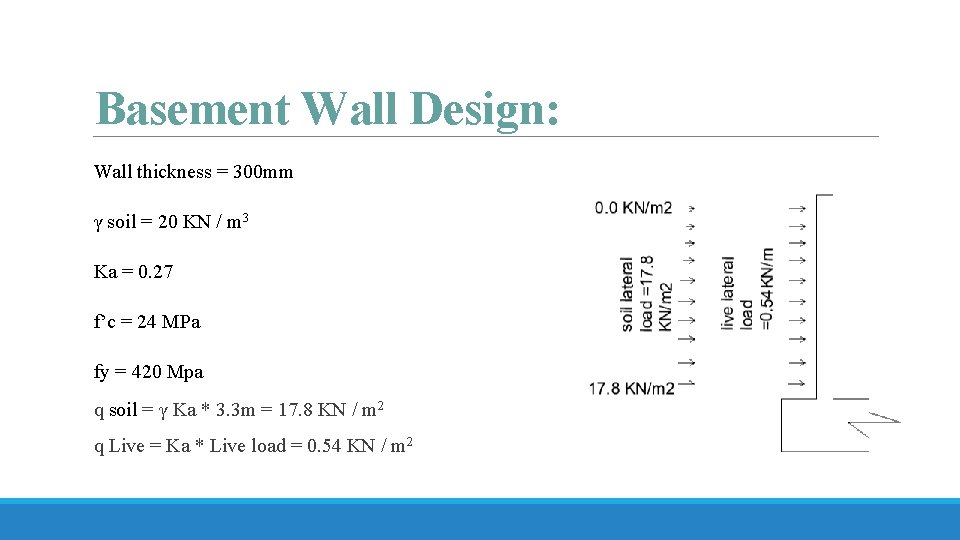
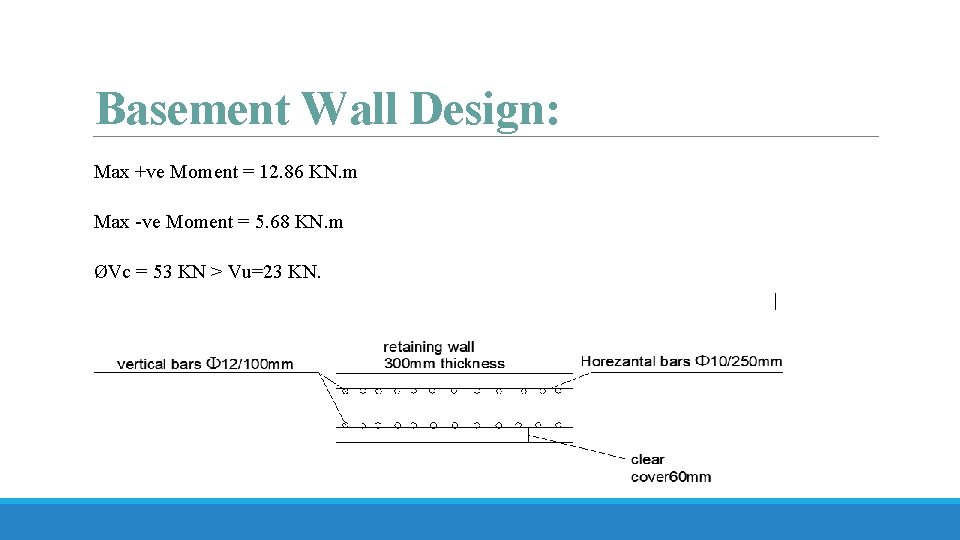
Basement Wall Design: Wall thickness = 300 mm γ soil = 20 KN / m 3 Ka = 0. 27 f’c = 24 MPa fy = 420 Mpa q soil = γ Ka * 3. 3 m = 17. 8 KN / m 2 q Live = Ka * Live load = 0. 54 KN / m 2
Basement Wall Design: Max +ve Moment = 12. 86 KN. m Max -ve Moment = 5. 68 KN. m ØVc = 53 KN > Vu=23 KN.
Foundation Design: The foundation system we used is a mat Foundation system. We used Safe software program to design the foundations.
Foundation Details: The allowable bearing capacity for soil in the location of the building is 240 KN/m 2. Thickness of each foundation was chosen based on wide beam shear and punching shear. Our foundation thickness is 1000 mm.
Foundation Checks: v. Wide beam shear check. v. Deflection check. v. Stresses check.
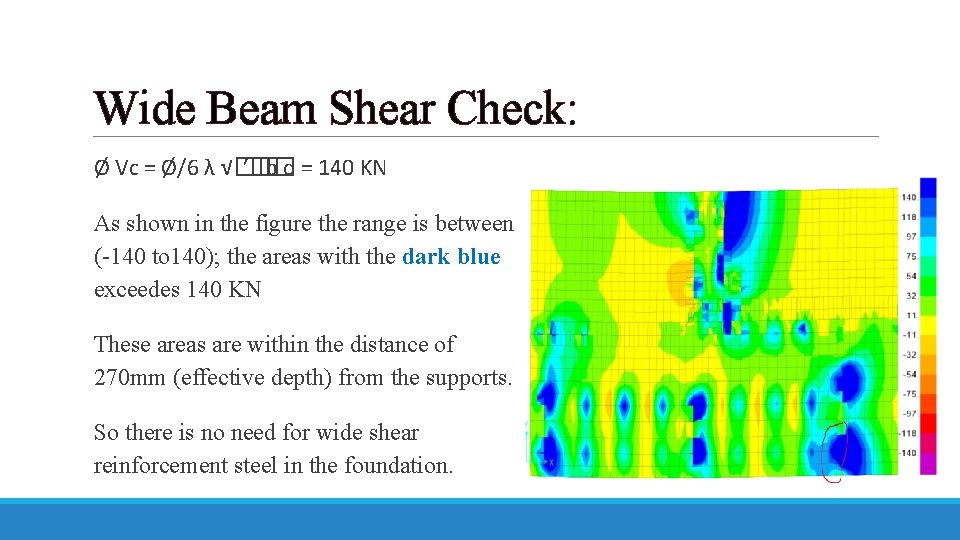
Wide Beam Shear Check: Ø Vc = Ø/6 λ √�� ′�� b d = 140 KN As shown in the figure the range is between (-140 to 140); the areas with the dark blue exceedes 140 KN These areas are within the distance of 270 mm (effective depth) from the supports. So there is no need for wide shear reinforcement steel in the foundation.
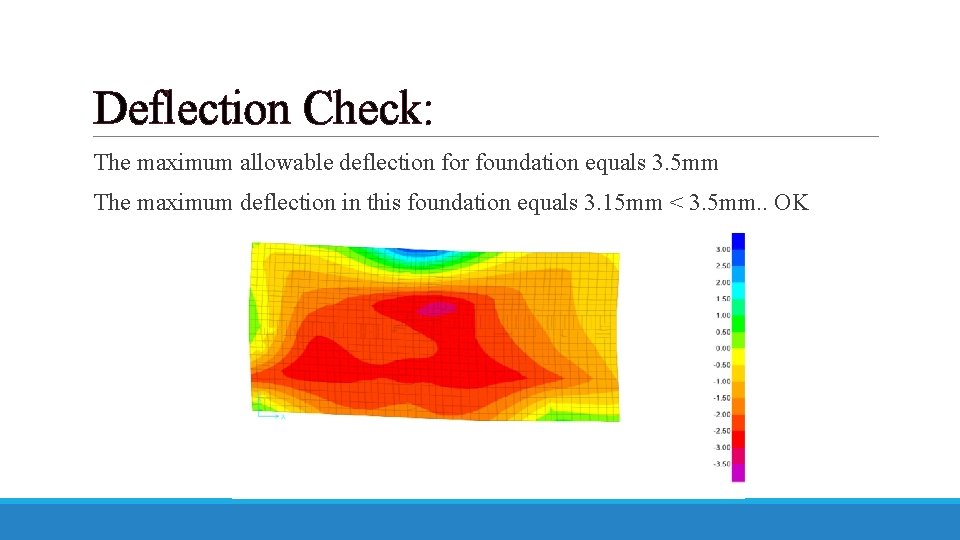
Deflection Check: The maximum allowable deflection for foundation equals 3. 5 mm The maximum deflection in this foundation equals 3. 15 mm < 3. 5 mm. . OK
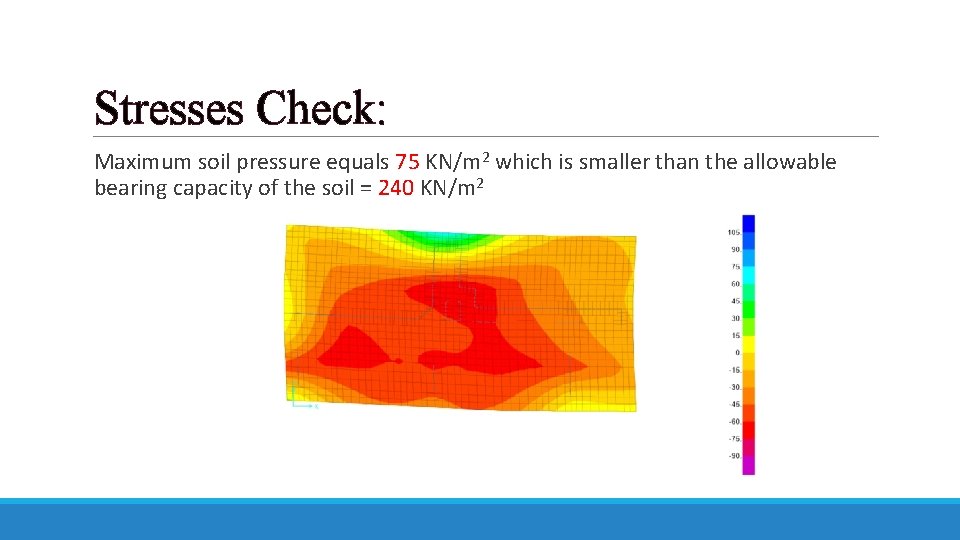
Stresses Check: Maximum soil pressure equals 75 KN/m 2 which is smaller than the allowable bearing capacity of the soil = 240 KN/m 2
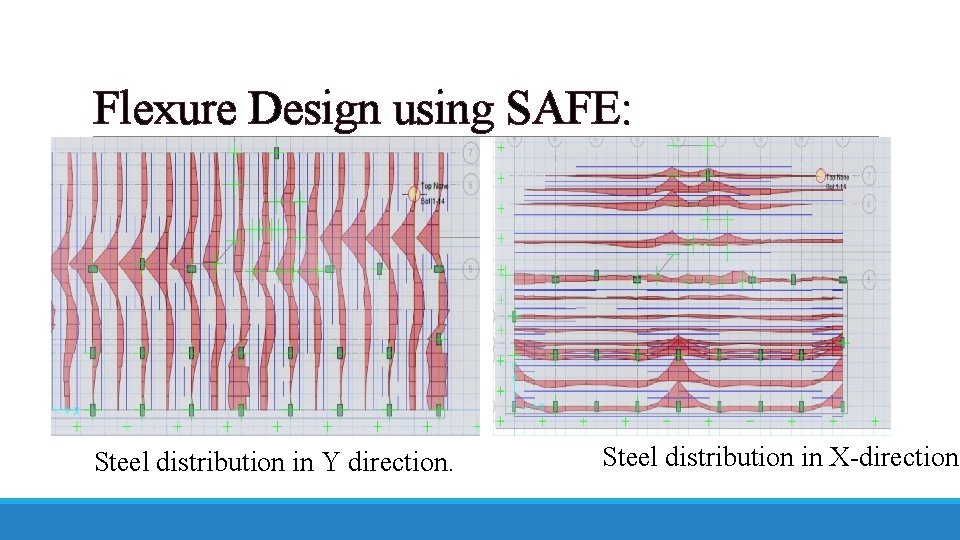
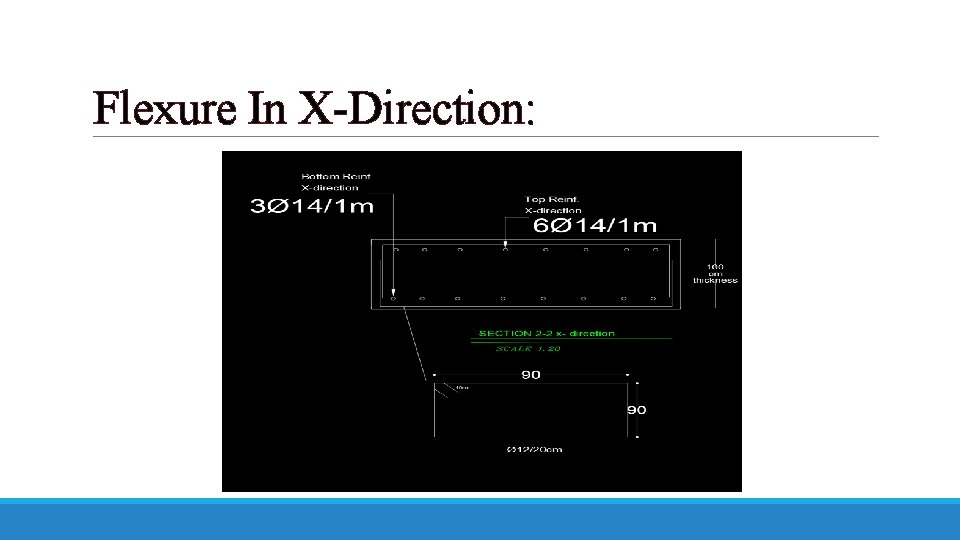
Flexure Design using SAFE: Steel distribution in Y direction. Steel distribution in X-direction.
Flexure In Y-Direction:
Flexure In X-Direction:
References: ØACI Committee 318 “Building Code Requirements for Structural Concrete (ACI 318 M-14)” American concrete institute, Michigan, 2011. Ø ASCE Committee (2010), “American Society of Civil Engineers, Minimum Design Loads for Buildings and Other Structures” American Society of Civil Engineers, Virginia 20191, 2010. ØIBC 2012