
Graduation Project II Lean Manufacturing in Dalia Factory
- Slides: 59
Graduation Project II Lean Manufacturing in Dalia Factory for Plastic Bags Prepared By : Waleed Jamal Faqeeh Abdul Rahman Herzallah Under Supervision of : Eng. Majd Abu Amsha
Table of Contents Ø Introduction Ø Process Ø Flow chart of the process Ø Seven Wastes Ø Result and Analysis Ø Discussion Ø Conclusion and Recommendations
Introduction Ø Dalia plastic factory, north of Nablus. Ø It was founded in 1995, it produces full capacity throughout the day for 2 shift Ø Number of workers 9 Ø The factory has 4 production lines produces plastic bags of all shapes and sizes Ø Exports 60% of its products occupied territory and 40% inside the West Bank
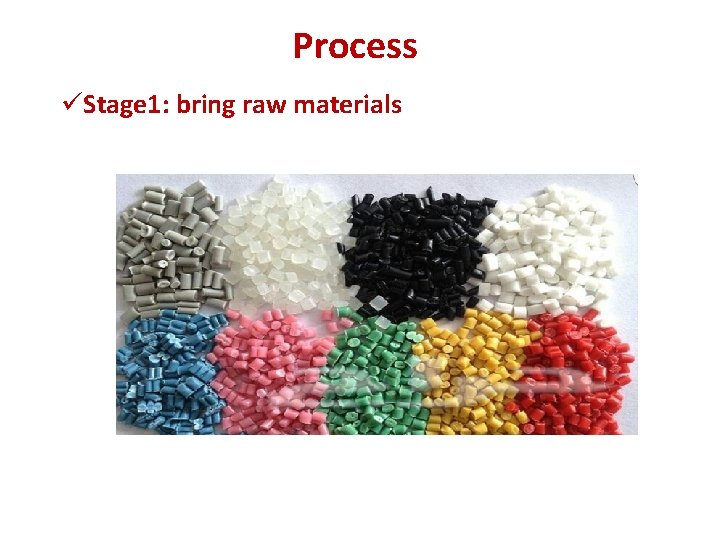
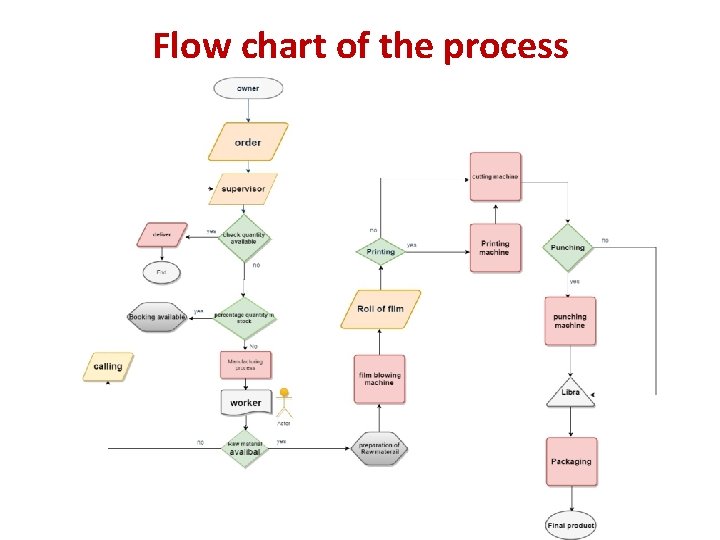
Process üStage 1: bring raw materials
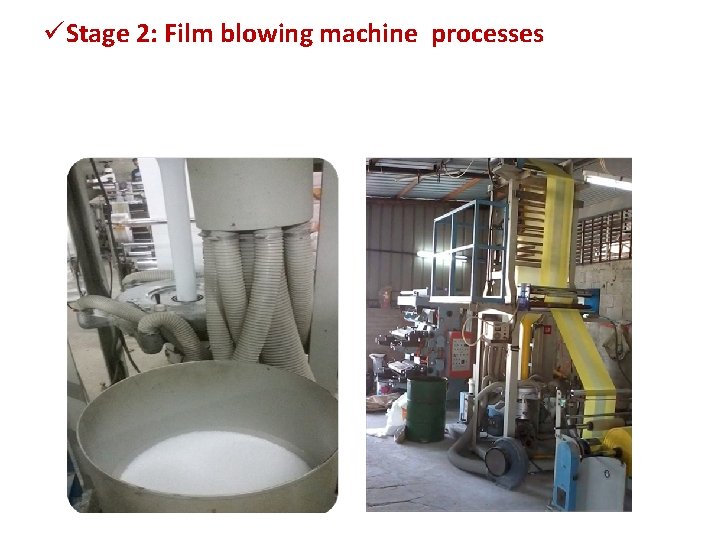
üStage 2: Film blowing machine processes
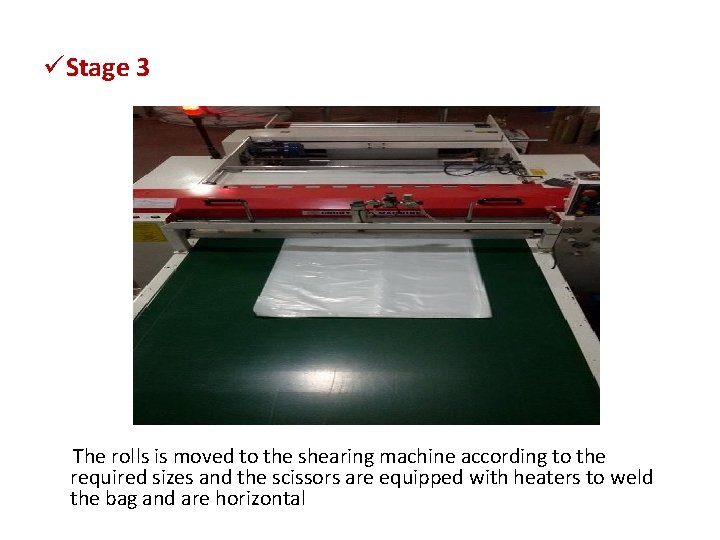
üStage 3 The rolls is moved to the shearing machine according to the required sizes and the scissors are equipped with heaters to weld the bag and are horizontal
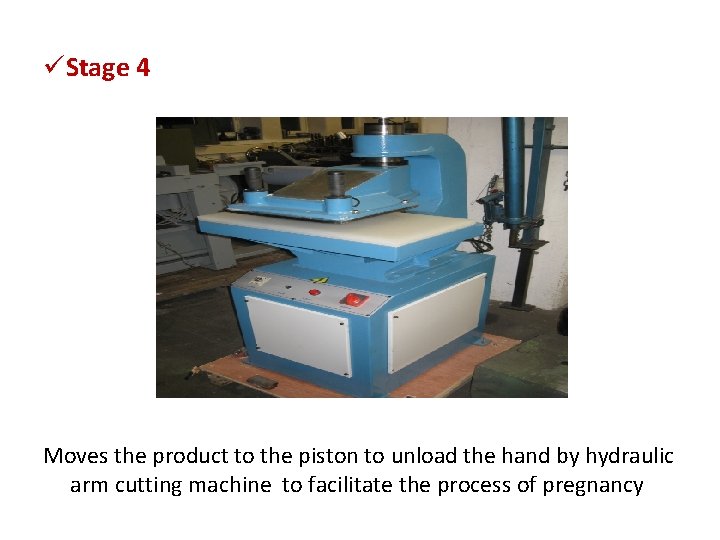
üStage 4 Moves the product to the piston to unload the hand by hydraulic arm cutting machine to facilitate the process of pregnancy
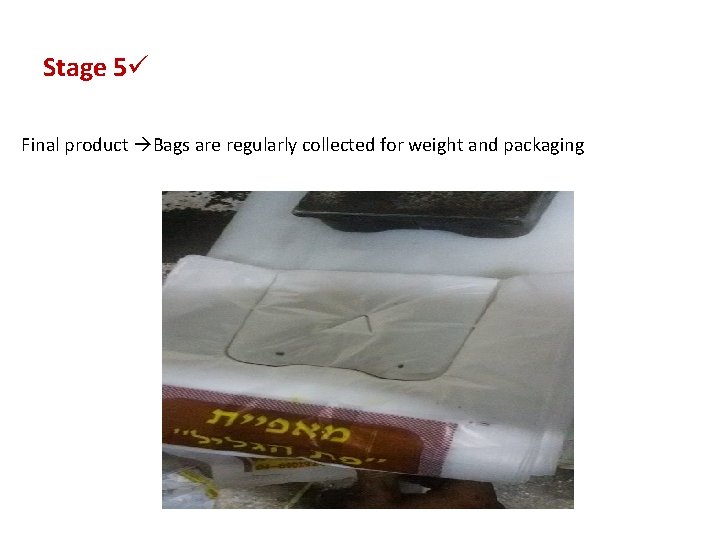
Stage 5ü Final product Bags are regularly collected for weight and packaging
Flow chart of the process
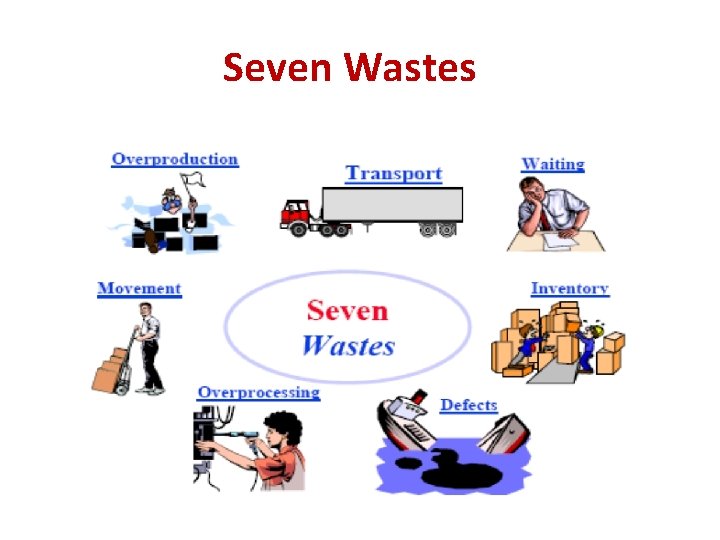
Seven Wastes
Result and Analysis
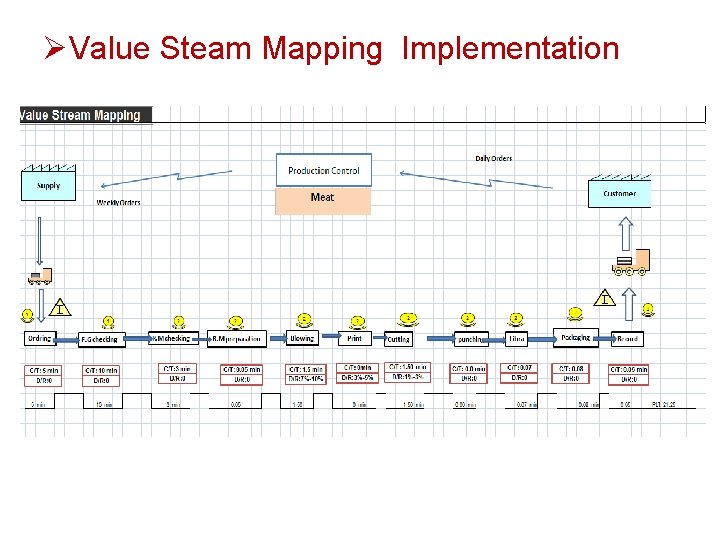
ØValue Steam Mapping Implementation
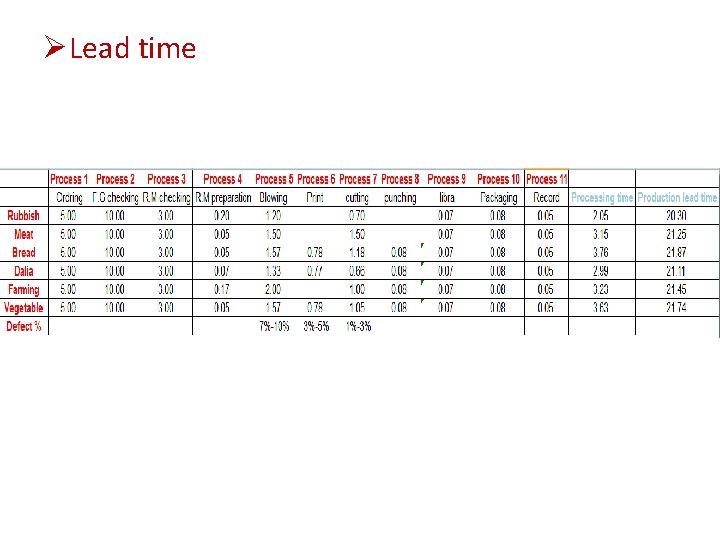
ØLead time
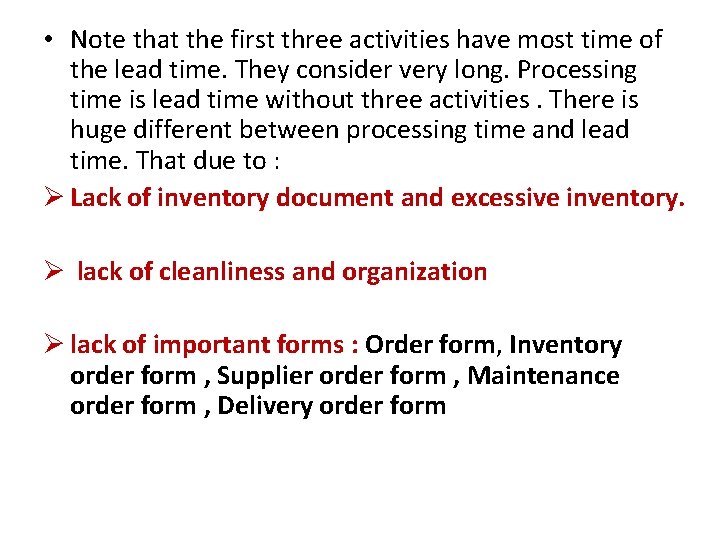
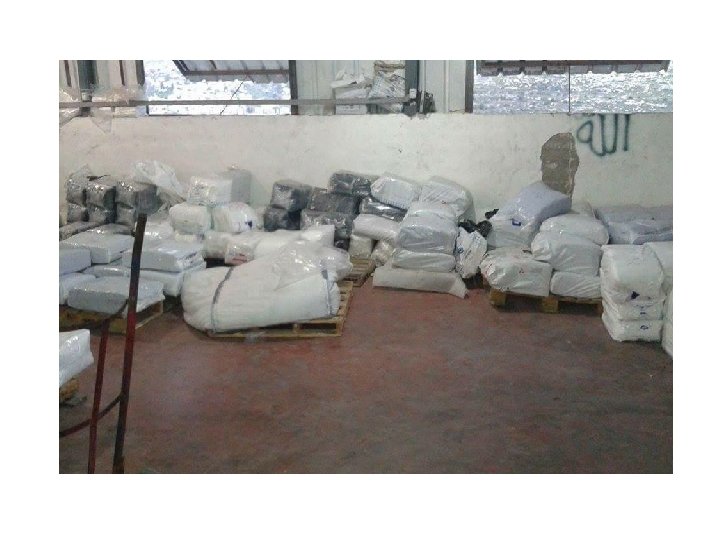
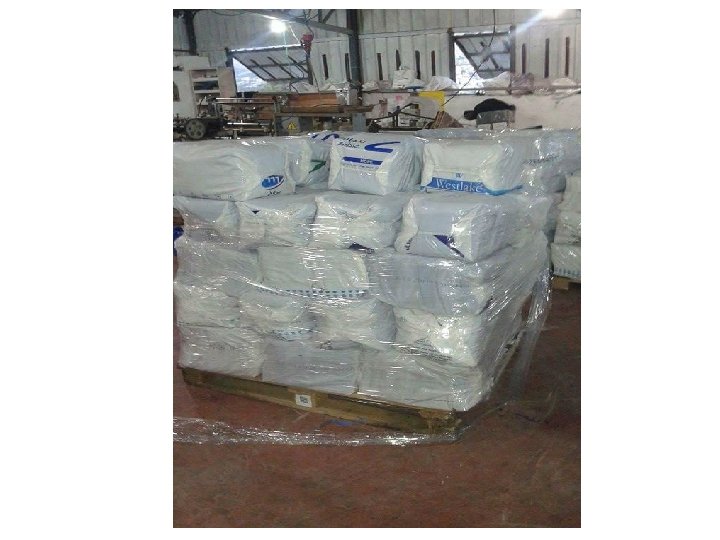
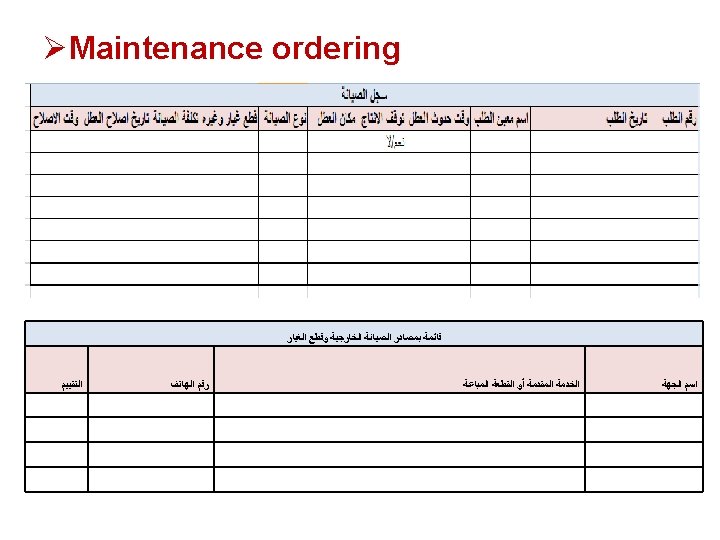
• Note that the first three activities have most time of the lead time. They consider very long. Processing time is lead time without three activities. There is huge different between processing time and lead time. That due to : Ø Lack of inventory document and excessive inventory. Ø lack of cleanliness and organization Ø lack of important forms : Order form, Inventory order form , Supplier order form , Maintenance order form , Delivery order form
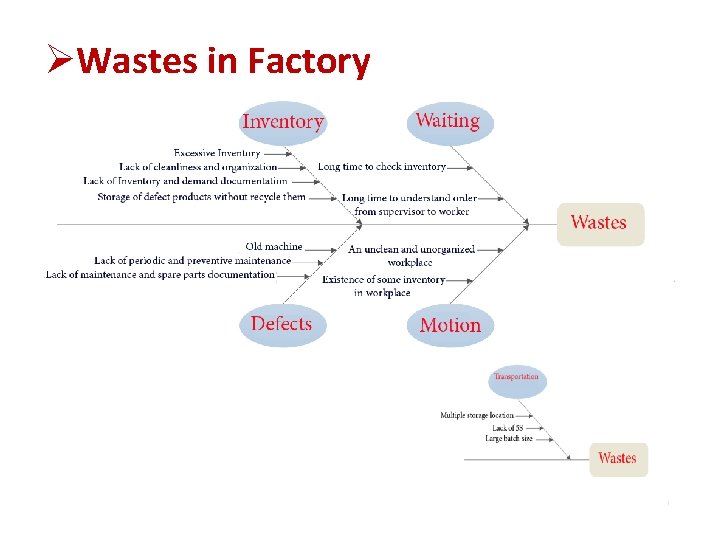
ØWastes in Factory
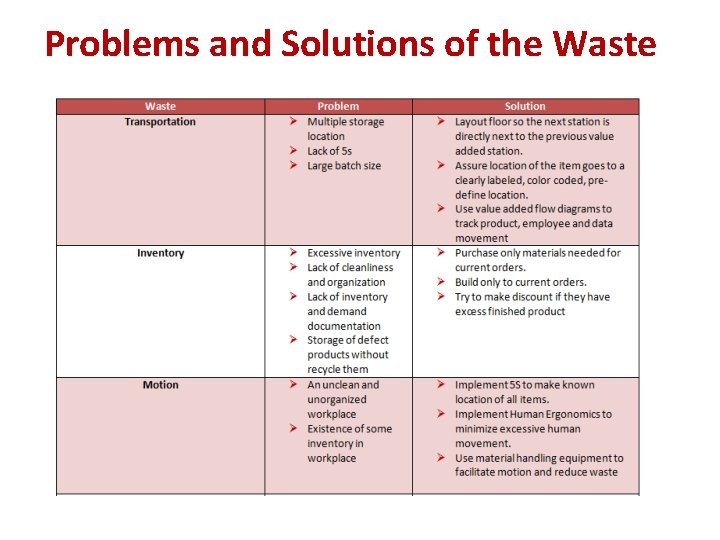
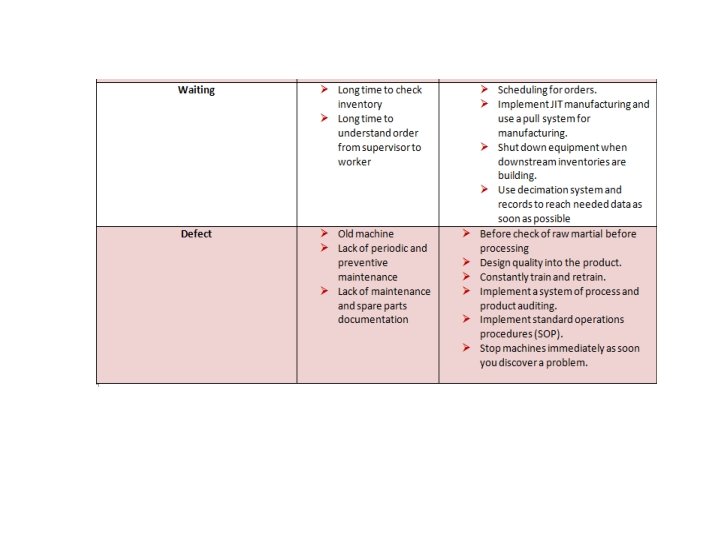
Problems and Solutions of the Waste
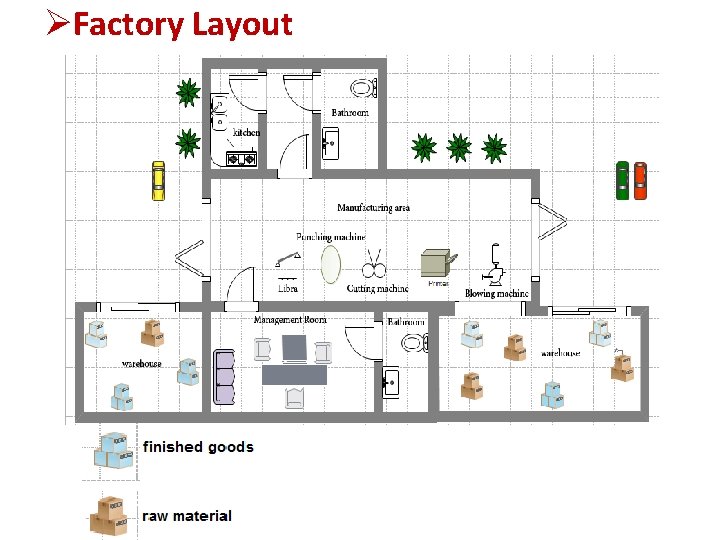
ØFactory Layout
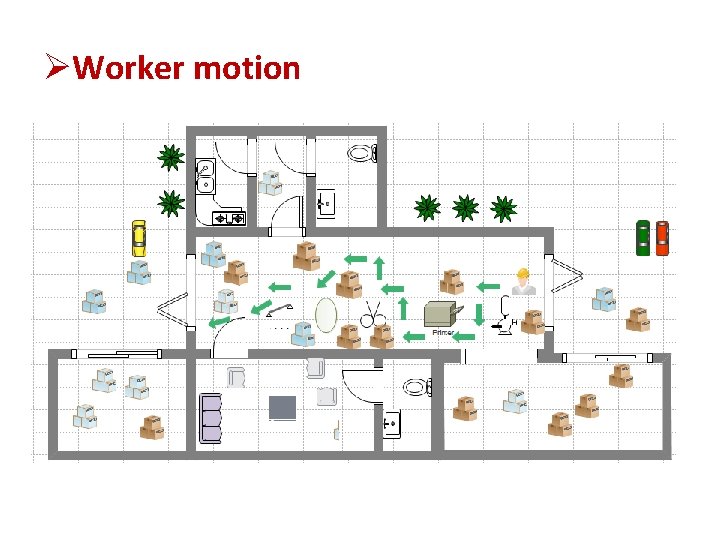
ØWorker motion
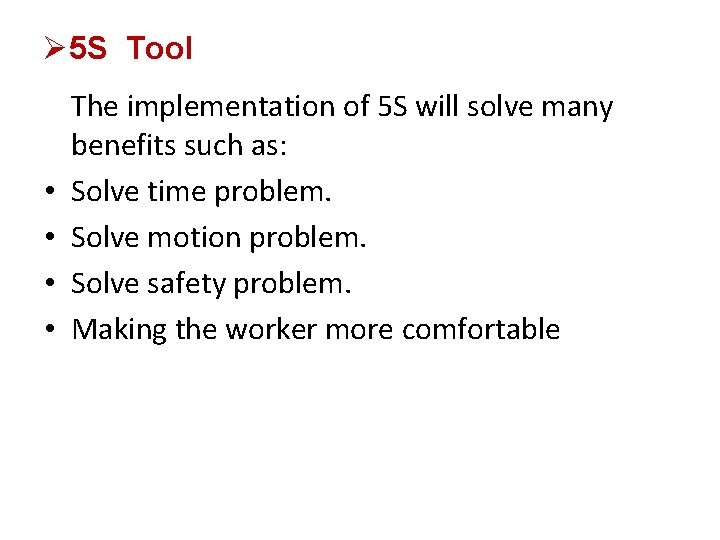
Ø 5 S Tool • • The implementation of 5 S will solve many benefits such as: Solve time problem. Solve motion problem. Solve safety problem. Making the worker more comfortable
Why the 5 s? According to the current situation in the factory , the most appropriate tool for possible improvement is 5 s, as it helps to eliminate waste, streamline production, and optimize efficiencies. When you adopt 5 s thinking, you make a commitment to put safety, organization and effectiveness ahead of production deadlines, profits and output. The end result is always an increase in overall success
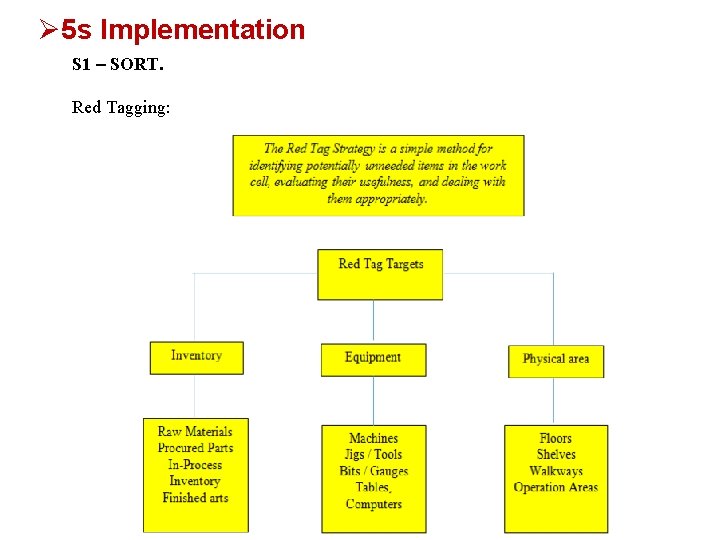
Ø 5 s Implementation S 1 – SORT. Red Tagging:
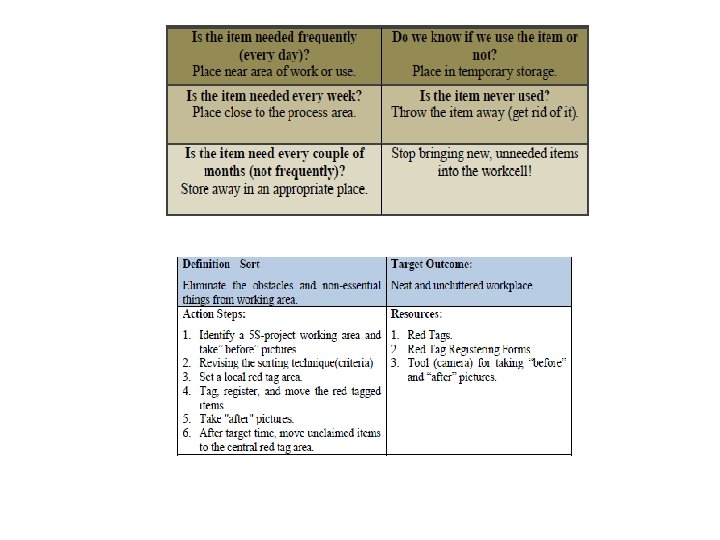
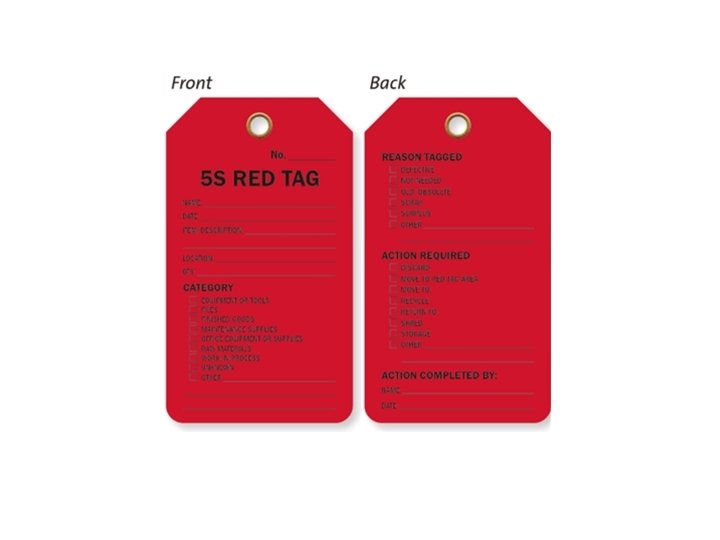
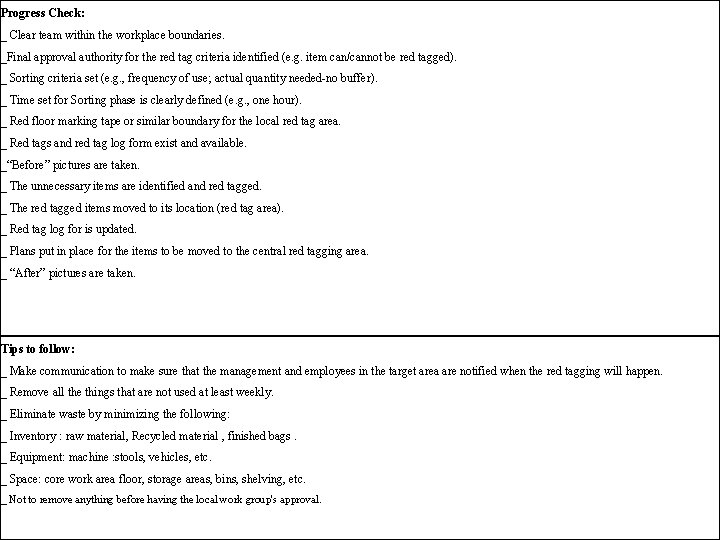
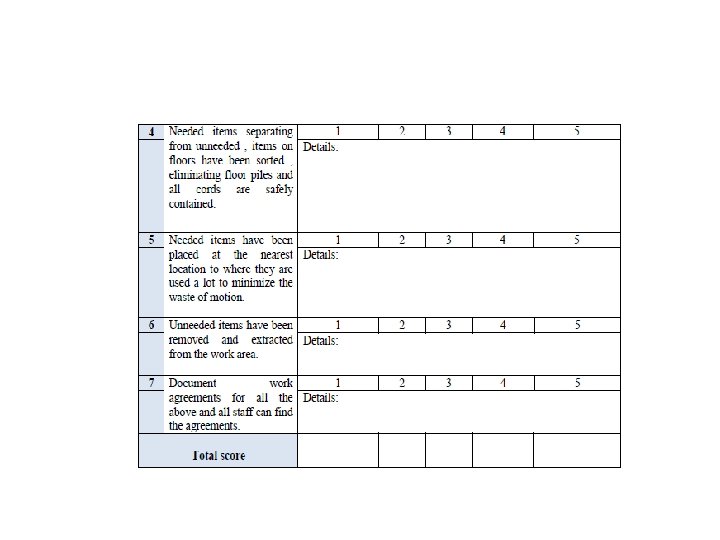
Progress Check: _ Clear team within the workplace boundaries. _Final approval authority for the red tag criteria identified (e. g. item can/cannot be red tagged). _ Sorting criteria set (e. g. , frequency of use; actual quantity needed-no buffer). _ Time set for Sorting phase is clearly defined (e. g. , one hour). _ Red floor marking tape or similar boundary for the local red tag area. _ Red tags and red tag log form exist and available. _“Before” pictures are taken. _ The unnecessary items are identified and red tagged. _ The red tagged items moved to its location (red tag area). _ Red tag log for is updated. _ Plans put in place for the items to be moved to the central red tagging area. _ “After” pictures are taken. Tips to follow: _ Make communication to make sure that the management and employees in the target area are notified when the red tagging will happen. _ Remove all the things that are not used at least weekly. _ Eliminate waste by minimizing the following: _ Inventory : raw material, Recycled material , finished bags. _ Equipment: machine : stools, vehicles, etc. _ Space: core work area floor, storage areas, bins, shelving, etc. _ Not to remove anything before having the local work group's approval.
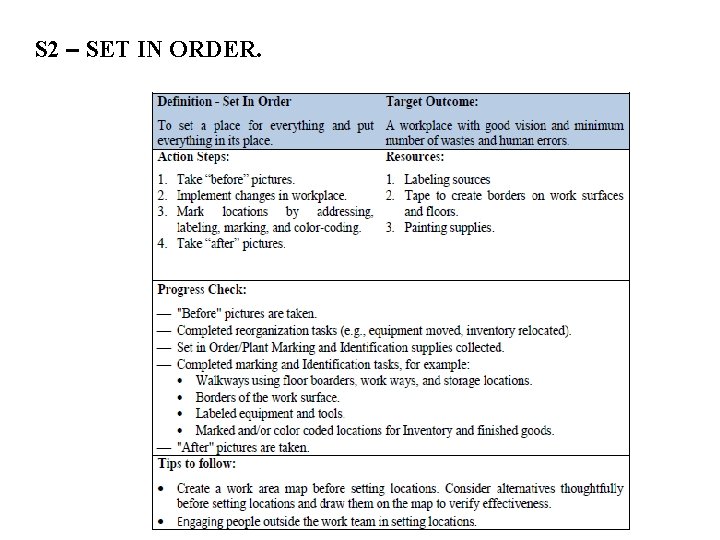
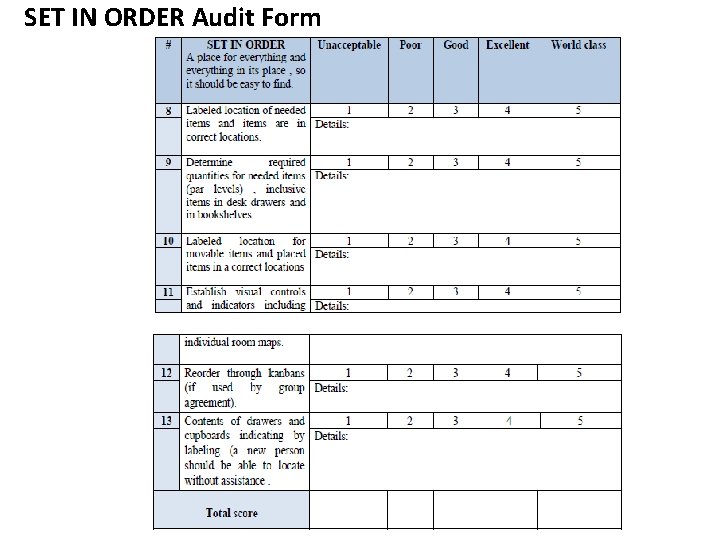
S 2 – SET IN ORDER.
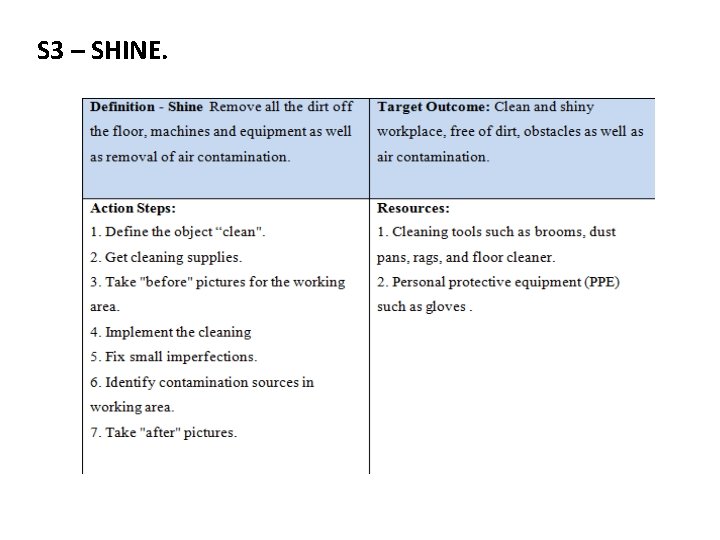
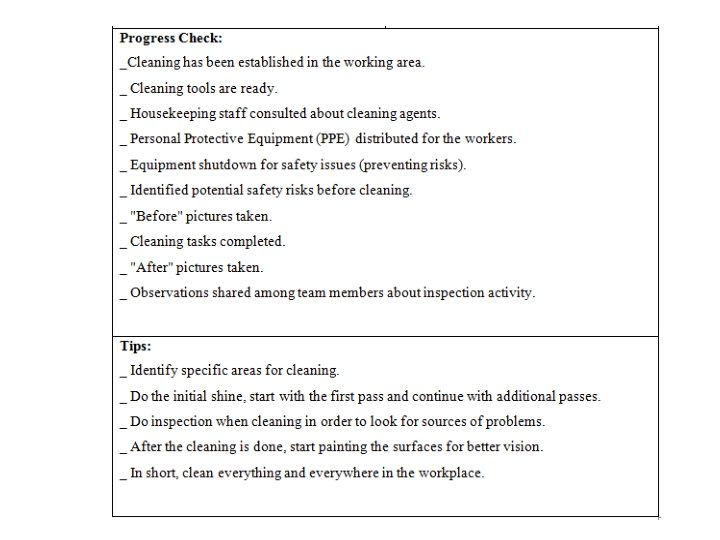
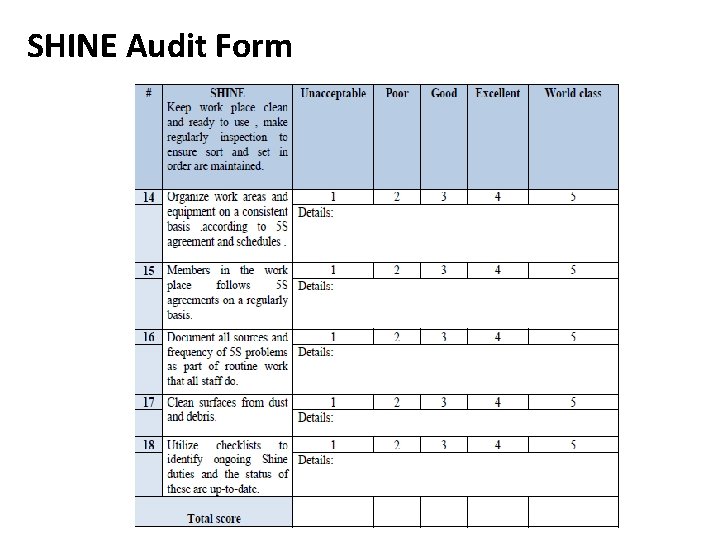
S 3 – SHINE.
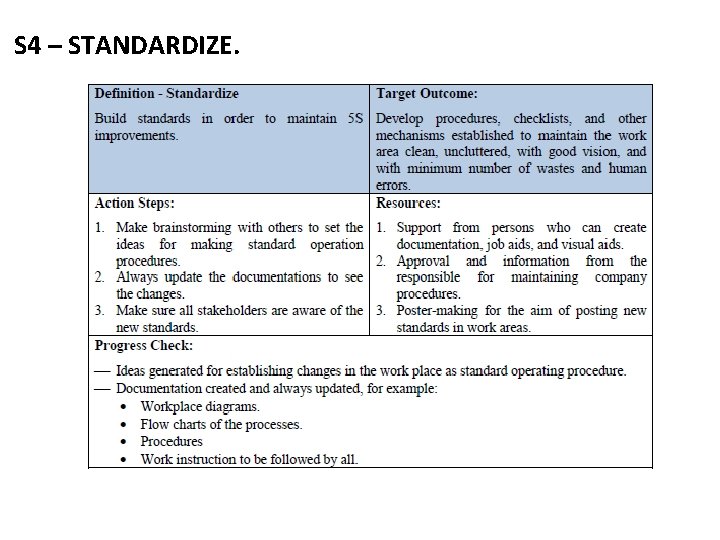
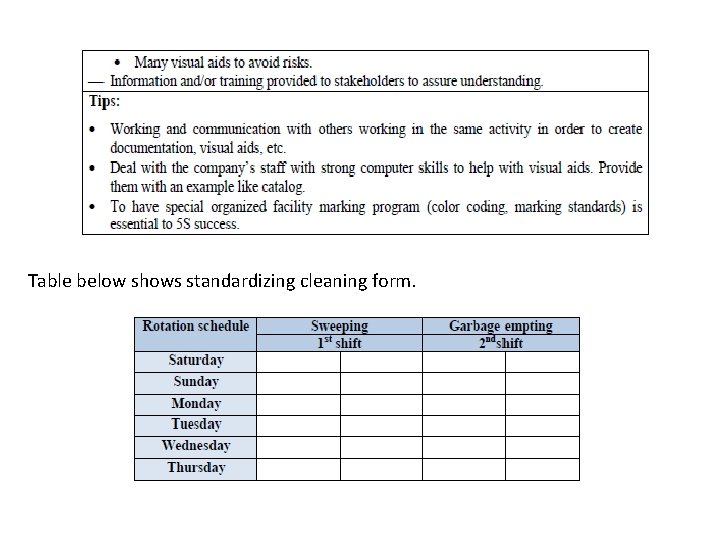
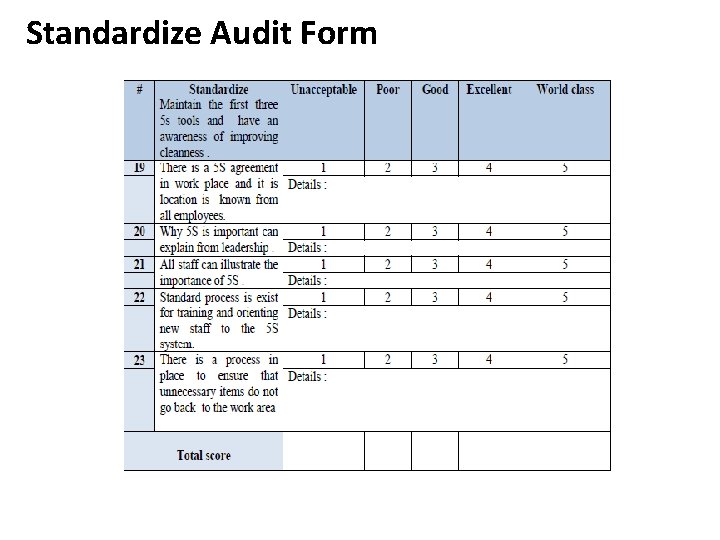
S 4 – STANDARDIZE.
Table below shows standardizing cleaning form.
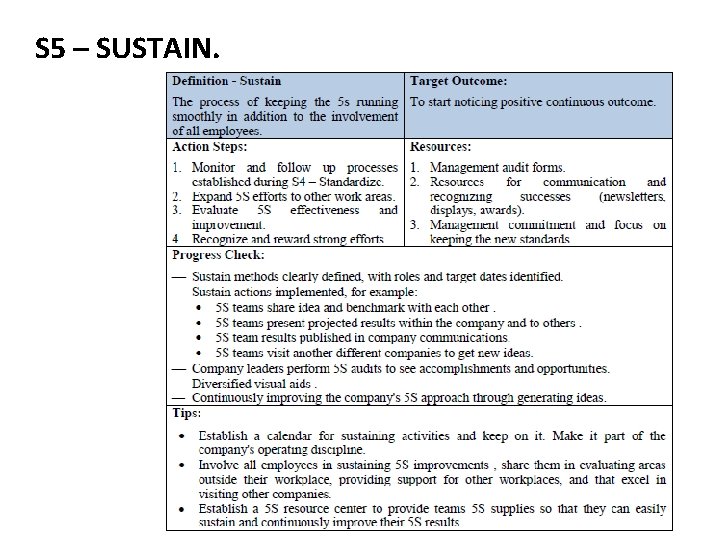
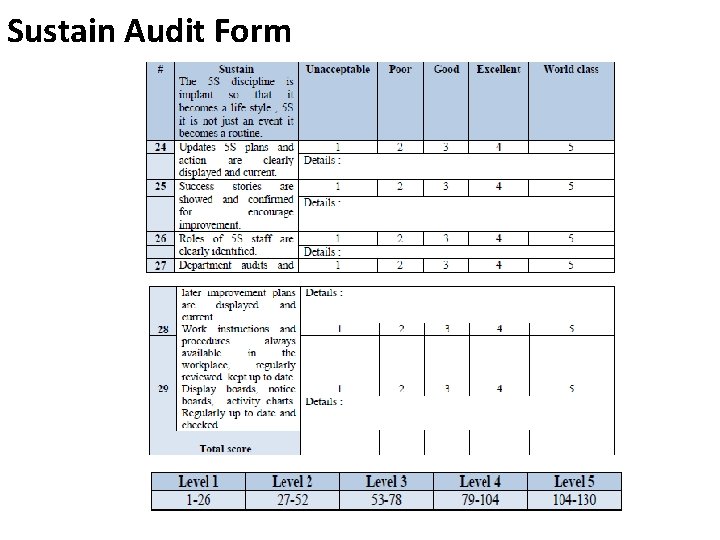
S 5 – SUSTAIN.
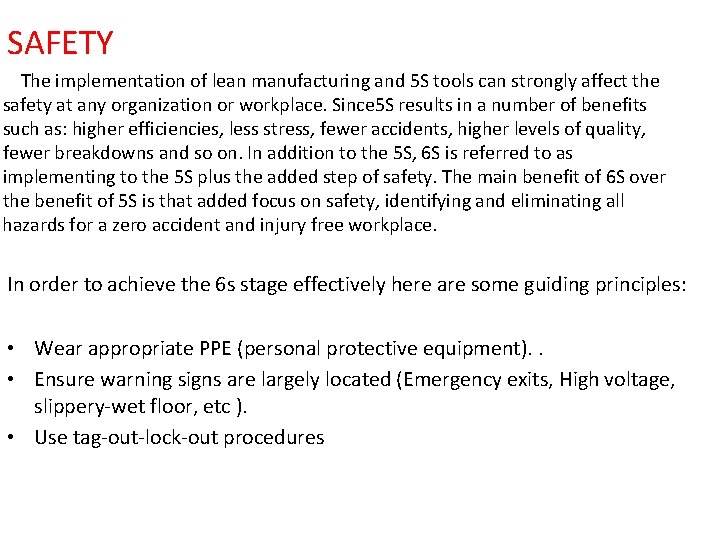
SAFETY The implementation of lean manufacturing and 5 S tools can strongly affect the safety at any organization or workplace. Since 5 S results in a number of benefits such as: higher efficiencies, less stress, fewer accidents, higher levels of quality, fewer breakdowns and so on. In addition to the 5 S, 6 S is referred to as implementing to the 5 S plus the added step of safety. The main benefit of 6 S over the benefit of 5 S is that added focus on safety, identifying and eliminating all hazards for a zero accident and injury free workplace. In order to achieve the 6 s stage effectively here are some guiding principles: • Wear appropriate PPE (personal protective equipment). . • Ensure warning signs are largely located (Emergency exits, High voltage, slippery-wet floor, etc ). • Use tag-out-lock-out procedures
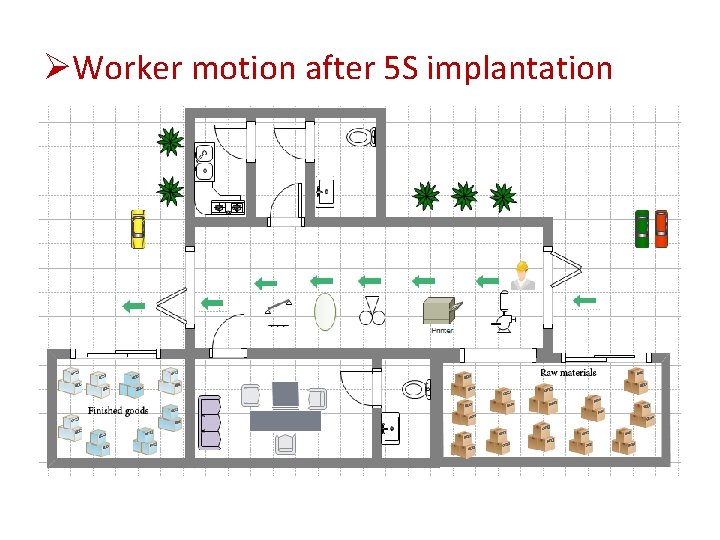
ØWorker motion after 5 S implantation
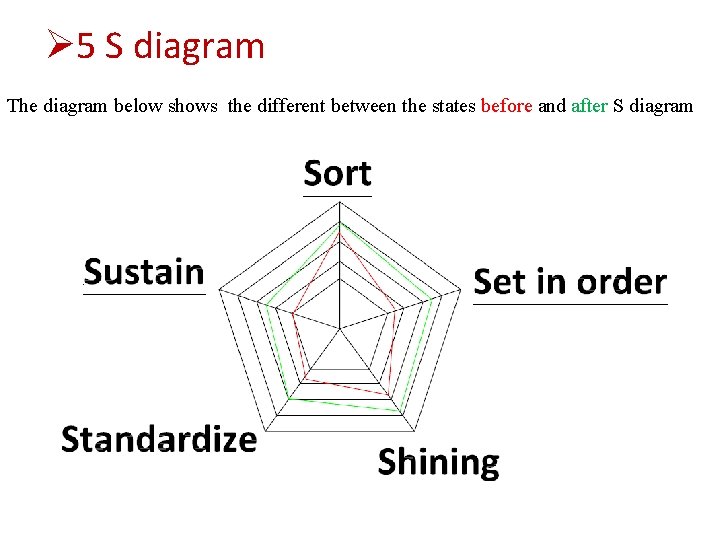
Ø 5 S diagram The diagram below shows the different between the states before and after S diagram
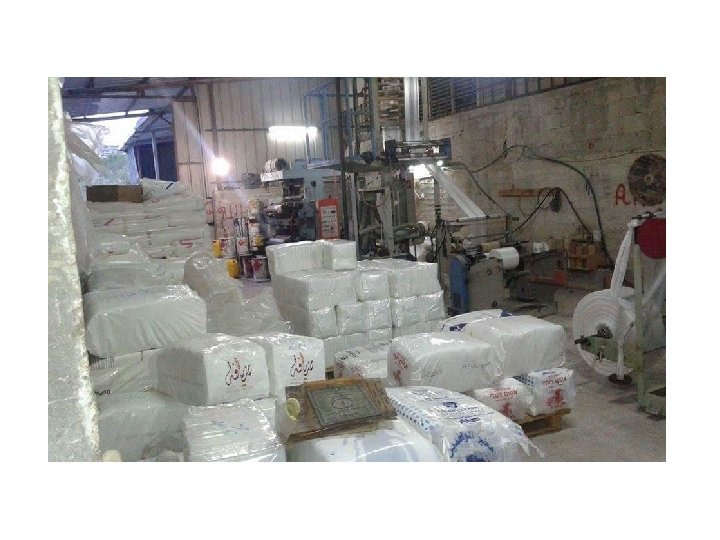
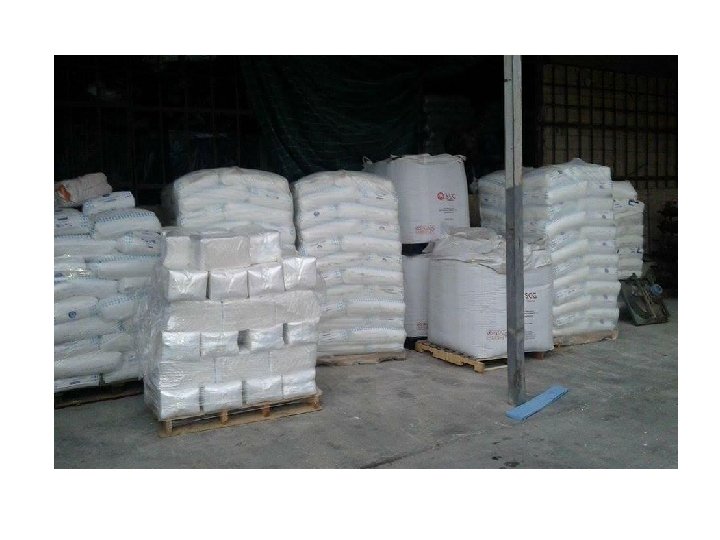
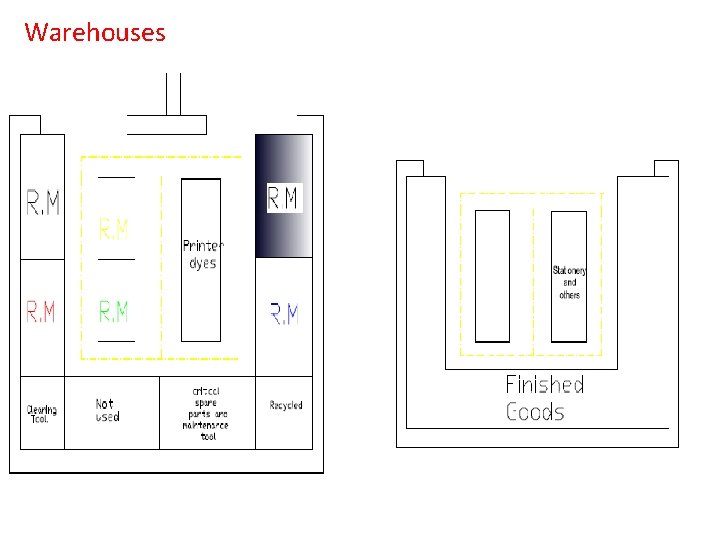
Warehouses
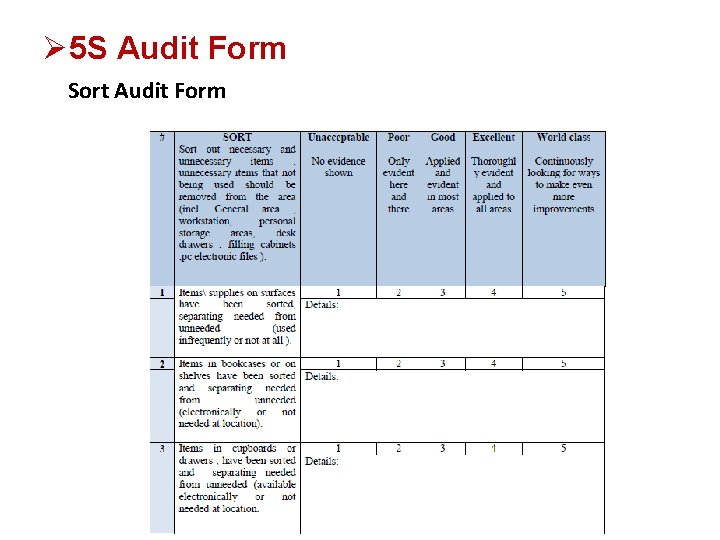
Ø 5 S Audit Form Sort Audit Form
SET IN ORDER Audit Form
SHINE Audit Form
Standardize Audit Form
Sustain Audit Form
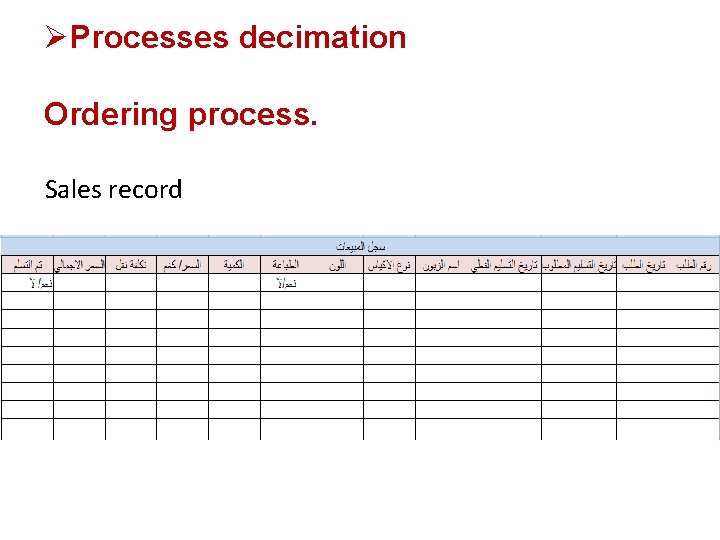
ØProcesses decimation Ordering process. Sales record
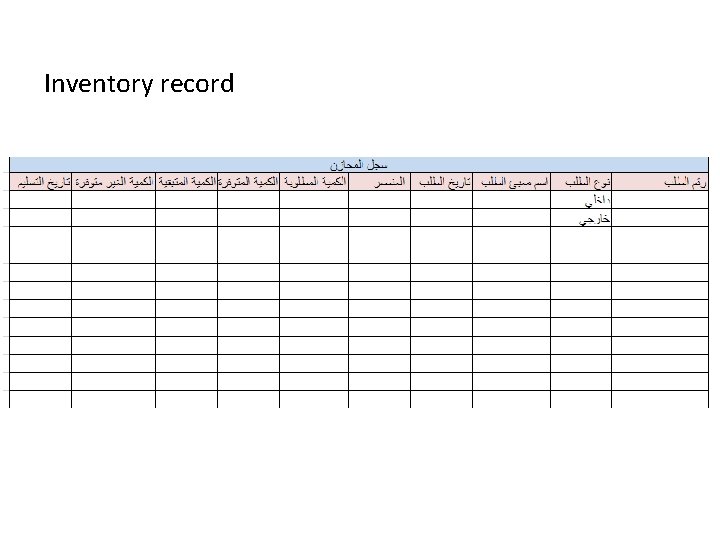
Inventory record
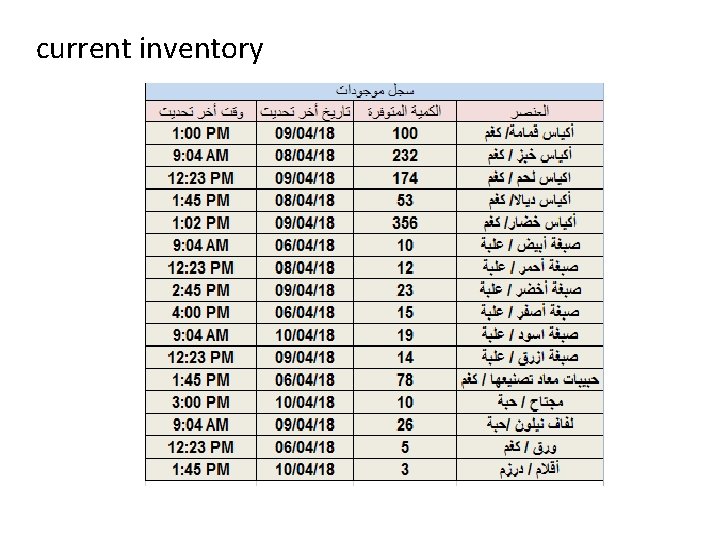
current inventory
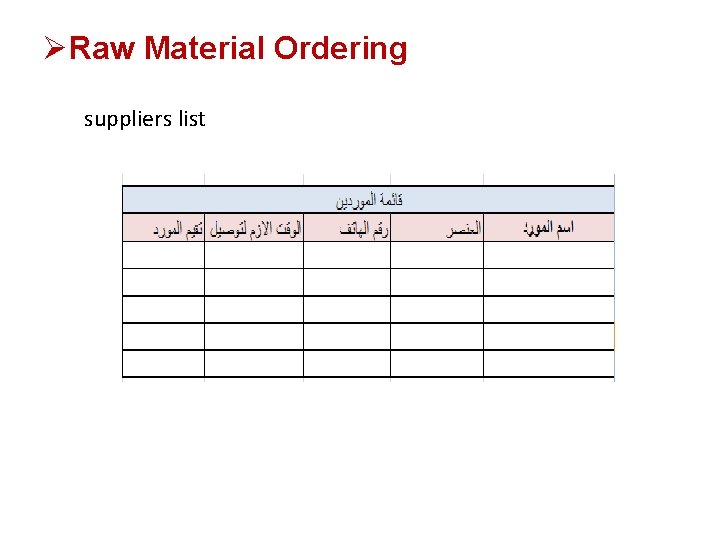
ØRaw Material Ordering suppliers list
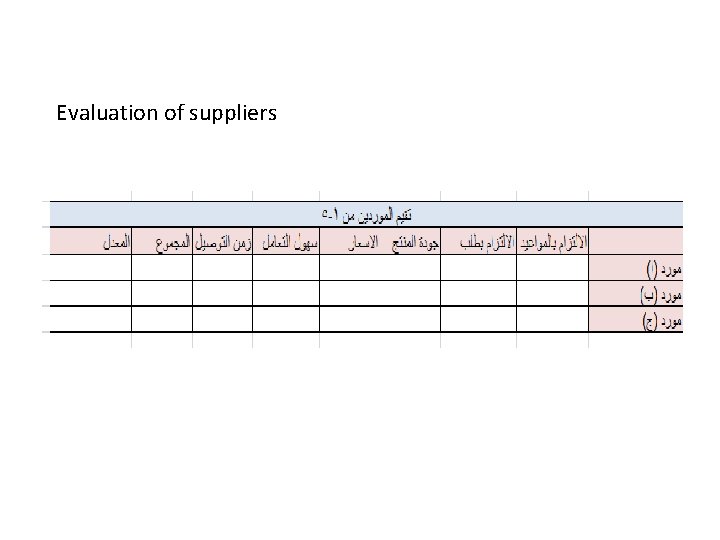
Evaluation of suppliers
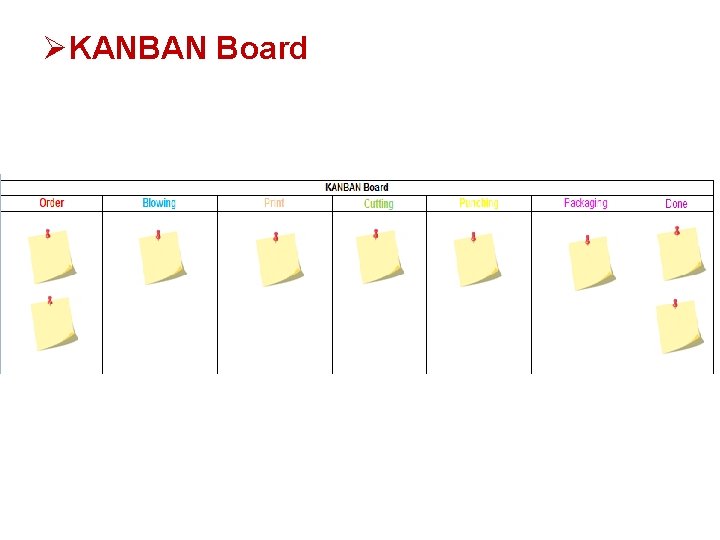
ØKANBAN Board
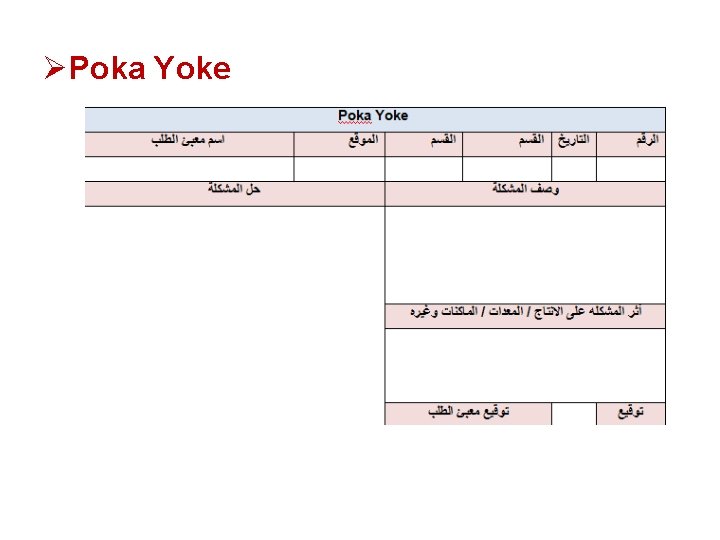
ØPoka Yoke
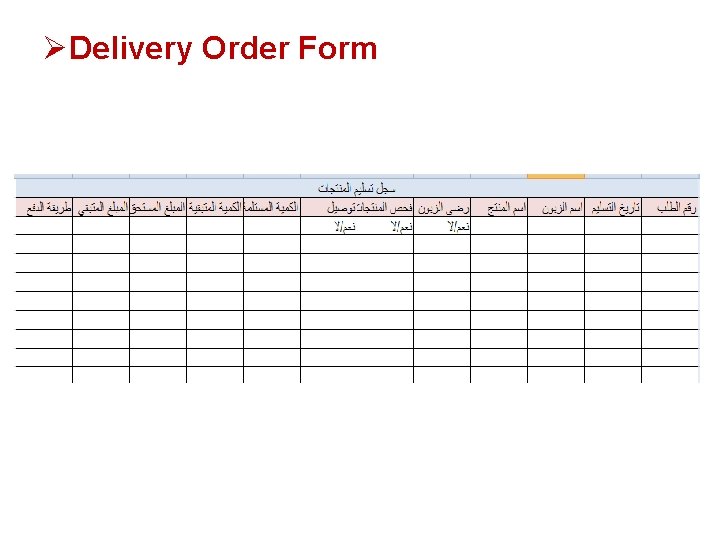
ØDelivery Order Form
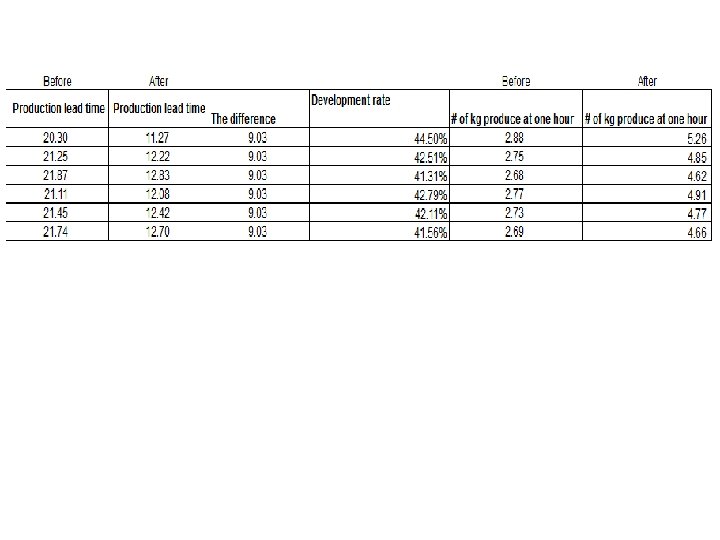
Discussion Lean approach will achieve high improvement. Lean can provide an organization with a clear competitive advantage since the correct application of the Lean principles will realize substantial benefits that include: • • • Greater productivity Greater throughput Improved quality Reduced cycle times Less Defects Smoother operation
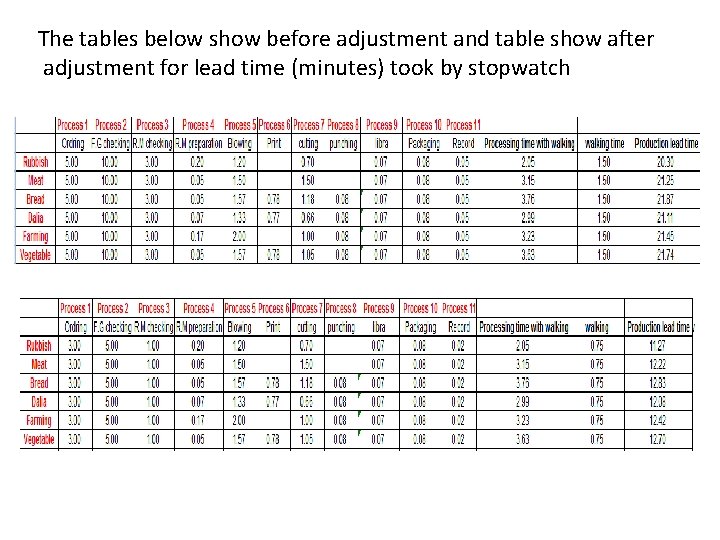
The tables below show before adjustment and table show after adjustment for lead time (minutes) took by stopwatch
Conclusion In this part of the project we discussed the concept of lean manufacturing, its principles and tools, we used this concept and applied it to Dalia factory for plastic bags, we have talked about the nature of the industry, the factory, its structure, what the factory produces , and how to do the manufacturing process. Implementation of the Lean Manufacturing concept is a shift from a traditional production scheme to a modern manufacturing systems, rapidly responding to market changes and varying demands of final recipients. It also stands for reduction of the amount of operating resources involved in the production process. There are many limitations that have affected us in applying the concept of industry to the fullest in the factory, such as factory do not have the tendency to implement lean and that is not because they do not want or do not know about lean production advantages, rather it is because they cannot do that, the lack of skilled employees is concluded, and occupation policy aimed at obliterating Palestinian industries.
ØRecommendations Ø The workers need for improvement course regularly. Ø Document system should be improved and regularly edited. Ø The factory need to forecast system , quality management system , inventory management system and planning. Ø The workers must adhere to the new system instructions. Ø Lean manufacturing should be as culture in side factory.