
GRADUATION APPROACHING HOW DO YOU PLAN TO HANDLE




- Slides: 45
GRADUATION APPROACHING? ? ? HOW DO YOU PLAN TO HANDLE YOUR STUDENT By: Elizabeth Le & Michael A. Couch II
OVERVIEW OF PRESENTATION Who’s in the room? Our Story Research shows Understanding Your Loans Loan Repayment Types of payment plans Deferment & Forbearance Default Forgiveness, Cancellation & Discharge Repayment Summaries Best Practices
WHO’S IN THE ROOM?
OUR STORIES
LIZ’S STORY Liz is an outgoing financial aid professional that prides herself on finding unique alternatives for all students to be able to fund the education they dream of. I have been working in financial aid for over 8 years and spend a majority of my time meeting with new and returning students and their families. I also supervisor, hire and train student employees in the financial aid office. My main program responsibility is the “gray” areas of financial aid; so special circumstances, independent appeals and standards of academic progress appeals. I love the balance of work that the financial aid office gives me and the variety of each day at work. I grew up in the greater Grand Rapids area and call this place my home! I am raising my own family of 7—a live in mother-in-law, husband of 9 years and 4 kids (Chris-16, Davis-6, Cooper 5 and my baby girl Piper-2). This life keeps me busy, but working in higher education offers me a great work life balance that allows me the flexibility to “do it all” as a mom, professional, woman and wife. I have always loved working with adolescent and young adults populations of students and believe my purpose is mentoring, counseling and advising this group of students on whatever it is that they see for their futures. In the little free time I have I enjoy volunteering in my church youth group, shopping and baking.
MICHAEL’S STORY Michael is a native of Grand Rapids, Michigan and currently lives in Grand Rapids as well. Michael has earned a Bachelor’s of Science degree with an emphasis on Physical Education K-12 in 2006. GVSU then prepared him to continue his educational journey at Western Michigan University where he received a Masters of Arts with the emphasis of Higher Education and Student Affairs in 2010. Today Michael works as a part of the Student Financial Aid team at Western Michigan University. He serves in the role of a Financial Aid Counselor in his role he counsels and advises students and families about financial aid eligibility, application procedures, aid programs, costs, indebtedness, money management and financial planning and individualizes information to the particular needs and situation of the student and or the family. His passion areas are early awareness, multicultural outreach and financial literacy. Last but not least…Michael is married to his college sweetheart Janean. They met in 2001 and have been married for five years this May. Together they enjoy traveling, watching movies, shopping and spending quality time with family and friends.
SO NOW THAT YOU ARE APPROACHING GRADUATION WHAT ARE SOME THINGS THAT YOU ARE THINKING ABOUT? ? ?
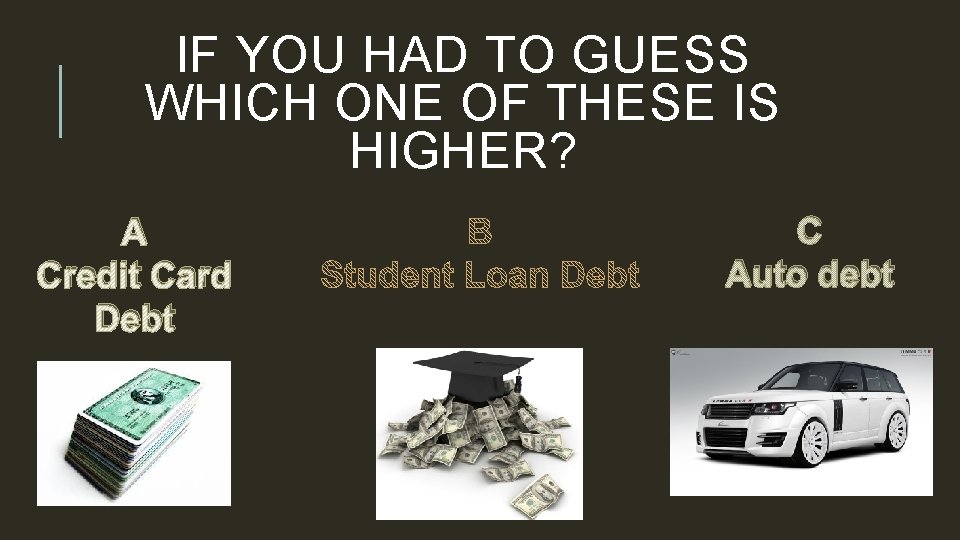
IF YOU HAD TO GUESS WHICH ONE OF THESE IS HIGHER? A Credit Card Debt C Auto debt
THIS IS NOT TO SCARE YOU BUT TO MAKE YOU AWARE….
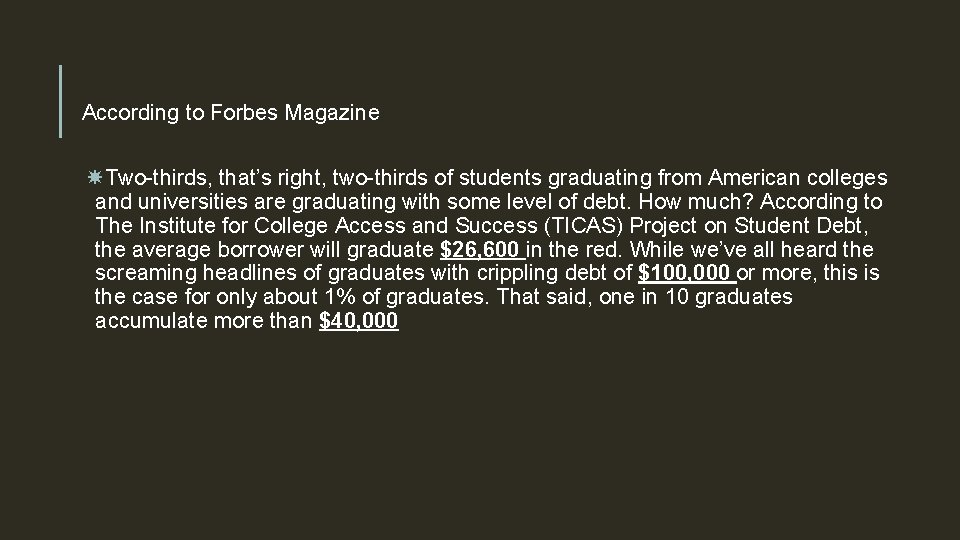
According to Forbes Magazine Two-thirds, that’s right, two-thirds of students graduating from American colleges and universities are graduating with some level of debt. How much? According to The Institute for College Access and Success (TICAS) Project on Student Debt, the average borrower will graduate $26, 600 in the red. While we’ve all heard the screaming headlines of graduates with crippling debt of $100, 000 or more, this is the case for only about 1% of graduates. That said, one in 10 graduates accumulate more than $40, 000
HOW MUCH MONEY DO YOU THINK YOU’LL MAKE ANNUALLY?
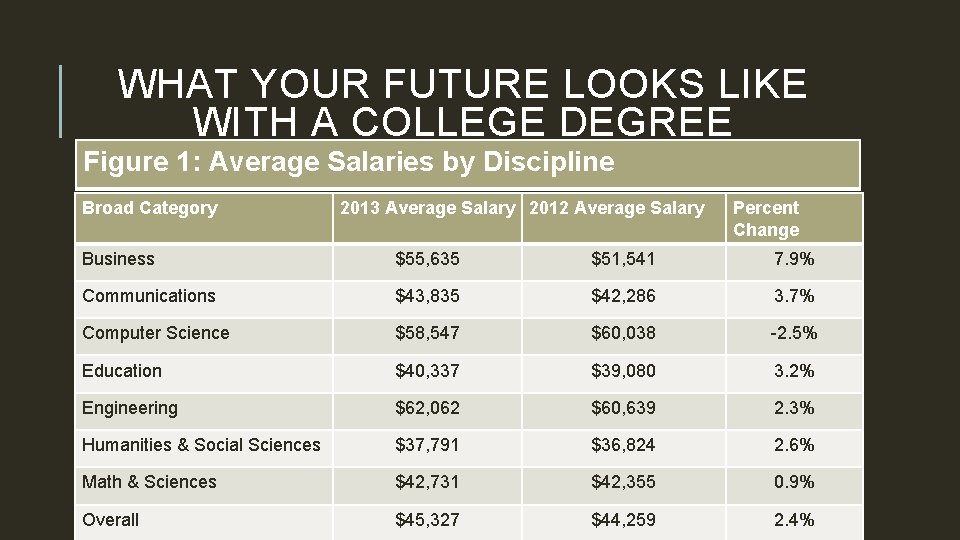
WHAT YOUR FUTURE LOOKS LIKE WITH A COLLEGE DEGREE Figure 1: Average Salaries by Discipline Broad Category 2013 Average Salary 2012 Average Salary Percent Change Business $55, 635 $51, 541 7. 9% Communications $43, 835 $42, 286 3. 7% Computer Science $58, 547 $60, 038 -2. 5% Education $40, 337 $39, 080 3. 2% Engineering $62, 062 $60, 639 2. 3% Humanities & Social Sciences $37, 791 $36, 824 2. 6% Math & Sciences $42, 731 $42, 355 0. 9% Overall $45, 327 $44, 259 2. 4%
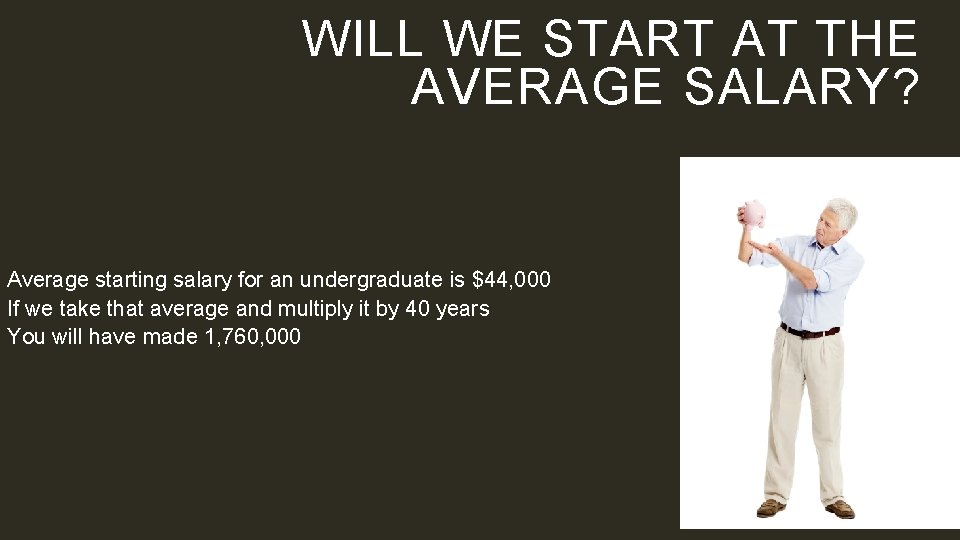
WILL WE START AT THE AVERAGE SALARY? Average starting salary for an undergraduate is $44, 000 If we take that average and multiply it by 40 years You will have made 1, 760, 000
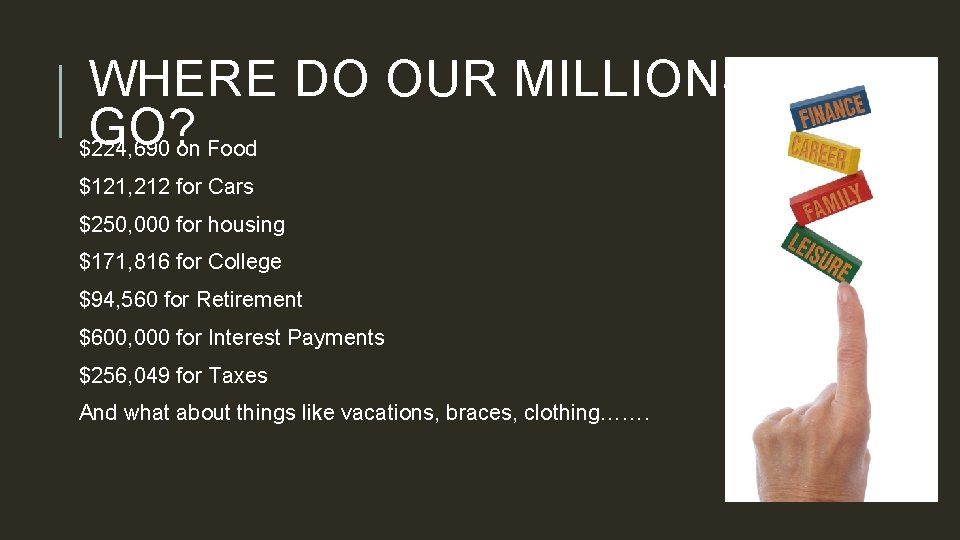
WHERE DO OUR MILLIONS GO? $224, 690 on Food $121, 212 for Cars $250, 000 for housing $171, 816 for College $94, 560 for Retirement $600, 000 for Interest Payments $256, 049 for Taxes And what about things like vacations, braces, clothing…….
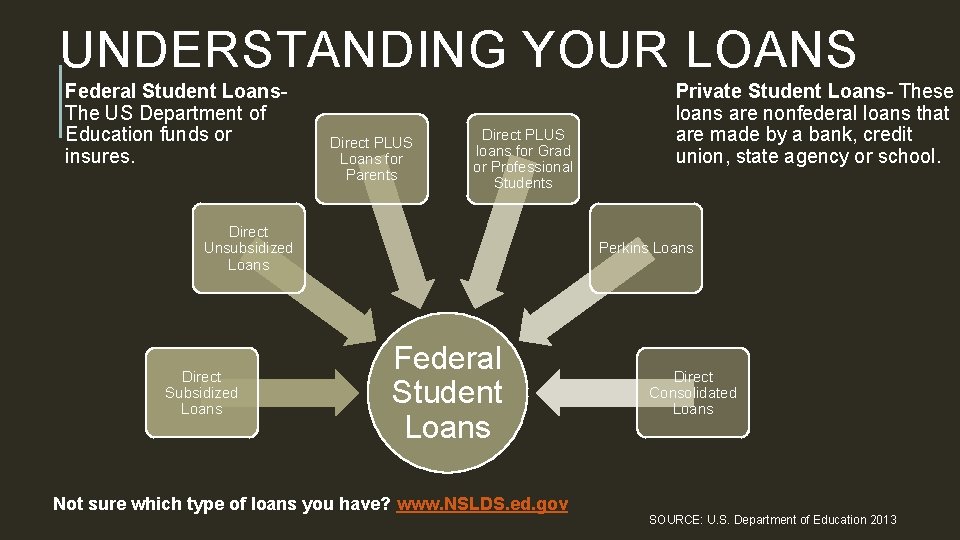
UNDERSTANDING YOUR LOANS Federal Student Loans. The US Department of Education funds or insures. Direct PLUS Loans for Parents Direct PLUS loans for Grad or Professional Students Direct Unsubsidized Loans Direct Subsidized Loans Private Student Loans- These loans are nonfederal loans that are made by a bank, credit union, state agency or school. Perkins Loans Federal Student Loans Not sure which type of loans you have? www. NSLDS. ed. gov Direct Consolidated Loans SOURCE: U. S. Department of Education 2013
WHAT DO YOU KNOW ABOUT FINANCIAL AID? First it is important to know the difference between your Subsidized and Unsubsidized loans. Your Subsidized loans will not begin to accrue interest until you graduate, or un-enroll from college. Your Unsubsidized loans begin to compound interest as soon as you take them out. Either way, you are paying back interest. It is important to check how often your loan will compound interest; for instance your Stafford Loans will compound interest annually. However, others may compound interest quarterly – as an example, in the case of most credit cards your interest is monthly.
WHAT DO YOU KNOW ABOUT FINANCIAL AID? The interest rate for Stafford Loans is at a 6. 8% fixed rate, if you were to borrow $10, 000 your interest will be $680. This means that $57 of your monthly payment is going to cover your interest only. If you defer your payments until you graduate, each year your interest is added to your debt which means by the time you graduate that $10, 000 is now $13, 010. 22 Or simply put only borrow what you need and stay away from excess financial aid because you will have to pay it back in the long run.
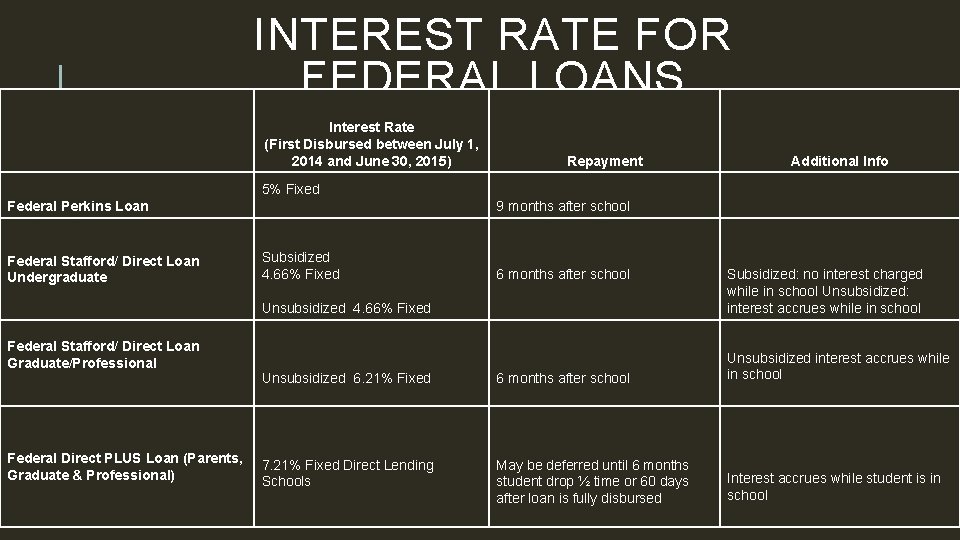
INTEREST RATE FOR FEDERAL LOANS Interest Rate (First Disbursed between July 1, 2014 and June 30, 2015) Repayment Additional Info 5% Fixed Federal Perkins Loan Federal Stafford/ Direct Loan Undergraduate Federal Stafford/ Direct Loan Graduate/Professional Federal Direct PLUS Loan (Parents, Graduate & Professional) 9 months after school Subsidized 4. 66% Fixed 6 months after school Unsubsidized 4. 66% Fixed Subsidized: no interest charged while in school Unsubsidized: interest accrues while in school Unsubsidized 6. 21% Fixed 6 months after school Unsubsidized interest accrues while in school 7. 21% Fixed Direct Lending Schools May be deferred until 6 months student drop ½ time or 60 days after loan is fully disbursed Interest accrues while student is in school
LOAN REPAYMENT From earlier the average student is leaving school is $26, 600 25% of students borrow $30, 500 or more 10% of students borrow $39, 300 or more Student loan repayment shouldn’t exceed more than 10 -15% of your expected monthly income
LOAN REPAYMENT Does anybody know how much time after graduation do you have before you have to start repaying your student loans? A No Time B 1 year C 6 months
WHEN MUST I BEGIN MAKING PAYMENTS? Most are 6 months after graduation or if you drop below ½ time PLUS loans have no grace period Paying interest while in school can help to keep loans low You can estimate your monthly payments at: http: //www. finaid. org/calculators/loanpayments. phtml https: //studentloans. gov/my. Direct. Loan/mobile/repayment. Estimator. action
MY PAYMENT IS WHAT!? !?
FEDERAL LOAN REPAYMENT PLAN OPTIONS Standard Graduated Extended Income-Sensitive Income-Contingent Income-Based
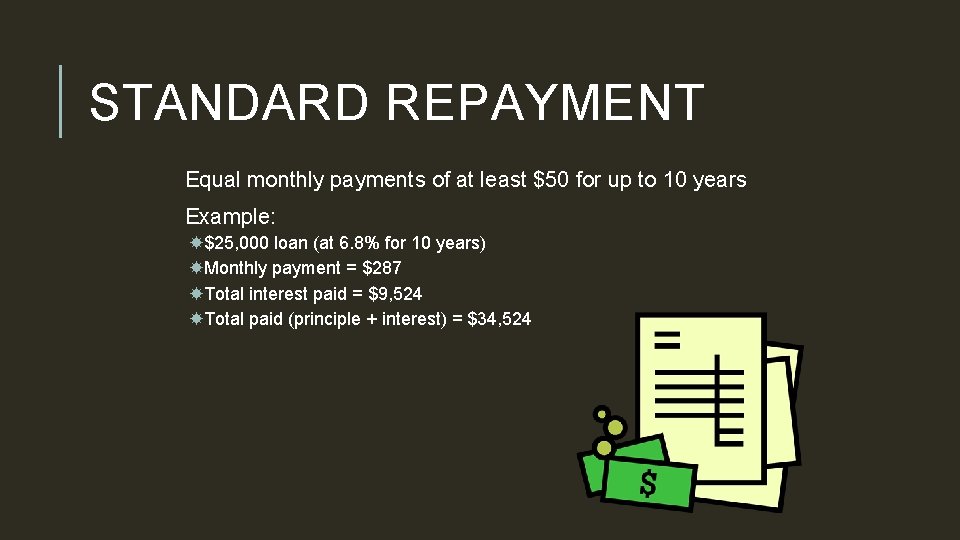
STANDARD REPAYMENT Equal monthly payments of at least $50 for up to 10 years Example: $25, 000 loan (at 6. 8% for 10 years) Monthly payment = $287 Total interest paid = $9, 524 Total paid (principle + interest) = $34, 524
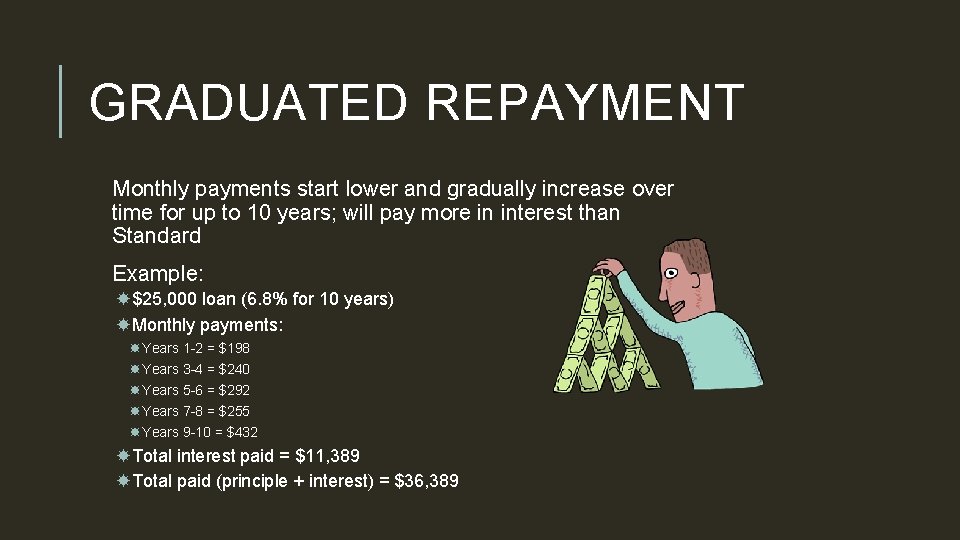
GRADUATED REPAYMENT Monthly payments start lower and gradually increase over time for up to 10 years; will pay more in interest than Standard Example: $25, 000 loan (6. 8% for 10 years) Monthly payments: Years 1 -2 = $198 Years 3 -4 = $240 Years 5 -6 = $292 Years 7 -8 = $255 Years 9 -10 = $432 Total interest paid = $11, 389 Total paid (principle + interest) = $36, 389
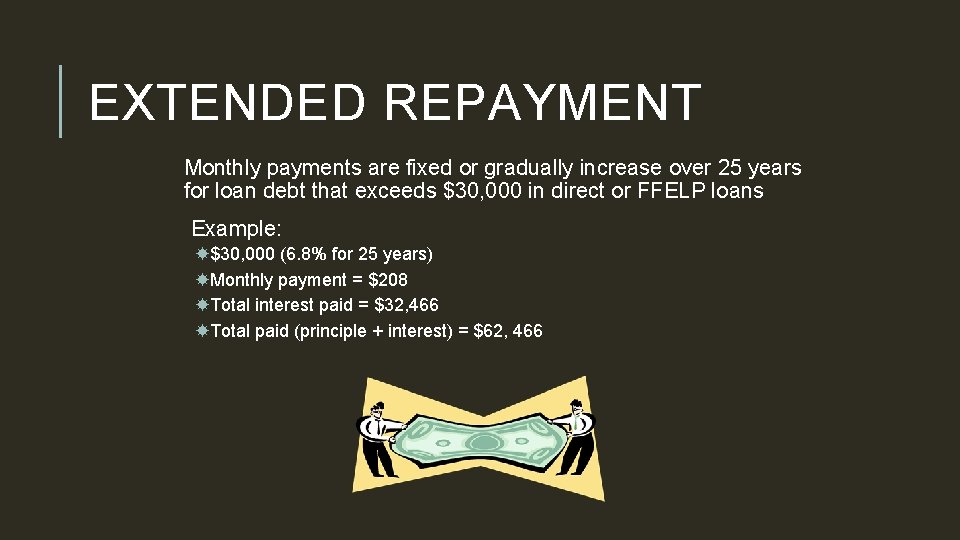
EXTENDED REPAYMENT Monthly payments are fixed or gradually increase over 25 years for loan debt that exceeds $30, 000 in direct or FFELP loans Example: $30, 000 (6. 8% for 25 years) Monthly payment = $208 Total interest paid = $32, 466 Total paid (principle + interest) = $62, 466
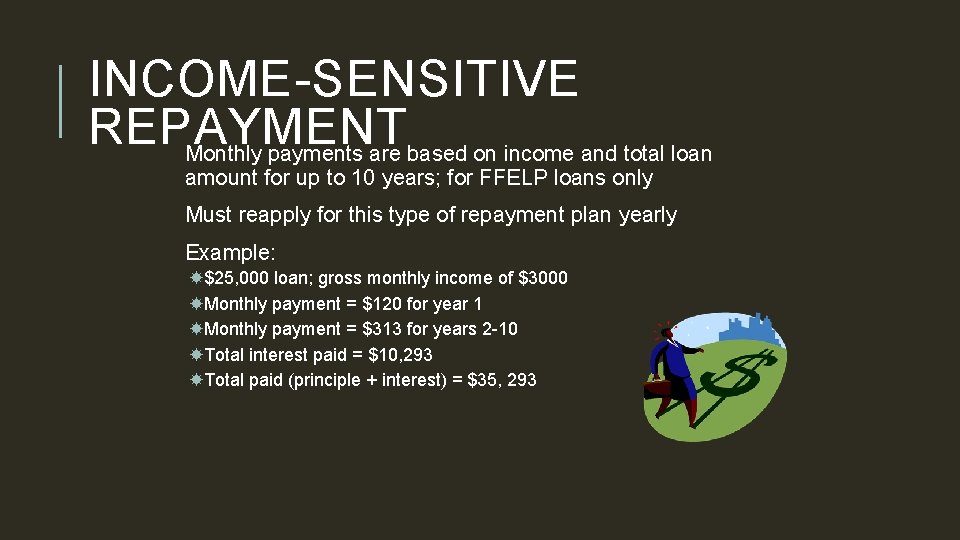
INCOME-SENSITIVE REPAYMENT Monthly payments are based on income and total loan amount for up to 10 years; for FFELP loans only Must reapply for this type of repayment plan yearly Example: $25, 000 loan; gross monthly income of $3000 Monthly payment = $120 for year 1 Monthly payment = $313 for years 2 -10 Total interest paid = $10, 293 Total paid (principle + interest) = $35, 293
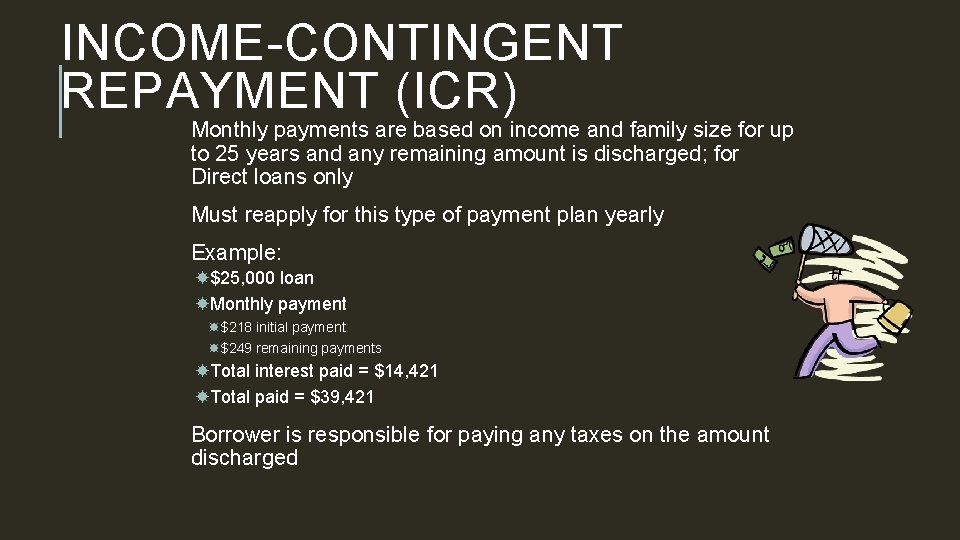
INCOME-CONTINGENT REPAYMENT (ICR) Monthly payments are based on income and family size for up to 25 years and any remaining amount is discharged; for Direct loans only Must reapply for this type of payment plan yearly Example: $25, 000 loan Monthly payment $218 initial payment $249 remaining payments Total interest paid = $14, 421 Total paid = $39, 421 Borrower is responsible for paying any taxes on the amount discharged
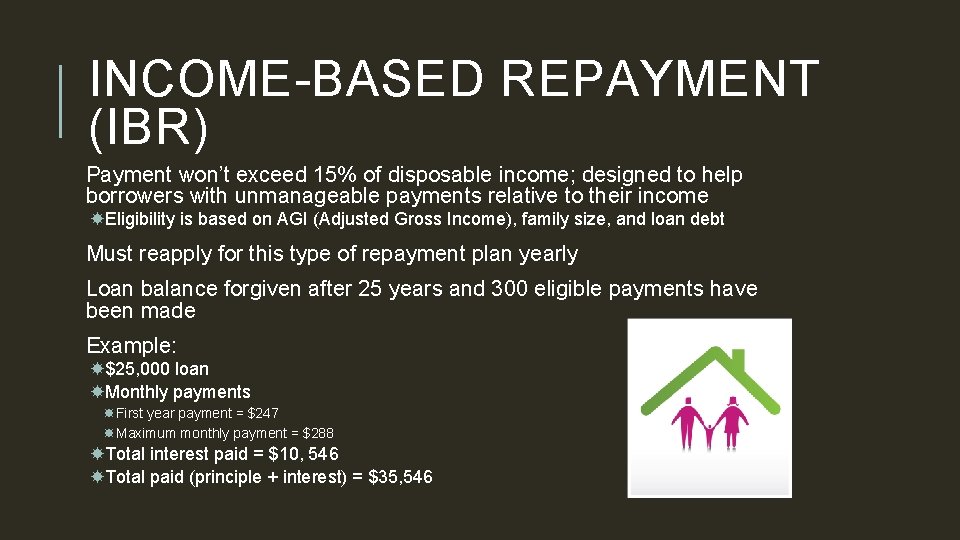
INCOME-BASED REPAYMENT (IBR) Payment won’t exceed 15% of disposable income; designed to help borrowers with unmanageable payments relative to their income Eligibility is based on AGI (Adjusted Gross Income), family size, and loan debt Must reapply for this type of repayment plan yearly Loan balance forgiven after 25 years and 300 eligible payments have been made Example: $25, 000 loan Monthly payments First year payment = $247 Maximum monthly payment = $288 Total interest paid = $10, 546 Total paid (principle + interest) = $35, 546
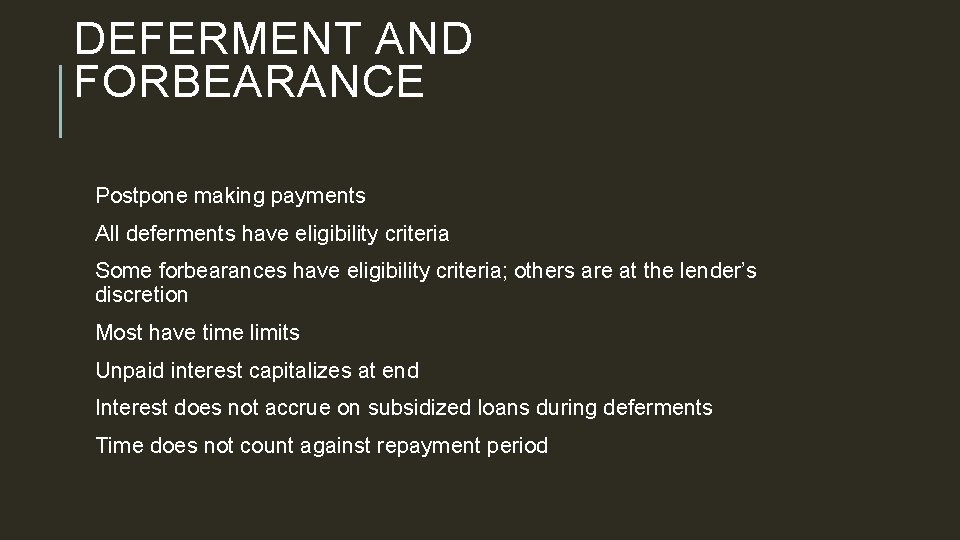
DEFERMENT AND FORBEARANCE Postpone making payments All deferments have eligibility criteria Some forbearances have eligibility criteria; others are at the lender’s discretion Most have time limits Unpaid interest capitalizes at end Interest does not accrue on subsidized loans during deferments Time does not count against repayment period
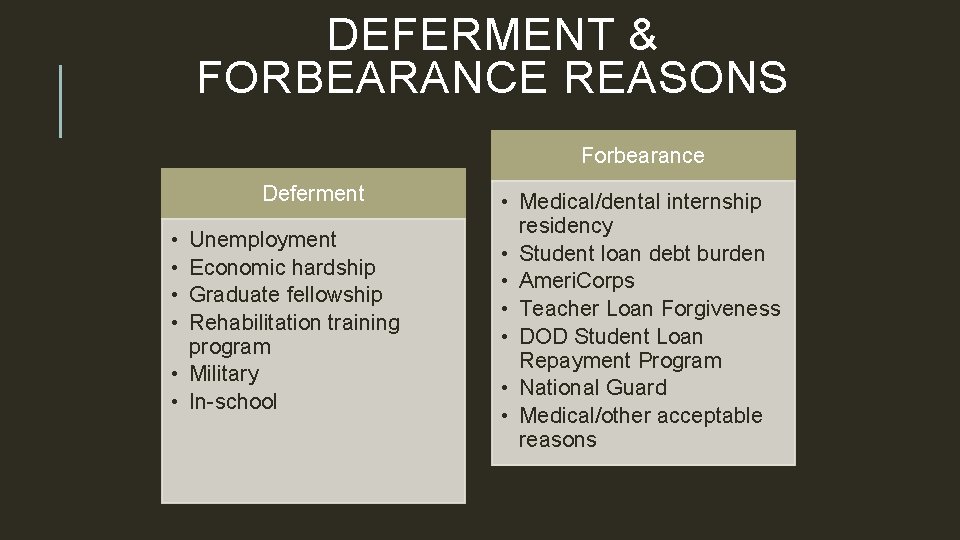
DEFERMENT & FORBEARANCE REASONS Forbearance Deferment • • Unemployment Economic hardship Graduate fellowship Rehabilitation training program • Military • In-school • Medical/dental internship residency • Student loan debt burden • Ameri. Corps • Teacher Loan Forgiveness • DOD Student Loan Repayment Program • National Guard • Medical/other acceptable reasons
LOAN FORGIVENESS Public Service Loan Forgiveness Teacher Loan Forgiveness Federal Employee Loan Forgiveness
PUBLIC SERVICE LOAN FORGIVENESS Borrower’s who work for a public service employer may be eligible to have a portion of their direct loan debt forgiven after 120 qualifying monthly payments are made after October 1, 2007 Public Service Organization Federal, state, local or tribal government agency/organization Public child or family service agency Non-profit organization under section 501(c)(3) A tribal college or university A private organization that provides public services Qualifications: Cannot be in default Must be employed full time (30 hours/week) Must make 120 qualified payments These payments do not have to be consecutive, but must be separate, on-time, and full monthly payments Payments must be made under IBR, ICR, or standard repayment plans
LOAN FORGIVENESS FOR TEACHERS Borrowers who teach in an elementary or secondary school that is designated as lowincome may be eligible to have a portion of their Stafford loan debt forgiven Qualifications: Teach full-time for at least 5 consecutive years at a low-income school Cannot be in default Must be a “highly qualified” teacher Obtained full state certification; bachelor’s degree; and demonstrate subject knowledge and teaching skills in reading, writing, math, or other basic elementary curriculum (for elementary teachers) or high level of competency in the subject area taught (for secondary teachers) Up to $5000 in forgiveness for teachers who meet the qualifications on or after October 30, 2004 Up to $17, 500 in forgiveness for “highly qualified” mathematics or science teacher in a secondary school or for “highly qualified” special education teachers in an elementary or secondary school
FEDERAL EMPLOYEE LOAN FORGIVENESS Permits federal agencies to repay federal student loans as a recruitment or retention incentive for candidates or current employees of the federal agency
LOAN CONSOLIDATION • Combine multiple federal student loans into one loan • Single monthly payment instead of multiple payments • Can consolidate: Direct Subsidized Loans, Direct Unsubsidized Loans, Graduate PLUS Loans, Perkins Loans • Can NOT consolidate private (alternative) loans • PLUS Loan borrowed by a parent on behalf of a student cannot be transferred to the student through consolidation • Consolidation loan will have a fixed interest rate that is the weighted average of the interest rates of the loans being consolidated www. loanconsolidation. ed. gov
THINGS TO CONSIDER • Single monthly payment instead of multiple payments • Can lower monthly payments and give up to 30 years to repay loans • However, extending the years of repayment will increase the total amount repaid • Once loans are combined into a consolidation loan, they cannot be removed • Certain borrower benefits of original loans, such as interest rate discounts, principal rebates, and some loan cancellation benefits, can be lost if loans are consolidated
DEFAULT • If you fail to make payments according to the terms of your master promissory note, your loans can go into default • The first time you miss a payment, your loan becomes delinquent • Delinquencies of at least 90 days are reported to the three major credit bureaus • Default occurs when a payment has not been made for 270 days • If you are having trouble making your payments, immediately contact your loan servicer – can change payment due date, change repayment plan, apply for deferment or forbearance, or consolidate loans
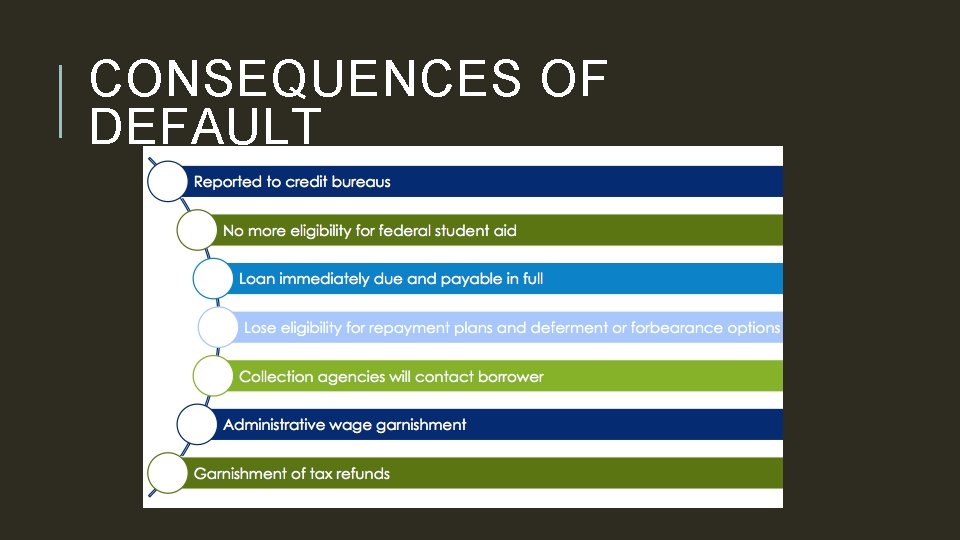
CONSEQUENCES OF DEFAULT
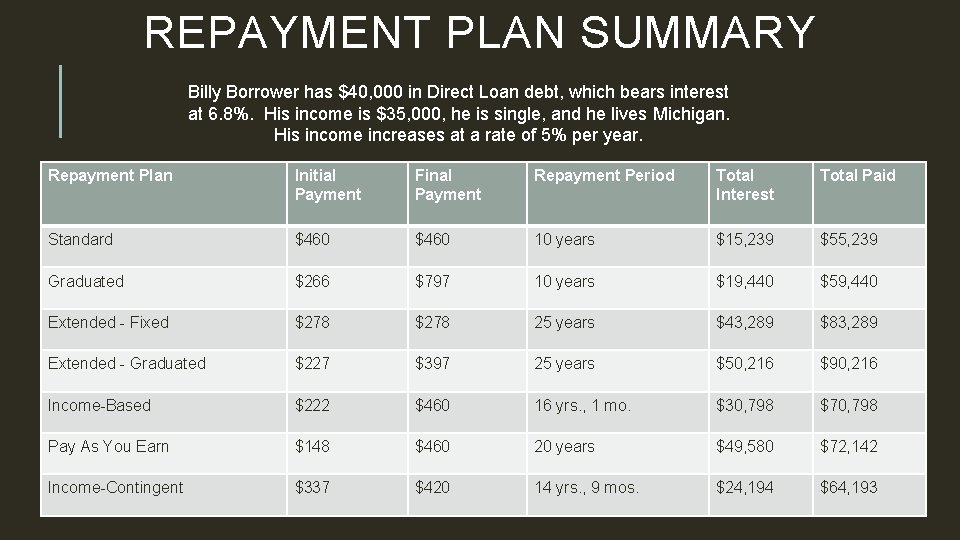
REPAYMENT PLAN SUMMARY Billy Borrower has $40, 000 in Direct Loan debt, which bears interest at 6. 8%. His income is $35, 000, he is single, and he lives Michigan. His income increases at a rate of 5% per year. Repayment Plan Initial Payment Final Payment Repayment Period Total Interest Total Paid Standard $460 10 years $15, 239 $55, 239 Graduated $266 $797 10 years $19, 440 $59, 440 Extended - Fixed $278 25 years $43, 289 $83, 289 Extended - Graduated $227 $397 25 years $50, 216 $90, 216 Income-Based $222 $460 16 yrs. , 1 mo. $30, 798 $70, 798 Pay As You Earn $148 $460 20 years $49, 580 $72, 142 Income-Contingent $337 $420 14 yrs. , 9 mos. $24, 194 $64, 193
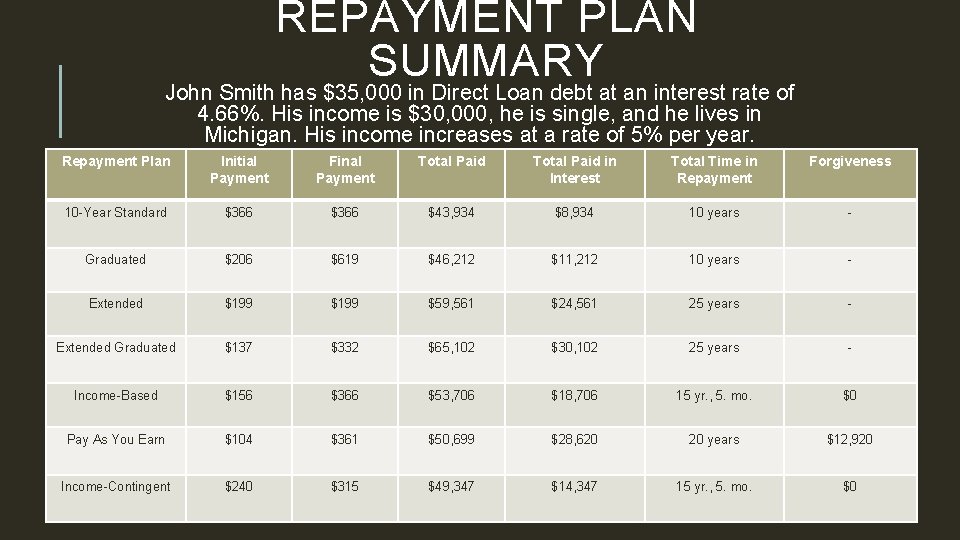
REPAYMENT PLAN SUMMARY John Smith has $35, 000 in Direct Loan debt at an interest rate of 4. 66%. His income is $30, 000, he is single, and he lives in Michigan. His income increases at a rate of 5% per year. Repayment Plan Initial Payment Final Payment Total Paid in Interest Total Time in Repayment Forgiveness 10 -Year Standard $366 $43, 934 $8, 934 10 years - Graduated $206 $619 $46, 212 $11, 212 10 years - Extended $199 $59, 561 $24, 561 25 years - Extended Graduated $137 $332 $65, 102 $30, 102 25 years - Income-Based $156 $366 $53, 706 $18, 706 15 yr. , 5. mo. $0 Pay As You Earn $104 $361 $50, 699 $28, 620 20 years $12, 920 Income-Contingent $240 $315 $49, 347 $14, 347 15 yr. , 5. mo. $0
WHAT TO EXPECT FROM YOUR LOAN SERVICER A repayment disclosure notice Outlines the terms of the loan borrowed Provides repayment options available Establishes the first payment due date
YOUR RESPONSIBILITIES Stay on top of your loans Inform each servicer of changes to your name, address, or telephone number Discuss options with your servicer before failing to make a payment Remember that you can change your repayment plan and due date (at least 1 x annually) If you have difficulty making payments, remember deferment and forbearance
WEB RESOURCES • www. studentaid. gov • www. nslds. ed. gov • www. loanconsolidation. ed. gov • Department of Education • US Department of Labor Features, F. (2013, August 7). How The $1. 2 Trillion College Debt Crisis Is Crippling Students, Parents And The Economy. Forbes. Retrieved March 5, 2014, from http: //www. forbes. com/sites/specialfeatures/2013/08/07/how-the-college-debt-is-cripplingstudents-parents-and-the-economy/ Salary Survey: Average Starting Salary for Class of 2013 Grads Increases 2. 4 Percent. (2013, September 4). Salary Survey: Average Starting Salary for Class of 2013 Grads Increases 2. 4 Percent. Retrieved March 6, 2014, from http: //naceweb. org/s 09042013/salarysurvey-average-starting-class-2013. aspx
QUESTIONS? ? ?