
GRADUATE INTERNSHIPS AND WORKPLACE EXPOSURE UNIVERSITY INDUSTRY SKILLS

- Slides: 21
GRADUATE INTERNSHIPS AND WORKPLACE EXPOSURE: UNIVERSITY - INDUSTRY SKILLS RELEVANT TRAINING AND IMPACT BASED RESEARCH By PROFESSOR OPUDA-ASIBO, J. BVM (Makerere), MPH & Ph. D, (Minnesota, USA) EXECUTIVE DIRECTOR NATIONAL COUNCIL OF HIGHER EDUCATION UGANDA DURING: ENGAGING PRIVATE COMPANIES TO BE IN THE CENTRE GOVERNANCE ADVISORY BODIES OF ACE II PROJECT ACTIVITIES. ON THE 18 TH – 19 TH OCTOBER 2017. AT PARK INN BY RADISSON HOTEL, KIGALI RWANDA.
PRESENTED IN THREE PARTS 1. INTRODUCTION 2. PARADIGMS OF THE THOUGHT PROCESSES FOR GRADUATE TRAINING • • Critical Thinking and Creative Thinking Innovation and Discovery 3. GRADUATE INTERNSHIPS AND WORKPLACE EXPOSURE - MENTORING
1. INTRODUCTION Ø Research is a systematic quest for knowledge based on a desire from individuals and/or society to understand the following: * Our own very existence and the world around us through evaluating daily experiences, by trial and error including generalization from observations. These generalizations are based on first-hand experience and use of logical reasoning. * By actively/deliberately solving existing problems. * Desire to expand knowledge beyond the current realms.
INTRODUCTION (cont’d) Ø Graduate Internship and workplace exposure is an unmatched monitored and evaluated experience in diverse and inclusive environment and exposure for skills development, real life challenges experience and knowledge application. Ø It is mutually beneficial to Industry, Government or University (Mentoring agencies) and the graduate student. Industry based learning with learning facilities setup in industry)! Ø To the Mentoring agencies. They advance organizational goals (Productive areas are enhanced; solve own problems; add youthful personnel; establish and strengthen research Departments) and potential recruitment of those already known.
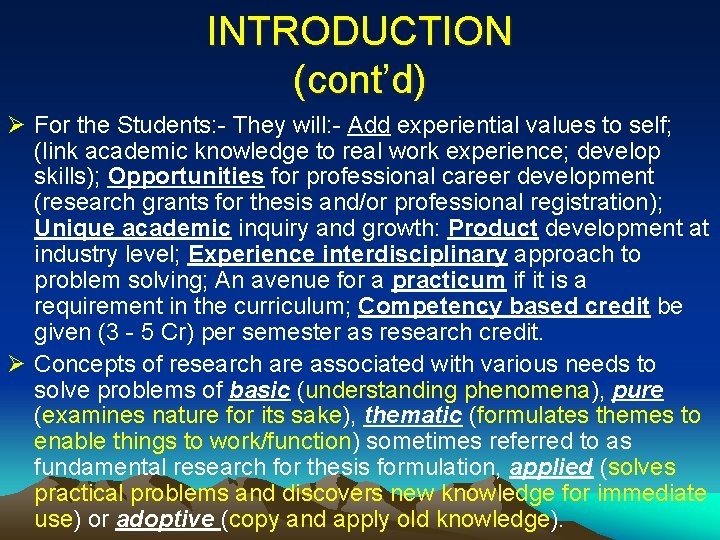
INTRODUCTION (cont’d) Ø For the Students: - They will: - Add experiential values to self; (link academic knowledge to real work experience; develop skills); Opportunities for professional career development (research grants for thesis and/or professional registration); Unique academic inquiry and growth: Product development at industry level; Experience interdisciplinary approach to problem solving; An avenue for a practicum if it is a requirement in the curriculum; Competency based credit be given (3 - 5 Cr) per semester as research credit. Ø Concepts of research are associated with various needs to solve problems of basic (understanding phenomena), pure (examines nature for its sake), thematic (formulates themes to enable things to work/function) sometimes referred to as fundamental research for thesis formulation, applied (solves practical problems and discovers new knowledge for immediate use) or adoptive (copy and apply old knowledge).
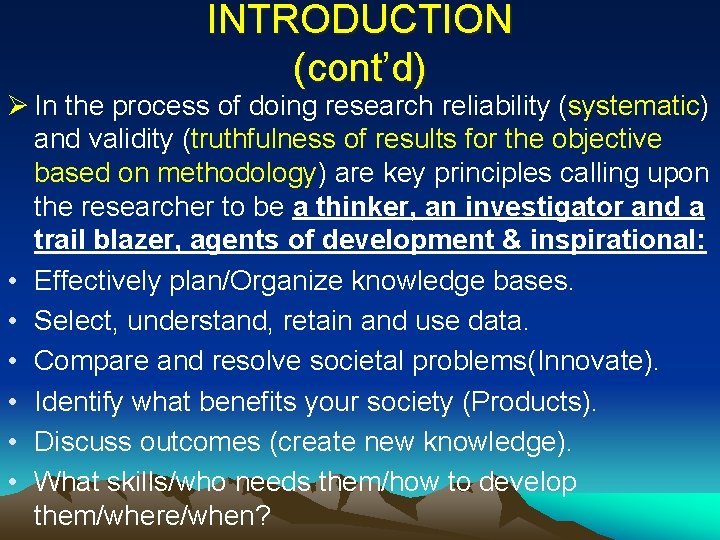
INTRODUCTION (cont’d) Ø In the process of doing research reliability (systematic) and validity (truthfulness of results for the objective based on methodology) are key principles calling upon the researcher to be a thinker, an investigator and a trail blazer, agents of development & inspirational: • Effectively plan/Organize knowledge bases. • Select, understand, retain and use data. • Compare and resolve societal problems(Innovate). • Identify what benefits your society (Products). • Discuss outcomes (create new knowledge). • What skills/who needs them/how to develop them/where/when?
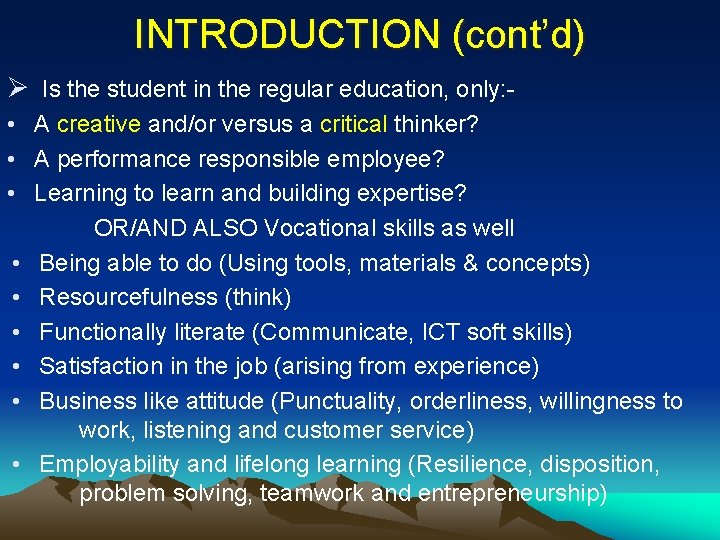
INTRODUCTION (cont’d) Ø Is the student in the regular education, only: • A creative and/or versus a critical thinker? • A performance responsible employee? • Learning to learn and building expertise? OR/AND ALSO Vocational skills as well • Being able to do (Using tools, materials & concepts) • Resourcefulness (think) • Functionally literate (Communicate, ICT soft skills) • Satisfaction in the job (arising from experience) • Business like attitude (Punctuality, orderliness, willingness to work, listening and customer service) • Employability and lifelong learning (Resilience, disposition, problem solving, teamwork and entrepreneurship)
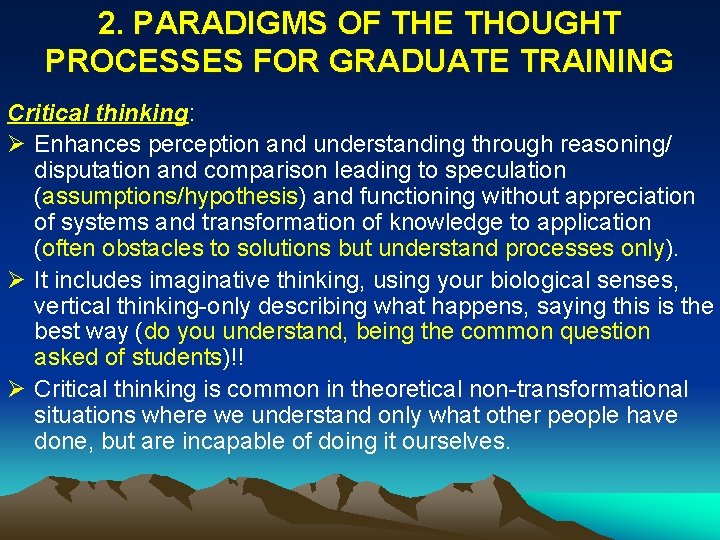
2. PARADIGMS OF THE THOUGHT PROCESSES FOR GRADUATE TRAINING Critical thinking: Ø Enhances perception and understanding through reasoning/ disputation and comparison leading to speculation (assumptions/hypothesis) and functioning without appreciation of systems and transformation of knowledge to application (often obstacles to solutions but understand processes only). Ø It includes imaginative thinking, using your biological senses, vertical thinking-only describing what happens, saying this is the best way (do you understand, being the common question asked of students)!! Ø Critical thinking is common in theoretical non-transformational situations where we understand only what other people have done, but are incapable of doing it ourselves.
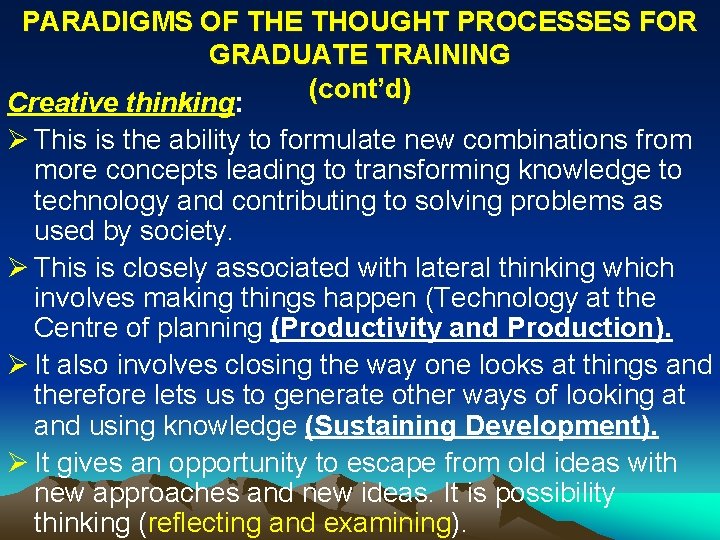
PARADIGMS OF THE THOUGHT PROCESSES FOR GRADUATE TRAINING (cont’d) Creative thinking: Ø This is the ability to formulate new combinations from more concepts leading to transforming knowledge to technology and contributing to solving problems as used by society. Ø This is closely associated with lateral thinking which involves making things happen (Technology at the Centre of planning (Productivity and Production). Ø It also involves closing the way one looks at things and therefore lets us to generate other ways of looking at and using knowledge (Sustaining Development). Ø It gives an opportunity to escape from old ideas with new approaches and new ideas. It is possibility thinking (reflecting and examining).
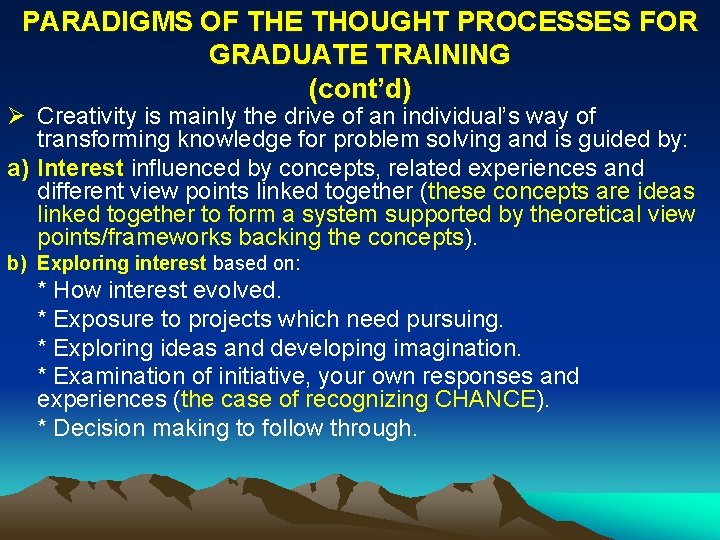
PARADIGMS OF THE THOUGHT PROCESSES FOR GRADUATE TRAINING (cont’d) Ø Creativity is mainly the drive of an individual’s way of transforming knowledge for problem solving and is guided by: a) Interest influenced by concepts, related experiences and different view points linked together (these concepts are ideas linked together to form a system supported by theoretical view points/frameworks backing the concepts). b) Exploring interest based on: * How interest evolved. * Exposure to projects which need pursuing. * Exploring ideas and developing imagination. * Examination of initiative, your own responses and experiences (the case of recognizing CHANCE). * Decision making to follow through.
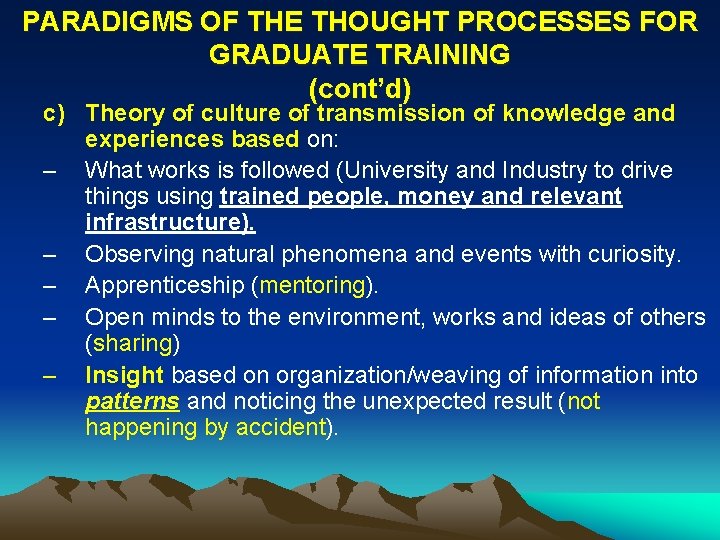
PARADIGMS OF THE THOUGHT PROCESSES FOR GRADUATE TRAINING (cont’d) c) Theory of culture of transmission of knowledge and experiences based on: – What works is followed (University and Industry to drive things using trained people, money and relevant infrastructure). – Observing natural phenomena and events with curiosity. – Apprenticeship (mentoring). – Open minds to the environment, works and ideas of others (sharing) – Insight based on organization/weaving of information into patterns and noticing the unexpected result (not happening by accident).
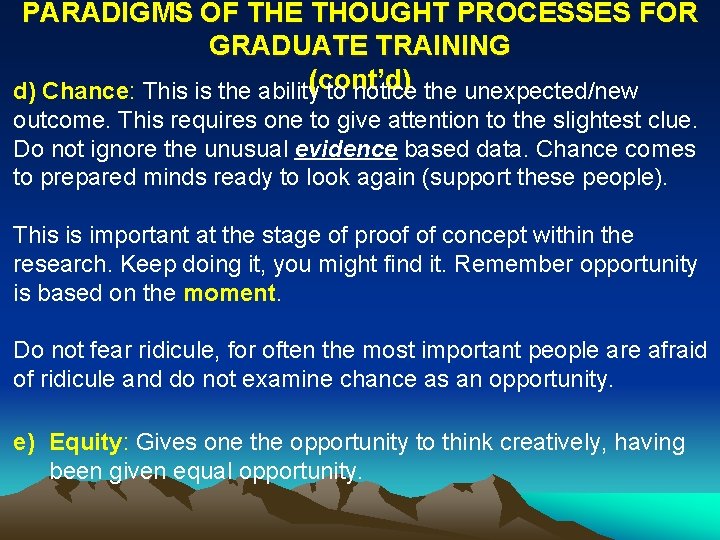
PARADIGMS OF THE THOUGHT PROCESSES FOR GRADUATE TRAINING d) Chance: This is the ability(cont’d) to notice the unexpected/new outcome. This requires one to give attention to the slightest clue. Do not ignore the unusual evidence based data. Chance comes to prepared minds ready to look again (support these people). This is important at the stage of proof of concept within the research. Keep doing it, you might find it. Remember opportunity is based on the moment. Do not fear ridicule, for often the most important people are afraid of ridicule and do not examine chance as an opportunity. e) Equity: Gives one the opportunity to think creatively, having been given equal opportunity.
PARADIGMS OF THE THOUGHT PROCESSES FOR GRADUATE TRAINING (cont’d) Innovation and Discovery Ø While a creative process is the means to make new combinations, these new combinations are innovations, when localized form innovation clusters and for discovery management, form innovation/discovery centers. Motivational factors to benefit and succeed proactively are the basis for entrepreneurship. Ø Discovery is a result of critical and creative thinking and innovation producing new results to known or unknown problems.
PARADIGMS OF THE THOUGHT PROCESSES FOR GRADUATE TRAINING (cont’d) Innovation and Discovery (cont’d) For this to occur, it requires the following: Ø Creative persons with enhanced potential to be creative through achievement and recognition as motivators. Ø Creative climate and organizational set up. Ø Learning opportunities to foster creativity.
PARADIGMS OF THE THOUGHT PROCESSES FOR GRADUATE TRAINING (cont’d) Innovation and Discovery (cont’d) Ø Leadership styles: – – – Participatory and performance/output oriented style as opposed to visibility/power type. Understanding the complexity of the research and discovery processes. Networking. Ø Learning environment to include resource availability, financial budgets, automation of some systems, i. e. ICT, Patents and Intellectual Property Policies.
3. GRADUATE INTERNSHIP AND WORKPLACE EXPOSURE - MENTORING Ø For this to succeed, good quality students, competent staff and an enabling environment to handle research for development through enquiry are essential (WHERE IS THE DCV RESEARCH AND EXTENSION IN OUR UNIVERSITIES!). Ø Where is the Graduate School/Research policies? Ø The existence of the Graduate training framework from NCHE/COMMISSION! Ø While the designation and selection of staff as supervisors, alone or in a supervisory committee should be mutually agreeable to the student, friendship between staff and student is vital. Ø Emphasis on the award rather than the research outcome undermines the relationship between the students and staff.
GRADUATE AND POSTDOCTORAL MENTORING (cont’d) Ø Competent and dedicated staff within one University and/or other Universities in the region should be shared for the benefit of student training and maximum human resource utilization. Ø Where are research priorities? (Basic/Applied, personal, national, Institutional, Industry, collaborative) Ø The staff/Industry should be responsible for funding the studies for them to have a stake in the results. This avoids the prevailing situation where students are both funders of the research and the main stakeholders of the results. Ø Availability of student support, research, space and other facilities and RIGHTS is important for creating an
GRADUATE AND POSTDOCTORAL MENTORING (cont’d) Ø Programme Coordinators to ensure supervision and limiting the number of students to be supervised by the same individual, is necessary. Ø Who supervises Graduate students in industry! Ø Student responsibilities (meeting deadlines and clear procedures should be in place). Ø Quality assurance of all processes from admission requirements, staffing, research facilities, funding and examination processes should be ascertained.
GRADUATE AND POSTDOCTORAL MENTORING (cont’d) Ø Mentorship is enhanced through mobility of students and academic staff throughout the region. Ø This needs to be facilitated and harmonized (the Inter-University Council for East Africa), reducing intra-university academic in-breeding, which ideally should not exceed 40% of staff trained and working in the same University. Ø Programmes and courses accreditation be enhanced. Ø Joint degree awards encouraged.
CONCLUSION GOVERNRMENT (UNIVERSITIES + PUBLIC RESEARCH CENTRES) + INDUSTRY MUST DRIVE AND INFLUENCE PRODUCTIVITY AND PRODUCTION (DEVELOPMENT) FOR TRANSFORMATION OF SOCIETY AND THE WELL BEING OF THE PEOPLE
THANK YOU