
GRADING WITH ZEROS On a 100 point scale
- Slides: 7
GRADING WITH ZEROS On a 100 point scale
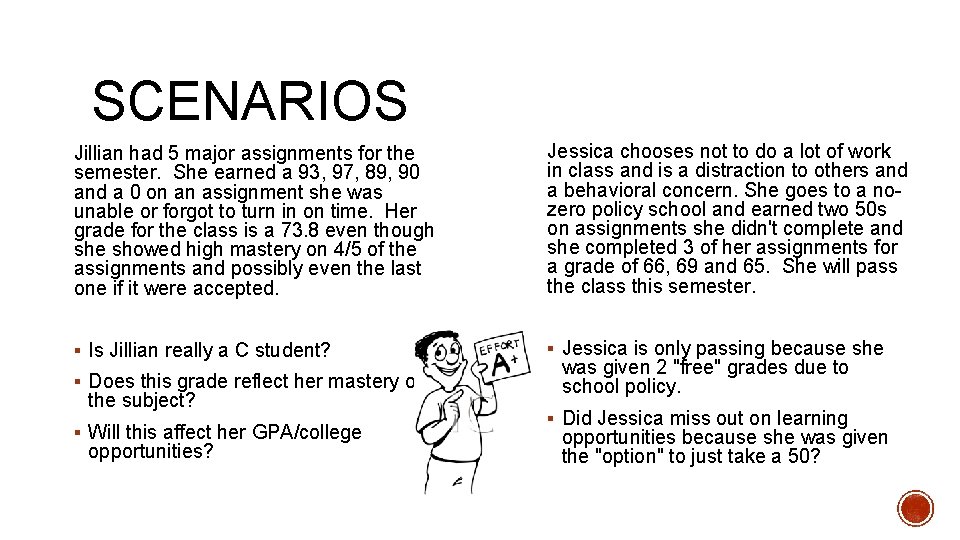
SCENARIOS Jillian had 5 major assignments for the semester. She earned a 93, 97, 89, 90 and a 0 on an assignment she was unable or forgot to turn in on time. Her grade for the class is a 73. 8 even though she showed high mastery on 4/5 of the assignments and possibly even the last one if it were accepted. Jessica chooses not to do a lot of work in class and is a distraction to others and a behavioral concern. She goes to a nozero policy school and earned two 50 s on assignments she didn't complete and she completed 3 of her assignments for a grade of 66, 69 and 65. She will pass the class this semester. § Is Jillian really a C student? § Jessica is only passing because she § Does this grade reflect her mastery of the subject? § Will this affect her GPA/college opportunities? was given 2 "free" grades due to school policy. § Did Jessica miss out on learning opportunities because she was given the "option" to just take a 50?
FOR THE USE OF ZEROS § Promotes student accountability. It helps students become college- and career-ready; university professors will not likely be so tolerant in giving grades, and future bosses will have clear performance expectations § Zero effort deserves zero reward. If students do none of the work, they get none of the grade. § Giving students some credit rewards those who don’t try at all. They may not really be learning but are getting a grade. § A fear of zeros is a good motivator to complete assignments § Zeros teach students to respect deadlines. Lightening up policies sends the message that hard work and homework are not important § Failure is a learning opportunity.
AGAINST THE USE OF ZEROS § Giving zeros disciplines behavior not actual student knowledge. It places too much emphasis on a teacher’s “rules and expectations” instead of actual student knowledge. § It shouldn’t matter when students complete an assignment, if they’ve got the knowledge, they’ve got the knowledge. § Such a low mark on a 100 -point scale doesn’t accurately measure what a student knows and is more likely to push an at-risk student to give up on a class mid-semester. § A zero can also over-proportionally, negatively impact a high achieving student for a one time mistake. § On a 100 point scale, grades are uneven. You have 10 points between an A and a B whereas an F can be a 0 -60 § The use of zeros forgotten/late assignments is an example of grades used for discipline. § A zero for not meeting a deadline is too harsh for preparing students for the “real world”. The “real world” may actually be more forgiving. (If you don't pay your bill on time, they will still accept your money but with a penalty of sorts. )
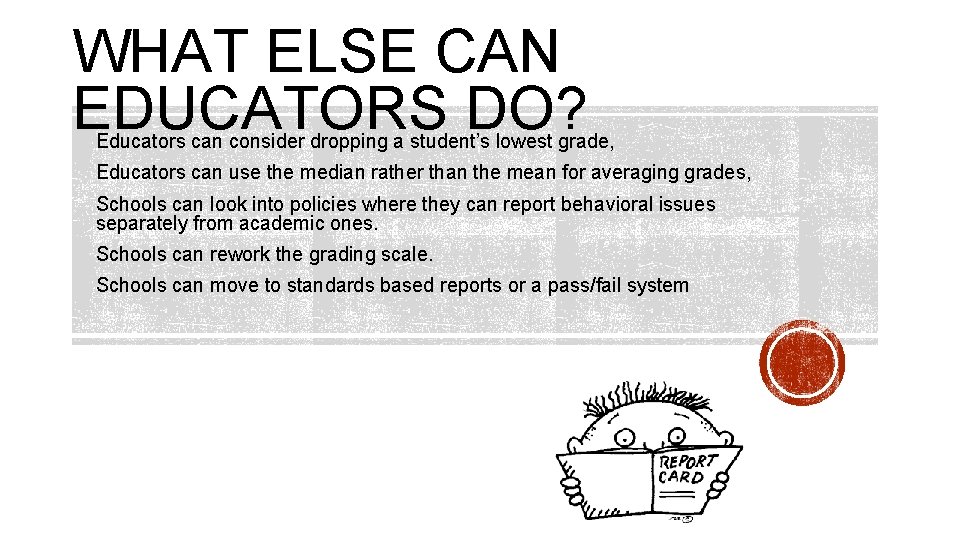
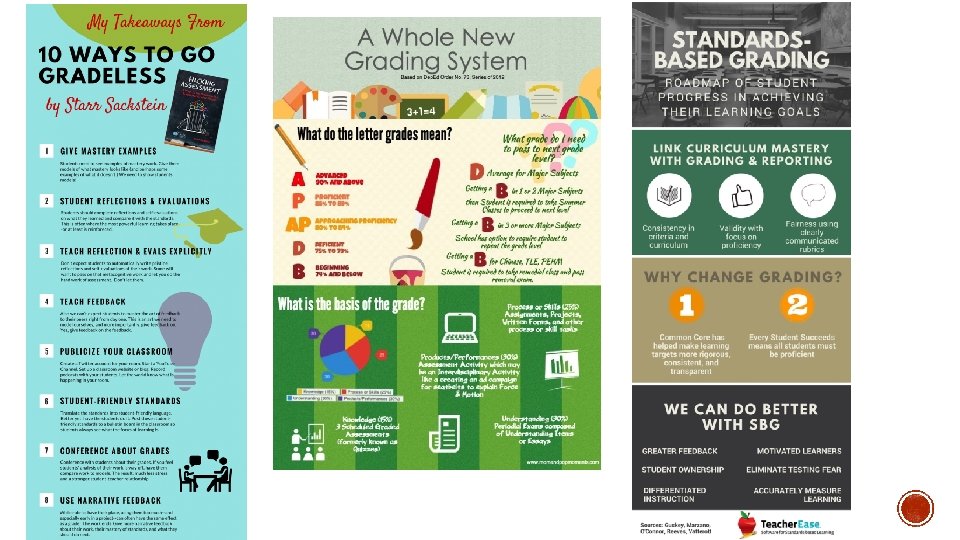
WHAT ELSE CAN EDUCATORS DO? Educators can consider dropping a student’s lowest grade, Educators can use the median rather than the mean for averaging grades, Schools can look into policies where they can report behavioral issues separately from academic ones. Schools can rework the grading scale. Schools can move to standards based reports or a pass/fail system
SOURCES Balingit, M. , & George, D. S. (2016, July 05). Is it becoming too hard to fail? Schools are shifting toward no-zero grading policies. Retrieved February 03, 2018, from https: //www. washingtonpost. com/local/education/is-it-becoming-too-hard-to-fail-schools-are-shifting-toward-no-zero-gradingpolicies/2016/07/05/3 c 464 f 5 e-3 cb 0 -11 e 6 -80 bc-d 06711 fd 2125_story. html? utm_term=. f 3807 cbf 62 c 8 Stoltzfus, K. (2016, July 11). When It Comes to Grading, Is '50' the New 'Zero'? Retrieved February 03, 2018, From http: //blogs. edweek. org/teachers/teaching_now/2016/07/when_it_comes_to_grading_50_is_the_new_zero. html? intc=mainmpsmvs Walker, T. (2016, August 4). Teachers Divided Over Controversial 'No-Zero' Grading Policy. Retrieved February 03, 2018, from http: //neatoday. org/2016/08/04/no-zero-policy-pro-con/ Powers, T. N. (2015, December). Less Than Zero. Retrieved February 03, 2018, from https: //www. nsba. org/newsroom/american-school-board-journal/latest-edition/less-zero