
Grading Rubrics Heartland Community College IDC Rubrics Purpose
Grading Rubrics Heartland Community College IDC
Rubrics § Purpose of Workshop – Define Rubrics and Identify their general Strengths and Weaknesses – Identify the value of Rubrics for faculty – Create a Rubric for your Assignment – Reflect upon the usefulness of Rubrics

Rubrics § Definition – Explicit plans for classification of behaviors or artifacts into categories along a continuum. – Use Measurable Criteria, Operationalize – Two types § Holistic and Analytic
Rubrics § Rubrics in an assessment context validity understanding misspecification over-simplification up front work
Rubrics § Rubrics in Program Assessment – ID program strengths and weaknesses – Way to aggregate assignments, artifacts – Staff Development – Support Assertions, Credibility – Can be both formative and summative – Way to “force” dept. /division dialogue – Tool not an answer
Rubrics § Value of Rubrics for faculty – Intentional and Explicit – Go over examples, samples of good work – Separate from grade if desired – Interactive, empowering for students – Feedback is guided, may save time – Allows for multiple forms of interactions in classroom
Rubrics § Creating a Rubric (View Handouts) – Operationalize Quality § ID Outcomes § ID Levels of Performance – Beginner, Developing, Accomplished – Unacceptable, Marginal, Acceptable, Good, Outstanding – Novice, Competent, Exemplary – Needs Work, Good, Excellent – Intern, Member of Congress, Senator, President
Rubrics § Creating a Rubric – Additional Considerations § Define behaviors/products at each level § Start with best and worst § Levels should be clear, simple, valid § Use existing artifacts as a guide § Practice § Be Iterative and Flexible § Revise
Rubrics § Creating a Rubric for Your Class – ID Assignment – ID Expected Outcomes – ID Levels of Ability – ID Expectations for Each Level – Test and Revise
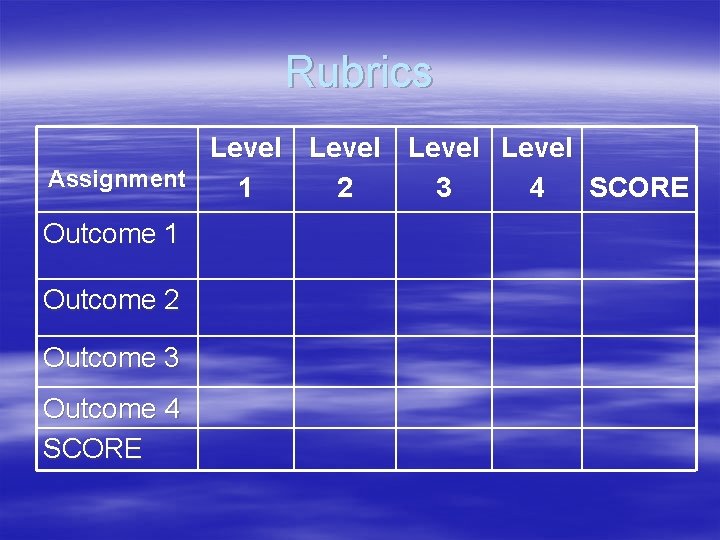
Rubrics Level Assignment 1 2 3 4 SCORE Outcome 1 Outcome 2 Outcome 3 Outcome 4 SCORE
Rubrics § Sum Up – Holistic or Analytic – Intentional and Interactive – Subject to Misuse and Misinterpretation – Can be a time saver – Can foster wide ranging conversations about learning outcomes.
Rubrics § Some Rubric Resources – http: //www. uc. edu/gened/Exemplar. Rubrics/Entry. htm – http: //www. bridgew. edu/Assessment. Guidebook/examples. cfm – http: //www. pz. harvard. edu/Research/Rubric. Self. htm – http: //www 2. sjsu. edu/ugs/assessment/as-tools. htm – http: //www. coloradocollege. edu/library/ACMassign/thinking. html – http: //web. njit. edu/~ronkowit/teaching/rubrics/
Rubrics § Rubric Generators On-line – http: //www. teach-nology. com/web_tools/rubrics/ – http: //rubistar. 4 teachers. org/index. php – http: //its. monmouth. edu/Faculty. Resource. Center /Rubrics/A%20 Rubric%20 for%20 Rubrics. htm
- Slides: 13