
Grading Practices that Hit the Mark and Why

- Slides: 15
Grading Practices that Hit the Mark and Why Many Traditional Grading Practices Miss the Mark Presented by: Amy Cashwell
Today’s Learning Targets We will: Examine the purpose of grading Realize the complexity of grading Recognize the importance of critically examining traditional grading practices Examine the power of formative assessment when coupled with descriptive feedback Explore why teachers should strategically consider equitable grading practices and a focused approach on learning targets rather than relying on traditional grading practices to promote student achievement
What is the Purpose of a Grade? Or a Report Card? Communication to the student? Communication to the parent? Improving learning? Accountability? High School, Private School or College admissions? Permanent record? Punishment? Celebration? None of the above? All of the above?
Primary Purpose of Grading Grades should ultimately be used to communicate or provide feedback regarding achievement, be it to the student, parent, or others.
Are the Grades in Your School on Target? How confident are you that the grades students get in your school are: • accurate • consistent • meaningful, and • supportive of learning? If grades do not meet these four conditions of quality they are “broken, ” or ineffective. © Ken O’Connor, 2012
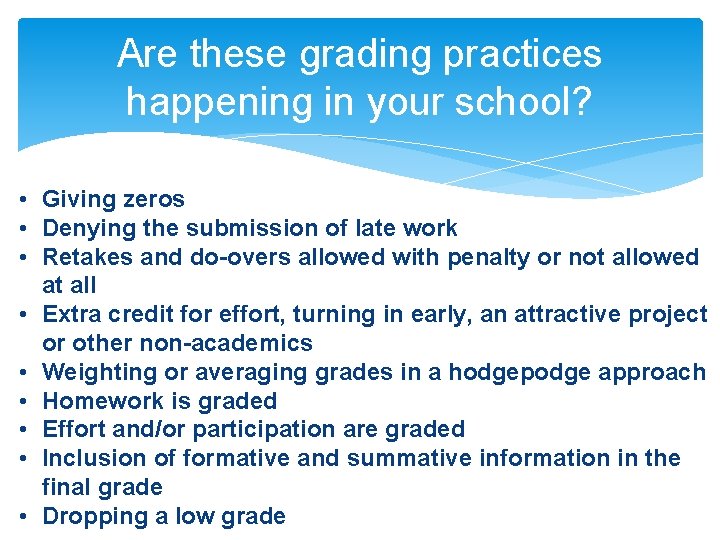
Are these grading practices happening in your school? • Giving zeros • Denying the submission of late work • Retakes and do-overs allowed with penalty or not allowed at all • Extra credit for effort, turning in early, an attractive project or other non-academics • Weighting or averaging grades in a hodgepodge approach • Homework is graded • Effort and/or participation are graded • Inclusion of formative and summative information in the final grade • Dropping a low grade
When Grades are Missing the Mark “Why would anyone want to change current grading practices? ” “The answer is quite simple: grades are so imprecise that they are almost meaningless. ” Marzano, R. J. , Transforming Classroom Grading, ASCD, Alexandria, VA, 2000
Tweet, tweet… From @Rick. Wormeli “Stop grades as compensation and start grades as communication…Grading is a report of learning, not doing. ”
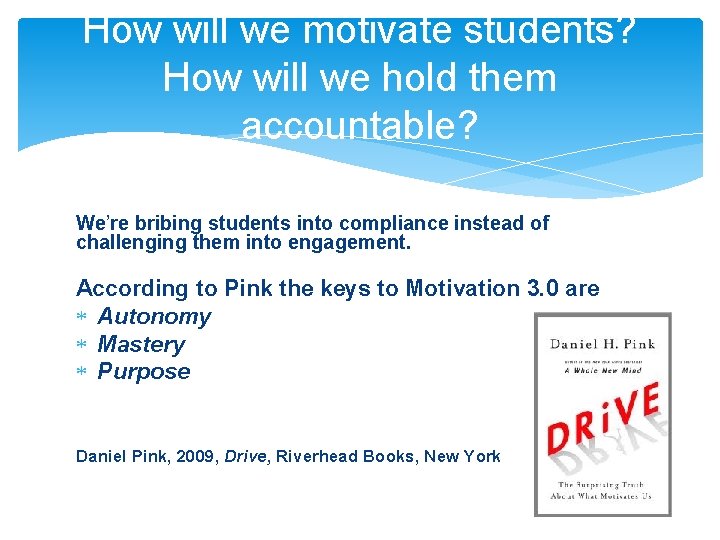
How will we motivate students? How will we hold them accountable? We’re bribing students into compliance instead of challenging them into engagement. According to Pink the keys to Motivation 3. 0 are Autonomy Mastery Purpose Daniel Pink, 2009, Drive, Riverhead Books, New York
Grades as Punishment “Don’t use grades punitively…Without exception, experts in the area of student grading recommend that grades not be used in a punitive sense. When a teacher uses grades as punishment for student behaviors, the teacher establishes an adversarial relationship in which grades are no longer meaningful to students as indicators of their accomplishments. The punitive use of grades only increases the likelihood that students will lose respect for the evaluation system; consequently the appeal to students of subverting such a system will be heightened. ” Source: Cizek, G. J. 2003. Detecting and Preventing Cheating; Promoting Integrity in Assessment, Corwin, Thousand Oaks, CA, 2003, 100 in O’Connor, K. , A Repair Kit for Grading
O’Connor’s 15 Fixes for Broken Grades Fixes for ingredients that distort achievement 1. Don’t include student behaviors (effort, participation, adherence to class rules, etc) in grades; include only achievement. 2. Don’t reduce marks on ‘work’ submitted late; provide support for the learner. 3. Don’t give points for extra credit or use bonus points; seek only evidence that more work has resulted in a higher level of achievement.
Guskey on the Purpose of Grading is not essential to learning. Checking is essential to learning. His idea here is that grading is not essential to the instructional process. Students need someone checking on their learning; someone to guide them and shape their experiences. Grading is evaluative, teacher is a Judge. Checking is Diagnostic, teacher is an Advocate. Think differently about the role of a teacher. Students perform best when they know the teacher is invested in their learning. This supports the idea of teachers making strong connections with the students not just delivering strong content to the students.
Where to aim? “Grading policies such as refusing to accept late work, giving grades of zero, and refusing to allow students to redo their work may be intended as punishment for poor performance, but such policies will not really teach students to be accountable, and they provide very little useful information about students' mastery of the material. Assessment and feedback, particularly during the course of learning, are the most effective ways for students to learn accountability in their work and in their personal lives. ”
Providing Feedback on Assessments Feedback alone? Grades alone? Feedback and Grades? Dylan Wiliam found that it was feedback alone that students found most meaningful.
Limitations of Letter Grades “The principal limitation of any grading system that requires the teacher to assign one number or letter to represent. . . learning is that one symbol can convey only one meaning. . ” “One symbol cannot do justice to the different degrees of learning a student acquires across all learning outcomes. ” Tombari and Borich, Authentic Assessment in the Classroom.